Spring cleaning for the soul

With the flowers all coming out at the same time, the birdsong increasing in quantity and volume, the warmer air and longer days settling in, it really does seem that spring is on the way.  It feels like it has been a long winter this year, even though we’ve had, overall, quite mild temperatures!  A brief week of snow was very welcome, if only to brighten the dullness of British winter days.  Though the long dark hours of night are quite nice to have, time to regroup, rethink and dream it all up again for the coming year, the return of the light is always welcome, even though that change may mean we have to rouse ourselves from our cozy winter’s slumber and face the world once again.

And what better way to shake off the winter’s drowsiness than a good dose of spring cleaning?  It’s good for your body, mind, soul and your house.  Every autumn and spring I give the whole house a good scrub down from top to bottom – preparing it for the season ahead.  This weekend I really went for it – clearing all clutter from workspaces and tables, removing all unnecessary decorations – items that weren’t loved – even the closets!  It’s quite difficult, especially when an item is a gift from someone – you don’t feel as though you can give it away as someone went to all the effort and expense to get it for you. But if you don’t need it, and don’t use it, it is clutter.

So, living with a husband who hoards, I was quite surprised when each item I presented to him was met with very little resistance – do you use this? Do you love this? If the answer was no, then away it went, with very little hassle.  One wrench was a set of glass candles (the kind where you pour oil into them and place the wick inside) – these had lost the wicks.  They were, essentially, useless. Yes, we could go out and buy wicks for them, but we knew we never would – we have plenty of other candles that we use.  It was the fact that he had had them for so long that made it difficult to let go, and yet, in the end, he decided that yes, they should be recycled. It just makes sense.

How much do we do this in our own lives? How much do we hang onto things simply because they’ve been a part of our lives for so long? If, as Druids and pagans, we try to live with honourable relationship to the world around us, then we know that life works in cycles – we see it in nature around us.  Things begin, and things end, and things begin again.  The trick is in the letting go when things have come to their natural ending.  We’re taught to hold on as long as we can, and sometimes that can be a good thing, or even an instinctual thing – survival.  But in other areas, it can cause quite a lot of pain – the euthanasia debate still rages on.  We are allowed to put our pets “to sleep” because they are in extreme pain and their quality of life is so diminished, but we are not allowed that same grace for our relatives.  However, that is an entirely other discussion!

It isn’t only material things we hang on to – emotions, memories, feelings are quite often riding our shoulders, weighing us down, not allowing us the freedom to move ahead.  We have to learn to not attach to these feelings – they have come and gone, the initial reaction realised.  We feel our sadness, our rage, our joy, our pride – we shouldn’t suppress our feelings. However, we should not cling to them – we find a space to express them honourably, to feel them – whether it’s creating sacred space and time to allow the feelings to be felt, through ritual, or art, poetry, storytelling, dance, etc.  Then we let them go.

Like painting, or sculpting, or playing music – the trick is to know when to stop.

This letting go isn’t a one-time deal, sadly.  We must learn to let go, again and again in our lives, for our human need and craving for safety and security challenges the idea of letting go.  But, like the candlesticks, if it no longer provides us with any nourishment, or happiness, then it is time to let it go. Space is made, either to remain as free and empty space where energy can roam, or space is made for something we really do care about and that we can nurture and sustain as it does for us.

So go on, give your house a good spring cleaning. Reflect that in your body, mind and soul as well.  You’ll feel so much better.

Another excerpt from my new book, Zen Druidry

Meditation – stopping to get started 

Ironically, the best way to start on the path of Zen Druidry is to simply stop! We use meditation as a point that we can return to, again and again, to remind us of how to live in the present moment, fully and with awareness.  We try to live as fully as we can all the time, but when we are just beginning on this path, taking time out to stop and simply be can result in a lifelong, lifestyle change. It really can affect how we live the rest of our lives – something so simple, yet so difficult.

Zen teaches us all about non-attachment. Druidry teaches us about relationship. It may sound contradictory, but both hold each other so deeply it is hard to extricate them.  Non-attachment lets us get on with our lives, to live fully present in the moment, allowing us to see thoughts and actions and then let them go or act on them as we need to.  Druidry, when applied with the mechanics of non-attachment, allow for a total immersion in the present moment, where true relationship can be obtained, where the awen flows as freely as it ever could.  Like the blackbird singing at dusk, we are purely in the moment and by being in the moment, connected to everything and being true to our own nature.

Meditation helps us along the path to both non-attachment and connection.  It stills the mind so that it can find the space to simple “be”.  Once we have achieved that state, we can come to know ourselves, our thought processes, the patterns we create in our head.  Aware of these patterns, we can step outside them and see them for what they truly are.  These patterns no longer impede us on our journey to true connection.  We live with full awareness.

We stop living inside our heads, and venture out into the world to walk our talk.

A family of trees

Such a beautiful piece!

stormyviews's avatarstormyviews

Today I went for a walk
And found a family of trees.
A close-knit community,
Generations of energies.

First clan member I met
Was the wise grandmother.
A spirit that had seen it all,
And knew all and shares it.
Knowledgeable, content,
Unruffled and grounded,
Whose energies washes over
Like a gentle bubbling stream.

Next come the teenager
Newest member to the clan
Who wants to see the world
But goes about it all wrong.
Boundless energies, growing,
Overconfident and forestwise.
His energies drill into me
Like music from a rock concert.

The next two members live
Side by side, separated by
A dusty, well walked lane.
But living worlds apart within
The same space in time.
Sisters, different temperaments,
One who never left home
Other travelled without roots .

Younger Sister, the revolutionary
The one who never laid roots
Whose life revolved around
Drinking, shopping and pampering.
Lustrous, sophisticated…

View original post 96 more words

The Sacredness of All Things

As an animist, I see, honour and acknowledge that everything has a spirit, its own energy, its own sense of being, from beetle to bear, sequoia to sea, walnut to wind.  That energy is what makes it what it is – I’m not a physicist by any means, and I barely understand it, but I do know that even in “inanimate” objects, molecules or atoms are moving at incredible speeds, giving the table I am writing on its density, for instance.  All things hum, have a vibration, have an energy.  My bathwater, treated as it is to remove bacteria, is still water – run off from the local reservoir, filled with the songs of rain and wind, of tears and urine, all the things that is “water”, since time began (if you believe in a linear version of time). The carrot from my garden is full of the energy of the earth, the sunlight and the water, packed with its own vitamins.  My cats are fluid energy, predator and friend, singing their own songs of sleep and comfort, hunting and love, sunbeams and radiators.  Everything is a collection of energy that forms a distinct pattern that we recognise as a chair, a computer, a loved one. 

Seeing this energy, honouring it for what it is, it becomes less easy to dismiss things.  The spider can no longer be crushed simply because it has found its way into our home.  Household cleaning products that pollute our waterways are an abomination.  Sweatshop factory clothing, clear-cut forests and unsustainable fishing become grievous crimes against the energy that is life. The food that we eat, what we consume, becomes sacred. 

I recently read that people are trying to breed featherless chickens.  To make it easier in the killing stages and get them ready for production into meat.  This is me is a crime against life.  It completely denies the nature of what a chicken is – it is no longer acknowledging a chicken as a chicken – it is merely a product, food, something to be consumed, a resource. Like a forest or a field of wheat, it is just a crop – its value is in the return of investment.  It denies the acknowledgement of wheat as wheat – a precious form of life that contains the seeds of the next generation much as we humans and every other thing does.  Its potential no longer lies in life, but in financial gain.  This is a singularly human trait – to observe and treat other living things as such. 

In honouring the food that we eat, we re-establish that connection to the sacred, to life itself.  Life has no opposite – it simply is.  Most people think that the opposite of life is death, however, death is a singular event, thus making birth the opposite of death.  Life has no opposite. 

As a vegetarian, I see the killing of animals for food in our modern, comfortable lives completely and wholly unnecessary.  It’s a wasteful process, using up so much energy in its production.  When compared to growing fields of wheat or corn, the yield is so much greater (because that is what is important to us now) and the cost is so much less, both financially and environmentally, especially if it is grown organically.  I could go on about how the rainforest, the earth’s lungs, is being destroyed to make way for grazing cattle to fill an unnecessary predilection for eating meat, but that is easily found on the internet and other resources.  A good starting point on ethical food can be found on the Druid Network – http://druidnetwork.org/ethical/food/index.html.  Travel and research further, and you will be horrified at what you find out about the meat industry. 

Growing as much of your own food as possible, being a part of the process, nurturing plants so that they may nourish you, and honouring the cycle, knowing that one day my body will nourish the soil as I lie in the ground with nothing but a winding sheet, to slowly decay and feed the earth – this is all part of the process of honouring the sacredness in all things. It is part of the exchange that has nothing to do with money – it is the give and take, the relationship with the earth that all living things do.  It’s just us humans that screw that up, taking and taking, more than we need, giving nothing in return, crapping on our home – and even our crap has very little nourishment to it!  Seeing the sacredness, learning about the give and take, is what my Druidry is all about – that is what any relationship is all about. 

Words are clumsy when it comes to trying to describe the emotion I feel when I connect with the sacredness of all things – which I try to maintain throughout my life, every minute of every day.  It is no easy task – in Zen, we can only do our best, for it is all that we can do.  We are not Buddha.  We lose that connection from time to time. The point is not to berate ourselves for this, but to learn from it, and re-establish that connection as often as we can, reminding ourselves over and over again how beautiful and wonderful the process of give and take can be. A true relationship is a gift.  We should never take this gift for granted.

Waking Up to the World, again and again…

It’s funny how time away, especially time spent in the great out of doors, surrounded by wilderness and wildness, can really change your priorities. 

I’ve just spent a week away in Norway, cross-country skiing amidst silent snow-filled woods and frozen fells, hearing the voices of the giants and the trolls in the howling wind, the beauty of the gods and goddesses in the winter landscape that sings to my soul.  It made me realise how much time I have spent inside this winter, enjoying the comforts of my new-ish home.  I needed to get out. I needed to kick free, like a horse that’s been kept too long in its stall. 

I spent waaaay too much time on Facebook in the weeks leading up to this holiday.  It’s a very easy thing to do.  Wanting to keep up with friends, seeing what is happening in the wider world – addictive to the core.  But it’s a way of keeping up with the world without being a part of it – it’s a passive role as opposed to an active role. Keeping to the indoors after sharing my body with a virus, I became very passive indeed. 

In the midst of a swirling snowstorm on the high fells above Lillehammer, shattered after many, many kilometres of skiing, still recovering from a cold yet mustering the energy to get back to the apartment, knowing that no one was going to get me back but my very own self – it changes everything.  That is why I love cross-country skiing so much. It is you and the wilderness.  If anything happens, goes wrong – if the weather changes suddenly, or you break a ski or a pole, it is up to you to sort it out and get yourself back home safely.  Of course, it’s always a good idea to ski with at least one other person – and I had my husband.  Yet still, out there with the light failing and the snow stinging in my face as we turned for those last two kilometres through the storm, falling over as legs give way to exhaustion and getting back up again, nose running and eyes watering – you know you are alive. 

That’s a reminder that we all need more often than not. 

It’s a reminder that insidiously slips away in the comfort of our modern homes and our modern lives.

Like Druidry, like Zen, like life – it’s easy to read about it. The secret is doing it. You will never get fulfilment from reading or hearing about things. It’s all in the doing.  Druidry teaches us about connection and relationship, of the wonder of life itself and the spirit of life that hums within all things.  Zen teaches us to wake up to the wonder, again and again, every single day, every single minute. I intend to spend much more time outside, studying and learning from the world around me, not letting the temptations of social networking or passive screen entertainment to seduce me into a less than active role. It was a lesson well-learned, and I am thankful for it.

Me at the BBC!

So, my first radio appearance here, on BBC Radio Suffolk  Promoting East Anglian Belly Dance Superstars… and belly dance in general!  Hear the interview on my website at http://www.gypsydreamsbellydance.co.uk/latest-news.php


Meh.

Reactions are interesting things.  They can only truly happen once – every emotion following them is built upon a memory of the event.  We all have an initial reaction to things – some people cover theirs up, some people let it all out emotionally, some people simply have a “meh” and move on. 

How we react to things – is this in our control?  I would like to think it is.  I’m not advocating not reacting, or suppressing reactions to the extent that we become cold and frigid, uncaring.  But I think it is a very interesting concept – it is emotion combined with instinct.  A bear walks across our path in the woods – we have a reaction.  Someone tells us they love us – we have a reaction. Our car skids across the road on ice – we have a reaction.  Deep down in the limbic part of the brain, most of the physical parts of reaction are engaged – adrenaline, tears, laughter.  That’s the first thing to hit us. The second is our emotional response – fear, sadness, joy.  

Next up is usually a mixture of learned behaviour and patterns that we have created over our lifetimes.  From quite an early age, we are told and we learn not to let all of our emotions and reactions run riot.  We can’t have what we want – the five year old has a tantrum.  The parent (rightly so, in my opinion) tells the child to stop. We begin to learn to control our desires as we separate ourselves further from the parental embrace that gives us everything we need – the difference between desire and need is established. 

In our learned behaviour, we have created all sorts of attachments to memories and feelings that will colour our future reactions.  We have been hurt by someone in the past – when a partner says they have something they want to talk to us about, we may instantly jump to the conclusion that they want to end the relationship – our initial reaction is insecurity.  It may or may not be well off the mark.  If we can let go of these attachments, then we can simply react accordingly to each situation.  How much smoother would life run if that were the case? 

Again, this is not a suppression – that does us absolutely no good at all.  Through meditation and mindfulness, gained through meditation (Zen techniques and philosophy), we learn to observe ourselves, our thought patterns and our behaviours.  We learn that we react in different ways to different things, and noticing the reactions enables us to shift slightly out of our pattern in order to create more harmonious ones with the rest of the world.  

Druidry is about connection.  If we are truly connected, our reactions to things would be much different than what they usually are.  If we realise that we are connected to the person who cut us up on the motorway, our reaction wouldn’t be filled with anger – there might be an initial adrenaline surge as we hit the brakes, avoid any possible accidents, the initial swearing – but afterwards we don’t have to get angry.  That person is made of the same stuff we are, existing on the same planet, breathing the same air, having joys and difficulties in their own lives.  We can simply acknowledge that and move on with our own lives, thus changing our reaction to events. We avoid any accident and continue driving, concentrating on our own path through the lanes. We aren’t suppressing any emotion, because there isn’t an emotional attachment to suppress anymore.  We can’t attach to the reaction either, because it has been and gone. 

Acknowledging that we cannot control other people has a great deal to do with our attachment to our responses.  I can try to manipulate my husband, but I ultimately have no control over him whatsoever, and vice versa.  When we realise that, everything becomes simplified.  We don’t have to become passive – we can still make our point, without becoming upset that the other person doesn’t agree with it. We can still protest on Wall Street.  We can work to make the world a better place with care and compassion for all living things.  We just don’t have to get so attached to it. 

In essence then, is the “meh” attitude one worth having? Next time someone upsets me, I’m going to give it a try. I’ll simply say “meh” and get on with my own life, for it is the only one that I can change for good or ill.  I’ll let you know how I get on.

Fab photo shoot!

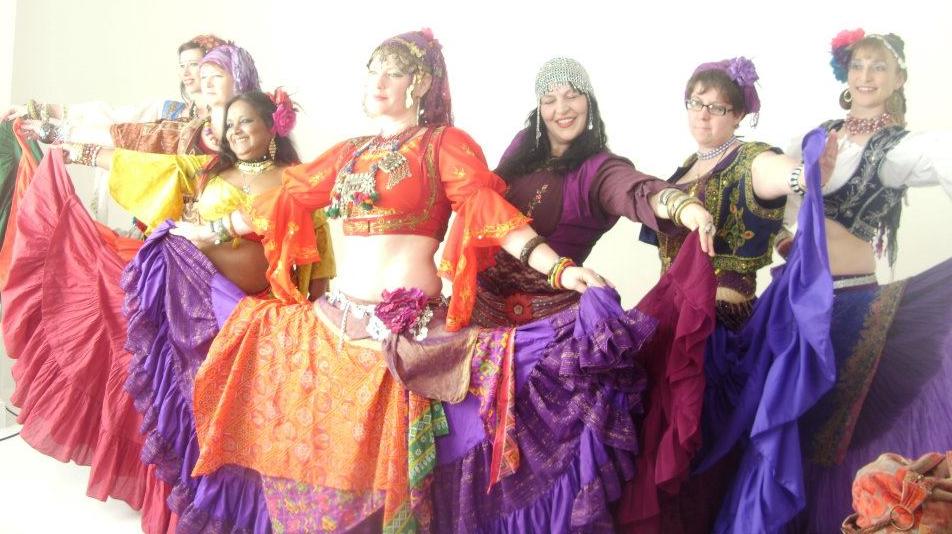
We had a great photoshoot last night at Emily’s studio, Venture in Framlingham, Suffolk.  I love all my gypsy ladies! These are Lisa’s photos of the photoshoot – can’t wait to see the final pics!