Essence of Zen


I’ve been so busy lately with belly dancing, that I haven’t posted for a while – so here’s a little something from our photo shoot that we did a while back, to make you smile!
Many people ask – what is enlightenment? Oh for an easily explained answer. The Buddha, when choosing his successor, simply held up a flower and one of his disciples was enlightened and smiled – he then became the successor. There are many stories in Zen philosophy and spirituality about enlightenment, but none of these stories actually tell you just what it is. And nor should they – it is something to be experienced, not read or talked about.
Outiside of Japan, most Zen practioners experience enlightenment gradually, as opposed to the full smack upside the head that satori can create. It is through meditaiton, and being completely aware that you gradually gain enlightenment. As the ego starts to fall away, the so-called “real” self emerges.
To allow the ego to fall away, one technique is to use the “Don’t Know” mind.
“Everybody says, “I” — “I want this, I am like that…” But nobody understands this “I.” Before you were born, where did your I come from? When you die, where will your I go? If you sincerely ask, “What am I?” sooner or later you will run into a wall where all thinking is cut off. We call this “Don’t know.” Zen is keeping this “Don’t know” mind always and everywhere. When walking, standing, sitting, lying down, speaking, being silent, moving, being still. At all times, in all places, without interruption – what is this?” – taken from http://zen.buddhism.org/about-zen.html
It’s a hard thing to admit that we don’t really know anything. And yet, any true scientiest will tell you that it is impossible to know 100% about anything – there is always margin for error. When we embrace the fact that we don’t really know anything, whole worlds open up for us. We can examine ourselves more deeply, and then ponder even on the notion of self if we were to take it one step further. Enlightenment is said to strike when we realise that there is no self – that we are all part of everything else. In Zen, the term “oneness” is often used, but I don’t like the monopoly that this word invokes – instead I think of it as a “wholeness”.
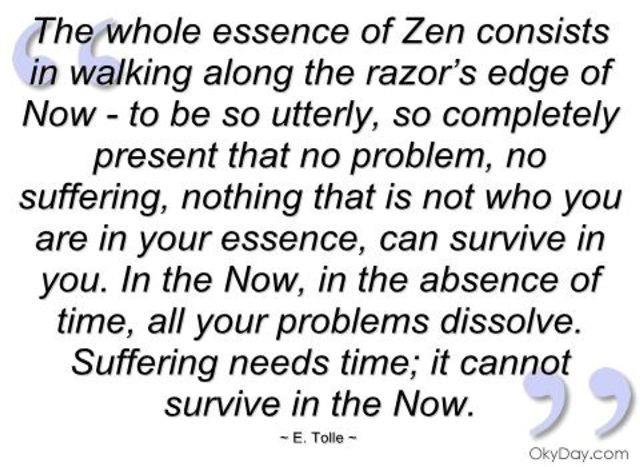
When we are completely in the moment, when our chattering minds are stilled, when our sense of self falls away and there is only the now, we become enlightened. In this state, many great things can happen – the perfect haiku is written, the archer and the target become one and the bullseye is hit without thought, the music simply flows, the painting emerges.
This reminds me of a similar term in Druidry, which is awen. Many people now believe the Welsh word’s translation to be something akin to “flowing spirit” or “flowing inspiration”. Is this any different to the Eastern version of enlightenment? As Druids, we gain awen from the world around us, which inspires us to create or to be still, to act or to remain passive, to be in complete and total relationship with the world around us. Not so different to satori, is it? Again, to be in a perfect relationship with the world around us, we must learn not to separate the I from the It – instead viewing the world as a whole rather than as separate. In this way, the inspiration or flowing spirit can flow freely down all channels directly into our soul and out into the wider web of the universe.
So, am I enlightened?
Don’t know.
A traditional Zen story:
A beautiful girl in the village was pregnant. Her angry parents demanded to know who was the father. At first resistant to confess, the anxious and embarrassed girl finally pointed to Hakuin, the Zen master whom everyone previously revered for living such a pure life. When the outraged parents confronted Hakuin with their daughter’s accusation, he simply replied “Is that so?”
When the child was born, the parents brought it to Hakuin, who now was viewed as a pariah by the whole village. They demanded that he take care of the child since it was his responsibility. “Is that so?” Hakuin said calmly as he accepted the child.
For many months he took very good care of the child until the daughter could no longer withstand the lie she had told. She confessed that the real father was a young man in the village whom she had tried to protect. The parents immediately went to Hakuin to see if he would return the baby. With profuse apologies they explained what had happened. “Is that so?” Hakuin said as he handed them the child.
How would you respond if you were Hakuin? Outraged at the lie? Unconcerned about your “image”? Persistently telling the world “the truth” about the whole situation? Refusing to take the child in?
I love this story. For me, it’s about getting on with things what need to be done, and not minding what others think, for opinions change, and we have absolutely no control over other people’s opinions. We can try and influence, but we have ultimately no control whatsoever. The best response in that situation is not to decry it, not to shout aloud your own opinion from the rooftops, but simply to get on with getting on with your own life. It’s all matter of perception, and perception is so subjective that to get upset about it is a waste of time. There is a Zen saying – do not seek the truth, only cease to cherish opinions.
It’s also a story about compassion. The baby in the story requires care, and is the unfortunate pawn in the game. Hakuin refuses to use the pawn, and instead raises the child as need dictates. When the child is demanded to be returned by the parents, the child is given freely, for Hakuin does not play the game. How many times in our lives have we been drawn in to playing a game that we do not enjoy? What if we simply said no to the game, lived with compassion and did what needed to be done?
“Is that so?” Such a simple statement, but breaking it down, can mean so much. “Is” questions a defined reality, “that” refers to something that is external to ourselves, “so” is our individual perception of the world. Not simply a knock-off devil-may-care attitude or answer, it is truly meaningful, constantly asking at each point in the story that everyone involved, including Hakuin himself, assess the situation and act with the right level of response, compassion, integrity and kindness.
Let’s give a shot.

The Grand National was this weekend, and two more horses died on the difficult and dangerous course, while many others were whipped with what is now termed as “unnecessary force” as they crossed the finish line. All to support financial greed. Stop this now. http://www.animalaid.org.uk/images/pdf/leaflets/grandnational.pdf

Every day we are caught in mind-traps – little prisons of our own making. We are constantly hijaked by our thoughts and feelings, our attachments to them and our egos, that we spin endlessly in circles until we fall down upon our butts. The key to breaking free of these mind traps is through observation.
When we meditate in the Zen style, or do zazen as it is called, we become aware of our bodies and our thoughts. We do not “zone out”, we are not “away with the faeries” or pondering the mysteries of life – in zazen we focus on pure experience. This focus helps us in our lives when we are not in zazen. We are aware of how our bodies are feeling – whether our breath is shallow or deep, that twinge in our back, whether our facial muscles are tense or relaxed. We also turn that awareness to our surroundings, listening to the birdsong outside, or the traffic, feeling the breeze or the sunlight upon our shoulders. We are aware as much as is humanly possible of everything that is around us and within us. It is no easy task.
Our thoughts are constantly seeking to distract us from the comfortable reality that we have created. Even though this reality may be a false reality, still it is more comfortable than sitting, thinking about our headache or the plain “boredom” of doing zazen. We daydream, we think through all our life’s problems, we spin off in attempts to do anything but simply be in the moment, because we feel that we deserve otherwise. Remember that old saying, “there is no time like the present”? Similarly, there is no experience other than this present moment – mayhap the best thing you could be doing is simply experiencing it right now.
We like to think. There is nothing wrong with thinking – we can solve problems, work out situations with a little forethought. We plan – and again, there is nothing wrong with having life plans. It is our attachment to these plans that sets us off in another mindtrap – where if we don’t achieve them our life can feel in ruins.
In zazen, we learn to observe. We sit, and we observe our bodies’ attempts to defy our intention of just sitting still and being in the moment. Why do our bodies do this? Because they reflect our thoughts – our thoughts don’t want to sit still – they want to run riot. In zazen, it is not so much controlling our thoughts, pushing them away or yelling at them to be quiet like unruly children – we observe the thoughts and gradually, through observing them, they become quieter. A new thought is a wonderful, shiny thing that we want to explore – whether it is a “good” thought or a “bad” thought. When we have observed that thought 100 times, it becomes a lot less interesting. This is what zazen is about.
If we think about what happened to us that upset us during the day, we can easily become lost in our emotional attachment to it. If we simply observe the thought – “Oh, I’m having a thought about this again” and then return our attention to simply sitting and being in the moment, then we are on the path to freedom from these mindtraps. Again, it is not easy – we may have to do this 10, 100 or 1,000 times before the thoughts settle down and we tire of them. With persistence, they will.
We must be careful, however, to simply observe, without “being” the observer. If we become the observer, then we have created a separate entity that does not exist. If we are simply observing, then we are the pure moment. The past does not exist, neither does the future. It is only this moment, that is constantly changing, that exists. If thoughts about the past occur, you can observe them, but then ask yourself – “where is the past right now?” It does not exist. When we worry about the future, we can ask ourself “where is the future right now?”. It does not exist. Only this present, everchanging moment exists.
I love to daydream – but not when I am in meditation. I set aside a time in the day to daydream, to come up with wonderful stories that may see the light of day in future novels or short stories. There is nothing wrong with imagination – it is a gift that should be used every day. We must learn, however, not to become lost in it, this imaginary world, as it is so much better than our reality can seem. Living in a pure moment does not leave us unthinking, mindless zombies. We are totally and completely present, truly living life to the fullest. That is the greatest gift.
It is time to break free of your mindtraps – look at what thoughts keep occurring, what keeps rising to the surface when you are being silent and still. By observing them you will notice them, notice the patterns that are created, the emotions and physical pain that may be attached to these thoughts and how they so easily control your life. Once we see the pattern, we can weave our way out into a new pattern, into a new cycle. Through zazen, we can take this into our everyday lives, and so, when someone upsets us, or hurts us, or brings us joy – we can see the pattern that is created and either choose to remain within it, or weave a new pattern upon the web of life. We can either live in this very moment, or stay within our mindtraps. The choice is ours.
I read somewhere recently that you can tell who is married at a pub or restaurant – it’s the couple that aren’t talking to each other. While it’s funny, it’s also true – but perhaps not for the reason intended!
I love going for walks in the countryside with my husband. We talk about things occasionally, but most of the time is spent in silence. It is a companionable silence – where words aren’t necessary to share the experience. Sometimes it is simply enough to be with someone without words – words can spoil a brilliant moment, such a sunrise, or making love, holding a sleeping kitten.
It is in these moments where we can be with another person without there being a need – we are simply there, together, experiencing a shared moment without asking anything of the other. There are no demands to be made, no attention to be sought – all there is, is shared experience. It is gloriously freeing.
I have often said that my two best friends are my cats, who simply enjoy sharing company with me for no other reason than sometimes it’s nice to be together. They will sit with me outside or inside in the same room, without making demands (apart from the odd cuddle that they come up and ask for, willingly given). We spend most of our day in silence, which is bliss. Much like the walks with my husband, we are not asking for anything in return. And when we’ve had enough, we can retreat to separate rooms to be back in our own space.
There can be so many demands made upon us – at times it is wonderful just to have a shared moment like this. That couple in the pub who aren’t talking – they’re probably happier than the young couple struggling to make conversation to ease their moment of experience. Silence is golden.
So, what is Zen?
Zen is living your meditation, being fully awake and aware. Bodhidharma (528 A.D.) said: “Not dependent on the written word, transmission apart from the scriptures; directly pointing at one’s heart, seeing one’s nature, becoming Buddha”. It is not about sitting on a cushion all day meditating – it is about awareness of everything, and bringing that awareness into every aspect of our lives, seeing our own nature.
Zen is often likened to a philosophy or an attitude rather than a belief. It doesn’t require a belief in anything, not even Buddha. It is about relationship, and understanding our relationship with everything around us – we are not entities alone in this world. We are individuals, but we are also a collective of individuals. Zen is about experiencing, fully. It refuses to be distracted by the illusions of the constructed world around us, from the prisons we create in our own minds to the material consumerism we see running rampant around us. Zen means not only going with the flow of the world around us, but being the flow itself. It is about the true joy of life itself.
So, what is Druidry?
Druidry was the spiritual tradition of the natives of Britain and Ireland and parts of Europe. An ancient pagan tradition, it was a relationship between people and the land which is maintained in modern Druidry, with a focus towards more individualised relationships with the natural world. Druidry today includes relationships with the ancestors and a cultural heritage, as well as encompassing many other worldviews.
Druidry, like Zen, is often likened to a philosophy – it is indeed a way of life, that does not require a belief in any external deity or concept. Druidry seeks to strengthen our bonds of relationship with the natural world, gaining inspiration and wisdom from studying the patterns that nature constantly unfolds before us. At its very core, Druidry holds a reverence for nature. It is about attuning to the cycles of nature around us that we often find ourselves distanced from in this modern world, and finding the wisdom of the oak.
So, what is Zen Druidry?
Zen Druidry encompasses both teachings from Zen and Druidry to combine into a spirituality that is infused with an awareness of the natural world around us. Both Zen and Druidry are all about relationship, and how we fit into the world around us. Through meditation and concepts such as non-attachment to thoughts and experiences coupled with high levels of concentration, Zen Druidry allows us to see the world for what it really is, and in doing so, to honour it and hold a deep reverence for nature in her all glory.
I really enjoy Charlotte’s way of looking at life. I’ve copied an interview with her and the original can can be found here:- http://www.oxherding.com/my_weblog/2009/03/charlotte-joko-beck.html
Look up her books on amazon. Then stop reading and just do it! x
Shambhala SunSpace recently published an interview with Charlotte Joko Beck, conducted by Donna Rockwell.
In my experience, few teachers have Beck’s willingness to jettison all the trappings and traditions of Buddhism, in order to express themselves without disguise. I hope you’ll read the entire interview, below.
How old were you when you started meditating?
Charlotte Joko Beck: Thirty-nine, forty, somewhere in there.
Did you have any realization through meditation?
No. Of course we have realizations, but that’s not really what drives practice.
Will you say more about that?
I meet all sorts of people who’ve had all sorts of experiences and they’re still confused and not doing very well in their life. Experiences are not enough. My students learn that if they have so-called experiences, I really don’t care much about hearing about them. I just tell them, “Yeah, that’s O.K. Don’t hold onto it. And how are you getting along with your mother?” Otherwise, they get stuck there. It’s not the important thing in practice.
And may I ask you what is?
Learning how to deal with one’s personal, egotistic self. That’s the work. Very, very difficult.
There seems to be a payoff, though, because you feel alive instead of dead.
I wouldn’t say a payoff. You’re returning to the source, you might say – what you always were, but which was severely covered by your core belief and all its systems. And when those get weaker, you do feel joy. I mean, then it’s no big deal to do the dishes and clean up the house and go to work and things like that.
Doing the dishes is a great meditation — especially if you hate it…
Well, if your mind wanders to other things while you’re doing the dishes, just return it to the dishes. Meditation isn’t something special. It’s not a special way of being. It’s simply being aware of what is going on.
Doesn’t sitting meditation prepare the ground to do that?
Sure. It gives you the strength to face the more complex things in your life. You’re not meeting anything much when you’re sitting except your little mind. That’s relatively easy when compared to some of the complex situations we have to live our way through. Sitting gives you the ability to work with your life.
I read your books.
Oh you read. Well, give up reading, O.K.?
Give up reading your books?
Well, they’re all right. Read them once and that’s enough. Books are useful. But some people read for fifty years, you know. And they haven’t begun their practice.
How would you describe self-discovery?
You’re really just an ongoing set of events: boom, boom, boom, boom, boom, one after the other. The awareness is keeping up with those events, seeing your life unfolding as it is, not your ideas of it, not your pictures of it. See what I mean?
How would you define meditation?
Awareness of what is, mentally, physically.
Can you please complete the following sentences for me? “The experience of meditation is…”
“…awareness of what is.”
“Meditative awareness has changed my life in the following way…”
“It has changed my life in the direction of it being more harmonious, more satisfactory, more joyful and more useful probably.”Though I don’t think much in those terms. I don’t wake up in the morning thinking I’m going to be useful. I really think about what I’m going to have for breakfast.”
“The one thing awareness has taught me that I want to share with all people is that…”
I don’t want to share anything with all people.
Who do you want to share with?
Nobody. I just live my life. I don’t go around wanting to share something. That’s extra.
Could you talk about that a little bit?
Well, there’s a little shade of piety that creeps into practice. You know, “I have this wonderful practice, I want to share it with everyone.” There’s an error in that. You could probably figure it out yourself.
I think that’s something I need to learn.
You and I know there’s nothing that’s going to make me run away faster than somebody who comes around and wants to be helpful. You know what I mean? I don’t want people to be helpful to me. I just want to live my own life.
Do you think you share yourself?
Yeah, but who’s that?
Standing on the edge, with a cosmically delineated point where the tide turns from winter to spring, we teeter on the brink of the spring equinox. It is a time for madness.
Many of us are not yet ready to run full tilt into the light of the summer sun – not yet ready to pull away from the skirts of winter and face all that summer will bring. Some of us are more than ready, like a horse left too long in its stall, ready to kick free and run in the fields with the spring grasses underfoot. Often times these two will clash. Some of us don’t feel a change at all.
Whether you are ready or not, if you are at all sensitive to the times and tides of nature, this is a time of uncertainty. Much as with our previous agrarian lifestyle, we don’t know if our crops will fail, whether the seeds we are planting will come to anything. Our dreaming of winter hangs in the balance – do we dare to take those dreams out of the darkness of inception and into the growing light, or do they need more time, in case they are exposed to the uncertainties much as a late spring frost could easily kill our early seedlings.
It is a time of courage. Like the seed that sprouts, not certain if the soil is good, its position prominent and well taken, we must go forth into the world out of our winter’s hibernation. We must find that spark deep within that allows change to happen, for we cannot hibernate forever.
It is also a time of hardship. All those creatures, especially the herbivores, find this the hungry season, where food is scarce after the long winter’s cold and the summer’s bounty still yet to come. Our ancestors knew this as the hungry time as well – the last of the winter cabbages and apples gone, awaiting the time of new lambs and calves to provide extra nourishment. The first of the nettles and primroses are now shining through, with their beneficial nutrients. We can take this opportunity to learn what it means to be hungry, and also what is available in our own landscapes that can nourish us both physically and mentally.
Hares are visible in the stubble or newly ploughed fields, or running across little country roads. Boxing males and females are spotted under the light of both sun and moon. Are they mad as well?
It is a time of great tides, such as the Severn Bore. Combined with a full moon, rain and storm surges it can cause havoc and severe flooding. Like the tides of spring and autumn equinox, we can ride them either into the growing light of summer or the fading light of winter. Is your raft well crafted? Will you be able to hang on? Are you able to ride the tides and see where they take you?
Like I said, it is a time of madness.

 Down the Forest Path