Druid Magic

magic circleDruids aren’t associated with magic in the same way that other Pagan traditions, such as Wicca or Witchcraft seem to be.  Yet I’ve found that in every spiritual path, there are elements of magic contained within that are often very similar in nature.

What is Druid magic? Do Druids cast spells? Have magical tools? Do we think of Gandalf, brandishing his staff and saying mightily “You Shall Not Pass!” or his mushroom-addled fellow, Radagast, who lives in the woods, talks to animals and, according to the latest Hobbit films, has a rabbit-powered all-terrain sleigh and brings hedgehogs back from the dead?

Of course it’s none of these things. It would be pretty cool if it were. But Druid magic, like all magic, is subtler than what we see on the screen or read in books.  There isn’t lightning shooting from fingertips or fire balls sparking from one’s eyes.  In fact, many modern Druids don’t use magic at all, or don’t call it magic.

So what is magic? It has often been quoted these days as manipulating the natural forces of energy within nature to provide a desired result.  This could have many interpretations.  Flicking a switch and having my living room lit up at night could fall within this category, but I’m being a bit facetious. It is also often said that magic should be the last recourse after having tried all mundane means of solving a problem.  So how do Druids use magic, if at all?

There is a growing trend of blending Wicca and Druidry, as in Philip Carr-Gomm’s new book, Druidcraft.  This is a lovely way of expressing the divide between two very similar paths; kind of bridging the gap that lies between.  I thought the book, especially the audio book, was brilliant, and yet I’m still not one to perform spells on a regular basis.  Why is that?

As stated previously, magic is often the last recourse to a situation.  If all other means have been tried, and I’m plum run out of ideas, then I might turn to magic. I might equally turn to prayer. Praying for some guidance, asking the gods, the spirits, the ancestors for a little advice when I’m stuck could be called a spell – it could also be called a prayer.  Lighting a candle and some incense, meditating and then seeking some clarification or inspiration from the ancestors could indeed look like the workings of a magical spell. I think perhaps the difference is in the intention – in both magic and prayer, we are hoping for a result, but the results are often different.

In prayer, asking for the gods to solve a problem for us rarely, if ever, works in my own experience.  I prefer to ask them for inspiration on how to get through this, or my spirit guides on where to go to next in order to resolve and issue.  Casting a spell bypasses the question, in a way, and seeks to get an answer to a question not asked.  Perhaps this is why I resort to magic so little, I always like to ask the input of others to seek out different perspectives on a situation. Again, this is only my own personal views, and others may have other ways of both prayer and spell-casting that are vastly different to my own.

For me, as a Druid I am always questing the awen – for me, awen is the Grail.  Inspiration, flowing spirit – it is such a beautiful word from the Welsh language that has so many different meanings.  To me, awen is magic, though perhaps not in the spellcaster’s sense of the word.  It is energy, it is flowing, it is the Tao and The Force of the Jedi Knight.  It is something to be tapped into in order to gain a new perspective, to see the bigger picture, to obtain compassion. Awen is Buddhist enlightenment.  It is the Christian “God is Love”.

Instead of performing a magic spell, I might wander the heathland or forest, looking for inspiration around me. I might find a place to pray, using that inspiration to guide my prayers to better understanding of myself, the situation, the world.  When all other recourses have failed, then I might try magic – the last recourse.

I feel that magic is something special, something not to be abused or overused.  We often hear the term “god-bothering” and magic may indeed be another form of “bothering” – whether it is the elements, the energy of nature, or something else entirely. I feel that Druids on the whole would turn to awen rather than magic, but perhaps with the blending of Druidry and other traditions this could indeed change, or maybe even change back to the way Druidry used to be – who knows?

Perhaps my quest for awen is my magic.  Magic includes transformation, and questing the awen will indeed change someone.  None of the knights on the Grail quest were ever the same.  None who seek enlightenment will ever be the same person they were before. We are constantly changing anyways, living a life of impermanence and fluidity, of change and flux.

Perhaps just tapping into that idea is magic, is awen.

(Reblogged from my channel at SageWoman: http://www.witchesandpagans.com/SageWoman-Blogs/druid-magic.html)
Craft Names

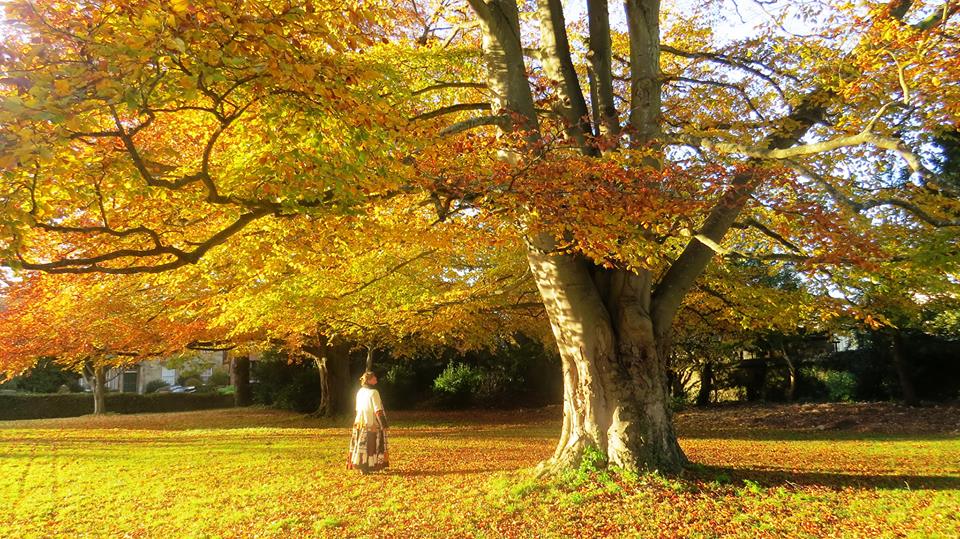
Autumn SongWithin Druidry, and indeed in modern Paganism, it is usual to adopt a craft name within your tradition.  It is not necessary, and if you feel that you don’t need one, or one doesn’t appeal, then by all means forego the craft name. However, choosing a craft name, or having one bestowed upon you can enhance your connection to your tradition, if you allow it.

Craft names can provide an air of mystery and magic.  We can choose something that reflects our work, such as Oak Seeker, Coll (hazel, if working with ogham), or Pathfinder.  We can choose something that reflects a part of the environment that we love – Alder, Willow, Rain.  We can put two words together that express a deep part of our soul, or a deep love that we have, such as Gentle Bear, Running Horse, or my craft name – Autumn Song.  We can adopt names of the gods and goddesses that we love, such as Nehalennia, Freya, Lugh, Branwen, Rhiannon, Bridget.  There are also mythological names like Merlin, Morgan and Nimue that might strike a chord deep within our hearts.  We can even choose names from fantasy books that we love – Gandalf, Radagast, Arwen, Goldberry, Eomer, Eowyn, Faramir (all Lord of the Rings names).  What matters most is that our name expresses a deep part of our soul; that when we utter it, write it, exhale it into the twilight it means something to us, connects us to the awen.

You can inscribe your craft name upon your altar, or your tools. You can sign correspondence with it.  You may even change your name to your craft name if you feel that better reflects who you are.  I like having both names, as I can honour my two grandmothers for whom I am named after, and honour my tradition with my craft name. Besides, it took me long enough to learn how to write my own name, and I’m sticking to it…

We might choose our craft name, or we might be gifted it by another. We could meditate, commune with the local spirits of place, or deity, and ask that they bestow us a name. In some magical traditions, a craft name is given upon initiation into the tradition, or upon completion of various grades.  When working alone, we do not have to wait to have a name bestowed upon us – we can seek it out ourselves from whatever inspires us whenever we feel ready.  We can ask our ancestors, our spirit guides, even friends and family for ideas and inspiration.

Our craft names may also change with time.  As we grow and develop in our spirituality, we might find that we outgrow our name, and thereby be inspired to choose another that better suits our current work.  We can include our naming in ceremonies, whether it is our first time or our fifth time in choosing a craft name.  Taking on a name is not something to be done lightly, however.  It requires much thought and meditation if you wish for it to be important to your work.

Whatever name you choose, or however you decide to be named, honour that name with all that you are.  Find ways of being that reflect your name in deep and compassionate ways, working to create peace and harmony in your life and in all life around you.

Reblog: Authenticity vs Validity

Here is my blog for Moon Books’ blog page – I write the monthly essay. Check out some of their other blogs as well – really good stuff there!

I remember, quite a few years ago now, reading Ronald Hutton’s Triumph of the Moon. I had always known, vaguely, that modern paganism was just that – modern.  After reading that book, and finding out just how modern most of our rituals and celebrations are, I had a bit of a religious crisis.  I was having a really hard time coming to terms with the fact that the spiritual path I was following was essentially made up by two guys in the 1950’s and 60’s.

For a couple of weeks I toiled with this issue, until it finally dawned on me that all religions, at some point, were made up by some people.  Simply because someone made it up 200, 2,000 or 20,000 years ago didn’t make it any more valid. I realised that authenticity did not equal validity.

There was no way of tracing pagan roots back to what we would imagine to be a more “pagan time”  – ie. for most this would be before Christianity.  Paganism didn’t write or record much down in words, though we can catch remnant in snatches of old folk songs, rhymes and the like.  If our paganism is inspired by an even older spirituality, such as our Neolithic ancestors, then certainly we have no written records – a few artefacts, burial mounds and sacred sites to draw inspiration on, but nothing of their words to live by. We still do not know, and can never be certain, what they actually believed, how they lived their lives and how they communed with their gods, if any. We can only speculate.

And so, two men, Gerald Gardner and Ross Nichols pieced together a spirituality as best they could, after looking into folk traditions and seeking inspiration from the natural world itself.  This evolved into what is recognised as Wicca and Druidry today.  These paths are not hundreds of years old, though they have been inspired by older traditions.  This does not invalidate them in any way.

I would personally have a harder time believing in the validity of someone’s path who told me that they were following a “thousands year old British tradition” than someone who told me that they made up their own spiritual path.  Why? Because the need for justification of a tradition bothers me – why do we need to justify our paths?  Our good Druid friend, Iolo Morganwg, made up a lot of stuff when he couldn’t find any reference to it a couple of hundred years ago, and yet the stuff that he made up has great resonance and beauty for some druids.  Yes, he passed it on as “real”, and was only caught out fairly recently in his forgeries, however they still remain beautiful and meaningful forgeries nonetheless for many.  It bothers me that he felt the need to forge these documents, but it doesn’t make his tradition any less valid for himself and others with whom it inspires. The question of lying about the authenticity of a tradition is what invalidates it for many.

Why do we feel the need to authenticate a religion or spiritual path before we embark upon it?  Does this have anything to do with the Age of Enlightenment vs the Age of Reason? Why should one be more valid than the other, simply because it has hard facts that it can draw upon?

A religious and spiritual path is such a personal thing, that I find it hard to believe that any one path is good for more than one person.  We can certainly be inspired by it, but the path must be walked by us, and us alone – no one else can do it for us.  Buddha said “Be a light unto thyself”.  We have to find our own ways of communing, our own relationship with the world in order for it to make full sense to our hearts, bodies, minds and souls.  Oftentimes the words and teachings of others can come close, and yet they are still not quite as personal as a one to one relationship.

Protestants have a more personal relationship with God, for the most part, than Catholics when it comes down to it.  That in an inherent part of Protestantism, one that is explored and made quite poignant in Arthur Miller’s The Crucible.    Protestantism placed a great emphasis on personal, individual reading of the Bible, thereby increasing the personal relationship with God – no other could really do that for you.  Sadly, within history and especially after the birth of Calvinism, fundamentalism became de rigeur.

How much of our paganism today is influenced by this Protestant way of thinking? It’s hard to tell, but it’s not something I have a problem with.  I like the idea of everyone having to find their own personal relationship with God, or a god, or goddess, or the spirits of place, their ancestors or the three worlds of land, sea and sky.  This idea is, of course, not solely attributed to Protestantism (remember Buddha’s quote?) but it is one of the more recent religious institutions in the UK, of which we are currently exploring the legacy.

How far back the tradition of personal relationship with deity goes is, to me, of no consequence.  It’s nice to have historical authenticity, but it does not a spirituality make.  It is within the personal relationship with whatever it is that you are communing with, and which changes you, inspires you or moves you that is really what matters in this life.  Whether you pray using a prayer that is a thousand years old, or one that you made up on the spot, it is in the feeling and intent behind it that matters most, not in the words themselves.  It must connect you with what it is you are trying to reach, else what is the point?

So, to all those out there who are making it up as they go along, who find spiritual validity in what they do, I give a hearty hail!  To those whose find the words of others resonate deeply within their soul, and blend their historic traditions with personal experience, again I give a hearty hail!  Life is too short to follow a path simply because others have trodden it – we can learn from that path, but ultimately it is we who are doing the walking, no one else, and in that is our own validity and personal experience found and blessing us along the way.

http://moon-books.net/blogs/moonbooks/authenticity-v-validity/