Enough Already!

How often you do say “enough already”?  Mostly, when you’re sick of something, and really don’t want anything more, or anything more to do with it.  These past few months I’ve been applying the “enough already” to my life, though with different connotations.

What are our needs, as human beings? Food, shelter, clothing and something of a sense of security go a long way to making our lives happy.  Social interaction, music and literature also go a long way to making our lives better.  Yet in our culture, we just can’t seem to get “enough”.  Our economy, if it isn’t growing, is in recession – if our GDP isn’t constantly on the up, then we’re seen as failing.  We need more news, faster, and through all kinds of media.  We need bigger houses for all our possessions, multiple cars and swimming pools.  This is the measure of success in our culture, not happiness.

I would pose that we need to relearn just what enough is.  We’ve got things galore, but do they make us happy?  Looking up the word galore, I came across with an interesting little find – galore also means enough.  Irish go leor  enough, plenty ( Scots Gaelic gu leòr, leòir ).  To have enough is plenty.

Some 20th century modcons make our lives much easier – the telephone, for example.  We can talk to people and distance is no longer a factor, though money still is – you must be able to afford that phone call (though I would say that even this is a stretch, for I know people with mobile phones who manage to pay their mobile phone bills but not their rent).  However, do we really need phones that do everything, with all the latest apps?  I have a mobile phone that I have for emergencies, ie. if my car breaks down on a lonely country road, I can call for help. This phone is 10 years old.  If people want to reach me, they have my landline. If I’m not home, they can leave a message.  It’s not life or death if I can’t be reached 24/7. It rarely is for most people.  (I often wonder if this 24/7 reachability gives people a sense of self-importance – and if so, that’s something that saddens me terribly).

I don’t need to wait in line outside a store for hours for the latest IPhone release.  Why on earth would I want to do that?  I have a life to live, in all honesty, that does not revolve around bowing down to the gods of consumerism.  My phone is enough for my needs, which are pretty basic when it comes to phones.

A computer is also a necessity in my line of work.  For writing, for my other jobs, I just couldn’t do without one.  Social media is also a necessity for me, to share ideas and get feedback, to promote events and subjects that I feel are important, to keep in touch with my family who are thousands of miles away.  But I don’t have a Twitter account, or pininterest, or the host of other things that create an online presence – I have what I need in my line of work – a blog, a website, a Youtube account (for my dance company, visual is the most important form of media) and a Facebook account.  This already seems like a lot to me, and I don’t want to expand this any further – so much time is already spent on all of these, and there are, after all, other things I need to be doing for my work, like writing and choreographing to say the least!

When is enough plenty?  When we can find something to wear that doesn’t take more than a few seconds to think about.  When we eat until we are 80% full, knowing that we will feel full in a few minutes.  When our grooming habits take less than 20 minutes for a usual day.  When we don’t feel the need for the latest “thing”.

A good exercise – take a look around your house, maybe just one room, and note all the things you absolutely need.  Write them down. Now make another list of everything that isn’t essential, and then compare the two.  A few items, such as a gift from someone that you love and want to display on your mantelpiece, for instance, shouldn’t really count against you.  But all the things that you don’t love, that don’t have meaning, that you could just as easily do without – these are the things we need to think about.

Before each purchase, I always ask myself – do I need this? If the answer is no, then I won’t buy it.  It’s that simple.  I made a vow last year (the second time I’ve done this) to not buy any new clothes for a year.  I still have license to buy whatever I would like from charity shops, but even then I always ask myself – do I need this? If the answer is still no, even if it is only £2, then I won’t buy it. I have enough. I have plenty.



Three useful words…

On one of my favourite television shows, two characters were taking a road trip, and the tire blew.  They got out of the car, and the young man said “Well, that happened.”  His girlfriend queried this -“Is that all you’ve got to say?”

I like his attitude.  There are many, many things in our life that are beyond our control.  We have no control over other people, the weather, the bus timetable.  It’s an acceptance of things the way they are – that doesn’t mean that you don’t have to change it if you aren’t happy with it, but it is the path of least suffering.

Those three words also state that whatever happened no longer exists – it is in the past, and the past is ungraspable.  So is the future. We only have the now. Let’s get on with it.

I could rant and rail about other people’s behaviour and actions. Or I could get on with living my own life the best that I can.  I can use the people and situations around me as inspiration to be the best person I can be at this point in time.  I can also release any notion of control, for it is a fallacy at best.

Yes, certain events in human history are exceptionally horrid – it’s hard to say those three words about things like the holocaust, for example.  It’s not letting go of the responsibility of our actions; it’s more about getting on with making things better instead of dwelling in our heads with our emotions and not really achieving anything.  If a loved one dies, these three words aren’t particularly comforting.  But it can give us a context, where we can feel the emotion at the time, and then work to make the world a better place in the precious time that we have left.

The next time something happens that has the ability to upset me, this is what I’m going to say. “Well, that happened”.

Leo Babuata’s 12 Essential Rules to Live More Like a Zen Monk

12 Essential Rules to Live More Like a Zen Monk  (taken from http://zenhabits.net/12-essential-rules-to-live-more-like-a-zen-monk/)

“We have more possibilities available in each moment than we realize.” – Thich Nhat Hanh

Post written by Leo Babauta.

I’m not a Zen monk, nor will I ever become one. However, I find great inspiration in the way they try to live their lives: the simplicity of their lives, the concentration and mindfulness of every activity, the calm and peace they find in their days.

You probably don’t want to become a Zen monk either, but you can live your life in a more Zen-like manner by following a few simple rules.

Why live more like a Zen monk? Because who among us can’t use a little more concentration, tranquility, and mindfulness in our lives? Because Zen monks for hundreds of years have devoted their lives to being present in everything they do, to being dedicated and to serving others. Because it serves as an example for our lives, and whether we ever really reach that ideal is not the point.

One of my favorite Zen monks, Thich Nhat Hanh, simplified the rules in just a few words: “Smile, breathe and go slowly.” It doesn’t get any better than that.

However, for those who would like a little more detail, I thought I’d share some of the things I’ve discovered to work very well in my experiments with Zen-like living. I am no Zen master … I am not even a Zen Buddhist. However, I’ve found that there are certain principles that can be applied to any life, no matter what your religious beliefs or what your standard of living.

“Zen is not some kind of excitement, but concentration on our usual everyday routine.” – Shunryu Suzuki

    1. Do one thing at a time. This rule (and some of the others that follow) will be familiar to long-time Zen Habits readers. It’s part of my philosophy, and it’s also a part of the life of a Zen monk: single-task, don’t multi-task. When you’re pouring water, just pour water. When you’re eating, just eat. When you’re bathing, just bathe. Don’t try to knock off a few tasks while eating or bathing. Zen proverb: “When walking, walk. When eating, eat.”
    2. Do it slowly and deliberately. You can do one task at a time, but also rush that task. Instead, take your time, and move slowly. Make your actions deliberate, not rushed and random. It takes practice, but it helps you focus on the task.
    3. Do it completely. Put your mind completely on the task. Don’t move on to the next task until you’re finished. If, for some reason, you have no choice but to move on to something else, try to at least put away the unfinished task and clean up after yourself. If you prepare a sandwich, don’t start eating it until you’ve put away the stuff you used to prepare it, wiped down the counter, and washed the dishes used for preparation. Then you’re done with that task, and can focus more completely on the next task.
    4. Do less. A Zen monk doesn’t lead a lazy life: he wakes early and has a day filled with work. However, he doesn’t have an unending task list either — there are certain things he’s going to do today, and no more. If you do less, you can do those things more slowly, more completely and with more concentration. If you fill your day with tasks, you will be rushing from one thing to the next without stopping to think about what you do.
    5. Put space between things. Related to the “Do less” rule, but it’s a way of managing your schedule so that you always have time to complete each task. Don’t schedule things close together — instead, leave room between things on your schedule. That gives you a more relaxed schedule, and leaves space in case one task takes longer than you planned.
    6. Develop rituals. Zen monks have rituals for many things they do, from eating to cleaning to meditation. Ritual gives something a sense of importance — if it’s important enough to have a ritual, it’s important enough to be given your entire attention, and to be done slowly and correctly. You don’t have to learn the Zen monk rituals — you can create your own, for the preparation of food, for eating, for cleaning, for what you do before you start your work, for what you do when you wake up and before you go to bed, for what you do just before exercise. Anything you want, really.
    7. Designate time for certain things. There are certain times in the day of a Zen monk designated for certain activities. A time for for bathing, a time for work, a time for cleaning, a time for eating. This ensures that those things get done regularly. You can designate time for your own activities, whether that be work or cleaning or exercise or quiet contemplation. If it’s important enough to do regularly, consider designating a time for it.

  1. Devote time to sitting. In the life of a Zen monk, sitting meditation (zazen) is one of the most important parts of his day. Each day, there is time designated just for sitting. This meditation is really practice for learning to be present. You can devote time for sitting meditation, or do what I do: I use running as a way to practice being in the moment. You could use any activity in the same way, as long as you do it regularly and practice being present.
  2. Smile and serve others. Zen monks spend part of their day in service to others, whether that be other monks in the monastery or people on the outside world. It teaches them humility, and ensures that their lives are not just selfish, but devoted to others. If you’re a parent, it’s likely you already spend at least some time in service to others in your household, and non-parents may already do this too. Similarly, smiling and being kind to others can be a great way to improve the lives of those around you. Also consider volunteering for charity work.
  3. Make cleaning and cooking become meditation. Aside from the zazen mentioned above, cooking and cleaning are two of the most exalted parts of a Zen monk’s day. They are both great ways to practice mindfulness, and can be great rituals performed each day. If cooking and cleaning seem like boring chores to you, try doing them as a form of meditation. Put your entire mind into those tasks, concentrate, and do them slowly and completely. It could change your entire day (as well as leave you with a cleaner house).
  4. Think about what is necessary. There is little in a Zen monk’s life that isn’t necessary. He doesn’t have a closet full of shoes, or the latest in trendy clothes. He doesn’t have a refrigerator and cabinets full of junk food. He doesn’t have the latest gadgets, cars, televisions, or iPod. He has basic clothing, basic shelter, basic utensils, basic tools, and the most basic food (they eat simple, vegetarian meals consisting usually of rice, miso soup, vegetables, and pickled vegetables). Now, I’m not saying you should live exactly like a Zen monk — I certainly don’t. But it does serve as a reminder that there is much in our lives that aren’t necessary, and it can be useful to give some thought about what we really need, and whether it is important to have all the stuff we have that’s not necessary.
  5. Live simply. The corollary of Rule 11 is that if something isn’t necessary, you can probably live without it. And so to live simply is to rid your life of as many of the unnecessary and unessential things as you can, to make room for the essential. Now, what is essential will be different to each person. For me, my family, my writing, my running and my reading are essential. To others, yoga and spending time with close friends might be essential. For others it will be nursing and volunteering and going to church and collecting comic books. There is no law saying what should be essential for you — but you should consider what is most important to your life, and make room for that by eliminating the other less essential things in your life.

“Before enlightenment chop wood and carry water. After enlightenment, chop wood and carry water.” – Wu Li

Back to Reality

Reality is a slippery little devil.  Our minds are so adept at creating our own version of reality that the boundaries between what is real and what is not can become so blurred as to be indistinguishable.

Our thoughts can control us so much that they can keep us running around in circles, spinning off into the depths of our minds and in doing so, missing out on all the wonders and also the reality of the present moment.  Most people don’t enjoy being in the present moment – they avoid it at all costs. However, this is because they have probably, for the most part, never ever truly experienced being in the present moment. (See my previous blog post on mindtraps for more on this subject – https://downtheforestpath.wordpress.com/?s=mindtraps.)

But I digress.  Problems arise when our perceptions of reality become twisted with the imaginative and creative thought processes that our human brains are so capable of.  This was made clear when my husband received a phone call last night from someone he hadn’t heard from in a long time.  When he queried why the person hadn’t been in touch (he didn’t have their number) they stated that he had become upset at their last conversation, and that he had put the  phone down on them.

This was not true – I don’t believe he has ever put the phone down on anyone, and especially would never do so to this person.  This person had left the real conversation months ago, and was not satisfied with the outcome.  And so, this person developed in their minds ways that it would appear that they had been wronged, so that they could continue to avoid reality and live in their preferred state of being the victim.  They may have told and retold the story of the conversation in their minds over and over again, changing the details until, after a period of days, weeks or months, reality had changed. Stories change with the telling, we know this.  But we are fooling ourselves when we keep changing reality to suit our own egos and emotions.

I remember times when I’ve done this myself in the past – sometimes it is to justify certain behaviour, or to explain events.  The key is to become aware of when you are doing it, to stop and say “Right.  I know what the facts are, and I’m going to stick to them, and not change them to suit my own desires”.  I still get surprised when I see this in other people – I’ve had people accuse me of certain things, of promising others and of creating a totally separate reality to that which actually occurred.  It can be hurtful, at times, until you understand the thought process that creates this – you then realise that you had no part in it, that it became an entity totally foreign to your own being.

This doesn’t mean that you are not responsible for your actions – we all must be the best human beings we can at this present moment. Actions have consequences. However, we must also be aware and have some compassion for those who are caught up in their own realities, to a certain extent. We don’t have to live in them, or even partake of that reality, but we can understand the reasons why.

We have to learn how to live in the here and now.  Being alive and present in the here and now allows no time for emotional attachment to our thoughts and feelings – we still respond emotionally to situations, but we don’t become attached to the emotion itself.  As I left work yesterday, after a long staff meeting, my colleague was upset at what was said about our department, which was, unwittingly or not, derogatory.  Not only does this emphasise that we need to think very clearly before we speak, but also that we also cannot attach to the emotions that follow after a certain event.  I too was very displeased with the outcome of the meeting and the insinuation, and driving home could feel anger welling inside, threatening to ruin the whole drive home and run well into the evening. However, I caught myself, and brought myself back to reality and the present moment.  What was the present moment? Driving home, in the late afternoon sun, putting miles between myself and the event, figuratively and literally.  It was no longer happening now, except in my head.  I could either let it continue to live in my head, or simply enjoy the evening. I chose the latter.

This doesn’t mean that the issue will not be dealt with. It will, in a calm, rational and compassionate way.  But it won’t dictate reality for me – reality is what it is, and nothing more.  When the time is appropriate, the issue will be raised without undo emotional attachment to the residual event that still exists in our minds, which may have altered slightly or even greatly since the actual event occurred – reality is a slippery devil indeed.  I will not go over the event again and again in my mind, perhaps changing reality in doing so.  I will deal with the facts.

Let us continue to tell stories, but not make up the story of our own life.  Our own lives are brilliant and fascinating enough – we don’t need to add more drama to them.  By doing so, we will miss our own lives, living instead in our minds and foregoing some of the wondrous nature that is constantly unfolding right before our very eyes.  We can hurt other people by making up stories to suit our egos and our needs, and the person whom we hurt most is ourselves.

Reality is not such a bad place.  Really.


A lovely insight into becoming aware of your body, from Nimue Brown…

Nimue Brown's avatarDruid Life

Zazen is a form of sitting meditation that comes from Zen practice, and it’s all about being present and aware in the moment, and noticing what is happening. Now, all of the physical meditations I use tend to interest me for their capacity to control the body – calming and relaxing being part of that. However, I come to realise I’ve got into a thing that I need to get out of.

I tune out pain. I’m good at ignoring it, and telling myself it isn’t there. A long history underpins this, to do with various people who assumed that if I expressed discomfort I was just being lazy, attention seeking or a drama queen. There were some situations in which expressing pain could result in life getting harder, not easier. I learned to keep my mouth shut. It’s easier not to accidentally show pain when you have decided it…

View original post 402 more words

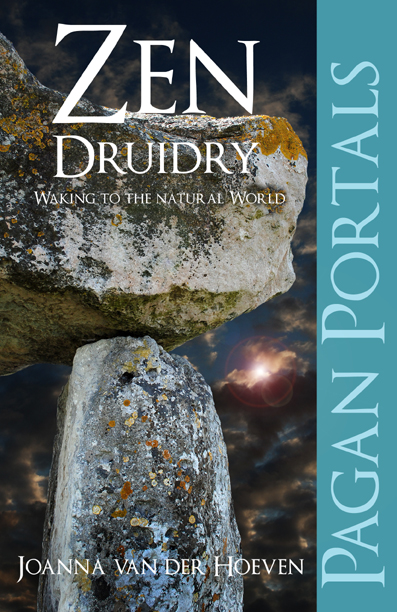
Review of Zen Druidry

zen druidry low res

Book review from the lovely Nimue Brown – order your advance copy on amazon!  “This is a fascinating book that lays out the core concepts of both Zen and Druidry, exploring the points of overlap and the ways in which these two traditions compliment each other. The writing is precise, lucid and beautifully accessible whilst managing to put across a vast amount of information in a very small space. I would say that even if you aren’t attracted to the idea of Zen, this book is still well worth your time, because of what it shows through the contrast between the two traditions. Joanna draws attention to the importance of being as present in the moment as we can be, and as open to life as possible. That’s an issue for Druids of all flavours to consider. Druidry is very much about here and now, and what we do from moment to moment, after all.

If you’ve been attracted to both traditions all along, this is, quite simply, the book you have been waiting for.

Nimue Brown”

Little Pagan Monastery

chalicwell1So, after a lot of interest in my previous Pagan Monasticism blog posts, it looks like I will be co-running a retreat weekend this winter at Chalice Well Gardens, called the Little Pagan Monastery.  The dates haven’t been confirmed yet, but we’re looking at something between October and December 2013, and then again in the summer of 2014.

The Little Pagan Monastery will give people a brief glimpse into a pagan monastic life – the weekend will be structured around daily prayers, meditations, lectures, chores around the houses and Chalice Well Gardens, as well as outings to the White Spring and Glastonbury Tor.  It will be a weekend of the contemplative life – a time to devote yourself 100% to your gods and spirituality in the tranquil setting of Chalice Well Gardens. It is open to all pagans.  Expect to rise with the dawn! We will also have out of hours access to the Chalice Well Gardens, and will end the weekend with ritual.

Prices have yet to be determined, as we need a rough estimate of numbers first.  We are aiming to keep the cost of this weekend as low as possible, to enable everyone no matter what their financial circumstances are the opportunity to dip their toes into pagan monastic life.  We’re hoping that everyone will go away nurtured by the weekend, and finding new and imaginative ways of incorporating more spirituality in their daily lives, should they so wish.

If you are interested, please email me at autumnsong@hotmail.co.uk to be put on the sign-up list.  When we have a good idea of numbers, we will then let people know the financial costs and proceed from there. Space will be very limited, so please get in touch as soon as you can to be put on the list.

We hope to see you there!

Sacred spaces, not magic circles…

Many, many teachers and authors emphasise the need for creating a circle when performing ritual, or doing inner pathworking, or meditation, and so on.  My first steps on the pagan path were Wiccan, and creating the circle is a large part of any ritual action.  I cringed, and still do, at any mention of creating a circle with salt – especially out of doors – it’s something that lacks all common sense in a nature-based spirituality; let’s protect ourselves by throwing salt down on the ground and potentially killing all nearby flora and fauna.  But I digress – the question is, how important is the creation of sacred space?

One of my patron goddesses is Nemetona, the goddess of sanctuary.  She is the representation, the embodiment of sanctuary, a place where we are held; a safe place. She is a goddess of transformation, for in a safe space we are able to explore, to try new things, to grow. Much as under our mother’s watchful eye, we can learn and develop as human beings.  However, we must also push the boundaries in order to develop – we must leave the protected and safe spaces to discover our own, to create our own.

When I perform ritual by myself, I don’t see the need to create a circle.  For me, either in my home or outside, the creation of a circle is setting a time and space outside of time and space, and this is not something I want to do. I want to be wholly in this world, grounded and interacting with it.  When performing rituals for others, I always respect their wish to create a circle if they so choose, for that is their path. For me though, it just isn’t necessary.

Inner pathworking is simply done, without the complex or simple creation of a safe place where I cannot be harmed by outside influences, or where my own energy can harm others,  for I don’t believe energy works this way.  Much like a curse, it only has an effect is the cursed believes in said curse.  I don’t believe that external energies are grasping and clawing around the edges of my circle, trying to get inside my mind as I undertake an inner journey, or that there are things crawling around the boundaries of my circle in ritual; demonic forces waiting to get in and cause havoc.  I also don’t believe that I can unwillingly send energy in ritual, thereby needing a circle to contain the energy until I so choose.  It’s something that some pagans agree with, but many do not.

In public ritual, I have also often found that the creation of the circles is merely words and actions – there isn’t any actual manipulation of energy behind it;  the circle isn’t really created, as far as I’m concerned.  Someone may walk around saying the words, then consecrating however they choose, but there is no energy in it – they are simply going through the motions. That, a circle does not make. Just walking around in a circle doesn’t create magical space unless there is sufficient intention behind it.

My home is a sanctuary.  It is a blessed and sacred space.  If I choose to do an inner pathworking there, “unguarded from external forces”, I don’t believe that they have the capability to do any harm. In fact, I don’t believe in them at all.  My home is sacred because of the way I feel about it, the way I honour the spirits of warmth and energy, of rest and play, of love and laughter that occurs within those walls.  I feel the same way about ritual outside in the wilds – the circle is unnecessary, for nature is simply nature.  Were I to work outdoors in the city, perhaps, where the human threat of physical violence must be considered, then perhaps I would create a “magic” circle. Most likely I would simply find a safer place from physical harm.

I’m currently reading a book on Druidry that does quite a bit of inner pathworking as part of the suggested work.  This book is fraught with warnings, about when something happens in your inner pathworking that you don’t like, that you don’t control – people entering, things not going according to plan.  I think that the mere suggestion of the possibility of this is leading people to self-sabotage their pathworkings – if you believe it, then chances are that the suggestion planted in the subconscious can and will emerge when we feel most vulnerable.  Suggesting that we must protect ourselves, that we are vulnerable when we perform these actions – to me this is nonsense.  If these suggestions had never even been made, then most likely “bad things” would never happen in pathworking. I have done many pathworking, and undergone hypnosis – both in classes teaching it and myself being a subject to know what it is like.  You are fully in control, as if you were not “under” hypnosis.  It is merely a state of relaxation where you can access parts of the brain that the “conscious” mind just shouts over.   I know that many would disagree with me – again I will reiterate that this is simply my personal opinion, and that others will have their own equally valid opinions.  The whole subject is subjective – and what works for you may not work for others.

I suppose sacred spaces for me are those places where there is no need, no desire to protect myself from outside influences, at least those that I believe in.  My rituals are open to the world, so that I can connect fully and wholly with the world around me.  The intention behind my rituals, behind the way that I live my life, is what matters most – and that does not include creating spheres around me for protection.  It’s all a bit Hollywood for me – I just don’t believe in it. I do, however, believe in sacred space, in the sanctuaries that we create, or that we come across – a grove in a forest, a clearing on a mountaintop, a space behind a waterfall, a corner of the bedroom – all these places that sing to our heart, these are our sacred places.  I feel no need to fence them in, in the physical or the spiritual sense.  I am a part of them, wholly influenced and touched by them when I am sharing their space and time.  It is a gift, and one that I accept wholeheartedly.

Ancestors

I’ve been thinking a lot about the ancestors lately.  When people think of the ancestors, the first thing that comes to mind is blood relatives from the past.  In Druidry, we honour our blood ancestors, but also those ancestors of tradition (those who have shared our worldviews) and of place (those who are a part of our land).  Yet it is not ancestors of the past that currently occupy my thoughts – it is ancestors of the future, those yet to come, that are my main guiding force in life.

I am childless by choice.  I will not have direct descendants, though I share my genetic makeup with the rest of my family, my nephews, cousins and more, which will be passed down through blood.  However, I will become a future ancestors of tradition as well as having future ancestors of tradition, and the same can be said for being and having future ancestors of place.  It is mostly to these ancestors yet to come, my future ancestors of all three groups, that direct the way in which I live my life.

Our ancestors of the past have helped to shape us, to make us what we are, though we are our own person and always have our own choices to make in life.  We can repeat past mistakes or we can change – it is up to us.  Our ancestors of the future do not have the luxury of choice – they are stuck with whatever it is that we provide them.  With the world being in such a mess, alongside the moments of pure beauty, I worry about what I will leave for them.

Emma Restall Orr states on her website that she endeavours to live a life of which her ancestors would be proud.  That is a beautiful and motivating sentiment – and is especially poignant for our future ancestors.  We have the option of learning from our previous ancestors to make this world a better place, in however big or small a way, for our future ancestors.  Apathy has no place in my worldview – everything we do matters.

I have made mistakes in my past. I have had glorious achievements.  I can acknowledge all of these, and today be the best person I can be, for the sake of my future ancestors of blood, tradition and place.  There is no time to wallow in guilt, or to rest on my laurels – every single deed, every single action right now will have an effect on the future.  The past is there to teach us, the future is there to direct us, and the present moment exists to capture all that we can be in this moment in time.

Heathenry, or the Northern Tradition in paganism, has a beautiful saying – “We are our deeds”.  We must live up to it.  The past is gone, the future ungraspable – so make this very moment count.  Live honourably, with awareness.  To my future ancestors, know that you are honoured.


More has been added to the Learning Druidry pages!

We’re nearly there – the seasonal work for Spring and Autumn has been added to the Learning Druidry Section, and it is just Winter and Summer to go, as well as some further continutation exercises.  I really hope that you enjoy these, should you wish to try them out – and if you do, please do let me know how you get on!

Blessings. x