When compassion is challenged…

Some people have differing opinions to ours.  That is their entitlement – we all may agree or disagree with each other, have different viewpoints and perspectives.  Only we can see the world through our own eyes, layered with our own experiences, trials and tribulations. Only we know our own story fully and completely.  No other can know us the way we know ourselves, the reasons for our actions and the choices we make.

Everyone is on their own path, fighting their own battles, making their own decisions according to the principles that they live by, the culture and society they grew up in, and their own soul’s calling.  We should never berate another for following their own path. We can certainly disagree, and stand up for what we believe in, whether that is against a political party, a company, an abusive relationship – but we must always remember that belittling someone is never the right thing to do.  People will make bad choices, people will not care about the same things that we do. However, making fun of them does not solve anything. Looking down on someone means that you have placed yourself in a position of authority or power over them – an illusory pedestal.
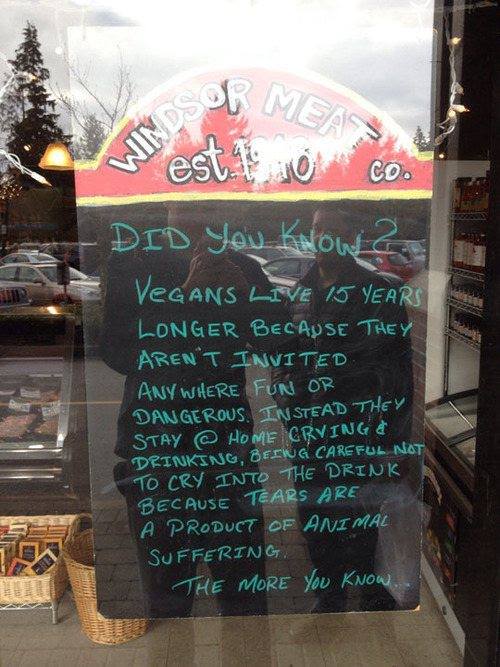
meat coThe photo here is an example of a meat company who are putting down vegans in order to gain more people to their “side”, using “humour” as a unifier against some perceived threat to their way of life. What we have to realise is that there are no sides in life – only differing choices and opinions.  There is no Us and Them – there is only the human experience.  The entire Us and Them mentality has led to the most atrocious human behaviour possible – war and genocide, murder and rape, crime and racism, just to name a few.

Those who choose to become vegan or vegetarian have their own reasons – health, weight loss, environmentalism, religion.  It is wrong to belittle someone for any of these reasons. In fact, it is wrong to belittle anyone – end of story.  I disagree with people all the time, and I know I’m not perfect, but when I catch myself belittling someone I do my best to stop it, to realise that they are on their own journey, and to have compassion for them.  I do not want to be like the person who wrote this sign. I choose to behave differently.

I chose to become vegetarian twenty years ago, and am currently in the switch to vegan. This is my personal choice, based on research and religious reasons that ring true to my own soul. This may not be the same choice for other people, and I understand that.  However, I do tire of people making fun of my choice – I have had to endure that for over twenty years.  It is inevitable at dinner parties where someone who doesn’t know you very well, and who is a self-confessed “meat lover”, will question your choice at the dinner table, confronting you on your life path when all you want to do is eat with a good conscience and enjoy your meal with your friends or family, in harmony.  The ubiquitous “screaming vegetables” always comes up, and I must explain my reasons for becoming vegetarian or remain silent. Sometimes I choose to, other times I simply let it be. For the sake of peace, I make a decision based on compassion for all those who are sharing the meal with me. I only wish certain others could do the same.

Would it be correct to challenge someone on their religion at the dinner table? I don’t think so.  What about their decision to join Amnesty International, or Greenpeace?  Would it be right to poke fun at someone because they looked different? We must appreciate each other’s diversity, and in that appreciation realise that we are all human beings on our own journeys- that unifying factor within the diversity is what compassion is all about.

looking downThat is why in response to the photo above, I am posting this other photo.  It reflects and is only my opinion, but it matters to me in my spiritual journey.  Zen Buddhism tells us to hold to our opinions lightly, and indeed I see the wisdom in this. Our opinions are always changing – we are always learning and growing.  However, we must do so with compassion and awareness of the journey of others as well, even those who challenge us and our opinions.  I must have compassion for the people who own that meat company, realising that they have their own reasons for writing this sign, however much I disagree with them. I can voice my own opinion against it with this blog, with my words, with respect and as much understanding as my situation allows.  I don’t have to think it is right. I don’t have to agree with them. But I shall not belittle them for their opinion.

Watching Parliament in full swing makes me cringe – I remember the first time I saw a “discussion” which never let the other side finish what they were saying, instead making so much noise as to drown out the current speaker’s voice in a wall of derision.  This was how our country was and is being governed. It saddened and enraged me – this so-called civilised way of government.  How much better could it be if we just took the time to listen to each other without judgement, allowing the other person their say, and respectfully choosing to disagree if it does not ring true to our souls?  If the government cannot govern their behaviour in Parliament, why should the people? I found it so saddening, and still do…

Never be afraid to speak out against what you think is wrong, or for what you believe in. However, do so with compassion, with respect. Otherwise, you are simply acting and reacting to the bad behaviour of others. Remember also that acting with compassion does not necessarily elevate you above these others – you are not “good” for acting compassionately. You are simply acting compassionately – that is all.

Live with honour and dignity. Act with love and compassion. It’s not that hard. Blessings on your journey. X

Working with Kindness

Many religions and spiritualities the world over teach that kindness and compassion is the way to live your life in order the create harmony and peace not only for yourself, but for the rest of the world.  This is a form of service, which I think may be lacking in much of modern paganism.  It is in the service to others where we truly shine.  The Sisterhood of Avalon states it beautifully in a triad – service to the self, service to the Sisterhood and service to the Goddess.  Like most things, it starts from within and then spreads to the wider community and the world at large.  Sadly, perhaps due to the growing number of self-help books and various psychologies, this service tends to stop at the self.  Instant gratification in our capitalist society combined with living in relative ease can allow complacency in our lives and in our minds.  We can become grasping even, wanting to be healed, looking for that one thing or one person who will heal us, as we have been taught my marketing campaigns the world over.  Me, me me. I, I, I.

There seems to be a great need for healing in the world today.  Paganism embraces this healing with open arms, honouring it in all its various forms.  We are often told that we must first heal ourselves before we can heal others. In this, I very much agree.  It’s often the hardest thing to heal yourself – focusing on others is much easier than coming face to face with your own pain, grief, demons or shadow self.  However, we can become too engrossed in looking inwards that we forget to look outwards as well.  Too much self-awareness and not enough external awareness.  It can even border on or become egocentric.

The key here I believe lies in kindness.  Through these last few months, when the darkness of winter takes hold and we are gifted with the time and space to reflect, we can look at how we can be kind to ourselves.  This is the best thing we can do for ourselves in terms of our own healing.  It is easier to forgive others for hurting us, or causing us stress, grief or pain than it is to forgive ourselves for doing things that we regret.  Yet we must look at ourselves in the same light as we do others and be able to forgive ourselves in order to move the service from self to others, through the act of love and kindness.  This is our service to our self.

We have to be aware of our edges – we must create boundaries so that when we allow kindness to flow through us we have an awareness that not everyone will be kind in return.  This is not a shutting down or closing off of the soul to others – it is simply being prepared.  Like meeting a strange dog or cat for the first time, we are unsure as to how they will react, and so we proceed with caution.  We still show compassion and love and try to help them should they need it in any way possible. We will also do all that we can to prevent being bitten. This is our service to others.

I have been too open – I have not guarded my boundaries as well as I should have. I have loved freely and been bitten on the ass in return.  I have learned to use boundaries to let me help myself and to help others.  In Brian Froud’s latest faery oracle card deck, there is a card that I drew called The Lady of Faith.  She wears a helmet and shoulder armour, but her breast is bare of armour and she is leaning towards something with a hand to her heart.  This card shows that we must protect ourselves but still allow our hearts to move us in kindness and compassion.

I recently saw a documentary on Phil Robertson, of Duck Dynasty fame about how he transformed his life through his religion and coming to know God and Jesus.  While we may not share the same religious points of view we can agree that it all comes down to kindness.  He described when he was making a living fishing on the river and other “river rats” would come and steal from his nets.  After he had found Jesus, he worked with the idea of kindness and so, when he caught them stealing again, offered them the fish freely.  They took it and responded to his kindness by never stealing from him again.  Phil stated that he will act towards all things with kindness, but still carry a shotgun in case all things weren’t kind to him.

This is very similar to a Zen Buddhist story, where a monk is sitting and praying in his cave high on the mountaintop. A thief comes upon him and threatens him. The monk looks at the thief and states that if he wanted his possessions so badly, feeling he had to threaten and steal them, then he would freely give them if that was his need.  The thief left bewildered and the monk sat outside, looking up at the moon.  “If only I could have given him this beautiful moon”, he said. (Some argue that the monk should have done a Phil Roberston and had a shotgun as well, but that doesn’t fit in with the peaceful and non-violent ideals that the monk held to.)

Living to our ideals, exploring our shadow aspects (those aspects of the soul that we fear, that we loathe, that we deny) and giving back to the world results naturally in leading the way to the further service to the gods.  We dedicate our lives to kindness and compassion with full awareness and in doing so, reflect the true nature of not only our being, but of being.  For me, the gods that I follow all have an aspect of peace and kindness that we can find in their stories to inspire us along our own life’s journey.  Tyr, most often seen as a god of war and justice, to me also represents kindness to animals and loyalty as when he fed the wolf, Fenris, when no one else would.  Nehelennia, the goddess of the North Sea rages and leaves us with a fresh world – sometimes battered but ever inspired by the impermanence of all things.  Morrighan heals after the battles and rejuvenates after the blood is spilled.  Nemetona teaches of boundaries as well as love and peace.  In this I have dedicated myself to learning and being open to the awen of their songs.

Through coming into our own true potential, we are better able to serve ourselves, our community and our gods.  The key to it all is through kindness.  How very simple, how often this message had been repeated over thousands of years. How easy it is to forget in today’s society.  Yet when we open ourselves to the possibilities and let kindness lead us in our actions, peace and harmony are a natural result.

Beware the Green-Eyed Monster…

Social media can be a very good thing. It’s good at getting the word out, or for sharing ideas. It can also be a place where we can feel inadequate, where jealous feelings of other’s lives can creep into our thinking and affect how we live.

First of all we must remember that what we see online is not the 100% truth.  What people post on Facebook or Twitter or any other media or forum is not the whole enchilada. We look up someone on Facebook who doesn’t post anything negative, has beautiful photos and deep insights and feel that we are inadequate in our own lives.  What we have to remember is that this is simply a portrayal of a person and not the person themselves. To know the person, we must know them in person, spend a lot of time with them and connect, soul to soul. You can’t do that on a computer in my opinion. You can find a lot of commonalities with what you both have decided to put out there, however it is not the big picture.

Jealousy is an interesting beast.  What causes it? More often than not, it is through experiences that we have gone through that reflect upon our current and future situations.  Something may have happened to us in the past, an emotional pain that casts its pall over everything.  If we are jealous of what we perceive to be someone’s great life on the internet, what is it that is making us jealous? What is causing feelings of inadequacy, or anger, or resentment? Could it be someone in your past that you didn’t live up to, or dreams that you haven’t fulfilled, failings that have been brought to light?  Do they reflect our inner demons, perhaps of low self-esteem or external validation?

Catch yourself the next time you feel jealousy creeping in. Examine it. Why are you jealous? What is the root cause? It is not the person causing the feelings but your own inner self. Why should that be? The person is not the root of the problem – what’s happening in the mind is.  We cannot blame other people’s lives for our feelings of jealousy for they all stem from within.

Wouldn’t it feel better if we let go of these jealous feelings? What if we celebrated others’ successes instead of wallowing in inadequacy? What if we realised that others’ lives are not a reflection of our own? What if we stepped outside our narrow worldview, our egocentric perspective and honoured others for being what they are? The world does not revolve around you, so why persist in these feelings?

Letting go of jealousy is hard. It requires a lot of investigation into the darker regions of the mind but it is well worth it.  We can lead happier, more satisfying and positive lives when we are aware of the green-eyed monster and lay it to rest. So, the next time you are on Facebook and think “my life sucks compared to hers/his” remember, not only are you not seeing the bigger picture; you are also not seeing your self.

Looking inwards

“Not until we are lost do we begin to understand ourselves.” -Henry David Thoreau

As I have begun my journey into the descent of both the self and the dark half of the year, thoughts and feelings have arisen which require acknowledgement. It has often been said that those thoughts that we are unaware of, control us. Quite.

Just as we are not our jobs, our familial roles or any other singular label, so too are we not our past, nor our future. We can only be our present.  All too often I have beat myself up about what I have done in the past. After a couple of months of looking inwards and discovering these thought patterns, I have realised that I have to let go of what I thought of myself in the past.

In the past I have been selfish. In the past I have done things I am not proud of. However, that does not mean that I am selfish now, or that I will do these things again, now or in the future.  What happened does not define me in the present moment so much as inform me of how I got here. I am only the person I am now, typing up this blog post trying to make sense of the self and how it works.

It is a season for letting go and so, every time I have a thought on how I have failed, I remind myself that this was something that happened in the past and, in truth, is not who I am now. It is extremely liberating, and enables me to be the best person I can be right now, as opposed to living in destructive and judgemental behaviour about what I have done.  I can certainly be critical of things, looking at them with detachment and learning from it, however no condemnation can be made because it no longer exists.  Often in Zen we hear of teachers asking students who bring up past faults and issues “Yes, but where is this now?”  Baffled, the student cannot answer, for it does not exist in the present moment. They are memories and lessons learned. They existed in the past. They inform us of the future.

Sometimes the best thing to do is to lose that sense of self in order to be able to look inwards critically.  Putting aside the ego and simply seeing thoughts for what they are is extremely difficult. The ego jostles for attention at any possible chance, with thoughts of “I am this” or comparisons to other people, opinions on the world at large and a deep-seated fear of annihilation. When we put all these aside we are simply left with our own personal truth.

Why should the Gods care?

Do the Gods care?  I’m not so sure.

In my own experience, I know that the wild gods especially, those of heath and forest, of the seas and wind, of storm and sunshine, do not care about what happens to humanity.  They simply follow their nature, their path.  In my perception, the universe does not care.  I remember in Pirates of the Caribbean, when the goddess of the sea, Calypso, was asked why she had a change of heart about a man that she once loved, simply stated in that slow, West Indes drawl: “It is my nature”.  They may interact with us, but do they have our best interests at heart? Some may, but some may not.  Some may not even acknowledge us – the hurricane passes through despite our pleas, following its own song of wind and water, doing what is in its nature to do.  The sun shines down relentlessly on the crops, burning the fields or ripening the wheat dependent upon other weather conditions during the season.  Our best interests are not on their agenda.

And why should they be?  It is the human fallacy, that mindset of us being the centre of the universe?  Why should we be the recipients of all that we perceive to be good in the world, and why do we rail against the perceived tragedy? Yes, an earthquake is devastating, and can kill thousands of people, causing pain and anguish among humanity, and all other creatures that suffer from its effects.  But the earthquake is not at fault (pardon the pun) – that is the nature of the earthquake.  It will not seek out a place where it can cause the least destruction, nor vice versa – it happens where it needs to happen, where the elements dictate it should be, where the song takes it.  It does not consider the repercussions it will have on anything.

These wild gods are of a totally different consciousness to us, and it can be damned hard to relate to. That is why we often anthropomorphise them, in order to be able to relate.  It is easier to talk to a god of thunder, who struts around wielding a great hammer against giants than it is to talk to a thundercloud, or the lightning.  These gods, who we have given human form – do they care for us?

By giving them some sort of humanity, we automatically assume that they should. After all, they look like us, talk like us, have adventures that we can relate to.  We have created these wonderful stories about them.  We care for them, we devote ourselves to them – should they not do the same?

This can often be the falling down point in relationships with the gods for many people.  I have known people who have abandoned the gods, because they have lost loved ones, or had other trauma in their lives that the gods did not intercede in.  My question would be – why should they intercede?  At the moment, I have a very ill cat, who is not responding to medication.  I have prayed to Bridget for healing strength to help her get over the illness, and to give us all strength and knowledge of the illness so that we may better cope with it.  So far the results of the prayers have not been successful – should I therefore abandon all relationship with Bridget? It I did, then I would be assuming that the gods are “on call” for us, for our whims and demands and pleas for help.

They are not.

I have relationships with several gods, to help me understand them, and the ways of the world a little better, but I know that I am not special; that should I receive healing energy from Bridget it would not be because she is granting me a favour, or a gift.  What I hope to achieve through my relationship with her is a better understanding of the bigger picture in life, beyond my own mortal limitations in order to better my own situation.

I don’t think Bridget really cares whether or not my cat lives or dies.  She may, however, help me to understand the illness better, to help me find the inspiration and strength to continue through my relationship with her. Sometimes just talking to someone about it helps, even if you cannot see them.  Like the Catholic confession, simply talking to someone can sometimes clarify things in your own mind.  The priest taking the confession will give advice, tell you how many Hail Marys or acts of contrition you must do to absolve you of the sin that you committed – but the priest does not care, per se – they are simply acting on behalf of what they believe their god would like their followers to do.

Does this leave me feeling a bit lonely, a bit unwanted and left out because my gods do not care about me?  Not really.  My gods teach me how to cope with the world – Nemetona teaches me about sanctuary and sacred space, where I can in myself learn about finding those places where I can be free. She does not grant them to me, but shows me how to find them through her and through my own practice.  Similarly, Frigge does not care for me in any motherly or matronly sort of way, nor Freya – what they do is provide me with inspiration to keep my household in good order, or to talk through relationship issues.  They are not Dial-A-Gods with whom to pray to for help with this or that; through our ongoing relationship with them we begin to see how we can find the awen in their stories and weave that into our own lives.

Sometimes it may feel like our pleas are heard – that someone receives a miraculous recovery, or the tidal wave does not reach the shore. However, I would posit that this has nothing to do with us personally.  The infection may go away because of the mindset and resulting physiological effects this has on a person who knows that others are praying for them, or who have made them a special amulet.  Does this have anything to do with directed energy from the gods themselves? I’m not so sure – I think it has more to do with the inspiration these gods have given humanity to fix it, or try to fix it, themselves.  I could, of course, be totally wrong.

The fact that the gods don’t care does not affect my relationship with them. The tree at the bottom of my garden does not care whether I live or die, neither do the horses in the field, the frogs in the pond, the throngs of humanity who have no knowledge that I even exist.  Does this mean that I should not love them? I don’t think so.

Right Livelihood

autumn leavesDuring the time around the autumn equinox, in my particular path of blending Zen and Druidry I focus on the Buddhist aspects of Right Livelihood within a Druid context.  I do this throughout the year, blending the Buddhist Eightfold Path into the eight seasons of modern Paganism, and have found it spiritually inspiring and enlightening. (For further reading into Zen Druidry, please see my latest book, Zen Druidry, available on Amazon and through Moon Books).

Right Livelihood, in essence, means taking on a way of living and working that does not compromise the other principles within the eightfold path, or indeed any of the Dharma Principles. However, it is much more than ensuring that your occupation is not harmful to others – for me, this accords to everything I do, my entire life.  My livelihood is not just my office job, or my dance company, my writing or my work as a Druid priest. My livelihood is the way in which I live my life – my whole Druidry as a way of living, not just as a practice.

I have ensured that the traditional view of Right Livelihood is upheld in my life – all my jobs do not create harm in others, abuse others or the environment inasmuch as is humanly possible.  Yes, three out of my four jobs require that I drive a car, and that is a compromise that I have to make, which I try to offset in other areas of my life.  I used to work as a legal secretary, but was slowly having my soul destroyed by helping the rich dodge inheritance taxes.  It took the universe to give me a great kick up the bum to get out of that job and dive into something more meaningful for my own self – other similar legal jobs may work for some people, it just wasn’t in accordance with Right Livelihood for me personally.  I quit, went back to university and got a job straight away working for a music company and charity, got writing again, started a dance company and began in my priest work.  I felt much more at ease with myself, knowing that I was partaking in Right Livelihood (or Livelihoods!).

Some of us may feel trapped in jobs that we do not like, but we need the money to support our families, or ourselves.  However, that doesn’t mean that we cannot be on the lookout for something that would sit better within our hearts and souls, and it also doesn’t mean that we can’t offshoot this, say perhaps by doing some volunteer work, donating to charity, etc.  I personally don’t have much spare time, but the time that I do have I try to use wisely – though this year I haven’t succeeded as well as I may have, having run myself a little too ragged.  Organising charity events, performing wedding ceremonies, on top of my other jobs left too little time for me and my husband, and in that regard I failed at Right Livelihood, as there was harm and neglect on that front.  I have worked too hard, and now physically and emotionally see the repercussions. Now, in the autumn of the year, when I can see the results of what I have sown in the springtime of the year, I can also reflect on how to do better next year.

Right Livelihood means living right – it’s not just your job.  For me, within Druidry, it means establishing a life that has as little impact ecologically as is possible at the time for me and my family.  It means investing our savings in solar panels, recycling and composting everything, using cruelty and chemical-free toiletries, working towards creating peace and inspiring others.  It means walking the walk instead of just talking the talk.  It’s bloody hard to do. It means being aware of everything around you, of the impact that you have on the world, from the interaction I have with my co-workers to how many kilowatt hours our household has consumed in the last year.  It means sacrificing ignorance for knowledge, and the practical application of such.

Druidry teaches us about creating honourable relationships with the world around us, with all things if you are an animist like myself. Seeing the inherent value in all things means that no single thing can be taken for granted.  Incorporating Zen means bringing awareness of my own self and how my brain works, as well as working on an awareness of the world at large by living as mindfully as is possible.  Sometimes I am hugely successful at both – other times I fail spectacularly.  At any rate, it’s a learning curve.

Throughout the darkening days until Samhain, my focus on Right Livelihood is a constant reminder to live well.  Taking inspiration from nature, I learn not to take more than is necessary, or at least I am inspired not to – succeeding in this regard is damned hard in a fairly affluent Western society.  I breathe into the growing twilight, the longer nights and learn how to simply be in the world, leaving behind barriers of separation as much as I can, within myself and nature, humanity and the universe.  The rich scents of autumn tingle in my nose, the decaying leaf mould and woodsmoke, the chill winds and starry skies above inspiring me to continue. It is  Inspiring me to create a life that is worthwhile, and in doing so, following a path of Right Livelihood.

Honour in Druidry

The gods in Druidry, for those Druids who believe in the gods, are vast.  They may be ancestral deities out of myth and legend, the stories of the people from an area that may be carried through time, over oceans and continents and held within the blood of the tribe. They may be gods of wind and rain, of thunder and sunshine and the growing of crops.  They may be from a pantheon of gods local to the area, or from thousands of miles away.  With such a diverse range of gods, and what it is to be a god in Druidry, how can we celebrate together, or even separately as a tradition under the single banner of Druidry?

I purport that it is with honour that we acknowledge the similarities and differences within the tradition, that which is holding it all together. But what then is honour?

As a noun, honour has several meanings*:

1.            personal integrity; allegiance to moral principles

2.            a. fame or glory

b. a person or thing that wins this for another: he is an honour to the school

3.            ( often plural ) great respect, regard, esteem, etc, or an outward sign of this

4.            ( often plural ) high or noble rank

5.            a privilege or pleasure: it is an honour to serve you

Let’s being with number one – personal integrity and allegiance to moral principles.  Within Druidry, it is widely understood that one does not need to have gods in order to have a moral and ethical code.  Druids take their inspiration from the natural world around them, and whether or not they see certain aspects of nature as deity is irrelevant – it is quite possible to be an ethical Druid, or an ethical anything, without a belief in god.  What is most meaningful in this, however, is maintaining your personal integrity, your moral principles, without trampling over those of others. So, while an atheist Druid might disagree with a Pagan Druid on the existence of gods, having personal integrity means that you don’t stomp all over someone else’s belief, or lack of belief.

Number two, fame or glory, is an odd wording in my opinion – I would classify it more as an asset rather than fame or glory.  However, in Celtic and indeed in religions the world over, one’s  reputation is of utmost importance, and perhaps in this context it would work.  By walking our walk, instead of just talking out talk, in Druidry we know that honour means accepting the diversity of nature, and human nature, which includes religion and philosophy.  What we need to also acknowledge are the assets of others, famous or not.  A Druid quietly standing by a fracking site in peaceful protest is just as important as a well-reknowned poet, or author, or activist Druid that is more publicly known.  It also implies that those in supposed positions of power should think more on the repercussions of their actions, and how they conduct themselves publicly, though I would like to say that this should apply to each and every individual on the planet.

Great respect, regard and self-esteem tends to overlap with my points for number two, especially with regards to walking our walk.

Number four doesn’t really apply to Druidry, but in our own human nature and society, we still often revert to ranking systems in order to classify people, much as some of us absolutely hate it. We have Chief Executives in companies, and High Judges in the legal system.  We have so-called and often self-styled Arch Druids and High Priests and Priestesses in some Pagan traditions.  Often there is debate in Druidry over who is even entitled to call themselves a Druid, some believing that this is only an accolade offered to those who have studied for a certain length of time.  I personally don’t subscribe to this notion, but there are many who do, who state that one can follow the path of Druidry, without being a Druid per se.  This often follows a set of grades that those who follow Druidry study, being that of Bard, Ovate and Druid. It is sometimes, in error, also seen as hierarchal grades in which to achieve status.  After spending many years in primary and secondary school systems and indeed, in many other aspects of our society, you can see how many come to this conclusion – you need to get this grade in order to progress to this grade, etc.  However, in Druidry many Druids (and note that here I mean all those who follow the path of Druidry) don’t give a tinker’s dam about rank, and treat everyone equally.  This again has its roots in honour, and in honouring someone for who they are innately, as opposed to honouring a rank.

Number five, a privilege or pleasure, is a most interesting description. In my Druidry, serving the gods and the community ranks highly.  Indeed, it is an honour to call oneself a Druid, as it is an honour to serve that which inspires me – nature.  It is also an honour to share that inspiration with the community, with a deep respect for the tradition and for each other.

Honour is also a verb – and again there are many descriptions:

* to hold in respect or esteem

* to show courteous behaviour towards

* to worship

* to confer a distinction upon

* to accept and then pay when due (a cheque, draft, etc)

* to keep (one’s promise); fulfil (a previous agreement)

* to bow or curtsy to (one’s dancing partner)

Again, many of these overlap with the noun descriptives. However, there are some that hold a particular resonance with me, and are perhaps more poignant as a verb than as a noun.  To show courteous behaviour towards another is quite important, as a) it is just a nicer way to deal with the world at large, and b) it implies a certain respect for other souls who are sharing this planet with us, whether they are human or non-human.  I show equal courteous behaviour to a tree as I would a relative, or a person on the bus – in my mind they are all souls sharing this journey of life. Whilst I maintain boundaries in dealing with people, and indeed, those who refuse act with similar courtesy are then relegated to the outer bounds of my interaction, there is still a basic understanding of human and non-human functioning and a shared existence.

Equating the word honour with the word worship is quite a tricky one. Many atheists would balk at it, with good cause.  Many Druids, even those who have a relationship with the gods do not like the term “worship”, as it implies a subservience, at least in today’s society.  Its roots in Old English stem from weorthscipe, the worth of something to the person.  This perhaps is more meaningful. The gods are worthy of my praise, of my attention, and so I worship deity.  This is not however, universally held within the tradition, and can cause problems, most of which are linguistically based.

So, when dealing with the concept of honour, we begin to see how this can create a cohesive bonding in such a varied landscape of paths that all fall under the banner of Druidry.  For many, it also comes down to an awareness of the spirit of everything – each thing’s own inherent consciousness, and each thing’s own inherent value, often known as animism.  When we realise the worth of something, and not in a financial or in a resource sort of way, but its own inherent worth, we then act with honour in our relationship to it.  So, a political Druid who often gets media attention through their behaviour and who you often may roll your eyes at, has his or her own inherent worth.  A wasp that is trying to get in your nice cold pint of beer has its own inherent worth.  Even the troll who is trying to get a rise out of you on an internet social media forum has its own inherent worth.

In seeing the inherent worth in everything, something even more accepting than tolerance is gained – it is more akin perhaps to an immersion with everything around you, rather than a passive acceptance.  The acknowledgement is participatory, instead of passive.  Druids, when celebrating together, can acknowledge the beauty and diversity, rather than simply tolerate each other’s beliefs.  It is much more meaningful that way, much more poignant.  Nature does not tolerate diversity, nature IS diversity.

Therefore, Druids too are diversity.

*taken from dictionary.com


Zen Druidry at No. 10!

My little book, Zen Druidry is currently at No. 10 on Amazon’s Best Selling list for Pagan and Neo-Pagan books.

I would like to take this opportunity to thank everyone for their support, and for the encouragement of the community – without you there would be no book! A big thank you to my publishers, Moon Books, and to my editor, Trevor Greenfield, who believed in the success of this book, even where I was a little unsure!

Thank you, thank you, thank you.

J.x

P.S. As of this afternoon, it has reached No.4!

Being Pagan

Sometimes being a Pagan is simply not fun.

In my path of Druidry, I have to consider the ramifications of every action that I take, in order to maintain honourable relationship with the world around me.  I gave up eating meat nearly twenty years ago. I have since given up dairy altogether.  I recycle everything I can, even though that can be time-consuming and tedious.  I’m spending thousands of pounds on solar panels for my home instead of putting it into a personal savings account.  Every day I make choices based on my spiritual and ethical practice, most of which are “not fun”.

We as humans have been altogether far too selfish. Our endless consuming of resources, without thought for future generations, demonstrates this.  We as humans have the capacity for forethought, and yet we still destroy the planet, our future and the future of our ancestors yet to come.  The world population has doubled in the last 50 years, yet people are still having children, or visiting fertility clinics when there are millions of children already born who need good homes.  We believe in an economy that only works when it keeps growing, when we keep spending to keep this mythical beast alive, feeding it with our hard-earned cash.  We invest in nuclear and chemical weapons, sometimes unknowingly, through the banks we put our money in.  We take, take and take, and virtually give nothing back.

It’s easy to dismiss those people who take a stand for what they believe in, who care for the environment, for whom their religion would not allow them to do otherwise.  Call them overly dramatic, call them attention seekers, call them hippies, fluffy bunny new-agers, or just plain crazy.  De-humanize them, for it is easier to control them and dismiss their arguments then.  Their feelings don’t matter – they’re all just fluff and air.  We need to get on with having our fun, for crying out loud, and not listen to these whingers.

I have been called all these things.  I defy them all, and stand proud in my convictions.  I make my choices based on generations of humans and non-humans yet to come, not out of selfish greed.  I will take a stand against destruction of bluebell woods.  I will protest fracking.  I will sign any petition Greenpeace throw my way.  I will feed the badgers in my backyard and pray for their counterparts in the culling areas, and I will continue to write to MPs to ask them to stop.  I will eat as organically and as locally as I can.

This may mean that I have to give up a hobby with a certain company rather than see the destruction of a single plant, or give up a weekend away with my husband to go to a rally.  My internet time of looking at cute kittens will be limited.  My evenings will be spent ensuring the welfare of my animal cousins.  My food may not be as easy to get, or as accessible (being seasonal and all), but dammit – I don’t care.  This is my life, and this is how I am going to live it.

My Paganism is not limited to circles glowing in the candlelight, the swirls of incense drifting about my upraised arms as I pray to my Goddess.  My religion is in my every action in life.  It is not mystical in the least – it is real, it is practical and it is me.  Whether I am in my ceremonial robes or my pyjamas, my work is important, my connection to the world and my relationship with everything in it equally valid whether I’m waving a wand or not. I may stand at the clifftop and shout my thanks to the ancestors across the sea, or I may sit in the conservatory and stroke my kitty in the growing twilight.  Either act is an act of devotion, of dedication to the present moment, to this world, this time and this place.

I cannot leave my Paganism, my Druidry behind.  It is me.  It is my life.  Others may try to dismiss it, but with love and compassion for all things, I hear their words, and I smile, letting them know that I’ve heard them, and then get on with what needs to be done to spread peace, harmony and love in this world.

I stand proud in the starlight, gazing out at the Milky Way and knowing where my place is within that great spiral dance.


Four Mantras for Good Relationship

Vietnemese Zen Buddhist monk, Thich Nhat Hanh recently spoke in a live webstream from Plum Village (the community he set up in France) about many things, one of which really struck a chord with me about relationships.  He has produced four mantras which help us to learn compassion for each other, and to better open up lines of communication, which is key to any relationship. The four mantras are:

  • Darling, I’m here for you.
  • Darling, I know you are there…and I’m so happy you are there.
  • Darling, I know you suffer…that is why I am here for you.
  • Darling, I suffer – I am trying my best to practice. Please help me.

The first mantra, “Darling, I’m here for you” demonstrates that the other is not alone in this world. Indeed, we are never alone – the idea of being alone is one that has hounded us ever since we made the mind/body disconnection.  The rationalists and the materialists have argued this one thoroughly, so I won’t go into it here, but suffice it to say that within most branches of paganism, the mind are body are thought of as connected.  That being said, through our bodies we are all connected to every other thing on this planet – we contain minerals in our blood that are found in stars, we breathe the air our ancestors breathed, we are all held down by gravity.  There can be no separation in the truest sense.  Our current lives lead us to believe that there is separation – could this simply be a marketing ploy, to divide and conquer?  Something to think about later… but I digress.  When we say “Darling, I’m here for you” we are putting the needs of another ahead of our own, as well as showing them that they are not alone.  In today’s society, that can be and is a great gift that we can give to others.

The second mantra, “Darling, I know you are there, and I am so happy you are there” shows us the joy that others give us, simply by sharing this journey is life.  It is a simple recognition of another soul, which again in today’s society can be so lacking. We lead such virtual and busy lives that speaking these words can reconnect us to the one that means so much to us.  We take so many things for granted, and we should never, ever take our loved ones for granted.  We must remind ourselves each and every day how wonderful it is to have these people in our lives. Allowing ourselves to feel the joy in having someone in our life is another gift, and when we express that joy, that joy spreads throughout the world.

The third mantra, “Darling, I know you suffer, that is why I am here for you” enables us to feel compassion for others in our lives, to show them that we see that they suffer.  So often people feel that they are suffering alone, and when we acknowledge the suffering of others, we immediately have more compassion for them, whether they are our loved ones or not. Everyone is fighting their own battles.  This changes not only our worldview, but changes the perception of those whom we are trying to connect to. Simply listening to someone, truly listening to them, is a great aspect of this mantra.  So often we are not listened to – we are often heard, but is anyone really listening? To give your full heart and attention when someone is trying to connect with you, or vice versa, is key to any relationship.

The fourth mantra, “Darling, I suffer – I am trying my best to practice. Please help me” is perhaps the hardest one to fulfil.  So often our egos get in the way that we simply cannot ask for help, let alone allow others to see our suffering.  How many times have you “suffered in silence”? Why do we do this?  Sometimes, when a loved one has upset us, and then they ask us “What is wrong?” our immediate response is “Nothing,” filled with anger, fear and tension.  They know that something is wrong, but we refuse to tell them in an attempt to punish them for hurting us.  If we allow that hurt to express itself, it will not linger and communication can open up in order to find a resolution.  If we simply answered the question, without judgement or anger, we might be able to see the other side.  We must admit to others that they have upset us, and we must do our best not to let our anger get control. We feel our anger, but we do not attach to it. By not attaching to it, we can talk about it with greater compassion and find greater healing.  We do our best to practice.  When we ask for help, we are putting aside our egos and allowing that other person in.  It’s not easy, but it does change everything. So often our anger is based on a misperception, and allowing the room for that perception to be corrected gives us greater scope for compassion in the world today.

These four mantras are changing the way that I relate to others, I feel in a truly positive and beneficial way for everyone.  For that, I am truly thankful!