When compassion is challenged…

Some people have differing opinions to ours.  That is their entitlement – we all may agree or disagree with each other, have different viewpoints and perspectives.  Only we can see the world through our own eyes, layered with our own experiences, trials and tribulations. Only we know our own story fully and completely.  No other can know us the way we know ourselves, the reasons for our actions and the choices we make.

Everyone is on their own path, fighting their own battles, making their own decisions according to the principles that they live by, the culture and society they grew up in, and their own soul’s calling.  We should never berate another for following their own path. We can certainly disagree, and stand up for what we believe in, whether that is against a political party, a company, an abusive relationship – but we must always remember that belittling someone is never the right thing to do.  People will make bad choices, people will not care about the same things that we do. However, making fun of them does not solve anything. Looking down on someone means that you have placed yourself in a position of authority or power over them – an illusory pedestal.
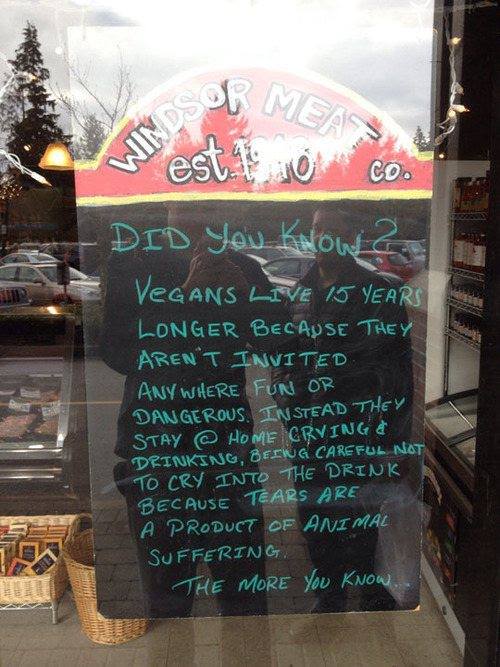
meat coThe photo here is an example of a meat company who are putting down vegans in order to gain more people to their “side”, using “humour” as a unifier against some perceived threat to their way of life. What we have to realise is that there are no sides in life – only differing choices and opinions.  There is no Us and Them – there is only the human experience.  The entire Us and Them mentality has led to the most atrocious human behaviour possible – war and genocide, murder and rape, crime and racism, just to name a few.

Those who choose to become vegan or vegetarian have their own reasons – health, weight loss, environmentalism, religion.  It is wrong to belittle someone for any of these reasons. In fact, it is wrong to belittle anyone – end of story.  I disagree with people all the time, and I know I’m not perfect, but when I catch myself belittling someone I do my best to stop it, to realise that they are on their own journey, and to have compassion for them.  I do not want to be like the person who wrote this sign. I choose to behave differently.

I chose to become vegetarian twenty years ago, and am currently in the switch to vegan. This is my personal choice, based on research and religious reasons that ring true to my own soul. This may not be the same choice for other people, and I understand that.  However, I do tire of people making fun of my choice – I have had to endure that for over twenty years.  It is inevitable at dinner parties where someone who doesn’t know you very well, and who is a self-confessed “meat lover”, will question your choice at the dinner table, confronting you on your life path when all you want to do is eat with a good conscience and enjoy your meal with your friends or family, in harmony.  The ubiquitous “screaming vegetables” always comes up, and I must explain my reasons for becoming vegetarian or remain silent. Sometimes I choose to, other times I simply let it be. For the sake of peace, I make a decision based on compassion for all those who are sharing the meal with me. I only wish certain others could do the same.

Would it be correct to challenge someone on their religion at the dinner table? I don’t think so.  What about their decision to join Amnesty International, or Greenpeace?  Would it be right to poke fun at someone because they looked different? We must appreciate each other’s diversity, and in that appreciation realise that we are all human beings on our own journeys- that unifying factor within the diversity is what compassion is all about.

looking downThat is why in response to the photo above, I am posting this other photo.  It reflects and is only my opinion, but it matters to me in my spiritual journey.  Zen Buddhism tells us to hold to our opinions lightly, and indeed I see the wisdom in this. Our opinions are always changing – we are always learning and growing.  However, we must do so with compassion and awareness of the journey of others as well, even those who challenge us and our opinions.  I must have compassion for the people who own that meat company, realising that they have their own reasons for writing this sign, however much I disagree with them. I can voice my own opinion against it with this blog, with my words, with respect and as much understanding as my situation allows.  I don’t have to think it is right. I don’t have to agree with them. But I shall not belittle them for their opinion.

Watching Parliament in full swing makes me cringe – I remember the first time I saw a “discussion” which never let the other side finish what they were saying, instead making so much noise as to drown out the current speaker’s voice in a wall of derision.  This was how our country was and is being governed. It saddened and enraged me – this so-called civilised way of government.  How much better could it be if we just took the time to listen to each other without judgement, allowing the other person their say, and respectfully choosing to disagree if it does not ring true to our souls?  If the government cannot govern their behaviour in Parliament, why should the people? I found it so saddening, and still do…

Never be afraid to speak out against what you think is wrong, or for what you believe in. However, do so with compassion, with respect. Otherwise, you are simply acting and reacting to the bad behaviour of others. Remember also that acting with compassion does not necessarily elevate you above these others – you are not “good” for acting compassionately. You are simply acting compassionately – that is all.

Live with honour and dignity. Act with love and compassion. It’s not that hard. Blessings on your journey. X

Working with Kindness

Many religions and spiritualities the world over teach that kindness and compassion is the way to live your life in order the create harmony and peace not only for yourself, but for the rest of the world.  This is a form of service, which I think may be lacking in much of modern paganism.  It is in the service to others where we truly shine.  The Sisterhood of Avalon states it beautifully in a triad – service to the self, service to the Sisterhood and service to the Goddess.  Like most things, it starts from within and then spreads to the wider community and the world at large.  Sadly, perhaps due to the growing number of self-help books and various psychologies, this service tends to stop at the self.  Instant gratification in our capitalist society combined with living in relative ease can allow complacency in our lives and in our minds.  We can become grasping even, wanting to be healed, looking for that one thing or one person who will heal us, as we have been taught my marketing campaigns the world over.  Me, me me. I, I, I.

There seems to be a great need for healing in the world today.  Paganism embraces this healing with open arms, honouring it in all its various forms.  We are often told that we must first heal ourselves before we can heal others. In this, I very much agree.  It’s often the hardest thing to heal yourself – focusing on others is much easier than coming face to face with your own pain, grief, demons or shadow self.  However, we can become too engrossed in looking inwards that we forget to look outwards as well.  Too much self-awareness and not enough external awareness.  It can even border on or become egocentric.

The key here I believe lies in kindness.  Through these last few months, when the darkness of winter takes hold and we are gifted with the time and space to reflect, we can look at how we can be kind to ourselves.  This is the best thing we can do for ourselves in terms of our own healing.  It is easier to forgive others for hurting us, or causing us stress, grief or pain than it is to forgive ourselves for doing things that we regret.  Yet we must look at ourselves in the same light as we do others and be able to forgive ourselves in order to move the service from self to others, through the act of love and kindness.  This is our service to our self.

We have to be aware of our edges – we must create boundaries so that when we allow kindness to flow through us we have an awareness that not everyone will be kind in return.  This is not a shutting down or closing off of the soul to others – it is simply being prepared.  Like meeting a strange dog or cat for the first time, we are unsure as to how they will react, and so we proceed with caution.  We still show compassion and love and try to help them should they need it in any way possible. We will also do all that we can to prevent being bitten. This is our service to others.

I have been too open – I have not guarded my boundaries as well as I should have. I have loved freely and been bitten on the ass in return.  I have learned to use boundaries to let me help myself and to help others.  In Brian Froud’s latest faery oracle card deck, there is a card that I drew called The Lady of Faith.  She wears a helmet and shoulder armour, but her breast is bare of armour and she is leaning towards something with a hand to her heart.  This card shows that we must protect ourselves but still allow our hearts to move us in kindness and compassion.

I recently saw a documentary on Phil Robertson, of Duck Dynasty fame about how he transformed his life through his religion and coming to know God and Jesus.  While we may not share the same religious points of view we can agree that it all comes down to kindness.  He described when he was making a living fishing on the river and other “river rats” would come and steal from his nets.  After he had found Jesus, he worked with the idea of kindness and so, when he caught them stealing again, offered them the fish freely.  They took it and responded to his kindness by never stealing from him again.  Phil stated that he will act towards all things with kindness, but still carry a shotgun in case all things weren’t kind to him.

This is very similar to a Zen Buddhist story, where a monk is sitting and praying in his cave high on the mountaintop. A thief comes upon him and threatens him. The monk looks at the thief and states that if he wanted his possessions so badly, feeling he had to threaten and steal them, then he would freely give them if that was his need.  The thief left bewildered and the monk sat outside, looking up at the moon.  “If only I could have given him this beautiful moon”, he said. (Some argue that the monk should have done a Phil Roberston and had a shotgun as well, but that doesn’t fit in with the peaceful and non-violent ideals that the monk held to.)

Living to our ideals, exploring our shadow aspects (those aspects of the soul that we fear, that we loathe, that we deny) and giving back to the world results naturally in leading the way to the further service to the gods.  We dedicate our lives to kindness and compassion with full awareness and in doing so, reflect the true nature of not only our being, but of being.  For me, the gods that I follow all have an aspect of peace and kindness that we can find in their stories to inspire us along our own life’s journey.  Tyr, most often seen as a god of war and justice, to me also represents kindness to animals and loyalty as when he fed the wolf, Fenris, when no one else would.  Nehelennia, the goddess of the North Sea rages and leaves us with a fresh world – sometimes battered but ever inspired by the impermanence of all things.  Morrighan heals after the battles and rejuvenates after the blood is spilled.  Nemetona teaches of boundaries as well as love and peace.  In this I have dedicated myself to learning and being open to the awen of their songs.

Through coming into our own true potential, we are better able to serve ourselves, our community and our gods.  The key to it all is through kindness.  How very simple, how often this message had been repeated over thousands of years. How easy it is to forget in today’s society.  Yet when we open ourselves to the possibilities and let kindness lead us in our actions, peace and harmony are a natural result.

Reblog – How Druidry Relates to the Environment

This is a reblog from my latest offering for this month’s Moon Books’ Blog – please note that in my opening sentence, I say “perhaps” with regard to Druidry taking the environment into deep consideration in the spirituality.  I am aware that those of other faiths hold it as dear as I do, but I am speaking from what I have seen and experienced within the pagan community in general…  For me as it is for many, many Druids, the environment is at the heart of everything that we do.

This article first appeared on The Druid Network’s website which I submitted few years ago.  The website is currently undergoing an overhaul, but there are still many articles on there to inspire! http://druidnetwork.org/what-is-druidry/ethical-living/environmental-awareness/environmental-articles/

Awen blessings!

Druidry, perhaps more than any other strand of Paganism in the wide weave of spiritual traditions, takes the environment into consideration on so many levels.  Druidry – most commonly believed to be from the old Irish words dru and wid meaning “oak knower”, or even the  Proto-European deru and  weid “oak-seeker” acknowledges this communion with nature in the very roots (pardon the pun) of the word.  Heathenry – one from the heaths, or Wicca (most commonly believed to be from the Saxon wicce, to bend or shape, as a willow branch can be bent or shaped into something quite beautiful) have similar nature-orientated origins, however, the communication between the natural environment and the Druid of utmost importance in the path.

How do Druids view their environment?  Many, if not most Druids are animistic, believing in the essential spirit of everything, whether it be rock or tree, raindrop, beetle, horse or the sea.  There is a sense of consciousness in everything.  When I use the word consciousness, I don’t mean in the scientific sense of the last two centuries, where it was used to differentiate between humans and other animals and also “non-sentient” beings.  Consciousness, to me, is a part of the greater whole web of life, where threads are woven together, separate but still connected.  It is what makes something what it is – whether it is the rose, a cloud or the moon.  It is its own inherent identity, or, more poetically, its own song that makes it what it is.

With that sense of consciousness in all things, it is much harder for the Druid to disregard any aspect of the environment.  No longer are wildflowers plucked for their beauty, to die within days on our dining room table.  No longer is it an option to squash the spider in the living room who seeking warmth from the coming winter. Our entire perception is changed once we view the environment both as having its own consciousness and as we do so conscientiously.  We gain both a greater and broader view of the web of existence, at the same time as finding our own place within it.  How wonderful is that?

That world view brings with it a responsibility.  No longer are we allowed to remain ignorant in the ways of our own environment. If we are to view it as a whole, then we must truly see every part that we also play within it.  If the whole of nature has a spirit, then issues arise such as the taking of a life for food.  Many within Druidry are vegetarian, if not vegan, and yet there are still many others who eat the flesh of an animal. Some do so, claiming that ethically raised and slaughtered animals for food are perfectly acceptable to put on our plates. In my own vision of Druidry, the damage caused to the environment by the raising of animals for food does not allow that luxury of thinking.  It takes much more energy and resources to raise animals for food than it does to plant in the same amount of land a sustainable, organic crop for food.  In giving up animal meat and animal products for both food and other commodities, we are caring more for our environment and also, at the same time, sacrificing our ignorance of the weighty issues behind such matters to become fully aware.  We must accept responsibility for our part.

The word environment has many meanings, however. Our immediate response to the word is the natural environment – nature.  There are many other environments, however – little worlds created by human consciousness. We have our work environment, our home environment, our villages, communities and cities.  There is the issue of human to human interaction as well as interaction with nature (though as humans are a part of nature, I realise that I am contradicting myself in some ways, but please bear with me).  Our own sense of self, or self-awareness, creates a thorny path through which we must navigate carefully, in order not to injure ourselves or others.  Unless one lives as a  hermit, the Druid will have interaction with other human beings, some Druids, some not.  As with the Druid relationship with nature, sensing the inherent consciousness within it, Druidry teaches us that same sense of consciousness in human interactions.  I admit – it is a lot easier for some people to respect an old oak tree than most human beings, however to be fully aware of our relationship with others we must act with a certain sense of honour, that same sense of honour, in fact, that we give to nature. We may not like some human beings, much in the same way we may not like broccoli, but we still acknowledge and respect their place in the wider web.

So how do we relate to our environment?  Within Druidry, there is a beautiful Welsh word, awen.  Various meanings range from flowing water to divine inspiration.  I prefer the inspirational route, however, this is not an “out of the blue” inspirational experience, but one that is crafted through time and dedication to one’s environment to develop a rapport with both nature and inspiration itself, until they both work hand in hand.  To the Druid, inspiration lies all around us in the environment, whichever environment that may be.

The word – inspiration – to inspire, breathe in.  Breathing in must, of course, be followed by breathing out – exhalation.  Breathing is the most primitive and simplest way we relate to our environment, and the most effective way of remembering that we are a part of it.  The air that we breathe is also the air our ancestors breathed 50, 100, 1000 years ago.  It is also the air that the willow, alders and yew trees exhaled 50, 100 or 1000 years ago.  The wasp breathes in the same air, the grasses and wildflowers exhaling into the deepening twilight.  We can relate to our environment by simply remembering how to breathe, what we breathe and how it is all connected.  From that, we literally gain inspiration, as well as being inspired by it.  The inspired Druid then exhales that inspiration, whether it be a song to the darkening skies before a thunderstorm, giving thanks before partaking in a meal, writing a symphony, throwing paint at a wall or dancing in the light of the moon.  This establishes a communication between the Druid and the environment – speaking to each other, even if it is without words.

We relate to our environment though inspiration, and we are all related, as the Native American proverb says.  It isn’t simply communication with our environment, but a soul-deep sense of relativity – we are all related.  By being related, this instills within us a sense of responsibility, of caring for the environment, whichever one it may be.  If we see that we are related to the badgers living in the brown-land area soon to be re-developed, then we also see that we must take action to ensure that they are safe.  If we see that we are related to the food that we eat, we will ensure that we eat organically and, if possible, grow our own food as much as we can to develop that relationship even further. If we see that we are related to our neighbour next door, we are more likely to establish an honourable connection to them and the rest of the community. It creates a sense of caring for the environment and all within it, and it is no easy task.

The challenge that faces the Druid is to see clearly these relationships, and to act honourably in all regards.  If this challenge is accepted, then the worldview is broadened considerably, as is the environment.  The web of life will shimmer with inspiration along every thread.  May it do so for you, all my relations.

http://moon-books.net/blogs/moonbooks/druidry-and-the-environment/


Honour in Druidry

The gods in Druidry, for those Druids who believe in the gods, are vast.  They may be ancestral deities out of myth and legend, the stories of the people from an area that may be carried through time, over oceans and continents and held within the blood of the tribe. They may be gods of wind and rain, of thunder and sunshine and the growing of crops.  They may be from a pantheon of gods local to the area, or from thousands of miles away.  With such a diverse range of gods, and what it is to be a god in Druidry, how can we celebrate together, or even separately as a tradition under the single banner of Druidry?

I purport that it is with honour that we acknowledge the similarities and differences within the tradition, that which is holding it all together. But what then is honour?

As a noun, honour has several meanings*:

1.            personal integrity; allegiance to moral principles

2.            a. fame or glory

b. a person or thing that wins this for another: he is an honour to the school

3.            ( often plural ) great respect, regard, esteem, etc, or an outward sign of this

4.            ( often plural ) high or noble rank

5.            a privilege or pleasure: it is an honour to serve you

Let’s being with number one – personal integrity and allegiance to moral principles.  Within Druidry, it is widely understood that one does not need to have gods in order to have a moral and ethical code.  Druids take their inspiration from the natural world around them, and whether or not they see certain aspects of nature as deity is irrelevant – it is quite possible to be an ethical Druid, or an ethical anything, without a belief in god.  What is most meaningful in this, however, is maintaining your personal integrity, your moral principles, without trampling over those of others. So, while an atheist Druid might disagree with a Pagan Druid on the existence of gods, having personal integrity means that you don’t stomp all over someone else’s belief, or lack of belief.

Number two, fame or glory, is an odd wording in my opinion – I would classify it more as an asset rather than fame or glory.  However, in Celtic and indeed in religions the world over, one’s  reputation is of utmost importance, and perhaps in this context it would work.  By walking our walk, instead of just talking out talk, in Druidry we know that honour means accepting the diversity of nature, and human nature, which includes religion and philosophy.  What we need to also acknowledge are the assets of others, famous or not.  A Druid quietly standing by a fracking site in peaceful protest is just as important as a well-reknowned poet, or author, or activist Druid that is more publicly known.  It also implies that those in supposed positions of power should think more on the repercussions of their actions, and how they conduct themselves publicly, though I would like to say that this should apply to each and every individual on the planet.

Great respect, regard and self-esteem tends to overlap with my points for number two, especially with regards to walking our walk.

Number four doesn’t really apply to Druidry, but in our own human nature and society, we still often revert to ranking systems in order to classify people, much as some of us absolutely hate it. We have Chief Executives in companies, and High Judges in the legal system.  We have so-called and often self-styled Arch Druids and High Priests and Priestesses in some Pagan traditions.  Often there is debate in Druidry over who is even entitled to call themselves a Druid, some believing that this is only an accolade offered to those who have studied for a certain length of time.  I personally don’t subscribe to this notion, but there are many who do, who state that one can follow the path of Druidry, without being a Druid per se.  This often follows a set of grades that those who follow Druidry study, being that of Bard, Ovate and Druid. It is sometimes, in error, also seen as hierarchal grades in which to achieve status.  After spending many years in primary and secondary school systems and indeed, in many other aspects of our society, you can see how many come to this conclusion – you need to get this grade in order to progress to this grade, etc.  However, in Druidry many Druids (and note that here I mean all those who follow the path of Druidry) don’t give a tinker’s dam about rank, and treat everyone equally.  This again has its roots in honour, and in honouring someone for who they are innately, as opposed to honouring a rank.

Number five, a privilege or pleasure, is a most interesting description. In my Druidry, serving the gods and the community ranks highly.  Indeed, it is an honour to call oneself a Druid, as it is an honour to serve that which inspires me – nature.  It is also an honour to share that inspiration with the community, with a deep respect for the tradition and for each other.

Honour is also a verb – and again there are many descriptions:

* to hold in respect or esteem

* to show courteous behaviour towards

* to worship

* to confer a distinction upon

* to accept and then pay when due (a cheque, draft, etc)

* to keep (one’s promise); fulfil (a previous agreement)

* to bow or curtsy to (one’s dancing partner)

Again, many of these overlap with the noun descriptives. However, there are some that hold a particular resonance with me, and are perhaps more poignant as a verb than as a noun.  To show courteous behaviour towards another is quite important, as a) it is just a nicer way to deal with the world at large, and b) it implies a certain respect for other souls who are sharing this planet with us, whether they are human or non-human.  I show equal courteous behaviour to a tree as I would a relative, or a person on the bus – in my mind they are all souls sharing this journey of life. Whilst I maintain boundaries in dealing with people, and indeed, those who refuse act with similar courtesy are then relegated to the outer bounds of my interaction, there is still a basic understanding of human and non-human functioning and a shared existence.

Equating the word honour with the word worship is quite a tricky one. Many atheists would balk at it, with good cause.  Many Druids, even those who have a relationship with the gods do not like the term “worship”, as it implies a subservience, at least in today’s society.  Its roots in Old English stem from weorthscipe, the worth of something to the person.  This perhaps is more meaningful. The gods are worthy of my praise, of my attention, and so I worship deity.  This is not however, universally held within the tradition, and can cause problems, most of which are linguistically based.

So, when dealing with the concept of honour, we begin to see how this can create a cohesive bonding in such a varied landscape of paths that all fall under the banner of Druidry.  For many, it also comes down to an awareness of the spirit of everything – each thing’s own inherent consciousness, and each thing’s own inherent value, often known as animism.  When we realise the worth of something, and not in a financial or in a resource sort of way, but its own inherent worth, we then act with honour in our relationship to it.  So, a political Druid who often gets media attention through their behaviour and who you often may roll your eyes at, has his or her own inherent worth.  A wasp that is trying to get in your nice cold pint of beer has its own inherent worth.  Even the troll who is trying to get a rise out of you on an internet social media forum has its own inherent worth.

In seeing the inherent worth in everything, something even more accepting than tolerance is gained – it is more akin perhaps to an immersion with everything around you, rather than a passive acceptance.  The acknowledgement is participatory, instead of passive.  Druids, when celebrating together, can acknowledge the beauty and diversity, rather than simply tolerate each other’s beliefs.  It is much more meaningful that way, much more poignant.  Nature does not tolerate diversity, nature IS diversity.

Therefore, Druids too are diversity.

*taken from dictionary.com


Reblog : Standing on the knife’s edge of the equinox

Here is a reblog of my post on the SageWoman’s channel at Witches and Pagans… http://www.witchesandpagans.com/SageWoman-Blogs/the-knife-edge-of-the-equinox.html

Now we are diving deep into the cool waters of the West, into autumn’s light.  The equinox is just around the corner, and the new moon of September passed.  This year we will be blessed by a nearly full moon over the equinox, which is at 21:44 on Sunday, 22 September (where I live in the UK).  The tipping point is near, the balance will shift, and we will enter into the fading times of restful thought, of dreaming in the dark.

This is a pivotal point of the year.  Relishing in that special moment, when day and night are equal, we can ride that wave of energy, humming with all that we bring to it, the sacredness of the time and place in which we celebrate.  Standing at the edge, looking over the horizon for a moment, maybe two; we breathe deeply before we fall forward into our lives once again, with its cycles and spirals.

As we plunge into the depths of the dark half of the year, what will we bring with us along the journey?  Now is the time to think about what it is that we wish to carry forward, and what it is that we wish to leave behind.  It is a time to think about honour, integrity, loyalty, courage and wisdom.  It is a time to look at our actions, at our lives, and see in what way we can live in a more truthful way to our own wild natures, yet still moving within the compass of compassion and awareness.

Are you living your ethical code?  Are you in tune with your moral ideal? If not, now is the time to address that.  Looking over the year, our lives, generations upon generations of souls, we see what seeds have been planted, and which are most beneficial for all.  We carefully collect these seeds, to carry them with us through the dark months, to plant again next year.  We hone our sense of ethics, we look deeply into the meaning of honour.  What actions have we made that have been dishonourable? What will we do to ensure that this does not happen again? How can we live in tune with our ideals, and support our community, our planet, and our universe?

I know I am breathing deeply of late, with prayers into the growing dusk and spending time reflecting upon what has been, what requires change.  For me, autumn is a time of reflection, the light upon the water. And as I stand on the knife’s edge, I hold close to my heart my inspiration, my awen, and laughing I will fall forward into the cool darkness of winter, knowing that the cycle continues.

Beware of Trolls

Can we look for reasons behind why some people behave the way they do?  Psychologists have been attempting to do that for hundreds of years, perhaps priests and other members of the community who wanted to help said before that.  In today’s day and age, we have the internet phenomenon of “trolling”.

According to Wikipedia, trolling is when someone attempts to sow discord on the internet by trying to start arguments and upset people.  They can do this in a variety of ways – posting off-topic messages to detract from the original intention, or posting inflammatory words on groups and online forums in the hopes of kicking things off.  From the wiki site:-

“Early incidents of trolling were considered to be the same as flaming, but this has changed with modern usage by the news media to refer to the creation of any content that targets another person. The Internet dictionary NetLingo suggests there are four grades of trolling: playtime trolling, tactical trolling, strategic trolling, and domination trolling. The relationship between trolling and flaming was observed in open-access forums in California, on a series of modem-linked computers in the 1970s, like CommuniTree which when accessed by high school teenagers became a ground for trashing and abuse. Some psychologists have suggested that flaming would be caused by deindividuation or decreased self-evaluation: the anonymity of online postings would lead to disinhibition amongst individuals Others have suggested that although flaming and trolling is often unpleasant, it may be a form of normative behavior that expresses the social identity of a certain user group  According to Tom Postmes, a professor of social and organisational psychology at the universities of Exeter, England, and Groningen, The Netherlands, and the author of Individuality and the Group, who has studied online behavior for 20 years, “Trolls aspire to violence, to the level of trouble they can cause in an environment. They want it to kick off. They want to promote antipathetic emotions of disgust and outrage, which morbidly gives them a sense of pleasure.” Adams, Tim (24 July 2011). “How the internet created an age of rage”. London: The Guardian (The Observer).

“Trolling is a game about identity deception, albeit one that is played without the consent of most of the players. The troll attempts to pass as a legitimate participant, sharing the group’s common interests and concerns; the newsgroups members, if they are cognizant of trolls and other identity deceptions, attempt to both distinguish real from trolling postings, and upon judging a poster a troll, make the offending poster leave the group. Their success at the former depends on how well they – and the troll – understand identity cues; their success at the latter depends on whether the troll’s enjoyment is sufficiently diminished or outweighed by the costs imposed by the group. Trolls can be costly in several ways. A troll can disrupt the discussion on a newsgroup, disseminate bad advice, and damage the feeling of trust in the newsgroup community. Furthermore, in a group that has become sensitized to trolling – where the rate of deception is high – many honestly naïve questions may be quickly rejected as trollings. This can be quite off-putting to the new user who upon venturing a first posting is immediately bombarded with angry accusations. Even if the accusation is unfounded, being branded a troll is quite damaging to one’s online reputation. “ (Donath, Judith S. (1999). “Identity and deception in the virtual community”. In Smith, Marc A.; Kollock, Peter. Communities in Cyberspace (illustrated, reprint ed.). Routledge. pp. 29–59. ISBN 978-0-415-19140-1. Retrieved 2009-03-24.)

The term trolling these days can refer to not only those people who have a clear agenda in creating discord or playing identity games, but also those for whom bullying is an enjoyable pastime.  Online bullying tends to fall under the category of trolling, perhaps because it is simply easier to call all those who misbehave on the internet with a single label.

I have been subject to various trolls over my online lifetime – both those who simply wish to sow discord on online forums, those who have a hidden agenda and those who are simply bullies.  The question remains – why on earth would someone want to do such a thing?

In a way, I’m not sure this question can ever be answered, for we cannot get inside someone’s head. We can understand some of their motives, but unless we have access to every single second of their lives which may have influenced their behaviour, we are still making assumptions, which may never be proved.

Some of “my” trolls have sought to change the topic of conversation, for reasons only known to them. I can speculate that they didn’t like my opinion, or that they may be working with those who are on the “other” side of the situation, debate or discussion.  Trying to return back to the subject time and again can be futile, especially when there are several trolls working together. In this case, I have simply walked away from that discussion, forum or group if I feel that the moderators are not doing their job correctly in keeping things going forward on topic, troll-free.

Other trolls have been bullies, such as on this blog where a particular troll was attempting to silence me from any further posting for whatever reason.  Swearing and telling me that I should seek psychiatric help among other things led me to believe that the individual in question was projecting their own fears and anxieties onto me, a faceless person (they may or may not have known me personally).  At any rate, any of my thoughts on this person’s behaviour would simply be speculation.

So, what can we do about it? Are we simply to accept that there are trolls online, and we are to ignore them, as many people have suggested – “Do Not Feed The Trolls”? Or is there something that we can do?

For moderated online communities, I feel the responsibility should like with those who claim to be moderators. Some moderators may have their own agendas, however, and so are perhaps not the ideal people to perform such a task.  If a moderator on an online forum, group or community was part of a company, and a discussion was taking place in where the objectives of that company were in question, they may simply close down the thread or delete it for no apparent reason.  In this instance, freedom of speech is being impinged upon, and there is very little we can do about other than try to work around said moderators, to try and go over their heads to a “higher source” who may or may not listen to our opinions, suggestions or queries.

If it is a “personal” attack, such as on a personal blog, what can we do? Do we delete all the posts that this person has made, and simply ignore it?  I haven’t – I have left these person’s posts in place to show how life is for some people – it is a testament to human interactions, to human behaviour and to society and culture as a whole.  Only when the remarks have become so antagonistic as to resort to swearing and using violent terms have I decided to no longer accept posts from these people.  I am using these trolls as an example to other readers as to how some people behave, either in an online community or, heaven forbid, in real life.

In a way, I have a very real sympathy for these trolls.  This may be totally imagined, and it is only a personal assumption, but I believe these people to have very unsatisfying lives in general.  Why else would someone want to do such a thing?

In our world of ever-increasing virtual interaction, it is my fear that more and more people will not be able to engage with others in a respectful and honourable way. Without that face to face interaction, will we see an ever-growing increase in such bad behaviour, which could also impact upon real-life situations?  Will this bad behaviour, ingrained and learnt from an early age be taken out into the real world, where this will occur more and more in face to face situations? I sincerely hope not – it’s bad enough that it is occurring online.

So, what can we do about it?  We can make people aware of what is occurring, for starters.  We can then deal with each interaction with as much respect and honour as we are able.  We can make points known, and then if the discussion falls into chaos and disrespect due to trolls, we can refuse to engage, simply stating why we are refusing and then walk away.

Sometimes walking away from a bully doesn’t work, however. Sometimes they get their best shot when your back is turned.  All we can do is to remember that, as the heathen saying goes, “We Are Our Deeds”.  Whether these are online opinions or not, I feel that this saying is applicable to everything that we do in our lives.  Sure, not everyone of us is a shining example of humanity, and simply because we have done less than honourable deeds in the past does not mean that we continue in dishonour – we can work to gain that back through everything that we say and do today.

And so, for all the trolls out there who may be reading this – remember this saying. We are our deeds.  It’s not too late.

And for those who are being plagued by trolls, I offer up a previous blog post which may help to overcome any feelings instilled by this abhorrent behaviour:  https://downtheforestpath.wordpress.com/2012/04/17/is-that-so/