Compassion for Pirates

Sometimes in this life there are people who challenge us.  It is often difficult to maintain an awareness of our reactions when we are being challenged by another, or when someone upsets us, frustrates or annoys us.  These people can often be our greatest teachers, however, helping us to learn the ways of compassion.

Compassion is not the same as blind acceptance and becoming a sort of door mat for this kind of behaviour. It is not about loving people unconditionally.  There is a social contract involved, based on circumstance, culture and society.  Compassion is trying to understand the other person before falling into a reactionary role.  It is trying to see the bigger picture, in order to act appropriately.  We can stand up for ourselves, for what we believe is right. We can also try to understand those who challenge our views, who have hurt us in the past, who continue to frustrate or upset us in the present moment.

It might not even be that person’s fault that they upset you so.  Vietnemese monk, Thich Nhat Hanh wrote in his book, Interbeing on how if he had grown up on the coast of Siam, there is every possibility that he could have become a pirate like so many other men that plague the waters and make it dangerous for anyone living there.  Often it is due to matters out of anyone’s control – place of birth and circumstances of living that no one can have any sort of say in.

That’s not to say that people can’t change.  It is up to each and every individual to find the path that leads to the least amount of suffering in the world.  We all know that suffering exists – what we should aim to do is to alleviate that suffering where we can, both within our own hearts and in the hearts of others.

We cannot change other people – they have to want to change themselves. We can only lead by example, with our hearts open to the joys of life, not shutting down despite how much we have been hurt. Many may say that this way of living simply invites more hurt into your lives, but I would disagree.  By closing yourself down to love, you are doing yourself a disservice, and not having the right amount of compassion for your own self.  We do not allow people to hurt us – if they do, we walk away to a safe distance, try to understand the reasons why they have behaved in the way that they did, and perhaps try to alleviate the suffering on both sides through compassionate dialogue. Where this isn’t appropriate or where it just isn’t possible, perhaps because we have been hurt too much, we can simply bow and walk away, wishing peace for them and for our own hearts to still open to the possibility of love from a myriad of sources that exist in the world.

There are people in my life that I simply do not get on with.  It is sometimes a personality clash, or they have done/said something that I do not agree with – the circumstances vary.  When we have been mistreated, it is often hard to have compassion for the person who has done you wrong.  Your mind can get so caught up in what this person has done to you that everything they do annoys you.  The way they walk, the way they talk – the way they may apparently blunder through life.  When I find myself faced with such thoughts, it offers me the opportunity to see my own reactions and emotions, to understand how my mind works a little better. This is a true gift.

Yes, this person behaved inappropriately towards me in the past. But why should I let them continue to hurt me, to annoy me, to frustrate me? This is all within my control to end whenever I feel like it.  I don’t have to attach to the past hurt – I can let that go and get on with my life.  When I find myself glaring, or sneering on the inside, when I am disturbed on any level by this other person, I stop, pay attention what is happening in my mind, and smile. I can see the reactions for what they are. They are not actions – they are reactions.  I am acting mindlessly upon something that has already happened, and I am acting again and again in a repetitive state that does not help to alleviate anyone’s suffering. We have the opportunity to really act only once in any given situation, at the moment it happens. After that, we are acting upon the memory of the situation.

I am grateful for the opportunities I am given to see how my mind works, how my emotions can override the reality of a situation.  We are emotional beings, passionate creatures.  We can live a passionate life without being ruled by mindless behaviour. When it becomes too much, we can walk away, taking time to breathe, to try to understand ourselves and the other, to see the reality of the situation. Where there is no way forward, where is there is only hurt or danger we walk away with open hearts. Where there is a chance for reconciliation and healing then we take that with gratitude.

Living with compassion is not an easy thing – it takes dedication to truly want to understand your self, and others around you.  Yet when you do, the world opens up like a beautiful lotus flower, the many petals of existence showering you with beauty.
Slow Down…

teaSlow down.

This little phrase may not only save your life, but can continue to make your life a lot easier.  I’ve been slowing down a lot this year, saying “no” to many things, acknowledging that there is already enough on my plate.  I’m taking time to simply be, to be in the moment, to stop the running around and to well and truly live.

Slowing down, physically, (and mentally, as a result – thoughts eventually stop racing around in your mind when your body slows down) can bring new joys in an otherwise missed-out world.  Eat your breakfast mindfully, slowly. Drink your tea mindfully, slowly.  Drive your car mindfully, slowly.  Just try these three things for the first week and you will notice a distinct improvement in how you feel. It’s amazing how changing small habits can have such a grand effect.

Eating and drinking too quickly, unaware of your food, can lead to stomach upsets, food waste, and over-eating just to name a few things.  Driving too quickly can result in loss of control of your car, and ultimately your life or the life of another.  Taking the time to really be in the moment of these “little” things, these everyday things, can bring a new awareness and gratitude for the small pleasures in life.

Feel the consistency of your breakfast banana, really smell it, touch it, run your fingers over it before you even peel it and begin eating.  Be thankful that you have that banana to eat. Savour each mouthful, chewing slowly, swallowing purposefully – it may sound silly, but just try it.  Drink your tea in beautiful china cups, taking the time to brew it carefully in a teapot, aware of every movement of your body as you do so.  Pour the tea with full awareness.  Raise the cup, feel the smooth porcelain on your lips just before the warm liquid dances on your tongue.  Be thankful that you have tea.  Touch your car before getting into it.  Sit down gracefully, feeling your body in the seat.  Start the engine mindfully, and drive with total awareness of the steering wheel beneath your hands, the road beneath the tires.  Be thankful that you have a car.

By slowing down you will may find yourself less stressed when you get to work, or when you arrive back home from work.  We are not meant to live under the constant stress that our everyday lives present us when we live un-mindfully.  By taking a few moments to slow down, to become aware of where we are and what we are doing, we can help heal and restore the balance in our lives.

Deep Paganism

Reblogged from my articles at Moon Books – http://moon-books.net/blogs/moonbooks/deep-paganism/

As Pagans I feel that we naturally tend towards a worldview that is less anthropocentric, especially if we follow an animistic path.  Our love of nature, whether it is the world around us, or human nature, or both leads us on a journey that can take us outside of our selves, and thereby gaining a wider perspective on the whole.

Deep ecology is about thinking less about the benefits towards humanity, and more about the benefits to the environment. Buddhism, with its tenets of compassion, is very much in a similar vein; we try to drop the ego in order to benefit the world, and by becoming less self-centred, are better able to help others.  Some spiritual and secular journeys can put too much stress on human relations, and not enough on the wider web of life.  Within Paganism, we can see that we are always connected, and that connection is what inspires us to lead a life more attuned to the natural cycles, or vice versa.

In my own Druidry, what I seek is total immersion in my natural environment. I strive to loosen my sense of self as an individual and instead seek to blend my song with that of the world around me, finding a harmonious union.  When out walking on the heath or in the woodland, I let the “I” drop away, and become totally immersed in the present moment. I feel that this gives me a greater connection to the world, allowing what Buddhism calls the dharma to flow.  Dharma is simply reality, which we so often tend to avoid at all costs. When we realise the beauty of the present moment, when we can truly live it in every sense of the word, then we are truly connected to everything.  We become part of everything, and in this I also see the Druid concept of awen, or flowing inspiration; the life force itself.

If I can free myself of myself, I can open truly to the songs of the universe.  There is no separation – I am the heath, the forest, the deer.  Movements are made in full awareness, and every step is taken in love and reverence. Every breath is a blessing. Everything my eye falls upon is a gift.

In living such a life, what is fundamental is a respect for all things. This is at the heart of animism, which sees the inherent value in all things just as they are.  No one thing is more worthy than another. Each thing is an expression of itself in full blossom, in full fruition.  Even my self, my physical self, is simply energy taking form as my body in this present momen t and perhaps even my mind), for however long or short a time span.  This body is in permanent change and flux, growing and changing shape, eventually dying. In death the change continues, and the form alongside the energy flows in different currents. My body will continue to change, as cells break down and bacteria work to return the physical form to the earth.  The process of life and death, of decay and regeneration is honoured within Druidry and within animism. No one process even is more important than the other. Birth is no more important than death. What we do realise is that life has no opposite – there is only flow, change, awen.

My sense of self is of little consequence in the grand scheme of things. What matters is that I pay attention to what is happening around me, and use that to inspire me to live my life accordingly, with honour and respect.  Paganism allows us to leave behind all the machinations of humanity to follow a different flow, one where we see where we fit in the puzzle.  The love of nature inspires us along the path, demonstrating that there is more to the world that our own human lives.  We are the country folk, the paganus. Even though we may live in cities, we still feel the pull and hum of nature around us, reflected in the sun’s cycles, the seasons, the flows of human nature.

Immersion is key.  If we can allow ourselves to not only ride the current, but become one with the flow itself, we are then blessed with a wholly different perspective not based upon human need and desire.  There is much more to the world than our anthropocentric view, and we honour that world with all that we are.

Heaven and Hell

Blending Buddhist and Zen principles into my Druidry is integral to helping me find my personal spiritual path.  There is no monopoly on wisdom, and I find the teachings of both Buddhism and Druidry are universal.

One aspect of Buddhism that I find is often misquoted or misinterpreted is the idea that you push away your feelings, in order to function with a clear mind. What I have found is that within Buddhist training and discipline, you not only feel your feelings more, you also learn more from the feeling itself.

We are not taught to suppress our feelings within Buddhist teachings. Letting go of attachments is what is at the heart of Buddhism. That includes attachments to your feelings.  So, we feel our anger, our pain, our grief acutely – we give ourselves some time and space to truly feel these feelings, to express them if we need to with honour and compassion, and then to let go. It’s not easy to do at first, but not many things in life are…

I can be very quick to anger. But I have learned to try to not to act or react on that anger without truly feeling it first. In some situations, yes, you may have to make a immediate decisions. If you see an animal being abused, you act right away to stop it. However, you can feel your anger but not allow it to control you, thereby allowing you to act appropriately.  Anger can often to lead violence, physical or verbal, which only elevates the suffering in both parties and which resolves nothing. We should act to help each other and all other living beings on the planet.

When I get angry, if I feel I cannot react to a situation respectfully or honourably and I have the opportunity to take a moment, I do.  Taking a walk, or sitting and meditating with the anger is a great tool to use in order to gain a deeper understanding of it.  Learning how your mind works is an invaluable asset to living a life with greater understanding, or compassion.  If I can, I sit with my anger, or grief, pain, suffering and really feel it. I look it over from all sides.  I try to find root causes of it.  I see that anger reflected in others around me. I then place myself in the situation of the person that I am angry with.  Why am I angry with them? What has caused the anger within me?

Buddhism teaches that anger comes from within – it is not something that is bestowed from without. This is seen in the famous Zen story of the monk and the warrior:

The old monk sat by the side of the road. With his eyes closed, his legs crossed and his hands folded in his lap, he sat. In deep meditation, he sat.

Suddenly his zazen was interrupted by the harsh and demanding voice of a samurai warrior. “Old man! Teach me about heaven and hell!”

At first, as though he had not heard, there was no perceptible response from the monk. But gradually he began to open his eyes, the faintest hint of a smile playing around the corners of his mouth as the samurai stood there, waiting impatiently, growing more and more agitated with each passing second.

“You wish to know the secrets of heaven and hell?” replied the monk at last. “You who are so unkempt. You whose hands and feet are covered with dirt. You whose hair is uncombed, whose breath is foul, whose sword is all rusty and neglected. You who are ugly and whose mother dresses you funny. You would ask me of heaven and hell?”

The samurai uttered a vile curse. He drew his sword and raised it high above his head. His face turned to crimson and the veins on his neck stood out in bold relief as he prepared to sever the monk’s head from its shoulders.

“That is hell,” said the old monk gently, just as the sword began its descent. In that fraction of a second, the samurai was overcome with amazement, awe, compassion and love for this gentle being who had dared to risk his very life to give him such a teaching. He stopped his sword in mid-flight and his eyes filled with grateful tears.

“And that,” said the monk, “is heaven.”

(http://nathayogacenter.com/category-blog/106-spiritual-masters/86-inspired-zen-stories-the-secrets-of-heaven-and-hell)

When our emotions control us, when they are the ones that are raising the sword and not our true minds, that is when we are in hell. When we are aware of what we are doing, and in that awareness come to understand the nature of all beings, ourselves included, then we are in heaven.  Acting with intention, instead of reactionary living, is what can make this world a better place.

 My anger can fuel my fire to fight against injustices in the world. It is kept in check, it is a sheathed sword.  I know it is there, but I choose not to use it, instead working with compassion.  It is a conscious choice. Sometimes I fail, and when I do I notice where and how I have failed, and see the opportunity to work with that. I cannot blame others for my anger.  Their behaviour is nothing that I can control. What I can work on is my own behaviour towards them and to making the world a better place.  Giving like for like can be a very damaging thing to do.  When someone hurts us, our first reaction, our first desire is often to hurt them back.  It takes a lot of work to come out of this mindset, a lot of practice.

They say that practice makes perfect. So every time I let my anger rule me, as Thich Naht Hanh said, I am practicing being angry. Every time I practice awareness, mindfulness and compassion, I get better at those ways of being and living.  I know which I would rather aim towards!

Love Thyself

Love Thyself

Today I have the day to myself – no one else, just me in the house with my cat. For me, it is pure bliss. After the sometimes chaotic nature of the holiday season spent in constant company, whether that is with beloved family or friends, a little downtime is a blessing.  I love these moments, when I am free to do as I choose, when the house is quiet and no one needs anything.  I can write or listen to music, meditate without extraneous noise, or simply just sit in the conservatory with a cup of tea and enjoy the silence and the season. After busy times, I crave solitude.

In today’s society, however, I am seeing more and more evidence that people do not want to spend time with themselves.  There are constant distractions everywhere, the worst culprit being mobile phones.  Not only are they being used to call or text people constantly, but now people can tweet, check their facebook or email and never spend a moment without their “friends”.  I remember about six months ago going to my local pub and sitting at the bar, chatting to the bar staff. Other locals were around me sharing conversation, but once the bartender had disappeared they all lowered their heads and were on their phones, thumbs hammering away.  I have gone out to dinner on numerous occasions where I see other couples sitting across from each other not talking to each other but on their phones. It makes me so sad that people do not want to be together physically when they are given the precious opportunity. What I find perhaps even more distressing is the fact that people don’t know how to be alone either.

In a supermarket queue, no one can just stand there anymore and wait in line, either simply being and standing, or making eye contact with others, offering a smile, perhaps some comment on the weather.  I respect it when people don’t want to talk to strangers – I can feel annoyed when people want my attention and I don’t want to give it to them at that particular moment. It can feel intrusive.  Men who expect you to flirt back, for instance. But I digress – surrounded by real people in the supermarket queue, people would rather look to a tiny screen that acknowledge those around them, or perhaps even succumb to their own thoughts for the barest instant.

I know that I am assuming much here – I can’t know what really goes on in other people’s heads.  But I think it is a fair assumption to make.  Being alone is scary for a lot of people, especially if they’re not used to it. What worries me is that a whole generation of human beings is living without the blessing of time spent by and with themselves. They will never experience that exquisite silence when the gadgets are turned off. They will never know their own thoughts, being constantly distracted by the thoughts of others. They might never truly know themselves.

Time spent alone is precious time to look within, to check on our self and see if everything is okay.  Not enough time is spent doing this, in my opinion.  Giving this gift of attention to our selves, we can see where we are simply reacting to events, instead of acting with intention.  It gives us a chance to be compassionate with our selves, and thereby allowing us to be more compassionate with others.  We check in on others all the time with social media – what I suggest is that we check in with ourselves as well.

Mindfulness and meditation are two great ways to check in with the self, to see how you are doing at this particular moment in time.  Breathing in, being aware of the breath, you can do this anywhere – even in the supermarket queue.  Simply saying “breathing in, I am aware that I am breathing in, breathing out, I am aware that I am breathing out” in your mind as you breathe gives you a moment in time that is all your own.  I like to do this regularly, and also to see where I am holding tension in my body.  Often I will find that my right shoulder is raised, and I can make a conscious effort to relax my muscles, giving them a rest as well as my mind.  I am unconsciously tensing, perhaps protectively with my dominant arm against some unperceived threat. When I am aware of this, I see that there is no threat, and can relax and enjoy the moment better.

In meditation, simply stopping is a brilliant way to get back in touch with your self.  Sitting on a cushion, perhaps some incense burning as an offering, simply spend time with your self and your thoughts.  See the thoughts in your mind as they arise, but do not attach to them – let them go. See and discover how crazily the mind works, how hurried and fast thoughts arise. Just as quickly as they come, let them go, and slowly, with time and with effort, with a little discipline, the thoughts will begin to settle like mud in a pond, eventually allowing clear insight into the depths. It doesn’t happen all at once, and takes dedication, but it is so worth it.

Spend some time with yourself today, even if it only for two minutes. Breathe, stand outside after work and smell the night air.  Take a candlelit bath and really feel the water surround you, relaxing your body and noticing where there may be tension.  Sit at your meal and savour each and every bite, really paying attention to what it is that you are putting in your mouth.  Lying down to sleep, do a full body sweep with your mind to feel areas of tension, relaxing the muscles one by one.

And for the love of your self, turn your phone off. x

Beware the Green-Eyed Monster…

Social media can be a very good thing. It’s good at getting the word out, or for sharing ideas. It can also be a place where we can feel inadequate, where jealous feelings of other’s lives can creep into our thinking and affect how we live.

First of all we must remember that what we see online is not the 100% truth.  What people post on Facebook or Twitter or any other media or forum is not the whole enchilada. We look up someone on Facebook who doesn’t post anything negative, has beautiful photos and deep insights and feel that we are inadequate in our own lives.  What we have to remember is that this is simply a portrayal of a person and not the person themselves. To know the person, we must know them in person, spend a lot of time with them and connect, soul to soul. You can’t do that on a computer in my opinion. You can find a lot of commonalities with what you both have decided to put out there, however it is not the big picture.

Jealousy is an interesting beast.  What causes it? More often than not, it is through experiences that we have gone through that reflect upon our current and future situations.  Something may have happened to us in the past, an emotional pain that casts its pall over everything.  If we are jealous of what we perceive to be someone’s great life on the internet, what is it that is making us jealous? What is causing feelings of inadequacy, or anger, or resentment? Could it be someone in your past that you didn’t live up to, or dreams that you haven’t fulfilled, failings that have been brought to light?  Do they reflect our inner demons, perhaps of low self-esteem or external validation?

Catch yourself the next time you feel jealousy creeping in. Examine it. Why are you jealous? What is the root cause? It is not the person causing the feelings but your own inner self. Why should that be? The person is not the root of the problem – what’s happening in the mind is.  We cannot blame other people’s lives for our feelings of jealousy for they all stem from within.

Wouldn’t it feel better if we let go of these jealous feelings? What if we celebrated others’ successes instead of wallowing in inadequacy? What if we realised that others’ lives are not a reflection of our own? What if we stepped outside our narrow worldview, our egocentric perspective and honoured others for being what they are? The world does not revolve around you, so why persist in these feelings?

Letting go of jealousy is hard. It requires a lot of investigation into the darker regions of the mind but it is well worth it.  We can lead happier, more satisfying and positive lives when we are aware of the green-eyed monster and lay it to rest. So, the next time you are on Facebook and think “my life sucks compared to hers/his” remember, not only are you not seeing the bigger picture; you are also not seeing your self.

Looking inwards

“Not until we are lost do we begin to understand ourselves.” -Henry David Thoreau

As I have begun my journey into the descent of both the self and the dark half of the year, thoughts and feelings have arisen which require acknowledgement. It has often been said that those thoughts that we are unaware of, control us. Quite.

Just as we are not our jobs, our familial roles or any other singular label, so too are we not our past, nor our future. We can only be our present.  All too often I have beat myself up about what I have done in the past. After a couple of months of looking inwards and discovering these thought patterns, I have realised that I have to let go of what I thought of myself in the past.

In the past I have been selfish. In the past I have done things I am not proud of. However, that does not mean that I am selfish now, or that I will do these things again, now or in the future.  What happened does not define me in the present moment so much as inform me of how I got here. I am only the person I am now, typing up this blog post trying to make sense of the self and how it works.

It is a season for letting go and so, every time I have a thought on how I have failed, I remind myself that this was something that happened in the past and, in truth, is not who I am now. It is extremely liberating, and enables me to be the best person I can be right now, as opposed to living in destructive and judgemental behaviour about what I have done.  I can certainly be critical of things, looking at them with detachment and learning from it, however no condemnation can be made because it no longer exists.  Often in Zen we hear of teachers asking students who bring up past faults and issues “Yes, but where is this now?”  Baffled, the student cannot answer, for it does not exist in the present moment. They are memories and lessons learned. They existed in the past. They inform us of the future.

Sometimes the best thing to do is to lose that sense of self in order to be able to look inwards critically.  Putting aside the ego and simply seeing thoughts for what they are is extremely difficult. The ego jostles for attention at any possible chance, with thoughts of “I am this” or comparisons to other people, opinions on the world at large and a deep-seated fear of annihilation. When we put all these aside we are simply left with our own personal truth.

Darkness and Mystery

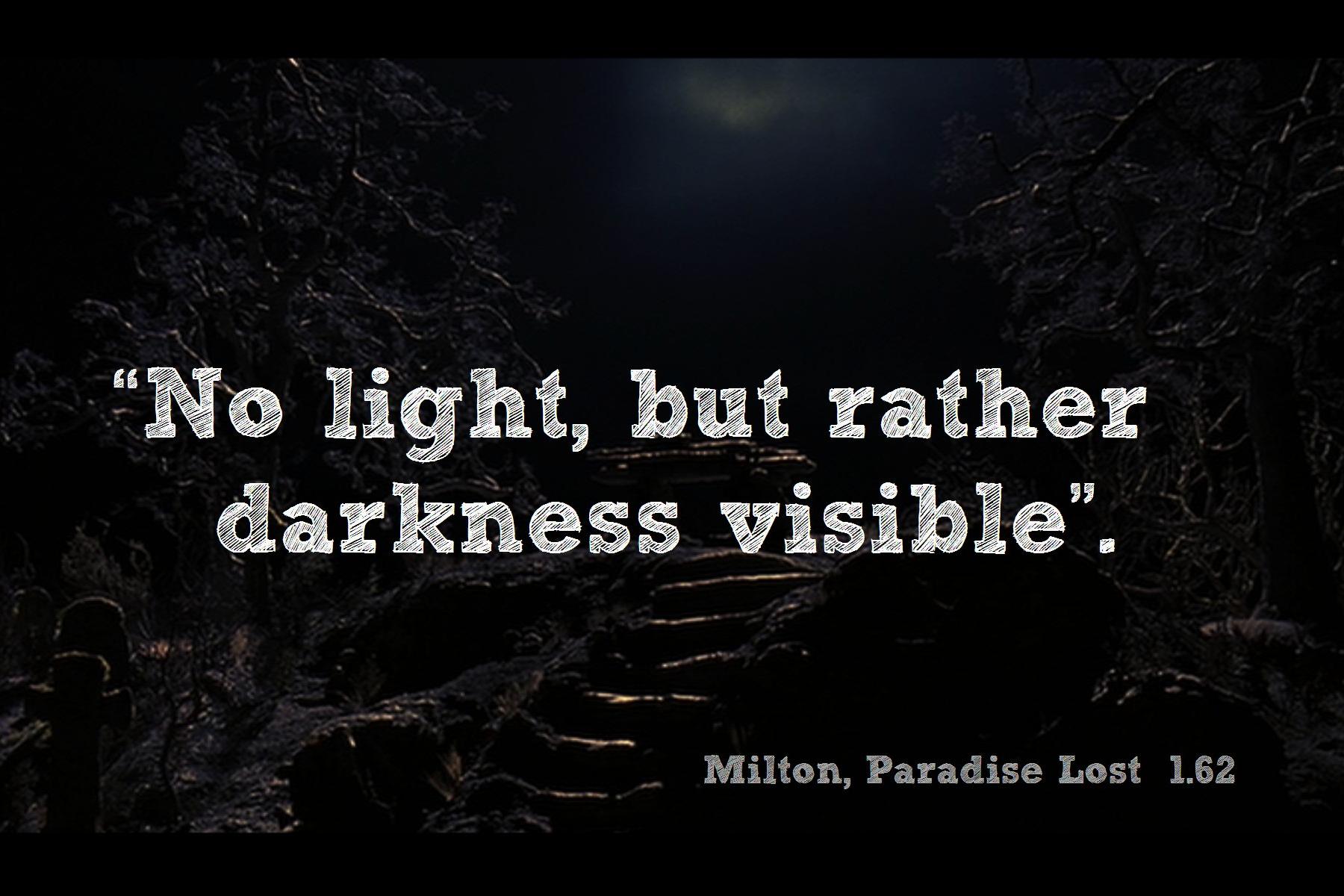
milton paradise lostThe evenings draw in closer, the darkness growing as we make our way towards the winter solstice.  It is a time for deep thought, reflection and understanding – thinking and understanding so deeply you are hardly doing it at all.  In the darkness our minds are much less distracted by visual stimulation.  We can explore the darkness both within and without, as well as the great mystery of the unknown.

In Zen Buddhism, along the Eightfold Path we learn about Right Mind.  At this time of year, I apply it when journeying ever closer towards the rebirth of the light. It is in the darkness that the mind is truly explored. It is in the darkness that the world outside is truly confronted.  It is in the darkness where we find the greatest mystery of all.

Right Mind requires an understanding of the self, in order to see that the self is really not all that important.  First we must learn about our reactions to the world – how we relate to it, what is automatic and what is intentional.  By studying our selves and studying our navels, we look deep within to see where we might be able to work on living in full awareness of our actions in our daily lives.  If we have an understanding that we instantly react to the person on the social networking site who criticises us, we can then work on that so that there isn’t attachment to it.  We learn that we don’t even have to react – that it is within our power as to how we behave.  When our co-worker in the office won’t help us even when we ask for it, we learn not to instantly react and let it ruin our day. We simply get on with the job at hand, perhaps asking for help elsewhere.

We are not owed anything. Learning this lesson can be of great value in our own spiritual awakening.  People do not have to act as we would wish them to. Not everyone has to agree with us. People will have different opinions.  We don’t have to comment, criticise or even give it second thought if we do not wish to.  Our emotions, our passions should be the spark of inspiration. They should not be the raging inferno that takes over.

By looking deep within to see how our passions and emotions play through our daily lives, we come to an understanding of them. We cannot ever develop a relationship with anything, be it person, tree, mountain or deity without first understanding them to a certain degree.  We often do not understand ourselves, to our detriment.  Why do we behave the way we do? How can we live more intentionally?

Through daily meditation we can come to a greater awareness of our selves.  Once we have attained that awareness, it is best to let it go.

You may ask – why spend all that time learning about our selves, only to let it go?

If we are constantly looking inwards, we will neglect to look outwards.  Druidry and much of modern day Paganism are at the risk of becoming too self-involved, too inwardly focused.  Five words remind me of this on a daily basis. It’s not all about you.

We can become so self-absorbed in looking at our navels that the world passes us by.  There is so much out there that we need to become aware of, just as previously there was so much inside that we needed to be aware of.  Once we have achieved a level of competency in knowing ourselves, the best thing we could do is to lose that sense of self in order to understand the bigger picture.

This dropping of the ego, this letting go is not an annihilation of the self. It is not negation. It is immersion, integration – utterly being.  It shows us the boundaries between the worlds, between us and other humans, between us as the natural environment. It also shows us that these boundaries are simply illusion. We are all just energy.

We can then begin to explore the greatest mystery of all, within the nurturing darkness – that of not knowing.  After learning to understand our selves and the world, we lose understanding as well, realising that we really do not know very much at all.  In such a vast landscape, both inner and outer, how can we truly know anything at all?  Often in Zen this is referred to as Mu, or nothing.  In the not knowing we are open to everything, our minds not being closed off.  The great mystery of not knowing is where the true potential lies.  In not knowing, we are free.

Deep within the darkness, the journey continues.

Spiritually Ill

At Samhain, by sunset I was in bed, the world was spinning.  I had just gotten off the phone to cancel the evening’s ritual. I had doggedly worked through the previous two days with a headache that just wouldn’t go away, and an all over body ache that I attributed to overdoing it in yoga.  Now nausea took over; I closed my eyes and tried to sleep. This was something different.

My blood boiled and the fever took over, running for the next three days.  Then blisters began to appear, and I knew – I had chicken pox.  I had managed to elude it for 39 years, and it finally caught up with me. My immune system was already weakened from a previous virus and an unrelaxing but still enjoyable holiday.

Halfway through the night we had to get up to change the sheets.  The fire in my body was trying to be quenched with sweat. The pounding in my head was almost unbearable.  As I dragged my aching body back into bed and into the blessed darkness, I wondered how I could deal with this illness on a spiritual level.

Using meditation techniques to calm the body and ease the headache, it was pretty easy at first. But then the rash came out, and all thoughts of coping with meditation flew out the window.  The fever comes and goes, a rush of fire through the body and that is quite easy to follow along, feeling it along my body and in my bones, through my hair and rising off my body.  It’s the stillness that is difficult in these circumstances.  I thought my Zen and meditation training would help to ease this. I was wrong.

It was impossible to sit still.  It was impossible to sleep. It still is.  Lying down, you feel all the nerves reacting to the virus, sending sharp little elf shots throughout the body and into the blisters.  You twitch. Even now, the twitching doesn’t stop.  The mind is doing all it can to get away from the pain, from the discomfort. Trying to type these words and form a cohesive thought pattern is a real challenge.

So what to do? How to deal with the chicken pox virus spiritually as well as physically? I’ve found that my skin is soothed outside, by sitting in the backyard, letting the sun and the wind ease the pain.  It doesn’t last for long – when I go back inside again it returns, but I am reminded of the moments of normalcy, of nature all around me, continuing on even as the fires rage within my body.  It is a reminder that the world is bigger than you are – when we are ill, we can so easily become despondent, self-absorbed ( I know – writing a blog about this is a tad on the solipsism side, but bear with me).

I look at my cat, who has been fighting with a stomach infection for months now.  She doesn’t seem terribly bothered by it – animals deal with pain and illness, death and dying so much better than most humans. They have an innate grace when it comes to it, all things considered.  And so I take inspiration from nature to help me combat the mental and physical challenges that lie ahead this week.

I let the awen flow.

I also hit the bottle of calamine lotion, and take some white willow bark.

I feel that this is also a turning point – the Celtic New Year has begun.  My body is undergoing some serious trials right now, and I feel that at the end of this journey I will have learned something valuable.  I was not able to perform any Samhain rituals, but did light a candle for the ancestors and leave it in the front and rear windows of the home, like I do every year, to guide the dead on their journey.  A couple of days later I was able to sit in my altar room and, after trying and giving up on meditation I turned to my oldest set of cards for inspiration.  What did I need to learn from this, I asked? The card I drew was Initiation.

And so, I feel that this is telling me to stop, to slow down even, to see the new phase in my life.  To literally do nothing. To deal with pain.  To deal with suffering.  To get on and be inspired by life.  To let go of all concepts related to my looks.  To let go of all thoughts of the future. To enjoy the moment. To simply be.  There is nothing like pain to get you in the present moment, if you truly open yourself up to it.

It has showed me that even though I talk about slowing down, and not taking on so many commitments, that I need to walk the talk.  I have talked about slowing down for months now, and yet keep accepting new work, birthing new ideas and letting the awen flow.  What I need to do is to retreat, to stop for a bit, to perhaps stem the flow of awen pouring out, and focus on it pouring back in.

This illness has really highlighted that for me.  Exchange, relationship. I talk about this a lot, and yet now see how unbalanced I was in it.  And so, learning from this episode in my life, I start the new year unable to do much except sit and read, or watch the birds as the sun sets a little closer each evening.  There are books to read, sacred places to visit.  A retreat from the world in order to better engage with it – this is what the monastic tradition is all about.  It’s calling to me at the moment. Time to ponder on thoughts of the self, to chop wood and carry water.  The cool breeze from the open window beside me is so delicious on my hot and blistered skin.

Is this how to deal with illness as a Druid? Maybe – each person’s journey is different, and sacred. May yours be walked in balance and harmony, in darkness and in light with equal joy and yes, pain.


Reblog: The Ancestors from Moon Books’ blog

Here is my latest blog for the Moon Books’ main blog page. May the ancestors guide you well! x http://moon-books.net/blogs/moonbooks/ancestors/

Samhain is a time to think on the ancestors, as it is often said that at this time of the year, the veil between the worlds is thin.  Our ancestors can mean so much to us, and yet, how much do we acknowledge them in our lives?

If you stop to think about it, you are the result of hundreds of thousands of years of ancestors, their numbers legion.  You, right now, are the result of evolution.  Taking a moment to stop and think about this can have great impact upon our lives.  We may suddenly realise that we are not alone – that we have the songs of millions of ancestors running through our veins.  That we are part of a grander cycle of life, death and birth that makes the little dramas, worries and events in our lives pale by comparison. It also reminds us that we are connected to all living things – that if you go back far enough, we have the stuff of stars in the minerals of our blood, the water of the vast oceans in our bodies, the sunlight and storms of times gone by.  In this way, there is absolutely no way we could say that we are an entity alone on this planet, and yet so many of us feel to be disconnected from everything and everyone around us.

Why do we feel this disconnection?  Ancestor worship used to be common, and still is, among many societies around the globe.  While the word worship may prove to be difficult for some, perhaps simple acknowledgement of the ancestors would be more apt. We have the good, bad and the ugly in our heritage – we need not worship any of them. However, connecting with and knowing that they are there, with all their glory and all their faults allows us the time and space to truly see life for what it really is – a culmination of everything that has previously happened, and the potential that lies within the future, with this present moment the very real blessing that it is if we are awake enough to immerse ourselves within it.

So why have we lost this connection to our ancestors? I don’t really know – I can only speculate.  Our real, blood ancestors may have been replaced by myths from the dominant religion, or pushed aside to form the secular culture of today.  Patronymic and matronymic Names such as Svensson or Gudrunsdottir were pushed aside by governments and churches in order to identify people according to the fashion of the time.  Women were forced to give up their maiden names when they married, and whole lineages were lost in a patriarchal society.  Voices were muted, or forcibly silenced.

What we can do now is to piece together the fragments that remain, in order to connect with our ancestors.  For some this is easier than others – broken homes and families, orphans and adoptees face a very and ever increasing challenge in coming to know and understand the ancestors.  Through rising conflicts in various countries, researching your genealogy might reveal some truths best left hidden from your social peers.  There may not even be access to records available – so what is a person to do?  We must remember that it is not only the secular world we live in, but also a spiritual world, where our ancestors await us if we choose to meet with them.

And so we do, in an odd fashion, at this time of year without really knowing why.  Stories of ghosts and witches and the dead coming to life flit through the minds of children and adults alike, as they dress up in ghoulish costumes ready to tackle the dark streets with other like-minded adventurers.  I remember fondly my years of trick-or-treating with my brother and sister – roaming the streets full of children, very little adult presence, dressed up in scary or not so scary costumes, out past the normal time allowed and going onto neighbours’ properties, walking beneath the bared branches of the trees, the moon shining spookily through just like in all the pictures we’d been drawing in school, a cat running across our path.  Ghosts lurked behind every bush and darkened window, witches flew on brooms past the rounded face of the moon, skeletons danced in the graveyards.  These images of the dead, the scary, the ancestors were still so evocative and ignited the imagination of every child wandering and testing the dark streets of both their neighbourhood and their soul.

We have a very real fear of death in our society.  We do not talk about it. We go to visit dying relatives in the hospital and tell them that they will be okay.  When they do die, we send the bodies off for preparation by someone most likely not a family member – if we are lucky, the family knows the undertaker through their previous work.  On this night, the night of Samhain, Hallowe’en, we the masses are allowed to talk of death, or if not talk about it, act it out in a sugar induced high as children, or an alcohol induced platitude in our adulthood.

Taking a step back from all this and really acknowledging the season for what it is, for what it means to relate to our ancestors, is what Samhain is really about for me.  I acknowledge not only my human ancestors, but all those who have gone before, whether they be cat or tree, mountain or sea.  The tides of time and life and constantly changing, and death is always around us, as is life.  However, at this time of year, where here in the UK the leaves are changing colour and falling to the ground, the ground foliage dying back and bare earth being exposed for the first time in many months, the smell of death and decay all around – it is easier and much more obvious to honour the cycle of death.  Rebirth will happen when the sun begins to warm up the earth, when the days begin to become longer. Right now, the darkness awaits, and in that darkness, the stillness of death. Taking a moment to be still ourselves, to experience a little death on this most hallowed night, is so utterly freeing and grounding at the same time.

We are so often not human beings, but human doings. To stop, to cease doing things, to stop being active is to become old, or worse, dead.  Yet we are not annihilated when we cease to run around on the hamster wheel – instead we are immersed in the wonder of life and death, of creation and destruction.  That immersion is, for me as a Druid, what it is all about.  Dropping that sense of self to be free within the world is all important.  Knowing who you are first is essential – for when you know who you are, you can then let it go into the dark void of potential, into the cauldron of unknowing.

So this Samhain, take a moment to stop and connect with the ancestors.  Realise that the threads are always with you, shimmering along ethereal lines of connectivity in a grander tapestry of life.  Some may have faded with time, some may need mending, but we have the magic lying within our very souls to do this.  Pick up the veil that lies between the worlds, and see the shimmering lives of the ancestors on the other side – and know that there is no other side in truth.  We are all here together, but our minds create the gauzy veil between the worlds.  Lift that veil.  Look death in the eye.  Smile, and death will smile back at you.  Rejoice in the impermanence of all things, and know that one day you too will be an ancestor, your threads still connecting you to all that is within the web of existence. Dance in the present moment, with the ancestors of past the future dancing alongside you.