
The Celts had Indo-European roots, migrating across Europe and leaving their mark across many countries. They share many similar spiritual beliefs to other traditions – Buddhist, Saxon and Norse just to name a few. There are similarities in artwork and other modes of creative expression. Finding something that is “pure” in any tradition is, at least in my opinion, unattainable. We are constantly being influenced by other people, whether it was 50 years ago, 500 or 5,000 years ago.
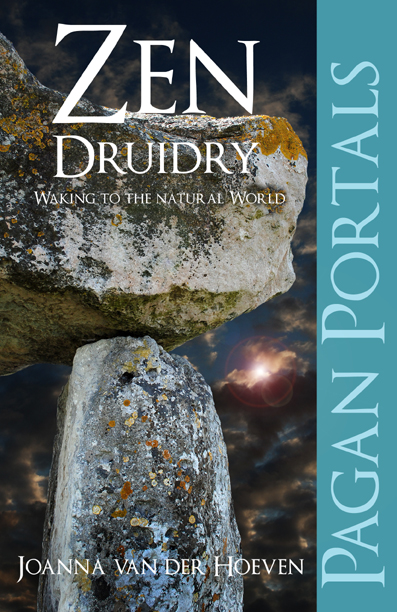
Incorporating Zen and Druidry has given me a personal life path that makes a lot of sense in my daily practice. Simply because Zen Buddhism is an Eastern tradition doesn’t mean that it can’t work with what is commonly thought of as a Western tradition. (For a more in depth look at Druidry and other Dharmic paths, including Buddhism, Jainism and Hinduism, Philip Carr-Gomm has written a brilliant page on The Order of Bards, Ovates and Druids’ website – http://www.druidry.org/druid-way/other-paths/druidry-dharma.)
Zen and Druidry blend together to form a life path that is utterly devoted to being in the present, giving the Druid a total immersion within nature. This immersion, not just going with the flow but being the flow itself, is what makes it so special. Zen teaches us to let go of our sense of self, to silence our chattering minds in order to be able to pay attention to the world at large. It also teaches us of discipline, learning how our minds work and how we are so often ruled by our minds, through bad habits, reactionary living, destructive behaviour and so on.
With Soto Zen, the mind is brought under control through hours and hours of meditation, of learning to simply “be”, slowly and gently silencing our “monkey mind” so that we may better hear the songs of the universe. This is what is meant by releasing the sense of self – it is not, as so many people assume it to be, becoming a mindless zombie. It is allowing other songs, other voices to be heard above our own so that we may better integrate. We will still have opinions, but we will cherish them less, for we know that everything is in constant change and flux. We will have a sense of self, but again we hold to it lightly so that we may better see where we fit in the world and where we can do the most good. It is not annihilation – it is immersion, awareness and mindfulness.
Within Druidry, we learn to work with awen, with inspiration and the flow of life itself to see where we fit in the grand scheme of things. We work to see how we can live with the least harm to ourselves and the planet, and also what we can do to make the world a better place. We work to create peace within ourselves and peace in the outer world as well. Using our natural abilities and skills, we may work with songs and poetry, or with visions or herbal medicine, with roles in teaching and counselling, in law or in environmentalism – the list is endless. We are devoted to helping and conserving nature and our planet, sharing the awen and giving back for what we have received.
Using the techniques from Zen for training the mind and the love of nature from Druidry we can find a way to immerse ourselves in our spirituality that is so deeply integrated on so many levels. When out walking in the forest, we can lose our sense of self in order to become the forest. Once we are the forest, we are able to drink deeply from the flow of awen that is all life around us. We become the trees, the deer, the fox, the boulder, the streams and the badger. We can learn so much from this integration which can also rejuvenate us, providing us with even more inspiration. We are not looking at ourselves being at one in the forest; we have lost even that in order to become the forest. When we are fully immersed in simply “being”, we are fully in the flow of awen.
Our footsteps become lighter, our passage barely noticeable. Like the deer, we are able to bound through the trees, awake and aware to every sense. Indeed, all our sense become sharper, clearer, for our minds are not running us ragged thinking about what to have for dinner, that paper that is due, the meeting we have on Monday. Fully in the moment, we become the awen.
Zen Buddhism has also leant another aspect to my Druidry that has been rich and rewarding – the idea of compassion. Again, many people misinterpret compassion, seeing it as weak, or being a pushover. Why be kind to others when so few are kind to us? Living with compassion is what enables us to connect once again to that all important word in Druidry – awen. The songs of life can only be heard if we try to understand them. We cannot understand them unless we open ourselves to compassion.
In one of the Grail legends, Perceval reaches the wounded Fisher King, and is invited into his castle. The knight does not ask the King why he is wounded, or how it happened. He shows no interest in learning the story behind the wounded King. Upon sharing a meal with the King, the knight also sees a courtly procession whereby a young maiden carries the Grail through the hall repeatedly throughout the night. Again, trying to appear worldly and nonchalant, Perceval does not ask about this. These two incidents are the clues in which the Fisher King might be healed, and in which Perceval failed at his chance in finding the Grail. If he had only asked the King “What ails thee?” then the King would have been instantly and magically healed. If Perceval had only asked “Whom does the Grail serve?” he would have understood its purpose, and achieved the totality of his quest.
The simple question of “What ails thee” is the showing of compassion. It is taking ourselves outside of our own minds and our own troubles and asking another person what is wrong, seeking to alleviate their suffering. Also, by asking our selves (the separation of the words, instead of writing ourselves is intentional here) “What ails thee?” we take the time to look within, to perhaps explore shadow aspects of ourselves. Within many Eastern traditions, it is through meditation that we understand our selves better, and also understand and redirect our reactions to the world – ie. instead of simply reacting to an event, we act with intention, with mindfulness and awareness. With the Grail question, we can ask this of our selves as well as others in pretty much any situation, therefore eliminating a reactionary response for a more intentional approach. In doing so, we may just find the healing for our selves and the world that is so needed.
The second Grail question, “Whom does the Grail serve?” invites us to question our intention. Whether we are experiencing pleasant or unpleasant aspects in our lives, we can ask our selves “who does this serve?”, thereby eliminating that which is no longer necessary, and bringing joy, awe and wonder back into our lives. With old habits and patterns of behaviour that we wish to be freed from, we can simply ask this question over and over again until we have the answer that is required for spiritual growth. We can ask this question in every aspect of our lives, from our weekly shopping (in order to make better choices not only for ourselves, but the planet) to our everyday interactions with other people. If we are making a positive change instead of falling into negative, but comfortable patterns then we are on the road to spiritual progress. Reminding our selves of the Grail questions has been integral to my learning these past few months, becoming a mantra for everyday life.
In our quest for wholeness, we can either run around in circles, questing after the Grail through established means, or we can simply look within to gain a better perspective on compassion and the divine, whether it be male or female, or even genderless. It is the deep exploration within that allows us to bring that knowledge out into the world – we cannot simply spend our lives gazing at our own navels – we must bring the Grail out for the benefit of others. We must offer the gifts of compassion and self-awareness. In this, the Grail Mysteries are best served.
In this way as well, both Eastern and Western traditions come together to allow us to help not only our own suffering, but that of the world. We can learn the values of compassion and mindfulness, and we also look deep within for the inspiration to live an integrated life that reflects the natural cycles of the world around us.
We do not simply touch the awen every now and then – we become the awen ourselves.
(From my blog at Moon Books – http://moon-books.net/blogs/moonbooks/zen-and-the-awen/)





 Down the Forest Path