 Here is my latest blog for the SageWoman’s blog channel at Witches and Pagans, on the subject of the coming of autumn, my favourite season. x
http://witchesandpagans.com/SageWoman-Blogs/in-autumn-s-light.html

Here is my latest blog for the SageWoman’s blog channel at Witches and Pagans, on the subject of the coming of autumn, my favourite season. x
http://witchesandpagans.com/SageWoman-Blogs/in-autumn-s-light.html
From Lammas, the first harvest, to the Spring Equinox, in my spirituality I focus on a specific aspect of the Buddhist Eightfold path – Right Speech. For every one of the eight pagan festivals, I have corresponded a part of the Eightfold path, finding a great blending of the two traditions together (see my book, Zen Druidry, for more details http://www.moon-books.net/books/pagan-portals-zen-druidry). To me, at this time of year when the Celtic peoples gathered together to celebrate the harvest, participate in games and competitions, wedding ceremonies and such, considering how to converse and behave appropriately was paramount in order for the tribe to thrive and meet other tribes without violence or bloodshed. I see this paralleled in the Eastern concept of Right Speech.
So, what do we mean when we speak of Right Speech? The concept of right speech involves four elements; abstaining from false speech, abstaining from slanderous speech, abstaining from harsh speech and abstaining from idle chatter. For the Buddhist, this shows the sacredness of speech, and gives us a framework within which we can work towards more compassionate and thoughtful speech.
Here is a quote taken from The Secular Buddhist:
“The Buddha divides right speech into four components: abstaining from false speech, abstaining from slanderous speech, abstaining from harsh speech, and abstaining from idle chatter. Because the effects of speech are not as immediately evident as those of bodily action, its importance and potential is easily overlooked. But a little reflection will show that speech and its offshoot, the written word, can have enormous consequences for good or for harm. In fact, whereas for beings such as animals who live at the preverbal level physical action is of dominant concern, for humans immersed in verbal communication speech gains the ascendency. Speech can break lives, create enemies, and start wars, or it can give wisdom, heal divisions, and create peace. This has always been so, yet in the modern age the positive and negative potentials of speech have been vastly multiplied by the tremendous increase in the means, speed, and range of communications. The capacity for verbal expression, oral and written, has often been regarded as the distinguishing mark of the human species. From this we can appreciate the need to make this capacity the means to human excellence rather than, as too often has been the case, the sign of human degradation.” http://www.thesecularbuddhist.com/nep_04.php
Living in such a verbal society, we must take extra special care of our words, both verbal and written. It is an increasingly difficult thing to do, in my opinion, when we are living “virtual lives” more and more with the internet. We have an “online presence” as much as our real physical presence. It is up to the individual how closely the two are related.
What we say, both physically in face to face encounters, as well as in a virtual community or forum may have varying degrees of impact, dependent upon who is actually listening. The fact of the matter remains – whether it is virtual or physical, there is an impact. For someone to be cruel to another person online could have devastating consequences (as we have seen recently with the suicide of two teenagers bullied on a social media forum). A person may be attacked by an online community, and feel no repercussions whatsoever. In a face to face situation, the reverse might happen. One thing remains – we are personally responsible for our own behaviour, for we cannot control the behaviour of others. We can lead by example, but underlying fundamental control of others is beyond our grasp.
I have been verbally attacked on social media forums, bullied and trolled. As yet, it still does not get any easier with time. I stand by the view that the internet is as much a tool for sensitive souls as it is abused by being a playground for trolls. I do not think that sensitive souls should have to “toughen up” in order to be online or to deal with face to face encounters. I think that people should be responsible and culpable for their actions, whether virtual or real, and take others thoughts and feelings into consideration.
As a recent example, a friend of mine told me that there is now a new term in a couple of UK LRP (LARP) communities/systems which is replacing a previous term. He finds this fascinating, as he loves studying etymology. It is indeed food for thought! The previous term within the community was “special snowflake”, something that people used to deride another person on the basis that snowflake in question thought of themselves as being unique, and therefore life should go according to their own terms on this basis. The new term that has cropped up to replace this, is “bluebell”.
Now, some of you may know of my decision to abstain from a particular company due to the reason that I cannot condone the fact that each spring they hold battles in woodland that is carpeted with the most brilliant bluebells. For an in depth look at this, please see my previous post “ Druidry and Choices” here: https://downtheforestpath.wordpress.com/2013/06/04/druidry-and-choices/. It would appear that some players have decided to take it upon themselves to take this particular subject and twist it around to insinuate that I was a “special snowflake”. There was some agreement by players on a social media board, before it exploded and abuse and trolling were hurled by some members. All I asked what if others felt the same way as I did about protecting what I saw as a beautiful woodland – I did not, in fact, want to change the system to suit my needs.
And so, the new term “bluebell” has been born to denote a self-centred, self-indulgent ignorant person who wants to have their own way as opposed to someone who loves and cares for the environment. This was, in all honesty, quite hurtful for me to hear, and I wondered at the people who would twist such a simple stance to suit their own agenda.
Then it got me thinking.
So, why on earth would someone want to do such a thing? The obvious response is that it makes them feel better about themselves by putting someone or something down. I cannot know for certain, however that this is the case. Looking at popular culture, however, would seem to indicate that this may, indeed be the way that things are heading. Why? Because more and more we see people criticising others using derogatory terms. Instead of discussion, debate and honest criticism, we see through television and other media people judging other people with harsher and harsher verbal terminology. Just watch any “reality” television show where they have judges – how many judges simply put a value on a performance without becoming personal? There is a growing trend for celebrity television judges to make it personal, to get people on their side, to appear “cool” or “funny”. This is also the case in everyday life.
In our ever-growing faceless society, the need to “save face” is, ironically, coming to the fore. With an unseen audience of who knows how many, we feel we have to witty and clever. (Yes, I do see the irony in putting this in an online blog). For some, the easiest way to do this is by putting another person down – in essence, to be “bigger and more clever”. Well, as the British saying goes – it’s not big and it’s not clever.
Having spoken to people in science based professional fields, there still seems that there is the ability for disagreement on a subject to occur within the professional sphere without someone feeling the need to act “big and clever”. Of course, there are always exceptions, but generally debate is still held within certain bounds of respect and integrity that may be lacking in popular culture debates and interactions. They are able to criticise things without being derogatory, something which I think is falling by the wayside in mainstream society. I’m still mulling this one over, and your thoughts would be appreciated!
I’ve said it before and I’ll say it again – you don’t need to blow out someone else’s candle for yours to burn all the brighter. We can use words and speech, whether online or offline to interact with each other respectfully. In Zen, it is agreed that we cannot control the behaviour of others, and so to ponder why people do the things they do is, in fact, a bit of a waste of time. But I still do wonder why people do the things they do – I can’t help it, and I’m working on it as much as I can – I’m no Buddha. I find it easy to have pity for people, however, pity requires making a judgement call on their life which may or may not be true – ie. I pity someone because they must have such a dull life they have to hurt other people to make themselves feel better. This isn’t right, I know. What I should be doing is having compassion for people – compassion, unlike pity, requires a total lack of judgement on the individual’s part.
Compassion is both the easiest thing and the damned hardest thing in the world. To learn the ways of compassion, one must first release the notion of the self, the ego that one clings to, in order to see that we are all related, that we are all connected – that there are no “special snowflakes” or even “bluebells” 🙂 There is no one to hurt and be hurt by. We are all Buddhas. By taking advice from Buddha’s Eightfold Path, we can learn how to live more compassionately. By focusing this Lammastide on Right Speech, I hope to change my behaviour so that I may benefit the world and not just my own agenda. Like racism, sexism and a host of other human ills, hateful speech is learned behaviour. The good thing about that is that it can be unlearned.
Like I said, I’m working on it.
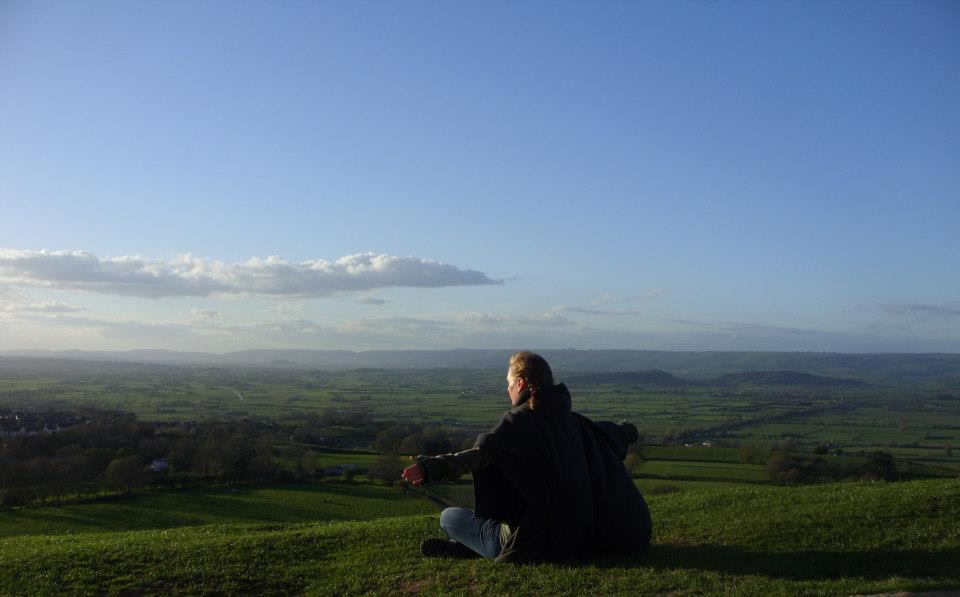 From Nimue’s blog:
“I cannot live in a temple in the sky. I have to come back, eventually. Reluctantly. Here in this space, the immediate and human concerns loom large. They seem increasingly like distractions from that which is truly important.”
See the whole article here – it resonates within my heart! http://druidlife.wordpress.com/2013/08/13/a-temple-of-sky/
Below is a link to Sylvan Reverie’s blog, where the idea of Mutt Druidry and nature spirituality is expanded and just absolutely beautifully written. It clarifies for me a lot of things I have been thinking about, and is clear, concise and inspired. x
http://fallingleaf.wordpress.com/2013/08/12/to-whom-the-gods-belong/
Growing up in Canada, with Dutch parents and being first generation Canadian, I’ve always felt a little bit of a mutt when it came to spirituality. I was confirmed at our church when I was in primary school, hating staying after class to do religious studies when I’d rather be running outside beneath the birch trees or biking down the road with my brother and sister. I never felt a very strong connection to the Christian God or to Jesus himself, though as I’ve grown older I have developed a deep respect for Jesus and his teaching, much as I have for Buddha. Christianity did not, for me, help to explain why nature did what it did – and so I looked further afield, finding inspiration in Aesop’s fables, which became a dog-eared book read and re-read time and again. I also found deep meaning in Native American mythology, which spoke of the natural world around me that I was familiar with – the Great Lakes, the mountains and deciduous forest, the animals that roamed within it.
It saddens me that the Lakota, Dakota and Nakota nations felt they had to pass their Declaration of War back in 1993 against the theft of their spiritual beliefs. (To see the full Declaration, please visit http://www.aics.org/war.html). I fully understand, and yet have always felt a little bereft – the native spirituality helped me to make sense of the natural world in which I lived in, in the forests of Quebec. The seasons were beautifully explained by ancient myths, as was the behaviour of animals and much, much more. They spoke of creatures and countryside that I was familiar with. For long I have worried that I would be seen to be “stealing” from a culture not my own. It was so at odds with some other religious and spiritual beliefs, such as Buddhism, which as far as I am aware has never been concerned with cultural theft, even though it too has been oppressed in many places. I understood the need for the Declaration, and yet I did not – it is a difficult thing to get my head around.
Eventually, when I came to Druidry, I realised that it was all about language – Druidry was the language that I could use to communicate with others and to commune with nature. It did not matter what religious tradition I followed; I could still use the same vocabulary to describe them in a way that made sense to me, and to others who followed this path. Through Druidry, my awareness of both myself and other religious traditions expanded, and I learned a lot more about theology. I came to know my ancestral gods of Anglo and Saxon culture. I even tried taking them back to Canada with me to honour and commune with them there – but I just couldn’t “feel” them there. It was much easier to honour the ravens and the bears, the Great Spirit – how much of that was out of habit, and how much of that dictated by the concept of place, I wonder?
Studying more and more, I realised that some ceremonies that would be considered Native American are shared throughout the world’s religious traditions. When I make a smudge stick from mugwort growing in my garden, am I imitating Native American culture, or Scots Gaelic saining? At Druid Camp, when I attend a sweat lodge, am I treading upon Native American ceremonies, or participating in millennia old traditions of our palaeolithic British ancestors? When I call upon the elements in ritual, using words such as the Great Eagle, exactly which tradition am I honouring? In my craft name of Autumn Song, I have taken two things that I love most and created a name for myself. Am I thieving, have I started a war?
I have no desire to “go native” – I am not Native American. But I honour their beliefs, as I honour those of my Christian family members. I honour my Buddhist friends, my Wiccan friends, my Druid friends. I honour my atheist husband. I can see and understand all points of view, and they are all a part of my life. Some of the Haudenosaunee myths and traditions made perfect sense to me as a child growing up in the Eastern Woodlands. The Abrahamic God eluded me, but his son was a bit of a dude whom I grew to respect. The Lord and Lady made themselves known to me as a young adult back in the early 90’s. The Celtic gods and goddesses and the Northern gods and goddesses then followed. I learned about Buddha and Zen, and found merit in all these teachings. I see so many similarities between Druidry and eastern traditions, such as Zen – as you know, I’ve written a book about combining the two. It’s nice to know I’m not the only one making these connections either – see OBOD’s page here for more information on Druidry and other paths http://www.druidry.org/druid-way/druidry-other-paths.
So where exactly do I fit in then?
I’ve previously coined my form of Druidry as Mutt Druidry, in an article written for The Druid Network. Growing up surrounded by so many spiritual beliefs, living in so many parts of the world, hungry for knowledge and desiring deep connection with the natural world around me, I have learned and still continue to learn from all traditions. Is there something fundamentally wrong with this, and if so, what is it?
Blessings on your journey. x
This excerpt deals with the relationship that I see between the two elusive goddesses of Elen and Nemetona….
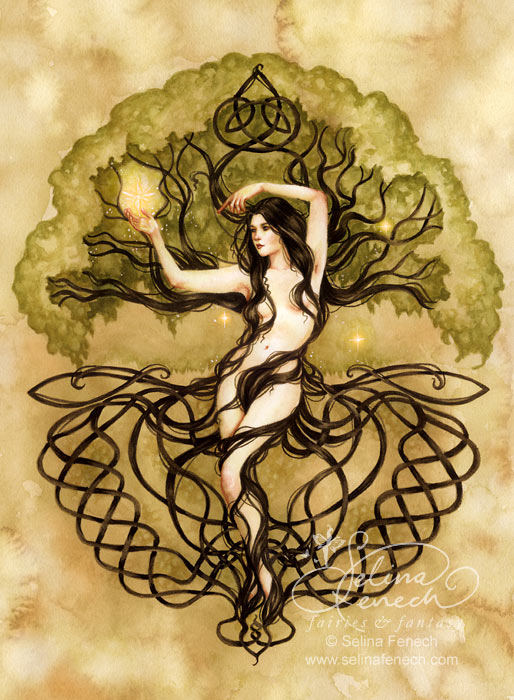
From website: http://nshrine.com/shrine/Nemetona
I’ve always thought of Nemetona as a relation to the ever elusive goddess, Elen. The antlered goddess, Elen is currently undergoing a bit of a resurrection today, with more and more people discovering Her, though physical sources explaining Her and Her attributes are few and far between. Elen is a wild goddess, found deep within the wood. Hidden in the shadows of the trees, she watches you with eyes millennia old. You may catch a brief glimpse of her, and then she is gone, flitting silent as ghost amidst the snowy boughs, disappearing in a heartbeat. She is the heartbeat of the wood, of the wild places, of heathland and moorland. She dances under the moon in star-filled skies, her dance exhilarating and free. And in the blink of an eye she is gone, lost in the mist that slowly curls over the land in eloquent drifts.
Elen seems to have escaped the history books and academia of the human race. She knows this, and it pleases her greatly. You cannot know her without seeking her out, in the wild places, in the darkness and in the light, in the heat and in the cold. She is to be experienced, not to be read about. She is Elen of the Ways, of the trackways and paths that cross both nature and the human soul. She is a physical deity – you must put one foot in front of the other if you are ever to know her. If you are lucky, you can find the ancient pathways she had trod, leaving her energy behind, enticing you further, deeper into the heart of the wood, where the mysteries lie. Follow the footprints – in the snow, in the mud, in the sand. The cloven hoof of the deer will lead you to her. They are her children, they are Her. Like the deer, she is grace and strength, she is trusting and wary, she is capable of great stillness and explosive action. She is curious and wise, and she will beckon you further in if your heart is open.
Even as Elen embodies the wild aspects of our souls, Nemetona is that which is held in deep reverence, in sanctuary. Elen runs wild and free throughout the forest, Nemetona holds that spirit safe within the bounds of her circle, the sacred glade at the heart of the wood. Both goddesses have very little academic and historical knowledge available about them – however both are very much present here in the British Isles, and indeed throughout the world.
For me, Nemetona walks gracefully in the heart of the sacred grove, robed in natural linens, white limbs shining in the moonlight, her long dark hair flowing down her back. Elen runs free, flitting between the great trunks of the trees, ghostly as the deer, her limbs browned by the sun and her wild red hair tumbling free about her shoulders. Elen’s pathways often lead to Nemetona at the sacred heart of the wood. They often smile to each other, honouring each other and the sanctity of the sacredness of all things.
For those lucky enough to physically have a sacred grove, a forest or woodland to go to on a regular basis, making that commitment to spend time in that very special place can be an excellent way to meet with Nemetona, and indeed her wilder sister, Elen. If you can, find a space where you can go as often as you can, to walk beneath the boughs, to become a part of the forest or wood. If there is a glade within the wood, so much the better – it doesn’t have to be big. Sit and meditate there, dance in the moonlight, make offering to Nemetona in order to establish that deep connection to Her in her sacred grove that words just cannot even begin to describe.
 Check out my latest blog for the SageWoman Magazine channel at Witches and Pagans – the first harvest, and what it means to me…
http://www.witchesandpagans.com/SageWoman-Blogs/lammas-mysteries.html
I have a new Facebook page dedicated to Zen Druidry, so if you’d like to keep up to date with news, views, articles, videos and more then please feel free to “Like”! Awen blessings. x
These past two months, and these last two weeks in particular, I have noticed an increase in disrespectful behaviour on several Facebook groups that I am a part of. Some of these groups have absolutely nothing to do with each other, so there is no correlating theme that might suggest crossover between them. So what is causing people to behave so badly in a public forum?
Trolling and dishonourable behaviour has always plagued online discussions, due to the lack of face to face contact and the deterioration of basic social skills as a result of an increased virtual presence and virtual world. One can very easily be rude to a faceless person, or a faceless mass – there is no real-time, real-life repercussions in most cases (barring those individuals who have been prosecuted for various internet related crimes and misdemeanours, such as bullying or trolling on gross levels, often involving minors). It’s a sad state of affairs, and I fear for the future of social interaction in a world where people are addicted to their phones and other social media (yes, I spot the irony in an online blog, but bear with me) and are increasingly isolating themselves whilst under the illusion of always being connected.
People being rude for apparently no reason, people are trying to publicly shame another person or group, people for whom basic manners is all but lost, people with low self-esteem or any other number of issues that lead too poor behaviour. But why this sudden increase lately?
I wonder whether it has something to do with the weather. Here in Britain, in a climate that for the most part does not suffer the extremes that other countries deal with on a regular basis, when it is very hot or very cold there can be a rise in poor behaviour. These past few weeks Britain has experienced a heat wave, which may have something to do with what is happening in these groups. In Psychology Today, Amie Gordon states “in the summer, hotter weather was associated with being in a more negative mood. Heat is also associated with increased aggression. So when you find yourself feeling sad, grouchy, or wanting to punch someone in the middle of summer, try taking a weekend trip to somewhere cool.” (For the full article, see http://www.psychologytoday.com/blog/between-you-and-me/201301/sour-in-the-sun-3-unexpected-ways-weather-affects-your-mood). Dr Joh Grohol wrote a in his online blog “Heat waves are related to more violent behavior and aggression, may be associated with higher drug and alcohol abuse, anxiety tends to decrease with a rise in temperatures, depression and lowered mood tends to increase with a rise in temperatures, high levels of humidity — which often accompany a heat wave — lower concentration, high humidity also increases sleepiness (probably related to poor sleep) and high humidity also appears related to a lack of vigor and energy” (http://psychcentral.com/blog/archives/2011/07/20/the-psychology-of-a-heat-wave).
Though we are not, and can never be, separate from external forces such as the weather, we are also highly equipped to deal with our emotions and behaviour through cultural and social standards, upbringing and self-discipline. We are not slaves to these either, but can use them to help reinforce a positive world-view and to make this world a better place for all beings. It is entirely in our hands.
When we are engaging with the world, whether it is using an online presence or a physical face to face engagement, we have to remember that we are dealing with another soul. This is a person who has thoughts and feelings, a history and a future, a journey in life that they are trying to complete perhaps as best they can. It’s all too easy to forget this. I am often reminded by the simple Hindu word/phrase, Namaste – my spirit honours your spirit. (http://en.wikipedia.org/wiki/Namaste). Keeping this in mind has helped me a great deal.
This is not to say that simple acceptance of bad behaviour should take place, that we cannot change the world, that you shouldn’t stand up for what you believe in – if you need to speak out on an issue, then you should, with honour and respect. I have done so in the past, and indeed am currently doing so in this very blog. Note that I have not named names, groups, or anything that would personally implicate another soul. Instead, I am trying in my own little way to work through this issue, have my say and try to make the world a better place.
So, if you are ever tempted to belittle, degrade, shame another person, either in person or in an online forum, perhaps in the hopes of getting people to “your side” of the issue, remember that there are no sides, that there is no real need for this behaviour, no positive effect on the world at large. Talk about it, talk it through with respect. Love and compassion are key, and where two souls meet but cannot agree, then, with respect, bow and walk away.
Being kind is not difficult.
And if all else fails, find somewhere cool to think it through first. Namaste
 The final piece awaited, locked within myself and held in trust by an old friend. I had found those fragments of my soul through a two week exploration, being in the beauty of my ancestral home and surrounded by family. It had been a lot easier than I had anticipated – perhaps it had something to do with being home, physically home in a place that meant so much to me. At any rate, it was the right choice to make, to follow this path of soul retrieval and finding the essential self on my own, instead of following the “traditional” shamanic route. I am more comfortable with my own tradition – to each their own on this gorgeous journey of life.
The fourteen year old girl who hid away because she was bullied and found sanctuary with the horses in the valley – all I had to do was stand at the valley edge, where I could see her, extend my hand and watch her turn to me, smile, and extend hers – across the valley she flew back into me. The 24 year old woman, who was about to leave Canada for the first time with her new husband, once again leaving behind everything she knew to face the unknown, and who did not want to come with me, choosing instead to remain on that path that she walked every day as she waited for the visa clearance – she was equally easy to find. On a hot, humid evening I found her as I walked down that same path, and she walked towards me and straight into me, my heart feeling full as I told her that everything turned out okay, that there was nothing to fear. She settled at once within me and I felt both heavier and lighter at the same time, my heart a little fuller. I now just needed one more piece to make the puzzle complete.
And so we went to the power spot, where the river met the lake, in the late afternoon sunshine. In the sand on the beach, I drew a circle around me, reinforcing the nature of the cyclical, the sacredness of the world, the fact that there is no beginning and no end. I made my prayers to the spirits of place, the four quarters of the world and the ancestors. I sat down and made clear my intention, and then my friend joined me to help.
He reminded me of that part of myself that I felt I had left behind, that I had trouble reaching lately. He described, in detail, aspects of her that I had forgotten completely. Seeing myself reflected through his eyes, she came back to life. Being with someone who knew me so deeply was not only a comfort, but he was also my guide back to her. And in doing so, he surprised himself by finding a part of his own soul that he had nearly forgotten.
With open arms I welcomed her back. We hugged each other with tears in our eyes as we both remembered our essential selves, and honoured the beauty and sacredness of the moment, this life, this world.
Welcome home.
 Down the Forest Path