Druidry and the Ten Bulls

The Ten Bulls is an illustrated poem used by followers of Zen Buddhism to explain the search for enlightenment.  For me, it also represents the search for meaning in my own Druidry and indeed, in my own life in general.  It can be applied to everything, but for the purposes of this blog I’ll stick to Druidry. To see the Ten Bulls, otherwise known as the Ox-herding pictures, you can follow this link:- http://www.sanbo-zen.org/cow_e.html.

The search for enlightenment, the search for the Self and meaning is a major part of any religion or spirituality.  What will explain that sense of something missing, that lacking? What will fill it, or guide us to fill it in? What will help us to realise our full potential and live according to our True Self?

For me, this has been blending Zen with Druidry, and in the Ten Bulls can be encapsulated quite neatly.  They are, as follows:-

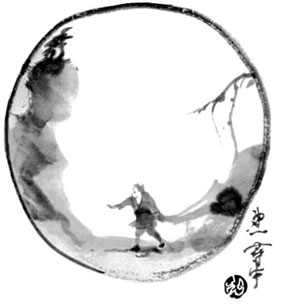
 1.In Search of the Bull
1

When we first come to Druidry, we do not really know what it means, for there are no long-established formal schools or training that we know of.  We can look to history, and then find out about courses now offered in Druidry through various organisations, but is this Druidry? It is certainly a version of it – Druidry is what it is, to each and every person. Moreover, to each and every person, it is different, yet still falls under a single banner. Confusing? Hell yeah. In a way, I think it’s meant to be. It encourages us to get out there, and find out more – beginning the adventure.


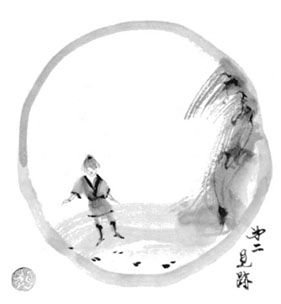
2.Discovery of the Footprints
2

We have begun our adventure, and are searching now for what Druidry is.  We catch glimpses of it in the works and writings of others, yet we still have not experienced Druidry for ourselves.  Like the wind, we can’t see it, we can only see its effect on other things.  We continue and go deeper into our Druidry to find out what it really is.


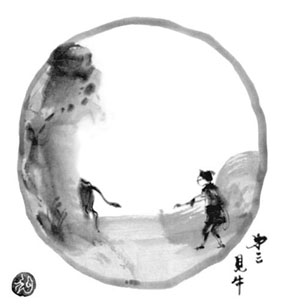
3.Perceiving the Bull
3

We’ve caught a glimpse!  We’ve had an insight into what Druidry is – we know that we’re now on the right path in our journey of self-discovery. Yet it is still not entirely clear – the experience is not yet full.  We run after the bull in the hopes of understanding.


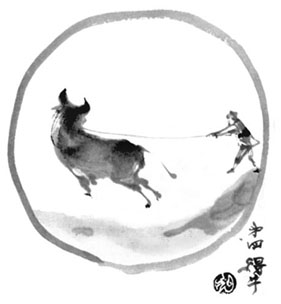
4.Catching the Bull
4

We’ve found our Druidry!  After many twists and turns, we’ve come across a path, or developed our own, that seems to flow with the essential spirit that we call the Self.  We may find several bulls, even, until we find the right bull, but eventually we come across a method, training, or experience that reflects our inner core. We harness that energy, but what do we do with it now?


 5.Taming the Bull
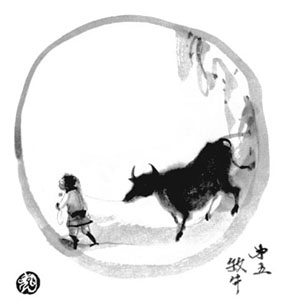
5

We learn that knowing what Druidry is, is simply not enough. We must practice with it, again and again, experience it and not simply read about it.  We hold rituals, we meditate, we get our fingernails dirty.  We do the work necessary, and learn discipline.


6.Riding the Bull Home
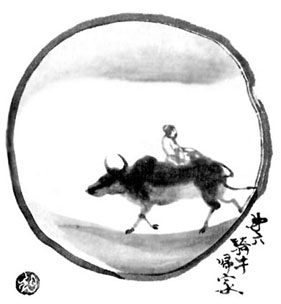
6

This is Druidry! This is what it means, and it is a joyous expression of our inner souls.  We have a sense of “coming home” – we know how to celebrate the seasons and each other, and we may find the beginnings of an inner peace hitherto unknown.


 7.The Bull Transcended
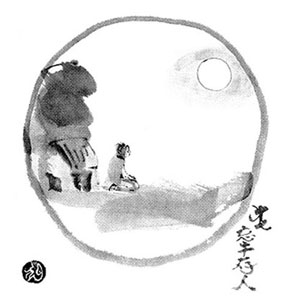
7

We then realise that Druidry is not something external, nor even internal – that it is something to be lived.  There is no separateness, no duality to Druidry – it is not a way of life, but it is life itself.  There is a stillness to it.


8.Both Bull and Self Transcended
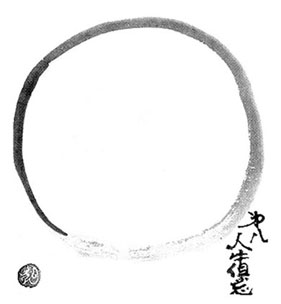
8

We are no longer separate from the world and from Druidry either.  Druidry is us, it was always us.  We experience each and every moment with the same reverence we would to ritual – everything becomes sacred.


 9.Reaching the Source
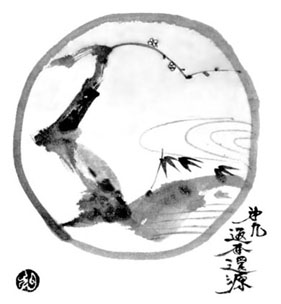
9

We have reached the source of life itself, and find that meaning or no meaning have no place – only life itself. There is no Druidry. There is no Self. There is no separateness.  All is unified under the banner of Life, changing moment by moment, unconcerned with meaning or no meaning.


10.Return to Society
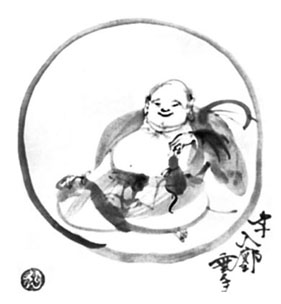
10We return to integrate what we have learned from our experiences, to share them and to help others who may be seeking.  We do what we need to do for ourselves, our family, the environment without any selfish thoughts – we simply do.  With the knowledge that we have gained that so expresses ourselves, and which is known as Druidry, we live as best we can, in the world, present, awake and aware.


The Dying of the Light

Dylan Thomas’ poem, “Do not go gentle into that good night” is often in my thoughts at this time of year, when the winter solstice is approaching and the ever increasing night draws close, the cold winds howling outside.  Yet I do not agree with the poem’s repetitive line – “Rage, rage against the dying of the light“.  

Though wise men at their end know dark is right,
Because their words had forked no lightning they
Do not go gentle into that good night.

Good men, the last wave by, crying how bright
Their frail deeds might have danced in a green bay,
Rage, rage against the dying of the light.

It would seem that the wise know dark is right, and yet their pride, hubris or egos get in the way of going gently into that good night, as their words “had no forked lighting” – they want to be remembered for their wise words, at least, is the suggestion. The true wise person has no need of such external gratification – wisdom is inherent, not granted externally. Written for his father, whom Dylan Thomas wanted to die raging instead of quietly, perhaps for his own selfish attachment or whatever reason, is still spoken of today when the nights are long and we seek illumination in every sense of the word. 

It’s all around us – gaudy, flashing lights – some set at incredible speed settings that I can only assume is to disorientate the viewer, often going up before the leaves have fallen from the trees and the ground not yet frozen.  Many, many people are raging against the dying of the light, putting up the Christmas or Yule lights, lighting the darkness and consuming considerable amounts of energy at this time of year in a display that is somewhat missing the point.  As pagans, we celebrate the return of the sun after the winter solstice, certainly – but we should also honour the darkness in the days leading up to the solstice with equal measure. 

Christmas or Yule lights can certainly be very pretty – if done tastefully, and using very low energy lights, turning off others that we would normally have on at this time of year to offset the energy.  But first we must come to grips with the darkness before we light the lights.  We must look into ourselves to see why and what it is that we fear, loathe, or deny in the darkness – why we are so hesitant to look into the abyss.  Is it because we, as Dylan Thomas did, equate darkness with death?

Yet it is the time of year when death is all around us.  One look at our gardens instantly confirms this – very few things are still alive above ground.  A cycle has ended, and the seeds of the next generation lie below ground to await the return of the light – but they know that this does not happen instantaneously on the winter solstice.  They respond to the growing light and warmth slowly, in the months after the solstice, in their own time, and hopefully not too soon, like some of my daffodils did last January…

Acceptance of death is key here.  We should not rage against it, but embrace it as part of the cycle.  Many people think that death is the opposite of life – yet death is a singular event, and as such its opposite would be birth.  Life has no opposite.  We do not rage against a birth – why should we rage against a death? 

Taking inspiration from the natural world around us, we follow its rhythms and cycles and turn inwards to nurture that which is most precious to us, to guard it for the coming year ahead. It is in that darkness where we can truly know ourselves, our thought patterns, our behavioural tendencies.  Looking inwards into our own darkness we can find that small spark of light that needs to be kept safe in the darkness until it is ready to come to light, and not be snuffed out like a candle in the winter wind. It is time to cease looking for a distraction from the darkness all around us, and instead focus on our own wellbeing, and nurturing that seed of inspiration within, as well as facing our own death and fear.  It is all too easy to lose that in the crowds doing late-night shopping amidst chintzy tinsel and bright lights, with tinny music being piped into the stores that are overheated because they leave the door open to attract more customers into the lure of consumerism.  If we must, we must, but then seek the darkness to recoup and recover. 

Honour the darkness for the wonderful rest that it brings.  Without it we would have no spring.  Celebrate the darkness – turn off all the lights and central heating during the evening of the winter solstice, if you can, and truly experience the time of year. At midnight, light the fire in the hearth or candles in the house to honour the change, slowly, very slowly, lest we become blinded by the artificial return of the light and stumble around unable to see.  Do not rage against the dying of the light – for all the rage in the world will not stop death or the darkening days leading up to the solstice. Embrace, embrace the dying of the light.


An Enlightened Druid?

Many people ask – what is enlightenment?  Oh for an easily explained answer.  The Buddha, when choosing his successor, simply held up a flower and one of his disciples was enlightened and smiled – he then became the successor.  There are many stories in Zen philosophy and spirituality about enlightenment, but none of these stories actually tell you just what it is. And nor should they – it is something to be experienced, not read or talked about.

Outiside of Japan, most Zen practioners experience enlightenment gradually, as opposed to the full smack upside the head that satori can create.  It is through meditaiton, and being completely aware that you gradually gain enlightenment.  As the ego starts to fall away, the so-called “real” self emerges.

To allow the ego to fall away, one technique is to use the “Don’t Know” mind.

“Everybody says, “I” — “I want this, I am like that…” But nobody understands this “I.” Before you were born, where did your I come from? When you die, where will your I go? If you sincerely ask, “What am I?” sooner or later you will run into a wall where all thinking is cut off. We call this “Don’t know.” Zen is keeping this “Don’t know” mind always and everywhere. When walking, standing, sitting, lying down, speaking, being silent, moving, being still. At all times, in all places, without interruption – what is this?” – taken from http://zen.buddhism.org/about-zen.html

It’s a hard thing to admit that we don’t really know anything.  And yet, any true scientiest will tell you that it is impossible to know 100% about anything – there is always margin for error.  When we embrace the fact that we don’t really know anything, whole worlds open up for us.  We can examine ourselves more deeply, and then ponder even on the notion of self if we were to take it one step further.  Enlightenment is said to strike when we realise that there is no self – that we are all part of everything else. In Zen, the term “oneness” is often used, but I don’t like the monopoly that this word invokes – instead I think of it as a “wholeness”.

When we are completely in the moment, when our chattering minds are stilled, when our sense of self falls away and there is only the now, we become enlightened.  In this state, many great things can happen – the perfect haiku is written, the archer and the target become one and the bullseye is hit without thought, the music simply flows, the painting emerges.

This reminds me of a similar term in Druidry, which is awen.  Many people now believe the Welsh word’s translation to be something akin to “flowing spirit” or “flowing inspiration”.  Is this any different to the Eastern version of enlightenment?  As Druids, we gain awen from the world around us, which inspires us to create or to be still, to act or to remain passive, to be in complete and total relationship with the world around us.  Not so different to satori, is it?  Again, to be in a perfect relationship with the world around us, we must learn not to separate the I from the It – instead viewing the world as a whole rather than as separate.  In this way, the inspiration or flowing spirit can flow freely down all channels directly into our soul and out into the wider web of the universe.

So, am I enlightened?

Don’t know.

Animals or individuals? The Human Arrogance…

BBC News published an article on dolphins recently, explaining the point of view that some scientists have come to conclude  that dolphins and whales are “people” and should be given rights as individuals. See the article here – http://www.bbc.co.uk/news/world-17116882

Reading this article provoked conflicting emotions within me – both happiness that finally some people are starting to catch on, and anger at the continuing human arrogance and ignorance that is our perpetual state of being for the majority of humankind.

The exceeding arrogance, that we as human animals, determine whether an animal is “sufficiently intelligent” just rocks me to my very core.  As an animist, I see and hear, I acknowledge, with respect, the soul song, the physical manifestation of every living thing in as much as I can with total awareness – I’m not perfect, but I usually catch myself out when I find I am lacking.  That this outmoded and outdated worldview still exists today, coming from philosophies and religions that place humankind at the top of some existential hierarchy makes me want to scream my outrage at the complete and utter stupidity of it all.

“It is based on years of research that has shown dolphins and whales have large, complex brains and a human-like level of self-awareness. This has led the experts to conclude that although non-human, dolphins and whales are “people” in a philosophical sense, which has far-reaching implications.” What I want to know is why we are always comparing other animals to our own selves, our own brains and ideas about self-awareness, especially using really really old philosophy that maybe, just maybe, needs to be rethought? How limiting is that – to compare all animals to our own humanity? Sounds primitive, totally ridiculous – reminds me of the saying “Dogs think they’re human, cats think they’re Gods”.  If we are so damned self-aware, why can we not recognise that this ability may be in other animals as well – we just don’t see it, we can’t find the “place in the brain” or the trigger cues, such as the mirror test mentioned in the article, because we are lacking in sufficient knowledge to see or find it.

My point is made clear in Dr Marino’s statement in the article –  “We went from seeing the dolphin/whale brain as being a giant amorphous blob that doesn’t carry a lot of intelligence and complexity to not only being an enormous brain but an enormous brain with an enormous amount of complexity, and a complexity that rivals our own.” We failed to recognise something, and so we discounted it – what we don’t understand, we throw away, ignore, or worse – we demean it.  And the icing on the cake? Believing that we are special, that we have enormously complex brains that make us different.  How about we just have different brains?  We can’t say for 100% that other animals don’t have complex brains – they may just use them differently.  We cannot compare apples to oranges.  And that also raises the question – what of all the livings things that don’t have brains?

It is interesting to hear Ethics Professor, Tom White, discussing at what point we needs to step in to defend what we see as equal to our own self.   He defined dolphins as “non-human persons”, stating that “a person needs to be an individual. If individuals count, then the deliberate killing of individuals of this sort is ethically the equivalent of deliberately killing a human being”.

Does a person have to be an individual to count?  What are the criteria? Is it universal? Why?

In an interesting related article, five Killer Whales are sueing Seaworld on slavery charges – full article here http://www.bbc.co.uk/news/world-us-canada-16920866. Interestingly, one of the whales in on the plaintiff’s side is also a murderer – he killed his trainer in a show, and has been linked to two other deaths http://www.bbc.co.uk/news/world-us-canada-12920267 .  Clearly, he is not a happy bunny, so to speak – that or he is demonstrating his natural song, to kill things seal-size (note he did not eat them, however, as he would have a seal – could we taste that bad, or is this demonstrative behaviour against slavery?) If we see him as a person, could we then charge him with murder?  The icing on the cake, is the trainer’s opinion on the matter to put him back in the shows still (with the trainers safely behind steel bars where they can’t be harmed – yet). “ Participating in shows is just a portion of Tilikum’s day, but we feel it is an important component of his physical, social and mental enrichment,” he said in a statement. Once again, human arrogance and ignorance rears its ugly, ugly head. That, and the whale makes a killing financially for Seaworld (pun intended, with all due respect to the family of the dead trainer and two others victims).

When are we going to wake up and smell the proverbial coffee? When are we going to admit that we are not smarter, cleverer, or the dominant species in a world that is so rich and vast with other living beings?  When are we going to admit to ourselves that we don’t know everything, that we can’t really even know anything?  This has really got me thinking – it is even okay to ride horses?  In my love of horse riding, have I been ignorant too?  I have never ridden a horse that, from what I can tell, doesn’t want to be ridden – I learned my lesson from a temperamental Arab mare who threw me off whenever she just wanted to be left alone.  But what of the others who were not so overt in their opinions? Does that cat really want to be picked up an cuddled?  Do those dogs really enjoy pulling that sled?

How much longer can we all be complicit in our arrogance and ignorance?