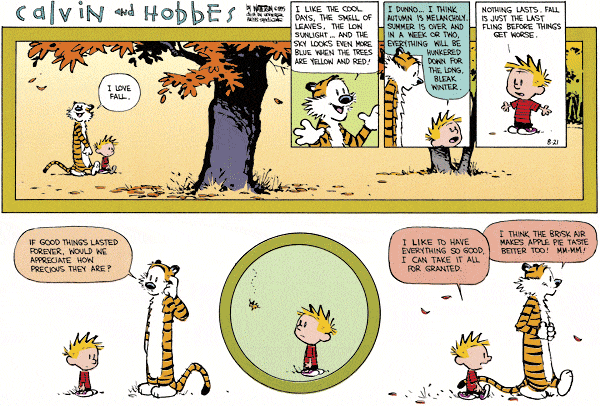
Precious things…

I have come across many people in my life who are part-time Pagans. Like a Christian who only considers God when in church on Sunday, I cannot relate at all to this form of religion or spirituality. For me, my religion is utter dedication, a full-time affair that seeps into every decision I make. I am not überPagan, I know. I make mistakes. I do fail. I am always questioning, however, looking for ways to improve my life for future generations, for the ancestors yet to come and in honour of the ancestors of blood, tradition and place.
This is going to be a critical blog. If it upsets people, I apologise for upsetting you.
The part-time Pagan doesn’t consider the food that they eat. They’ll happily munch away on fast food while piling on the pounds, regardless of the effect that it is having on the planet and on their health. They do not say a prayer or words, or even think before they shove it into their mouth.
The part-time Pagan doesn’t meditate. On anything. At any time. They live a reactionary life, filled with excuses for not meditating. They allow their emotions to rule their actions, their behaviour often less than appealing. They often act out of fear and insecurity.
The part-time Pagan performs ritual at the seasonal celebrations, and may gather at pagan moots or events, but for them it pretty much ends there. They fill their free time with crap television shows and computer games.
The part-time Pagan does not consider the ethical implications of the life that they lead. They buy the cheapest factory sweat-shop clothing, enscribed with the emblem of their faith, and proudly wear it to display their religion. Oblivious to the fact that the religion they are promoting is simply capitalism and selfishness, corporate bodies and entities, they support dubious industry with the money that they spend. Crystals raped from the earth, animal skins hunted for sport, cigarettes and alcohol. They do not look into the banks that they use, the companies that they work for.
The part-time Pagan does not take care of their body. They do not exercise or eat well.
The part-time Pagan does not consider the ancestors, most importantly the ancestors of the future. They care not a jot for the generations to come, not wanting to sacrifice any of their comfort in the present moment. They are afraid of changing their habits, even for the benefit of all, for it would require willpower and sacrifice.
The part-time Pagan may have rooms full of ritual gear and regalia, but has yet to actually commune on any level with the world at large. They often seek the “easiest” path – to deity, to power, to wealth and fame. They hate hard work.
Small changes can turn the part-time Pagan into the full-time Pagan. It requires a willingness to step out of the comfort zone, of perhaps giving up some of the things you “love” – meat, television, cigarettes, time on social media. Becoming more present in the here and now, giving your full attention to another and respecting them is another step forwards. Stop buying cheaply produced things that will fall apart. Grow vegetables. Meditate. Look at how you relate to the world, and where you can improve upon those relationships.
This is but a start. Sometimes I just want to scream, to shake people by the shoulders and cry out: “This is not Paganism!” I do know that my Paganism will differ from others, however, it is my belief that all Paganism is rooted in a love for the land. Changing any of the above would be a step towards strengthening that relationship and that love.
May we all walk our paths fully awake and aware to the gods, the ancestors, the land and to the cycles of life and death all around us.
Often we relegate things like love and lust, rage and compassion, anger and fear into emotions. If we think of them as just emotions, we may not work with them on a level that is appropriate. In fact, if we do not give them the respect that they deserve, they can sneak up on us when we least expect it and give us a good kick up the arse.
My teacher, Bobcat told us students many years ago that we should regard them as gods. It took me a while to understand what she meant, and only after the experience of years since does it all seem clear to me now. We often have to stumble and fall before we actually pay attention to the ground we are walking upon. The idea of the gods of human tides took a good few years to sink in, but they now sit comfortably within my framework of ethics, living in honourable relationship.
Gods often demand respect. Not because they are seeking power over us and have something to prove, but rather that if we do not respect them we could be swept away on their currents of energy. It is often said that in Druidry we do not sublimate to the gods, but rather work to create a relationship with them that is rich and sustainable, as we do with all things.
The gods of the human tides are treated with the same respect as the gods of thunder and lightning, the sea and sun, the winter’s howling and the spring’s blooming. We must look carefully into our anger, our lust, our greed, our compassion, our generosity in order to understand the intention behind them better. If we are not careful, we can get swept away with them all too quickly. If we do not stand our ground we can jeopardise our entire existence, all that we have worked for, all our dreams and schemes, our morals and our ethics.
It requires a willingness to be soul naked and bare, to look inside the self and see the constructs of it in order to better understand why it works the way it does. It requires utter honesty. How many of us are completely honest with ourselves? Very few, if any.
I am not an exception. I have fallen before the gods of humanity, swept away on various currents and seeing the destruction that is wrought by the giving in to their powerful surge. It has led me to look deeper within myself to find the root causes of why I allowed that to happen, and in doing so ensuring that it doesn’t happen in the future. Creating a relationship with these gods means that I understand them better, and myself more, therefore acting with intention instead of simple reaction. Great doubt and insecurity, great fear and anger all lie within our souls. Facing these requires great courage and strength, great faith in ourselves and in the world around us.
None of us are perfect. But we learn from our mistakes, the tripping up awakening us, making us pay attention to the footsteps we take along life’s journey. Then each step is walked with honour, respect and integrity. Do not dwell on past mistakes, but do not let them happen again. Awake and aware, we walk forward, deeper into the heart of the forest and the wisdom of the oak.
Now available on Amazon, check out this lovely book – something to sink your teeth into! x
Since last February I have been working with others on a book about contemplative Druidry. It has now been published and it is available on Amazon.com and Amazon.co.uk in paperback and on Kindle.
‘Contemplative Druidry: People Practice and Potential’ was written to show that contemplative approaches are growing in modern Druidry, and to look at ways in which they might be fostered. Practices discussed include solo and group meditation, contemplation in natural settings and contemplative arts.
In my approach to this project, I decided to take a snapshot of contemplative Druidry in a particular place and time. The place is England, with a particular (though not exclusive) focus on a Druid contemplative group meeting in Gloucestershire. The time is March-July 2014, where 15 Druids responded to a questionnaire either through face-to-face interviews or in writing.
The questionnaire was designed to let respondents talk freely about their understanding of ‘contemplative Druidry’…
View original post 288 more words
Whoa, Shane. Wow. This.
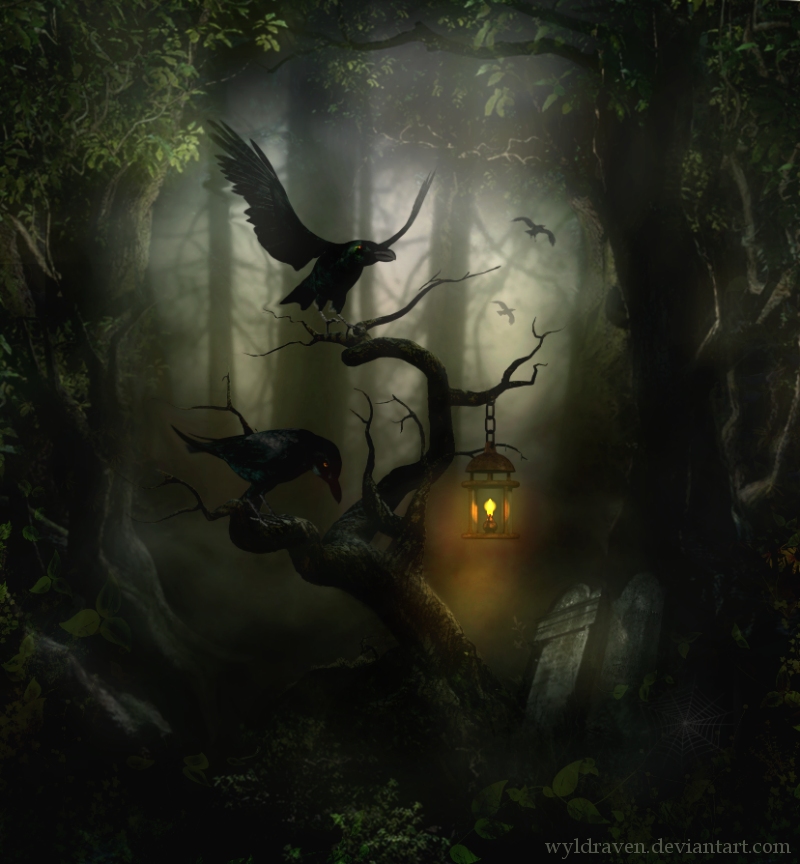
Raven’s Hollowby Wyldraven © Wyldraven 2011- 2014 http://wyldraven.deviantart.com/art/Raven-s-Hollow-208469580
In a blog post written last year, I wrote about my contemplations on the Samhain tide of the year, touching upon the nature of death and the Otherworld.
As the darkness closes in with earlier nights and later mornings, thoughts and feelings seek out the lessons to be learnt in the growing dark, where boundaries fall away and where we know nothing at all. Walking through the garden at sunset, shuffling though the fallen beech leaves, greeting my cat at her gravesite (who passed away last Yule), watching as my garden plants return the energy to their roots, I am surrounded by death as much as I am surrounded by life.
Thoughts inescapably turn to death during the Samhain tide, where in Druidry it is recognised and not shuffled away, never to be spoken of in conversation, turning it “morbid” or filled with superstition that the mention death will bring. Death comes to us all, whether we talk about it or not. Might as well talk about it.
My first thoughts turn towards the concept of the Otherworld. Many within Druidry believe in such a place, or places, where our soul goes to rest, to party, to do whatever it is we believe it does, perhaps before we reincarnate. While I do believe in reincarnation, my belief is much more simplistic that this.
More and more I come to realise that, at least for me, there is only this world. There is no Otherworld. There is no veil between the worlds, for there is only this world. And what a wonderful, awe-inspiring world, filled with gods and ancestors and life and death.
The belief in reincarnation, that our soul lives on to occupy another body at a certain time either in the future or in the past, is based upon the belief that there is a place where our soul goes when we die. For me, there is no such thing as “away”. We cannot throw our garbage “away”. We cannot be “away” with the faeries. Our souls cannot go to a resting place before coming back to this world. There is only this world. Let me elaborate.
Using nature as my teacher, I look deeply at how death occurs, the process and the stories that unfold. Death is all around us, from the earth we walk on that is made up of millions of dead things, to the death that we ourselves create with our very existence. Life is also all around us, things coming into being and growing, being nurtured and nurturing in turn. When something dies, it returns back to the soil, to transform into another way of life. Essentially, for me this is what reincarnation is all about. Changing our form. When I die, my body will be devoured by bacteria and worms, become plant food and be drawn up through the roots of trees to be exhaled into the deepening twilight. This is change, this is reincarnation, becoming incarnate in another form, becoming incarnate in a legion of other forms.
My body is made up of a similar legion of other forms, dating back to when we were all just star stuff. Everything on this planet has an original ancestor of star material, and whatever came before stars. My body is made up of living things and dead things. In my bones are stars, in my blood is iron from the hills where I grew up. All these things are living through me, and will continue to live even when I die to be expressed in a different form. They don’t go anywhere but right here.
The human crisis of self-awareness has led to a clinging of the ego which convinces us that without the idea of a separate identity, a sense of self, an “I am” we are simply lost in complete annihilation upon death – that we cease to be. Screaming for attention, it feeds upon the fear and insecurity that the knowledge of our own deaths bring in the darkness. A few religions, philosophies and spiritualities overcome this fear, learning how to transcend the ego, to let it go in order to become one again with the universe. As a Druid and Pagan, this feels right to me, for this leads to a life that is completely integrated with the natural world around us. It drops the illusion of barriers between us and the environment, and allows for full immersion into the present moment where we can be awake and aware to every shimmering drop of existence.
Yet in modern paganism the focus is usually on the “I”, the personal transformation into a better being and a better Pagan, to search for the truth of our souls and to live that truth honourably in accordance with our tradition. Self-actualisation is a big thing, not only in Paganism but also around the world. Based on concepts of the self, a return to the self and coming into our own power, we work on our selves constantly. This in itself is not a bad thing, but for me it needs to go one step further. We have to look inside our selves to understand the nature of the self, and then we can be rid of it. Emma Restall Orr discussed this in a very poignant essay, “After Paganism”, in Moon Books’ Essays in Contemporary Paganism (2013).
Many would query the validity of this, as for them the be all and end all is their sense of self, what they can do and what they have achieved in the world. Without this sense of self, would they be able to make their dreams come true, to work for political and environmental causes, to further their own desires and needs?
While I do not, as yet, have an answer to this question, it is still one that is worthwhile in the asking. I truly believe that we can, at least for moments, perhaps days or weeks, months or even years to drop that sense of self in order to integrate fully with the world. When we have, we can come back to the world with a sense of self that is not separate, that observes but does not judge, that is wakeful and aware without needing to fight for its own existence.
Returning to the subject of death and dying, if we have sufficiently come to terms with the notion that the self is not separate, and that there is no need for an individuated self to exist then when we die, we simply return to the earth. That spark that is human consciousness, that allows us to think about life and death and the self, that too returns to the earth. I seriously question whether humans are the only beings on the planet with the capability of questioning on these subjects, for it my belief that we simply have not been able to language this with other species, out of ignorance or human arrogance, or perhaps both.
Everything returns to the earth. Everything. My consciousness will seep into the soil even as my blood and bones, hair and nails. In this, complete and utter integration will occur, a reincarnation into a myriad of forms. My songs will blow with the wind. My eyes will be in the heads of flowers. My heart will be deep in the darkness of the soil. I will not leave, I will forever be here, in this world, in a multitude of forms. The ego “I” that I speak of will be long gone, released willingly into the night, but the sefless “I” will still be here.
There is comfort in this, in the knowledge that when we die, we don’t go anywhere. The ancestors are always with us, everywhere. Everything that has ever lived and ever died is still here, in another form, whether pebble or mountain, horse or mouse. You can’t create something out of nothing. You can evolve, but that’s a different story – our story is one that is shared universally.
Some would say my thinking is based upon a materialistic view of the world, however, when everything is inspirited, when everything has a consciousness that is not separate, there can be no question that it is wholly animistic. It’s not just the case of “the worm crawls in, the worm crawls out, the worm plays pinochle on your snout” – there IS more to it. Death is not stopping. Death, or dying, is an event that takes place – it is not a “forever”. Death is not the opposite to life – the opposite of death is birth, a singular event. Life has no opposite.
If there is no opposite, then there is no need for other worlds. Everything is right here, right now. The gods of nature are all around us, in the sunshine and in the rain, in the air that we breathe, in the storm and in the drought. So too are the ancestors, our ancient ancestors and our grandmothers who all are letting go of their stories into the soil, to be told again in other forms.
I realise that my words may not be in tune with the majority of Pagans, however, they are spoken with the utmost respect. And in the darkness I breathe, deeply, until there is no longer anyone breathing.
A great blog post here folks, that challenges the “traditional” with real engagement, making us think fully about what we say or do in ritual and in the rest of our lives in accordance with our Paganism.
Advisory:
The subject matter of this post, to some, will be challenging. It is not my intention to cause offence as such but I will be questioning some core aspects of some general Pagan frameworks. If your path is clearly defined for you and you are happy with that definition, it would probably be better to now move away from this post. Any comments directed to this site that adopt an antagonistic or personal attack will be deleted.
Ever since I embarked on this journey of what at this time, is self defined as Druidry, there have been aspects of general paganism and, indeed in some quarters, Druidry, that have created problems for me. These problems at this time, the summer solstice of 2014, now appear to be at the forefront of my thoughts and it’s time to address them.
Both myself and my partner have been recently getting involved…
View original post 1,072 more words
This is a reblog from my channel, DruidHeart, at the Witches and Pagans website. To read the full article, click HERE.
Here in the UK, the weather has turned and the colder air sweeps down from the North. Nights are longer, as the sun jumps along the horizon with each rising and setting, heading further and further towards the south. Trees are changing colours, and plants are beginning to die back, the green fading into golden and tawny hues, foliage less dense and earth beginning to peek through the underbrush.
The tide of Samhain has begun, when, after the autumn equinox we prepare for the darkness to come. The balance has been tipped, and we have tipped with it, our internal clocks trying to adjust to new temperatures and light levels. Often, we try to establish our centre, attempting to find some foothold or handhold in the coming darkness, our egos crying out the great rallying cry of “I AM!” The darkness, however, knows the folly of this, and smiles as it creeps ever closer.
In the darkness there are no guidelines. There are no boundaries. There is no up or down, no left or right. There is only impenetrable night, a sweet release from the constraints of the known…
To read the full article, click HERE.
On the 29th of September 2014, at the Annual General Meeting of The Inter Faith Network for the United Kingdom (IFN UK), The Druid Network (TDN) was admitted to Membership.
IFN works to promote understanding, cooperation and good relations between organisations and persons of different faiths in the UK.
In April 2012, IFN refused the first application for membership of The Druid Network due to its current membership policy restricting membership to the ‘big’ nine faiths. This refusal resulted in TDN becoming involved in dialogue with IFN, with a view to reviewing their membership policy to become both more inclusive and to remove any suggestion of discrimination against minority faiths. Other interested parties also took up this challenge and this led to a meeting, hosted in the House of Lords, discussing religious freedom within the UK. This meeting was held in November 2012 and representatives of some twenty religions gathered in the House of Lords to raise their voices in defence of religious freedom. The meeting was admirably led by the excellent Rev’d Peter Owen-Jones and TDN played a key role. This event was recorded in pictures and is available at: http://www.demotix.com/news/1636944/religions-come-together-house-lords#media-1636867 The eminent human rights lawyer, John Halford, from Bindmans LLP publicly issued a legal opinion for the event at the House of Lords in November. http://religiousfreedom.org.uk/guidance.pdf
Following the House of Lords event TDN was invited, along with other interested parties, to provide input to the IFN Strategic Review, this review to include consideration of the membership criteria of IFN. The Pagan Federation (PF) and TDN were further invited to a meeting with some representatives of IFN to provide information and clarity on their beliefs and practices. The prior membership rejection was reported in an article by Ruth Gledhill of The Times newspaper in December 2012 available to subscribers at: http://www.thetimes.co.uk/tto/faith/article3617192.ece (non subscribers can only view the first couple of paragraphs of the article).
The process of IFN’s Strategic Review, giving consideration to all the arguments placed before them, resulted in a revised membership policy that is more inclusive whilst still holding the right to determine membership. In light of this change The Druid Network re-applied for membership under the new membership policy.On 29th September 2014 at the AGM of the Interfaith Network , the following new faith bodies from Minority Religions/New Religious Movements were admitted to membership of the Inter Faith Network:
• THE DRUID NETWORK
• THE CHURCH OF JESUS CHRIST OF THE LATTER DAY SAINTS
• THE SPIRITUALISTS’ NATIONAL UNION
• THE PAGAN FEDERATION
In addition, Revd Prudence Jones of the Pagan Federation, was appointed to the Executive Committee of the Inter Faith Network – the first person outside the “nine mainstream faiths” to achieve this position.
This is an historic achievement on many levels, it is the fruition of the work of many people seeking to find resolution within conflict, those people coming from many diverse backgrounds, professions and faiths. The Druid Network extends its appreciation and thanks to all who helped bring about this momentous change.
The concept of universal ethics is the one that makes the most sense to me. How I live my life depends on one, simple question: “What if everyone did the same?”
Dismissing any notion or remarks of creating a totalitarian world by using such a universal concept as simply fear of making personal change, it is my belief that by asking ourselves this very question could greatly increase the quality of life for everything on this planet. Let me provide some examples:
These are but a few examples of “what ifs” that could change the world. Some are small things, some are larger, but the impact on the whole is still considerable if everyone followed the same guidelines. Looking at the bigger picture, and thinking about our actions isn’t always pleasant. It can reveal some real hard truths about ourselves that we have ignored for years. It can turn our world upside down. Equally, it can create within us a lasting peace in the sense that we know that we are walking on the right path. It can provide a real sense of purpose, of integrity and of integration with the rest of the world.
Pessimistically, I don’t see it happening anytime in the near future. There are far too many humans out there whose egos are striving for attention, to fulfil their own desires and need for recognition. In our striving towards self-actualisation, we can become so focused on the self that when we have achieved a sense of self, we stop there. We need to broaden that sense of self, to extend it beyond the self into the whole, and from there gain a better understanding of the world. The best leaders are those who work creatively to make the world a better place for all. The worst leaders are those that use their power for their own personal benefit.
Universalist ethics could provide the way forward, a way of thinking beyond the ego and the self into a more holistic way of being. It requires the fear that lies behind all personal striving to be let go, to dissolve into the outbreath in order to breathe in pure awen, pure inspiration. Only then can we move forward, together, as a community, as a species and as a planet towards real actualisation and not mere pageantry.


 Down the Forest Path