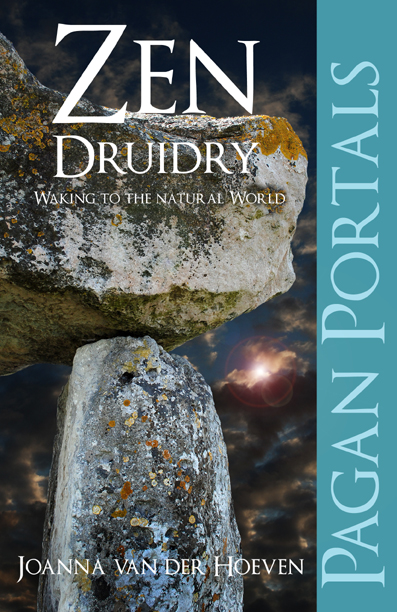
Great Reviews for Zen Druidry!

Great reviews still coming in for Zen Druidry – you can still pick up a Kindle copy for only £1.23, or a paperback version from other sellers on Amazon for only £1.03! In North America, Kindle versions are only $1.97, and paperbacks start from $3.20 – a great deal…

Zen Druidry

zen druidry low res

Right Livelihood

autumn leavesDuring the time around the autumn equinox, in my particular path of blending Zen and Druidry I focus on the Buddhist aspects of Right Livelihood within a Druid context.  I do this throughout the year, blending the Buddhist Eightfold Path into the eight seasons of modern Paganism, and have found it spiritually inspiring and enlightening. (For further reading into Zen Druidry, please see my latest book, Zen Druidry, available on Amazon and through Moon Books).

Right Livelihood, in essence, means taking on a way of living and working that does not compromise the other principles within the eightfold path, or indeed any of the Dharma Principles. However, it is much more than ensuring that your occupation is not harmful to others – for me, this accords to everything I do, my entire life.  My livelihood is not just my office job, or my dance company, my writing or my work as a Druid priest. My livelihood is the way in which I live my life – my whole Druidry as a way of living, not just as a practice.

I have ensured that the traditional view of Right Livelihood is upheld in my life – all my jobs do not create harm in others, abuse others or the environment inasmuch as is humanly possible.  Yes, three out of my four jobs require that I drive a car, and that is a compromise that I have to make, which I try to offset in other areas of my life.  I used to work as a legal secretary, but was slowly having my soul destroyed by helping the rich dodge inheritance taxes.  It took the universe to give me a great kick up the bum to get out of that job and dive into something more meaningful for my own self – other similar legal jobs may work for some people, it just wasn’t in accordance with Right Livelihood for me personally.  I quit, went back to university and got a job straight away working for a music company and charity, got writing again, started a dance company and began in my priest work.  I felt much more at ease with myself, knowing that I was partaking in Right Livelihood (or Livelihoods!).

Some of us may feel trapped in jobs that we do not like, but we need the money to support our families, or ourselves.  However, that doesn’t mean that we cannot be on the lookout for something that would sit better within our hearts and souls, and it also doesn’t mean that we can’t offshoot this, say perhaps by doing some volunteer work, donating to charity, etc.  I personally don’t have much spare time, but the time that I do have I try to use wisely – though this year I haven’t succeeded as well as I may have, having run myself a little too ragged.  Organising charity events, performing wedding ceremonies, on top of my other jobs left too little time for me and my husband, and in that regard I failed at Right Livelihood, as there was harm and neglect on that front.  I have worked too hard, and now physically and emotionally see the repercussions. Now, in the autumn of the year, when I can see the results of what I have sown in the springtime of the year, I can also reflect on how to do better next year.

Right Livelihood means living right – it’s not just your job.  For me, within Druidry, it means establishing a life that has as little impact ecologically as is possible at the time for me and my family.  It means investing our savings in solar panels, recycling and composting everything, using cruelty and chemical-free toiletries, working towards creating peace and inspiring others.  It means walking the walk instead of just talking the talk.  It’s bloody hard to do. It means being aware of everything around you, of the impact that you have on the world, from the interaction I have with my co-workers to how many kilowatt hours our household has consumed in the last year.  It means sacrificing ignorance for knowledge, and the practical application of such.

Druidry teaches us about creating honourable relationships with the world around us, with all things if you are an animist like myself. Seeing the inherent value in all things means that no single thing can be taken for granted.  Incorporating Zen means bringing awareness of my own self and how my brain works, as well as working on an awareness of the world at large by living as mindfully as is possible.  Sometimes I am hugely successful at both – other times I fail spectacularly.  At any rate, it’s a learning curve.

Throughout the darkening days until Samhain, my focus on Right Livelihood is a constant reminder to live well.  Taking inspiration from nature, I learn not to take more than is necessary, or at least I am inspired not to – succeeding in this regard is damned hard in a fairly affluent Western society.  I breathe into the growing twilight, the longer nights and learn how to simply be in the world, leaving behind barriers of separation as much as I can, within myself and nature, humanity and the universe.  The rich scents of autumn tingle in my nose, the decaying leaf mould and woodsmoke, the chill winds and starry skies above inspiring me to continue. It is  Inspiring me to create a life that is worthwhile, and in doing so, following a path of Right Livelihood.

Zen Druidry at No. 10!

My little book, Zen Druidry is currently at No. 10 on Amazon’s Best Selling list for Pagan and Neo-Pagan books.

I would like to take this opportunity to thank everyone for their support, and for the encouragement of the community – without you there would be no book! A big thank you to my publishers, Moon Books, and to my editor, Trevor Greenfield, who believed in the success of this book, even where I was a little unsure!

Thank you, thank you, thank you.

J.x

P.S. As of this afternoon, it has reached No.4!

Four Mantras for Good Relationship

Vietnemese Zen Buddhist monk, Thich Nhat Hanh recently spoke in a live webstream from Plum Village (the community he set up in France) about many things, one of which really struck a chord with me about relationships.  He has produced four mantras which help us to learn compassion for each other, and to better open up lines of communication, which is key to any relationship. The four mantras are:

  • Darling, I’m here for you.
  • Darling, I know you are there…and I’m so happy you are there.
  • Darling, I know you suffer…that is why I am here for you.
  • Darling, I suffer – I am trying my best to practice. Please help me.

The first mantra, “Darling, I’m here for you” demonstrates that the other is not alone in this world. Indeed, we are never alone – the idea of being alone is one that has hounded us ever since we made the mind/body disconnection.  The rationalists and the materialists have argued this one thoroughly, so I won’t go into it here, but suffice it to say that within most branches of paganism, the mind are body are thought of as connected.  That being said, through our bodies we are all connected to every other thing on this planet – we contain minerals in our blood that are found in stars, we breathe the air our ancestors breathed, we are all held down by gravity.  There can be no separation in the truest sense.  Our current lives lead us to believe that there is separation – could this simply be a marketing ploy, to divide and conquer?  Something to think about later… but I digress.  When we say “Darling, I’m here for you” we are putting the needs of another ahead of our own, as well as showing them that they are not alone.  In today’s society, that can be and is a great gift that we can give to others.

The second mantra, “Darling, I know you are there, and I am so happy you are there” shows us the joy that others give us, simply by sharing this journey is life.  It is a simple recognition of another soul, which again in today’s society can be so lacking. We lead such virtual and busy lives that speaking these words can reconnect us to the one that means so much to us.  We take so many things for granted, and we should never, ever take our loved ones for granted.  We must remind ourselves each and every day how wonderful it is to have these people in our lives. Allowing ourselves to feel the joy in having someone in our life is another gift, and when we express that joy, that joy spreads throughout the world.

The third mantra, “Darling, I know you suffer, that is why I am here for you” enables us to feel compassion for others in our lives, to show them that we see that they suffer.  So often people feel that they are suffering alone, and when we acknowledge the suffering of others, we immediately have more compassion for them, whether they are our loved ones or not. Everyone is fighting their own battles.  This changes not only our worldview, but changes the perception of those whom we are trying to connect to. Simply listening to someone, truly listening to them, is a great aspect of this mantra.  So often we are not listened to – we are often heard, but is anyone really listening? To give your full heart and attention when someone is trying to connect with you, or vice versa, is key to any relationship.

The fourth mantra, “Darling, I suffer – I am trying my best to practice. Please help me” is perhaps the hardest one to fulfil.  So often our egos get in the way that we simply cannot ask for help, let alone allow others to see our suffering.  How many times have you “suffered in silence”? Why do we do this?  Sometimes, when a loved one has upset us, and then they ask us “What is wrong?” our immediate response is “Nothing,” filled with anger, fear and tension.  They know that something is wrong, but we refuse to tell them in an attempt to punish them for hurting us.  If we allow that hurt to express itself, it will not linger and communication can open up in order to find a resolution.  If we simply answered the question, without judgement or anger, we might be able to see the other side.  We must admit to others that they have upset us, and we must do our best not to let our anger get control. We feel our anger, but we do not attach to it. By not attaching to it, we can talk about it with greater compassion and find greater healing.  We do our best to practice.  When we ask for help, we are putting aside our egos and allowing that other person in.  It’s not easy, but it does change everything. So often our anger is based on a misperception, and allowing the room for that perception to be corrected gives us greater scope for compassion in the world today.

These four mantras are changing the way that I relate to others, I feel in a truly positive and beneficial way for everyone.  For that, I am truly thankful!

Living with Right Speech

From Lammas, the first harvest, to the Spring Equinox, in my spirituality I focus on a specific aspect of the Buddhist Eightfold path – Right Speech.  For every one of the eight pagan festivals, I have corresponded a part of the Eightfold path, finding a great blending of the two traditions together (see my book, Zen Druidry, for more details http://www.moon-books.net/books/pagan-portals-zen-druidry).  To me, at this time of year when the Celtic peoples gathered together to celebrate the harvest, participate in games and competitions, wedding ceremonies and such, considering how to converse and behave appropriately was paramount in order for the tribe to thrive and meet other tribes without violence or bloodshed.  I see this paralleled in the Eastern concept of Right Speech.

So, what do we mean when we speak of Right Speech?  The concept of right speech involves four elements; abstaining from false speech, abstaining from slanderous speech, abstaining from harsh speech and abstaining from idle chatter.  For the Buddhist, this shows the sacredness of speech, and gives us a framework within which we can work towards more compassionate and thoughtful speech.

Here is a quote taken from The Secular Buddhist:

“The Buddha divides right speech into four components: abstaining from false speech, abstaining from slanderous speech, abstaining from harsh speech, and abstaining from idle chatter. Because the effects of speech are not as immediately evident as those of bodily action, its importance and potential is easily overlooked. But a little reflection will show that speech and its offshoot, the written word, can have enormous consequences for good or for harm. In fact, whereas for beings such as animals who live at the preverbal level physical action is of dominant concern, for humans immersed in verbal communication speech gains the ascendency. Speech can break lives, create enemies, and start wars, or it can give wisdom, heal divisions, and create peace. This has always been so, yet in the modern age the positive and negative potentials of speech have been vastly multiplied by the tremendous increase in the means, speed, and range of communications. The capacity for verbal expression, oral and written, has often been regarded as the distinguishing mark of the human species. From this we can appreciate the need to make this capacity the means to human excellence rather than, as too often has been the case, the sign of human degradation.” http://www.thesecularbuddhist.com/nep_04.php

Living in such a verbal society, we must take extra special care of our words, both verbal and written.  It is an increasingly difficult thing to do, in my opinion, when we are living “virtual lives” more and more with the internet.  We have an “online presence” as much as our real physical presence.  It is up to the individual how closely the two are related.

What we say, both physically in face to face encounters, as well as in a virtual community or forum may have varying degrees of impact, dependent upon who is actually listening.  The fact of the matter remains – whether it is virtual or physical, there is an impact.  For someone to be cruel to another person online could have devastating consequences (as we have seen recently with the suicide of two teenagers bullied on a social media forum).  A person may be attacked by an online community, and feel no repercussions whatsoever.  In a face to face situation, the reverse might happen.  One thing remains – we are personally responsible for our own behaviour, for we cannot control the behaviour of others. We can lead by example, but underlying fundamental control of others is beyond our grasp.

I have been verbally attacked on social media forums, bullied and trolled.  As yet, it still does not get any easier with time.  I stand by the view that the internet is as much a tool for sensitive souls as it is abused by being a playground for trolls.  I do not think that sensitive souls should have to “toughen up” in order to be online or to deal with face to face encounters. I think that people should be responsible and culpable for their actions, whether virtual or real, and take others thoughts and feelings into consideration.

As a recent example, a friend of mine told me that there is now a new term in a couple of UK LRP (LARP) communities/systems which is replacing a previous term.  He finds this fascinating, as he loves studying etymology.  It is indeed food for thought!  The previous term within the community was “special snowflake”, something that people used to deride another person on the basis that snowflake in question thought of themselves as being unique, and therefore life should go according to their own terms on this basis.  The new term that has cropped up to replace this,  is “bluebell”.

Now, some of you may know of my decision to abstain from a particular company due to the reason that I cannot condone the fact that each spring they hold battles in woodland that is carpeted with the most brilliant bluebells.  For an in depth look at this, please see my previous post “ Druidry and Choices” here: https://downtheforestpath.wordpress.com/2013/06/04/druidry-and-choices/.  It would appear that some players have decided to take it upon themselves to take this particular subject and twist it around to insinuate that I was a “special snowflake”.  There was some agreement by players on a social media board, before it exploded and abuse and trolling were hurled by some members.  All I asked what if others felt the same way as I did about protecting what I saw as a beautiful woodland – I did not, in fact, want to change the system to suit my needs.

And so, the new term “bluebell” has been born to denote a self-centred, self-indulgent ignorant person who wants to have their own way as opposed to someone who loves and cares for the environment.  This was, in all honesty, quite hurtful for me to hear, and I wondered at the people who would twist such a simple stance to suit their own agenda.

Then it got me thinking.

So, why on earth would someone want to do such a thing?  The obvious response is that it makes them feel better about themselves by putting someone or something down.  I cannot know for certain, however that this is the case.  Looking at popular culture, however, would seem to indicate that this may, indeed be the way that things are heading.  Why? Because more and more we see people criticising others using derogatory terms.  Instead of discussion, debate and honest criticism, we see through television and other media people judging other people with harsher and harsher verbal terminology.  Just watch any “reality” television show where they have judges – how many judges simply put a value on a performance without becoming personal?  There is a growing trend for celebrity television judges to make it personal, to get people on their side, to appear “cool” or “funny”.  This is also the case in everyday life.

In our ever-growing faceless society, the need to “save face” is, ironically, coming to the fore.  With an unseen audience of who knows how many, we feel we have to witty and clever. (Yes, I do see the irony in putting this in an online blog).  For some, the easiest way to do this is by putting another person down – in essence, to be “bigger and more clever”.  Well, as the British saying goes – it’s not big and it’s not clever.

Having spoken to people in science based professional fields, there still seems that there is the ability for disagreement on a subject to occur within the professional sphere without someone feeling the need to act “big and clever”.  Of course, there are always exceptions, but generally debate is still held within certain bounds of respect and integrity that may be lacking in popular culture debates and interactions.  They are able to criticise things without being derogatory, something which I think is falling by the wayside in mainstream society.  I’m still mulling this one over, and your thoughts would be appreciated!

I’ve said it before and I’ll say it again – you don’t need to blow out someone else’s candle for yours to burn all the brighter.  We can use words and speech, whether online or offline to interact with each other respectfully.  In Zen, it is agreed that we cannot control the behaviour of others, and so to ponder why people do the things they do is, in fact, a bit of a waste of time.  But I still do wonder why people do the things they do – I can’t help it, and I’m working on it as much as I can – I’m no Buddha.  I find it easy to have pity for people, however, pity requires making a judgement call on their life which may or may not be true – ie. I pity someone because they must have such a dull life they have to hurt other people to make themselves feel better.  This isn’t right, I know.  What I should be doing is having compassion for people – compassion, unlike pity, requires a total lack of judgement on the individual’s part.

Compassion is both the easiest thing and the damned hardest thing in the world.  To learn the ways of compassion, one must first release the notion of the self, the ego that one clings to, in order to see that we are all related, that we are all connected – that there are no “special snowflakes” or even “bluebells” 🙂   There is no one to hurt and be hurt by.  We are all Buddhas.  By taking advice from Buddha’s Eightfold Path, we can learn how to live more compassionately.  By focusing this Lammastide on Right Speech, I hope to change my behaviour so that I may benefit the world and not just my own agenda.  Like racism, sexism and a host of other human ills, hateful speech is learned behaviour.  The good thing about that is that it can be unlearned.

Like I said, I’m working on it.

Mutt Druidry

Growing up in Canada, with Dutch parents and being first generation Canadian, I’ve always felt a little bit of a mutt when it came to spirituality. I was confirmed at our church when I was in primary school, hating staying after class to do religious studies when I’d rather be running outside beneath the birch trees or biking down the road with my brother and sister.  I never felt a very strong connection to the Christian God or to Jesus himself, though as I’ve grown older I have developed a deep respect for Jesus and his teaching, much as I have for Buddha.  Christianity did not, for me, help to explain why nature did what it did – and so I looked further afield,  finding inspiration in Aesop’s fables, which became a dog-eared book read and re-read time and again. I also found deep meaning in Native American mythology, which spoke of the natural world around me that I was familiar with – the Great Lakes, the mountains and deciduous forest, the animals that roamed within it.

It saddens me that the Lakota, Dakota and Nakota nations felt they had to pass their Declaration of War back in 1993 against the theft of their spiritual beliefs.  (To see the full Declaration, please visit http://www.aics.org/war.html).  I fully understand, and yet have always felt a little bereft – the native spirituality helped me to make sense of the natural world in which I lived in, in the forests of Quebec.  The seasons were beautifully explained by ancient myths, as was the behaviour of animals and much, much more.  They spoke of creatures and countryside that I was familiar with.  For long I have worried that I would be seen to be “stealing” from a culture not my own.  It was so at odds with some other religious and spiritual beliefs, such as Buddhism, which as far as I am aware has never been concerned with cultural theft, even though it too has been oppressed in many places.  I understood the need for the Declaration, and yet I did not – it is a difficult thing to get my head around.

Eventually, when I came to Druidry, I realised that it was all about language – Druidry was the language that I could use to communicate with others  and to commune with nature.  It did not matter what religious tradition I followed; I could still use the same vocabulary to describe them in a way that made sense to me, and to others who followed this path.  Through Druidry, my awareness of both myself and other religious traditions expanded, and I learned a lot more about theology.  I came to know my ancestral gods of Anglo and Saxon culture.  I even tried taking them back to Canada with me to honour and commune with them there – but I just couldn’t “feel” them there.  It was much easier to honour the ravens and the bears, the Great Spirit – how much of that was out of habit, and how much of that dictated by the concept of place, I wonder?

Studying more and more, I realised that some ceremonies that would be considered Native American are shared throughout the world’s religious traditions.  When I make a smudge stick from mugwort growing in my garden, am I imitating Native American culture, or Scots Gaelic saining?  At Druid Camp, when I attend a sweat lodge, am I treading upon Native American ceremonies, or participating in millennia old traditions of our palaeolithic British ancestors?  When I call upon the elements in ritual, using words such as the Great Eagle, exactly which tradition am I honouring? In my craft name of Autumn Song, I have taken two things that I love most and created a name for myself. Am I thieving, have I started a war?

I have no desire to “go native” – I am not Native American.  But I honour their beliefs, as I honour those of my Christian family members. I honour my Buddhist friends, my Wiccan friends, my Druid friends.  I honour my atheist husband.  I can see and understand all points of view, and they are all a part of my life.  Some of the  Haudenosaunee myths and traditions made perfect sense to me as a child growing up in the Eastern Woodlands.  The Abrahamic God eluded me, but his son was a bit of a dude whom I grew to respect.  The Lord and Lady made themselves known to me as a young adult back in the early 90’s.  The Celtic gods and goddesses and the Northern gods and goddesses then followed.  I learned about Buddha and Zen, and found merit in all these teachings.  I see so many similarities between Druidry and eastern traditions, such as Zen – as you know, I’ve written a book about combining the two.  It’s nice to know I’m not the only one making these connections either – see OBOD’s page here for more information on Druidry and other paths http://www.druidry.org/druid-way/druidry-other-paths.

So where exactly do I fit in then?

I’ve previously coined my form of Druidry as Mutt Druidry, in an article written for The Druid Network.  Growing up surrounded by so many spiritual beliefs, living in so many parts of the world, hungry for knowledge and desiring deep connection with the natural world around me, I have learned and still continue to learn from all traditions.  Is there something fundamentally wrong with this, and if so, what is it?

Blessings on your journey. x

Where there is no cold and heat…

A monk asked Tozan, “How can we escape the cold and heat?”

Tozan replied, “Why not go where there is no cold and heat?”

“Is there such a place?” the monk asked.

Tozan commented, “When cold, be thoroughly cold; when hot, be hot through and through.


On a day like this, when it is around 44 degrees C with the humidex, and you sweat just sitting still, this Zen saying comes to mind.  So many people try to escape the heat, much as they try to escape other less than pleasant aspects of their lives.  Some people even try to escape the “good” things that happen too.  We have developed all sorts of energy wasting devices in order to maintain our “comfort” levels. Now, I realise that I have central heating and drive a car to work in the countryside, and so contribute to the energy consumption that these devices use.  But I will never, ever get air-conditioning, for example.

Growing up in Canada, I loved the summers as much as I loved the winters. It is -30 in the winter, +30 in the summer – quite a temperature extreme.  In the UK, where I now live, there isn’t as much of a temperature flux between the seasons, but we do occasionally get a hot spell in the summer, and a cold spell in the winter, which does get everyone talking about (or complaining about).  However, I digress – I always found it odd that people wanted to escape the season.

In the wintertime, we long for those hot summer days, and vice versa. We always want, or always think we want, something else.  That something else will make things better.  In the sticky, sweaty heat of summer, it will always be better if we have air-conditioning.  What I propose is that it isn’t – it’s just cooler.

I know a lot of people would say that being cooler IS better, but it isn’t – it’s just cooler.  Problems that we have are still with us, and the air-con has its own problems as well, with health and well-being that affects some more than others.  I know also that for some it is a godsend.

However, what if we spent all the energy we put into fighting the heat into simple acceptance of the heat? On a sweltering, sticky day, instead of running to the air-conditioned stores, what if we just accepted the sticky, sweatiness of it all?  I often find that when I do, I’m a lot cooler, even though that isn’t my goal.  When I’m hot, I just be hot. Then it isn’t a problem for me anymore, because I’m not trying to be anything else. I have a little more trouble being cold – if I’m cold, I do put on an extra sweater, for example.  The zen saying doesn’t advocate hypothermia, or heatstroke – it’s more of an analogy to life, perhaps not to be taken so literally, but still darned good advice.

Instead of trying to escape our lives, if we totally immersed ourselves in them, and accepted them for what they are, then perhaps things would be a little different for us. And in a good way.  What do you think?

Grab that strawberry!

The wild strawberries are now out in my garden, and I am reminded of this Zen story.

A man traveling across a field encountered a tiger. He fled, the tiger after him. Coming to a precipice, he caught hold of the root of a wild vine and swung himself down over the edge. The tiger sniffed at him from above. Trembling, the man looked down to where, far below, another tiger was waiting to eat him. Only the vine sustained him. Two mice, one white and one black, little by little started to gnaw away the vine. The man saw a luscious strawberry near him. Grasping the vine with one hand, he plucked the strawberry with the other. How sweet it tasted!

What if I told you that we choose to let our emotions, our grief, the struggles of living day to day affect us?  Who on earth would willingly choose to allow these to happen? Those who are afraid to face them, to engage with them. They are often the people who believe that mediation is all about pushing your feelings away for a space in time in which to breathe. While this can be a short-term coping mechanism, in the long term it achieves nothing. We must choose to face the abyss, and have the abyss stare back at us (Nietzche).

So many people believe Zen or Buddhist meditation is all about emptying the mind, to achieve nothingness. To wilfully push out everything and focus on nothing. However, in doing so, as soon as when we stop focusing on nothing, everything else comes rushing back in.

If, instead, we focus on issues that we are facing when we meditate we can resolve them – perhaps not all in one sitting, but over time, getting to know our fears in order to work with them.  We’ll never know how to break free of our demons until we can name them.

Simply sitting, zazen, is a brilliant tool for focusing the mind on the here and now. Laying aside the past and future for a session, we immerse ourselves in the present moment, fully aware of everything going around us.  Sometimes when we do this, feelings come up, of sadness or despair, joy or tranquillity.  We can ignore these feelings, and see them come back and back again, or we can engage with them.

Engaging with them does not mean to fall utterly within their tantalising spell, however. Through our previous sessions of simply being in the moment, focused, we have developed two great tools – the power of concentration and the power of detachment.  Think of them as your power tools 😉

Using concentration, we can fully focus on the emotion, the memory – whatever it is that pops into our head, giving it our full attention. With detachment, we see it for what it is – something that exists in our minds only, that has no substance.  Using both tools, we can delve even further if we so wish, looking to where the thoughts may stem from.  Then, equally with both tools, we can see that it is a choice as to whether we allow the thought or memory to control our lives, or whether we choose otherwise.

It’s our choice as to whether we hold on to things, or whether we engage with them.  You can’t fight what you don’t know. Face the fear, the emotion, and come out the other side, naming it, staring straight back at it, knowing that it no longer has a hold over you. Some demons never go away, but are silenced for a time, and letting go is never a one-time process. We have to let go each and every day, face our fears, our emotions, stoically in order to understand ourselves and others.  Enjoy the present moment.

It’s your choice.


Awen and Peace – East meets West

Further exploring the nature of peace, what leads me to understand the fundamental precept behind achieving peace is through compassion.  But what is compassion?

Dictionary definitions say that it is a state of sympathy with someone who is suffering, and yet that doesn’t adequately describe compassion in my mind, in either the Zen or the Druid tradition.  Two words in Sanskrit delve a little closer, such as karuna, a gentle affection and a willingness to bear others’ pain, or metta, often described now as loving kindness, acting for the benefit of all living things with a selfless attitude.

The Dalai Lama stated “Genuine compassion must have both wisdom and lovingkindness. That is to say, one must understand the nature of the suffering from which we wish to free others (this is wisdom), and one must experience deep intimacy and empathy with other sentient beings (this is lovingkindness)” –  (The Essence of the Heart Sutra).

For me, compassion is all about relationship, about an integration with the world, with the universe. As the native American saying goes – “We are all related”.  (Not just humanity, but essentially go far enough back and see that we are all star stuff.)  In order for this integration to occur, we have to learn how to lose that sense of self, for is there is a separate self, there can be no true integration, only the state of sympathy.  There is someone observing someone else’s suffering, and helping to alleviate their suffering but still retaining a sense of Us and Them. In Buddhism, wisdom, or prajna, is most often found through the teachings of No Self, or attana.

In my studies in Zen Buddhism, we are taught to help wherever we can, as selflessly as is possible, which is true compassion. If you help someone and then expect a reward, there is still a separate self expecting reward from a separate person.  We have to learn to drop all expectations. The Tibetan practice of Lojong’s final slogan is brilliant in this regard – Do Not Expect Applause.  Only then, there is there an integration of everyone involved.

In Druidry, this integration is often termed as relationship – but again, words fail to describe the enormity of the meaning behind it all. Druidry also uses the word, awen, a Welsh word with several interpretations: poetic inspiration and flowing spirit to name a few.  For me, awen is the life “force” itself, in its myriad expressions, in constant change and flux.

To find true peace, one must release into this, into awen, losing that sense of separateness, and in doing so discovering the nature of compassion in soul to soul relationship.


Exploring the nature of criticism…

I don’t put much store in astrology, but when people say Virgos are very critical, I can’t really deny it. All the Virgos that I know are – then again, I also know a lot of people who aren’t Virgos who are…

Ever since my post on the death of Margaret Thatcher and my criticism on the subsequent behaviour of those who downloaded Ding Dong I have been thinking about the criticisms that I hold on to in everyday life, and those that I feel I need to share with others.

In order to criticise something, there must be a sense of self, someone who is standing back and commenting.  Yet in Zen, the goalless goal is to integrate completely, so that the sense of self falls away and we are completely immersed in the here and now, in the environment, in life itself.  As a Druid this is so very appealing, for I long to release into nature to become a part of it; to stop distancing myself from it with ideas and notions of who I am, which are constantly changing anyway.  Pondering on the idea of self, Zen would offer that the sense of self is but an illusion that we create and cling to, for various reasons – out of security, fear and ego-driven desires.  Therefore, holding on to an illusion is a little bit of a waste of time. Criticising someone else’s is a total waste.  If it’s not real, there’s no point.

We have this idea about our selves, that we have created throughout our lives.  What if this sense of self was just those ideas that we repeat the most, the ones that we like the best (or hate the most), the ones that shout the most loudly in our heads? Ideas are not real things – they are abstracts.  Experience is the key here, for experience is not an abstract.

So, back to criticism – in a Zen Druid worldview, is it ever right or worth the effort to criticise something?  There’s that old adage – if you’ve got nothing good to say, don’t say anything at all. For me, this is not enough, for when something needs changing, when those who can’t speak for themselves need a voice, I will speak out against it.  The key here is to do so with respect, honour and integrity. I’m still learning.

Also, offering criticism when it is not asked for is an easy trap to fall into.  Our lives are filled with it – we are inundated with television shows like Big Brother, or more importantly other reality shows such as The X Factor, Dancing on Ice, Strictly Come Dancing, etc. where we are expected to criticise, where we are voting for who we wish to win.  The judges on these shows often criticise dishonourably, mocking and offering nothing helpful. Sometimes they are offering good criticism and are right (at least, we agree with them).  (Spot the paradox – I just criticised judges on reality shows J).  At any rate, what these shows may do is to make us feel better about ourselves, with an underlying fear that we could be that person being criticised.   What I am suggesting is that maybe we need to detatch from the world of dishonourable relationship, where criticisms are just plain mean, or mis-informed.  I know I’m still working on it personally, as per my Maggie post earlier.

In Zen Buddhism Right Speech is part of the Eightfold Path.  I remind myself of this every time that I can before I now offer criticism.  Yet Right Speech does not say “do not to criticise”, but rather to reflect on whether this criticism is beneficial to anyone.  Talking about people behind their backs, offering criticism when it is not asked for, or condemning people when you have absolutely no idea what their motivations are is not altogether “right”.  Yet Zen states that we will never fully know the motivations of others, and that reflecting on this is also a waste of time.  So before you say something about someone, ask yourself – “Is this beneficial to anyone? Is this making the world a better place?” If so, then go ahead – with love and compassion we certainly need to do this in our world.  If the answer is no, then keep it to yourself, or even better, let it go, seeing it for what it is – an illusion, in most cases.  We are not omniscient – therefore our opinions on most things are subjective, and indeed flawed in that regard.

In Zen there is a saying – “Do not seek the truth, only cease to cherish opinions”.  This really strikes a chord with me. It is not saying that we shouldn’t have opinions, but that we should hold to them lightly, for how often has your opinion on something changed?  My Thatcher post and subsequent discussion changed my opinion, certainly.  If we cherished opinions so highly, we could never learn new things, progress and really be in the here and now, in a state of true experience. We would be holding so tightly to things that shift and change, that are never constant. It’s like trying to hold water in your hands – no matter how tightly you squeeze, a little water always dribbles out.

So, next time I am about to criticise something, I will consider Right Speech. I will also question what or who it is that I am criticising, as well as just who I think is doing the criticising. Most likely, I will have no idea on either score, and therefore either keep my mouth shut or investigate further, delving deep into experience before coming to any conclusions.

Having a critical mind is a wonderful thing.  It can really help us to see what can be done in the world to make it a better place. How we use it is entirely up to us.  Also losing your critical mind can be a wonderful thing, being utterly absorbed into the natural world, at one with everything.  The paradox is delicious.