Holistic manifestation – the nature of awen

In my previous blog post on my other blog, DruidHeart for SageWoman, I wrote about how we are never born, and how we can never die: we are simply manifest for a while in one form, and then we manifest again in another when the conditions are right. For me, this represents reincarnation, the nitty gritty basics of it and the science behind reincarnation.

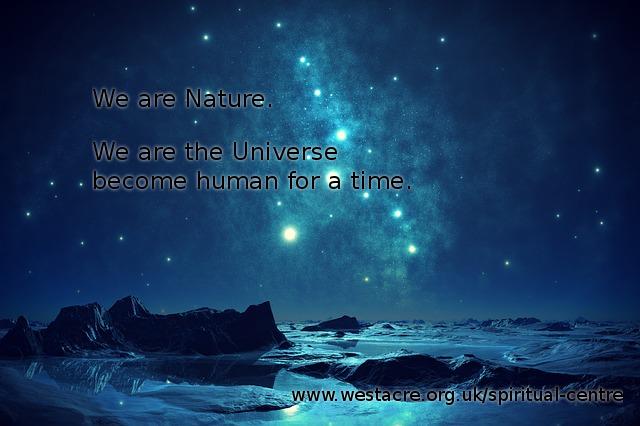
Another aspect of manifestation is that we are not separate beings on this planet, or indeed in this universe. We cannot be, for we are all made up of different elements of existence. A human being is made up of non-human elements, such as calcium and magnesium, sunlight and wave, clouds and stars. All manifestation has a shared existence, for we cannot exist without everything else. This is explained beautifully by Zen monk Thich Nhat Hanh in what he called Inter-Being. We cannot exist alone, we can only inter-be with everything else on this planet. It is a wonderfully evocative and holistic way of thinking that sits very well within my vision of Druidry. When we realise that we are not separate from the whole, we immediately act with a different intention, and live our lives filled with compassion and love instead of alienation and fear.

Our ancestors are with us all the time. Though their bodies may have long since physically disappeared to our eyes in the soil, their manifestation has not – it has simply changed its form. Energy cannot be destroyed, it cannot go anywhere. Neither can it be brought forth out of nothing. We are all manifestations of energy, energy that has existed on this planet for 4.54 billion years. This is a shared energy, one that we cannot claim as our own. If we cannot claim this energy as our own, how can we claim anything to be our own?

Ownership requires the belief that we are separate creatures. In our brief manifestation as human beings, we may think we own our house, our pets, our cars, however this is all illusion. We are only borrowing them, using them for however long or short a period of time before we are changed in form upon our so-called “death”. This death is not a singular, separate event, but merely a way to describe the cessation of a certain manifestation. Equally, there is no birth, simply the beginning of a new manifestation. The energy behind the manifestation is always there.

This shared energy is in the heart of the sun, in the rocky surface of the moon, in the wind and in the rain. It is in the bee and in the bear, in the holly bush and in the snow. The icicle is made up of non-icicle elements. The cat is made up of non-cat elements. This is what it means to have a shared existence. Not shared existences, but a singular shared existence.

If we are all a part of each other, we will see that if we fight with another person, we fight with ourselves. If we grieve for another person, we grieve for ourselves. If we act with love and compassion for the world, we also act with love and compassion for our selves.

The plant that has died is still there, in another form. It is still a part of our self as well, for we have breathed in its oxygen; we are in its soil as its soil is within us. There exists a beautiful garden in our compost heap. The sea is held within the sky. I am within a woman grieving in Palestine, and she is within me.

Keeping this thought close to my heart, I can reach out and touch the awen that connects the threads of all existence. That energy where soul touches soul, where boundaries fall way, where we are beautifully inspired by the acknowledgment of another being and seeing that being reflected and existing in our souls – this is at the heart of Druid teaching. Walking awake and aware in the world, seeing the connecting threads, seeing the shared manifestation and shared existence fills our souls with beauty and awe in the wonder that is the world.

May we be the awen.
universe human

Perception, assumption and suffering

How much of our lives are based around incorrect perceptions? How often does our emotional state and relationship with others fall apart based on incorrect perceptions? And just what is perception?

Perception is how we interpret the world, through our own subjectivity. We have a store consciousness built on our past experiences and those experiences related to us by others. We use this store consciousness to help inform us on our view of the world. It helps us to survive. We know that fire burns, so we don’t touch it. We know that cougars are dangerous, so we don’t approach. We look both ways (hopefully) before crossing the street. However, as our perception of the world is so subjective, how often do we get it wrong?

This is not to say that we should throw out all useful perception and experience. What we need to do is to become aware of our perceptions, and to see if we are making assumptions that aren’t based on actual fact. So much of our lives are built upon this, which is a rather shaky foundation.

Incorrect perception can lead to all sorts of problems and can create a huge amount of suffering. We might have the incorrect assumption that we are alone, which gives us the false perception that we are completely isolated from the rest of the world. We may react to a situation based on what we think someone said, rather than what they actually said, and thereby create a false perception of the actual event. We may assume from past experience that all politicians lie, and create a false perception that we cannot trust anyone, much less bother to vote. We might get angry at someone for their behaviour, without seeing the root causes behind it. Changing your perception leads to understanding, which is the essence of compassion.

We will still make mistakes, however. We have habits, ingrained learned behaviour that is difficult to overcome if we are not aware of it. However, once we see the patterns formed in learned behaviour, we can unlearn it. We can break free of negative, destructive cycles, beginning to heal ourselves and then work towards healing our community, our world.

By nature I judge everything – it’s simply a part of my personality. While it’s worth having to some extent, it’s also a detriment. What I have had to learn is how to judge without being judgemental. It may not sound like that great a difference, but really it is the foundation of trying to understand the human being.

Daily meditation helps with this on so many levels. Practising awareness for 10 to 20 mins a day in mindful meditation begins to seep into every aspect of your life. Once you become aware of your thought patterns and behavioural patterns, you can then learn to break free of these in order to live with more intention. Everyone can meditate to some extent – you just have to want to. You have to want to spend time with yourself, and thereby doing some pretty deep examination, coming to terms with the less than glowing aspects of your self, as well as embracing those parts of your self that nourish and bring peace. It’s very simple and sometimes very difficult. However, if you want to get off that treadmill of constant running, out of that vicious cycle you feel trapped in, it’s well worth the effort.

Next time you are angry, depressed or sad, take the time to look deeply into your perceptions. If you find that they are based on incorrect or unsubstantiated views, perhaps they are not perceptions but assumptions. You will have to let go of the anger, depression or sadness as well as the ego in order to fully see – things we like to cling on to for various reasons, ie. because we know we are right, because we know we are not good enough, etc. This knowledge is not true knowledge, but assumption based on false perception.

Doing this work can lead to a life filled with less suffering, and in doing so even bring more joy into the world. May we do the work with a peaceful heart and with pure intention.

Recommended Reading: Thich Nhat Hanh, Love Letter to the Earth

TNH LLtoE

The wisdom of compassion allows us to see that we are part of a great cycle, that there is no separation. The earth is us, and we are the earth.

In this book, Love Letter to the Earth, Vietnemese Buddhist monk, Thich Nhat Hanh, talks about the stress we humans are putting upon the planet, and what we can do to live more harmoniously with the rest of the natural world.

I read this with the eyes of a human, the mind of a Zen Buddhist and the heart of a Druid.  In my opinion, this book needs to be on every Pagan’s bookshelf, let alone read by everyone regardless of faith, spiritual path, economic circumstance, political party, etc.

It is animism, and how to live it.

Reblog: Reclaiming the word discipline and living with intention

This is a reblog from my blog, DruidHeart, at Sagewoman Magazine’s channel on Witches and Pagans.


discipline

ˈdɪsɪplɪn/

noun

noun: discipline

1.    the practice of training people to obey rules or a code of behaviour, using punishment to correct disobedience.

“a lack of proper parental and school discipline”

2.    a branch of knowledge, typically one studied in higher education.

“sociology is a fairly new discipline”


Wow. No wonder people hate the word discipline. It’s often equated with punishment, correcting a perceived disobedience. We are free people, we should be able to do what we want, when we want, so long as it harms none. Life is for living, right?

Of course, I would agree with the above, that we are free, that life is for living. However, I’m also here to reclaim the word discipline into something that is positive.

We live in a world filled with instant gratification. We have IPhones and tablets that can “connect” us with people anywhere, anytime, so that we never have to be alone (even in a crowd of people). We have hundreds upon hundreds of television channels that tempt us into thinking that something better than the current moment we are living in is on the tube. We have internet to answer all questions at the push of a button. We have access to food 24/7 (most of us) – we’re usually never too far away from our larders or a shop. We love to “treat” ourselves. Marketing has told us that “we’re worth it”, or making us feel that we’re not good enough, and with their product we will be. Problems solved, instantly.

Now, this isn’t a blog post about self-denial, asceticism or anything similar. It is about truly seeing and understanding our needs versus our desires. Our modern world has twisted our desires into needs, and it is up to us to rebalance, to rejig our way of thinking in order to live a life filled with more intention.

I work three jobs, alongside my work as a Druid priest. Time can be in pretty hard demand sometimes, but planning makes it all work. It takes effort, but that is what discipline is: effort made in order to improve a situation, to live a life of intention, to learn more about integration and compassion.

This is only an excerpt – to read the full article, click HERE.

Yoga, Animism and the Nature of Evil

During yoga last night, halfway through the class and moving to another pose, a loud “wham!” sounded in the room. In the middle of the class, a woman had squashed some spider or insect with her shoe on the wooden floor. “Did you get him?” the yoga teacher asked.

“Yep,” the lady replied, pleased with herself.

My heart fell. I was saddened, not only by the loss of life, but more by the wanton destruction of said life, as if it had no right to existence. For one such as myself, intentional killing of another animal is tantamount to murder, when it is completely unnecessary. The class carried on as if nothing happened.

I’m still thinking about it. I know that I personally could not squash a spider or bug, snail or slug, no matter how yucky they might appear to my preconceived human perception of what is beautiful and what is not. Driven since a very young age, we are told that wasps are evil, spiders are scary and snails are gross and destructive in our gardens. They all deserve to die because of these things. It is utterly absurd.

I have sat down to a meal at a pub, outside in their beer garden, where customers could request a can of insecticide to kill the wasps that came looking for food, tantalised by the sweet smell of beer. Horrified, not only by the wanton killing but by the thought of such chemicals near food, I have not been back since. The way the human mind works both disgusts and challenges me sometimes.

I’m not overly fond of worms or slugs, slimy things or creatures that live in the ocean that I cannot see beneath me when I am swimming. Big spiders are slightly frightening, only because I know that they can bite (I’ve yet to be bitten). That doesn’t mean that I seek to eradicate spiders, or all slimy things from my garden, or cull sharks when I want to swim in their waters. We really have to get over our ideas of what is good, what is beautiful and what has a right to existence, and what doesn’t. Who the hell are we to say?

I’ve been an Animist all my life. I have known on a very deep level that all things have a right to existence. This was not instilled in me by my parents, per se – it just seems an inherent part of my personal nature. I know that all things are connected on both a spiritual level and also on a scientific level. We live in ecosystems, where one part relies on another part to function. We often forget that we are part of such complex systems, or we believe we are above them. I recently wrote to my local newsletter in response to a letter to the editor asking for the eradication of ragweed near his home. He saw the dangers of the toxic plant, however he also failed to recognise the many lives are dependent on this one species of plant. For himself, he saw no benefit in this plant. He saw himself as above and more valuable to the ecosystem in which this plant existed. This is the nature of evil, in my opinion – belief that we are separate and therefore we can do as we please.

Philip Carr-Gomm has recently shared his queries and thoughts on the nature of evil in a recent social media status update. He states:

“Humans can be so unspeakably destructive – either to their fellow humans or the Earth, perhaps the ‘unthinkable’ needs to be thought – that human nature is not naturally beneficent, and evil acts therefore the result of aberration, but that it is in its essence a mixture of beneficent and maleficent, and that only some sort of training, discipline, spiritual practice, psychotherapy or education that can help us ensure our beneficence rules our head, heart and actions, rather than the reverse.

What do you think? Have you sometimes thought ‘perhaps they got it right when they came up with the idea of Original Sin’?”

The idea of Original Sin to me is abhorrent as killing things without thought. It is used to guilt people into behaving in the way that those in power think they should, to keep those in power in the status quo. This is not a criticism of Christianity as a whole, but of those who use it to further their own purposes. There is much within Christianity that is beautiful and inspiring. This abuse of power is not limited to Christianity, but can found in religions and communities all over the world.

I personally do not think that people are born evil. When I look at human beings, I see monkeys with car keys. Sadly, these monkeys have forgotten their roots, forgotten that they are just monkeys, forgotten that they are a part of the world and a part of an intricate web of existence. This is where the nature of evil occurs, the sin that divides and separates. This is where the destruction occurs, because we believe we are separate, that we are in control, that we have power over other beings.

I would argue that nothing in nature is beneficent – everything simply is what it is, neither good nor bad. The sun is not being beneficent in providing us with light and life – it is just being what it is. The clouds are not being beneficent by providing us with rain – they are just being clouds. Beneficent seems to imply a focused and intentional act of giving. While nature has its own consciousness, how intentional is it? This leads us to the ultimate question – what is the meaning of life?

For me, life has no inherent meaning – it just is. Things are alive because the appropriate conditions were available for life to be. This includes humans and all other beings. There is no master plan. It is a wonderful, beautiful, freestyle weaving of a web of life.

We are not born evil, or with evil intent. We are not born good, or with good intent. We are simply born, and the lives that we live, the circumstances of those lives and the environment that we live in all provide us with a path that we take. We have a choice to cut ourselves off from our inherent nature, of living in harmony with the rest of the world. We choose to do this for the most part out of desire for personal gain, whatever the cost to other lives and the planet as a whole. When we believe in the lie that we are separate, we can commit the worst atrocities.

We don’t even need a religion or spirituality, psychotherapy or other means to find some sort of return to harmony. We just need to wake up and shake off the lie, the belief that we are separate. We need to see things how they are, not how we think they should be. We need to see our place in the warp and weft of the tapestry of life. We need to sing in tune with all the other songs of existence. We need to remember what it is to be truly alive.

When we awaken, we also find the proverbial return to the garden. We understand life in all its forms. By living with eyes open, we walk the earth with compassion for all things.

When we return to our place in the web, the end result is deep and lasting peace.

Duty

Recently I wrote a blog post about self-governance, and mentioned that another word that we need to reclaim in Druidry and Paganism in general is “duty”.

The concept of duty can go against the grain of some the Pagans and Druids out there who feel that it compromises their expressions of freedom. Duty seems to allude to the fact that we MUST do something, and being told to do anything can make many a pagan balk. However, duty is central to my Druidry, and there are many things that I must do to maintain my focus on a path and journey of honourable relationship and discovery.

As a Pagan and Druid who seeks a deep, sustainable, meaningful and honourable relationship with the land and the world around me, the concept of giving back for all that I have received is key. That giving back is my duty, my obligation to see that sustainability is kept, otherwise the whole thing might fall apart. I see it as my duty to recycle, to reduce my consumption of material goods, to be vegan, to organise litter clear-ups, to promote environmental activism, equality and rights for both human and non-human animals. I see it as my duty to act as priest for my community, to serve them in the best way that I can, whether that is as ritualist or celebrant, author or dance director, eternal student of nature and life. All of these I see as part of my dedication to my community, my gods and my ancestors. But it goes deeper than that. That is simply the work and the life path’s that I have chosen to embark on to live in a more meaningful, inspired and honourable way.

There aren’t really words to describe the depth of my duty towards my Druidry. It is something that is lived, is felt deep within the heart and deep within the gut. It is expressed dancing in the wind and collecting wild mushrooms. It is writing letters to the local council against the proposed housing development that will eradicate delicate and endangered species. It is a dedication to learning all about where I live, from where my water comes from to how I generate my own electricity. It is about learning to run with the deer on the heath and sing with the bees in the thick clumps of heather. It is about not settling for “good enough” or resting on your laurels. It is about constantly learning, experiencing and awakening.

Duty is tied with responsibility – the ability to respond. In keeping with the previous blog’s message of self-governance, we can use this to help us respond to situations better, more efficiently and with more compassion.

Duty is described in the dictionary as something that one is expected or required to do by moral or legal obligation. Indeed, my morality dictates my duty, however, the legality side is guided by my morals (and not the other way around). It is my civic duty to report abuse, or stop when I witness a car crash, yet I would do this regardless of whether there was legal obligation. Often duty is considered as something we are “forced” to do, yet I can think of no other way to be in the world. I am not being forced by anyone do live the way I do. I choose to live my life in service and in constant awe of the power of nature.

The nature and etymology of word duty is long and complicated. From Anglo-French deute and Old French deu, it means what is owed, due, proper and just. Go back further to the Latin, and we have debitus, the past participle of debere, which means debt, or to owe something. This ties in nicely with what I stated earlier, in the giving back for all that I have received in my life. I cannot simply take and take without giving anything back. Look at what that has already done to the world.

And so, duty is not a bad word in my vocabulary. It fits in my world view of being of service. It is about sustainable and honourable relationship within the cycles of life. We are never distanced from nature or life, but ever dancing within the wheels of time and the tides of life and death, entwined in each other’s arms and lives like Celtic knotwork. There is no separation, no Other. When we realise that, we realise our duty.

Self-Governance

mudraFar too often we allow our emotions to control us, dictating how we react and respond to situations and perhaps not in the best way. Some would argue that our emotions are what gets things done, however, something done with anger, for instance, may not always be the best way forward.

Discipline has become a bad word in our society. What we need to do is to reclaim this word, along with duty (which I will elaborate more on in another blog). We need to sit down with ourselves and take a good, long, hard look at our emotions and the roots of these emotions, finding out why we react to situations the way we do, discover underlying patterns and unravel the threads that are loose, or about to snap, reworking them into something more harmonious.

If we work on a situation based on an emotion of anger, hate or jealousy, then the outcome will most likely not be conducive to creating compassion and harmony with the world. Exploring the roots of these “negative” emotions, we will realise that the underlying thread is one of fear. Anger is another expression of fear. We become angry at our partner for not behaving in a manner that we think he should. In reality, we may be fearful of losing our partner, or of changing feelings for him, of not having enough control in our own lives, etc. Hate is based in fear, as we fear that which is the Other, separate from ourselves, the unknown. Jealousy is based on fear of change, our own insecurities and fears created out of past experiences.

What we need to do it to sit down with our feelings, to better understand them and in doing so, better understand our selves. In creating a safe space to sit with our feelings, we can engage with them openly and honestly. Creating a haven, a sanctuary in which to perform this task, we can explore the deepest corners of our minds. For me, the goddess Nemetona helps in this exercise.

She is a goddess of sanctuary and sacred space. She is present in my home and in my heart. Human beings have such a craving for safety and security, and within this goddess we can find that wherever we are. Not only does it help with emotional discipline and self-governance, but the two are intricately woven together, with self-governance creating that safety. Let me explain.

If we are ruled by the tides of our emotions, we will never settle, never find a place that we can call a sanctuary. We are subject to the peaks and valleys of an emotional long hard slog, and never really find a good breathing space in which to find some respite. If we do not have that sanctuary, we have no place to breathe and to truly connect with our emotions. And so an endless cycle of repetition is created.

Finding time every day to simply sit and breathe is a great way to begin. In a safe, comfortable place, whether indoors or out, we focus on our breath, in and out, breathing in the air that our ancestors breathed, that all living things breathe. We breathe out into the world, exhaling even as the trees exhale in the deepening twilight. Sharing this beautiful moment, this sacred breath, we come to an awareness of ourselves, of our self and how we currently feel in the world at this particular moment. We can call upon Nemetona to hold this space while we simply sit and breathe, honouring Her for all that She is with a return to the stillness at our core.

It’s not easy, taking the time to simply breathe, to meditate on our breath. Our minds will try every trick in the book to distract us from this present moment and this one little act. It is with discipline that we return to our breath again and again, each time we find ourselves wandering off mentally, or shifting our bums restlessly. You have to really want to find stillness – it doesn’t just happen. You have to be disciplined enough to achieve it. It won’t simply suddenly appear out of nowhere, nor can it be spoon-fed. Discipline will not allow any passivity. We must take full responsibility for our selves and for our world.

After breathing, we can take some time looking at our feelings and emotions without attaching to them. Again, we can ask Nemetona to help us, to hold the space and to guide us to explore our feelings without getting too involved, wrapped up once again the in the emotion. She won’t do it for us, however. We can look at our fear, at our anger, our impatience, our joy and our happiness. We can find the roots of these if we don’t let them take control over our minds, and therefore live in better awareness.

For not only do we have to be careful of the negative emotions ruling our behaviour, but we must also become aware of the more pleasant emotions. Far too often we experience a beautiful emotion, and crave that emotion for the rest of our lives. We will never be able to recreate that experience, for it has happened and exists only in the past. All we have is this present moment, which is always changing, moving forwards. If we try to regain the feeling of joy that we had on our wedding day every time we look at our loved one, we disregard other emotions and feelings that will eventually come and bite us on our backside. We may not notice the present moment. Focusing only on positive emotions doesn’t work – we are human and we have negative emotions too. Those who deny them, who suppress them, will face some pretty hard demons at some point in their life.

So we sit, and we meditate day after day, breathing and coming to an awareness of the present moment. We are able to take the time to look at our feelings and get to know them better, thereby allowing ourselves the opportunity to break from negative patterns of behaviour into more purposefully led lives. Discipline and self-governance are not things to be afraid of, nor are they something to shun as not in keeping with our freedom of expression. We are better able to express ourselves when we are not ruled by our emotions, allowing us to see what lies at the root of our souls, and thereby what lies in others’ souls as well.

This is the heart of compassion. When we understand ourselves we can better understand others, and see their fears, their patterns being created. We can work with them to help create new patterns, or we can simply walk away with respect and not have their patterns reflected in our own. We can only help those who want to be helped, and this includes our own self.

So please do take the time to sit, every day, and be in the present moment. Become aware of your breathing. Call upon Nemetona or any other god to help you find that peace, that space to explore your feelings, should you so desire. Look at your feelings and better understand them for what they are. In doing so, you will no longer be ruled by them, but instead be able to respond in the world with an awareness and mindfulness that can only create harmony. We come to understand each other in a very deep and meaningful way when we take what we learn of ourselves and relate that to others. In this, we can see that we are all related.

We are not restricting ourselves with self-governance, but allowing ourselves to open to the world with the eyes of compassion and hearts that are true.


For more about the goddess, Nemetona, please see my book, Dancing With Nemetona: A Druid’s Exploration of Sanctuary and Sacred Space

Reblog: Nemetona and Sanctuary

This is a reblog from my post at Druid Heart, at SageWoman’s channel on Witches and Pagans.

524734_640754085941583_54399955_nSometimes one has to retreat from the world, in order to better understand it. Finding sanctuary, a sacred space where we can open our souls without fear, where we can simply be, is a glorious experience. It happens a lot less than we need in our lives, in my opinion.

A goddess of sanctuary, Nemetona is an elusive deity. Not much is written or recorded about her in Classical texts or history. Just the barest hints and place names, some tribe names and a couple of inscriptions. Who is this goddess to whom we can bare our souls, in complete soul truth, knowing that we are held?

In our modern day world, so often we feel we have to close ourselves off in order not to be overwhelmed – by people, media, technology. For sensitive souls, it sometimes is pure hell. We need to allow our soul truths to emerge, otherwise as caged birds we function behind bars, never truly spreading our wings and knowing what it means to fly. We feel we have to be careful not to be too open, too emotive, too sensitive to what people are saying or what is happening in the world around us. We are not allowed to be offended, we are not allowed to speak out without fear of being shot down a lot of the time. We are told that we shouldn’t be so sensitive. Our souls grow smaller with each experience of shutting down, never letting anyone or anything in.

That physical space around us, where we feel uncomfortable if someone we do not trust enters, is a valuable space. It is our personal nemeton, a space where our energy exists outside of our bodies. Many liken it to your aura. Some nemetons are strong and radiant, some wounded with gaping holes, others barricaded with steel. What we have to learn, or relearn, is how to open this space in love and trust – that is what Nemetona provides, often in a world wherein we feel no other human is able to provide this for us…

To read the full post, click HERE.

Reblog: Wonder on the Wing, from Holy Wild

Here is a short excerpt from Alison Leigh Lily’s blog, Holy Wild, which deeply resonated with me. You can read the full article HERE.

Sometimes the very concept of “wildlife management” seems problematic to me. The desire to have a positive impact on the environment can be twisted into the beguiling belief that “technological progress will save us” from the consequences of our past and we need only sit back and enjoy our supremacy. Sometimes I think what we really need is a bit more human management: more self-restraint, more humility in the face of natural forces whose consequences we don’t (perhaps never can) fully understand.

World Suffering – Thich Nhat Hanh

This little gem came as a great reminder today, when the suffering of the world threatened to overwhelm me.  Bursting into tears as I watched on the BBC news children’s toys scattered in the rubble of the Gaza bombings,, their bodies being loaded together into the mortuary. Rude people at the village shop blocking other people’s cars, and making them wait until they finish shopping to move their car, even after the person has asked them to politely to move.  Loud, overbearing people in the bays next to you at the driving range.  The obnoxious amount of money spent on the World Cup Football in Brazil while people starve in the streets.

Thich’s words were a welcome reminder to find the beauty, and to nourish ourselves in order to better serve the world, in a world filled with suffering – not to be overwhelmed by it, but to find the beauty to carry on regardless. To find a community as well, of like-minded souls, who can inspire you on your journey through life.  To be out in nature, and to see the wonder and live with the awe of a child again.

Then, you will be better able to serve the world, instead of submitting to the suffering and the grief, the rage and the injustice.  Returning to the centre, finding peace and being peace is all that matters.