Unconditional Love

In the Goddess Temple in Glastonbury this June, as I sat down to find some space after an interview with Philip Carr-Gomm for Druidcast, a lady approached me and asked if I would write a blog post about unconditional love. She said she was having trouble with this concept, and I said I would do my best. I have been thinking about this matter for a few weeks now, mulling it over and letting it settle in my mind before putting words to paper (or a computer screen, as it were – it just seems less poetic).

First, we have to define just what love is. The Oxford English dictionary defines it thus:
• A strong feeling of affection
• A great interest and pleasure in something
• A person or thing that one loves

A difficult one; look at several other dictionaries and you’ll notice that even they cannot seem to agree on what love is first and foremost. It is such a widespread and subjective concept that changes depending upon culture, religious or philosophical points of view. In an Eastern tradition such as Buddhism, love is more than affection, pleasure or something that one loves. Indeed, in most traditions it is more than that: love is peace; love is understanding; love is compassion; love is life itself.

For me, love is all these things. That is why it is so difficult to define. When considered in this context, love is, in itself, unconditional – or is it? Can you put a condition on the notion of peace, of understanding, of compassion, of life itself?

In a way, yes. Throughout the world, peace, understanding and living are kept under certain conditions in order to benefit the greater good. Laws and customs in every society are created for the supposed benefit of all – is this love? Laws and customs are a condition for keeping the peace, yet when we consider things such as genital mutilation, are we acting on a condition that brings about love?

Reining it back in for a moment, in most Eastern traditions love equals compassion. So, what is compassion? I’ve talked about the nature of compassion for years on this blog, considering it from every angle possible. Compassion is trying to see the bigger picture, to see that everyone suffers, and to alleviate suffering, both yours and the world at large. This compassion does not mean that you then become a doormat, however. The Dalai Lama states in his essay on “Compassion and the Individual”:

“[w]hen a problem first arises, try to remain humble and maintain a sincere attitude and be concerned that the outcome is fair. Of course, others may try to take advantage of you, and if your remaining detached only encourages unjust aggression, adopt a strong stand. This, however, should be done with compassion, and if it is necessary to express your views and take strong countermeasures, do so without anger or ill-intent.”

In this quote, compassion comes about with a concern that the outcome is fair. Fairness is, in itself, yet another subjective concept that means so many different things to so many different people. It would appear that we’re already on shaky ground before we’ve even gotten through to the concept of unconditional love. However, in the “without anger or ill-intent” there seems to be a key.

If we do not harbour anger or ill-intent towards anyone, is this the gift that unlocks the door to unconditional love? It just might be. I may disagree with political parties, companies, individual persons, but I do not wish them harm. I may hate most of David Cameron’s policies, but I would not wish him personally to come to harm. I may write petitions, raise money or volunteer, protest his policies; I may express my point of view with words and conviction, strong in my personal belief of what is right. I can do all of this without ill-intent. Without anger? Sometimes, but not all the time. For me, anger and ill-intent are two very separate issues.

So what is unconditional love? Is it living in a world without ill-intent towards other beings, human and non-human? I’m not sure that quite covers it – loving someone and not wishing them harm are not exactly the same thing. Is anger here the key to unlocking this further mystery?

What is anger? I’ve pondered this one for years, and have come to the conclusion that anger has its roots in fear. I become angry because I fear my personal rights are compromised. I become angry because I fear for the safety of a bluebell wood. I become angry because I fear for the well-being of a friend who suffers. This anger is directed, focused into non-violent action and activism. It is fear that is transformed into energy for what I perceive to be the greater good. Like everything, it is subjective. Is this anger all that bad then, considering the focus? Looking and understanding fear helps me to use anger and to understand anger in others. When someone shouts abuse at me, I understand their fear. It doesn’t mean I have to like it, but I understand it. With Thich Nhat Hanh’s concept of “Engaged Buddhism”, one can work to counter that fear and anger and stand up for what they believe is right, while maintaining an awareness of the whole.

There is a saying, “love means never having to say you’re sorry”. This is not to mean that one should behave badly, without thought or care for others – quite the contrary. It means that one should live a life that causes the least amount of suffering for others, so that you will never have to apologise in the first place. It’s a nice thought, and one to work towards. It carries the notion of personal responsibility for all actions.

In my opinion, it is all that we can do to become aware of our emotions, of our fears and our passions and work for the greater good in all that we do. I can look to my gods for inspiration.
With regards to Druidry, it is often said that we do not submit to our gods, for to do so would destroy us. In Druidry, anger is a god. Love is equally a god. Should we therefore not submit to love, either? More questions…

We may have to take a strong stand in our convictions at times. We have to look at the nature of love, of anger and of fear and understand the currents of these energies to better understand their influence in our lives. Thinking about these energies more often than not brings up more questions, making us quest ever deeper for the awen that will show us the way to peace.

Perhaps love is more akin to the concept of animism, which Emma Restall Orr defines as seeing the inherent value in all things. We do not need conditions to make this idea work. We value everything, no matter what, and work with our gods to better understand the nature of all being and all beings, questing the awen that will allow us to tap into that well and drink deeply.

So is this unconditional love? Or is it a case of only if when there is absolutely no fear, can there be unconditional love. Is that humanly possible? I’m not so sure yet – I’m still thinking about it. Is animism the inspiration that will unlock the mystery of unconditional love?

Midsummer

Ah – midsummer. I remember when I first moved to these isles over 16 years ago from Canada – it was a cold and wet summer, and I wondered just what on earth I had done. And yet, the light fascinated me at that time of year, and later at the winter solstice, the darkness. It was so much more than where I grew up – the twilight of midsummer and the barest space of total darkness, the unrelenting darkness that forces you to face it head on in winter. The difference in latitude was a great teacher – (Montreal, 45.5N, London 51.5N).

 
The current is running strong in the British Isles right now. As I go to my outdoor altar every evening, laying my hands upon the soft, mossy earth I feel the white dragon that has risen to the surface and is dancing in the ethereal currents of energy crisscrossing the land. It is a time of great joy, of celebration.

 
This is a time of year to be proud of what you have done so far in the year’s cycle. But beware – the carpet can be pulled from underneath you, and the harvest may not quite be as expected. For this brief moment, however, we can perform this wonderful balancing act, in a liminal time before the tide tips over and we tumble headlong with it. It is important to be proud of what you have achieved – it is too easily done to become prideful.

 
Stand and feel the earth beneath your feet. Feel the serpent energy rising, the dragons of these lands, filling your soul with this time of year. Reflect on your achievements, and state them aloud under the eye of the sun. Confirm for yourself the good that you have done for the world, for your family, your community, for yourself. Let the sun’s rays witness this confirmation.

 
On Saturday I will be reflecting on the good investment of my solar panels – this time of year it is especially rewarding to know that the longer daylight hours are helping others in the village, ie. local businesses. I will take a bow for the two books published (and doing well), and the third and fourth on their way. I will applaud the money that has been raised for various charities through a lot of hard work in fundraising, events and suchlike over the course of the year. For this brief moment, I will take pleasure in my achievements, and remind myself that this is why I do the work I do, and live the life that I live. I will remember this moment in the darker times, to guide me through them and out the other side.

 
And then I will immerse myself once again, into the landscape, losing that sense of self and becoming a part of it, letting it guide me, teach me, blend with my blood and my bones with the whispers of the ancestors blessing it all.

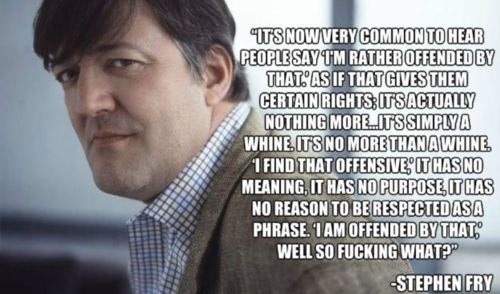
Offense taken, Mr Fry

*Warning – this blog post contains strong language*

 
stephen-fry-on-offenceI’ve been thinking about Stephen Fry’s little rant that made the rounds of social media a year or so back. It’s something I’ve been meaning to comment on for a while, mulling it over thoroughly, discussing it with other people and trying to understand the mindset that would provide such an opinion.

 
In short, I just can’t understand why he would say such a thing.

 
The blog Tea Leaves and Dog Ears has provided a good reply to his statement. However, there are still a lot of people who agree with Fry’s sentiment, including Ricky Gervais, who stated on his Facebook page in August 2013:

 
“We have to stop this recent culture of people telling us they’re offended and expecting us to give a fuck.”

 
Fry and Gervais’ comments are nothing short of belligerent. When someone does not care regarding the effect their words and actions have on society in general, they are also not acting in any way with compassion. Fry’s comments about taking offense are well and good if he is the one being offensive, however, as in Tea Leaves and Dog Ears’ blog, when it is his own person that is being offended, the tables turn and a double standard occurs.

 
I’ve been studying the Celtic worldview for some while now, diving in to the history and research, and have come across one perspective time and again: that of personal responsibility. In a culture, in a society, we all have a personal responsibility to behave in accordance with that society and the laws that it contains. If we don’t like them, we should be able to speak out against them in a peaceful manner, protesting using our freedom of speech. Yet every action, every word that comes out of our mouths we are responsible for, whether spoken with mindfulness or mindlessness.

 
I believe that Fry’s and Gervais’ comments were spoken out of mindlessness. In Mr Fry’s case, also taken out of context. I also believe that they would, and probably have, taken offense at something since they made those comments. It is human nature to have an opinion. We have a voice and we use it. Sometimes we do so with full intention, sometimes we do not think before we speak.

 
I simply cannot fathom walking around, saying things without thinking of the repercussions my words and actions would have on the world. My sense of personal responsibility lies too thickly ingrained in my soul. It is confirmed by my Druidry, by my spiritual path. Stating that those who are taking offense are merely having a “whine” is to diminish their point of view, their opinion as worthless. It goes against the very freedom of speech that the original rant seems to hold up.

 
Sometimes it can be hard to find the words at the exact moment the offense is being taken. We’re not all eloquent beyond belief, able to put thoughts and emotions into carefully constructed arguments on the spot. It is a talent that some people have, some do not. We should not dismiss those who cannot find the words to express their true feelings, who can only say at that moment that they’ve taken offense. We have hurt someone’s feelings. We hate it when our feelings get hurt. Why do we forget that when we are the ones that are creating the offense?

 
Acting with compassion in all things is central to Buddhism. Right Speech is part of the Eightfold Path. I personally do not believe that Fry or Gervais’ comments are made with this in mind. Speech, words and stories were very important to the Celtic ancestors. The Druid teachings up until the modern day were never written down, for various reasons – to keep it within a political and spiritual elite in Classical times, for example. Going back further than this brief point in history, the written word did not exist for our Bronze Age or Neolithic ancestors. What was said, expressed in a language either now lost or evolved into our current tongue mattered. Even before verbal language, body language meant so much. Just watch two strange cats meeting each other, eyeing each other up for the first time…

 
So, we shouldn’t dismiss someone for taking offense simply because they cannot express in words at that time what it is that is hurting them. It’s difficult for a lot of people. And what of those non-human beings that we hurt? We must act with compassion, yes – but we must also be allowed to stand up for our rights, to be able to express it in our own time without being told that we are simply “whining”.

 
Supporting Fry and Gervais’ statements can lead to all sorts of messy encounters. Sexual harassment, jokes of a sexist, racist or religious nature can lead to a culture sliding down the slippery slope of intolerance, misogyny and bigotry. The words “rape culture” are hot right now, filled with debate about what it is and what is isn’t, who is contributing to it and who isn’t. Again, here I think that personal responsibility is key to working in honourable relationship with the world at large. Not giving a f*ck isn’t.

 
There is also the argument that letting go without taking offense is the best way forward. However, this only applies to a comfortable Western point of view, where one isn’t being shot at, forced to marry their rapist, or being subjected to all manner of discrimination due to the colour of their skin, their gender or their religious beliefs.
We are a vocal tribe now, and as such we should discuss things with compassion. Simply stating that someone is whining is not taking a look at the broader picture. In doing so, one is dismissing another human being. In time, someone may find the words to express their offense – it is a matter of eloquence and language, not one of who is right and who is wrong. Dismissing the other for taking offense is, in my opinion, repulsive and incorrigible. It is bad behaviour and bad form.

 
Stand up for what you believe in. Express yourself as eloquently and as honourably as you can. Consider the impact that your words will have on the world at large. Use the tenets of Right Speech and personal responsibility to the best of your ability. It is all that we can do. We may fail, we may be brought up on it, and it is up to us to make amends. Do not let pride get in the way. No one is infallible.


Dealing with depression and despair…

Dealing with depression and despair…

Being kind isn’t all that hard. Being jolly and upbeat all the time is – and is a denial of our emotions and bodily responses to certain situations.

 
I woke up yesterday in a bad mood – which has spilled over into today. The reasons for it are numerous: tiredness, frustration, a lack of compassion in the world amongst others. The Zen thing to do would be to be present in the moment, for in this moment there is all that we need. There is nothing but this moment. Feelings of despair arise when we separate ourselves from the moment, and think about the past or the future, dwelling on certain aspects and perhaps not seeing the bigger picture (or perhaps even seeing the bigger picture, which can cause us to despair even more).

 
Yes – I am quite comfortable in this present moment as I write this. I am not being shot at. I am not in fear for my life. My loved ones are safe. I have a cup of tea, and enough food to eat. My body is clean, my clothes warm. Compared to many, what on earth am I doing feeling despondent?

 
Humanity’s blessing, and curse, is the ability to see the bigger picture. This can lead to glorious ideas about the direction we should take; it can also lead to despair when we take into consideration the negative aspects of our lives on this planet. Focusing on just the positive isn’t balanced – neither is focusing on the negative. As a Druid, I am constantly seeking balance and harmony, to find my place in the world and to serve this world in the best capacity that I can, being true to my nature and honourable in my deeds.

 
I sometimes fail at this. I sometimes succeed. In this, there is balance. Of course, I aim to look at things from a balanced perspective, but on the whole we are conditioned throughout our lives to try and look at things positively. However, when looking at things negatively, we need to remember that negative does not equal apathy. If there is something we do not like, we can seek a way to change it. It’s in our hands.

 
This is not denying the negative. It is living a life with intention. Creating peace is damned hard work. It requires a person to see all sides of a story and work with the ideals of compassion and empathy. If we only acknowledged the positive things in our lives, our compassion and empathy would be seriously diminished.

 
I sometimes find myself thinking that Buddhist monks have got it pretty easy, secluded away in their monasteries, not engaging with the real world. Some do. However, I remind myself that other monks have engaged with the world in ways that I probably will never be able to – think Thich Nhat Hanh helping to rebuild villages during the Vietnam War, not taking sides with anyone and simply helping people as best he could. I’m sure at some points he too despaired, seeing children dying, homes destroyed and his country torn apart. My despair pales in comparison to this.

 
This is not to say that I should not acknowledge my own despair, however. If I did, if I pushed it to one side to focus on the positive, I’m sure that it would return to bite me on the ass at the most inopportune moment. We don’t have to give in to feelings of despair, but neither should we push them aside. We normally don’t push feelings of joy aside – we like to experience these. All feelings should be felt – and then we can move on.

 
So, tired after dance rehearsals and depressed by the amount of litter that I see along the roadsides that I will have to clear (again), apprehensive about coming engagements and a workload that was supposed to be lighter this year being heavier than ever, I am feeling my despair, my depression. I am allowing it to move through me, so that I can come out the other side having had the experience, which will hopefully transform into some sort of wisdom.

 
This despair will be self-contained – I will not be taking it out on others. I will try not to snap at people even though my emotions and reactions feel more “on edge” than normal. You can despair at the world and still be kind. You can reach out a hand to friends or family if you need to. You can write about it in a blog.

 
Above all, you are allowed to feel it, in your bones and in your soul.

The Power of Love

I dreamt the other night that I was on a bus, and we were driving up a hill. I was sitting up front, behind the driver, and as we rounded a corner I knew that we were going too fast – we skidded off the road and then off the cliff.

 
We plummeted through the air, the fall foliage from the treetops skimming the bottom of the bus. I decided to try and make my way to the back of the bus, where I might stand a slim chance of survival when we hit the ground. Fighting against gravity, I pulled myself up two, three, four rows. By now, I realised that we would soon hit the ground, and so I thought to myself “It’s time to turn around, and see death as it approaches”. I turned to face my impending doom.

 
The ground rushed up to meet us, but we just managed to miss – it was an outcropping of the same cliff. So we continued our plummet, the wind rushing around us. I made my way further to the back of bus, hoping to survive the final crash. At about halfway, I turned once again to meet my fate. I watched the ground come closer, and just before we hit, I said “I love you”. I pictured my husband’s face, but it was not only for him that the words were meant; I felt love also for my family, my friends, and the entire planet. I felt love for ALL life. It was the most extraordinary feeling.

 
No sooner had those words escaped my lips, and the feeling of love filled my heart, that the bus caught a thermal updraft, and we swooped inches above the ground, rising softly to land as lightly as a feather upon the ground.

 
I woke up, completely astounded.

 
That was the power of love.

Go slowly in the Springtime…

This morning I accidentally ran over a small, young rabbit.

Living where I do, accidents such as these are unavoidable at times. Springtime is the worst time, as youngsters are making their way further and further from their homes, unaware of the dangers of the road. Baby birds that are not yet fully proficient in flying, young badgers and even deer that haven’t seen a car in their life. I carry special gloves in my car to take those I find left on the road and bring them to a more respectful distance, to be taken by the ants and foxes, the crows and other creatures. I’ve picked up all manner of roadkill from other people where they have just left it – even putting my back out once dragging a dead deer stag from the middle of the road where it endangered drivers coming around a blind bend. How people could just leave animals that they have hit is beyond me. I’ve had to call the police to inform them of deer that had been hit on the highway and that was still alive, blocking a lane, thereby getting police and environment officials there to kill the deer humanely as quickly as possible, and see that no one else gets hurt. It infuriated me that no one else bothered to take responsibility – no one else had made that call before me.

It doesn’t make it any easier, no matter how much death you see. Picking up the warm, soft furry body, its entrails in my other hand I carried it to the side of the road and placed it gently beneath the hedgerow. I was struck for a moment at how some Druids of old, such as the famed Boudicca would have read the entrails of a sacrificed hare to foretell battle outcomes, if classical sources are correct. I thought about how gentle my Druidry is compared to that, and how I would not change it for the world. As I lay its body on the ground, the green grass and nettles growing up towards the sun, all I could think was “I’m so sorry”. I asked that the gods be kind, and that they may forgive as this little one goes back to the earth from whence it came. A crow directly overhead cawed as I finished my prayer.

I know it may seem odd, asking pagan gods for forgiveness – many would say that attitude is for another religion. However, at that moment it felt utterly right – it was the first step towards making amends for the taking of a life. It acknowledged responsibility as well as regret. Whether the gods accepted it or not I do not know – the crow cawed just at that moment, but he may have just been greeting his mates, or laughing at me, or genuinely speaking for the spirits of that area.

Accepting responsibility for the taking of a life is a concept that was well known to the Celtic ancestors in this country. Whether accidentally or not, reparation must be made and responsibility claimed for one’s own actions. Stopping and taking the little body to a better resting spot was just the first step towards reparation. Asking forgiveness and expressing sorrow and regret was the second. Making a donation to the Hare Trust upon reaching work the third, and tonight in a small ritual an offering will be made to the spirits of place for peace. None of this will bring that little life back. However, it is a constant reminder of my place in the cycle of life, in the grand web of all our lives, how we are all connected, and how each of us is responsible for our actions.

Why all this effort just for a rabbit, some may wonder? To me, all life is sacred – it is why I am a Druid and a vegan. Ideas of reciprocity and responsibility are at the forefront of my worldview. I take what I have learned from our Celtic ancestors and apply the wisdom found in their teachings into modern life. Ancient Celts may not have felt so sorrowful at killing a bunny – but I’m not an ancient Celt. I don’t eat the meat, I cannot make use of the body, and so it seems dishonourable not to do something to make amends for the taking of its life. I live in a different world to the ancient Celts, and thereby must apply their wisdom into my modern worldview in the best way that I can to ensure that my life is lived fully, aware and awake and with honour.

Driving home, I shall drive even slower than I usually do, no matter what the cars behind me think. I am a part of my environment, a part of a very special ecosystem and I will do all that I can to preserve it, to cherish it and to honour it with all that I am. For me, there is no other way.

Reblog: Peace – Knowing When to Speak Out and When to Keep Silent

This is a reblog from my latest post at SageWoman Magazine’s channel, on Witches and Pagans: for the full article click HERE

This past week I have had to hold my tongue. Sometimes it felt like I was holding my tongue so hard all I could taste was blood.

A few people have told me that I should have spoken up, said my piece right there and then, never holding back. However, what I have learned in my own life experience and in my Druid path is that there is time to speak up, and a time to hold your tongue. It all relates to one word – peace.

It has often been said that the Druids were not only the political advisors and religious authority to the Celts, but that they were also the peacemakers within society. They had the power to walk between the battle lines without being harmed, such was their honouring of the notion of peace and their own personal authority and control. As a student of Zen Buddhism as well as Druidry, I have come to know the concept of peace from another worldview that blends in beautifully with what I hold to be true in my path.

Peace is when there is no need. Peace is when we are able to step outside of our ego and relate to the world with loving kindness. Peace is when we are able to find compassion, both for ourselves and for others.

Peace and truth are inexorably entwined within the Druid tradition. Only when we have discovered the nature of truth are we able to find peace. Truth is our natural place in the world, in its cycles and rhythms, the flow of life itself. It is in the riding of the currents of awen that we come to know truth in all its forms. When we know truth, we find peace…

Continued HERE


Reblog from Zen Habits – Emotional Independence

Here’s an extract from Leo’s most recent blog post – read the full article HERE.

Becoming Emotionally Self-Reliant

We look for happiness from others, but this is an unreliable source of happiness. Other people will come and go, or they’ll be emotionally unavailable for their own personal reasons.

And here’s the thing: it’s not their job to fill our emotional needs. They are struggling trying to meet their own needs.

So instead of looking for happiness from someone else, we have to realize it’s not out there. It’s within us.

Happiness isn’t in the future, it’s not somewhere else. It’s available right inside us, right now, all the time.

How can we find this happiness? It takes some inner searching, but consider these suggestions:

  • Sit by yourself, without a device or distraction, for a few minutes. Look inside. Notice your thoughts as they come up. Get to know your mind. See how fascinating it is. This in itself is an endless source of entertainment and learning.
  • One of my sources of happiness is creating, coming up with ideas, producing something. I don’t need anyone to do those things, and they give me wonder at my own abilities.
  • I also love learning. It gives me happiness, helps me grow.
  • Curiosity is a boundless source of happiness for me.
  • Learn to fix your own problems. If you are bored, fix it. If you are lonely or hurt, comfort yourself. If you are jealous, don’t hope that someone will reassure you … reassure yourself.
  • Take responsibility. If you find yourself blaming others, tell yourself that the other person is never the problem. Of course, you can believe the other person is the problem, but then you are reliant on them for the solution. If you believe that they aren’t the problem, then you look inside yourself for the solution.
  • If you find yourself complaining, instead find a way to be grateful.
  • If you find yourself being needy, instead find a way to give.
  • If you find yourself wanting someone to help you, help yourself.

Create your own source of built-in happiness. Walk around as a whole, happy person, needing nothing.

Then come from this place of wholeness, of self-reliance and independence, and love others. Not because you want them to love you back, not because you want to be needed, but because loving them is an amazing thing to do.

Compassion for Pirates

Sometimes in this life there are people who challenge us.  It is often difficult to maintain an awareness of our reactions when we are being challenged by another, or when someone upsets us, frustrates or annoys us.  These people can often be our greatest teachers, however, helping us to learn the ways of compassion.

Compassion is not the same as blind acceptance and becoming a sort of door mat for this kind of behaviour. It is not about loving people unconditionally.  There is a social contract involved, based on circumstance, culture and society.  Compassion is trying to understand the other person before falling into a reactionary role.  It is trying to see the bigger picture, in order to act appropriately.  We can stand up for ourselves, for what we believe is right. We can also try to understand those who challenge our views, who have hurt us in the past, who continue to frustrate or upset us in the present moment.

It might not even be that person’s fault that they upset you so.  Vietnemese monk, Thich Nhat Hanh wrote in his book, Interbeing on how if he had grown up on the coast of Siam, there is every possibility that he could have become a pirate like so many other men that plague the waters and make it dangerous for anyone living there.  Often it is due to matters out of anyone’s control – place of birth and circumstances of living that no one can have any sort of say in.

That’s not to say that people can’t change.  It is up to each and every individual to find the path that leads to the least amount of suffering in the world.  We all know that suffering exists – what we should aim to do is to alleviate that suffering where we can, both within our own hearts and in the hearts of others.

We cannot change other people – they have to want to change themselves. We can only lead by example, with our hearts open to the joys of life, not shutting down despite how much we have been hurt. Many may say that this way of living simply invites more hurt into your lives, but I would disagree.  By closing yourself down to love, you are doing yourself a disservice, and not having the right amount of compassion for your own self.  We do not allow people to hurt us – if they do, we walk away to a safe distance, try to understand the reasons why they have behaved in the way that they did, and perhaps try to alleviate the suffering on both sides through compassionate dialogue. Where this isn’t appropriate or where it just isn’t possible, perhaps because we have been hurt too much, we can simply bow and walk away, wishing peace for them and for our own hearts to still open to the possibility of love from a myriad of sources that exist in the world.

There are people in my life that I simply do not get on with.  It is sometimes a personality clash, or they have done/said something that I do not agree with – the circumstances vary.  When we have been mistreated, it is often hard to have compassion for the person who has done you wrong.  Your mind can get so caught up in what this person has done to you that everything they do annoys you.  The way they walk, the way they talk – the way they may apparently blunder through life.  When I find myself faced with such thoughts, it offers me the opportunity to see my own reactions and emotions, to understand how my mind works a little better. This is a true gift.

Yes, this person behaved inappropriately towards me in the past. But why should I let them continue to hurt me, to annoy me, to frustrate me? This is all within my control to end whenever I feel like it.  I don’t have to attach to the past hurt – I can let that go and get on with my life.  When I find myself glaring, or sneering on the inside, when I am disturbed on any level by this other person, I stop, pay attention what is happening in my mind, and smile. I can see the reactions for what they are. They are not actions – they are reactions.  I am acting mindlessly upon something that has already happened, and I am acting again and again in a repetitive state that does not help to alleviate anyone’s suffering. We have the opportunity to really act only once in any given situation, at the moment it happens. After that, we are acting upon the memory of the situation.

I am grateful for the opportunities I am given to see how my mind works, how my emotions can override the reality of a situation.  We are emotional beings, passionate creatures.  We can live a passionate life without being ruled by mindless behaviour. When it becomes too much, we can walk away, taking time to breathe, to try to understand ourselves and the other, to see the reality of the situation. Where there is no way forward, where is there is only hurt or danger we walk away with open hearts. Where there is a chance for reconciliation and healing then we take that with gratitude.

Living with compassion is not an easy thing – it takes dedication to truly want to understand your self, and others around you.  Yet when you do, the world opens up like a beautiful lotus flower, the many petals of existence showering you with beauty.

Sanctuary, Compassion and Freedom

We all need a little sanctuary in our lives. A place where we can let down our walls, let the barriers fall and simply be ourselves, wrapped in the security and safety of knowing that we are held.  My patron goddess, Nemetona, provides me with many opportunities to savour this precious moment, and to help create it for others.  She is the Lady of Holding, of Sacred Space, of Sanctuary.

Often when we meet others, especially human beings, our walls shoot up if they haven’t already been erected, and we are on the defensive.  We regard others warily, perhaps even as enemies; guilty until proven innocent.  A certain wariness around strangers makes sense – it’s an innate human instinct that we also see reflected elsewhere in the animal kingdom.  It is a form of self-preservation.  However, what I would posit is that we become so used to keeping those walls up, that we barricade ourselves inside our selves, unable to see the bigger picture, unable to truly experience compassion.

I am not saying that we should allow others to do as they will to us – wilfully harming another person in any way is completely wrong.  So often when I speak of compassion, people think it is an open invitation to be trod upon, to be used and abused by those who would seek to take advantage of us.  Instead, I try to explain the ideas of compassion, and also of engaged Buddhism – simply put, compassion is about trying to understand, to see around our own sense of self into the bigger picture. Engaged Buddhism is being active in a world to stop suffering, to speak up against violence and injustice and work to spread love and compassion.

My Lady Nemetona helps me with this.  By coming into her sacred embrace, I find that I remember what it is like to be open, to be held, to be free in utter sanctuary.  Thus inspired, I try to find ways to bring that inspiration out into the wider world, making it a better place.  When we are held, when we are free to be our true selves, we also provide the opportunity for awen, for inspiration, to fill our souls with joy and wonder at the simplicity of simply being.  We can then become a conduit for this energy, bringing about positive change in the world, even in the midst of suffering.

Working with Nemetona, we become aware of our boundaries, when we erect them and when we let them dissolve. We also see how we involuntarily create barriers, whether it is in our energetic fields, our communication, or our perception.  Through meditation and work with this particular goddess, I have found a way of both strengthening my inner sanctuary, thereby being able to let down those walls and openly experience situations with complete awareness.  In this, intention is key.

By being open, I am also being receptive to input that might otherwise pass me by through my own ego-centric mindlessness.  By working with sanctuary, I can see where I have lapsed and allowed others to abuse my trust, and where I will never allow that to happen again.  By being aware of how, why and who we engage with, and with what intention, we can change how we react to situation, acting with intention instead of a more reactionary type of living.  By becoming engaged with my boundaries, I am aware of when I need to strengthen or release them as appropriate.

It’s been a tough ride, sometimes, working with this goddess and with compassion.  It has shown me where I have failed so many times in the past.  Understanding and awareness of those failures, however, is not there to deter me; they are there to remind me, lessons learned and opportunities for further growth.  The key to working with boundaries and compassion, and indeed Nemetona Herself, lies in awareness – of the self, of others and of the world at large.  It’s not an easy path, but one well worth walking. It can lead us down the shadowy paths in the long dark night of the soul, but we can emerge into the light of the sacred forest grove, whether it be dappled sunlight, pale moonlight or starshine.  In that emergence lies our true nature, inspired by nature and surrounded by our natural sanctuary.

In that emergence lies our freedom.