
Druidry
Meditation
Many modern day pagans incorporate meditation into their spiritual practice. The reasons are varied, from wanting a sense of inner peace, health benefits, to seeking a spirit guide and more. The techniques themselves are as varied as the reasons behind why meditation is becoming so important – from journeying, astral travel, going “under the cloak”, mindfulness and so on.
There is a certain mysticism surrounding meditation, which may be a reason why it is so popular in paganism. It can be a deeply spiritual experience, it can put you in contact with the Otherworld – it can also put you in touch with yourself and the world around you in the present moment (reality). It can be both mystical and mundane. Its uses are boundless, and the benefits too many to count. However, let’s go over a few anyway…
Meditation is said to lower blood pressure, to help with sleeping difficulties, depression, anxiety attacks, deep-seated fears and problems with concentration. The latest meditation fad on the health and science circuit is Mindfulness Based Cognitive Therapy (MBCT). BBC News Healthstates that “It teaches a way of looking at problems, observing them clearly but not necessarily trying to fix them or solve them.’It suggests to people that they begin to see all their thoughts as just thoughts, whether they are positive, negative or neutral’.” http://news.bbc.co.uk/1/hi/health/7319043.stm. Now, having been a Zen meditator for years now, this sounds like plain old Soto Zen meditation to me, under a different name. In fact, Mindfulness was first translated from Sanskrit in 1881 by Thomas William Rhys Davids, who further described it as “Right Mindfulness, the active and watchful mind”. Mindfulness in itself is nothing “new” – it’s been a part of Buddhist meditation for thousands of years. Yet, as Harvard Health online states “Mindfulness meditation is getting a lot of attention because it seems to help with so many physical and psychological problems—like high blood pressure, chronic pain, psoriasis, sleep trouble, anxiety, and depression. It’s also been shown to boost immune function and stop binge eating. http://www.health.harvard.edu/blog/mindfulness-meditation-improves-connections-in-the-brain-201104082253”. No matter what it is called, it seems to be working.
Meditation is not for everyone, but for those pagans who are looking to incorporate it into their lifestyle it can be a wonderful way to get in touch with your “inner self” and the world around you. As a Druid, I use meditation for relaxation, for journeying and for connecting with everything around me. As I mentioned earlier, I usually use the method of Soto Zen, literally “sitting meditation” for the most part. This, much as the MBCT above, is about being aware of thoughts, and thought processes, without judgement. It is also being aware and in the present moment, hearing, smelling, seeing everything with complete focus to the art of paying attention. It’s also about the discipline of keeping your butt on a cushion for more than five minutes at a time, which is the hardest part.
Zen meditation is not , as many people (and pagans) believe, about transcending the body, but about being 100% completely in it – awake and aware to everything. It’s about sitting on your cushion and feeling any tension in the body. It’s about feeling your breath moving in and out of your body. It’s about hearing the blackbird singing outside. It’s also about paying attention to the thoughts that arise in your mind – “Oh, I’m thinking about that again” instead of becoming wrapped up in the thought. It’s about being non-judgemental about absolutely everything – not thinking “I’m drifting off again, I must pay attention – I really, really suck at meditating”. It’s about returning to the present moment, again and again and again. It’s really very simply, and very difficult at the same time.
Another form of meditation that I like to use was taught to me by a former teacher, Emma Restall Orr. This is called the Tree Meditation, which is wonderful for grounding. The beginnings can be found here – http://druidnetwork.org/learning/exercises/tree. It is a beautiful, grounding meditation that really focuses on the breath as a an agent to plant your metaphysical roots into the ground, to become rooted like a tree, drawing up nourishment from the very earth, the sacred earth. I try to do this at least once a week along with my Zen meditations, for it brings me back to connection with the earth, my home and the soil in my backyard.
The Ancestor Meditation is another meditation that I learned whilst on the Bobcat’s Living Druidry Course, set in the beautiful Cotswolds countryside. This is a really deep meditation to connect you with your ancestors – I’ve only ever done this with blood ancestors, but I’m sure that it could be performed with spiritual ancestors as well. It’s about connection, and again, the tool for this is the breath – what better way to connect with others than by our breath? It is a shared thing – what we breath in, others have breathed out, from bird to beetle to beastie. This meditation takes us on a journey through the breath to connect with our ancestors in a truly profound way. Not for the faint-hearted!
I also enjoy the occasional Journeying – taking a “trip” to a special place to perform a certain task, to meet with a certain person, spirit, or even deity, to seek out answers or to simply have some fun. I perform a Dark Moon Journeying to meet with other members of the Order of the Yew – the dark heart of the Druid Network. To find out more about the Order of the Yew, and its meditation, you will have to become a member, but it is well worth it in my opinion. I also meditated regularly when studying with OBOD, using their exercises which really helped open my soul to new things, to new experiences. Again, you have to be a member, and it is rather a lot more than the Druid Network.
Then there are simply times when I am outside in the backyard, watching the sunset or the sunrise, or running with the deer on the heath, or sitting in front of the fireplace, honouring the spirits of place with all that I am. Sometimes singing back to the land is a part of the meditation – I have stood at the edge of the North Sea and spiritually sung words that have no meaning and yet are full of emotion to my ancestors across the sea.
The end result to all meditation is, I suppose, connection. It’s all about relationship, whether it is getting to know yourself better, or your world. It is deeply healing and transformative, and, in my opinion, should be performed as often as you can, in as many places as you can. It’s the benefit of taking time out for yourself, with no guilt or judgement, to re-connect to the threads of life that are woven all around you. Go on, if you haven’t already – give it a try.
Druidry and the Ten Bulls
The Ten Bulls is an illustrated poem used by followers of Zen Buddhism to explain the search for enlightenment. For me, it also represents the search for meaning in my own Druidry and indeed, in my own life in general. It can be applied to everything, but for the purposes of this blog I’ll stick to Druidry. To see the Ten Bulls, otherwise known as the Ox-herding pictures, you can follow this link:- http://www.sanbo-zen.org/cow_e.html.
The search for enlightenment, the search for the Self and meaning is a major part of any religion or spirituality. What will explain that sense of something missing, that lacking? What will fill it, or guide us to fill it in? What will help us to realise our full potential and live according to our True Self?
For me, this has been blending Zen with Druidry, and in the Ten Bulls can be encapsulated quite neatly. They are, as follows:-
1.In Search of the Bull
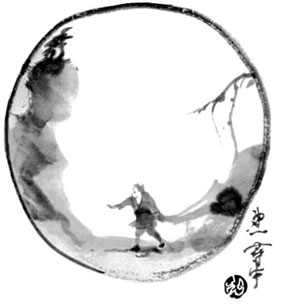
When we first come to Druidry, we do not really know what it means, for there are no long-established formal schools or training that we know of. We can look to history, and then find out about courses now offered in Druidry through various organisations, but is this Druidry? It is certainly a version of it – Druidry is what it is, to each and every person. Moreover, to each and every person, it is different, yet still falls under a single banner. Confusing? Hell yeah. In a way, I think it’s meant to be. It encourages us to get out there, and find out more – beginning the adventure.
2.Discovery of the Footprints
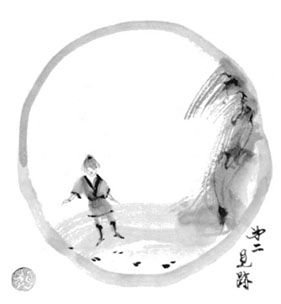
We have begun our adventure, and are searching now for what Druidry is. We catch glimpses of it in the works and writings of others, yet we still have not experienced Druidry for ourselves. Like the wind, we can’t see it, we can only see its effect on other things. We continue and go deeper into our Druidry to find out what it really is.
3.Perceiving the Bull
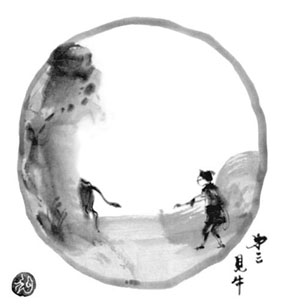
We’ve caught a glimpse! We’ve had an insight into what Druidry is – we know that we’re now on the right path in our journey of self-discovery. Yet it is still not entirely clear – the experience is not yet full. We run after the bull in the hopes of understanding.
4.Catching the Bull
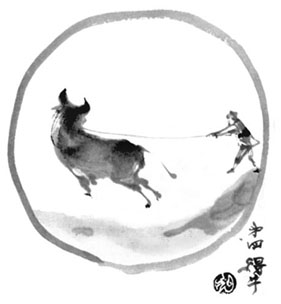
We’ve found our Druidry! After many twists and turns, we’ve come across a path, or developed our own, that seems to flow with the essential spirit that we call the Self. We may find several bulls, even, until we find the right bull, but eventually we come across a method, training, or experience that reflects our inner core. We harness that energy, but what do we do with it now?
5.Taming the Bull
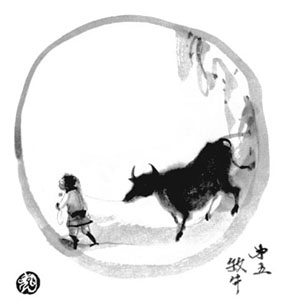
We learn that knowing what Druidry is, is simply not enough. We must practice with it, again and again, experience it and not simply read about it. We hold rituals, we meditate, we get our fingernails dirty. We do the work necessary, and learn discipline.
6.Riding the Bull Home
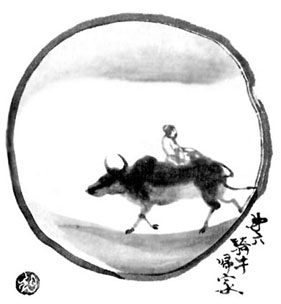
This is Druidry! This is what it means, and it is a joyous expression of our inner souls. We have a sense of “coming home” – we know how to celebrate the seasons and each other, and we may find the beginnings of an inner peace hitherto unknown.
7.The Bull Transcended
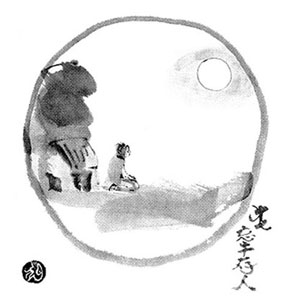
We then realise that Druidry is not something external, nor even internal – that it is something to be lived. There is no separateness, no duality to Druidry – it is not a way of life, but it is life itself. There is a stillness to it.
8.Both Bull and Self Transcended
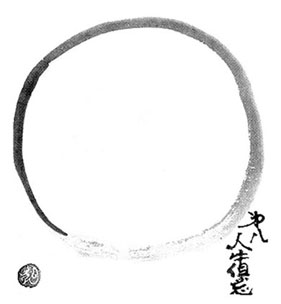
We are no longer separate from the world and from Druidry either. Druidry is us, it was always us. We experience each and every moment with the same reverence we would to ritual – everything becomes sacred.
9.Reaching the Source
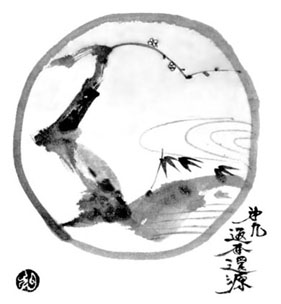
We have reached the source of life itself, and find that meaning or no meaning have no place – only life itself. There is no Druidry. There is no Self. There is no separateness. All is unified under the banner of Life, changing moment by moment, unconcerned with meaning or no meaning.
10.Return to Society
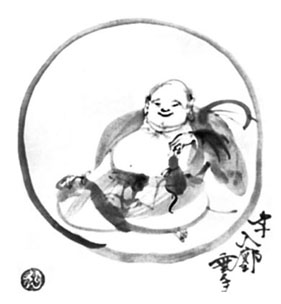 We return to integrate what we have learned from our experiences, to share them and to help others who may be seeking. We do what we need to do for ourselves, our family, the environment without any selfish thoughts – we simply do. With the knowledge that we have gained that so expresses ourselves, and which is known as Druidry, we live as best we can, in the world, present, awake and aware.
Kierkegaard and the Bullies
Perfect love means to love the one through whom one became unhappy – Soren Kierkegaard
Following on from a recent blog post about forgiveness, putting into practice the habit of it is, as is everything, much easier said than done. So I’m going to share some personal things in this blog post, which I don’t often do, but which I think is necessary to give it some context, and to perhaps allow for people in their own situation to relate to it in some way.
Kierkegaard’s reflection on forgiveness inspired me today to do something which I have never been able to do. Forgive the bullies. Thinking about forgiveness a lot lately, I have decided that the best place to start was at the beginning, when the first people who treated me badly first made an impression on my mind and my life.
I had a really happy childhood, growing up in beautiful countryside in a very loving family. I exceled in school – primary school was a breeze. I was top of the class in both academia and athletics – I loved them both. I was confident and happy – it was a great time for me. However, things changed when I went to secondary school.
The first half of the first year went well – though it was a shock moving from a Grade Six class that had five people in it to class sizes of twenty to thirty children. The school was enormous compared to my primary school, but I adapted pretty well (and much thanks to a map my sister drew especially for me to find my classes in the many halls, which was my saviour that first month!). I was confident and smart and making new friends under quite difficult circumstances to a very sensitive child. And then came the bullies.
They were two years older than me, and came from the same region, so we shared the long bus journey together (an hour each way, a total of two hours a day). That was where it all started. Name calling on the bus – for whatever reason, began the whole affair. I assume that it was because I was tall, pretty, blond and happy – though I can never truly know the full reason behind it. Sometimes people simply think that blowing out another person’s flame will make theirs shine all the brighter, but that just isn’t the case – everyone knows two flames are brighter than one alone. For whatever reason, the bullying started.
Being confident, I decided to fight back. I was smart, and could have a comeback for anything. Everyone, from television and film and books, said that if you fight back, the bullies will leave you alone.
That is not the case.
I fought back, with words, not allowing them to see that they were hurting me – throwing it back at them, and also hoping that others around me would rally to the cause and that we would all overthrow this minority of bullies who seemed to control “the bus”.
That was not the case either.
People didn’t stand up for me. But I still persevered, fighting back as best I could. Eventually it did get me down, and I started to doubt myself. But I stayed as strong as I could. They put glue in my hair. They threw food and garbage at me. They called me names. They threatened me. They taunted me every time we passed in the hallway until I avoided all the main halls and used the back stairs, entrances and exits as much as I could. I still held fast to the belief that it was because they were jealous – I stayed strong in my convictions, but it really, really started to get me down. I dreaded going to school every day, and dreaded the bus ride there and back. I joined after school clubs just so I wouldn’t have to take the same bus as they did home – I could take a later bus. I longed for the two days of respite that the weekend brought – Fridays after the bus dropped me off was like a whole new world of freedom to be me again.
It became so bad one day though, that I had had just about enough of it all and, with no holding back, turned around to where they had moved up in the now almost empty bus to sit directly behind me and taunt me ceaselessly. I let it rip, verbally, with all the hate, spite , viciousness and intelligence that I possessed. Their faces were shocked, and then anger took over. One girl grabbed me by the hair and started banging my head against the bus window, over and over again. An older boy came down from the back of the bus and pulled her off of me – I had started physically fighting back – and we were separated. I got off the bus seconds later at my stop, adrenaline bursting along with tears as soon as the bus was out of sight – I wasn’t going to let them see me cry. I hated myself and my life.
The next day we were, of course, called into the Principal’s Office. After a few minutes, where I (with seething calm) stated my case and then the other girl was allowed to state hers, she simply began to cry. I was too angry to care about why she was crying – she had made my life a living hell. I sincerely hoped the Principal was not “duped” by her show – though on reflection I do believe that she was a truly unhappy girl in an unhappy situation, the details of which I still am not aware of to this day – only rumours.
Nothing came of it for me – but I think she may have received a three-day suspension or something similar, though the memory of that is a little fuzzy. What I do remember is that evening she called my house, and my mother answered the phone. The girl threatened my mother and family, and also said that she didn’t care if she got expelled from school – she could always transfer to SAA. My mother said, “Go ahead, please do. BECAUSE THAT’S WHERE I WORK.” We never got a phone call from her again.
The bullying eased off from then on – just some taunts and words passing in the hallway. By this point, I saw the light at the end of the tunnel – the bullies were graduating that year, and once they were gone the school “was mine” again, in the sense that I could live, learn and do as I pleased and enjoy every second of it. They graduated, or failed – I don’t really know, but they left. Those last two years of my high school life were some of the best years of my life.
I still suffered from confidence issues – walking past a group of people laughing, I would assume they were laughing at me. Sometimes I still do – though now I catch myself and, with a wry grin, shrug it off. But one thing I’ve never been able to do is to forgive them for the years and years of torment that they put me through. Well, today I decided that enough is enough.
I have carried these bullies with me for 27 years now, and I’m more than ready to put them down. As in my previous blog post, the story of the monks and the sack of potatoes, I really don’t want to carry anger and hate to these people anymore – I’m going to empty the sack, and maybe one day lose the sack altogether so that it can never be filled with anger again. For anger is the cause of pain and suffering in the world – it is the root behind most, if not all, sufferering and “evil”. So, no more, thank you very much. I forgive you, CB, KJ, WG, D and A – I don’t want to carry you around any more. I hope that your lives are much happier now, and filled with love. Tears are welling up in my eyes even as I write this – the release is overwhelming. I have compassion for myself and for you. May you live well.
And so, I aim for what Kierkegaard wrote – for love is compassion and forgiveness. I am emptying my sack, one by one, and looking for perfect love with every person who has made me unhappy. In this way, I believe, the world can and will be a better place. Namaste.
The Dying of the Light
Dylan Thomas’ poem, “Do not go gentle into that good night” is often in my thoughts at this time of year, when the winter solstice is approaching and the ever increasing night draws close, the cold winds howling outside. Yet I do not agree with the poem’s repetitive line – “Rage, rage against the dying of the light“.
Though wise men at their end know dark is right,
Because their words had forked no lightning they
Do not go gentle into that good night.
Good men, the last wave by, crying how bright
Their frail deeds might have danced in a green bay,
Rage, rage against the dying of the light.
It would seem that the wise know dark is right, and yet their pride, hubris or egos get in the way of going gently into that good night, as their words “had no forked lighting” – they want to be remembered for their wise words, at least, is the suggestion. The true wise person has no need of such external gratification – wisdom is inherent, not granted externally. Written for his father, whom Dylan Thomas wanted to die raging instead of quietly, perhaps for his own selfish attachment or whatever reason, is still spoken of today when the nights are long and we seek illumination in every sense of the word.
It’s all around us – gaudy, flashing lights – some set at incredible speed settings that I can only assume is to disorientate the viewer, often going up before the leaves have fallen from the trees and the ground not yet frozen. Many, many people are raging against the dying of the light, putting up the Christmas or Yule lights, lighting the darkness and consuming considerable amounts of energy at this time of year in a display that is somewhat missing the point. As pagans, we celebrate the return of the sun after the winter solstice, certainly – but we should also honour the darkness in the days leading up to the solstice with equal measure.
Christmas or Yule lights can certainly be very pretty – if done tastefully, and using very low energy lights, turning off others that we would normally have on at this time of year to offset the energy. But first we must come to grips with the darkness before we light the lights. We must look into ourselves to see why and what it is that we fear, loathe, or deny in the darkness – why we are so hesitant to look into the abyss. Is it because we, as Dylan Thomas did, equate darkness with death?
Yet it is the time of year when death is all around us. One look at our gardens instantly confirms this – very few things are still alive above ground. A cycle has ended, and the seeds of the next generation lie below ground to await the return of the light – but they know that this does not happen instantaneously on the winter solstice. They respond to the growing light and warmth slowly, in the months after the solstice, in their own time, and hopefully not too soon, like some of my daffodils did last January…
Acceptance of death is key here. We should not rage against it, but embrace it as part of the cycle. Many people think that death is the opposite of life – yet death is a singular event, and as such its opposite would be birth. Life has no opposite. We do not rage against a birth – why should we rage against a death?
Taking inspiration from the natural world around us, we follow its rhythms and cycles and turn inwards to nurture that which is most precious to us, to guard it for the coming year ahead. It is in that darkness where we can truly know ourselves, our thought patterns, our behavioural tendencies. Looking inwards into our own darkness we can find that small spark of light that needs to be kept safe in the darkness until it is ready to come to light, and not be snuffed out like a candle in the winter wind. It is time to cease looking for a distraction from the darkness all around us, and instead focus on our own wellbeing, and nurturing that seed of inspiration within, as well as facing our own death and fear. It is all too easy to lose that in the crowds doing late-night shopping amidst chintzy tinsel and bright lights, with tinny music being piped into the stores that are overheated because they leave the door open to attract more customers into the lure of consumerism. If we must, we must, but then seek the darkness to recoup and recover.
Honour the darkness for the wonderful rest that it brings. Without it we would have no spring. Celebrate the darkness – turn off all the lights and central heating during the evening of the winter solstice, if you can, and truly experience the time of year. At midnight, light the fire in the hearth or candles in the house to honour the change, slowly, very slowly, lest we become blinded by the artificial return of the light and stumble around unable to see. Do not rage against the dying of the light – for all the rage in the world will not stop death or the darkening days leading up to the solstice. Embrace, embrace the dying of the light.
Book release date – 26 April 2013!

Dreaming it all up again
The winter solstice is coming up – a time for many across the world to celebrate, whatever their spirituality, if they are religious or not. For many pagans, and many Druids, the winter solstice is an especially important time of the year, marked in the public eye by the historic landmarks such as Newgrange or Stonehenge.
But it’s the more private celebrations that call to me at this time of year. Tired after a long year of hard work (with over 30 performances from our dance company, as well as workshops, classes, and filming dvds, on top of writing the next book, Zen Druidry, and oh – yes, my marketing job for a music company…) I am really, really, really looking forward to a couple of week’s rest at the end of December.
This is a time of year when I really connect with my European ancestors and gods – Frigge, the lady of the hearth and home, stands by my shoulder as I spend the evenings baking for my friends and my husband. I think of my mother’s beautiful hands, remembering them when she was cooking, or stroking the cat – how graceful they are, how unhurried and loving no matter what it was she was doing. I think of my grandmothers, with their laughter and love, as I drink a toast to them with a little snort of advocaat. Freya smiles as I snuggle into the warmth of the bed with my husband and cats.
The house is often bathed in the glow of candlelight, with pine scented loveliness drifting through, or the smell of woodsmoke as the fire crackles in the hearth. Though it is often dark and cold out, the home takes on special importance at this time of year. A big cleaning is undertaken in readiness for the months where more time is spent indoors, and everything is made just so, for comfort, ease and security. That feeling of preparedness still hits me late November, early December – make sure everything is good for the next couple of months, for when we will be spiritually, if not physically, snowed in.
For at this time of year, it is the best time to look inwards, to discover your self once again. Taking the time during the long dark months is perfect – a little meditation instead of the television, for instance, in front of that altar glowing with candles and the smoke of incense drifting through the room. The nights are so long – what will you do with them? Please, please please – do not watch more television. Go out with friends. Meditate. Bake. Make love. Walk in the frosty night. But whatever you do, make sure that you take time for yourself.
For me this is the dreaming period, an incubation of sorts. Time to dream it all up again. Think on the coming year, and make some plans – holding to them lightly. Protecting the seeds of your dreams in the darkness of winter, to slowly unfurl when the light returns in the spring. I absolutely adore it. There is nothing better than sitting indoors with a cup of hot chocolate, watching the snow fall, if you are so lucky, and simply being in the moment – or walking out with the snow and evening falling silently all around, the smell of winter thick in the cold, swirling air. Taking inspiration from it all and dreaming, dreaming deep – so deep that when you awaken you are refreshed, and ready for anything.
Take a step back from the manic lights and piped music in restaurants, pubs and shops, and step into your home, touching the frame of the doorway with a soft prayer to the household spirits for their sanctuary. Let yourself slip into the darkness, lit only by soft candlelight, and let the mind and soul rest for a while. And may you truly enjoy the holiday season.
Excerpt from new book, Zen Druidry
We are not “away with the faeries” in meditation – we are truly and more aware of what is going on around us than most people at that moment. We are also aware of our own bodies – any tightness, any pains, where we are relaxed and where we are tense. We can adjust our bodies, again without attachment, releasing tension and the moving on to full awareness of everything.
This first phase of meditation is exceedingly important. Once we have attained a modicum of discipline, we can then open ourselves up to what is going on around us without instantly jumping into thoughts about everything we see, hear or smell. We have already modified our behavioural patterns into something much simpler, much more integrated with the world around us.
The next phase is to allow the thoughts that arise, releasing the focus on our breath and our environment. We do not become absorbed in these thoughts, however. We let them bubble up, notice them, and then without paying any more attention to them let them go. This is the key – like an angry child with a temper tantrum, the more attention we give to our thoughts, the louder they will become, until they have completely absorbed us into their own little world. We must realise that their little world doesn’t even exist – we must learn to stop living inside our heads.
Some of the thoughts that arise might be full of emotion, leading us to joyous recollections or into the pits of despair. Again, we must simply see the thoughts that arise in these first stages of meditation, and later find the space to deal with them should they need to be dealt with. The idea of mindfulness is not to push aside the feelings, not to suppress them in any way. You truly have to feel them – and with such feelings like rage, it can be difficult. But it is possible to feel these emotions without acting upon them. It’s why I haven’t murdered anyone – and I hope I never will! Because we live in honorable relationship to the world, we know that to act on certain feelings is morally unethical. We can still feel them, acknowledge them – hell, we’re only monkeys with car keys after all. We honor the feelings of our own human nature, dance with them, surrender into their flow for a time, but never ever submit, for to do could quite possibly mean our death, or the death and harm of others.
Meh.
Reactions are interesting things. They can only truly happen once – every emotion following them is built upon a memory of the event. We all have an initial reaction to things – some people cover theirs up, some people let it all out emotionally, some people simply have a “meh” and move on.
How we react to things – is this in our control? I would like to think it is. I’m not advocating not reacting, or suppressing reactions to the extent that we become cold and frigid, uncaring. But I think it is a very interesting concept – it is emotion combined with instinct. A bear walks across our path in the woods – we have a reaction. Someone tells us they love us – we have a reaction. Our car skids across the road on ice – we have a reaction. Deep down in the limbic part of the brain, most of the physical parts of reaction are engaged – adrenaline, tears, laughter. That’s the first thing to hit us. The second is our emotional response – fear, sadness, joy.
Next up is usually a mixture of learned behaviour and patterns that we have created over our lifetimes. From quite an early age, we are told and we learn not to let all of our emotions and reactions run riot. We can’t have what we want – the five year old has a tantrum. The parent (rightly so, in my opinion) tells the child to stop. We begin to learn to control our desires as we separate ourselves further from the parental embrace that gives us everything we need – the difference between desire and need is established.
In our learned behaviour, we have created all sorts of attachments to memories and feelings that will colour our future reactions. We have been hurt by someone in the past – when a partner says they have something they want to talk to us about, we may instantly jump to the conclusion that they want to end the relationship – our initial reaction is insecurity. It may or may not be well off the mark. If we can let go of these attachments, then we can simply react accordingly to each situation. How much smoother would life run if that were the case?
Again, this is not a suppression – that does us absolutely no good at all. Through meditation and mindfulness, gained through meditation (Zen techniques and philosophy), we learn to observe ourselves, our thought patterns and our behaviours. We learn that we react in different ways to different things, and noticing the reactions enables us to shift slightly out of our pattern in order to create more harmonious ones with the rest of the world.
Druidry is about connection. If we are truly connected, our reactions to things would be much different than what they usually are. If we realise that we are connected to the person who cut us up on the motorway, our reaction wouldn’t be filled with anger – there might be an initial adrenaline surge as we hit the brakes, avoid any possible accidents, the initial swearing – but afterwards we don’t have to get angry. That person is made of the same stuff we are, existing on the same planet, breathing the same air, having joys and difficulties in their own lives. We can simply acknowledge that and move on with our own lives, thus changing our reaction to events. We avoid any accident and continue driving, concentrating on our own path through the lanes. We aren’t suppressing any emotion, because there isn’t an emotional attachment to suppress anymore. We can’t attach to the reaction either, because it has been and gone.
Acknowledging that we cannot control other people has a great deal to do with our attachment to our responses. I can try to manipulate my husband, but I ultimately have no control over him whatsoever, and vice versa. When we realise that, everything becomes simplified. We don’t have to become passive – we can still make our point, without becoming upset that the other person doesn’t agree with it. We can still protest on Wall Street. We can work to make the world a better place with care and compassion for all living things. We just don’t have to get so attached to it.
In essence then, is the “meh” attitude one worth having? Next time someone upsets me, I’m going to give it a try. I’ll simply say “meh” and get on with my own life, for it is the only one that I can change for good or ill. I’ll let you know how I get on.
 Down the Forest Path