Letting Go

Taking inspiration from nature, many Pagans see this season as a time of letting go. Even as leaves fall from the tree, we let go of things in our lives that no longer nourish us. In the letting go, we allow new manifestations to feed our creativity and inspire us in our journey, even as the fallen leaves feed the soil around the tree.

There are many different kinds of things we let go – ideas, relationships, emotions, material possessions. They key here is that if they are no longer nourishing, then we can softly let them go into the lengthening nights, thinking deeply about our lives and carrying within us new seeds for the coming year. They might be the vegetable garden that didn’t work, the friendship that no longer feels right, grief or anger that we have experienced or even just clutter in our houses.

We can also learn from the letting go – we can try and plant a vegetable garden in a different spot, grow different vegetables. We can focus on the relationships that we have that make our souls sing, and open ourselves to new possibilities. We remember those who have passed away, or who are struggling in the shared human journey. We learn to cherish and make space in our homes and in our lives for things that bring us joy.

The tree does not mourn the falling leaf, nor does the leaf mourn the tree. In the letting go, we simply allow for new manifestations to occur.

Blessings of Samhain.

Reblog: The Love of the Darkness

This a reblog from my channel, DruidHeart at Witches and Pagans, on SageWoman’s channel:


The still centre.

Outside, in the dark, the air is finally still. Like rich swathes of fabric, the darkness hangs around me, enfolding me, wrapping me in its exquisite embrace. I sit, breathing in the night air, the smell of cedar and dew wet grass filling me with pure awen. The last of the crickets are singing in the remnant of summer’s growth, owls hooting softly in the distance and underneath the beech tree near Caia’s grave I let the songs of the night wash over me in waves of indigo and black.

The quiet is shattered by the call of a stag just on the other side of the hedge. Calling to the does, he is in full rut, looking for the ladies in the shelter of the night. He is maybe four feet away, and his bark and rumbles excite me with the power that he is emanating in following his soul’s truth. I can hear the slight shuffle of leaves and grass beneath his hooves as he paces up the track and then back down towards the nature reserve and farmer’s fields.

Overhead, a few stars are shining between the cloud cover, and the moon has not yet risen. My muscles have become fluid, my sense of self sliding into the darkness until there is no separation. There is no I am to compare with: I cannot even say “I am one with this land”, for there is no I. No me. Just life and death, a cycle and spiral mirrored in the galaxy that we perch upon the edge of, in the vastness of space and time.

But eventually I come back; there is an “I” once again. An “I” to speak from this still centre, to make sense of the experience. Sometimes I loathe that “I”, wanting to remain forever in the embrace of the darkness, boundless and floating, no edges and completely open, sharing with everything on this planet in the beautiful, soundless dance in the round of existence. The “I” always returns however, a little smaller, a little less sure of itself, and for this I am glad.

Deep within the depths of the stillness, the songs of the universe can be heard. Beyond the sense of self is all existence.

The love of the darkness, where there is nothing but potential.


To see the original post, click HERE.


Samhain, Death and Dying

Raven’s Hollowby Wyldraven © Wyldraven 2011- 2014 http://wyldraven.deviantart.com/art/Raven-s-Hollow-208469580

In a blog post written last year, I wrote about my contemplations on the Samhain tide of the year, touching upon the nature of death and the Otherworld.

As the darkness closes in with earlier nights and later mornings, thoughts and feelings seek out the lessons to be learnt in the growing dark, where boundaries fall away and where we know nothing at all. Walking through the garden at sunset, shuffling though the fallen beech leaves, greeting my cat at her gravesite (who passed away last Yule), watching as my garden plants return the energy to their roots, I am surrounded by death as much as I am surrounded by life.

Thoughts inescapably turn to death during the Samhain tide, where in Druidry it is recognised and not shuffled away, never to be spoken of in conversation, turning it “morbid” or filled with superstition that the mention death will bring. Death comes to us all, whether we talk about it or not. Might as well talk about it.

My first thoughts turn towards the concept of the Otherworld. Many within Druidry believe in such a place, or places, where our soul goes to rest, to party, to do whatever it is we believe it does, perhaps before we reincarnate. While I do believe in reincarnation, my belief is much more simplistic that this.

More and more I come to realise that, at least for me, there is only this world. There is no Otherworld. There is no veil between the worlds, for there is only this world. And what a wonderful, awe-inspiring world, filled with gods and ancestors and life and death.

The belief in reincarnation, that our soul lives on to occupy another body at a certain time either in the future or in the past, is based upon the belief that there is a place where our soul goes when we die. For me, there is no such thing as “away”. We cannot throw our garbage “away”. We cannot be “away” with the faeries. Our souls cannot go to a resting place before coming back to this world. There is only this world. Let me elaborate.

Using nature as my teacher, I look deeply at how death occurs, the process and the stories that unfold. Death is all around us, from the earth we walk on that is made up of millions of dead things, to the death that we ourselves create with our very existence. Life is also all around us, things coming into being and growing, being nurtured and nurturing in turn. When something dies, it returns back to the soil, to transform into another way of life. Essentially, for me this is what reincarnation is all about. Changing our form. When I die, my body will be devoured by bacteria and worms, become plant food and be drawn up through the roots of trees to be exhaled into the deepening twilight. This is change, this is reincarnation, becoming incarnate in another form, becoming incarnate in a legion of other forms.

My body is made up of a similar legion of other forms, dating back to when we were all just star stuff. Everything on this planet has an original ancestor of star material, and whatever came before stars. My body is made up of living things and dead things. In my bones are stars, in my blood is iron from the hills where I grew up. All these things are living through me, and will continue to live even when I die to be expressed in a different form. They don’t go anywhere but right here.

The human crisis of self-awareness has led to a clinging of the ego which convinces us that without the idea of a separate identity, a sense of self, an “I am” we are simply lost in complete annihilation upon death – that we cease to be. Screaming for attention, it feeds upon the fear and insecurity that the knowledge of our own deaths bring in the darkness. A few religions, philosophies and spiritualities overcome this fear, learning how to transcend the ego, to let it go in order to become one again with the universe. As a Druid and Pagan, this feels right to me, for this leads to a life that is completely integrated with the natural world around us. It drops the illusion of barriers between us and the environment, and allows for full immersion into the present moment where we can be awake and aware to every shimmering drop of existence.

Yet in modern paganism the focus is usually on the “I”, the personal transformation into a better being and a better Pagan, to search for the truth of our souls and to live that truth honourably in accordance with our tradition. Self-actualisation is a big thing, not only in Paganism but also around the world. Based on concepts of the self, a return to the self and coming into our own power, we work on our selves constantly. This in itself is not a bad thing, but for me it needs to go one step further. We have to look inside our selves to understand the nature of the self, and then we can be rid of it. Emma Restall Orr discussed this in a very poignant essay, “After Paganism”, in Moon Books’ Essays in Contemporary Paganism (2013).

Many would query the validity of this, as for them the be all and end all is their sense of self, what they can do and what they have achieved in the world. Without this sense of self, would they be able to make their dreams come true, to work for political and environmental causes, to further their own desires and needs?

While I do not, as yet, have an answer to this question, it is still one that is worthwhile in the asking. I truly believe that we can, at least for moments, perhaps days or weeks, months or even years to drop that sense of self in order to integrate fully with the world. When we have, we can come back to the world with a sense of self that is not separate, that observes but does not judge, that is wakeful and aware without needing to fight for its own existence.

Returning to the subject of death and dying, if we have sufficiently come to terms with the notion that the self is not separate, and that there is no need for an individuated self to exist then when we die, we simply return to the earth. That spark that is human consciousness, that allows us to think about life and death and the self, that too returns to the earth. I seriously question whether humans are the only beings on the planet with the capability of questioning on these subjects, for it my belief that we simply have not been able to language this with other species, out of ignorance or human arrogance, or perhaps both.

Everything returns to the earth. Everything. My consciousness will seep into the soil even as my blood and bones, hair and nails. In this, complete and utter integration will occur, a reincarnation into a myriad of forms. My songs will blow with the wind. My eyes will be in the heads of flowers. My heart will be deep in the darkness of the soil. I will not leave, I will forever be here, in this world, in a multitude of forms. The ego “I” that I speak of will be long gone, released willingly into the night, but the sefless “I” will still be here.

There is comfort in this, in the knowledge that when we die, we don’t go anywhere. The ancestors are always with us, everywhere. Everything that has ever lived and ever died is still here, in another form, whether pebble or mountain, horse or mouse. You can’t create something out of nothing. You can evolve, but that’s a different story – our story is one that is shared universally.

Some would say my thinking is based upon a materialistic view of the world, however, when everything is inspirited, when everything has a consciousness that is not separate, there can be no question that it is wholly animistic. It’s not just the case of “the worm crawls in, the worm crawls out, the worm plays pinochle on your snout” – there IS more to it. Death is not stopping. Death, or dying, is an event that takes place – it is not a “forever”. Death is not the opposite to life – the opposite of death is birth, a singular event. Life has no opposite.

If there is no opposite, then there is no need for other worlds. Everything is right here, right now. The gods of nature are all around us, in the sunshine and in the rain, in the air that we breathe, in the storm and in the drought. So too are the ancestors, our ancient ancestors and our grandmothers who all are letting go of their stories into the soil, to be told again in other forms.

I realise that my words may not be in tune with the majority of Pagans, however, they are spoken with the utmost respect. And in the darkness I breathe, deeply, until there is no longer anyone breathing.

Reblog: The Blessing of Samhain… If You Dare…

This is a reblog from my channel, DruidHeart, at the Witches and Pagans website. To read the full article, click HERE.

Here in the UK, the weather has turned and the colder air sweeps down from the North. Nights are longer, as the sun jumps along the horizon with each rising and setting, heading further and further towards the south. Trees are changing colours, and plants are beginning to die back, the green fading into golden and tawny hues, foliage less dense and earth beginning to peek through the underbrush.

The tide of Samhain has begun, when, after the autumn equinox we prepare for the darkness to come. The balance has been tipped, and we have tipped with it, our internal clocks trying to adjust to new temperatures and light levels. Often, we try to establish our centre, attempting to find some foothold or handhold in the coming darkness, our egos crying out the great rallying cry of “I AM!” The darkness, however, knows the folly of this, and smiles as it creeps ever closer.

In the darkness there are no guidelines. There are no boundaries. There is no up or down, no left or right. There is only impenetrable night, a sweet release from the constraints of the known…

To read the full article, click HERE.

Universal ethics

The concept of universal ethics is the one that makes the most sense to me. How I live my life depends on one, simple question: “What if everyone did the same?”

Dismissing any notion or remarks of creating a totalitarian world by using such a universal concept as simply fear of making personal change, it is my belief that by asking ourselves this very question could greatly increase the quality of life for everything on this planet. Let me provide some examples:

  • What if everyone had a car and drove it everywhere?
  • What if everyone left all the lights on in their homes at night?
  • What if everyone turned off their televisions for half an hour?
  • What if everyone wanted to park their car/motorcycle next to Stonehenge instead of paying for parking?
  • What if everyone didn’t care about offending people, leaving aside any personal responsibility of creating peace?
  • What if everyone didn’t recycle?
  • What if everyone consumed the same amount that the average American consumes?
  • What if everyone paid higher taxes to ensure that the quality of life for all is kept, and no one seeks a way out to pay less?
  • What if everyone stopped looking for a bigger piece of the pie?
  • What if everyone planted a single tree in their lifetimes?
  • What if everyone stopped using unethical cosmetics and toiletries?
  • What if everyone stopped eating so much meat?
  • What if everyone grew some of their own food?
  • What if everyone decided to go to war?
  • What if everyone decided on world peace?

These are but a few examples of “what ifs” that could change the world. Some are small things, some are larger, but the impact on the whole is still considerable if everyone followed the same guidelines. Looking at the bigger picture, and thinking about our actions isn’t always pleasant. It can reveal some real hard truths about ourselves that we have ignored for years. It can turn our world upside down. Equally, it can create within us a lasting peace in the sense that we know that we are walking on the right path. It can provide a real sense of purpose, of integrity and of integration with the rest of the world.

Pessimistically, I don’t see it happening anytime in the near future. There are far too many humans out there whose egos are striving for attention, to fulfil their own desires and need for recognition. In our striving towards self-actualisation, we can become so focused on the self that when we have achieved a sense of self, we stop there. We need to broaden that sense of self, to extend it beyond the self into the whole, and from there gain a better understanding of the world. The best leaders are those who work creatively to make the world a better place for all. The worst leaders are those that use their power for their own personal benefit.

Universalist ethics could provide the way forward, a way of thinking beyond the ego and the self into a more holistic way of being. It requires the fear that lies behind all personal striving to be let go, to dissolve into the outbreath in order to breathe in pure awen, pure inspiration. Only then can we move forward, together, as a community, as a species and as a planet towards real actualisation and not mere pageantry.

Joy and hard graft in the autumn

P1060587 (1024x755)

The hedges have finally all been trimmed, and the garden is winding down after a really long season. Hard work from March through to November, our garden gives us immense joy as well as hard graft. Though the space is used more for enjoyment and relaxation rather than for growing food, next year we will be turning our front garden into a vegetable garden (out back the terrain isn’t ideal, and it’s full on sun so we’d have to water every day, and even with three water barrels it wouldn’t be enough. The front garden has some shade in the morning, so watering in the evening will last longer and be more efficient). We have three apple trees, two of which are groaning under the weight of the fruit. I see even more work in the future, but it is well worth it.

Half of our garden is on a steep slope, so it’s really difficult to grow anything there.  We bought a load of old railway timbers a couple of years ago, and created tiers going down the slope to stop the soil erosion that was happening. Planting a lot of hardy bushes where before a few perennial and some annual flowers simply could not stop the soil from washing away after a rainfall, we’ve also been blessed with lots of newcomers to the gardens that we never previously had – new butterflies, loads of crickets, ladybirds – even a mole! The bottom of the garden is delineated by a hedge, where muntjac and even fallow deer come through to have a drink from our pond and nibble on various things. It’s an organic garden as we wouldn’t have it any other way, so weeding is a constant chore, but it has encouraged so much wildlife that it only supports our decision to keep it pesticide free.

Working the land, even if only in a landscaping as opposed to a food producing endeavour, really puts me in touch with the ancestors. Not only my blood ancestors, such as my father and maternal grandfather who were landscapers by trade, but also the ancestors of place. Our house deeds go waaaay back, and we have framed in our hallway one of the grandest deeds, written in the time of George III, when the land went up for auction. Included in the details of the land were “hovels” where our house was situated, where obviously the poorer people in the village lived. I have no idea what happened to these people after the land was sold, whether they remained here or not, but I can feel their spirit still in the songs of the land. There also used to be an old apple orchard on this land, and the songs of apples and autumn are still heard on the cool breezes and lazy golden sunshine at this time of year. Though I may not work the land in the same way as the ancestors did, at least I can feel this connection with them through my sweat falling on the soil, my in breath and out breath mingling with the old ash trees that are hundreds of years old. The smell of dirt on your hands after gardening. Bit of tree and hedge in your hair. Sandy soil in your boots.

There is so much life in my garden. Roaming neighbourhood cats, owls, pigeons, mice, beetles, bats, spiders, swallows. Every day it changes, and something is different. At this time of year, when the sun sets ever further south on the horizon, I sit outside and watch as it jumps over the landscape, the days getting shorter and shorter much quicker. The light is always different, casting new shadows across the lawn, creating new shapes and colours. The smell of woodsmoke is on the wind, and the decaying leaves from the beech tree mingle with the tingly scent of freshly trimmed leylande. Life and death are all rolled into one beautiful cycle in my little haven, my little sanctuary.

My garden is pure awen.

Blessings of autumn to you all.

Reblog: Autumn Equinox and the Serpent Energies of Albion

This is a reblog from my channel, DruidHeart at SageWoman Magazine’s section on the Witches and Pagans website.

__________________________

The autumn equinox is upon us today, and we stand on the knife’s edge, leaping, stumbling, tumbling or diving down into the long nights. I love this time of year, as many of you know. The scents of leaves decaying in piles on the forest floor, the brilliant colours and the crisp air fills my heart with such joy. It is a wild cacophony to the senses, one last “hurrah!” before the silence of winter descends.

 
I love the retreat back into the earth, feeling my energy sinking back into my roots. The crazy time of summer and festivals, camps, parties and revelry has passed, and now it is time of reflection. We turn ourselves inwards, away from the social gatherings and noise, and focus on our own inner selves and what we have achieved. We take stock, we sum up, we begin the journey down into the darkness where one by one our senses are lost, eventually dreaming into the winter and letting go during the peaceful rest of deep sleep.

 
During the spring months, when the earth was warming under the eye of the sun, I felt Brighde’s energy rising, a large white dragon/serpent beneath the land that connected all of Albion. Dancing in the energies of midsummer, she then slowly began her retreat back into herself, and now at the equinox I feel her pulling back into the earth, the wild ride of her energy sinking back into the soil, the serpent retreating back into the cool nourishing earth, preparing for slumber. I too feel myself riding these serpent energies, ready to dream big this winter with wonderful new plans awaiting me.

 
Brighde is ancient. She is, for me, the British Isles. She is the bones of this land. She is not a mother goddess. She does not follow cycles of maiden, mother, queen and crone. She always was and always will be. She is as young as the snowdrop and as old as the hills. She has no relation at all to the Bridget of the mixed, revealed Christian and Pagan mythos. She is not all loving, she is not a warrior queen, she is not human in any way. She is the land, in a vast and exceedingly simple but elegant way…

_______________________

To read the the full article, please click HERE.

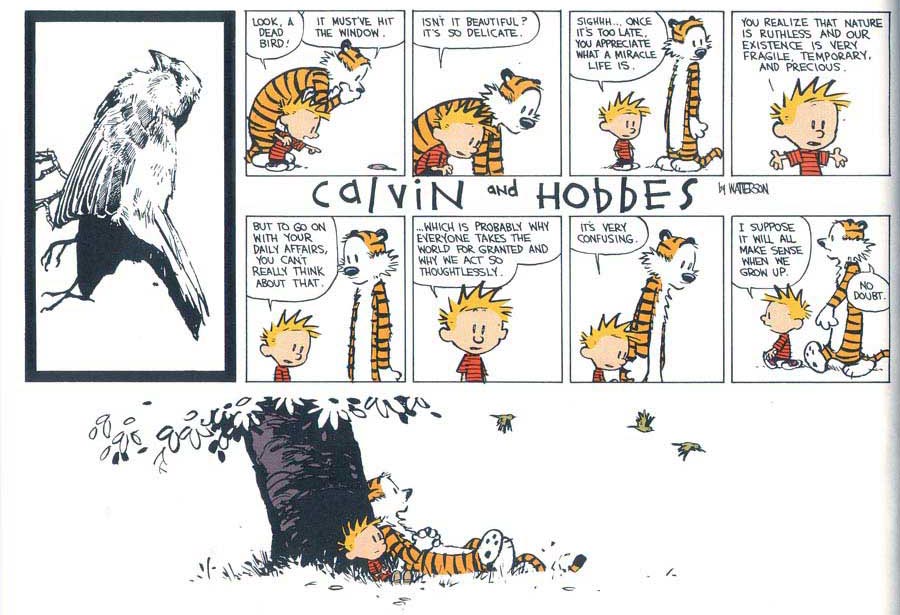
Making sense…

from Bill Waterson's Calvin & Hobbes, It's A Magical World

from Bill Waterson’s Calvin & Hobbes, It’s A Magical World

Yoga, Animism and the Nature of Evil

During yoga last night, halfway through the class and moving to another pose, a loud “wham!” sounded in the room. In the middle of the class, a woman had squashed some spider or insect with her shoe on the wooden floor. “Did you get him?” the yoga teacher asked.

“Yep,” the lady replied, pleased with herself.

My heart fell. I was saddened, not only by the loss of life, but more by the wanton destruction of said life, as if it had no right to existence. For one such as myself, intentional killing of another animal is tantamount to murder, when it is completely unnecessary. The class carried on as if nothing happened.

I’m still thinking about it. I know that I personally could not squash a spider or bug, snail or slug, no matter how yucky they might appear to my preconceived human perception of what is beautiful and what is not. Driven since a very young age, we are told that wasps are evil, spiders are scary and snails are gross and destructive in our gardens. They all deserve to die because of these things. It is utterly absurd.

I have sat down to a meal at a pub, outside in their beer garden, where customers could request a can of insecticide to kill the wasps that came looking for food, tantalised by the sweet smell of beer. Horrified, not only by the wanton killing but by the thought of such chemicals near food, I have not been back since. The way the human mind works both disgusts and challenges me sometimes.

I’m not overly fond of worms or slugs, slimy things or creatures that live in the ocean that I cannot see beneath me when I am swimming. Big spiders are slightly frightening, only because I know that they can bite (I’ve yet to be bitten). That doesn’t mean that I seek to eradicate spiders, or all slimy things from my garden, or cull sharks when I want to swim in their waters. We really have to get over our ideas of what is good, what is beautiful and what has a right to existence, and what doesn’t. Who the hell are we to say?

I’ve been an Animist all my life. I have known on a very deep level that all things have a right to existence. This was not instilled in me by my parents, per se – it just seems an inherent part of my personal nature. I know that all things are connected on both a spiritual level and also on a scientific level. We live in ecosystems, where one part relies on another part to function. We often forget that we are part of such complex systems, or we believe we are above them. I recently wrote to my local newsletter in response to a letter to the editor asking for the eradication of ragweed near his home. He saw the dangers of the toxic plant, however he also failed to recognise the many lives are dependent on this one species of plant. For himself, he saw no benefit in this plant. He saw himself as above and more valuable to the ecosystem in which this plant existed. This is the nature of evil, in my opinion – belief that we are separate and therefore we can do as we please.

Philip Carr-Gomm has recently shared his queries and thoughts on the nature of evil in a recent social media status update. He states:

“Humans can be so unspeakably destructive – either to their fellow humans or the Earth, perhaps the ‘unthinkable’ needs to be thought – that human nature is not naturally beneficent, and evil acts therefore the result of aberration, but that it is in its essence a mixture of beneficent and maleficent, and that only some sort of training, discipline, spiritual practice, psychotherapy or education that can help us ensure our beneficence rules our head, heart and actions, rather than the reverse.

What do you think? Have you sometimes thought ‘perhaps they got it right when they came up with the idea of Original Sin’?”

The idea of Original Sin to me is abhorrent as killing things without thought. It is used to guilt people into behaving in the way that those in power think they should, to keep those in power in the status quo. This is not a criticism of Christianity as a whole, but of those who use it to further their own purposes. There is much within Christianity that is beautiful and inspiring. This abuse of power is not limited to Christianity, but can found in religions and communities all over the world.

I personally do not think that people are born evil. When I look at human beings, I see monkeys with car keys. Sadly, these monkeys have forgotten their roots, forgotten that they are just monkeys, forgotten that they are a part of the world and a part of an intricate web of existence. This is where the nature of evil occurs, the sin that divides and separates. This is where the destruction occurs, because we believe we are separate, that we are in control, that we have power over other beings.

I would argue that nothing in nature is beneficent – everything simply is what it is, neither good nor bad. The sun is not being beneficent in providing us with light and life – it is just being what it is. The clouds are not being beneficent by providing us with rain – they are just being clouds. Beneficent seems to imply a focused and intentional act of giving. While nature has its own consciousness, how intentional is it? This leads us to the ultimate question – what is the meaning of life?

For me, life has no inherent meaning – it just is. Things are alive because the appropriate conditions were available for life to be. This includes humans and all other beings. There is no master plan. It is a wonderful, beautiful, freestyle weaving of a web of life.

We are not born evil, or with evil intent. We are not born good, or with good intent. We are simply born, and the lives that we live, the circumstances of those lives and the environment that we live in all provide us with a path that we take. We have a choice to cut ourselves off from our inherent nature, of living in harmony with the rest of the world. We choose to do this for the most part out of desire for personal gain, whatever the cost to other lives and the planet as a whole. When we believe in the lie that we are separate, we can commit the worst atrocities.

We don’t even need a religion or spirituality, psychotherapy or other means to find some sort of return to harmony. We just need to wake up and shake off the lie, the belief that we are separate. We need to see things how they are, not how we think they should be. We need to see our place in the warp and weft of the tapestry of life. We need to sing in tune with all the other songs of existence. We need to remember what it is to be truly alive.

When we awaken, we also find the proverbial return to the garden. We understand life in all its forms. By living with eyes open, we walk the earth with compassion for all things.

When we return to our place in the web, the end result is deep and lasting peace.

Duty

Recently I wrote a blog post about self-governance, and mentioned that another word that we need to reclaim in Druidry and Paganism in general is “duty”.

The concept of duty can go against the grain of some the Pagans and Druids out there who feel that it compromises their expressions of freedom. Duty seems to allude to the fact that we MUST do something, and being told to do anything can make many a pagan balk. However, duty is central to my Druidry, and there are many things that I must do to maintain my focus on a path and journey of honourable relationship and discovery.

As a Pagan and Druid who seeks a deep, sustainable, meaningful and honourable relationship with the land and the world around me, the concept of giving back for all that I have received is key. That giving back is my duty, my obligation to see that sustainability is kept, otherwise the whole thing might fall apart. I see it as my duty to recycle, to reduce my consumption of material goods, to be vegan, to organise litter clear-ups, to promote environmental activism, equality and rights for both human and non-human animals. I see it as my duty to act as priest for my community, to serve them in the best way that I can, whether that is as ritualist or celebrant, author or dance director, eternal student of nature and life. All of these I see as part of my dedication to my community, my gods and my ancestors. But it goes deeper than that. That is simply the work and the life path’s that I have chosen to embark on to live in a more meaningful, inspired and honourable way.

There aren’t really words to describe the depth of my duty towards my Druidry. It is something that is lived, is felt deep within the heart and deep within the gut. It is expressed dancing in the wind and collecting wild mushrooms. It is writing letters to the local council against the proposed housing development that will eradicate delicate and endangered species. It is a dedication to learning all about where I live, from where my water comes from to how I generate my own electricity. It is about learning to run with the deer on the heath and sing with the bees in the thick clumps of heather. It is about not settling for “good enough” or resting on your laurels. It is about constantly learning, experiencing and awakening.

Duty is tied with responsibility – the ability to respond. In keeping with the previous blog’s message of self-governance, we can use this to help us respond to situations better, more efficiently and with more compassion.

Duty is described in the dictionary as something that one is expected or required to do by moral or legal obligation. Indeed, my morality dictates my duty, however, the legality side is guided by my morals (and not the other way around). It is my civic duty to report abuse, or stop when I witness a car crash, yet I would do this regardless of whether there was legal obligation. Often duty is considered as something we are “forced” to do, yet I can think of no other way to be in the world. I am not being forced by anyone do live the way I do. I choose to live my life in service and in constant awe of the power of nature.

The nature and etymology of word duty is long and complicated. From Anglo-French deute and Old French deu, it means what is owed, due, proper and just. Go back further to the Latin, and we have debitus, the past participle of debere, which means debt, or to owe something. This ties in nicely with what I stated earlier, in the giving back for all that I have received in my life. I cannot simply take and take without giving anything back. Look at what that has already done to the world.

And so, duty is not a bad word in my vocabulary. It fits in my world view of being of service. It is about sustainable and honourable relationship within the cycles of life. We are never distanced from nature or life, but ever dancing within the wheels of time and the tides of life and death, entwined in each other’s arms and lives like Celtic knotwork. There is no separation, no Other. When we realise that, we realise our duty.