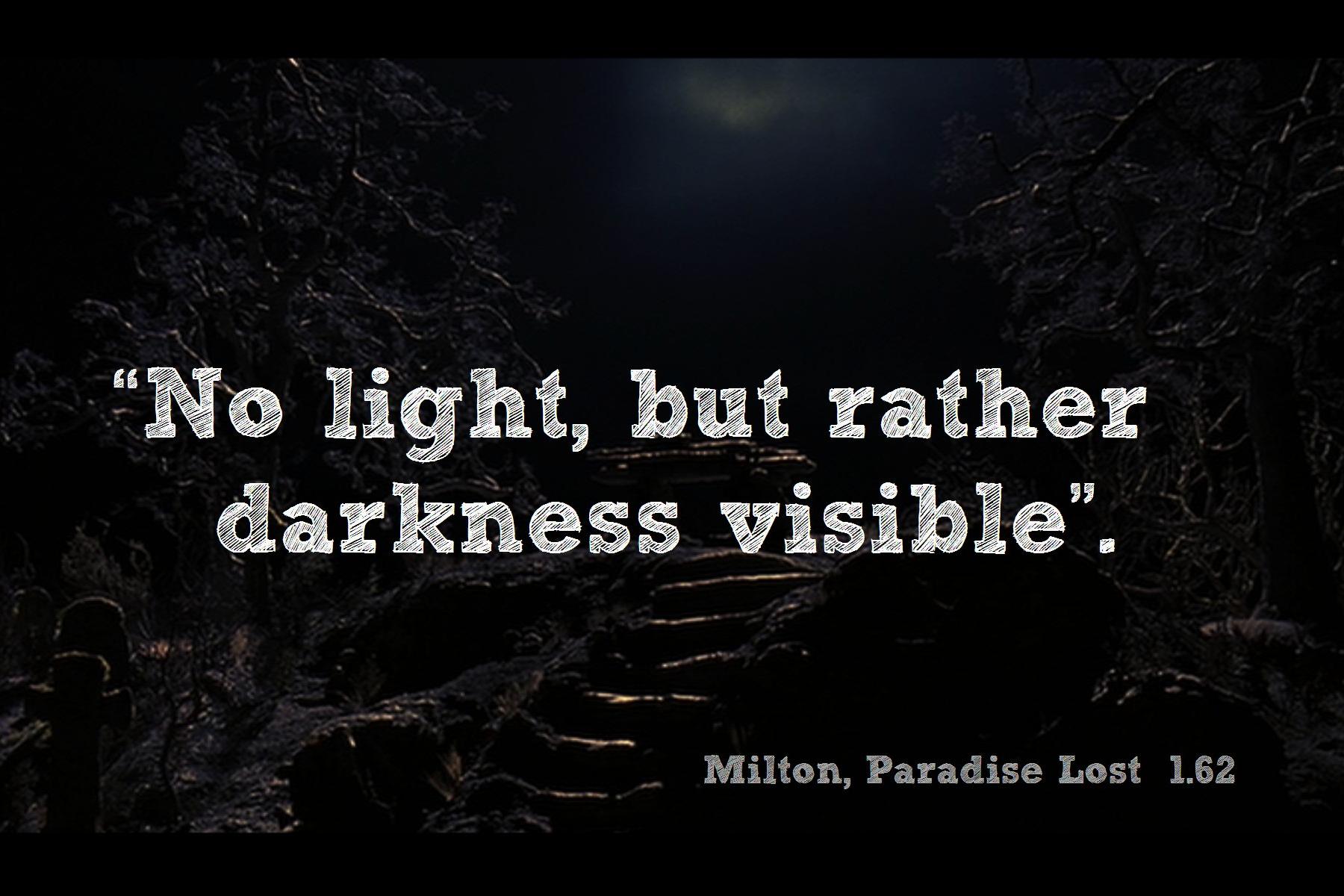
Darkness and Mystery

milton paradise lostThe evenings draw in closer, the darkness growing as we make our way towards the winter solstice.  It is a time for deep thought, reflection and understanding – thinking and understanding so deeply you are hardly doing it at all.  In the darkness our minds are much less distracted by visual stimulation.  We can explore the darkness both within and without, as well as the great mystery of the unknown.

In Zen Buddhism, along the Eightfold Path we learn about Right Mind.  At this time of year, I apply it when journeying ever closer towards the rebirth of the light. It is in the darkness that the mind is truly explored. It is in the darkness that the world outside is truly confronted.  It is in the darkness where we find the greatest mystery of all.

Right Mind requires an understanding of the self, in order to see that the self is really not all that important.  First we must learn about our reactions to the world – how we relate to it, what is automatic and what is intentional.  By studying our selves and studying our navels, we look deep within to see where we might be able to work on living in full awareness of our actions in our daily lives.  If we have an understanding that we instantly react to the person on the social networking site who criticises us, we can then work on that so that there isn’t attachment to it.  We learn that we don’t even have to react – that it is within our power as to how we behave.  When our co-worker in the office won’t help us even when we ask for it, we learn not to instantly react and let it ruin our day. We simply get on with the job at hand, perhaps asking for help elsewhere.

We are not owed anything. Learning this lesson can be of great value in our own spiritual awakening.  People do not have to act as we would wish them to. Not everyone has to agree with us. People will have different opinions.  We don’t have to comment, criticise or even give it second thought if we do not wish to.  Our emotions, our passions should be the spark of inspiration. They should not be the raging inferno that takes over.

By looking deep within to see how our passions and emotions play through our daily lives, we come to an understanding of them. We cannot ever develop a relationship with anything, be it person, tree, mountain or deity without first understanding them to a certain degree.  We often do not understand ourselves, to our detriment.  Why do we behave the way we do? How can we live more intentionally?

Through daily meditation we can come to a greater awareness of our selves.  Once we have attained that awareness, it is best to let it go.

You may ask – why spend all that time learning about our selves, only to let it go?

If we are constantly looking inwards, we will neglect to look outwards.  Druidry and much of modern day Paganism are at the risk of becoming too self-involved, too inwardly focused.  Five words remind me of this on a daily basis. It’s not all about you.

We can become so self-absorbed in looking at our navels that the world passes us by.  There is so much out there that we need to become aware of, just as previously there was so much inside that we needed to be aware of.  Once we have achieved a level of competency in knowing ourselves, the best thing we could do is to lose that sense of self in order to understand the bigger picture.

This dropping of the ego, this letting go is not an annihilation of the self. It is not negation. It is immersion, integration – utterly being.  It shows us the boundaries between the worlds, between us and other humans, between us as the natural environment. It also shows us that these boundaries are simply illusion. We are all just energy.

We can then begin to explore the greatest mystery of all, within the nurturing darkness – that of not knowing.  After learning to understand our selves and the world, we lose understanding as well, realising that we really do not know very much at all.  In such a vast landscape, both inner and outer, how can we truly know anything at all?  Often in Zen this is referred to as Mu, or nothing.  In the not knowing we are open to everything, our minds not being closed off.  The great mystery of not knowing is where the true potential lies.  In not knowing, we are free.

Deep within the darkness, the journey continues.

Fear of Ageing

Having recently just turned 39, my thoughts lately have been turning to our society’s views on ageing.  Ageing is something that we must fight, if you listen to all the women’s toiletries marketing ploys.  Combat ageing, they say, with their Miracle Defense Cure (incidentally, I did a search on how many products contain the word “defense” in their name for creams, lotions and potions, and it was staggering…) and you will be young forever, for young is beautiful.

Now, I don’t know about you, and can’t speak for the masses, but I don’t want to look like a twelve year old girl.  Most models in fashion magazines are under 16 years of age.  They wouldn’t even be able to afford the clothes that they are modelling for the older, more affluent women who buy said magazines.  Billboards and television advertisements show us young women all the time, for everything from cosmetics to kitchens.  We have ingrained in our minds that young is beautiful, and have it reinforced each and every day.

I have recently heard that young women are also shaving themselves completely, removing all pubic hair. Why, I have absolutely no idea, but this only reiterates our new obsession with youth – they may state for hygienic or fashion purposes, but the fact of the matter remains – they still will end up looking like pre-pubescent girls.  Not terribly sexy, in my opinion.

Why do we have such a fear of ageing? Why do we consider youth to be so beautiful, at least for the human race?  Many humans see beauty in older things, such as a 500 year old tree, or a 1,000 year old cathedral. Here in the UK, the ideal home in the country would be something reminiscent of a house built in the 1600 – 1800’s.  Old, at least for some things, is aesthetically pleasing. Why not for the human body as well?

We do not venerate the old in our society; it is not an achievement anymore to reach old age, what with the wonders of modern medicine.  Old people are a burden to those still earning money, getting in the way until they are put in homes.  We do not look after our elderly anymore, but pay others to do it for us.  Out of sight, out of mind.  We fear ageing, we do not want to have to deal with it.  It’s a sickening, maddening cycle, for we will all age. It’s the one thing that we cannot avoid at any cost.  The diet industry might lose us as customers once we’ve lost the desired weight, but there’s no stopping the ageing process, and manufacturers know this, licking their lips in anticipation of our progress down the linear track of time.

Ageing for a man is still, as far as I can observe, less of a fear than for a woman.  Men with grey hair are sexy. Women with grey hair are not.  Distinguished, people say of men with grey hair.  What of women?  Personally, I cannot wait to have grey hair, or white even – I love the colour.  But society disagrees with me, and sells us harmful chemicals to put on our heads to cover up those grey hairs.  As women live longer than men, on the whole, why do they fear ageing even more?

The loss of youth equals the loss of beauty.  We need to change our perception of that in order to alleviate our fears.  It’s a silly fear in the first place, as nothing we can do will prevent it from happening.  And yet, women all over the world go under the knife to have surgery, or injections, or pay exorbitant amounts of money on products that don’t really do anything.  Why, for the love of the goddess, why?

Fear is such a grand motivator in all things.  We must embrace our fear, as we must embrace our ageing.  What is it that we fear about ageing? For some, it might be the fear of being cast aside, of not being a “productive” member of society – what will I do in retirement? For others, it means coming to terms with their own mortality.  I know that after meditating on this for some time, my personal fear is the loss of beauty – until I realised that beauty does not come with an age limit.  I look around me and find inspiration in all things beautiful and realise just how limiting it is to think of beauty in terms of age.  Step outside the human mindset and watch your world expand.

Watching my face and body change is now no longer depressing – it’s interesting, and a little exciting.  My curves are softer, my breasts larger.  I have cellulite on my thighs.  I have wrinkles on my cleavage.  Little lines around my eyes.  My hands show the hours of work that I have put them to.  My days of sunshine and laughter shown in freckles and wrinkles.  Tattoos mark life transitions, and will look amazing no matter what age I get, as they will change with my body.  Scars show life’s trials and tribulations. All these are a part of my self, and denying these, hating these, is hating myself. What a bloody waste of time.

If society tells me that I should fear ageing, I shall stick up two fingers to it and tell them to bugger off.  I’m more afraid of war, nuclear waste, fracking and the poor badgers who are being culled than I am of ageing.  I no longer fear ageing full stop. To hell with their distractions – there are so much more important things to be doing that standing in front of a mirror looking at a wrinkle or two.

I adored my youth, and have many, many fond memories of it.  Growing up in a beautiful part of the world, loving a beautiful boy for the first time, learning to play music and sing, to roam and find personal freedom.  I am also adoring my “middle years”, whatever that may mean.  Each and every day is precious, and so I will be thankful for them.  There is no battle to be fought, there is no war to be won on ageing.  Time is time, and cares not whether you try out your best wrinkle defense cream.  Be like time, and care not about that which you cannot alter. Don’t go with the flow, but be the flow itself.  Live, love and be happy, free of the fear that society tells you that you should have.  Stand tall and proud, grey hairs and saggy breasted, and know that you are goddess, that you are beautiful, if you only allow yourself to be.

Grab that strawberry!

The wild strawberries are now out in my garden, and I am reminded of this Zen story.

A man traveling across a field encountered a tiger. He fled, the tiger after him. Coming to a precipice, he caught hold of the root of a wild vine and swung himself down over the edge. The tiger sniffed at him from above. Trembling, the man looked down to where, far below, another tiger was waiting to eat him. Only the vine sustained him. Two mice, one white and one black, little by little started to gnaw away the vine. The man saw a luscious strawberry near him. Grasping the vine with one hand, he plucked the strawberry with the other. How sweet it tasted!

What if I told you that we choose to let our emotions, our grief, the struggles of living day to day affect us?  Who on earth would willingly choose to allow these to happen? Those who are afraid to face them, to engage with them. They are often the people who believe that mediation is all about pushing your feelings away for a space in time in which to breathe. While this can be a short-term coping mechanism, in the long term it achieves nothing. We must choose to face the abyss, and have the abyss stare back at us (Nietzche).

So many people believe Zen or Buddhist meditation is all about emptying the mind, to achieve nothingness. To wilfully push out everything and focus on nothing. However, in doing so, as soon as when we stop focusing on nothing, everything else comes rushing back in.

If, instead, we focus on issues that we are facing when we meditate we can resolve them – perhaps not all in one sitting, but over time, getting to know our fears in order to work with them.  We’ll never know how to break free of our demons until we can name them.

Simply sitting, zazen, is a brilliant tool for focusing the mind on the here and now. Laying aside the past and future for a session, we immerse ourselves in the present moment, fully aware of everything going around us.  Sometimes when we do this, feelings come up, of sadness or despair, joy or tranquillity.  We can ignore these feelings, and see them come back and back again, or we can engage with them.

Engaging with them does not mean to fall utterly within their tantalising spell, however. Through our previous sessions of simply being in the moment, focused, we have developed two great tools – the power of concentration and the power of detachment.  Think of them as your power tools 😉

Using concentration, we can fully focus on the emotion, the memory – whatever it is that pops into our head, giving it our full attention. With detachment, we see it for what it is – something that exists in our minds only, that has no substance.  Using both tools, we can delve even further if we so wish, looking to where the thoughts may stem from.  Then, equally with both tools, we can see that it is a choice as to whether we allow the thought or memory to control our lives, or whether we choose otherwise.

It’s our choice as to whether we hold on to things, or whether we engage with them.  You can’t fight what you don’t know. Face the fear, the emotion, and come out the other side, naming it, staring straight back at it, knowing that it no longer has a hold over you. Some demons never go away, but are silenced for a time, and letting go is never a one-time process. We have to let go each and every day, face our fears, our emotions, stoically in order to understand ourselves and others.  Enjoy the present moment.

It’s your choice.


Beltane – welcoming the summer

Beltane – the fire festival celebrating the arrival of summer. All throughout the UK, last night and today Pagans and non-Pagans alike are joining in the festivities of this special time of the year, with Morris dancing and bonfires, Maypoles and feasting.  A long weekend awaits us with a bank holiday Monday, where many pubs will host barbeques and hog roasts, entertainment and more.

After a very long winter, this festival is most welcome.  At Imbolc and the Spring Equionox, we quietly ushered in the lengthening days, the gradual shift towards the summer solstice, noticing the ever changing cycles around us.  Now it is a time for the first of what I deem the “louder” festivals of summer, where drumming and dancing and cavorting are done with abandon.

Here where I live in Suffolk, it’s not quite time however.  I prefer to celebrate Beltane when the May is out; when the hawthorn flowers in the softest shades of pink-tinged white.  It will be another week or two yet before these blossoms begin the scent the hedgerows, and bring with them that sense of a definitive coming of summer.

For me, Beltane is also a time when it is finally warm enough to stay outside comfortably, to sit in meditation or to make love under the dappled light of the sun beneath the tender new canopy of leaves deep within the forest.  The Goddess is still waking up, slowly, soon to dance freely with the Lord of the Wildwood. It is not yet time to awaken her fully with shouts and drumming and the ecstatic pleasure of ritual love-making – not quite yet.

I can feel the anticipation growing inside me, as I long to reach out towards the sunlight and stretch my soul into the warm air, or to dance in the summer rain.  It is coming, it is coming…

Paperback edition of new book now available!

Paperback version of my new book is out today – ebook will be ready soon! A big thank you to the Druid, Buddhist and Pagan community, who continually inspire me – may we be the awen!  http://www.amazon.co.uk/Pagan-Portals-Druidry-Natural-Awareness/dp/1780993900/ref=sr_1_1?s=books&ie=UTF8&qid=1365503883&sr=1-1&keywords=zen+druidry

BOOK

The benefits of meditation

Sitting in meditation with awareness transcends into every aspect of your life. I know it has done mine. It’s so hard, and yet so simple – simply to sit for at least 15 mins to half an hour each day, in total awareness.

At first it’s really hard not to fidget – trying to get comfortable, the mind is doing everything it can to move the body so that we don’t have to feel this very moment, in all its glory or mundaneness. That is my biggest hurdle – the sitting still part. Sometimes I simply can’t, and then a walking meditation will take the place of sitting meditation. However, the importance of keeping that butt on that cushion should not be underestimated.

Forcing myself into stillness, I can then imagine a rock being thrown into a pond – it settles to the bottom of its own accord, and find the stillness. Then, it is time to simply “be” in the present moment. Feeling the tension in my shoulders, hearing the wind howl outside, thick with snow. Hearing the central heating come on, the soft padding of a cat entering the room. Smelling the incense, seeing the light of the candle upon my altar. For a few, brief moments, it is blissful and relaxing.

Then come the thoughts – anyone who has ever tried to meditate knows the flurry of thoughts that will fly through your head at any given moment. It can sometimes be a Herculean task to just sit when all these thoughts are going through your head – if you’re moving, you don’t have to think about them, or notice that they are passing through your head with lightning speed. But sitting still and facing all these thoughts – it can sometimes seem futile. I’ve heard so many people say “I can’t meditate – I can’t turn off, switch off; I keep thinking a million things”. You’ve got to persevere.

So, in sitting meditation, in zazen, we don’t try to push away all these thoughts – what we learn to do is to become the observer. It’s all about noticing the thoughts that go through the mind, without attaching to them and becoming lost in them. As soon as we attach to them, we’ve lost our awareness, our sense of being an observer – instead we are a willing or unwilling participant in them, and the benefits of meditation we will rarely see.

So, with all these thoughts whizzing through my head, I become the observer. I notice that I’m thinking about the belly dance show that I’m putting on in October, that I have to start dinner soon, that a friend hasn’t been in contact for months, that the car windscreen has a sticky annoying film on it that just won’t go away – noticing the thoughts without going into them – which is supremely difficult for some thoughts. And I am not always successful either, but I eventually do catch myself getting absorbed in the thoughts at some point, and bring my attention and awareness back into the room where I am sitting in front of the alter, with the candle and incense and cats sleeping around me.

Slowly, the more and more I meditate, the less and less I become absorbed in these thoughts. However, we all have good days and bad days. But I have found when I don’t meditate for a few days, I can and do get lost in my thoughts, creating drama out of them, or becoming easily annoyed with myself or other people around me – losing that sense of connectedness, compassion and empathy. For the benefits of sitting meditation carry through into all aspects of life – seeping through like springwater into the surrounding areas, benefiting all with its nourishment.

The more I do zazen, the less irritable I am (though again, we all have good days and bad days). I notice tension in my body more throughout the day. I notice when I am being self-centred, and when I am losing myself in the drama that I have created to give my life more importance. Sitting meditation makes you realise that all this drama is self-created to a large extent. While some tragedies can still occur, the correlating attachment to them will be lessened, and life flows that much easier even in the midst of major trauma or upheaval.

You have to want to meditate. People who say they cannot perhaps haven’t tried hard enough, or don’t want it enough in their lives. You have to be willing to commit to a certain amount of time and effort each and every day, and also to a commitment not to change yourself, but to become better aware of yourself, and by doing so, flow through life better. Obstacles will still be there, but like water we can flow around them instead of slamming into them again and again, never getting any further along the way.

Your life will become more active, and less reactive – instead of reacting to every situation, you can act with empathy and compassion; your ability to respond well increases each and every day. It is a responsibility – the ability to respond. It is also learning discipline, to sit when you don’t feel like it, to be aware of your body when your mind and body both are rebelling against it, and would rather be in the made-up world of your mind instead of sitting in the reality of the here and now.

Slowly, that awareness gained through sitting meditation will affect everything you say and do, for the better. The goal is not self-improvement, however – the goal is to be in the here and now, this very moment in this very life, and to see the joy and wonder that it truly is. We are gifted with long lives, should nothing unforeseen happen, and minds that can be trained back into awareness – let’s use them to the best of our ability. By doing so, a sense of connection to the here and now, to all the beautiful life around us, will be achieved – which makes it worth the effort.

Meditation

Many modern day pagans incorporate meditation into their spiritual practice. The reasons are varied, from wanting a sense of inner peace, health benefits, to seeking a spirit guide and more. The techniques themselves are as varied as the reasons behind why meditation is becoming so important – from journeying, astral travel, going “under the cloak”, mindfulness and so on.

There is a certain mysticism surrounding meditation, which may be a reason why it is so popular in paganism. It can be a deeply spiritual experience, it can put you in contact with the Otherworld – it can also put you in touch with yourself and the world around you in the present moment (reality). It can be both mystical and mundane. Its uses are boundless, and the benefits too many to count. However, let’s go over a few anyway…

Meditation is said to lower blood pressure, to help with sleeping difficulties, depression, anxiety attacks, deep-seated fears and problems with concentration. The latest meditation fad on the health and science circuit is Mindfulness Based Cognitive Therapy (MBCT). BBC News Healthstates that “It teaches a way of looking at problems, observing them clearly but not necessarily trying to fix them or solve them.’It suggests to people that they begin to see all their thoughts as just thoughts, whether they are positive, negative or neutral’.” http://news.bbc.co.uk/1/hi/health/7319043.stm. Now, having been a Zen meditator for years now, this sounds like plain old Soto Zen meditation to me, under a different name. In fact, Mindfulness was first translated from Sanskrit in 1881 by Thomas William Rhys Davids, who further described it as “Right Mindfulness, the active and watchful mind”. Mindfulness in itself is nothing “new” – it’s been a part of Buddhist meditation for thousands of years. Yet, as Harvard Health online states “Mindfulness meditation is getting a lot of attention because it seems to help with so many physical and psychological problems—like high blood pressure, chronic pain, psoriasis, sleep trouble, anxiety, and depression. It’s also been shown to boost immune function and stop binge eating. http://www.health.harvard.edu/blog/mindfulness-meditation-improves-connections-in-the-brain-201104082253”. No matter what it is called, it seems to be working.

Meditation is not for everyone, but for those pagans who are looking to incorporate it into their lifestyle it can be a wonderful way to get in touch with your “inner self” and the world around you. As a Druid, I use meditation for relaxation, for journeying and for connecting with everything around me. As I mentioned earlier, I usually use the method of Soto Zen, literally “sitting meditation” for the most part. This, much as the MBCT above, is about being aware of thoughts, and thought processes, without judgement. It is also being aware and in the present moment, hearing, smelling, seeing everything with complete focus to the art of paying attention. It’s also about the discipline of keeping your butt on a cushion for more than five minutes at a time, which is the hardest part.

Zen meditation is not , as many people (and pagans) believe, about transcending the body, but about being 100% completely in it – awake and aware to everything. It’s about sitting on your cushion and feeling any tension in the body. It’s about feeling your breath moving in and out of your body. It’s about hearing the blackbird singing outside. It’s also about paying attention to the thoughts that arise in your mind – “Oh, I’m thinking about that again” instead of becoming wrapped up in the thought. It’s about being non-judgemental about absolutely everything – not thinking “I’m drifting off again, I must pay attention – I really, really suck at meditating”. It’s about returning to the present moment, again and again and again. It’s really very simply, and very difficult at the same time.

Another form of meditation that I like to use was taught to me by a former teacher, Emma Restall Orr. This is called the Tree Meditation, which is wonderful for grounding. The beginnings can be found here – http://druidnetwork.org/learning/exercises/tree. It is a beautiful, grounding meditation that really focuses on the breath as a an agent to plant your metaphysical roots into the ground, to become rooted like a tree, drawing up nourishment from the very earth, the sacred earth. I try to do this at least once a week along with my Zen meditations, for it brings me back to connection with the earth, my home and the soil in my backyard.

The Ancestor Meditation is another meditation that I learned whilst on the Bobcat’s Living Druidry Course, set in the beautiful Cotswolds countryside. This is a really deep meditation to connect you with your ancestors – I’ve only ever done this with blood ancestors, but I’m sure that it could be performed with spiritual ancestors as well. It’s about connection, and again, the tool for this is the breath – what better way to connect with others than by our breath? It is a shared thing – what we breath in, others have breathed out, from bird to beetle to beastie. This meditation takes us on a journey through the breath to connect with our ancestors in a truly profound way. Not for the faint-hearted!

I also enjoy the occasional Journeying – taking a “trip” to a special place to perform a certain task, to meet with a certain person, spirit, or even deity, to seek out answers or to simply have some fun. I perform a Dark Moon Journeying to meet with other members of the Order of the Yew – the dark heart of the Druid Network. To find out more about the Order of the Yew, and its meditation, you will have to become a member, but it is well worth it in my opinion. I also meditated regularly when studying with OBOD, using their exercises which really helped open my soul to new things, to new experiences. Again, you have to be a member, and it is rather a lot more than the Druid Network.

Then there are simply times when I am outside in the backyard, watching the sunset or the sunrise, or running with the deer on the heath, or sitting in front of the fireplace, honouring the spirits of place with all that I am. Sometimes singing back to the land is a part of the meditation – I have stood at the edge of the North Sea and spiritually sung words that have no meaning and yet are full of emotion to my ancestors across the sea.

The end result to all meditation is, I suppose, connection. It’s all about relationship, whether it is getting to know yourself better, or your world. It is deeply healing and transformative, and, in my opinion, should be performed as often as you can, in as many places as you can. It’s the benefit of taking time out for yourself, with no guilt or judgement, to re-connect to the threads of life that are woven all around you. Go on, if you haven’t already – give it a try.