When compassion is challenged…

Some people have differing opinions to ours.  That is their entitlement – we all may agree or disagree with each other, have different viewpoints and perspectives.  Only we can see the world through our own eyes, layered with our own experiences, trials and tribulations. Only we know our own story fully and completely.  No other can know us the way we know ourselves, the reasons for our actions and the choices we make.

Everyone is on their own path, fighting their own battles, making their own decisions according to the principles that they live by, the culture and society they grew up in, and their own soul’s calling.  We should never berate another for following their own path. We can certainly disagree, and stand up for what we believe in, whether that is against a political party, a company, an abusive relationship – but we must always remember that belittling someone is never the right thing to do.  People will make bad choices, people will not care about the same things that we do. However, making fun of them does not solve anything. Looking down on someone means that you have placed yourself in a position of authority or power over them – an illusory pedestal.
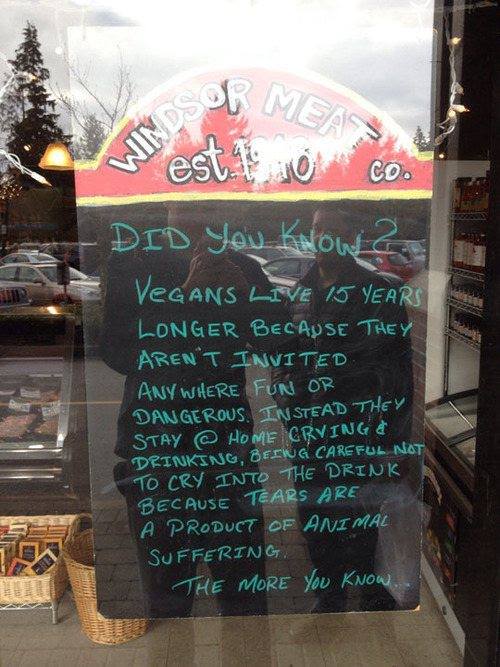
meat coThe photo here is an example of a meat company who are putting down vegans in order to gain more people to their “side”, using “humour” as a unifier against some perceived threat to their way of life. What we have to realise is that there are no sides in life – only differing choices and opinions.  There is no Us and Them – there is only the human experience.  The entire Us and Them mentality has led to the most atrocious human behaviour possible – war and genocide, murder and rape, crime and racism, just to name a few.

Those who choose to become vegan or vegetarian have their own reasons – health, weight loss, environmentalism, religion.  It is wrong to belittle someone for any of these reasons. In fact, it is wrong to belittle anyone – end of story.  I disagree with people all the time, and I know I’m not perfect, but when I catch myself belittling someone I do my best to stop it, to realise that they are on their own journey, and to have compassion for them.  I do not want to be like the person who wrote this sign. I choose to behave differently.

I chose to become vegetarian twenty years ago, and am currently in the switch to vegan. This is my personal choice, based on research and religious reasons that ring true to my own soul. This may not be the same choice for other people, and I understand that.  However, I do tire of people making fun of my choice – I have had to endure that for over twenty years.  It is inevitable at dinner parties where someone who doesn’t know you very well, and who is a self-confessed “meat lover”, will question your choice at the dinner table, confronting you on your life path when all you want to do is eat with a good conscience and enjoy your meal with your friends or family, in harmony.  The ubiquitous “screaming vegetables” always comes up, and I must explain my reasons for becoming vegetarian or remain silent. Sometimes I choose to, other times I simply let it be. For the sake of peace, I make a decision based on compassion for all those who are sharing the meal with me. I only wish certain others could do the same.

Would it be correct to challenge someone on their religion at the dinner table? I don’t think so.  What about their decision to join Amnesty International, or Greenpeace?  Would it be right to poke fun at someone because they looked different? We must appreciate each other’s diversity, and in that appreciation realise that we are all human beings on our own journeys- that unifying factor within the diversity is what compassion is all about.

looking downThat is why in response to the photo above, I am posting this other photo.  It reflects and is only my opinion, but it matters to me in my spiritual journey.  Zen Buddhism tells us to hold to our opinions lightly, and indeed I see the wisdom in this. Our opinions are always changing – we are always learning and growing.  However, we must do so with compassion and awareness of the journey of others as well, even those who challenge us and our opinions.  I must have compassion for the people who own that meat company, realising that they have their own reasons for writing this sign, however much I disagree with them. I can voice my own opinion against it with this blog, with my words, with respect and as much understanding as my situation allows.  I don’t have to think it is right. I don’t have to agree with them. But I shall not belittle them for their opinion.

Watching Parliament in full swing makes me cringe – I remember the first time I saw a “discussion” which never let the other side finish what they were saying, instead making so much noise as to drown out the current speaker’s voice in a wall of derision.  This was how our country was and is being governed. It saddened and enraged me – this so-called civilised way of government.  How much better could it be if we just took the time to listen to each other without judgement, allowing the other person their say, and respectfully choosing to disagree if it does not ring true to our souls?  If the government cannot govern their behaviour in Parliament, why should the people? I found it so saddening, and still do…

Never be afraid to speak out against what you think is wrong, or for what you believe in. However, do so with compassion, with respect. Otherwise, you are simply acting and reacting to the bad behaviour of others. Remember also that acting with compassion does not necessarily elevate you above these others – you are not “good” for acting compassionately. You are simply acting compassionately – that is all.

Live with honour and dignity. Act with love and compassion. It’s not that hard. Blessings on your journey. X

Excerpt from new book, Dancing with Nemetona: A Druid’s Exploration of Sanctuary and Sacred Space

Here’s a little taster from my upcoming book, Dancing With Nemetona, published with Moon Books, available this spring…

Lady of Ritual

magic circleRitual – the word rolls off the tongue. It evokes images of moonlight and standing stones, or incense and flower filled temple rooms, women and men gathered under the stars or the light of day to celebrate an aspect of life, death and rebirth.

Ritual is as simple or complex as we allow it to be.  We can follow a set liturgy, or we can create our own path.  Within paganism, both are equally acceptable.  As paganism is, technically, a newly rebirthed religion the question of authenticity with regards to validity is moot – someone, somewhere along the line, whether it was 60 years ago, 600 years ago or 60,000 years ago made it up at some point.  That has no bearing on its validity.

When we create ritual, we are taking a moment, taking time out, to celebrate or honour a specific moment in time. It may be as simple as saying a prayer of thanks at sunrise or sunset, or it may be a full blown affair held within a stone circle, with 20 or more participants, having rehearsed their roles and re-enacting a mythic drama.  Whatever ritual you choose to perform, establishing a relationship with Nemetona can be a rich and rewarding experience to lend to these sacred acts.

Nemetona is Lady of the Sacred Grove, where it is believed that ritual occurred in past history.  The ritual itself is just as important as the setting.  It must speak to us, must sing to our soul, otherwise, what is the point?

As the Lady of Holding, of guarding and watching over our sacred space, our created sanctuaries, Nemetona is also a lady of ritual, integral to it if we so desire.  She moves in circles and in cycles, and therefore when we hold a ritual circle, we can invoke her easily within that sacred place.  She is all that is within the sacred circle, and also all that is without.  Like a vase, the vase is not only the boundaries of its own edges, but also the emptiness within that allows it to be a vase.

We can call upon Nemetona in ritual, to protect our sacred circle, to bless it, or simply to witness what it is that we are doing within that space (or all three).  She can be called upon before a ritual to help define its intent and purpose.  She is the Lady of Holding, and within her embrace we are free to be and do as we wish.  Within the sacred ritual circle, she enables change and growth, safety and security where we might otherwise not feel it to be.

Within the ritual circle is a space where we can grow, where we can make associations and develop our spirituality to its true potential.  Within the sacred circle, we overlay it with our associations in ritual such as the elements, our spirit guides, ancestors, gods and goddesses and more.  By finding out where these “fit” in the sacred ritual circle, held within the arms of Nemetona we come to truly understand ourselves, and the greater world at large.

Working with Kindness

Many religions and spiritualities the world over teach that kindness and compassion is the way to live your life in order the create harmony and peace not only for yourself, but for the rest of the world.  This is a form of service, which I think may be lacking in much of modern paganism.  It is in the service to others where we truly shine.  The Sisterhood of Avalon states it beautifully in a triad – service to the self, service to the Sisterhood and service to the Goddess.  Like most things, it starts from within and then spreads to the wider community and the world at large.  Sadly, perhaps due to the growing number of self-help books and various psychologies, this service tends to stop at the self.  Instant gratification in our capitalist society combined with living in relative ease can allow complacency in our lives and in our minds.  We can become grasping even, wanting to be healed, looking for that one thing or one person who will heal us, as we have been taught my marketing campaigns the world over.  Me, me me. I, I, I.

There seems to be a great need for healing in the world today.  Paganism embraces this healing with open arms, honouring it in all its various forms.  We are often told that we must first heal ourselves before we can heal others. In this, I very much agree.  It’s often the hardest thing to heal yourself – focusing on others is much easier than coming face to face with your own pain, grief, demons or shadow self.  However, we can become too engrossed in looking inwards that we forget to look outwards as well.  Too much self-awareness and not enough external awareness.  It can even border on or become egocentric.

The key here I believe lies in kindness.  Through these last few months, when the darkness of winter takes hold and we are gifted with the time and space to reflect, we can look at how we can be kind to ourselves.  This is the best thing we can do for ourselves in terms of our own healing.  It is easier to forgive others for hurting us, or causing us stress, grief or pain than it is to forgive ourselves for doing things that we regret.  Yet we must look at ourselves in the same light as we do others and be able to forgive ourselves in order to move the service from self to others, through the act of love and kindness.  This is our service to our self.

We have to be aware of our edges – we must create boundaries so that when we allow kindness to flow through us we have an awareness that not everyone will be kind in return.  This is not a shutting down or closing off of the soul to others – it is simply being prepared.  Like meeting a strange dog or cat for the first time, we are unsure as to how they will react, and so we proceed with caution.  We still show compassion and love and try to help them should they need it in any way possible. We will also do all that we can to prevent being bitten. This is our service to others.

I have been too open – I have not guarded my boundaries as well as I should have. I have loved freely and been bitten on the ass in return.  I have learned to use boundaries to let me help myself and to help others.  In Brian Froud’s latest faery oracle card deck, there is a card that I drew called The Lady of Faith.  She wears a helmet and shoulder armour, but her breast is bare of armour and she is leaning towards something with a hand to her heart.  This card shows that we must protect ourselves but still allow our hearts to move us in kindness and compassion.

I recently saw a documentary on Phil Robertson, of Duck Dynasty fame about how he transformed his life through his religion and coming to know God and Jesus.  While we may not share the same religious points of view we can agree that it all comes down to kindness.  He described when he was making a living fishing on the river and other “river rats” would come and steal from his nets.  After he had found Jesus, he worked with the idea of kindness and so, when he caught them stealing again, offered them the fish freely.  They took it and responded to his kindness by never stealing from him again.  Phil stated that he will act towards all things with kindness, but still carry a shotgun in case all things weren’t kind to him.

This is very similar to a Zen Buddhist story, where a monk is sitting and praying in his cave high on the mountaintop. A thief comes upon him and threatens him. The monk looks at the thief and states that if he wanted his possessions so badly, feeling he had to threaten and steal them, then he would freely give them if that was his need.  The thief left bewildered and the monk sat outside, looking up at the moon.  “If only I could have given him this beautiful moon”, he said. (Some argue that the monk should have done a Phil Roberston and had a shotgun as well, but that doesn’t fit in with the peaceful and non-violent ideals that the monk held to.)

Living to our ideals, exploring our shadow aspects (those aspects of the soul that we fear, that we loathe, that we deny) and giving back to the world results naturally in leading the way to the further service to the gods.  We dedicate our lives to kindness and compassion with full awareness and in doing so, reflect the true nature of not only our being, but of being.  For me, the gods that I follow all have an aspect of peace and kindness that we can find in their stories to inspire us along our own life’s journey.  Tyr, most often seen as a god of war and justice, to me also represents kindness to animals and loyalty as when he fed the wolf, Fenris, when no one else would.  Nehelennia, the goddess of the North Sea rages and leaves us with a fresh world – sometimes battered but ever inspired by the impermanence of all things.  Morrighan heals after the battles and rejuvenates after the blood is spilled.  Nemetona teaches of boundaries as well as love and peace.  In this I have dedicated myself to learning and being open to the awen of their songs.

Through coming into our own true potential, we are better able to serve ourselves, our community and our gods.  The key to it all is through kindness.  How very simple, how often this message had been repeated over thousands of years. How easy it is to forget in today’s society.  Yet when we open ourselves to the possibilities and let kindness lead us in our actions, peace and harmony are a natural result.

When Maiden, Mother, Crone isn’t right…

My latest blog for SageWoman…

http://www.witchesandpagans.com/SageWoman-Blogs/when-maiden-mother-crone-isn-t-enough.html

After having spent a lovely weekend in Glastonbury with a dear friend, I noticed that there is a lot of focus on the triumvirate of Maiden, Mother and Crone. Walk into any shop and you will find this triple goddess littering shelves, books about these aspects and people talking about where they are in relation to Her.

This triple goddess, however, leaves me a bit cold. Childless by choice, I have no relationship with the Mother aspect of Her, and absolutely no desire for one.  Yet is seemed to be constantly thrown in front of me – at a certain age, we should be entering our Mother phase. My little inner anarchist said bollocks to that.

Firstly, I’ve always had difficulty with a triple goddess, reflected in the phases of the moon for, as everyone knows, there are four phases – waxing, full, waning and new or dark moon.  So, a triple goddess of the moon makes no sense for me personally, though it may work for others.

Secondly, there are many women out there who can identify with my choice of not bearing any children and for whom the phase of motherhood may seem out of place.  I understand that the term motherhood may have many different meanings – you can give birth to ideas, or nurture your own environment. However, to me the term mother has always been a literal one. It is partly why I don’t believe in an all-loving Mother Goddess.  I have a physical mother and no need for a metaphysical one.  My deities of nature do not have the usual aspects of motherhood instilled within them. They simply are what they are, whether that is wind and rain, fog or mist, love, anger and fear, time and tides, floods and drought.

So what is a person to do when bombarded by this triple goddess? It seems taken for granted that everyone identifies with such, especially women. This is not the case. Perhaps we need to find something else that works for us individually.

I considered over the weekend how to change the triumvirate of Maiden, Mother and Crone.  Some ideas that I have considered are Maiden, Priestess, Queen and Crone – and the aspect of Mother could easily fit into one of two categories there should the need arise.  This would also seem to fit in with the phases of the moon – Maiden as the growing, waxing moon, Priestess in the fullness of her power, Queen as we journey into the wisdom of sovereignty with our maturation, and Crone as we delve deep into the darkness and journey towards the winter of our lives.  This feels easier for me, without adding pressure of having to procreate to fit into one of her aspects.

I have heard of people replacing the Mother with Warrior, or Amazon, but this does not sit right with me.  As a Druid I am dedicated to peace, working to create peace in the world through empathy and compassion, using the Bardic arts that I am graced with, as well as the Ovatic gift of vision.

Perhaps I take this just a little too literally, a little too seriously.  As a woman who has made the decision not to have children however, I feel that it is sometimes necessary to redefine the boundaries of what we currently hold to be our personal truths in our ever-changing society.  I feel this is even more necessary in our spiritual worldviews. For me, religion should be an ever-evolving thing, growing with the person and with the society, holding a sacred relationship to our past while looking towards our ancestors of the future.

Rise in Druidry

There is a marked increase in the rise people who follow a Druid path and, indeed, all Pagan paths. Why should this be?

In today’s society, we can become so distanced from nature that we feel we need to do something to return to it; something that will connect us once again with the rhythms and flows of life.  However, this separation is in itself an illusion that we have created, for we can never be separate as long as we are living and breathing in this world. By mere fact of our existence, by the breath that we share with all other beings on this planet, we have a shared existence and a shared experience. We are never disconnected; we are never truly alone.

The illusion can be very convincing though.  It is supported with lifestyles and gadgets that seem to help fund the energy of the illusion.  We commute to work on a train with hundreds of people and feel lonely, as everyone is reading a paper, on their phones or listening to their music, shutting out everyone else. For some highly sensitive individuals, this is even a self-preservation technique.  We have mobile phones that can connect us with thousands of people anytime, anywhere (apparently) and yet we have very little human interaction with most of them.  We live in smaller and smaller family units where interaction with grandparents, cousins, aunts and uncles is ever decreasing for whatever reason – time, distance, etc.

Paganism and Druidy in particular can serve to address this need to reconnect, illusion or no.  It can offer us a group of like-minded people who share certain worldviews, or who like to perform ritual a certain way, or support environmental or political causes alongside their spirituality.  It may be discussion groups and forums, moots, talks, workshops, camps and retreats that we share and find inspiration in.  It is looking for that connecting thread that says we are part of a tribe.

With so many technological advances, someone might be drawn to Druidry to get away from their machines, the hum of electricity and the constant noise in an attempt to return to the natural cycles that are reflected in our environment.  Some may be called by poetry of the Romantics, or through historical references or self-actualization.  Some may be following their blood lineage of a Celtic heritage, others might feel called by the land upon which they live and use Druidry as the language with which to communicate.

For me personally, the draw to Druidry was in its simplicity. There are so many forms of Druidry, some highly ceremonial, some more ‘mud and blood’.  It is to the latter, the experiential Druidry, the simple but not simplistic view of the world and its rhythms and cycles that calls me further in.  With no need for magical spells or intricate ceremonies, no regalia or ritual items necessary, just plain and simple communion and communication with nature is what called me.  A fondness and easy way with animals and plants almost made the choice for me. Service to the land, the ancestors and the community is the key tenet of my practice, in that order.

More and more, people are choosing to follow a nature-based spirituality.  Their reasons may be legion, but love of nature is at the very heart.  For me, to be a Druid means not only a love of nature, but service to nature, to the world. We cannot take with abandon – we must give back. We must work hard to protect the things we love from our ever increasingly secular society and its rampant technological advances that do not take into consideration the impact on the rest of the world and indeed, the bigger picture. It is about seeing the sanctity and the sacredness in all things, using the language of Druidry to help us relate.

Druidry is all about the bigger picture. It is about our legacy and what we will leave to our ancestors of the future. It is learning from the past and living fully in the present, mindful of how we live and how we love. It is an ever evolving tradition that works with the talent and energy of the individual in service to the whole.

With the rise of numbers in Druidry, we need to remember this service to the world.  It is not only something for us, but something for the entire planet. We do not practice Druidry for our selves, but for the benefit of all.  This is not altruistic, merely an outcome of service to the land.  In service we grow in our selves, not the other way around. We must look deep within to find our reasons for our Druidry, taking a long hard look at our selves. We must also remember to look outside our selves to the world at large.

We practice, we work, we serve, we step back and regroup in order to practice, to work and to serve. It is a cycle that is represented in the seasons, in the life cycles of everything around us.  It is the awen. It is courage. It is Druidry.

The Sensitive Soul

Being quite sensitive, as in having senses that are very much alive, awake and aware, can leave someone shaking with overload or feelings of being overwhelmed. Working with the senses we find that it is truly a gift, not a curse.

I am a very sensitive person. Not just in the emotional sense but also in my physical senses.  I have very acute hearing (though sometimes selective, my husband says).  I am very sensitive to light levels.  I am extremely sensitive to changes in the weather, barometric pressure changes often giving me headaches or feelings of nausea. I have very delicate tastebuds – food that is barely spicy for most people sets my mouth on fire.  My sense of smell is such that it can often hinder as much as help me in my life – I find it hard to overcome any smell that I find unpleasant.  As for touch, perhaps it has to do with living with practical awareness as much as possible that allows me to really feel things – when I’m typing on the keyboard I really feel the keys, when I am driving I feel the road through the steering wheel – I have very vivid memories relating to the sense of touch.

I can easily be overwhelmed by today’s society.  Walking in the local garden centre a few months back, I had to leave as I was bombarded with visual displays in every aisle, each one making a different noise, talking about a different product, clashing with each other and taking attention away from other things. It became one big not-so-background mess of noise and sound and sight that I had to leave. I later emailed the garden centre to tell them of this – they agreed that others had complained as well.

If a thunderstorm is coming, I know it. If it will soon clear, I know it. I can feel it in my bones.  It can leave me on the bed, nauseous.  However, when it does arrive, I can also revel in the glorious energy that it brings. It needn’t always be a detriment.

When walking in the woods, the slightest sound or flicker of movement makes me aware of the presence of deer, ghosting through the trees.  My fingers touching the bark of an old friend, an old oak, I can feel the years of its growth, its songs and its stories. Listening to the waves of the North Sea lapping upon the shingle beach, I can hear the songs of my ancestors.

Like all things, I’ve simply learned to adapt my sensitivity and to avoid situations where I become overloaded.  Large cities are difficult for me, so I tend to stay away from them.  Cinemas are far too loud and so, if there a movie I must see in the cinema and cannot wait for the dvd or television release, I bring earplugs.  Similarly, I can use those earplugs when at the garden centre, though they seem to have toned down on their visual displays since I last contacted them.

I see my sensitivity as a blessing.  I can smell winter approaching. I can feel the point when the sun has set past the horizon.  I can stroke my cat’s fur in full awareness.  Work with the gifts that you are given.  Nothing is great and glorious, everything has a shadow side. Learning that the shadow is not something negative is truly freeing and enabling.

Beware the Green-Eyed Monster…

Social media can be a very good thing. It’s good at getting the word out, or for sharing ideas. It can also be a place where we can feel inadequate, where jealous feelings of other’s lives can creep into our thinking and affect how we live.

First of all we must remember that what we see online is not the 100% truth.  What people post on Facebook or Twitter or any other media or forum is not the whole enchilada. We look up someone on Facebook who doesn’t post anything negative, has beautiful photos and deep insights and feel that we are inadequate in our own lives.  What we have to remember is that this is simply a portrayal of a person and not the person themselves. To know the person, we must know them in person, spend a lot of time with them and connect, soul to soul. You can’t do that on a computer in my opinion. You can find a lot of commonalities with what you both have decided to put out there, however it is not the big picture.

Jealousy is an interesting beast.  What causes it? More often than not, it is through experiences that we have gone through that reflect upon our current and future situations.  Something may have happened to us in the past, an emotional pain that casts its pall over everything.  If we are jealous of what we perceive to be someone’s great life on the internet, what is it that is making us jealous? What is causing feelings of inadequacy, or anger, or resentment? Could it be someone in your past that you didn’t live up to, or dreams that you haven’t fulfilled, failings that have been brought to light?  Do they reflect our inner demons, perhaps of low self-esteem or external validation?

Catch yourself the next time you feel jealousy creeping in. Examine it. Why are you jealous? What is the root cause? It is not the person causing the feelings but your own inner self. Why should that be? The person is not the root of the problem – what’s happening in the mind is.  We cannot blame other people’s lives for our feelings of jealousy for they all stem from within.

Wouldn’t it feel better if we let go of these jealous feelings? What if we celebrated others’ successes instead of wallowing in inadequacy? What if we realised that others’ lives are not a reflection of our own? What if we stepped outside our narrow worldview, our egocentric perspective and honoured others for being what they are? The world does not revolve around you, so why persist in these feelings?

Letting go of jealousy is hard. It requires a lot of investigation into the darker regions of the mind but it is well worth it.  We can lead happier, more satisfying and positive lives when we are aware of the green-eyed monster and lay it to rest. So, the next time you are on Facebook and think “my life sucks compared to hers/his” remember, not only are you not seeing the bigger picture; you are also not seeing your self.

Looking inwards

“Not until we are lost do we begin to understand ourselves.” -Henry David Thoreau

As I have begun my journey into the descent of both the self and the dark half of the year, thoughts and feelings have arisen which require acknowledgement. It has often been said that those thoughts that we are unaware of, control us. Quite.

Just as we are not our jobs, our familial roles or any other singular label, so too are we not our past, nor our future. We can only be our present.  All too often I have beat myself up about what I have done in the past. After a couple of months of looking inwards and discovering these thought patterns, I have realised that I have to let go of what I thought of myself in the past.

In the past I have been selfish. In the past I have done things I am not proud of. However, that does not mean that I am selfish now, or that I will do these things again, now or in the future.  What happened does not define me in the present moment so much as inform me of how I got here. I am only the person I am now, typing up this blog post trying to make sense of the self and how it works.

It is a season for letting go and so, every time I have a thought on how I have failed, I remind myself that this was something that happened in the past and, in truth, is not who I am now. It is extremely liberating, and enables me to be the best person I can be right now, as opposed to living in destructive and judgemental behaviour about what I have done.  I can certainly be critical of things, looking at them with detachment and learning from it, however no condemnation can be made because it no longer exists.  Often in Zen we hear of teachers asking students who bring up past faults and issues “Yes, but where is this now?”  Baffled, the student cannot answer, for it does not exist in the present moment. They are memories and lessons learned. They existed in the past. They inform us of the future.

Sometimes the best thing to do is to lose that sense of self in order to be able to look inwards critically.  Putting aside the ego and simply seeing thoughts for what they are is extremely difficult. The ego jostles for attention at any possible chance, with thoughts of “I am this” or comparisons to other people, opinions on the world at large and a deep-seated fear of annihilation. When we put all these aside we are simply left with our own personal truth.

Animism Today

P1040954 (1024x768)What does it mean to be an animist in today’s world? Druid Emma Restall Orr describes animism as that which acknowledges the inherent value in all things.  This description, for me, is the best offered so far.

Many people can see animism as a throw-back to times when people were not so intelligent; the cavemen who believed in spirits imbuing inanimate objects. What I would offer is a redefinition of inanimate for, in my worldview, nothing could be inanimate.

How is this so? Well, I’m not a physicist however I’m pretty sure that everything is composed of atoms that are constantly moving (atomic theory).  Ancient philosopher Heraclitus theorised this yonks ago, claiming that everything is in a state of flux. Therefore, how could anything be inanimate? Most people, when considering the word inanimate, seem to think of things that don’t move, that aren’t “alive”.

So how does the dictionary define inanimate? There are a few: 1.not animate; lifeless. 2.spiritless; sluggish; dull. Synonyms: inorganic, vegetable, mineral; inert, dead. 2. inactive, dormant, torpid. Considering these descriptions, we must also consider the word “alive”. Oxford English dictionary describes it as 1.(of a person, animal, or plant) living, not dead; 2. continuing in existence or use.  Not very helpful, is it? Animate is something that is not lifeless, and alive is something that is not dead. So what is dead then?

I could go on.  Is the desk that my computer on dead? When did it cease to live? It is still in existence and continuing in existence and use, as the OED states something that is alive does.  The only change has been in the form of the matter. When someone dies, they change through the processes of decay, returning to the earth.  So have they truly died, or merely changed form?

If we cannot define what is alive and what is dead, what is animate and what is inanimate, then in essence everything should be treated equally.  With such loose terms we cannot and should not push aside what we do not fully comprehend.  Yet every single day millions of people do so, declaring that something is merely a tool, a resource, something to be used for their personal benefit.  The inherent value in something is in relation to its usefulness. Again, usefulness is such a broad and subjective term.

If the oceans are merely a resource, if a chicken is only a resource, then it loses its inherent value in the fact of it simply being.  We can then abuse it to our own purpose – mostly selfishness and greed.  We are able to pollute the seas because we no longer respect them. We cage hens and kill them once their usefulness in egg-production is up, or dairy cows when they have “dried up”.  They no longer have any value.

Animism honours each and every thing for what it is, whether it is bird or bee, human or cat, tree or rock, mountain or lake.  Each thing is made up of millions of other things. Each individual thing on this planet contains parts of other things.  Not only is everything inherent in its own being and value, but everything is interconnected.

Everything is made up of nothing – the essential building blocks of everything is nothing, if we go deeper in physics.  In this, we are all connected. We are all made up of things that are constantly in motion – energy always moving and creating different forms that we recognise as sibling, house, lorry.  For me, this blows my mind.

So does this mean that I need to bow down and worship the lorry that takes away our recycling?  Well, no, not really, though it’s an interesting concept.  Many pagans who also are animists have an apprehension or dislike for bowing down to anyone – but that is a separate issue. I have no problem in bowing to my gods.  We then have to define what constitutes deity. Again, I digress.

Recognising the inherent value of everything does not mean worshipping it. So, in seeing that the blackbird is energy taken form as a black-feathered bird with glorious song, I can see its inherent beauty and value.  But what of things we do not consider to be beautiful? I would posit that as beauty is so subjective, there can again be no limits on value.  Is a virus beautiful? For me personally, I think it is a remarkable thing. For someone who is dying from one, they may not see it in such a light.

Animism today is not walking around believing that the Moon is a goddess (though it may be for some, to each their own). It sees the inherent value of the moon and acknowledges it. We can honour as deity what the moon does to our planet, to ourselves. We can attach godlike qualities to these phenomena, creating a relationship with it through seeing them as archetypes.  We can lose the whole archetype consideration altogether and think of gods as things that can kill. Deity has far too many definitions and is again so subjective. It can be hard to have a relationship with something as vast as a mountain, so we create gods that we can relate to on a human level. It is difficult to have a relationship with an abstract, such as love, or anger. We relate to these as gods when we see the value of them and how they affect our lives.  The thunderstorm is simply a thunderstorm, yet it is also a wondrous coming together of energies that can change our lives forever.

In Druidry, we often hear the term “the song”. This is a poetic phrase to mean the energy and quality of a certain thing, whether it is the song of the wind through the leaves, or of the cat hunting in the backyard. It is the coming together of energies creating something that has its own inherent value simply by its matter of being. In animism, the song is what defines something as different from other things.

Through animism today, we can learn to create better relationships with the world around us. We learn of compassion and understanding, of differences and similarities.  We learn a new sense of gratitude and wonder. In my opinion, these things are not childlike or primitive, but the essential parts of being an evolved being.

This blog post is my contribution to The Animists Carnival: http://lifthrasirsuccess.wordpress.com/animist-blog-carnival/

(This month, blog Eaarth Animist is the host)

Reblog: Courage

Reblogged from my blog on SageWoman’s channel at Witches & Pagans: http://www.witchesandpagans.com

As the darkness approaches, I find myself thinking more and more about courage. What is courage? Personally, I think courage is so subjective – there is no one definition that would suit everyone. Yet I shall give it a go in any case.

The dictionary defines courage as: the quality of mind or spirit that enables a person to face difficulty, danger, pain, etc., without fear; bravery. I would posit that courage is the quality of mind/spirit that enables a person to face difficulties, etc in spite of fear. It is just not true that the brave know no fear – I believe that they simply get on with it. There is no such thing as a fearless person, unless that person has not the mental capacity for it, having suffered physical brain or emotional trauma.

What causes fear? For the most part, fear is the unknown. As humans, we crave constancy, security. We’re not especially fond of change, at least in great quantities. We fear what we cannot see – many are afraid of the dark. Is this an instinctual fear, based on what could attack and eat us from the shadows? I had an experience a couple of weeks ago, in my own backyard, where I went to offer some food at my altar – a large dark shadow that was not usually there made me stop in my tracks. A bear, my first thought was. Then my brain worked through the processes of logic – there are no bears in Britain. I’m not in Canada anymore. What animal would be big enough to create this? A stag? Would he attack me in this, the rutting season? No, he couldn’t get through the hedge with his rack at this time of year… After going through these thought processes (which probably took less than a second) I simply stepped forward to investigate, and found it to be a large branch from the beech tree that came down in the high winds. I smiled at the brain’s way of dealing with it and made my offering, honouring the darkness and shadows as well.

Growing up in Canada, in bear country, you are taught to be afraid of large, dark shapes at night and early morning. You stay away from them. That learned behaviour has stayed with me even though I have lived in the UK since 1998.

So, what is the great thing about learned behaviour? It can be unlearned. My fear of the dark, of the unknown, can be investigated, experienced fully. Now, of course it is healthy to have a certain instinctual fear of large shadows in the dark, just in case I find myself alone in the woods when I get back to Canada for a visit. I can’t expect my brain to make these logical leaps in time to deal with the situation of a real bear being there – my brain would rightfully tell me to leg it. However, dealing with a fear of the unknown can be unlearned.

In new situations, I don’t have to automatically feel apprehension. I don’t have to worry. I don’t have to react. I can breathe, and work with what is actually happening at the moment, rather than living in the past or fast-forwarding to the future. In the present moment, we cannot know fear – we can only fear outcomes. When we are hurt, when we are in pain or in danger, if we are thinking in the future, “when will this stop!” then we are not in the present moment – we have given over to the future. Facing the current moment of pain, of danger, requires us to be totally present. This very easy to say, not so easy to do. Still, it is worth the effort, I think.

While working on this concept, in the meantime one can learn to live with the fear, in the form of taking on the notion of courage and running with it. Face the darkness in spite of your fears – they may only be tree branches anyway. Fear is a very human emotion, one that has kept us alive for millennia.

For me, fear is a god. Fear can be crippling, fear can drown us in its depths; it can suffocate us until we know no other escape. As such, fear can kill. Yet, like most gods, only in submission to these raw flows of energy would we risk death. By working with the flows, riding the currents of fear, developing a relationship with it, we can better understand it as well as its place in our lives, and the rest of the world. In the meantime, may all your shadows only be deadwood. You’ll only find out by checking it out, at any rate…