Face the Abyss…

As per my latest blog post, I’ve been inspired to go media free one day a week, when I am home and have access to the internet, television and radio – it’s easy to go media free when on holiday, for instance, but not when we’re home alone, and have to be alone with ourselves. No phone calls, no internet, no television, no radio. One day a week, to get back in touch with myself. To remember a time before all this media and social media became so important. A time to remember what really matters.  A time to read, to meditate, to go for walks, to sing, to dance, to play an instrument, to create.

Look into the abyss, and the abyss looks back at you…

Little Pagan Monastery

chalicwell1So, after a lot of interest in my previous Pagan Monasticism blog posts, it looks like I will be co-running a retreat weekend this winter at Chalice Well Gardens, called the Little Pagan Monastery.  The dates haven’t been confirmed yet, but we’re looking at something between October and December 2013, and then again in the summer of 2014.

The Little Pagan Monastery will give people a brief glimpse into a pagan monastic life – the weekend will be structured around daily prayers, meditations, lectures, chores around the houses and Chalice Well Gardens, as well as outings to the White Spring and Glastonbury Tor.  It will be a weekend of the contemplative life – a time to devote yourself 100% to your gods and spirituality in the tranquil setting of Chalice Well Gardens. It is open to all pagans.  Expect to rise with the dawn! We will also have out of hours access to the Chalice Well Gardens, and will end the weekend with ritual.

Prices have yet to be determined, as we need a rough estimate of numbers first.  We are aiming to keep the cost of this weekend as low as possible, to enable everyone no matter what their financial circumstances are the opportunity to dip their toes into pagan monastic life.  We’re hoping that everyone will go away nurtured by the weekend, and finding new and imaginative ways of incorporating more spirituality in their daily lives, should they so wish.

If you are interested, please email me at autumnsong@hotmail.co.uk to be put on the sign-up list.  When we have a good idea of numbers, we will then let people know the financial costs and proceed from there. Space will be very limited, so please get in touch as soon as you can to be put on the list.

We hope to see you there!

Sacred spaces, not magic circles…

Many, many teachers and authors emphasise the need for creating a circle when performing ritual, or doing inner pathworking, or meditation, and so on.  My first steps on the pagan path were Wiccan, and creating the circle is a large part of any ritual action.  I cringed, and still do, at any mention of creating a circle with salt – especially out of doors – it’s something that lacks all common sense in a nature-based spirituality; let’s protect ourselves by throwing salt down on the ground and potentially killing all nearby flora and fauna.  But I digress – the question is, how important is the creation of sacred space?

One of my patron goddesses is Nemetona, the goddess of sanctuary.  She is the representation, the embodiment of sanctuary, a place where we are held; a safe place. She is a goddess of transformation, for in a safe space we are able to explore, to try new things, to grow. Much as under our mother’s watchful eye, we can learn and develop as human beings.  However, we must also push the boundaries in order to develop – we must leave the protected and safe spaces to discover our own, to create our own.

When I perform ritual by myself, I don’t see the need to create a circle.  For me, either in my home or outside, the creation of a circle is setting a time and space outside of time and space, and this is not something I want to do. I want to be wholly in this world, grounded and interacting with it.  When performing rituals for others, I always respect their wish to create a circle if they so choose, for that is their path. For me though, it just isn’t necessary.

Inner pathworking is simply done, without the complex or simple creation of a safe place where I cannot be harmed by outside influences, or where my own energy can harm others,  for I don’t believe energy works this way.  Much like a curse, it only has an effect is the cursed believes in said curse.  I don’t believe that external energies are grasping and clawing around the edges of my circle, trying to get inside my mind as I undertake an inner journey, or that there are things crawling around the boundaries of my circle in ritual; demonic forces waiting to get in and cause havoc.  I also don’t believe that I can unwillingly send energy in ritual, thereby needing a circle to contain the energy until I so choose.  It’s something that some pagans agree with, but many do not.

In public ritual, I have also often found that the creation of the circles is merely words and actions – there isn’t any actual manipulation of energy behind it;  the circle isn’t really created, as far as I’m concerned.  Someone may walk around saying the words, then consecrating however they choose, but there is no energy in it – they are simply going through the motions. That, a circle does not make. Just walking around in a circle doesn’t create magical space unless there is sufficient intention behind it.

My home is a sanctuary.  It is a blessed and sacred space.  If I choose to do an inner pathworking there, “unguarded from external forces”, I don’t believe that they have the capability to do any harm. In fact, I don’t believe in them at all.  My home is sacred because of the way I feel about it, the way I honour the spirits of warmth and energy, of rest and play, of love and laughter that occurs within those walls.  I feel the same way about ritual outside in the wilds – the circle is unnecessary, for nature is simply nature.  Were I to work outdoors in the city, perhaps, where the human threat of physical violence must be considered, then perhaps I would create a “magic” circle. Most likely I would simply find a safer place from physical harm.

I’m currently reading a book on Druidry that does quite a bit of inner pathworking as part of the suggested work.  This book is fraught with warnings, about when something happens in your inner pathworking that you don’t like, that you don’t control – people entering, things not going according to plan.  I think that the mere suggestion of the possibility of this is leading people to self-sabotage their pathworkings – if you believe it, then chances are that the suggestion planted in the subconscious can and will emerge when we feel most vulnerable.  Suggesting that we must protect ourselves, that we are vulnerable when we perform these actions – to me this is nonsense.  If these suggestions had never even been made, then most likely “bad things” would never happen in pathworking. I have done many pathworking, and undergone hypnosis – both in classes teaching it and myself being a subject to know what it is like.  You are fully in control, as if you were not “under” hypnosis.  It is merely a state of relaxation where you can access parts of the brain that the “conscious” mind just shouts over.   I know that many would disagree with me – again I will reiterate that this is simply my personal opinion, and that others will have their own equally valid opinions.  The whole subject is subjective – and what works for you may not work for others.

I suppose sacred spaces for me are those places where there is no need, no desire to protect myself from outside influences, at least those that I believe in.  My rituals are open to the world, so that I can connect fully and wholly with the world around me.  The intention behind my rituals, behind the way that I live my life, is what matters most – and that does not include creating spheres around me for protection.  It’s all a bit Hollywood for me – I just don’t believe in it. I do, however, believe in sacred space, in the sanctuaries that we create, or that we come across – a grove in a forest, a clearing on a mountaintop, a space behind a waterfall, a corner of the bedroom – all these places that sing to our heart, these are our sacred places.  I feel no need to fence them in, in the physical or the spiritual sense.  I am a part of them, wholly influenced and touched by them when I am sharing their space and time.  It is a gift, and one that I accept wholeheartedly.

Pagan Monasticim Part 2

eco villageEver since I read Marion Zimmer Bradley’s The Mists of Avalon about 20 years ago, I’ve always been in love with the idea of a group of priestesses or priests, living separate on an island, surrounded by the mists and completely dedicated to the goddesses and gods of their choice. From the moment they wake up, to the moment they sleep, and even in their dreams, they are 100% devoted to their religion.

This lovely tale can inspire us, even if it is unattainable, in modern day society.  As well, with my previous blog post the question of segregation, of separation from the outside world comes up – would this be the right thing to do for a pagan monastery?

I’ve been thinking about this solidly for two days since I posted my short, and quite quickly written little blog on the dream.  This had grown, solidified, and I am now looking into things like the logistics of it, the ethics and spiritual pathways.  So, what would my Pagan Monastery be like?

First of all, I’d have to start playing the lottery in able to have a chance at winning it.  I would then use whatever is left from the winnings, after distributing it between those that are in desperate need of it, to create the Pagan Monastery.  This would entail buying land that either had a suitable building on it that could house several people at once, and also put up people who wanted to come on retreat, or at least have the option to build something that would suit our purposes. The land would be essential, for we would need enough to grow as much of our own food as possible.  Ideally, it would incorporate areas of woodland, or if not, then these would be planted – not in neat little rows but sown in as wild and natural a way as possible, and lovingly maintained.  Even buying land that has come under threat from developers, or perhaps held in trust, like the wonderful, magical Sinfield Trust in Suffolk – imagine a monastery on that site! (www.sinfieldtrust.org).  If we had to build, or expand upon the buildings already there, imagine eco-friendly structures, solar and wind powered.

I pondered in the earlier blog post whether I would have to give up my relationship to my husband to commit myself to my goddesses – and I’ve discovered that the answer is no.  The Pagan Monastery would include families, and provide a supporting atmosphere – a real sense of community.  People can live and love as they choose, as long as the tenets of respect, devotion, honour, integrity, discipline and community are adhered to.

The Pagan Monastery would allow for many gods to be worshipped.  There would be altars and shrines for differing deities, kept by those that love and follow the path of their deity.  Communal prayers as well as solitary prayers would be given.  The seasonal festivals and moon rites would be kept, sometimes honouring a particular deity, sometimes incorporating all, or offering a more generic version.  Private rituals and rites could be undertaken at any point by those who wish to go deeper into the vision of their goddesses and gods, the ancestors and the spirits of place.

There would be a routine adhered to.  Discipline is not a bad word in the Pagan Monastery.  People would rise at dawn where possible (ie. new mothers, fathers and children need their sleep as and when they can get it) and meditate, followed by solitary prayer.  Those that wish to would then gather for the communal meal – others who wish to continue in a solitary fashion can do so.  Chores would then be undertaken – the cooking and cleaning, either communally or solitary.  Work on the crops, on conservation, on letter writing to protest destruction of wild habitats, chopping wood, tending herb garden, tree planting, laundry, child caring, litter picking along the highways; all manner of work could fall under this banner.  Those that wish to work in the community can do so, and leave the monastery to perform their “day job”, so long as it is not against the tenets of the monastery.  Working within the community would, indeed, be an essential part of the monastery. A portion of the salary of those with day jobs would go to the monastery in lieu of physical work undertaken during the day. Those that wish to remain on site can also do so – each would perform in the best capacity that they could.

Noon day prayers would be given communally. Following that, a lunch, and then either more work for those that choose to do so or perhaps attending a lecture, talk, workshop.  In the hours between that and supper, people would be encouraged to exercise, to get out and commune with nature, or partake in journal-writing, craftwork, etc.  This would be free time.  Those that leave the monastery to work in the community then return home, and have some time to “decompress” should they so desire. Then supper, again either communally or solitary, depending upon the person.  Prayers before each meal are essential, to give thanks for the bounty.

Evening prayers would be communal for those that wish to, filled with beautiful song, chants, poems, dance, and other inspiration received during the day.  The evening would be filled with stories, or discussions, or ritual dependent upon the time of year. Then, meditation for those that wish, and also bed – for those night owls, this routine would be different.

Retreats would be offered to those who seek to learn more – weekend retreats would be ideal.  Newcomers would be introduced to the routines, and take their part in the community, to do their share and get to experience what monastic life would be like for the pagan.  These retreats would be paid for by the retreatees, and funds going to the monastery for essentials – any excess then devoted to designated charities.

The Pagan Monastery would be a place of learning.  It would welcome and organise guest speakers to come and teach the community new things.  It would be a designated holy space for all pagans to come and spend some time, in prayer, in learning, in work and in devotion.

These are just some of the things that I envision for the Pagan Monastery.  While it may only be a dream, things are falling into place for a Little Pagan Monastery – ie. weekend retreats in a monastic style, with the routine outlined above, workshops, lectures and ritual.  Held perhaps quarterly, at either the cross-quarter days or the solar festivals, these retreats would bring together those who long for that monastic feel, a retreat to recharge the batteries and inspire the individual monastic style.

Watch this space.

Pagan Monasticism Part 1

How I long for a monastic life.  As pagans, we really don’t have that option, however.  Yet I still dream, of a life completely given to the gods; days spent in prayer, in total connection, separated from the outside world in order to go deeper.  I know, many would say that this is possible in every day life, that we are always connected – that the ability to go deeper, to drink awen from the cauldron is always at our fingertips, if we only know how to access it.  But it is in the quiet, in the stillness and relative solitude of like-minded people, who wish to give themselves completely to their religion that I seek.  That is rare, if it happens at all, in today’s society from the pagan perspective.

I dream of joining other priestesses and priests, in daily ritual, devotions, songs and prayers to our chosen deities. Of living as one with the earth – growing all our own food, of being as self-sufficient as possible but still serving the community.  Again, people will say that I can do this now, and yes, I do it as much as I can, but it is part of my life, not my entire life.  I still have to spend parts of my life working other jobs to keep my cash income flowing in the pay bills, to buy the food that I cannot grow.  I could dedicate some of my jobs to this goddess or that, but it just doesn’t feel the same.  I can’t sit at my desk and pray to my gods while I’m answering various client queries and emails.

It’s that urge to dedicate myself 100% to my religion that I crave.  It would mean giving up many things, some which I long to give up, others, like my husband, I would find very, very difficult.  But would I, if I had the choice? I don’t really know – I’ve yet to be offered that choice, and so cannot say for certain.

Does anyone else feel this way, I wonder?

P.S. I have since found this – though they have yet to build a physical building, the points are in place for something quite special.

http://monasticdruidry.weebly.com/

P.P.S.  There is a lot of interest in this, and ideas are brewing… I will keep you all posted!

The White Serpent Rising and the Goddess of Spring

The earth is stirring, can you feel it? Walking out in the sunshine today, I felt that same feeling that I had when I was a child back in Canada, that first day when the roads are clear, though still thick with sand, and you can take your bicycle out after the long winter months.  That smell of warming ground, of sunlight and fresh breezes, that scent of spring lingering, filtering through every fibre of your soul.  The scent of life.

Today has been warm, the sun’s strength heating the shoulders and exposed skin, pale after a long winter.  The birds are singing with renewed vigour – the great tits and blue tits, the pigeons and blackbirds, jackdaws and crows.  The trees, still snoozing lightly, have the first buds appearing, and the daffodils are mingling with the snowdrops and the hellebore that the deer have decided to stop eating.

There is anticipation all around.  What will this year bring? What new growth will there be, both in the physical and in the spiritual realms?  It’s almost like a humming, deep within the earth, that is slowly rising to the surface. Indeed, the white serpent is rising.

At Imbolc, during ritual I had a vision.  Sitting on my picnic blanket in the rural idyll of my backyard, feeling the ground beneath my feet responding to the first warm sunny day; I had a flash of vision tear through my soul – the white serpent.  Deep within the ground of these isles, there lies a white serpent of the land.  The white serpent IS the land.  It connects all of this land, and it is the heart and soul personified.  I was connected to everything and everyone, and it was inspiring.

This land, England, and indeed the whole of the UK and Ireland, has been inhabited by humans for an indeterminably long time.  I can feel it when I place my hands on the soil here – it is different to Canada, where although humans have lived there for just as long, there are vast expanses of land where no human foot has ever trod.  With space limited in these emerald isles, the songs of humanity run deep through it, alongside that of everything else that makes these little islands so wonderful.

With the deeds to my house, I have old, handwritten ones that go back hundreds and hundreds of years, to when the land was first purchased, and became an orchard, and then “hovels” existed upon it in the Victorian era, growing into cottages and finally the houses that are seen today.  There is a lot of human history here, alongside the natural history that is incredibly fascinating.  Sitting outside today, I could feel the old apple trees, long since cut down, stirring in the first soft light of spring.  Voices of those who lived here, mingling on the breeze with the birdsong and the sound of airplanes, high overhead, bound for the west.

And through it all the white serpent was stirring, awakening from the slumber and rising to the surface. Incredibly beautiful, this white dragon-like being enveloped it all, and still does, closer to the surface now – I’m quite certain that at either Beltane or Midsummer it will be revealed in all its glory.

I have done some research on this white serpent – it is not the white wyrm of the Saxon heritage. It is entirely British, entirely native to these isles.  I have come across a few references of a white serpent and the goddess Brigit, whom I’ve always been intrigued by but never had a “calling” to explore.  I’m thinking that is all going to change in the very near future.

Riding the excitement of the rising tides, like riding down the street that first time on my bicycle in the Spring – that is what life is all about.  New discoveries, and every spring we are reminded to look for these things in our lives, and to take inspiration from it all.

Blessed spring, everyone! May the Goddess of Spring bring you joy.


Walk lightly in Spring, for the Earth is pregnant

The light is growing – each and every day, the sun sets a little further along the horizon.  Though it’s still cold, it’s nice to drive home in the light – and light enough to still be able to go for a walk when I get home.  Though walking in the dark is nice, it’s a little difficult where I live unless you carry a torch – there are no lights, no light pollution. It is complete darkness.  Torches kind of spoil it, but they do prevent you from falling in ditches…

I’ve always loved going for walks.  A chance to be alone with nature, to listen and smell and feel the earth beneath my feet.  To walk under the shared space of trees, roots curling around stones hidden beneath the ground.  Feeling the breeze on my face, in my hair.  It’s a form of prayer.

I usually go for a walk a couple of times a week, on my “days off”, ie. days when I’m writing or preparing my dance classes, workshops or performances.  I’ve decided that I’m going to try and take a walk almost every day after work – Mondays and Thursdays are a little tricky sometimes, with work and then classes the same day – but I’m still going to give it a go.  Daily sitting meditation has worked well, and now will try daily moving meditation.

Like my sitting meditation, it is a time to be fully in the moment, to be present in this space and time that I am occupying.  Unlike my sitting meditation, this seems to involve more things, more stimuli, more interaction.  Instead of just sitting on my cushion in front of my altar, listening to the sounds of the house, focusing on my breath, hearing the birds outside, feeling my spine relax, the outdoor walking meditation involves even more interaction, with so many more beings.

Connection is integral to Druidry.  A walking meditation, or an outdoor meditation, for me is the best way to establish this connection, which to me is also a form of prayer.  Prayer is communion, and communion with nature is what it’s all about.  I can walk with compassion through the landscape, honouring the land upon which I live, honouring the people that share that landscape – neighbours walking the bridleway, the dog that always barks as I walk past his domain, the hazel hollow that is dark even on the brightest of days.  Doing this daily is a great opportunity to see the community and landscape as it changes throughout the seasons, and even day by day.

It’s also a great way to de-stress, and centre yourself before you come home.  Doing something physical, even something gentle like walking, will do your body a world of good.  Even only 15 – 20 minutes a day is beneficial.  Yesterday when I entered my home, touching the doorway and saying a prayer as I crossed the threshold, I entered in a completely different frame of mind than if I had just gone from my car to porch.  Tired from work, working through anger in issues of human nature, that walk helped me to resolve everything and made me feel more refreshed and relaxed at the same time.  Simply breathing in fresh air after a day in a stuffy office, the scent of warming earth and woodsmoke on the wind, blew away the cobwebs and gave me inspiration on multiple levels – I now had the way to deal with difficult human problems, as well as more mundane issues.

I am reminded of the Native American proverb – “Walk lightly upon the Earth in the Spring, for she is pregnant…”  We must take care of our planet, our minds and our bodies, and walk with compasion.

I look forward to my walk tonight.


The Kid

I just watched a Bruce Willis movie, called “The Kid”.  I enjoyed it, though it may be a bit saccharine for some – and yes, I did cry at the happy ending.  It’s a story of a bitter and spiritually dead but incredibly wealthy image consultant who meets his eight year old self, and has to relearn things about himself in order to save himself from a lonely end.  It also showed us that we should never forget our child self, and the dreams that child self had.

What did I want to be when I was eight years old? I can’t quite remember, and I’m not even sure that I thought that far ahead when I was eight.  If I did, I’m pretty sure that I would have wanted to be a fairy elven princess living in a castle in England.  Well, eight year old self, I didn’t do too bad. I’m a Druid living in a beautiful house in the English countryside – it’s pretty close.

What would I say to my eight year old self? Yes, there were rough spots and there were glorious spots.  There were heartbreaking tragedies and uplifting victories. There were mistakes and compassion, beauty and ugliness, and everything in between.  But it all turned out good.

In the movie, the 40 year old self and the eight year old self then meet the 70 year old self.  So, I wonder what my 70 year old self would say to me?  I hope that I have made that person proud, as proud as my eight year old self.  I would hope that life would be filled with love and compassion, and that I would never stop dreaming; never lose that eight year old self.

What would your eight year old self say to you?

Troll Country

Yes, this is troll country. I am currently in Norway, having a cross-country ski holiday – a week of skiing the forests and fells around Sjusjoen.  Today, we got halfway up the fells before the blizzard kicked in – there was such a wildness in the air, nothing like the softness of the habitated places of the UK.  Here in Norway, there is such a difference between the “human” places and the “wild” places. You can distinctly feel when you step from one into the other.

We were skiing out from the village, through the woods until suddenly we came across the open, frozen marshland of the lower fells.  The wind howled – nothing to break it.  You couldn’t see the mountains, for the snow was coming down too heavily.  Leaving the wooded area around the town, and out onto the fells – you could feel that shift. This was the place of the wild things.  This was troll country.

There is actually a place for these giants here in Norway, not too far away – Jotunheim (National Park). In the Northern Tradition (Heathenry) Jotunheim is the realm of the giants – and when you see landscape like this, you can believe it.  This is not a place for human habitation – the wind howls too fiercely, there is no cover.  The mountains loom high, and the marshlands can be treacherous.  This is a place for those who are not so soft – this is a place for ettins, jotuns and giants.

One of my favourite goddesses is Skadhi, an ettin who married into the Northern God clan.  She is wild and she is free – there is no bossing her about.  She is the snowshoe goddess, the hunter, the goddess of skiing.  She walks into the hall of the gods and demands reparation for the death of her father.  She means business.  She lives high in the mountains, listening to the howl of wolves and wind.  I say a prayer to her each time before we embark on our ski journey for the day:

Skadhi, Lady of Winter, know that you are honoured.

May my skis never break,

May my poles never bend,

May my eyes always remain on the beauty that is you.

This wild country tests you – with the wind stinging your face, tiny shards of snow and ice in your eyes, your eyelashes frozen and the howling all around you – you soon learn what you are made of.  I kept looking ahead, peering through the blizzard, almost expecting to see an enormous rock coloured ettin strolling through the snowy fells, enjoying the blizzard and not even noticing the tiny, insect-like creatures on the ground with their snowpants and ski jackets.

Sometimes you win – sometimes you make it through the storm and reach your destination. Sometimes, like today, you accept defeat at the hands of the ettins, and turn back before you lose your way.  We couldn’t see the tracks, we could barely make out the trail markers – it was time to turn back.  So, with a smile and a bow of defeat and in reverence, we turned back.

Once back in the treeline, the snow that had stung so much fell softly, almost like a blessing.  The quiet that only a heavily snow-shrouded landscape can bring was all around us – like the sanctity of a cathedral.  We were back in a human place, and behind us the trolls and ettins laughed in the winter’s rages, throwing snowballs and doing whatever is it that the jotuns do.

Coming back to the hotel, with a sauna and a fireplace, was such a relief.  However, we’re still going out again tomorrow, whatever the weather, to see what we can face.  This is what this beautiful country is all about.  This is troll country.

The Lure of Glastonbury

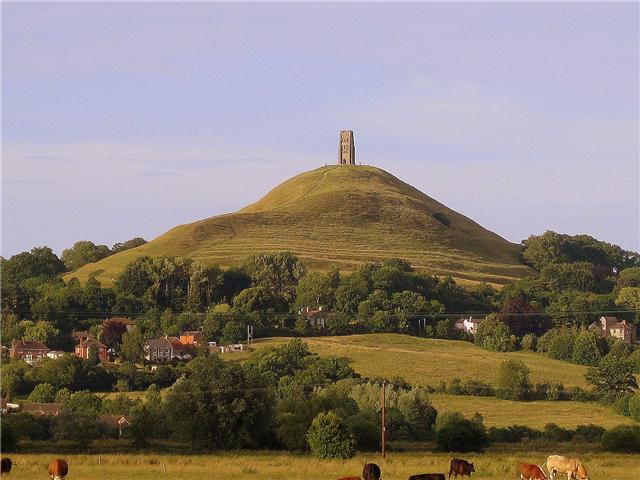
Glastonbury TorEver since childhood, I’ve always loved the stories of King Arthur, of Merlin and the Lady of the Lake.  I loved the tales of swords proclaiming kings, of beautiful and powerful women living on mysterious islands bestowing great gifts, of sorcerers and magicians that could both give rise to and destroy kingdoms.  This love has never left me, though it has changed and developed the more I learn about these tales, and the land upon which I live.

One of the things that has always captured my imagination, and always will, is Glastonbury Tor.  It is a wonderful place, a place of great beauty and incredible mystery.  For me, it is one of the holiest places in Britain.

The landscape is unlike anything I’ve ever seen – rising out of the flat, drained Somerset levels is the Tor.  From a certain angle it looks like a woman lying down.  The Tor itself is a marvel, for carved into it are plateaus, in what appear to be a labyrinthine pattern rising to the summit.  On autumn and spring mornings, often the mist obscures the ground, and the Tor rises out of mist – we could easily believe we have been transported back to the Avalon of old.

What is inside the Tor is equally fascinating – the White Spring.  It is widely believed that inside the Tor is a large carvern, where the White Spring emerges, eventually making its way down into the town of Glastonbury.  Old records mention of a time when a small hole appeared in the top of the hill, and when things were dropped down, it took a long time before a splash was heard.  The White Spring was redirected and made inaccessible in the Victorian era, a large pumphouse created to supply the town and cutting off access to what was once a beautiful little spot where the spring emerged, calcifying everything around it, giving it a fey quality. Thankfully, in 2005 the White Spring Trust re-opened the disused pumphouse and has turned the small caverns, rooms and interiors into separate sites where one can once again pay tribute and honour the spirit of the White Spring.

Two monasteries or churches were built on the Tor in the Christian era – the first destroyed, I believe, due to the Tor itself shifting, causing the building to collapse.  Was the previous pagan site revolting against this new religion?  Or was it the sand and limestone ever shifting, finding a comfortable place to rest for the next 500 years?

All that is left on the Tor now is the tower, St Michael’s Tower.  The rest of the building was destroyed in the Reformation.  I both like and hate the tower atop the Tor – it looks beautiful, standing there all alone, a kind of spiritual trig mark; I hate the fact that anything mars the natural beauty of the Tor, and do think that the tower one day will also collapse, as nature reclaims her own.

Smaller hills surround the Tor, Chalice Hill and Wearyall Hill.  Chalice Hill is said to the be source of the Red Spring, which flows down again like the White Spring to Glastonbury Town, and has the most beautiful gardens built around it.  For a small fee, one can enter the gardens and see it in all its glory (unlike the White Spring, which is free).  It was said that the Red Spring ran beneath a grove of Yew Trees, the iron rich water reflecting the blood red sap of the yew.

The Springs are perhaps the most significant thing about Glastonbury – White and Red, the colours of the Otherworld.  From two separate yet very close sources, these two very different springs come down to Glastonbury and are separated by the smallest of distances – I’m certain that at one point they ran together, but now I believe a street is blocking the union of the two springs.  Perhaps one day they will run together again.

The Tor, rising out of the watery levels, connected the Three Worlds of Land, Sea and Sky. The Red and White Spring issued forth from the fairy mound, the Gateway to the Otherworld.  The labyrinth way to the summit of the Tor was the spiral of life.  This is only a taste of the wonders that very special place – what a magical place!

Is it any wonder why I chose it at the setting for my latest book, The Isle of Apples?