The Self and the Middle Way

I’ve just been introduced to a wonderful concept, a very different view of the Middle Way by Vietnemese Zen Buddhist monk, Thich Nhat Hanh in his book, Beyond the Self: Teachings of the Middle Way.

So many people interpret the Buddha’s teachings of the Middle Way as walking between two extremes, of finding a middle ground between points of view. However, Thay talks about how we need to throw out all duality in order to truly understand the Middle Way. We do not walk between two extremes, but instead we throw out the concept of the extremes. We let go of dualistic points of view, and in doing so we are further able to release notions of the self in order to fully integrate with the world.

This has resonated so deeply with me, as for the past couple of months I have been exploring the release of the self and integration with the natural world as a result. To walk the middle way, we must, as Thay suggests “throw out” instead of letting go – as letting go still concedes to a dualistic nature of existence, and a self that is separate from nature. If we throw out all these ideas we are left with nothing but possibility.

The idea of the Middle Way, of changing the way that you think by throwing out dualities, has some other very interesting concepts to chew on. What happens if you throw out anger and joy? What happens when you throw out pain and bliss? Walking the Middle Way is not about never getting angry, or upset, or joyful, or blissful. It is about releasing ideas of opposites, and seeing the potential that is created in doing so.

How does this work then? If we throw out ideas of birth and death, we are simply left with manifestation of existence in all its forms. This reaffirms my belief that life does not begin when we are born, nor stop when we die: we simply change form, decomposing into the soil, molecules breaking down, chemical reactions occurring. We are released into the air through the plants growing around us, released into the water table, we fall as rain or snow, we are in the wind. There is no beginning and no end. When the conditions are right we manifest in different forms, whether that be human, water molecule, etc. When we strike a match, the flame does not come out of nowhere: the right chemical reaction must occur. When the flame is blown out, it does not disappear into nothingness, but simply ceases in that manifestation. When the conditions are right, it can appear again. As Thay puts it – clouds cannot die.

For me, this is the concept of reincarnation, exquisitely explained.

With regards to the self, we can take this further, realising that there is no separate self. We are beings that, like everything else on this planet, require the existence of other things in order to manifest. We are entirely co-dependent, there is nothing on this planet that can exist without other things. A cloud needs water and other elements in order to be. Humans needs water, food, shelter, oxygen and a host of other things in order to exist. Everything is interconnected. We cannot separate one thing from another – it is simply impossible. When we realise the interdependence of existence, we see that there really can be no separate sense of self – we are made up of millions of other human and non-human elements.

Thay goes further into describing all these other elements as having their own vitality, their own purpose, their own consciousness. Each thing is equally important in the manifestation of all existence.

For me, this is animism, exquisitely explained.

It is so wonderful when concepts that you hold so dear to your heart, concepts that you regularly meditate over, are expressed within a different religious path so eloquently. It shows a shared human experience, and a shared global manifestation of consciousness.

Thay is currently in hospital, aged 88 having suffered a brain haemorrhage. He is making progress, and we all wish him the best in his recovery, should that happen. Whatever may happen, we wish him peace and love. His teachings have made him a true hero of our time.

Wow!

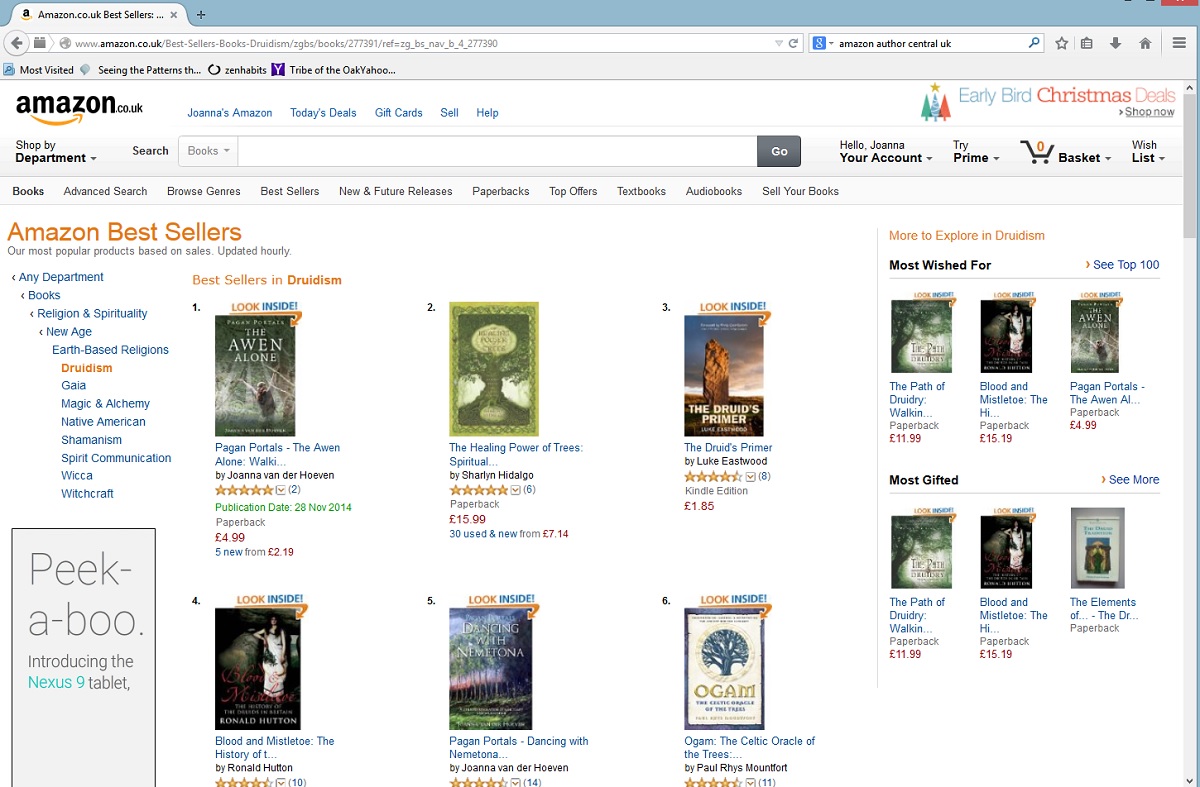
Look who is at Number 1 – AND Number 5!  Thank you all so much for your support. There just aren’t any words right now, my heart is so full. Big love to you all. xoxo

Awen Alone at number one

The Awen Alone reaches new milestone…

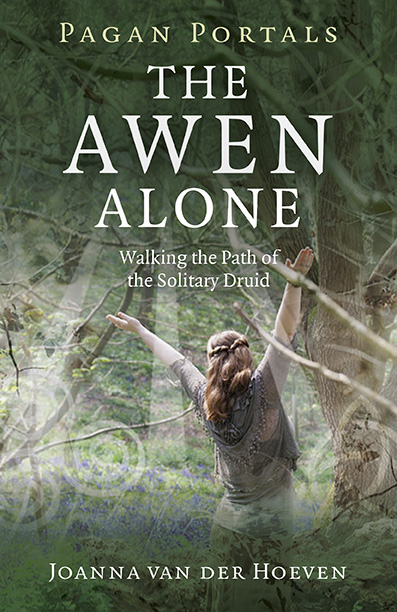
The Awen Alone Joanna van der Hoeven

This morning I came in to the good news that my latest book, The Awen Alone: Walking the Path of the Solitary Druid is currently rated 3,888th out of over 400,000 UK titles on Kindle in the book’s first 4 days of being released.  This is an amazing achievement for me and for my publishing company as it puts the book currently in the top 1% of all Kindle UK sellers, and we are so thankful to you all for your support.

This book would never have happened were it not for this blog, and the lovely supporters whose kind messages have always inspired me to write more, to share my personal experience and awen.

Thank you, thank you, thank you, from the very depths of my heart.  Big love to you all.

Jo. x


Note: As of 4.20pm today Amazon have switched back to Pre-Order mode, but don’t worry, it will be back ASAP – must be a glitch in their system that they’re working out!

The Awen Alone is now available!

The Awen Alone Joanna van der Hoeven


Today is the day!!! The Awen Alone: Walking the Path of the Solitary Druid is now available in stores!

Throughout the ages, people have withdrawn from the world in order to connect more fully with it. This book is an introductory guide for those who wish to walk the Druid path alone, for however long a time. It is about exploration and connection with the natural world, and finding our place within it. It covers the basics of Druidry and how, when applied to the everyday life, enriches it with a sense of beauty, magic and mystery.

This book is for those people who feel called to seek their own path, to use their wit and intelligence, compassion and honour to create their own tradition within Druidry.

Interview with Emma Restall Orr

Here is a link to a fairly recent radio interview with Emma Restall Orr (aka Bobcat) that gives a really good introduction to what Druidry is, what Druids believe and so on. Enjoy!

Emma Restall Orr Interview – Beyond the Dark with Pete Price

Review of Dancing With Nemetona

Dancing With NemetonaA lovely review of my book, Dancing With Nemetona, by Melusine Draco, author of Traditional Witchcraft for the Woods and Forests and other titles:

The sanctity of the ‘sacred space’ is an integral part of the majority of pagan beliefs and this celebration of the Celtic goddess Nemetona offers a Druid’s-eye view of the concept. In’ Dancing With Nemetoma’, Joanna van der Hoeven explores the influence of this little-known deity who was probably introduced into Britain by Celtic/Gallic mercenaries serving with the Roman legions. The name is derived from ‘nemeton’, a term designating Gaulish religious spaces and nemetons, or sacred groves and sacred spaces, can be located throughout the Celtic world by that name. The author gives an identity to that strange, otherworldly feeling we experience when coming upon a sacred space, whether spiritual or temporal, with which we can all identify regardless of the Path we travel.

Endorsed by many of the leading lights in contemporary Druidry, ‘Dancing With Nemetona’ is a singularly compelling book for those of any pagan persuasion who wish to identify with that unexplained feeling often encountered on both the inner and outer planes. I particularly liked the author’s honesty in stating right from the beginning: “With what little history we have, it is up to us to seek Her out and find Her again, making our own connections. Within these pages are ways in which I have come to know Her, and in which you may as well, if you have not already met with Her. What is found in these pages is not long-standing tradition, but my own journeys of discovery with this goddess that I wish to share with you.” Recommended reading

Melusine Draco, Coven of the Scales and author of Magic Crystals, Sacred Stones

Recommended Reading: Thich Nhat Hanh, Love Letter to the Earth

TNH LLtoE

The wisdom of compassion allows us to see that we are part of a great cycle, that there is no separation. The earth is us, and we are the earth.

In this book, Love Letter to the Earth, Vietnemese Buddhist monk, Thich Nhat Hanh, talks about the stress we humans are putting upon the planet, and what we can do to live more harmoniously with the rest of the natural world.

I read this with the eyes of a human, the mind of a Zen Buddhist and the heart of a Druid.  In my opinion, this book needs to be on every Pagan’s bookshelf, let alone read by everyone regardless of faith, spiritual path, economic circumstance, political party, etc.

It is animism, and how to live it.

Reblog: Reclaiming the word discipline and living with intention

This is a reblog from my blog, DruidHeart, at Sagewoman Magazine’s channel on Witches and Pagans.


discipline

ˈdɪsɪplɪn/

noun

noun: discipline

1.    the practice of training people to obey rules or a code of behaviour, using punishment to correct disobedience.

“a lack of proper parental and school discipline”

2.    a branch of knowledge, typically one studied in higher education.

“sociology is a fairly new discipline”


Wow. No wonder people hate the word discipline. It’s often equated with punishment, correcting a perceived disobedience. We are free people, we should be able to do what we want, when we want, so long as it harms none. Life is for living, right?

Of course, I would agree with the above, that we are free, that life is for living. However, I’m also here to reclaim the word discipline into something that is positive.

We live in a world filled with instant gratification. We have IPhones and tablets that can “connect” us with people anywhere, anytime, so that we never have to be alone (even in a crowd of people). We have hundreds upon hundreds of television channels that tempt us into thinking that something better than the current moment we are living in is on the tube. We have internet to answer all questions at the push of a button. We have access to food 24/7 (most of us) – we’re usually never too far away from our larders or a shop. We love to “treat” ourselves. Marketing has told us that “we’re worth it”, or making us feel that we’re not good enough, and with their product we will be. Problems solved, instantly.

Now, this isn’t a blog post about self-denial, asceticism or anything similar. It is about truly seeing and understanding our needs versus our desires. Our modern world has twisted our desires into needs, and it is up to us to rebalance, to rejig our way of thinking in order to live a life filled with more intention.

I work three jobs, alongside my work as a Druid priest. Time can be in pretty hard demand sometimes, but planning makes it all work. It takes effort, but that is what discipline is: effort made in order to improve a situation, to live a life of intention, to learn more about integration and compassion.

This is only an excerpt – to read the full article, click HERE.

The Awen Alone: Walking the Path of the Solitary Druid

Exciting news – you can now pre-order the Kindle version of my third book, The Awen Alone: Walking the Path of the Solitary Druid for only £1.85!

Click HERE for more details

cover low res