Ritual Importance

Is ritual important? Many Druids perform ritual on a fairly regular basis – at least the seasonal rituals that celebrate the turning of the wheel of the year. Many also honour the phases of the moon, in whatever aspect, whether it be quarter, half, full or new. There are also some for whom daily ritual gives special meaning to their lives and their loves – the rising or setting of the sun and moon, for instance, or saying a prayer of thanksgiving or a blessing before partaking of food and drink. But is it all that important?

I suppose that it is all based on the personal relationship to the natural world around us. For some, daily ritual helps to connect with the rhythms of life that might not otherwise be apparent – say, especially if you are living in the city, and it’s hard to hear the blackbirds at dusk above the din of rush-hour traffic, or aren’t able to see the sun or moon rise due to buildings blocking the way. For others a daily ritual isn’t that important, for they already feel much more connected simply in their living circumstances – for instance, a friend of mine, fellow author and blogger Nimue Brown, lives on a boat and is very much connected to and at the mercy of mother nature. It’s akin to a friendship, in a sense – sometimes your friend lives far away, and you have to make a special effort to keep in contact with her. Sometimes your friend lives right next door, and it’s much easier to keep in touch.

In Zen, regular daily practice of sitting meditation carries through into other aspects of our lives, where we bring awareness into everything, and in doing so taking away the illusionary drama and seeing reality for the wondrous gift that it is. It requires discipline, however – to sit through the boredom, to sit when we don’t feel like it, to be aware when we’d rather be daydreaming. Yet this discipline is, as I have found out, necessary for clarity.

I haven’t meditated for a week now, and I am feeling the difference. That daily ritual, of sitting down and spending half an hour each and every day in awareness really did permeate into the rest of my life. I didn’t become lost in attachments to emotions – I still had feelings, but they didn’t linger and cause as much suffering as before. When taking the time out to stop and meditate and be aware for a designated point each day was given up, those attachments came creeping back in. I was spending more and more time in my own head than in the real world.
Druid ritual can do the same for us, in keeping us connected to our spirituality, whatever our circumstances. Too easily we can become lost in our own worlds, realities that we have created out of our emotions and thoughts. Ritual can say “hey, look – enough. Stop. Look at what’s really going on around you. Hear the stag calling. Hear the aeroplane. Watch the sun rise. The world is more than just you”.

With Druid ritual, we gain inspiration from the natural world around us. That is what Awen is – an insight into nature, the nature of the world around us and our own human nature in turn. By doing Druid ritual we take the time to pause, to reflect, to take in that inspiration so that we may exhale it with love and compassion back into the world.

So, is ritual important? I think so – even if we use the friend analogy, ritual keeps us from taking it for granted. It brings awareness and that magic back into our mundane lives no matter what our circumstances are. No matter where we are in life, taking a moment to stop and simply be in the moment can help us gain inspiration and insight, and to also give back with thanks for all our blessings that we receive in this equally mundane and magical world.

Being a Druid – The Fantasy and Reality

What does it mean to be a Druid today? A lot of the time, when asked, people seem to think of Druids as long bearded men in white robes cutting mistletoe with sickles under the full moon. I’ve never had this image of a Druid. The only Druids I knew about when I was growing up were the ones in my Forgotten Realms and Dungeons & Dragons fantasy books. They didn’t fit the old, beardy image – these were the folk who felt a rapport with the natural world, that cared for it and respected it and worked with it to make the realms a better place. As far as I’m concerned, this was a pretty good introduction to Druidry.

Though these Druids had some pretty supernatural powers, able to call lightning and smite down their foes, or turn themselves into eagles or wolves or other animals, still it was that sense of wanting to leave the so called “civilised world” behind in favour of communing with nature – that sense of ease found in the forest and not in the cities. I empathised with these Druids who hated going within city walls, longing for the woods and the green. It wasn’t their powers that impressed me, it was their very sense of self – a sense of attunement and belonging to the natural world.

Though many modern-day Druids do live in cities, as I once did (not out of choice) it is in this rapport with nature that is the underlying factor in our religion, our spirituality or our philosophy. Our hearts are freer – they soar while standing on a cliff’s edge, or at the shoreline, or deep within a great wood. We hear the song of life around us, that beckons the soul to true expression – to simply be.

The Druid takes inspiration from the natural world around her – she takes delight in a cold winter’s morning as she watches the foxes scamper and chase each other across a field newly covered with snow. She feels the heat and passion as she hears or sees the rutting deer in the cold autumn months. She finds pure joy in the flight of the butterfly searching for nectar in the warm summer sunshine. She finds the thrill of the hunt as she watches a cat stalking its prey. She takes wing with the hawk as it soars across a cloudy sky, finding thermals in ever increasing spirals that reflect the spirals of life.

This may all sound wonderful, and true – but also a bit airy-fairy to some. Being a Druid is also about taking on responsibility for one’s actions, as well as for one’s environment. No longer can one be ignorant about either – it is waking up and making a commitment to understand to the best of our abilities in everything that we do and say. It is learning behavioural patterns in our own selves as well as in those animals that share our environment. It is learning from the cycles of nature, the seasons, the tides and times of life. Knowing when to break free, when to retreat, when to shout aloud and when to keep quiet.

Being a Druid is about making life choices in everything – from vigilant recycling to knowing where our tap water comes from. It is about making a relationship with everything, from the food we eat to the badgers that have been de-homed for the new housing complex. It is a huge sacrifice – giving up ignorance and opening our eyes to the world, and seeing what we can do to make it a better place.

We may wear robes, we may wear wellies – but we are still Druids. We may not smite our foes with lightning, but we fight to protect those of the natural world that humans would harm. We live and we learn through awen, through inspiration from nature. We may not achieve the same status as a 20th level D&D Druid, but we gain something much more important – a real magic in our lives that we can live with and honour each and every day.

Living the Dream…

Life can have so many problems. Life isn’t just life for most people. Sometimes it’s like trying to fart against a thunderstorm. Other days it’s all unicorns and rainbows. But looking deeper, into the reasons why we hurt, why we suffer, we begin to see patterns emerging that can help us to stop living the dream. Stop living the dream? Why would we want to do that? Isn’t “living the dream” the whole goal of life?

Our problems can seem huge to us at times. Yet these problems are only the front line – there is usually a deeper problem underneath that hides in the layers of these other problems. The trick is to spot the tricky little devils. Sitting with the problems helps – literally sitting yourself down, maybe having a chat with yourself and then some good old mindful meditation can do the trick. The more we do this, the easier it gets to spot the real problem.

Today, I felt bad – I felt used. I thought that was my problem. After sitting myself down, I realised that wasn’t the real problem – the real problem was insecurity. Peeling away the layers revealed this deep-rooted problem – and then I realised that it wasn’t really a problem either. I was feeling insecure. A feeling is a thought with an emotion attached to it, which often manifests itself physically in the body. I was in a state of contraction – I needed to release the contraction somehow, and the best way to do that is to understand it. Once understood, it was an “oh, of course” moment. The bad feelings left. In fact, it wasn’t even bad – it was just life.

Our problems, our depression, our anger occurs when life doesn’t happen the way we would like it to. When we understand this, we see our folly – life happens. The winds blow without first consulting us, people die without saying goodbye, friends come and friends go – there’s nothing we can do about that. What we can do is alter our reactions to it all.

So, instead of living the dream, why not try living the reality? That is where the real gem lies.

Meditation

Many modern day pagans incorporate meditation into their spiritual practice. The reasons are varied, from wanting a sense of inner peace, health benefits, to seeking a spirit guide and more. The techniques themselves are as varied as the reasons behind why meditation is becoming so important – from journeying, astral travel, going “under the cloak”, mindfulness and so on.

There is a certain mysticism surrounding meditation, which may be a reason why it is so popular in paganism. It can be a deeply spiritual experience, it can put you in contact with the Otherworld – it can also put you in touch with yourself and the world around you in the present moment (reality). It can be both mystical and mundane. Its uses are boundless, and the benefits too many to count. However, let’s go over a few anyway…

Meditation is said to lower blood pressure, to help with sleeping difficulties, depression, anxiety attacks, deep-seated fears and problems with concentration. The latest meditation fad on the health and science circuit is Mindfulness Based Cognitive Therapy (MBCT). BBC News Healthstates that “It teaches a way of looking at problems, observing them clearly but not necessarily trying to fix them or solve them.’It suggests to people that they begin to see all their thoughts as just thoughts, whether they are positive, negative or neutral’.” http://news.bbc.co.uk/1/hi/health/7319043.stm. Now, having been a Zen meditator for years now, this sounds like plain old Soto Zen meditation to me, under a different name. In fact, Mindfulness was first translated from Sanskrit in 1881 by Thomas William Rhys Davids, who further described it as “Right Mindfulness, the active and watchful mind”. Mindfulness in itself is nothing “new” – it’s been a part of Buddhist meditation for thousands of years. Yet, as Harvard Health online states “Mindfulness meditation is getting a lot of attention because it seems to help with so many physical and psychological problems—like high blood pressure, chronic pain, psoriasis, sleep trouble, anxiety, and depression. It’s also been shown to boost immune function and stop binge eating. http://www.health.harvard.edu/blog/mindfulness-meditation-improves-connections-in-the-brain-201104082253”. No matter what it is called, it seems to be working.

Meditation is not for everyone, but for those pagans who are looking to incorporate it into their lifestyle it can be a wonderful way to get in touch with your “inner self” and the world around you. As a Druid, I use meditation for relaxation, for journeying and for connecting with everything around me. As I mentioned earlier, I usually use the method of Soto Zen, literally “sitting meditation” for the most part. This, much as the MBCT above, is about being aware of thoughts, and thought processes, without judgement. It is also being aware and in the present moment, hearing, smelling, seeing everything with complete focus to the art of paying attention. It’s also about the discipline of keeping your butt on a cushion for more than five minutes at a time, which is the hardest part.

Zen meditation is not , as many people (and pagans) believe, about transcending the body, but about being 100% completely in it – awake and aware to everything. It’s about sitting on your cushion and feeling any tension in the body. It’s about feeling your breath moving in and out of your body. It’s about hearing the blackbird singing outside. It’s also about paying attention to the thoughts that arise in your mind – “Oh, I’m thinking about that again” instead of becoming wrapped up in the thought. It’s about being non-judgemental about absolutely everything – not thinking “I’m drifting off again, I must pay attention – I really, really suck at meditating”. It’s about returning to the present moment, again and again and again. It’s really very simply, and very difficult at the same time.

Another form of meditation that I like to use was taught to me by a former teacher, Emma Restall Orr. This is called the Tree Meditation, which is wonderful for grounding. The beginnings can be found here – http://druidnetwork.org/learning/exercises/tree. It is a beautiful, grounding meditation that really focuses on the breath as a an agent to plant your metaphysical roots into the ground, to become rooted like a tree, drawing up nourishment from the very earth, the sacred earth. I try to do this at least once a week along with my Zen meditations, for it brings me back to connection with the earth, my home and the soil in my backyard.

The Ancestor Meditation is another meditation that I learned whilst on the Bobcat’s Living Druidry Course, set in the beautiful Cotswolds countryside. This is a really deep meditation to connect you with your ancestors – I’ve only ever done this with blood ancestors, but I’m sure that it could be performed with spiritual ancestors as well. It’s about connection, and again, the tool for this is the breath – what better way to connect with others than by our breath? It is a shared thing – what we breath in, others have breathed out, from bird to beetle to beastie. This meditation takes us on a journey through the breath to connect with our ancestors in a truly profound way. Not for the faint-hearted!

I also enjoy the occasional Journeying – taking a “trip” to a special place to perform a certain task, to meet with a certain person, spirit, or even deity, to seek out answers or to simply have some fun. I perform a Dark Moon Journeying to meet with other members of the Order of the Yew – the dark heart of the Druid Network. To find out more about the Order of the Yew, and its meditation, you will have to become a member, but it is well worth it in my opinion. I also meditated regularly when studying with OBOD, using their exercises which really helped open my soul to new things, to new experiences. Again, you have to be a member, and it is rather a lot more than the Druid Network.

Then there are simply times when I am outside in the backyard, watching the sunset or the sunrise, or running with the deer on the heath, or sitting in front of the fireplace, honouring the spirits of place with all that I am. Sometimes singing back to the land is a part of the meditation – I have stood at the edge of the North Sea and spiritually sung words that have no meaning and yet are full of emotion to my ancestors across the sea.

The end result to all meditation is, I suppose, connection. It’s all about relationship, whether it is getting to know yourself better, or your world. It is deeply healing and transformative, and, in my opinion, should be performed as often as you can, in as many places as you can. It’s the benefit of taking time out for yourself, with no guilt or judgement, to re-connect to the threads of life that are woven all around you. Go on, if you haven’t already – give it a try.

Face to Face or Phone to Phone?

phoneSocial media today has led, as many are probably aware, to a serious decline in face to face interaction.  We are a social species, and everyone needs a little social interaction.  What I am discovering more and more is that people are forgetting, or never even learning, the niceties of a social situation – standing in line at the fairtrade coffee house and actually making eye contact with the person in front/behind you, maybe even smiling and talking to them.  I think we all, to a certain degree, need a little social interaction – face to face, even if we are self-proclaimed “not a ‘people person’”.  We are in dire peril of losing all our social graces. And yes, I do realise the slight hypocrisy of making my views aware on an online blog. 🙂

Last month when I went out to dinner with my husband and father in law, I noticed a couple at the table next to us.  They barely said two words to each other – either one or both spent most of the time on their mobile phones – not talking to other people on the phone, but presumably doing something with an app, or most likely checking social network sites.  I was truly saddened by this.  How many people spend their lives, head down, looking at a small screen to catch up with the latest? What about the world going on around them?

A few months before, in a crowded bar my friend and I asked to join a couple of lads at their table, as there were none free and my back was hurting – I needed to sit down.  They kindly agreed, and spent most of the time talking to themselves – fine, I wasn’t looking for conversation with them at any rate.  However, when one went to the bar to get drinks for the both of them, and my friend was also at the bar, I was left alone with one of the lads.  As soon as he was left alone, he went head down to his phone, completely ignoring everything and everyone around him.  Same thing happened at my local pub, sitting at the bar and chatting with the bartender and the bloke next to me – as soon as she left to get an order the bloke next to me put his head down and went straight for the phone.  Why go the pub at all?

What I worry about is the ability to interact with people in real life situations seriously declining.  Mere politeness is on the decrease, as any walk down a busy London street can testify.  I’m not expecting an ethical debate on animal testing, or politics, or whatever from someone standing in line with you, but what I would like to suggest is to put down the phone and at least acknowledge the person near you. Or at the very least, put the device away when you are walking down the street – a friend of mine nearly got run over last year because he was checking his phone.  How many phone related accidents do we need to hear about? Be aware of your surroundings.

One of my work colleagues told me of his New Year’s resolution last year, which I thought was brilliant.  He resolved to never pretend to not “see” somebody – to always acknowledge.  He thought it was really empowering  and I could see why – even when someone has pretended not to see you, you still go up and say “hi!”.  This most basic acknowledgement is such a small, yet significant thing.

Life is happening all around these people who are addicted to their phones, or tablets – using them to block out the world, or to avoid a social situation in which they are not comfortable. But really – it’s not that hard.  Someone isn’t going to bite your head off for smiling at you as you pass them in the street, or waiting in line at the shops.  Even if you are terribly shy – just try it.

I do wonder if there is a serious mobile phone addiction – a couple of days ago I saw a young couple walking out the door of a local recreational pool, both with phones in hands in case anyone should ring them – ready to answer at a moment’s notice.  Are they really that important? Are the callers? What about each other? Is this not a statement that whoever might ring them is more important than the person they are currently with, in person?

I’m sure I have some sympathisers – people who hate it when they go out to the pub or for coffee with a friend, and the friend puts the phone down on the table, right in front of them, face up, in case they receive a Facebook notification, an email or a call.  When I am with someone, I am with them. Fully. I think that anything less is rude, and a little saddening – judgement call, I know.  I really am attempting to understand rather than judge, but I realise I am failing in understanding – unless it truly is an addiction.  What do you think? Are people addicted to their phones? If so, isn’t there something we should do about it?

Lives are being wasted away.  If you are a person who always has their phone on, may I suggest you turn it off for a day, then two, then a week.  See if you have truly missed anything.  Don’t check Facebook for a day, then two, then a week, and again – did you really miss anything?  Be with the person you are with.  Acknowledge others around you.  Take that damned phone off the table and look the person in the eye.  Be there. Awake. Aware.

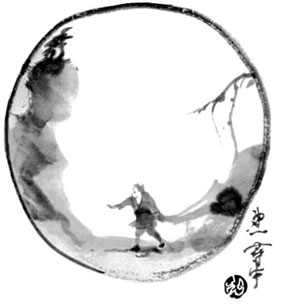
Druidry and the Ten Bulls

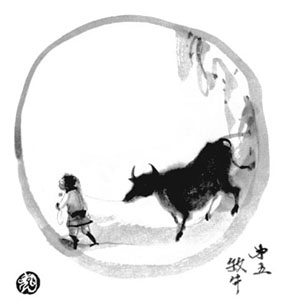
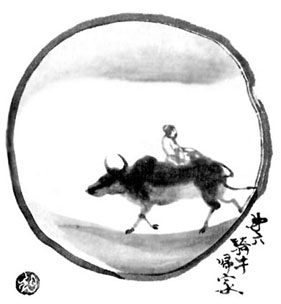
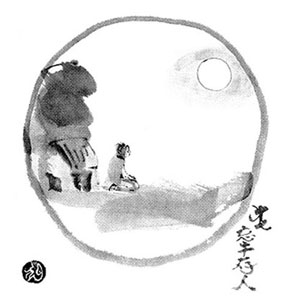
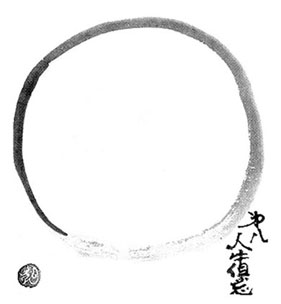
The Ten Bulls is an illustrated poem used by followers of Zen Buddhism to explain the search for enlightenment.  For me, it also represents the search for meaning in my own Druidry and indeed, in my own life in general.  It can be applied to everything, but for the purposes of this blog I’ll stick to Druidry. To see the Ten Bulls, otherwise known as the Ox-herding pictures, you can follow this link:- http://www.sanbo-zen.org/cow_e.html.

The search for enlightenment, the search for the Self and meaning is a major part of any religion or spirituality.  What will explain that sense of something missing, that lacking? What will fill it, or guide us to fill it in? What will help us to realise our full potential and live according to our True Self?

For me, this has been blending Zen with Druidry, and in the Ten Bulls can be encapsulated quite neatly.  They are, as follows:-

 1.In Search of the Bull

1

When we first come to Druidry, we do not really know what it means, for there are no long-established formal schools or training that we know of.  We can look to history, and then find out about courses now offered in Druidry through various organisations, but is this Druidry? It is certainly a version of it – Druidry is what it is, to each and every person. Moreover, to each and every person, it is different, yet still falls under a single banner. Confusing? Hell yeah. In a way, I think it’s meant to be. It encourages us to get out there, and find out more – beginning the adventure.


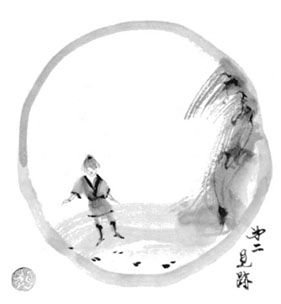
2.Discovery of the Footprints

2

We have begun our adventure, and are searching now for what Druidry is.  We catch glimpses of it in the works and writings of others, yet we still have not experienced Druidry for ourselves.  Like the wind, we can’t see it, we can only see its effect on other things.  We continue and go deeper into our Druidry to find out what it really is.


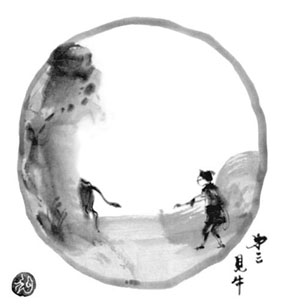
3.Perceiving the Bull

3

We’ve caught a glimpse!  We’ve had an insight into what Druidry is – we know that we’re now on the right path in our journey of self-discovery. Yet it is still not entirely clear – the experience is not yet full.  We run after the bull in the hopes of understanding.


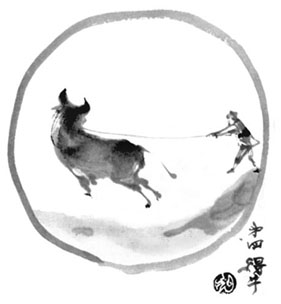
4.Catching the Bull

4

We’ve found our Druidry!  After many twists and turns, we’ve come across a path, or developed our own, that seems to flow with the essential spirit that we call the Self.  We may find several bulls, even, until we find the right bull, but eventually we come across a method, training, or experience that reflects our inner core. We harness that energy, but what do we do with it now?


 5.Taming the Bull

5

We learn that knowing what Druidry is, is simply not enough. We must practice with it, again and again, experience it and not simply read about it.  We hold rituals, we meditate, we get our fingernails dirty.  We do the work necessary, and learn discipline.


6.Riding the Bull Home

6

This is Druidry! This is what it means, and it is a joyous expression of our inner souls.  We have a sense of “coming home” – we know how to celebrate the seasons and each other, and we may find the beginnings of an inner peace hitherto unknown.


 7.The Bull Transcended

7

We then realise that Druidry is not something external, nor even internal – that it is something to be lived.  There is no separateness, no duality to Druidry – it is not a way of life, but it is life itself.  There is a stillness to it.


8.Both Bull and Self Transcended

8

We are no longer separate from the world and from Druidry either.  Druidry is us, it was always us.  We experience each and every moment with the same reverence we would to ritual – everything becomes sacred.


 9.Reaching the Source

9

We have reached the source of life itself, and find that meaning or no meaning have no place – only life itself. There is no Druidry. There is no Self. There is no separateness.  All is unified under the banner of Life, changing moment by moment, unconcerned with meaning or no meaning.


10.Return to Society

10We return to integrate what we have learned from our experiences, to share them and to help others who may be seeking.  We do what we need to do for ourselves, our family, the environment without any selfish thoughts – we simply do.  With the knowledge that we have gained that so expresses ourselves, and which is known as Druidry, we live as best we can, in the world, present, awake and aware.


The Myth of the Moral Highground

Is there such a thing as a moral highground?  I have heard people say that they can accept certain people’s behaviour, on the basis that they “are a better person”.  They have chosen their beliefs in themselves, their faith, whatever, and made a judgement call as to who is a better person.  But then, who is a better person above them? And above them? Isn’t it all about perspective anyway?

Believing that we are better than someone else is a falsity and a tragedy, in my opinion.  It can lead to all sorts of destructive behaviour, from bullying to arrogance to war.  Passing a homeless drug addict in the street – do you believe that you are better than that person? Finding out about someone’s infidelity – does that make you a better person? Working for charities, donating time and money – does that make you a better person?

Do you think Mother Theresa thought she was better than the rest of us by doing what she did? I hardly think so.

We all make mistakes. We all have moments of enlightenment, and moments of dark despair. Our lives have happiness and tragedy in them.  Yet claiming that we are better than someone else is simply to say that our circumstances are better than theirs – and circumstances can change on a dime.  As a noun, the dictionary defines circumstance as “a condition, detail, part, or attribute, with respect to time, place, manner, agent, etc., that accompanies, determines, or modifies a fact or event; a modifying or influencing factor: Do not judge his behaviour without considering every circumstance”.  We cannot even consider every circumstance, for we are in no way omniscient. We could become the homeless drug addict, and then where has the better person gone?

We are all on a level playing field.  The search for a moral highground is like looking for the Holy Grail.  All that each person can do is simply to do the best that they can at any given point in time. Sometimes their best may not be all that “good”, whether the person has had moments of enlightenment or not.  Yet to judge ourselves against others only separates us further from others, which leads to an Us and Them mentality, in which horrendous things can occur such as war.

Surely we need morals to follow, else anarchy would reign?  For the most part, most people naturally want to do “good”.  Morals are constantly changing as well, as are opinions – else women would still be the property of their husbands, African Americans would still be relegated to the back of the bus and Britain would be ruled by the Christian Church. Trying to gain the moral highground on a level playing field just doesn’t work – you’d simply be jumping up and down trying to get above everyone else, and yet gravity would bring you back down each time.

Realising that no one is better than anyone else is the key to living a happier life, for you and everyone around you.  People who think that they are better may fall into destructive patterns.  They may not realise that by blowing out someone else’s candle, it doesn’t make theirs burn all the brighter.

Yet there is nothing wrong with living a life of discipline, and of trying to better oneself – to be more aware of one’s own patterns of behaviour.  If we accept that we are only doing the best we can at this point in time, there’s nothing to say that we can’t do better in the future. But we shouldn’t strive to do or be better than other people.  The work should be done on ourselves, with the realisation that the thinking behind “I am better than her” does not make you better, and can, indeed, make you worse.  It is simply putting one’s self onto a pedestal to gain the moral highground, and anyone can fall off the pedestal easily.  I know that the next time I find myself thinking that, I am going to step off my pedestal and get back to the level playing field, where I can look everyone in the eye and see that we are only doing as we can, and just to do the best that I personally can, which is no better than anyone around me.

Kierkegaard and the Bullies

Perfect love means to love the one through whom one became unhappy – Soren Kierkegaard

Following on from a recent blog post about forgiveness, putting into practice the habit of it is, as is everything, much easier said than done. So I’m going to share some personal things in this blog post, which I don’t often do, but which I think is necessary to give it some context, and to perhaps allow for people in their own situation to relate to it in some way.

Kierkegaard’s reflection on forgiveness inspired me today to do something which I have never been able to do.  Forgive the bullies.  Thinking about forgiveness a lot lately, I have decided that the best place to start was at the beginning, when the first people who treated me badly first made an impression on my mind and my life.

I had a really happy childhood, growing up in beautiful countryside in a very loving family.  I exceled in school – primary school was a breeze.  I was top of the class in both academia and athletics – I loved them both. I was confident and happy – it was a great time for me.  However, things changed when I went to secondary school.

The first half of the first year went well – though it was a shock moving from a Grade Six class that had five people in it to class sizes of twenty to thirty children.  The school was enormous compared to my primary school, but I adapted pretty well (and much thanks to a map my sister drew especially for me to find my classes in the many halls, which was my saviour that first month!).  I was confident and smart and making new friends under quite difficult circumstances to a very sensitive child.  And then came the bullies.

They were two years older than me, and came from the same region, so we shared the long bus journey together (an hour each way, a total of two hours a day). That was where it all started.  Name calling on the bus – for whatever reason, began the whole affair.  I assume that it was because I was tall, pretty, blond and happy – though I can never truly know the full reason behind it.  Sometimes people simply think that blowing out another person’s flame will make theirs shine all the brighter, but that just isn’t the case – everyone knows two flames are brighter than one alone.  For whatever reason, the bullying started.

Being confident, I decided to fight back.  I was smart, and could have a comeback for anything. Everyone, from television and film and books, said that if you fight back, the bullies will leave you alone.

That is not the case.

I fought back, with words, not allowing them to see that they were hurting me – throwing it back at them, and also hoping that others around me would rally to the cause and that we would all overthrow this minority of bullies who seemed to control “the bus”.

That was not the case either.

People didn’t stand up for me. But I still persevered, fighting back as best I could. Eventually it did get me down, and I started to doubt myself. But I stayed as strong as I could. They put glue in my hair. They threw food and garbage at me. They called me names. They threatened me.  They taunted me every time we passed in the hallway until I avoided all the main halls and used the back stairs, entrances and exits as much as I could. I still held fast to the belief that it was because they were jealous – I stayed strong in my convictions, but it really, really started to get me down. I dreaded going to school every day, and dreaded the bus ride there and back.  I joined after school clubs just so I wouldn’t have to take the same bus as they did home – I could take a later bus. I longed for the two days of respite that the weekend brought – Fridays after the bus dropped me off was like a whole new world of freedom to be me again.

It became so bad one day though, that I had had just about enough of it all and, with no holding back, turned around to where they had moved up in the now almost empty bus to sit directly behind me and taunt me ceaselessly.  I let it rip, verbally, with all the hate, spite , viciousness and intelligence that I possessed. Their faces were shocked, and then anger took over. One girl grabbed me by the hair and started banging my head against the bus window, over and over again.  An older boy came down from the back of the bus and pulled her off of me – I had started physically fighting back – and we were separated.  I got off the bus seconds later at my stop, adrenaline bursting along with tears as soon as the bus was out of sight – I wasn’t going to let them see me cry.  I hated myself and my life.

The next day we were, of course, called into the Principal’s Office.  After a few minutes, where I (with seething calm) stated my case and then the other girl was allowed to state hers, she simply began to cry.  I was too angry to care about why she was crying – she had made my life a living hell.  I sincerely hoped the Principal was not “duped” by her show – though on reflection I do believe that she was a truly unhappy girl in an unhappy situation, the details of which I still am not aware of to this day – only rumours.

Nothing came of it for me – but I think she may have received a three-day suspension or something similar, though the memory of that is a little fuzzy.  What I do remember is that evening she called my house, and my mother answered the phone.  The girl threatened my mother and family, and also said that she didn’t care if she got expelled from school – she could always transfer to SAA.   My mother said, “Go ahead, please do.  BECAUSE THAT’S WHERE I WORK.” We never got a phone call from her again.

The bullying eased off from then on – just some taunts and words passing in the hallway. By this point, I saw the light at the end of the tunnel – the bullies were graduating that year, and once they were gone the school “was mine” again, in the sense that I could live, learn and do as I pleased and enjoy every second of it.  They graduated, or failed – I don’t really know, but they left. Those last two years of my high school life were some of the best years of my life.

I still suffered from confidence issues – walking past a group of people laughing, I would assume they were laughing at me.  Sometimes I still do – though now I catch myself and, with a wry grin, shrug it off.  But one thing I’ve never been able to do is to forgive them for the years and years of torment that they put me through.  Well, today I decided that enough is enough.

I have carried these bullies with me for 27 years now, and I’m more than ready to put them down.  As in my previous blog post, the story of the monks and the sack of potatoes, I really don’t want to carry anger and hate to these people anymore – I’m going to empty the sack, and maybe one day lose the sack altogether so that it can never be filled with anger again.  For anger is the cause of pain and suffering in the world – it is the root behind most, if not all, sufferering and “evil”.  So, no more, thank you very much.  I forgive you, CB, KJ, WG, D and A – I don’t want to carry you around any more.  I hope that your lives are much happier now, and filled with love.  Tears are welling up in my eyes even as I write this – the release is overwhelming.  I have compassion for myself and for you.  May you live well.

And so, I aim for what Kierkegaard wrote – for love is compassion and forgiveness.  I am emptying my sack, one by one, and looking for perfect love with every person who has made me unhappy.  In this way, I believe, the world can and will be a better place.  Namaste.

The Self, and No Self

Who am I?

Philosophers, religions, spiritualities and people all over the world have asked themselves this question. Lately, I too have been asking myself this – and looking into the meaning of the self, to see if there truly is a Self there to begin with.

The Materialists would say that there is no self at all – that there is no consciousness, that we are simply matter and energy and the result of material interactions.  Descartes stated “I think therefore I am”, to which the Materialists refuted Descartes dualism of a separate mind and body, ridiculing it as “ghost in the machine”.  Zen and Buddhism talks about a True Self that can only be realised by dropping all ideas of the self and achieving a pure state of being in the moment, a state of total selflessness in every sense of the word.

Nietzche stated that “We have never sought ourselves, how could it happen that we should ever find ourselves?”  Like the Materialists, he believed that we are a result of our experiences and actions, but that there still was a Self, a consciousness.  In order to be complete, Nietzche said that we must learn acceptance – to accept everything we have ever done.  I find this fascinating, because how many times have we done things our lives, stating that we were out of our minds, or did something “that was not me at all” – stepping outside of the core idea of what we are.  This acceptance, instead of avoidance, is key to the deeper understanding of the self, in my opinion.  Acceptance doesn’t mean liking everything that we may have done in the past, nor does it define us in the present moment, but what it does allow is a total non-judgemental overview of the self, and in doing so, a deep awareness that we might not achieve by avoidance of the subject.

Before Nietzche, Kierkegaard put forward the notion of choosing to be self-aware.  We are homo sapiens, after all – in fact, I believe the proper term for our species is homo sapiens sapiens – the beings that are aware that they are aware.  Kierkegaard stated that when we choose to be self-aware, we are both aware of our self and, at the same time, aware that we are aware of our self.  Observing the observer who is observing.  Yet, we choose not to observe, because we often don’t like what we see, or experience, either in the past, present or future.

This is all fascinating. And also requires some very deep thinking.  I’m currently exploring the theory of No Self from Zen Buddhism, which is a paradigm of course, as is much in Zen.  The No Self is also the True Self.  It states that our real self is in existence, always, and always has been.  It is pure, and shining free – we only distract ourselves from it to such an extent that we never see it.  Zen states that we are already complete, already whole, already perfect.

This is pretty simple to understand, and it makes sense.  The difficulties, the suffering in our lives detract us away from spending time in the pure moment, in which the True Self resides.  We suffer because we want things to be different, because we desire things, people, etc – and are not happy with the present moment as it is. If we are happy and accepting of the present moment as it is, without judgement of good or bad, or any attachment to it at all (see previous blog post on understanding, not judgement) then we can rediscover this True Self.  By letting go of all notions of the Self, we return to the core, essentially.

In Zen Buddhism, the term mu can mean a multitude of things – it essentially, and paradoxically, means “nothing”.  It can be termed as “no self”, “no ego”, “no holiness” and “impermanence”.  It is the transcending of all things, the enlightenment experience, the complete and utter letting go of affirmations and negations.  It is an answer to some Zen koans (questions asked to break apart the mind and let in a new way of understanding).  Zen master Keido Fukishima, like Kierkegaard, promotes the self-inquiry into our own being and mind, to be aware that we are being aware.  In Zen, this has the goalless goal of letting go – once we have found our mind, we lose it (not in an insane way, I might add) and in the losing, in the understanding of the impermanence of all things, including the mind and the self, we rediscover the True Self.  Keido Fukushima says, “Zen teaches us how to live by inquiring into and clarifying ourselves. This self-questioning is well suited to our contemporary ways of thinking. Rather than seeking salvation through an “other” or through grace, we achieve it on our own.”

Fukushima delves further into this idea, stating “The experience of mu may at first glance seem purely negative or passive,” he says, “but it is not so at all. Being mu, or empty of self, allows one to actively take in whatever comes. Our world today and all in it are separated into dualistic distinctions of good and evil, birth and death, gain and loss, self and other, and so on. By being mu, not only does one’s self-centeredness disappear, the conflicts that arise with others dissolve as well. Here is a simple example: When we look at a mountain, we tend to observe it as an object. But if we are mu, we no longer see the mountain as an object; we identify with it; we are the mountain itself. This transcendence of duality may sound like some psychic ability or spiritual power someone possesses. But that is not true. Rather, it is simply and naturally a case of being free, creative, and fresh. We become human beings full of boundless love and compassion.”

This rejects the dualists’, such as Descartes, theories and instead breaks down all barriers, which is both liberating and frightening at the same time.  There is no Us and Them, no Self and the Other – if we truly let go of all attachment we become one with everything.  Are we willing to do that, or do are we too attached to our sense of self to experience that? Can we truly dissolve into everything?

It comes in small flashes, in glimpses, for me so far.  The world, wrapped up in an apple, in a drop of rain, in the flight of a hawk.  Barriers have dropped, ego and self has fallen away, and we see the multitude of the universe (another paradox!).

This is passing through the Gateless Gate – I’ve also heard it called the groundless ground.  In realising the impermanence of everything, including the Self, we have a platform from which to jump off and into real living, where every moment counts and is never the same.  The Self changes from moment to moment.

This is hard, for we have spent our whole lives creating this sense of self, this timeless sense of self that we think defines us.  After seeing Taylor Swift’s new video, Trouble, in which she states “…I don’t know if you know who you are, until you lose who you are” really hit home.  I don’t think she meant this in a Zen sense, as she seems pretty attached to her past experiences (and boyfriends) but the statement really hit home.  She talks about losing her balance.  I really identified with this statement, having recently lost my balance in these last few months.  But what did I lose my balance from? Is the concept of balance just another distraction? I’m still working on it.

Starting with acceptance, and then moving on, letting go, without attachment, is crucial.  Maybe then the True Self will shine again, for longer and longer moments, ever shifting, ever changing, always truthful.

However, as Freud said, “It’s just a theory.”