Production is underway, will have a release date shortly! Stay tuned…

Production is underway, will have a release date shortly! Stay tuned…
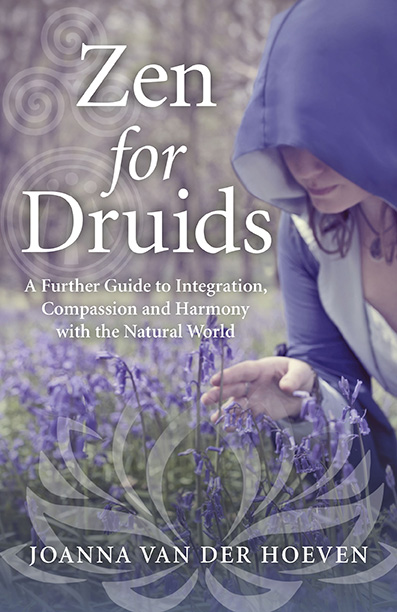
Well, the manuscript has been handed in for my next book, Zen for Druids: A Further Guide to Integration, Compassion and Harmony with Nature. I’ve just come back from a fabulous weekend of teaching at Druid College. It’s been a busy few weeks, to say the least! Everything is coming together, after the nourishing rains and sunlight, both in the inner worlds and the outer. The bluebells are out in full force, the awen is flowing and the sunlight every growing. Beltane is near.
These past few years I have learned so much about my local environment, having moved from the city to the country back in 2010. Being a country girl at heart, it was like a huge sigh of relief, getting away from the concrete and out into the sweet-smelling air of the rural countryside. I have explored the ancestors of place, finding ancient Celtic settlements, henges and tumuli. I have also discovered that my ancestry, with regards to ethnicity through DNA testing, is 56% British (“native” British people are usually 60%), which was a shock as I had pretty much thought all my ancestry would be Western European, seeing as I could trace my family history back to the Netherlands for at least 250 years. Does this give me a deeper sense of belonging to this land? It does, and it doesn’t. I feel less like a visitor, but then again I have been living here in the UK for nearly twenty years. When does someone become native? Is it justified by a length of time, by ancestry?
For me, I think it comes down to relationship. If I have soul-deep relationship with the land, if I am connected to it on every level, then I am home.
Where I live there are the songs of Celts and Saxons, Normans and Friesians. But it is the songs of the Celts that I find harmony with more than most, and being able to connect to these ancestors through blood, place and tradition brings an even deeper level of understanding to my being. I love living in Boudica country. I love learning more and more about the history, the theology. These have always got my fires burning, all throughout my schooling years as a child into adulthood. Now they feel a bit more solidified, a bit more a part of me than someone else’s stories.
Our teaching at Druid College combines the history and theology of both ancient Celtic and modern-day Druidry. I am blessed to have a co-tutor who is, in my eyes, the leading authority in this area (and many other world religions): Robin Herne. I feel that together we have created something that is truly special, truly unique. I have the most amazing students this year, our inaugural year, who inspire me in a beautiful cycle of awen and creativity.
Everything feels like it is coming together in wonderful synchronicity, in beautiful symbiosis. Flowing with the currents of awen, walking with honour and responsibility, ever inspired by the wonder of existence I simply cannot take anything for granted. The fires of Beltane will soon be lit. The fire in the head simply will not quit.
And so this Beltane I hope to travel out to the local ancient sacred spaces, to spend the night with the ancestors, lighting a fire and sleeping out under the stars, walking between this world and the Otherworld. The fire in my head will not allow me to do otherwise, it seems. The fire in the belly keeps me stoked. The fire in the cauldron brings potential and awen.
And if I’m not back in a hundred years, you’ll know where to find me!
This is an extract from my upcoming book, Zen for Druids: A Further Guide to Integration, Compassion and Harmony with Nature. It is the follow-up to my introductory book, Zen Druidry, which is part of the Pagan Portals series with Moon Books. This book delves deeper into incorporating Zen philosophy into a Druid tradition, allowing us to find deep integration with nature, flowing along the currents of inspiration, of awen.
Chapter One
The Three Treasures
The Three Treasures (sometimes called The Three Jewels) are what all Buddhists can take refuge in, in order to alleviate suffering. They are:
In today’s society, we often take refuge in that which causes us harm: drugs; alcohol; high fat foods and so on. We take refuge in violent or mind-numbing television shows. We may even take refuge in abusive relationships. All of these do not help to alleviate suffering, but only increase suffering. We need to re-evaluate what it is that we take refuge in. Let us look at the Three Treasures that Buddhists take refuge in, and see how they are reflected in modern Druidry.
Taking refuge in the Buddha: Everyone has a Buddha nature – In this teaching, we see that everyone has the essence of the Buddha within them. This means that everyone can achieve enlightenment. When we recognise the Buddha nature of a stranger, for example, our behaviour and attitude towards them will shift. We will act with more compassion, because we see that which is in ourselves, our own Buddha nature, is also within them. Within Druidry, as mentioned above, the sanctity of all nature is at the heart of its teachings. There is no hierarchy within Druidry; we are aware that we are a part of an ecosystem, part of a planet, part of the universe and part of the whole. Through the wonders of science, we know that we contain star stuff within our blood and bones. When we realise that we are made up of so many different elements, non-human elements, we are able to recognise the greater pattern that makes up life, and our part within it as a strand of the web of creation. We have rivers and oceans within us, for we drink water every day. We have the sun within us, in the food that we eat, the light upon our skin. We realise that the illusion of separation is just that: an illusion. When the boundaries of this illusory divide fall away, we can become fully integrated into the world around us. There is no human and nature, there is only nature.
There is a Zen story that states: “If you see Buddha on the road, kill him!” This means that anything that we conceive as being external to ourselves is only an illusion, for the Buddha is within. The Buddha is our potential to live our lives in our own perfect truth, awake and aware to life all around us, fully participating in life rather than being passengers on the journey. By recognising our own Buddha nature, we see it in others. The sanctity of life and all creation directs us to live our lives accordingly.
Buddha was/is a great teacher. He exists today as he existed thousands of years ago. He is an inspiration to all who honour the Buddhist tradition. In the Buddha we are inspired to great healing, great peace. We can honour our teachers from all traditions that speak to our soul. In Druidry, we work with the ancestors: ancestors of blood, ancestors of place and ancestors of tradition. Buddha can be a great ancestor of tradition – so can the Dalai Lama, or Zen Buddhist monk and activist Thich Nhat Hanh just as much as Taliesen, Boudicca or modern-day writers and Druids such as Emma Restall Orr or Phillip Carr-Gomm.
Taking refuge in the dharma: The dharma reflects ultimate truth – Truth is a tricky word in modern-day society. Yet it is central to both Buddhist and Druid teachings. In Buddhism, we drop the illusion of separateness; we step beyond suffering created by duality and merge into our own truth. Within modern Druidry, there is a saying: “The truth against the world”. The truth is our own self, our true self, without the conditions and restrictions placed upon it by the ego and others. This self works in the world to create peace and harmony, for it is at peace and harmony. The world is that which tries to impose illusions of duality or conditions of existence upon us. We are told that we need this or that in order to be happy. We are told what to eat, wear, what car to drive. We are told that we are superior to others, human and non-human. We often believe that we will be happy in the future, as we set a condition upon our lives for our own happiness. When we drop these conditions and really pay attention to life, we find out what we really need in order to have peace and happiness. When we follow our own nature and listen to the truth within, we are able to find our place in the world. We are better able to hear our own soul’s truth, and that is the truth against the world. We find wisdom in the teachings, in the dharma, and we know that through experience of the teachings we can understand the truth for ourselves. Within Zen Druidry we realise that there is no monopoly on wisdom. By combining the teachings of both Druidry and Zen Buddhism each are complemented and enhanced.
Taking refuge in the dharma, we recognise for ourselves that the real cause of suffering stems from within, as does the real cause of joy and peace. Taking refuge in the teachings of Druidry, we learn about integration with the world, and how to live our lives as a reflection of our love and devotion to the natural world around us. Both lead us to living lives fully awake and aware, lives that are filled with responsibility towards everything that exists on our planet. It guides us to live in harmony and in peace, mindful of sustainability and honour.
Taking refuge in the community: There is a community – In Buddhism, the community (known as the sangha) is there for one to take refuge in, providing support through shared ideals and goals. They are fellow Buddhists, people you meditate with, perhaps even a monastic community. They are like-minded people, on the path to enlightenment, trying to ease suffering. They are people who can help you on the path, and people that may come to you for help.
This community has been taken further in modern Buddhism to incorporate the planet, seeing and knowing that the earth is our home, our community, and therefore we must take better care of it. Within Druidry, the community is our environment. Not just the land upon which we live, but our homes, our workplaces, the Druid community: everything that we are working with in the world. Druidry knows that life is all inter-connected, that we are all parts of a whole. Ecosystems function because everything knows its place in the wider context, fulfilling its role (living its truth) and thereby contributing to the benefit of the whole. We support the community and the community supports us. We can take refuge in this community, knowing on the most basic level that we are all in this together. It engenders a deep respect for the community, for the whole.
There is a Druid community throughout the world, as there is a Buddhist community. It may be difficult to find other Druids in your particular area, however, there are groups and groves, festivals and camps, Orders and organisations you can join in order to connect with other people following the Druid path, to find support in a community, or to support others within the community in a Druid context. Druidry also recognises the community as a whole, on this little rock we call planet Earth, hurtling through time and space.
Questions
© Joanna van der Hoeven
Tomorrow my students and colleagues gather round for our second weekend of Druid College in the lovely Essex countryside. During this first year, we are introducing and exploring the three realms of land, sea and sky, as well as sacred fire at the centre for the final weekend. This coming weekend, we move from the realm of the land to the realm of the sea.
A part of working with the realm of the sea is learning to work with emotions. As living creatures, we experience all sorts of things and transmute that experience into thoughts and memories, forming our worldview. We are creatures that feel, and feel very deeply, with a wide range of emotions. What I will be exploring with my students this weekend is the current of emotion that runs through humanity, and how we can better work in the world by rafting these currents with skill and compassion.
I’m sure we all know people whose emotions seem to rule their entire world: people who lead reactionary lives. If they are upset or experience any sort of negative emotion, they lash out, immediately trying to hurt another in response to a hurt that they have experienced themselves. This is a cycle that is self-perpetuating, but only if we engage with it. When we become actively involved in our emotions, rather than reactionary, we are better able to deal with situations that could otherwise cause harm both to ourselves and to others.
As Druids, we understand that we are part of a wider functioning of the world, that we are part of an eco-system. We know that in order for us to survive, we must work towards the benefit of the whole rather than just our own well-being and satisfaction. We must work together to create a cohesive, sustaining environment in which to live, and that will continue to ensure the survival of the whole. We know that there is no separation.
If we allow our emotions to rule us, we disassociate ourselves from this integrated perspective, and become self-centred in our point of view. Often it comes in the form of “saving face”, or seeking to undermine others, all the variants that our brilliant minds can come up with or order to justify bad behaviour. We are such intelligent creatures that we are able to delude ourselves in order for our egos to remain intact.
When we step away from this ego self-preservation in its abusive context, we are able to raft the currents of emotion with much better skill. We are not ruled by our emotions, but rather allow them to inform us of our experience in life, and then take the useful information and use it without prejudice in order to provide our lives with a balance and harmony that any healthy ecosystem enjoys. We know that this doesn’t mean that we don’t feel emotions, but rather we feel them even more deeply, because we are thinking about them as well as feeling them. We are able to put them into a context, seeing the reason why we do the things we do, and better able to understand others in the process. Even in the face of an emotional storm, we are able to see the situation more clearly, feel the emotion more deeply, and work towards a resolution that is not self-destructive or that perpetuates abuse in any shape or form.
It takes time, energy and skill to be able to do this, but the key component is compassion. When we see in others all that is negative in ourselves, we are able to understand and in understanding lies the heart of compassion. When we are able to see all that is positive in another being, we are inspired and in that inspiration lies the heart of the quest in Druidry: awen.
We think deeply, we feel deeply. Yet we are responsible for our actions, our behaviour. We take this responsibility very seriously, and work to stop destructive habits and emotions that threaten the wellbeing of the ecosystem in whatever shape or form it takes.
Being aware of your emotions is not something easily done. It’s so easy to think that we are self-aware, but even thinking that can be a delusion. What we can do is work to the best of our ability to be self-aware, and remember that the integration, the part of being a whole is at the heart of Druidry, enabling us to create long-lasting, deep sustainable relationships. We put aside our self-centredness and see the vast perception of a holistic worldview that is truly and deeply inspiring, allowing us a freedom that we never thought possible.
It’s been four years today that this blog has been going, and I just wanted to take this opportunity to thank you all for reading, following, commenting, supporting and generally just being lovely!
I received a letter yesterday from a lady in India who runs a school influenced by the teachings of Krishnamurti and many Buddhist concepts. She also has a great love of Celtic theology and music, and took the time to write to me telling me how much she loved my first book, Zen Druidry. It’s so wonderful to receive letters like these, and I’m continually both surprised and delighted that so many people have taken the time to get in touch. I feel really connected to the readers of this blog and my books, and I thank you from the bottom of my heart for your words, your suggestions, your reviews, your letters, your support and more.
And the timing of that letter was brilliant; there is some good news to share as well! It looks very much like a follow-up to my first book, Zen Druidry will be published this year! Taking the ideas from Zen Druidry in the Pagan Portals series by Moon Books (this is a series of books that offer an introduction on subject in around 100 pages or less), these ideas are further expanded in this new book, as well as offering more ways to blend Zen and Druidry, Eastern and Western traditions to create a holistic worldview based on reverence for the natural world, utterly awake and aware to the present moment.
I’ll keep you all posted on updates, and once again, thank you all so very much!
You can’t stay stuck. You either have to move forward, sideways, or back the way you came. You have to find a way to follow the flow, to get where you need to go. This was made all the more clear to me today as my husband and I snowshoed the trails around my parents’ home.
These were trails that I had known all my life. In my youth I had spent many long hours in the forest, no one for miles around, hiking the trails in all seasons, with only the birds and the tracks of fox, deer, squirrel and rabbit to keep me company. Some of the trails I had made by my own passage, which are now no longer in existence. Things change, paths come and go.
We strapped on our snowshoes and headed out into familiar backcountry. It was beautiful, with a couple of feet of snow on the ground, heavy on the tree branches and falling lightly out of the grey sky. We followed an old trail that had a few deviances from its orginal path. When the path just ended for no reason, we decided to continue on; we weren’t forging a new trail, and others had gone before. We weren’t too bothered: we knew the area pretty well. A couple of miles up the mountain was a road, and a couple of miles below was the river. Eventually if you got too lost, you could just either head uphill or downhill. Walking parallel to the hill would either hit another road or powerlines, so you could again get your bearings pretty quickly. We had a phone if we needed a pickup from any of the roads.
Still, it was an adventure. The trail moved into unfamiliar terrain, and at one point near the top of the mountain there suddenly appeared “No Tresspassing” signs in the middle of the forest where the trail just stopped. We had been out for hours and we stopped, discussing the best thing to do. It was getting cold, we had climbed 90% of the mountain, and could either spend what little energy we had left trying to find the connecting path that should have been there (even though this meant trespassing) or go back the long way we came. Tired, sweaty and getting cold, we decided to keep going ahead, despite the signs. (Please note: this is not an endorsement to trespass on private property – it all depends on the circumstances.) The old trail used to go through this newly acquired or newly signed property, and I knew we weren’t far from the connection off towards the east. It was the best decision we could make, given our current circumstances and situation. We tried our GPS, but for some reason it had decided not to work. We had to rely on gut instinct. Ten minutes later, after walking past a dozen signs, the trail suddenly appeared again, this time with new signs and following a different path. Breathing a sigh of relief, we continued, moving forward, knowing that home was that much closer. We took out the compass and confirmed that we were indeed heading east, which is where we wanted to go.
The trail had changed, and though the name was familiar the terrain wasn’t. But eventually the trail connected to the old trail that I knew and had grown up with, for we saw some of the old signs that had been screwed into the trees. These little metal signs had been attached to the tree for so long that they were half covered by the tree, which had grown around it, and would eventually swallow them whole. I smiled, realising that these signs were new when I was younger, and reflected the growing, changing, ever flowing nature of time, and the nature of nature itself.
We found our third connection, and came out onto the road with great relief. It had been quite an adventure, physically challenging and mentally stressful, not knowing where you were, breaking the rules and hoping that your insinct is right. Some trails had drastically changed, some were the same, but moving forwards was essential in order for us to find the way home. As we walked down the road in the falling snow, I thought how much this reflected life in general.
Sometimes we work bloody hard to get where we need to go. It can be physically, mentally and emotionally challenging. What matters most though is taking those first steps, and getting out there, finding the path that works for you. It may not matter too much which path you start out on, as long as you do start. Sure, you might have to break a few rules on the way. Sure, you may seriously doubt yourself. Sure, you may find the path twists and turns unexpectedly. You may be exhausted. But at least you are trying. At least you are not stuck. Out there, in the backcountry woods, being stuck can be fatal. So you keep moving, you keep going.
We are resourceful creatures. Sometimes we just have to listen to our guts. I was so thankful when we found that connecting trail, confirming that my sense of direction had been right. We use what we have been gifted with, what we have learned, and what we are continuing to learn to help us move forward. Sometimes we may even have to move backwards for a while, retrace our steps in order to find a better path. Sometimes we may not even have a destination in mind; the journey is enough. Take pleasure in the journey, the good and the bad, the stresses and the glories. Use your wits and intelligence, your physical strengths, your intuition, your friends and family to help you get where you want or need to go. One foot in front of the other. You can do it.
All you need to do is keep moving.
Nature is in contant flux. It is never the same day twice. Everything is changing, growing and fading, living and dying. Follow that flow. Be the flow itself.
 It’s finally here: the Zen Druidry online course! An extension of my first Pagan Portals book, Zen Druidry: Living a Natural Life in Full Awareness, this 75 page online course delves deeper into the subject matter with practical exercises, links to videos and talks, provides questions to help the practitioner develop a broader level of understanding and more. A basic meditation audio file also comes with the course, to help beginners and the more adept alike in furthering their meditation practice. For more information on this course, please email autumnsong@hotmail.co.uk. £40
Ego is a funny thing. We can get so wrapped up in it without even noticing it. Differing from our functional self, which helps to get things done on a day to day basis, ego is a large part of the representational self, the story that we tell ourselves and the world around us. Is it true? Probably, for the most part. It is from a biased perspective? Absolutely – everything that we perceive is. Is it something that is worth having? I’m not so sure…
Our society fuels the ego like no other. Social media is a great place where one can either be puffed up or dragged down by people they have never met. (Yes, the irony/hypocrisy of writing this on an online blog is not lost on me.) People can use social media to help fuel the ego, and not in altogether productive ways. Sure, expressing your creativity is great: put up that piece of artwork that you’ve worked so hard on. Give us an excerpt from your latest book. Tell us of the charity work that you are doing in India. This is an expression of your self that is not separated from your functional self. It’s not all representational – unless you are totally attached to it.
I am a conduit. I am an interpreter. I am not the thing itself.
When it becomes all about the representational self, that’s where the problem comes in. We begin to live inside our heads, inside our stories and do not seek alternative points of view. We can become deluded by our story, confirmed by people we may have never even met. We can react viciously to things that upset us, through online comments, blog posts, etc. Why would we want to do this? Why would we want to hurt another? Why should this be? Is it because the ego is such a fragile thing?
The ego seeks to reaffirm itself in everything that it does. It’s based on its own self-preservation, fuelled by an erroneous concept that one would lose their identity with the loss of ego. This couldn’t be further from the truth. There are plenty of people out there with a very strong sense of identity and purpose, yet who are not fuelled by their ego. These people are inspiring, for they know that the work they do and how they live their life is more important that who they are.
No one is perfect. Everyone succumbs to their ego every now and then. But when we live entirely through the ego’s whimsy, then we are in big trouble. We may see other people’s success as our failure. We may take slight at something because we haven’t been included in it. We might want to make someone look bad and undermine everything that they do because they have hurt us in some shape or form. We cease to see with the eyes of compassion, instead only seeing through the eyes of “ME”.
Where does this all lead?
Is it worth it? What will be the outcome of living in your ego?
I don’t think it will be happiness. We will rage against those who argue against us. We will delude ourselves with notions of grandeur, or delusions of all shapes and forms. We will spend an inordinate amount of time thinking about things that don’t really matter. We spend all our time reinforcing the ego. What really matters in life? Your ego, or living well?
These are questions that I have asked myself, as I quest inspiration to live an integrated life. For me, integration cannot happen without the falling away of the ego’s hold on our reality. It’s about realising that I am not important, that no one is important; what is important is the work we do, not so much the words we say (though speaking honourably is a good thing). Our actions are important. Our walk, rather than our talk is important. It’s all about getting the work done, through the functional representation of the “I”, without the representational “Me” getting in the way.
Is this all semantics? Quite possibly.
The Song of Amergin is not an ego-boost. It’s about integration, realising that one is not separate from nature. It is about seeing the universe in yourself. It is about knowing that you would not exist were it not for everything else. It is about relationship.
At this time of year, when darkness fills my life, fills my soul, when the songs of winter flood through this land I see the little spark of ego, clinging desperately onto its belief systems and self-affirmations. And I smile to it as I watch it go out, letting the darkness and silence of integration fill my mind and my world. I am reminded of the Zen saying “hold lightly to your opinions”, because they will change. Impermanence is the nature of the world, the nature of nature.
This blog post was inspired by a Guardian article I read today about the backlash from the pagan community on Alex Mar’s latest book, as well as our government’s reaction and bombing in Syria. It’s not entirely about these things, but about these things and more.
Came across this little gem of a talk today…
Busy here getting the Zen Druidry online course ready, so apologies for the haphazard posting of late!
Here’s a short excerpt from the upcoming online Zen Druidry course, that delves deeper into the subject matter that was introduced in my first book, Zen Druidry as part of the Pagan Portals introductory books series. This course is quite extensive, with practical exercises, video links, audio files and more. We hope to release it by the Winter Solstice – keep everything crossed!
This excerpt is from the Wheel of the Year section, where each festival is looked at in depth and culminates in practical work that combines the elements of Zen Buddhism and Druidry.
Imbolc
The days are becoming longer, and though the air is still cold, the first signs of Spring emerge.
Extract from Zen Druidry: Living a Natural Life with Full Awareness by Joanna van der Hoeven:
At Imbolc we welcome the lengthening days and the first of the flowers, with the snowdrops coming into season. For those that celebrate by the calendar, Imbolc occurs on the 2nd February. I prefer to celebrate when the snowdrops are out, as I find this more in tune with the seasons. This could happen anytime from beginning of January to as late as March, depending on the winter. Imbolc is also the time when the sheep begin to produce milk – ewe’s milk, which is where we get the name Imbolc from. For our ancestors, this was a celebratory time, when cheeses and butter could once again be made to replenish the winter stores. Again, the milking time can occur anytime in February onwards – it’s always a joy to watch the fields and wait to see the new lambs scampering, flipping their ridiculous tails! This is a time for preparing the seeds of what we wish to achieve in the coming year, dreamt up over the long winter nights, but not yet ready to plant – we must still keep these dreams safe. With Zen, we can apply Right Concentration to this time of year, and focus on total immersion in the present moment.
As we have been using Right Mindfulness in the time from the Winter Solstice to the time of Imbolc, we will notice in our environment when the first snowdrops come out, the increasing amount of sunlight each day, the slow warming of the earth. We will feel the energy softly changing, moving from an introspective feel outwards towards the growing light.
The festival of Imbolc is one of gentle joy. Agriculturally our ancestors in the British Isles celebrated the time of lactation, when ewes first began to produce milk. The winter stores could be replenished with fresh milk and cheeses, to last the hungry time through Spring until the land began to offer her bounty once more and awake from her winter’s slumber. Imbolc is also a Fire Festival in the Celtic year, along with Samhain, Beltane and Lughnasad. The goddess Brighid has long been associated with this festival. She is a goddess of fire and water, of healing, poetry, smithcraft and more. This festival became Christianised as Candlemas, again showing the fire aspect of this time. The growing sunlight is reflected through earthly fire and flame. There are many ways to celebrate Imbolc, including household blessings, the making of Bride dolls, Brigid’s crosses, and more.
Become aware of how fire is a central aspect of your life, in all its manifestations. Give thanks when your central heating comes on. Give thanks for the sunlight that keeps our planet from becoming an ice cube hurtling through space. Give thanks for the gas that powers your stove/cooker, allowing you to have a hot meal. Look into a candle’s flame, or a fire in the hearth, and commune with the spirit of fire. Look at how fire is manifested within the body, in energy, emotion and more.
The Druid pays attention to her surroundings. With Right Concentration (sometimes referred to as Right Focus) she can hone her skills in mindfulness. Concentrating on being fully present, little will escape our attention and we will live a more integrated life with the natural world around us. Right Concentration is a skill that can be achieved through daily meditation. We begin with focusing on the breath and the body in meditation, and keeping our concentration centred within. We then move that focus outwards, without losing the concentration that keep us from distractions, from our chattering “monkey mind“.
It is easy to berate ourselves for not having enough concentration in our lives. In fact, when we look at modern-day society, we see that we are being bombarded by things that actually lessen our ability to concentrate for any period of time. We have smart phones that allow us to stop whatever it is we are doing at any given moment (apart from driving, we hope!) and look at/think about something else. We have telephones that ring us when we are at home. We have television shows, sometimes divided into 4-7 minute segments (mostly American shows) with advertising breaks in between. Our attention spans are becoming shorter and shorter simply through the media that we use. Twitter has a 140 character length, and if you can’t communicate what you have to say in that short space then you can’t say it at all. Their Vine app makes looping videos that are only 6.5 seconds long. The list continues.
We have to relearn how to concentrate, how to bring our awareness in directed focus on a subject in order for our minds, bodies and lives to begin to settle once more. As infants, we absorbed information in rapt attention, no matter if it was a light shining overhead or our mother’s voice. Toddlers exploring the world are intensely focused, beginning with their first steps and then on their goal. We begin to lose our abilities to concentrate with the more information we have to hand, thinking that we can absorb it all without actually realising the repercussions it has on our lives. Technology has advanced so much that our human bodies simply aren’t able to cope with the information overload, and we need to take a step back and refocus.
Most of the information we are receiving is not necessary to our daily function. Reading some celebrity’s tweet will not put dinner on the table. Checking replies to our Facebook status will not get our toilets cleaned. If you’ve spent a media-free day a week during the Winter Solstice to Imbolc period, then you probably have realised the benefit of stopping the information overload.
We begin with a simple candle meditation, incorporating the fire aspect of the season and the one-pointed focus required in this meditation. Sit before a candle, and simple watch its flame. When thoughts arise, notice them by saying “lunch” or “meeting” or “cat” and then let it go, returning your focus to the candle’s flame. If you have a family, it might be better to do this meditation either early in the morning or late at night when everyone is in bed. It doesn’t matter how many times you have to bring your focus back to the candle – what matters most is that you do it. Bring your attention and concentration back however many times you need to. Concentration is a skill, and any skill is something which is developed over time. It doesn’t happen in an instant.
Now is the time to take it a step further. Literally.
Walking meditation is a brilliant way draw focus into what we are doing, and help us to integrate with our natural surroundings on the Druid path. We can think of each step we take as kissing the earth, celebrating our love for life on this planet. Walking meditation began as an interlude to zazen, or sitting meditation, to allow the meditator to continue with their meditation while easing their body from a sedentary pose to a moving one, allowing for good circulation and bringing some exercise into the practice.
Walking meditation can be done indoors or outdoors. Zendos (Zen centres) will accommodate both practices in their buildings, but incorporating the Druid path into our spirituality means that we need to engage further with the natural world around us. Remaining indoors has its benefits, enabling us to concentrate better with less distractions, however, we can practice this outdoors with great joy. We can then let this practice become part of our lives to such a great extent that we walk mindfully, aware of our movements wherever we go, whatever we are doing. It requires Right Concentration. Do what you can, whether indoors or out.
Not only will we benefit personally from walking meditation, but the land will benefit as well. If we walk with love and with joy, instead of walking with anger or suffering, the land will also share in this experience. Too often we believe that we are the only beings experiencing, however, we can walk in the rain and experience the rain, knowing that the rain is also experiencing us. Let us make this a good experience.
With the exercise and fresh air, we also release stress and anxiety, as well as developing a practice that allows us to be in the world by silencing our monkey mind and embracing the world as it really is.
If you are lucky enough to have a backyard, these are ideal places to begin. It is out of doors, and relatively quiet, safe and secure. If you don’t have a backyard, you can try a local park that you feel is safe and secure, or a botanical garden, or even a friend’s backyard (with their permission, of course!). If you live deep in the heart of a city and don’t feel that you are able to access public parks with safety on your own, ask a friend or relative to join you. If you have wild stretches of forest or heathland at your doorstep, go for it, but do ensure that someone is aware of where you are going, and what you are doing. Again, take someone along if it makes you feel more at ease. If you have a young family, doing walking meditation with them is a great way to spend time together.
Barefoot walking is a great way to bring focus and attention to each and every step. However, it depends on your circumstances and whether this is a safe thing to do. Broken glass and other debris on city streets are not conducive to good barefoot walking meditation; neither is walking through gorse-laden brush in adder country. Be safe and responsible.
Really notice the feel of movement in your body as you slowly take one step, then another. Engage your whole foot in the step, touching the ground with the heel first, then rolling all the way to the tips of the toes. Be aware of what both feet are doing at the same time. This is surprisingly difficult at first, but it will hone your concentration. Breathe mindfully as if in meditation. Feel the air on your skin, the sunlight or the rain. Notice the light or darkness, the sounds and scents. Do not become lost in these, however; simply notice. Notice without judgement. You can even say to yourself “sunlight”, “dog barking”, “snowdrop”, “icy path” and allow your awareness of everything to keep you going. When you find the mind starting to wander, or you feel you begin to judge something, bring your attention back into your feet and your breath.
Walk as slowly or as quickly as feels comfortable. Most Zen walking meditation is done slowly, but some Zen centres do practice kinhin quickly, to get the blood flowing. As with everything, mindfulness is key. Do this every day if you can, noticing how your environment is changing through the seasons.
Some things to consider from Imbolc to the Spring Equinox are:
 Down the Forest Path