A Most Excellent Book by Thich Naht Hanh

“Promise me, promise me this day, promise me now, while the sun is overhead exactly at the zenith, promise me: … Even as they strike you down with a mountain of hatred and violence; even as they step on you and crush you like a worm, even as they dismember and   disembowel you, remember, brother, remember: man is not your enemy.
The only thing worthy of you is compassion – invincible, limitless, unconditional.   Hatred will never let you face the beast in man.
One day, when you face this beast alone, with your courage intact, your eyes kind, untroubled (even as no one sees them), out of your smile will bloom a flower.
And those who love you will behold you across ten thousand worlds of birth and dying.
Alone again, I will go on with bent head, knowing that love has become eternal.
On the long, rough road, the sun and the moon will continue to shine.”
~Thich Nhat Hanh
Here is an article and book promotion of Thich Naht Hanh’s view on understanding our enemy, and working towards love and peace. http://mettarefuge.wordpress.com/2010/08/06/thich-nhat-hanh-can-we-understand-the-suffering-of-our-enemy/
Peace out. x

Paperback edition of new book now available!

Paperback version of my new book is out today – ebook will be ready soon! A big thank you to the Druid, Buddhist and Pagan community, who continually inspire me – may we be the awen!  http://www.amazon.co.uk/Pagan-Portals-Druidry-Natural-Awareness/dp/1780993900/ref=sr_1_1?s=books&ie=UTF8&qid=1365503883&sr=1-1&keywords=zen+druidry

BOOK

Some lovely reviews of my latest book, Zen Druidry!

“This is a fascinating book that lays out the core concepts of both Zen and Druidry, exploring the points of overlap and the ways in which these two traditions compliment each other. The writing is precise, lucid and beautifully accessible whilst managing to put across a vast amount of information in a very small space. I would say that even if you aren’t attracted to the idea of Zen, this book is still well worth your time, because of what it shows through the contrast between the two traditions. Joanna draws attention to the importance of being as present in the moment as we can be, and as open to life as possible. That’s an issue for Druids of all flavours to consider. Druidry is very much about here and now, and what we do from moment to moment, after all.

If you’ve been attracted to both traditions all along, this is, quite simply, the book you have been waiting for.” –  Nimue Brown, author of Druidry and the Ancestors and also Druidry and Meditation


“Back in the distant past when I was taking early steps along the Druid path, I was also studying Eastern ways – Buddhism, Daoism, Confucianism, Brahmanism, and the like. I stayed on the Druid path and became Druid because I better understood the imagery and symbolism which allowed me to better shape my own metaphysical stance. But I have never ceased to be a student of those other ways.

It was a pleasant surprise, therefore, to pick up this little book which outlines both Zen (a school of Mahayana Buddhism that developed in China during the 6th century) and Druidry (the modern name given to a spiritual path developed from that overseen by ancestral Druids) and shows how they can work together. It is a little book, so you might not expect too much of it. You will, however, be pleasantly surprised. It manages to pack a lot into its 74 pages, largely because it is written without fuss or pretensions – indeed, very much in keeping with the subject matter. That alone speaks to me about how valuable this little book is. The author not only knows her subject inside out, she clearly practises what she preaches.

I found the application of the Buddhist Eightfold Path to the eight annual festivals of the Druid way to be of particular interest. Meditation is important to Zen and I have long felt that following the ritual year is a form of extended meditation. And here we have an extra layer to contemplate, integrate, and practice as the seasons revolve.

The greatest connection between Zen and Druidry (for me, at least) lies in mindfulness. It is, perhaps, an attribute common to all spiritual paths, but it is of especial interest to those who recognise their rootedness in this world, who recognise that the worlds of spirit and matter are as integrated as everything else. From the extempore prayers said by Celtic peoples over everyday tasks and events, words that spring from an awareness of working in the now, to the formal ritual built up around significant events in the life of the planet, the individual, the family, and the community, a Druid needs to be mindful. But it goes well beyond word into every aspect of our being – our thoughts, our dreams, and our every action. All this is simply and powerfully highlighted by this book.

So what we have is an engaging and thoughtful introduction to a pertinent fusion of ideas. A book which beautifully illustrates that when you strip away the fluff, the images, and the symbols there is very little that is different between the paths. And whilst it is something you could read at a single sitting (as I did), it is worth revisiting on a regular basis so as to be able to return to that clear and simple vision on which it is based. A book I would willingly recommend to anyone.”  – Graeme K Talboys, author of The Druid Way Made Easy, The Path Through the Forest: A Druid Guidebook and Arianrhod’s Dance: A Druid Ritual Handbook


“This little book gives an outline of druidry, what it is and how it works, followed by an introductory tour of Zen teachings and then shows you how to bring both ‘traditions’ together to form Zen Druidry.  Very intriguing concept, well written and interesting for anyone on a spiritual path.” Rachel Patterson, author of Kitchen Witchcraft, Grimoire of a Kitchen Witch and Hoodoo Folk Magic

Face the Abyss…

As per my latest blog post, I’ve been inspired to go media free one day a week, when I am home and have access to the internet, television and radio – it’s easy to go media free when on holiday, for instance, but not when we’re home alone, and have to be alone with ourselves. No phone calls, no internet, no television, no radio. One day a week, to get back in touch with myself. To remember a time before all this media and social media became so important. A time to remember what really matters.  A time to read, to meditate, to go for walks, to sing, to dance, to play an instrument, to create.

Look into the abyss, and the abyss looks back at you…

Leo Babuata’s 12 Essential Rules to Live More Like a Zen Monk

12 Essential Rules to Live More Like a Zen Monk  (taken from http://zenhabits.net/12-essential-rules-to-live-more-like-a-zen-monk/)

“We have more possibilities available in each moment than we realize.” – Thich Nhat Hanh

Post written by Leo Babauta.

I’m not a Zen monk, nor will I ever become one. However, I find great inspiration in the way they try to live their lives: the simplicity of their lives, the concentration and mindfulness of every activity, the calm and peace they find in their days.

You probably don’t want to become a Zen monk either, but you can live your life in a more Zen-like manner by following a few simple rules.

Why live more like a Zen monk? Because who among us can’t use a little more concentration, tranquility, and mindfulness in our lives? Because Zen monks for hundreds of years have devoted their lives to being present in everything they do, to being dedicated and to serving others. Because it serves as an example for our lives, and whether we ever really reach that ideal is not the point.

One of my favorite Zen monks, Thich Nhat Hanh, simplified the rules in just a few words: “Smile, breathe and go slowly.” It doesn’t get any better than that.

However, for those who would like a little more detail, I thought I’d share some of the things I’ve discovered to work very well in my experiments with Zen-like living. I am no Zen master … I am not even a Zen Buddhist. However, I’ve found that there are certain principles that can be applied to any life, no matter what your religious beliefs or what your standard of living.

“Zen is not some kind of excitement, but concentration on our usual everyday routine.” – Shunryu Suzuki

    1. Do one thing at a time. This rule (and some of the others that follow) will be familiar to long-time Zen Habits readers. It’s part of my philosophy, and it’s also a part of the life of a Zen monk: single-task, don’t multi-task. When you’re pouring water, just pour water. When you’re eating, just eat. When you’re bathing, just bathe. Don’t try to knock off a few tasks while eating or bathing. Zen proverb: “When walking, walk. When eating, eat.”
    2. Do it slowly and deliberately. You can do one task at a time, but also rush that task. Instead, take your time, and move slowly. Make your actions deliberate, not rushed and random. It takes practice, but it helps you focus on the task.
    3. Do it completely. Put your mind completely on the task. Don’t move on to the next task until you’re finished. If, for some reason, you have no choice but to move on to something else, try to at least put away the unfinished task and clean up after yourself. If you prepare a sandwich, don’t start eating it until you’ve put away the stuff you used to prepare it, wiped down the counter, and washed the dishes used for preparation. Then you’re done with that task, and can focus more completely on the next task.
    4. Do less. A Zen monk doesn’t lead a lazy life: he wakes early and has a day filled with work. However, he doesn’t have an unending task list either — there are certain things he’s going to do today, and no more. If you do less, you can do those things more slowly, more completely and with more concentration. If you fill your day with tasks, you will be rushing from one thing to the next without stopping to think about what you do.
    5. Put space between things. Related to the “Do less” rule, but it’s a way of managing your schedule so that you always have time to complete each task. Don’t schedule things close together — instead, leave room between things on your schedule. That gives you a more relaxed schedule, and leaves space in case one task takes longer than you planned.
    6. Develop rituals. Zen monks have rituals for many things they do, from eating to cleaning to meditation. Ritual gives something a sense of importance — if it’s important enough to have a ritual, it’s important enough to be given your entire attention, and to be done slowly and correctly. You don’t have to learn the Zen monk rituals — you can create your own, for the preparation of food, for eating, for cleaning, for what you do before you start your work, for what you do when you wake up and before you go to bed, for what you do just before exercise. Anything you want, really.
    7. Designate time for certain things. There are certain times in the day of a Zen monk designated for certain activities. A time for for bathing, a time for work, a time for cleaning, a time for eating. This ensures that those things get done regularly. You can designate time for your own activities, whether that be work or cleaning or exercise or quiet contemplation. If it’s important enough to do regularly, consider designating a time for it.

  1. Devote time to sitting. In the life of a Zen monk, sitting meditation (zazen) is one of the most important parts of his day. Each day, there is time designated just for sitting. This meditation is really practice for learning to be present. You can devote time for sitting meditation, or do what I do: I use running as a way to practice being in the moment. You could use any activity in the same way, as long as you do it regularly and practice being present.
  2. Smile and serve others. Zen monks spend part of their day in service to others, whether that be other monks in the monastery or people on the outside world. It teaches them humility, and ensures that their lives are not just selfish, but devoted to others. If you’re a parent, it’s likely you already spend at least some time in service to others in your household, and non-parents may already do this too. Similarly, smiling and being kind to others can be a great way to improve the lives of those around you. Also consider volunteering for charity work.
  3. Make cleaning and cooking become meditation. Aside from the zazen mentioned above, cooking and cleaning are two of the most exalted parts of a Zen monk’s day. They are both great ways to practice mindfulness, and can be great rituals performed each day. If cooking and cleaning seem like boring chores to you, try doing them as a form of meditation. Put your entire mind into those tasks, concentrate, and do them slowly and completely. It could change your entire day (as well as leave you with a cleaner house).
  4. Think about what is necessary. There is little in a Zen monk’s life that isn’t necessary. He doesn’t have a closet full of shoes, or the latest in trendy clothes. He doesn’t have a refrigerator and cabinets full of junk food. He doesn’t have the latest gadgets, cars, televisions, or iPod. He has basic clothing, basic shelter, basic utensils, basic tools, and the most basic food (they eat simple, vegetarian meals consisting usually of rice, miso soup, vegetables, and pickled vegetables). Now, I’m not saying you should live exactly like a Zen monk — I certainly don’t. But it does serve as a reminder that there is much in our lives that aren’t necessary, and it can be useful to give some thought about what we really need, and whether it is important to have all the stuff we have that’s not necessary.
  5. Live simply. The corollary of Rule 11 is that if something isn’t necessary, you can probably live without it. And so to live simply is to rid your life of as many of the unnecessary and unessential things as you can, to make room for the essential. Now, what is essential will be different to each person. For me, my family, my writing, my running and my reading are essential. To others, yoga and spending time with close friends might be essential. For others it will be nursing and volunteering and going to church and collecting comic books. There is no law saying what should be essential for you — but you should consider what is most important to your life, and make room for that by eliminating the other less essential things in your life.

“Before enlightenment chop wood and carry water. After enlightenment, chop wood and carry water.” – Wu Li

Meditation

Many modern day pagans incorporate meditation into their spiritual practice. The reasons are varied, from wanting a sense of inner peace, health benefits, to seeking a spirit guide and more. The techniques themselves are as varied as the reasons behind why meditation is becoming so important – from journeying, astral travel, going “under the cloak”, mindfulness and so on.

There is a certain mysticism surrounding meditation, which may be a reason why it is so popular in paganism. It can be a deeply spiritual experience, it can put you in contact with the Otherworld – it can also put you in touch with yourself and the world around you in the present moment (reality). It can be both mystical and mundane. Its uses are boundless, and the benefits too many to count. However, let’s go over a few anyway…

Meditation is said to lower blood pressure, to help with sleeping difficulties, depression, anxiety attacks, deep-seated fears and problems with concentration. The latest meditation fad on the health and science circuit is Mindfulness Based Cognitive Therapy (MBCT). BBC News Healthstates that “It teaches a way of looking at problems, observing them clearly but not necessarily trying to fix them or solve them.’It suggests to people that they begin to see all their thoughts as just thoughts, whether they are positive, negative or neutral’.” http://news.bbc.co.uk/1/hi/health/7319043.stm. Now, having been a Zen meditator for years now, this sounds like plain old Soto Zen meditation to me, under a different name. In fact, Mindfulness was first translated from Sanskrit in 1881 by Thomas William Rhys Davids, who further described it as “Right Mindfulness, the active and watchful mind”. Mindfulness in itself is nothing “new” – it’s been a part of Buddhist meditation for thousands of years. Yet, as Harvard Health online states “Mindfulness meditation is getting a lot of attention because it seems to help with so many physical and psychological problems—like high blood pressure, chronic pain, psoriasis, sleep trouble, anxiety, and depression. It’s also been shown to boost immune function and stop binge eating. http://www.health.harvard.edu/blog/mindfulness-meditation-improves-connections-in-the-brain-201104082253”. No matter what it is called, it seems to be working.

Meditation is not for everyone, but for those pagans who are looking to incorporate it into their lifestyle it can be a wonderful way to get in touch with your “inner self” and the world around you. As a Druid, I use meditation for relaxation, for journeying and for connecting with everything around me. As I mentioned earlier, I usually use the method of Soto Zen, literally “sitting meditation” for the most part. This, much as the MBCT above, is about being aware of thoughts, and thought processes, without judgement. It is also being aware and in the present moment, hearing, smelling, seeing everything with complete focus to the art of paying attention. It’s also about the discipline of keeping your butt on a cushion for more than five minutes at a time, which is the hardest part.

Zen meditation is not , as many people (and pagans) believe, about transcending the body, but about being 100% completely in it – awake and aware to everything. It’s about sitting on your cushion and feeling any tension in the body. It’s about feeling your breath moving in and out of your body. It’s about hearing the blackbird singing outside. It’s also about paying attention to the thoughts that arise in your mind – “Oh, I’m thinking about that again” instead of becoming wrapped up in the thought. It’s about being non-judgemental about absolutely everything – not thinking “I’m drifting off again, I must pay attention – I really, really suck at meditating”. It’s about returning to the present moment, again and again and again. It’s really very simply, and very difficult at the same time.

Another form of meditation that I like to use was taught to me by a former teacher, Emma Restall Orr. This is called the Tree Meditation, which is wonderful for grounding. The beginnings can be found here – http://druidnetwork.org/learning/exercises/tree. It is a beautiful, grounding meditation that really focuses on the breath as a an agent to plant your metaphysical roots into the ground, to become rooted like a tree, drawing up nourishment from the very earth, the sacred earth. I try to do this at least once a week along with my Zen meditations, for it brings me back to connection with the earth, my home and the soil in my backyard.

The Ancestor Meditation is another meditation that I learned whilst on the Bobcat’s Living Druidry Course, set in the beautiful Cotswolds countryside. This is a really deep meditation to connect you with your ancestors – I’ve only ever done this with blood ancestors, but I’m sure that it could be performed with spiritual ancestors as well. It’s about connection, and again, the tool for this is the breath – what better way to connect with others than by our breath? It is a shared thing – what we breath in, others have breathed out, from bird to beetle to beastie. This meditation takes us on a journey through the breath to connect with our ancestors in a truly profound way. Not for the faint-hearted!

I also enjoy the occasional Journeying – taking a “trip” to a special place to perform a certain task, to meet with a certain person, spirit, or even deity, to seek out answers or to simply have some fun. I perform a Dark Moon Journeying to meet with other members of the Order of the Yew – the dark heart of the Druid Network. To find out more about the Order of the Yew, and its meditation, you will have to become a member, but it is well worth it in my opinion. I also meditated regularly when studying with OBOD, using their exercises which really helped open my soul to new things, to new experiences. Again, you have to be a member, and it is rather a lot more than the Druid Network.

Then there are simply times when I am outside in the backyard, watching the sunset or the sunrise, or running with the deer on the heath, or sitting in front of the fireplace, honouring the spirits of place with all that I am. Sometimes singing back to the land is a part of the meditation – I have stood at the edge of the North Sea and spiritually sung words that have no meaning and yet are full of emotion to my ancestors across the sea.

The end result to all meditation is, I suppose, connection. It’s all about relationship, whether it is getting to know yourself better, or your world. It is deeply healing and transformative, and, in my opinion, should be performed as often as you can, in as many places as you can. It’s the benefit of taking time out for yourself, with no guilt or judgement, to re-connect to the threads of life that are woven all around you. Go on, if you haven’t already – give it a try.

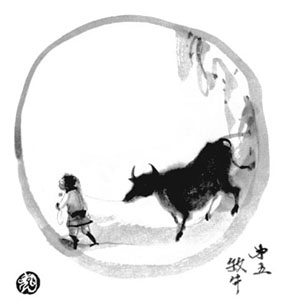
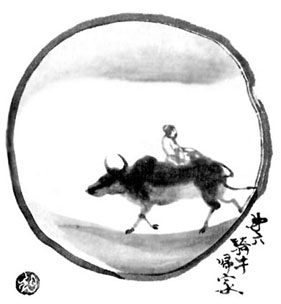
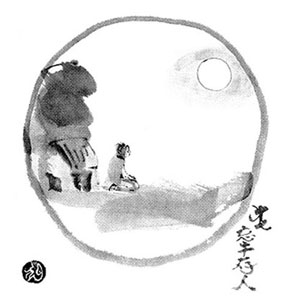
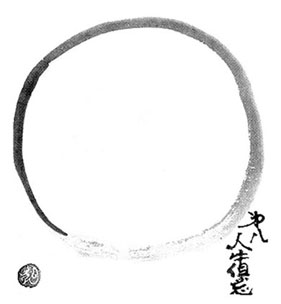
Druidry and the Ten Bulls

The Ten Bulls is an illustrated poem used by followers of Zen Buddhism to explain the search for enlightenment.  For me, it also represents the search for meaning in my own Druidry and indeed, in my own life in general.  It can be applied to everything, but for the purposes of this blog I’ll stick to Druidry. To see the Ten Bulls, otherwise known as the Ox-herding pictures, you can follow this link:- http://www.sanbo-zen.org/cow_e.html.

The search for enlightenment, the search for the Self and meaning is a major part of any religion or spirituality.  What will explain that sense of something missing, that lacking? What will fill it, or guide us to fill it in? What will help us to realise our full potential and live according to our True Self?

For me, this has been blending Zen with Druidry, and in the Ten Bulls can be encapsulated quite neatly.  They are, as follows:-

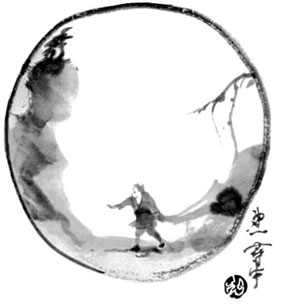
 1.In Search of the Bull

1

When we first come to Druidry, we do not really know what it means, for there are no long-established formal schools or training that we know of.  We can look to history, and then find out about courses now offered in Druidry through various organisations, but is this Druidry? It is certainly a version of it – Druidry is what it is, to each and every person. Moreover, to each and every person, it is different, yet still falls under a single banner. Confusing? Hell yeah. In a way, I think it’s meant to be. It encourages us to get out there, and find out more – beginning the adventure.


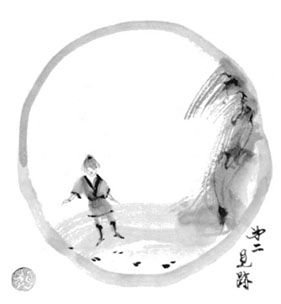
2.Discovery of the Footprints

2

We have begun our adventure, and are searching now for what Druidry is.  We catch glimpses of it in the works and writings of others, yet we still have not experienced Druidry for ourselves.  Like the wind, we can’t see it, we can only see its effect on other things.  We continue and go deeper into our Druidry to find out what it really is.


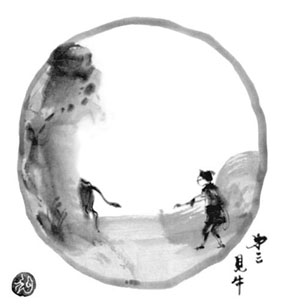
3.Perceiving the Bull

3

We’ve caught a glimpse!  We’ve had an insight into what Druidry is – we know that we’re now on the right path in our journey of self-discovery. Yet it is still not entirely clear – the experience is not yet full.  We run after the bull in the hopes of understanding.


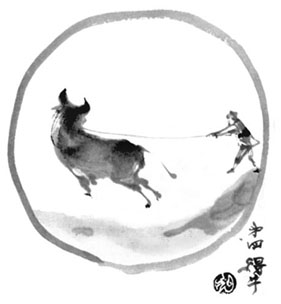
4.Catching the Bull

4

We’ve found our Druidry!  After many twists and turns, we’ve come across a path, or developed our own, that seems to flow with the essential spirit that we call the Self.  We may find several bulls, even, until we find the right bull, but eventually we come across a method, training, or experience that reflects our inner core. We harness that energy, but what do we do with it now?


 5.Taming the Bull

5

We learn that knowing what Druidry is, is simply not enough. We must practice with it, again and again, experience it and not simply read about it.  We hold rituals, we meditate, we get our fingernails dirty.  We do the work necessary, and learn discipline.


6.Riding the Bull Home

6

This is Druidry! This is what it means, and it is a joyous expression of our inner souls.  We have a sense of “coming home” – we know how to celebrate the seasons and each other, and we may find the beginnings of an inner peace hitherto unknown.


 7.The Bull Transcended

7

We then realise that Druidry is not something external, nor even internal – that it is something to be lived.  There is no separateness, no duality to Druidry – it is not a way of life, but it is life itself.  There is a stillness to it.


8.Both Bull and Self Transcended

8

We are no longer separate from the world and from Druidry either.  Druidry is us, it was always us.  We experience each and every moment with the same reverence we would to ritual – everything becomes sacred.


 9.Reaching the Source

9

We have reached the source of life itself, and find that meaning or no meaning have no place – only life itself. There is no Druidry. There is no Self. There is no separateness.  All is unified under the banner of Life, changing moment by moment, unconcerned with meaning or no meaning.


10.Return to Society

10We return to integrate what we have learned from our experiences, to share them and to help others who may be seeking.  We do what we need to do for ourselves, our family, the environment without any selfish thoughts – we simply do.  With the knowledge that we have gained that so expresses ourselves, and which is known as Druidry, we live as best we can, in the world, present, awake and aware.


Kierkegaard and the Bullies

Perfect love means to love the one through whom one became unhappy – Soren Kierkegaard

Following on from a recent blog post about forgiveness, putting into practice the habit of it is, as is everything, much easier said than done. So I’m going to share some personal things in this blog post, which I don’t often do, but which I think is necessary to give it some context, and to perhaps allow for people in their own situation to relate to it in some way.

Kierkegaard’s reflection on forgiveness inspired me today to do something which I have never been able to do.  Forgive the bullies.  Thinking about forgiveness a lot lately, I have decided that the best place to start was at the beginning, when the first people who treated me badly first made an impression on my mind and my life.

I had a really happy childhood, growing up in beautiful countryside in a very loving family.  I exceled in school – primary school was a breeze.  I was top of the class in both academia and athletics – I loved them both. I was confident and happy – it was a great time for me.  However, things changed when I went to secondary school.

The first half of the first year went well – though it was a shock moving from a Grade Six class that had five people in it to class sizes of twenty to thirty children.  The school was enormous compared to my primary school, but I adapted pretty well (and much thanks to a map my sister drew especially for me to find my classes in the many halls, which was my saviour that first month!).  I was confident and smart and making new friends under quite difficult circumstances to a very sensitive child.  And then came the bullies.

They were two years older than me, and came from the same region, so we shared the long bus journey together (an hour each way, a total of two hours a day). That was where it all started.  Name calling on the bus – for whatever reason, began the whole affair.  I assume that it was because I was tall, pretty, blond and happy – though I can never truly know the full reason behind it.  Sometimes people simply think that blowing out another person’s flame will make theirs shine all the brighter, but that just isn’t the case – everyone knows two flames are brighter than one alone.  For whatever reason, the bullying started.

Being confident, I decided to fight back.  I was smart, and could have a comeback for anything. Everyone, from television and film and books, said that if you fight back, the bullies will leave you alone.

That is not the case.

I fought back, with words, not allowing them to see that they were hurting me – throwing it back at them, and also hoping that others around me would rally to the cause and that we would all overthrow this minority of bullies who seemed to control “the bus”.

That was not the case either.

People didn’t stand up for me. But I still persevered, fighting back as best I could. Eventually it did get me down, and I started to doubt myself. But I stayed as strong as I could. They put glue in my hair. They threw food and garbage at me. They called me names. They threatened me.  They taunted me every time we passed in the hallway until I avoided all the main halls and used the back stairs, entrances and exits as much as I could. I still held fast to the belief that it was because they were jealous – I stayed strong in my convictions, but it really, really started to get me down. I dreaded going to school every day, and dreaded the bus ride there and back.  I joined after school clubs just so I wouldn’t have to take the same bus as they did home – I could take a later bus. I longed for the two days of respite that the weekend brought – Fridays after the bus dropped me off was like a whole new world of freedom to be me again.

It became so bad one day though, that I had had just about enough of it all and, with no holding back, turned around to where they had moved up in the now almost empty bus to sit directly behind me and taunt me ceaselessly.  I let it rip, verbally, with all the hate, spite , viciousness and intelligence that I possessed. Their faces were shocked, and then anger took over. One girl grabbed me by the hair and started banging my head against the bus window, over and over again.  An older boy came down from the back of the bus and pulled her off of me – I had started physically fighting back – and we were separated.  I got off the bus seconds later at my stop, adrenaline bursting along with tears as soon as the bus was out of sight – I wasn’t going to let them see me cry.  I hated myself and my life.

The next day we were, of course, called into the Principal’s Office.  After a few minutes, where I (with seething calm) stated my case and then the other girl was allowed to state hers, she simply began to cry.  I was too angry to care about why she was crying – she had made my life a living hell.  I sincerely hoped the Principal was not “duped” by her show – though on reflection I do believe that she was a truly unhappy girl in an unhappy situation, the details of which I still am not aware of to this day – only rumours.

Nothing came of it for me – but I think she may have received a three-day suspension or something similar, though the memory of that is a little fuzzy.  What I do remember is that evening she called my house, and my mother answered the phone.  The girl threatened my mother and family, and also said that she didn’t care if she got expelled from school – she could always transfer to SAA.   My mother said, “Go ahead, please do.  BECAUSE THAT’S WHERE I WORK.” We never got a phone call from her again.

The bullying eased off from then on – just some taunts and words passing in the hallway. By this point, I saw the light at the end of the tunnel – the bullies were graduating that year, and once they were gone the school “was mine” again, in the sense that I could live, learn and do as I pleased and enjoy every second of it.  They graduated, or failed – I don’t really know, but they left. Those last two years of my high school life were some of the best years of my life.

I still suffered from confidence issues – walking past a group of people laughing, I would assume they were laughing at me.  Sometimes I still do – though now I catch myself and, with a wry grin, shrug it off.  But one thing I’ve never been able to do is to forgive them for the years and years of torment that they put me through.  Well, today I decided that enough is enough.

I have carried these bullies with me for 27 years now, and I’m more than ready to put them down.  As in my previous blog post, the story of the monks and the sack of potatoes, I really don’t want to carry anger and hate to these people anymore – I’m going to empty the sack, and maybe one day lose the sack altogether so that it can never be filled with anger again.  For anger is the cause of pain and suffering in the world – it is the root behind most, if not all, sufferering and “evil”.  So, no more, thank you very much.  I forgive you, CB, KJ, WG, D and A – I don’t want to carry you around any more.  I hope that your lives are much happier now, and filled with love.  Tears are welling up in my eyes even as I write this – the release is overwhelming.  I have compassion for myself and for you.  May you live well.

And so, I aim for what Kierkegaard wrote – for love is compassion and forgiveness.  I am emptying my sack, one by one, and looking for perfect love with every person who has made me unhappy.  In this way, I believe, the world can and will be a better place.  Namaste.

Going lightly through life…

As I was out walking the other day, the saying” Living well is the best revenge” popped into my mind.  After a moment’s thought, an additional part to the saying came to mind – “yet if you are focused on revenge, you are not living well”.

At this time of year, when peace on earth and goodwill towards men is often heard, I thought that the addition was rather apt.  For the first part of the saying, it almost deals with the issue, but yet does not allow for forgiveness.  We are still holding a grudge towards someone for what they have done to us.

It reminded me of a story that I recently read, where a group of young monks were given a sack and a bunch of potatoes.  The Master told them that for every grudge, for every thing they could not let go, they had to put a potato in the sack and carry it with them – a physical reminder of the thoughts that they carry around in their heads, which can be outwardly reflected in our behaviour and even our bodies.

After a while, the young monks decided that it was much easier to forgive and let go than to keep carrying around this heavy load the whole time. So, one by one, the potatoes were taken out as they moved on, letting go.  Yet, even as they emptied their sacks, they realised that the sacks could be refilled, and quite easily as well.  So they discarded their sacks – seeing that the sack was as important as the potato. The potatoes were the thoughts, the sack was their very self.  If they held onto their sense of self as lightly as they did their thoughts, seeing that there is no duality and that all things are connected, then there would be no sack, no potatoes, and no burden to carry through life.

I have applied that story to all the old and new grudges that i have been carrying in my life – why would I want to carry them in the first place? Letting go, leaving it all behind and holding very lightly to opinions and the sense of a separate self seems to be the way forward.  It’s not easy, however. Forgiving someone means letting go of any sense of righteousness.  It means letting go of the idea that someone is wrong.  It means simply living in the moment and enjoying it for every second that it exists.  The saying goes “forgive and forget”.  Now, forgetting is much easier than forgiving. I think simply forgiving is enough – forgetting means that it may happen again.  Forgiving implies understanding and not judgement.

So, now is the time to live well, letting go of any ideas of revenge, of grudges.  Life is far, far too short to carry around all that we do not need.  Go lightly through life.  And blessings of the season to you.

The Self, and No Self

Who am I?

Philosophers, religions, spiritualities and people all over the world have asked themselves this question. Lately, I too have been asking myself this – and looking into the meaning of the self, to see if there truly is a Self there to begin with.

The Materialists would say that there is no self at all – that there is no consciousness, that we are simply matter and energy and the result of material interactions.  Descartes stated “I think therefore I am”, to which the Materialists refuted Descartes dualism of a separate mind and body, ridiculing it as “ghost in the machine”.  Zen and Buddhism talks about a True Self that can only be realised by dropping all ideas of the self and achieving a pure state of being in the moment, a state of total selflessness in every sense of the word.

Nietzche stated that “We have never sought ourselves, how could it happen that we should ever find ourselves?”  Like the Materialists, he believed that we are a result of our experiences and actions, but that there still was a Self, a consciousness.  In order to be complete, Nietzche said that we must learn acceptance – to accept everything we have ever done.  I find this fascinating, because how many times have we done things our lives, stating that we were out of our minds, or did something “that was not me at all” – stepping outside of the core idea of what we are.  This acceptance, instead of avoidance, is key to the deeper understanding of the self, in my opinion.  Acceptance doesn’t mean liking everything that we may have done in the past, nor does it define us in the present moment, but what it does allow is a total non-judgemental overview of the self, and in doing so, a deep awareness that we might not achieve by avoidance of the subject.

Before Nietzche, Kierkegaard put forward the notion of choosing to be self-aware.  We are homo sapiens, after all – in fact, I believe the proper term for our species is homo sapiens sapiens – the beings that are aware that they are aware.  Kierkegaard stated that when we choose to be self-aware, we are both aware of our self and, at the same time, aware that we are aware of our self.  Observing the observer who is observing.  Yet, we choose not to observe, because we often don’t like what we see, or experience, either in the past, present or future.

This is all fascinating. And also requires some very deep thinking.  I’m currently exploring the theory of No Self from Zen Buddhism, which is a paradigm of course, as is much in Zen.  The No Self is also the True Self.  It states that our real self is in existence, always, and always has been.  It is pure, and shining free – we only distract ourselves from it to such an extent that we never see it.  Zen states that we are already complete, already whole, already perfect.

This is pretty simple to understand, and it makes sense.  The difficulties, the suffering in our lives detract us away from spending time in the pure moment, in which the True Self resides.  We suffer because we want things to be different, because we desire things, people, etc – and are not happy with the present moment as it is. If we are happy and accepting of the present moment as it is, without judgement of good or bad, or any attachment to it at all (see previous blog post on understanding, not judgement) then we can rediscover this True Self.  By letting go of all notions of the Self, we return to the core, essentially.

In Zen Buddhism, the term mu can mean a multitude of things – it essentially, and paradoxically, means “nothing”.  It can be termed as “no self”, “no ego”, “no holiness” and “impermanence”.  It is the transcending of all things, the enlightenment experience, the complete and utter letting go of affirmations and negations.  It is an answer to some Zen koans (questions asked to break apart the mind and let in a new way of understanding).  Zen master Keido Fukishima, like Kierkegaard, promotes the self-inquiry into our own being and mind, to be aware that we are being aware.  In Zen, this has the goalless goal of letting go – once we have found our mind, we lose it (not in an insane way, I might add) and in the losing, in the understanding of the impermanence of all things, including the mind and the self, we rediscover the True Self.  Keido Fukushima says, “Zen teaches us how to live by inquiring into and clarifying ourselves. This self-questioning is well suited to our contemporary ways of thinking. Rather than seeking salvation through an “other” or through grace, we achieve it on our own.”

Fukushima delves further into this idea, stating “The experience of mu may at first glance seem purely negative or passive,” he says, “but it is not so at all. Being mu, or empty of self, allows one to actively take in whatever comes. Our world today and all in it are separated into dualistic distinctions of good and evil, birth and death, gain and loss, self and other, and so on. By being mu, not only does one’s self-centeredness disappear, the conflicts that arise with others dissolve as well. Here is a simple example: When we look at a mountain, we tend to observe it as an object. But if we are mu, we no longer see the mountain as an object; we identify with it; we are the mountain itself. This transcendence of duality may sound like some psychic ability or spiritual power someone possesses. But that is not true. Rather, it is simply and naturally a case of being free, creative, and fresh. We become human beings full of boundless love and compassion.”

This rejects the dualists’, such as Descartes, theories and instead breaks down all barriers, which is both liberating and frightening at the same time.  There is no Us and Them, no Self and the Other – if we truly let go of all attachment we become one with everything.  Are we willing to do that, or do are we too attached to our sense of self to experience that? Can we truly dissolve into everything?

It comes in small flashes, in glimpses, for me so far.  The world, wrapped up in an apple, in a drop of rain, in the flight of a hawk.  Barriers have dropped, ego and self has fallen away, and we see the multitude of the universe (another paradox!).

This is passing through the Gateless Gate – I’ve also heard it called the groundless ground.  In realising the impermanence of everything, including the Self, we have a platform from which to jump off and into real living, where every moment counts and is never the same.  The Self changes from moment to moment.

This is hard, for we have spent our whole lives creating this sense of self, this timeless sense of self that we think defines us.  After seeing Taylor Swift’s new video, Trouble, in which she states “…I don’t know if you know who you are, until you lose who you are” really hit home.  I don’t think she meant this in a Zen sense, as she seems pretty attached to her past experiences (and boyfriends) but the statement really hit home.  She talks about losing her balance.  I really identified with this statement, having recently lost my balance in these last few months.  But what did I lose my balance from? Is the concept of balance just another distraction? I’m still working on it.

Starting with acceptance, and then moving on, letting go, without attachment, is crucial.  Maybe then the True Self will shine again, for longer and longer moments, ever shifting, ever changing, always truthful.

However, as Freud said, “It’s just a theory.”