Here is an interview I had with Tommy from Upon a Pagan Path podcast, where we discuss my books, meditation, prayer and more!
Listen HERE.

Here is an interview I had with Tommy from Upon a Pagan Path podcast, where we discuss my books, meditation, prayer and more!
Listen HERE.
Brighid is often known as the goddess of the sacred flame and of the sacred well. It is often said in religions throughout the world that where fire and water meet there is the greatest potential. Exploring her aspects of fire and water are extremely beneficial and here I shall talk a bit about fire; however, perhaps not in its most usual aspect.
We are all familiar with fire as flame, as external energy whether that be a fire in the hearth, the combustion that allows us mechanised transportation or the heat of the sun. What I’ve also been exploring is the fire within, that flame or spark of energy that ignites us to do things, say things, create things. I often think of inspiration in the Druidical “fire in the head” sense, but I also feel fire in the belly and fire in the heart. The fire in the belly is intuitive, instinctive. The fire in the heart is our passion, our love, our capacity for compassion and understanding.
The fire of the heart can take a long time to come into being. In our society, we often feel isolated from each other, even when we are literally living on top of each other in urban high-rise complexes. We learn coping techniques of shutting ourselves off from one another in order to function. We may have been hurt by others in the past and that causes us to dampen our flame of love for the rest of the world.
We also live in a society wherein it seems perfectly acceptable to douse someone’s fire. Think of reality shows, especially those that have “judges” critiquing the participants. Last year I gave up watching Strictly Come Dancing because I was tired of one particular judge being an outright bully, thinking his comments were humorous when they were in reality just plain mean. Putting down, making fun of someone who is simply trying their best to participate in a dance show to raise money for Children in Need is not something I wanted to be a part of. I can donate money directly instead of supporting that kind of behaviour.
We are so influenced by what we watch on television – we cannot deny that we are not. And it frightens me, especially with the amount of television that children are often exposed to these days. It is a rare occurrence, even where I live, to actually see children playing outside despite there being the most gorgeous countryside at their disposal. Whether that is due to parents’ control or other factors I cannot know – all I know is that when I was growing up the streets would be filled with neighbourhood children riding bikes or playing street hockey among other games. Are children nowadays being raised by television and computer games instead?
We live in an extremely competitive society, or so we are told. We feel that we always need the upper hand, the edge on a situation. We are now programmed to work against each other as opposed to with each other. We are trying to beat that other person out in promotion, or to be the best as everyone knows that the top dog is the happiest. We live in a put-down culture where co-operation simply doesn’t exist. We do not know our neighbours.
Living like this provides a perfect divide and conquer technique for those who want to keep us under their control. What we need to do is to reclaim our own power, and that of our own community. Instead of dousing the fire in other people, we need to cheer them on, to work together to make our lives better. It’s happening in small grassroots ways here and there, but not on a massive scale. In my own village, we have a village allotment where people can get together to work on group projects as well as their own. The village shop often acts as a hub for people to interact with each other.
What we need to do is to stop trying to take each other down and instead build each other up. We need to realise that life is not about competition. As a social species, we thrive better when we work together. When we douse the fire in other people’s hearts we are also dousing the fire within our own hearts. Every word, every deed with the intention of dousing another’s fire reduces our own capacity for love and compassion, to make the world a better place. Why on earth would we want to do that?
In her book, The Earth Path author and activist Starhawk talks about this very subject, exploring it at various Witchcamps. A proud supporter of community effort and achievement, of bringing power back to the people, she has worked with the various elements. She tells us of the results of working with fire and dousing another’s energy.
“Throughout that week, we went on to reflect on the ways in which we put out each other’s fire. When we recognise subtle energies, we become responsible for the kind of energy we are putting forth in our community. The things we do and say about each other create subtle energetic fields that either support our work and our relationships, or undermine them.
Malicious gossip, backbiting, unsupportive criticism, and mean-spiritedness douse even the stoutest of fire. And because a fire takes energy to build and maintain, such negativity is wasteful of the community’s resources; it’s like use electricity not just to keep the radio on all the time, but to keep it tuned to an irritating and distracting station… when anger festers, when we chew over our grievances like old bones without expressing them directly, when we meet others with sullenness or resentment, we douse not only their fire but our own.”
We need to judge situations in our lives all the time – they key to doing so lies in not being judgemental. We also need to support each other. If you don’t like what someone is doing, if you think it is detrimental to the community, you need to speak to that person directly. If you just don’t like them, then leave them well enough alone. All too often it is easy to attack or undermine someone through subtle means – Facebook and blogs are often used as tools for such behaviour. We can so easily dowse another’s fire through incessant comments or insidious ways online without anyone else apart from the target being the wiser. Let’s stop this behaviour right now. It is within our power.
Let’s cheer each other on, and where we simply cannot let us walk away with respect. Let’s stand up for what we believe in without resorting to maliciousness. Let’s put some good fuel onto the fire of our hearts and that of others and in doing so everything will burn with a cleaner, better focused energy.
Brighid has taught me to look deeply into what is feeding my fire, and how I can feed the fire within others. For that I am utterly thankful.
Many of us have heard the saying “Love means never having to say you’re sorry”. Like all sayings, they can be misinterpreted. Love is one of the most powerful gods. Love is so much more than romance, than warm fuzzy feelings for another. Love can be an unshakeable force, it can inspire us to greatness or tear us apart.
Never having to say sorry with regards to love has been misused by many as an excuse to behave badly, to not care about the feelings of others, to live in a purely self-centred state. It is also often implied that if we really love someone we should always be willing to forgive their behaviour. In Buddhism, it is widely regarded that we are all Buddhas, that we all have the ability for true compassion. However, we are also all human, with all the wonderful implications, limitations and foibles that it entails.
We have all known people whose behaviour has been less than glowing, who are so entrapped in their own worlds and minds that they often create a reality which is completely and utterly different to the one that you may experience. As humans, we have a shared reality and shared human experience, but as beings that are supposedly self-aware we become trapped in this self-awareness to the point of it spilling over into less than glowing behaviour. Love accepts the humanity of everyone. Love accepts reality. Love is compassion.
Compassion, however, doesn’t mean we have to take everyone’s crap. Compassion is understanding, trying to see the bigger picture, to understand why someone behaves the way that they do. In this attempt, we step outside of our “small selves” and out into a greater reality. We open up our perception. We may never truly understand, but at least in the attempt we see that the world is more than just our experience, our perceived reality. We recognise the experience and reality of others.
When that reality hurts us, when people do or say things to undermine us for whatever reason, should we simply forgive and move on? I’m not entirely sure it’s within human capacity to truly forgive, though people like Zen monk Thich Nhat Hanh are real-life inspirations for this way of being. We may find that the hardest person to forgive is ourselves. Perhaps we need to focus less on “us” forgiving “them” and simply focus on living our own lives in way that means that we will never have to say “I’m sorry” to another. This, in my opinion, is the real interpretation of the saying “Love means never having to say I’m sorry”.
We may fail, and there is nothing wrong with saying “I’m sorry”, however.
When we come against people we simply cannot be with, we can still try to understand them, to look beyond our self. It can often put us into the bigger picture, allowing more of a peripheral vision of the world that encompasses everything and in doing so, allowing the self to fall away in integrated living. Sometimes we simply have to walk away from that relationship in order to work compassionately with our selves, for we simply suffer too much at that given time to be able to function properly. We can do this with partners we’ve been romantically involved with – when it no longer works, we can bow to each other and walk away with respect, and hopefully a little compassion for both them and ourselves.
What we have to focus on most though is our own life, and our own behaviour. We have to live our lives in a way that means we will hopefully never have to apologise for our behaviour. It’s not an easy path, but it’s one that is worthwhile. In doing so, we will walk lightly upon the earth, loving the earth with every fibre of our being, loving everything on the earth with eyes wide open and a heart filled with compassion. We can love life, the power of the gods moving through us and around us, and live our lives in celebration of this.
As the first snowdrops bloom here in the UK, and the songs of the birds change to love of each other, of the warming sun and the greening of the land, may our hearts too be filled with love.
Druidcast 94 is now out, with the Order of Bards, Ovates and Druids‘ Chosen Chief, Philip Carr-Gomm interviewing me last June for their 50th anniversary gala. We talked about religion and philosophy, my books and also what is Druidry today. Have a listen, and check some great music and another great talk by Jonathan Wooley on Druidry and the young adult!
http://druidcast.libsyn.com/druidcast-a-druid-podcast-episode-94
There are many ways we can be compassionate in today’s society. Compassion is merely trying to understand, to see beyond your own point of view and share in humanity as a whole. An act of compassion need not be grand – it can be as simple as giving up your seat on the bus, or smiling at someone who looks down as you walk past them on the street.
I came across this beautiful story from Jason at Parallax Press today, and had to share it. May peace and love fill your heart and soul, and flow out into the wider world.
|
|
|
|
This post is a reblog extract from my channel at SageWoman. To read the full article, click HERE.
For many people, myself included, Druidry and Animism go hand in hand. Since the Age of Enlightenment and perhaps even further back in history (perhaps with coming of Christianity) Animism has gotten the reputation of being somehow backward, a superstitious and childish view of the world wherein everything is “alive”. This belief is completely biased in that it is totally from a human-centric point of view; those who believe it to be silly would say that believing a stone has a soul is absolutely ridiculous. This point of view is a projection of our human perspective, of what is alive and what isn’t, what is ensouled and what isn’t. It doesn’t take into consideration differences in the metaphysical. This perspective is often derogatory of Animism, yet it fails to actually understand just what Animism actually means, and what living with an Animistic perspective can bring to human consciousness.
In my opinion, we are in great debt to author Emma Restall Orr for exploring Animism in her two books, Living With Honour and The Wakeful World. In both, she goes into just what it means to be an Animist, putting aside the childish perspective and engaging with the concept in a very rational and yet spiritual manner. I remember when I first saw her speak at Witchfest in Croydon many years ago, when she shouted from the stage that the moon was “just a big f*cking rock in the sky!” (which it is). Believing that the moon is deity is perhaps a childish view of the moon, however, seeing the deity within the rock is closer to the mark, dependent upon your concept of deity. In her two latest books, defining the often used words in Animism of soul and spirit, she shows the interconnectedness of all things in contexts of philosophy, spirituality and science.
This interconnectedness is reflected in many, if not most religions and spiritualities throughout the world. Zen monk Thich Nhat Hanh uses the term “interbeing”, even founding The Order of Interbeing, a way to live your life fully aware of the interconnections of all things. We cannot exist without each other – we are fully co-existing together. In a piece of paper, there is the sun, the tree, the rain, the wind, nitrogen, carbon dioxide, stars, clouds, loggers, factory workers, their ancestors, the ancestors of place, the foods that they ate – the list goes on forever. Since the beginning of time, if there ever was a beginning, we all come from the same source, if there is a source. We are all star-stuff.
Continued… to read the full article, click HERE.
Mindfulness is THE buzzword in self-improvement and New Age circles, but what does it really mean? If we go back to basics, we find that it is rooted in Buddhism, and can be easily explained in two simple phrases.
Chop wood. Carry water.
This is actually a pared down version of a slightly longer Zen story, wherein an enlightened monk recalls his process to enlightenment. He stated “When I was unenlightened, I chopped wood and carried water. When I became enlightened, I chopped wood and carried water.”
A lot of the time it can feel like we’re carrying wood and chopping water – not really getting anywhere, flailing around with a dripping axe. But when we stop, focus and concentrate, usually things become smoother, get done quicker and with little drama. Some may not want that – they enjoy the distraction that the flailing causes, or the drama, but after a while it can wear thin. Applying mindfulness, which is simply paying attention, can help alleviate any dis-ease that we may feel in our lives. That’s not to say that we’ll feel great all the time, but just by being in the present moment and not attaching to past experiences, dwelling on them or getting stuck in an emotion we can just get on with plain living.
So, with all that in mind, I’ve decided to dedicate an entire day to mindfulness each week. Ideally, I try to be mindful all the time, but I’m no Buddha. Having an entire day to focus on this will hopefully trickle down into the rest of the week, and all my thoughts, actions and their consequences. I’ve deemed this my Mindful Mondays.
So, what does this all mean? It means that when I’m eating breakfast, I’m just eating breakfast – not reading a book or article. When I’m washing the dishes, I’m just washing the dishes and not singing along to the latest Taylor Swift album. When I’m out walking, I am walking mindfully, at whatever speed, paying attention to my steps and my surroundings – not planning my evening meal. When I’m stroking my cat, I’m not thinking about writing the next chapter of my book. When I’m driving I’m really feeling the road beneath me, not dwelling on the driver that decided to overtake me on a blind summit. When I’m out for a meal with friends, I’m really paying attention to what they are saying, and not already forming a reply to their words before they’ve even finished talking.
Mindful Mondays are all about paying attention.
With that centred awareness, with that focus, we can simplify our lives immensely (part of my New Year’s resolution). People often fear that we will be less productive, but actually we will do jobs better, more efficiently, if we maintain that focus.
Being aware of your movements as well is doing a great kindness to your body. When we are walking down the stairs, we are focusing on our body moving. We will find that our movements may become less hurried and more graceful. A calm descends on our way of being. Like a leaf falling from the tree, we simply are in that moment, either floating down serenely or caught in a whirlwhind – either way it is done with grace.
So, like the monk who realised that life doesn’t change after enlightenment and that you still have to do the things you have to do, what you can change is how you do them. Mindfully, with awareness, focus and concentration. Give it a try, and let me know how you get on! Even if a day is too much, try an hour or half an hour each day. You don’t have to change your schedule, just do everything in it mindfully.
May you be peace as you chop wood and carry water.
My first book with Moon Books in the Pagan Portals series, this little introductory book shows how to blend Zen Buddhism with Druidry to create a life that is awake and aware to the natural world around us, fully immersed and living life in accordance with the flow.
 Kindness – in our modern Western world, this beautiful concept has become twisted, where in a “dog eat dog” world it equates to weakness. We have to push, we have to grasp at life, beat out the other guy in order to get the biggest piece of the pie.
The truth is, there is no pie.
Forget what the media tells you, forget what other people may tell you, that you need to be better than others, that to show your humanity you will soon slide down that corporate ladder. There is no ladder either.
There is no me. There is no you. All is illusion.
We are all made up of each other, there can be no separation. The tree and the coyote, the fox and the mountain, the sunlight and your brother are all made up of matter and energy. Matter and energy cannot be destroyed. They cannot come out of nothing. They only wait for the right conditions to manifest, for the right circumstances in which to come into a form that we recognise. They are always there. We have always been here. We have always been a part of this world, and a part of each other.
As humans, we have become very judgemental beings. We allow our emotions and thoughts to overide the reality of many situations. It’s far easier to judge the behaviour of others than to look deeply at our own selves. Each time we judge something, we tighten up in our hearts and in our bodies. An open heart is one that does is not judgemental. If there is no separation, there is nothing to judge.
We need to notice when we are forming judgements of people and of situations. We need to see when we are contricting our souls, when we are not open to what life really is in this present moment. We need to really begin to know what the word kindness means. If we truly see that we are all related, why would we be unkind to anyone or anything?
Do not believe in the illusion. Immerse yourself deeply in the awen, the poetic inspiration that opens the door to seeing the interconnectedness of all things. Open your heart to the wonder that is life all around you. Look into the eyes of your supposed enemy, and see their condition of being. Look into the circumstances that created their life, and see yourself reflected in that. You are them and they are you.
Being aware of each judgement we make, being aware of our thoughts about other people, being aware of what is coming out of our mouth makes such a difference to our lives. When we speak ill of someone, we are doing ill to ourselves. When we treat others unkindly, we are being unkind to our selves. Our hearts do not like to be constricted. The flow of awen, the flow of circulation in our bodies, the flow of a river or the flow of life itself moves better when we are open.
Our practice in life is simply kindness. It’s not hard, but we make it hard for ourselves. We have to lose our self-centred ego, our sense of self-importance, our sense that the world should be as we desire it to be, and not as it already is. When we have stepped away from that way of being and move into a way of being that is centred on others, be they bird or bee, refugee child or murderer, basking shark or polar bear, we see that the world is much greater than the small worlds we create around ourselves. We are released from anger and depression, hate and worry. We see how our little selves can take over, and we realise what is much more important that our little selves.
Kindness.
Have no fear – we will not become doormats for people to abuse if we are kind. We will not lose our place in life if we are kind. We will be happier, more free and really living as opposed to simply doing things. Kindness is not weakness – it is the truest form of being. It takes courage to be kind to someone who has hurt us. We do not have to allow them to continue hurting us, but we do not need to seek revenge, or punish them for their actions. We can let them see that they have hurt us, and we can try to understand them with an open heart free of judgement. We can look critically at a situation without judging it, without letting emotion or non-factual elements into the equation. We can release our self-centred perception to get a look at the bigger picture, and try to help others instead of focusing on our selves.
It’s not easy, changing the way you think and behave. We have to really pay attention. We have to be really aware of how we are, how we react, what we say and do in any given situation. We need to look deeply into our being, through practice and meditation, through every single act of our waking lives. We have to be willing to change out of our old habits and our old ways of self-centred thinking. We have to try, again and again, to step outside of our little selves.
When we do, the world opens up in wonder.
May your life be filled with wonder.
This post was originally displayed on SageWoman’s channel, on my blog DruidHeart at Witches & Pagans.
Around the winter solstice is the time of year when many people get together, families and friends, to celebrate the holidays. If we are fortunate, we have some time off to be together, all together in one place – we may not have such an opportunity until the next solstice season rolls around. It can be a wonderful time of loving hugs, good conversation and deep, belly filled laughs. It can also be a trying time, when the bonds of friendship or family can become tested as we are all thrown together, our usual routines and habits left behind and we are faced with situations that are perhaps out of the norm.
My home is usually very quiet, filled with deep silence and stillness. In that silence I find my personal sanctuary, where peace is around every corner. I’m not a big fan of crowds or noise. However, at this time of year, I leave behind my little sanctuary and venture out into the world of lights and noise, family and friends when I’d really rather be sitting on my meditation cushion in the dark, with a candle and some incense.
It’s quite a shift to deal with. There is constant noise around me, different noise to that of my own home. It’s the noise of other people, which I am not accustomed to. Loud televisions, conversations, arguments, laughter – it’s a bit of an assault on my senses. Dealing with other people’s behaviour when there is no opportunity to “escape”. I have to confront everything that upsets me head on, or lose my temper, say something in anger as my “sanctuary” is thrown out the window.
Or is it? Yes, it’s difficult. Even as I type this blog, there are interruptions by people walking in and out of the room, asking me what I’m doing and other various questions. Nemetona, my goddess of sanctuary, has taught me that she is ever within me even as she is without – I take her with me wherever I go, and where I go she is always there.
In my Zen practice, this time of year provides me with innumerable ways to really practice. Life becomes difficult when things don’t go our way. When we realise this, and when we see that life is simply going ahead whether we like it or not, things can become easier. I have to deal with behaviour that I don’t like – this gives me a chance to practice and to try to understand that person’s behaviour. Often I can see myself reflected in it, or see that they are lost in their own suffering. I can try to ease that, when I remember to try to understand it. When it just pisses me off, I’m not trying to understand, and anger can erupt. When this occurs, I realise that I am not practicing very well, that I am not aware of my own reactions and behaviour. It’s a constant reminder to look deeply at myself, to see my patterns and to alter them in order to have peace and harmony both within and without. My goddess and my Zen practice help me with this understanding.
I have two choices when I find myself in difficult circumstances – get upset or not get upset. When people are shouting in the kitchen, or using words unkindly, or their behaviour is totally out of sync with creating harmony, I feel a tightness, a contraction within my body. Getting upset with this only tightens that contraction even further, making me miserable, or lashing out in anger in a misguided attempt to alleviate the tightness within. Seeing people mistreat each other, taking each other for granted – all of these things can cause contractions within. Passive/aggressive behaviour, words that are intented to provoke, noise levels louder than they need to be – all these things cause a contraction within my body. I want to loosen that contraction, but how?
Sitting and walking meditation practice, daily, really help me through this challenging time. By sitting, I am aware of my body, and aware of my thoughts. I see patterns in my behaviour. I see the self that is screaming for attention, for comfort, for sanctuary. I also then see the illusion of the separate self, and the inter-connectedness of all things. We are all dependent on everything else – the sunlight, the rain, our parents, the air, food. Without any of these things we could not exist. We are in them and they are in us.
When people’s behaviour challenges us, it helps to remind ourselves of this inter-connectedness. They are in me, and I am in them. It’s easy to do when out in the forest, becoming one with nature. But in challenging situations, with people we are often more directly faced with egos and personalities, with habits and the ego’s constant self-regard. When someone says something that upsets us, instead of thinking “I’m so upset that he said that” we can just realise that he said something. That’s the truth of the matter. Someone simply said something. We can act on what they said, of course, if they are saying inappropriate things. But we don’t have to act on it in anger, simply in awareness. Things happen. People behave the way they do. We can either get upset and lose our practice, or we can see the opportunities to become even more aware of our selves. In this awareness lies peace.
Slowly losing our separate sense of self, our egos begin to dissolve. We listen more. We apologise more. We find a deep well of peace to draw from, where we nourish that which brings peace and harmony. We don’t ignore our feelings, but we don’t feed those that create discord. We’ve no wish to stay in that contraction, no desire to create it in others.
Use this time of year as an opportunity to practice, to see how in nature we are all connected. See how the awen flows, how we are inspired by each other in each and every moment. Use difficult situations as the chance to become aware of your self and the world around you. It’s not easy, I’m being challenged constantly. It’s also a wonderful opportunity to fully immerse in the flow of awen, and not to be bashed against the rocks and caught in the swirls and eddies in the river of life. When life isn’t going the way that you would like it to, simply remember that. When we are angry or depressed, remember that it is because life isn’t going the way we want it to. Work with those feelings, work with others, and the practice will begin to show its rewards in less contraction, less anger and less upset. Peace begins to seep in, trickling through out insight, aware of the delicious drops of awen upon our tongue.
Isn’t that what this time of year is all about? Peace and love, awareness of the darkness and the returning light, the times and tides of life. May this time of year bring you many chances to practice, and may you find true joy in that practice.
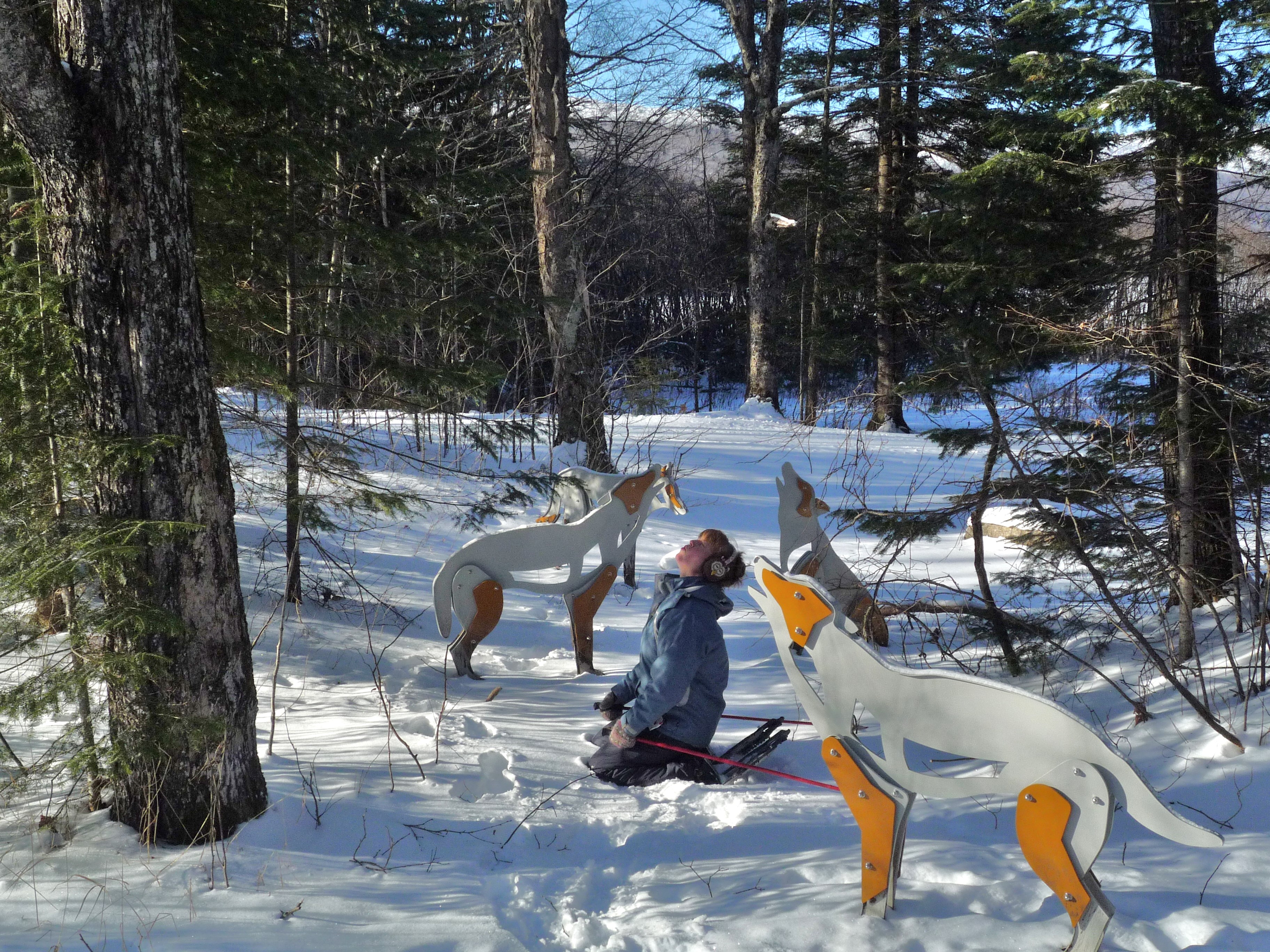
 Down the Forest Path