What Druidry Is Not…

abbeyFor me, Druidry is not a white-robed affair. Crawling under low scrub pines and getting inside secret places of gorse bushes where only the deer trod, or standing on the seashore in the howling rain, or in the heart of the forest with the badgers and mosquitos – it just doesn’t work.

Druidry is not clean. It’s not an exercise only for the mind. It requires experience to turn what you have learned into real wisdom. It’s not just book-learning. Until you get out there and commune with the landscape, it’s not felt in the soul. It cannot live in the head. It will get you dirty, wet, hot, sweating, cold, scratched, bitten. It is dirty fingernails and peering under bushes. It is a return to the curiosity and wonder of the child, yet it is not child-like. It is deep learning, deep experience.

Druidry is not a male-centred religion or spirituality, nor is it female-centric. It is about equality and egality, anarchic and subject first and foremost to the teachings of nature.

It not just about standing in stone circles waving swords and reading off of sheets of paper with a group of other people, the media and tourists alike taking photographs. It is doing work in the heart of where you live, often without thanks or regard of any kind. It is giving back to the land, honouring the cycles and working for the community – and by community, I mean each and every living thing in that area wherein you live and call home, not just human. It is not about power and ego, but about communion and deep relationship. It is about dropping ideas of the self to better fit in the landscape.

It is not about writing loads of books and offering courses, achieving kudos through output, students and media. It is about the sharing of inspiration, acknowledging the inspiration of others and allowing the awen the flow through you in whatever way you see fit. One may be a teacher, or an author, or someone with whom the media interact – but they are not a spokesperson for all Druidry, nor a guru of any sort, and have no monopoly on wisdom. There is little room in deep Druidry for ego.

There are no titles, save those bestowed either by a person on him or herself, or by a group of people following a shared path and learning. These titles are not relevant to all Druids – just to the person or the group. Claiming to be an arch-druid of so and so has no bearing on those who are outside of the group. There is no central authority in Druidry.

Druidry is not about having things – it is about doing things. It is being utterly mindful of personal and global consumerism. It is about looking at everything that you do, everything that you have, everything that you take and everything that you give back. It is not about doing the bare minimum. It is about sacrifice, of time and ignorance, of ego and of desire. It is about constant re-evaluation of ethics, values and honour. It is about constant learning.

Druidry is not about attaining levels of initiation or ordination within learning, however. Courses and instruction may guide us, may open our minds and shatter pre-conceived notions, expanding awareness – but they are not there to gratify the ego through the bestowing of grade or rank. Druidry is also not about a specific point in time, where to call oneself a Druid means to have studied for twenty-some years, learned the genealogies of kings, etc. The Druidry of the past is not the Druidry of today. The Druidry of a small frame in time within the past and from a small, specific region is most certainly not the Druidry of today. Its wisdom can guide us, but it is just one window in a mansion of many halls. The Classical Druids were the Classical Druids – we are not, nor can ever be, Classical Druids.

Druidry is not just an exploration of the self. It goes beyond the self, to a life lived in service to others.

These are just a few things of what Druidy is not.

So what is Druidry?

It is allowing the wisdom of the oak to guide you in all that you do.

Pagan Relationship

Paganism is all about relationship, and is central to my Druid path. Everything is interconnected – we simply could not exist were it not for the countless forms of other life on this planet. All life, in scientific circles, came from single-celled organisms that evolved into life as we know it; we all, everything on this planet, have a common ancestor.

Yet we are constantly bombarded by the dualistic thinking that has so plagued our species for many, many years. We often feel separated from nature, from the world, from other human beings, from our ancestors. It is often reinforced through marketing, various theologies and psychology, in most cases to ensure that there is repeat business, power and normalisation.

How many of us have come across the “food chain” concept when we were at school? Humans at the top, able to consume and control all beneath us. Whoever came up with this concept has not slept a night out in Canada, where the bears or cougars can get you, or swam in an ocean that has sharks, or paddled a river with crocodiles, or suffered from a debilitating or deadly virus. We are, most definitely, not the top of any chain whatsoever. We all become food for something, in time, whether it is before or after our physical death.

We are, however, all connected, and it is through personal relationships with place that the Pagan creates their worldview, learning from the land upon which they live, the ancestors and the gods. There is no such thing as a “thing” – we cannot look at anything (pardon the pun) in such regards. When we use the term “thing” we can often objectify it, not giving it the inherent right to existence that animism honours. Many native traditions use the term “brother”, “sister”, “grandmother” or “grandfather” when speaking of a life form that is non-human, whether it be non-human animal, the moon, the sea, a tree, the sky. In that way, relationship is acknowledged and inherent respect is created. A community is created, an ecosystem in every sense of the word. We are all descended from a few ancestors. We are all family. We have the stuff of stars in our blood and in our bodies, minerals found in distant galaxies.

As Pagans, we have to remember this in everything that we do. We have to ensure that we are not falling into the traps of dualism, marketing, secular culture. We have to see the beauty and awe in everything, and live a life that is filled with awareness of what lives and what dies, what threads connect us to the world. These threads will then shimmer with profound awen, where soul touches soul and relationship, true relationship, sacred relationship, is created.


Reblog: Wonder on the Wing, from Holy Wild

Here is a short excerpt from Alison Leigh Lily’s blog, Holy Wild, which deeply resonated with me. You can read the full article HERE.

Sometimes the very concept of “wildlife management” seems problematic to me. The desire to have a positive impact on the environment can be twisted into the beguiling belief that “technological progress will save us” from the consequences of our past and we need only sit back and enjoy our supremacy. Sometimes I think what we really need is a bit more human management: more self-restraint, more humility in the face of natural forces whose consequences we don’t (perhaps never can) fully understand.

30-Day No Plastic Challenge – The Results!

So, the last week of my “No Plastic for a Month” challenge and it’s been harder than I anticipated. I didn’t manage to get through the whole month without buying food that had been packaged in plastic: there were three exceptions. I had to make a rice dish for a wedding, and simply could not find rice that didn’t come in plastic packaging (where I live in Suffolk there are no big bulk food suppliers, sadly, not even at large food chain superstores. I shall be writing letters to them all about this.) I also had to buy some hazelnuts and sunflower seeds (vegan diet, my protein intake) and these too were unavailable without plastic.

All in all, I’ve looked at the waste that I produce, and it’s seriously overhauled. I thought I was pretty good at not having too much rubbish to collect every two weeks. I know that even the bag of rubbish that I was throwing out a week was too much, and since the challenge this has reduced to half, or even less than half a bag of rubbish a week. An eye-opener. The plastic that a lot of packaging comes in, the bendy but not stretchy plastic, is not recyclable in my area. I didn’t realise quite how much I was still using.

There is no such thing as “away”. We do not throw our rubbish “away” – it simply ends up in another place. With dwindling oil supplies and the rate that plastic biodegrades, we seriously need to re-evaluate our relationship with it. We do not live in a disposable society, no matter how much marketing in companies try to tell us otherwise. We only have one planet, one place to live, and we must treat that with utmost respect.

I shall continue in my search to find food that isn’t wrapped in plastic, and to keep my waste as low as possible, or even lower. Shopping is now not only concerned with ethical and organic implications, but also packaging to an even higher degree than before. Working on an ethical principle that asks the question, “What if everyone did the same?” is the best guideline I’ve ever come across so far.

To all those who took this challenge with me, well done, and long may you continue. If you’d like, please share your thoughts here on this blog, or write your own blog post and ping back to me – I’d love to hear from you!

Awen blessings,

Jo.x


Druid Camp 2014

Druid Camp was, once again, a wonderful experience. Though we were only there for Friday evening and Saturday, leaving early Sunday morning, it was an enriching time filled with laughter, good friends, a coming together of a tribe and community, and an honouring of the land. The focus of this year’s camp was environmentalism within a spiritual context.

We arrived Friday just after 7pm, after horrendous traffic on every single motorway – it took us over seven hours to get to Camp from the Suffolk Coast – three hours longer than usual. School holidays had just begun. We checked in and then hastily made our way to the ritual circle, where Phil and Ness were being handfasted. They had met at Druid Camp years ago, and were now taking their vows and pledging their love to each other, with the tribe and community acting as witness. It was beautiful.

Later that evening, Arthur ZZ Birmingham and then Ushti Baba, a gypsy/ska/folk band got the crowd on their feet and we danced the night away.

Saturday began with a lovely yoga session led by Theo, which worked out all the kinks from the night before and set us up perfectly for the day, followed by circle dancing. The morning meeting followed, where the next two days were laid out before us with an array of choices to make, which workshops to attend, and what was taking place where. The afternoon ritual was then planned, which I will come back to in a moment.

The marketplace at midday was the biggest I had ever seen it. Beautiful crafts and homemade wares were on display, as well as books, second hand clothing, incense, ritual gear, meads and wines. Arthur ZZ Birmingham led an improvised band (and I joined in on my new doumbek) and played some great blues tunes in the heat of the midday sun.

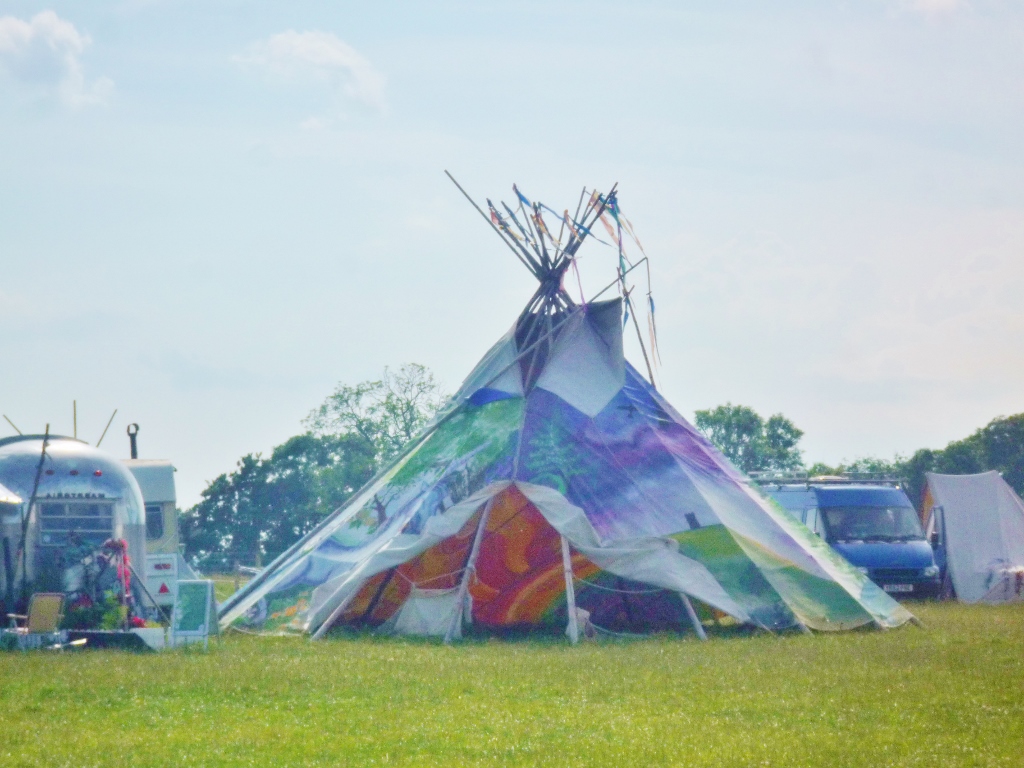
Mid-afternoon the healing and divination area was in full swing, as were the talks and workshops. I went to Brochfael’s talk on ethics within Paganism – something which I’ve been exploring quite a bit on this blog lately. Ideas were exchanged and points of view shared in a brilliantly painted teepee, with Will delivering his talk before a tableau of a red dragon dancing in the light of the sun.

Saturday afternoon’s ritual focus had an astrological bent – Mars in the various zodiac signs. Though I’m not a great believer in astrology, it did provide an interesting framework for ritual. The idea was that one woman would represent Boudicca, discovering and learning her warrior aspect as she dedicated herself utterly to the land. She was to move through the houses of the zodiac in which Mars resided for all ritual participants. Every single ritual participant was divided up into groups based upon which sign Mars was in for their own person – for me, Mars was in Virgo. The groups would then challenge and provide Boudicca with what she needed for her journey.

When the time came for the ritual, Mark Graham opened the circle and the woman who was chosen to play Boudicca entered, looking every inch the proud warrior queen, even down to the flaming red hair. Each house of the zodiac presented her with challenges and gifts, wisdom and advice as she progressed through the circle. It was so inspiring to see the creativity of everyone, wherein each group was so different and so unique, yet coming together to create a single ritual of great beauty.

After Boudicca (who was played by a woman aptly named Victoria) had processed and been blessed by the tribe in her protection of the land, everyone came together in the circle, chanting words dependent upon their ritual designation within the elements of earth, air, fire and water. The words flowed through each other in exquisite awen, as everyone circled and chanted, sang and set their hearts free in love of the land. I was quite overcome at this point, with the seagulls flying overhead, the wind upon my skin, the earth humming with energy beneath my feet and the waters of the Severn River encircling us upon this sacred hilltop. My love for this land and for the planet, the Earth itself, overwhelmed me and tears began to slide down my mud-stained cheeks as I called to my gods, opening my heart and soul to them in utter dedication and devotion. On the outer edges of the circle, I felt a great need to connect more fully with the earth, and dropped to my knees to lay my hands upon the sacred soil. Thankfully, those in the middle of the circle soon felt a similar need, and I was not trampled under Druidic feet! Everyone in the ritual knelt down to the ground, bringing their foreheads to touch the earth in peace and love, dedication and devotion to that which holds us so utterly and beautifully in the world. A selfless love flowed through me for the entirety of the world in a rush of pure, divine awen, and I tried not to sob out loud at the release.

After the ritual I made my way back to my tent, to process and integrate what I had just experienced. My husband and I then went out for dinner at the local pub, and coming back I meditated alone (in a field of sheep, so not entirely alone) watching the sun set over the hills within a bank of cloud, the crickets singing around me and the finches twittering overhead. Utterly spent, we had an early night that night.

Sunday we went for breakfast at the café, and had a great breakfast discussion with friends old and new about what they were working on in university, on gender roles and personal life experiences. This is what I love about Druid Camp – such engaging and brilliant discussion over beans on toast.

Then it was time for the long journey home towards the North Sea coast. Coming at last to our home, smelling the familiar scents of heath and forest, of sea and sky, I sat in my backyard by my altar and honoured the land upon which I live, connected as it is to all of the British Isles and the rest of the world. I said a prayer for peace, and reaffirmed my dedication once again to my gods, with the spirits of place and the ancestors as witness.

I can’t wait to see what will happen at next year’s camp.

P1060243 (1024x292)

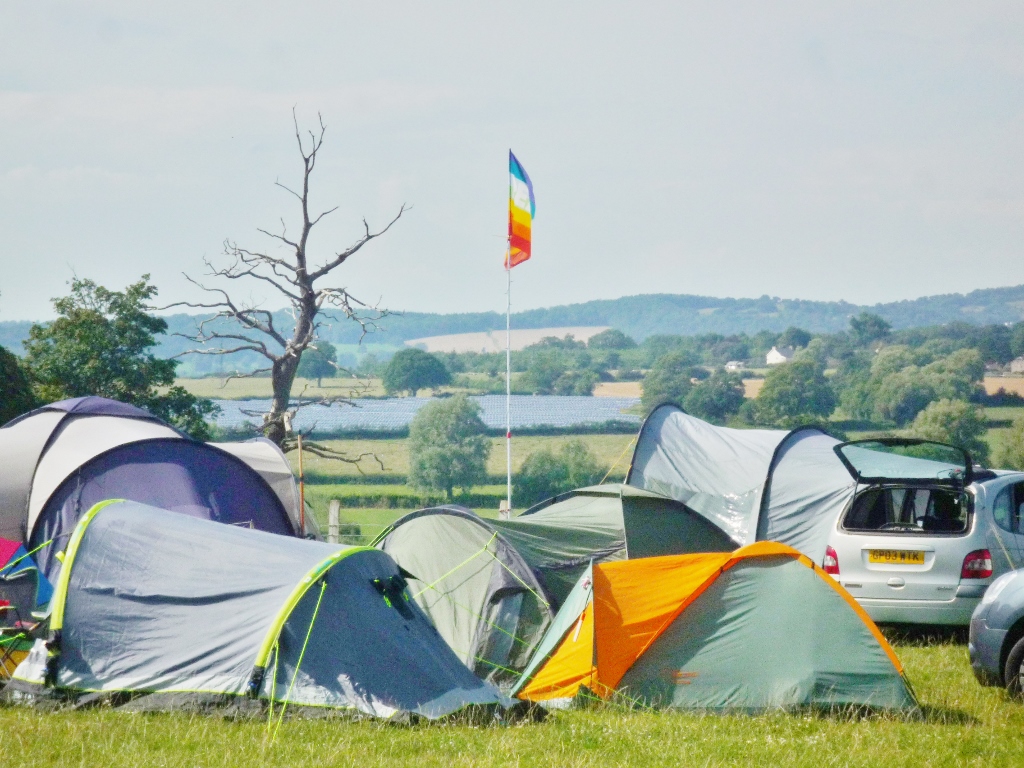
The view from out tent of the Severn River and the rolling hills…

P1060250 (1024x768)

Brochfael’s talk on Pagan ethics in the painted teepee, or is it a hobbit about to be eaten by Smaug???

P1060252 (1024x768)

Solar panels in the distance… how apt…

P1060257 (1024x768)

The astrological houses for the big ritual on Saturday afternoon…

P1060259 (1024x768)

My favourite tepee in the whole world…

P1060260 (1024x768)

Ritual preparation…

Reblog: Sacred Spaces

This is a reblog from DruidHeart, my blog on SageWoman Magazine’s channel at Witches and Pagans. Photo credit from The Sleepy Backpacker’s blog HERE.

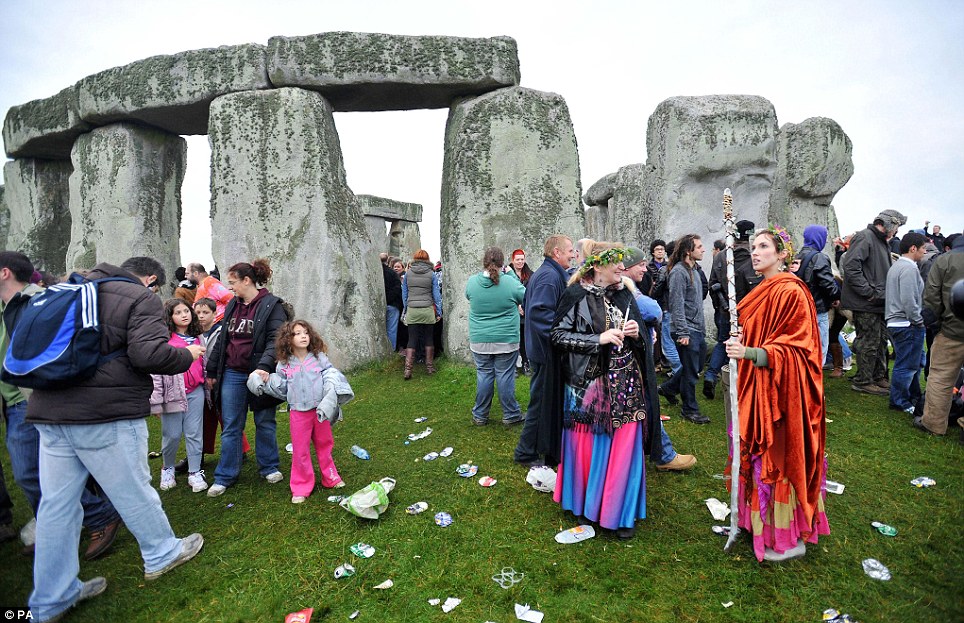
stonehenge2014Moonhenge, in Cambridgeshire, is a brilliant example of new Pagan sacred spaces being created. With so much controversy over some of the megalithic stone circles and other sites around Britain, why should we not be creating more new spaces in which to celebrate, should we so wish?

Every Western Pagan knows about Stonehenge. They all know about the summer solstice celebration there. A loud and rowdy affair in which the public join in, it is more a rave than a sacred celebration. Though we cannot know for certain what the ancestors did in that ritual space, to me personally it just seems wrong to have people getting drunk and shouting loudly, climbing on stones and partying all night in a temple so closely linked to the dead as well as the sunrises throughout the year. I may be entirely wrong.

However, it just seems like sacrilege when the spirits of place are not honoured in a respectful way. To make something sacred is to honour and respect it – it is connected to such words as dedication, devotion and veneration, three things which most of the partygoers at the high point in summer are not terribly concerned with at Stonehenge.

The creation of sacred space is a key tenet of Druidry and many other Pagan religions. It is an invasion to have people that you do not know enter your sacred space and act out of accordance with the intention of the rite or ritual being performed. Out of hours access permits are available to those who wish to use the particular temple of Stonehenge for more private use, however, during the actual time of the sunrises and sunsets at various times of the year, this temple space must be shared with those who are not in tune with the intention.

Other sacred sites around the world do not seem to suffer as much from this intrusion. We would not party in Chartres Cathedral, for instance, or rave all night in the Temple of Athena….

To read the full article, click HERE.

Reblog: Pagan Ethics

Here is my latest blog post for Moon Books…

How much of our Paganism do we allow to be defined by others? If we follow a specific or established spiritual tradition within Paganism, we look to those who have gone before, and those who are a part of it now, to inform our ideas about the path that we are journeying on. We can find great inspiration in doing so, finding relevance in the ideas of others that resonate deep within our souls, through the words and actions of those whom we may look up to, or feel a sense of rapport with. Equally, we may become frustrated and disappointed when those who follow the same spiritual path are at odds with our own beliefs, behaving badly, seeming to work in opposition to the very ethics that Paganism, by virtue of its deep-seated root in respect and love for nature, provides.

What are the ethics of Paganism? More and more, this topic is being discussed by prolific Pagan writers, teachers, organisations, established members of the community and newcomers to Paganism alike. We could look at what defines the Pagan community, but this is just too vast to cover in a blog post, as Paganism itself is so vast a subject. Therefore, the ethics that surround such a vast subject are numerous and varied according to each individual, if not organisation. For some, this is the brilliance of Paganism – for others, it is the downfall.

When the ethics that we hold dear to our heart are not being followed by others who claim to be a part of our tradition or spiritual path, we begin to question our path on so many levels. How can I be a part of this, when people behave like that? Issues with Pagans whom the media court may frustrate us, as we may feel we are not being represented properly or with due respect. Issues arising on social media, where wars with words are carried over into many different spheres can confound or simply clutter one’s newsfeed – these are all a part of being a modern Pagan, should you wish to use the term. Gossiping, griping, flaming, bullying – all these issues can make us question whether we want to be a part of this whole Pagan thing at all…

To read the full article, click HERE.


World Suffering – Thich Nhat Hanh

This little gem came as a great reminder today, when the suffering of the world threatened to overwhelm me.  Bursting into tears as I watched on the BBC news children’s toys scattered in the rubble of the Gaza bombings,, their bodies being loaded together into the mortuary. Rude people at the village shop blocking other people’s cars, and making them wait until they finish shopping to move their car, even after the person has asked them to politely to move.  Loud, overbearing people in the bays next to you at the driving range.  The obnoxious amount of money spent on the World Cup Football in Brazil while people starve in the streets.

Thich’s words were a welcome reminder to find the beauty, and to nourish ourselves in order to better serve the world, in a world filled with suffering – not to be overwhelmed by it, but to find the beauty to carry on regardless. To find a community as well, of like-minded souls, who can inspire you on your journey through life.  To be out in nature, and to see the wonder and live with the awe of a child again.

Then, you will be better able to serve the world, instead of submitting to the suffering and the grief, the rage and the injustice.  Returning to the centre, finding peace and being peace is all that matters.

Right, Wrong and the Self

Working with thoughts on the self, and release of the self these last few years (even more so since the publication of my first book, Zen Druidry) has been the focus of my studies and journey on the path of Druidry, yet has lately become the centrepoint in my vision of my own personal Druidry, ethics and the act of living with awareness.

We can appear, online at least, to be very focused on our individual selves, even to the point of megalomania. Social media comes from an individual’s personal viewpoint, or a company’s, a philosophy – it is an entity in and of itself. As an author it can appear even worse – we write, constantly, sorting out issues, celebrating life in all its glory with words spread across the screen if we decide to share those ideas and inspiration into the wider world.

Yet in my personal, living practice it is quite different. Yes, I do think a lot – but it is thoughts on the dissolution of the self in order to greater experience the world around me. Ironic, writing a blog post about it, but there you go.

Considering ethics within Paganism, there are many levels of “rightness” and “wrongness”, both morally, legally, socially and culturally. What matters most in our current culture here in Britain is legality, with social and cultural repercussions following the legal ones in order of importance (in secular circles) to consider. Morality can kind of get a back seat on this ride, all too sadly. However, what I’ve been thinking about is right and wrong and the ego, the sense of self that is always grasping to have its own expression heard, justifying itself and seeking validation any which way it can (yes, this blog is an irony in that, as well).

The most poignant thing that I have realised is that even though there is right and wrong, it doesn’t actually make anyone better if they are right, or worse if they are wrong. Just because someone is right doesn’t make them a better person, a better human being, nor vice versa. Even in a legal context, even if someone is found wrong, guilty of whatever transgression, it doesn’t make us better – it just makes us legally right.

Legally right may not even mean morally or ethically right. As a species, I don’t think we can actually live without a concept of right and wrong, as it is so ingrained into our psyche. That spark of human consciousness overrides the concept with the constant striving of the ego, the neocortical part of the brain laying down all manner of experience, assumptions, judgements, memories, possible outcomes etc. It’s often said that we instinctively know right from wrong, but does right and wrong have anything to do with instinct, or it is a purely human construct?

I know when someone is doing something wrong in my own social context, in my culture and society. I can condemn their behaviour as wrong, as something that needs to be addressed in order to fulfil our social contract with each other. I can report abusive behaviour, I can write letters of protest to local planning authorities, I can sign petitions and raise money to benefit those in need. All of these things do not make me a better person. They just make me, me.

The man who kicks his dog, I can report to the RSPCA. That doesn’t make me better than him though. The woman who abuses her child, I can also report to the authorities – that doesn’t make me better than her in any way. I may be right in thinking that these things are wrong, but it doesn’t make me a better person for not doing these things.

Ideas of right and wrong often include a judgemental factor that makes us feel that we are better than others. That is the striving of the ego for validation in any form, its screaming claws inside our head hoping for some sort of recognition. What we need to do is to be right, but not have the need to feel right, to feel better for being right.

In taking my inspiration, learning from the natural world around me, I am currently seeing things from a very different perspective. In a world where there is no human notion of right or wrong, and allowing my sense of self to dissolve slowly into that environment, whole new ideas on the nature of the human existence come blazing to the fore.

Stopping that chattering, self-centred mind to actually be in the world is time very well spent. Each time you do, you hear and learn more about the world, thus better defining your place within it. If you begin to lose even that, your sense of self, you come back less and less – the ego becomes smaller and smaller, and the true self has the opportunity to shine through.

Eventually, I hope to never come back at all.

ch2