Druidry and Choices

Sometimes we have to make choices in our lives that don’t give us pleasure, that don’t make our lives easier, that go against the popular majority.  If we are to live with a strong moral and ethical code, we will have to make a stand somewhere, even if we are standing alone.

In my Druid practice, there is a very strong ethical stance with regards to the environment.  It’s why I’ve been vegetarian for nearly twenty years, and why I’ve since gone vegan.  I’ve made a vow not to buy any new clothes for over a year, in order to learn to make do with what I have, or to buy second-hand items when necessary.  I use organic, SLS free bath and beauty products as much as I can. I recycle.  I use vinegar and water to clean my house, sometimes scented with an essential oil. My garden is organic.  These choices have not made my life any easier – in fact, rather the opposite.  But it’s a choice that really wasn’t a choice – I couldn’t follow my religious path without making those changes in my life.

This weekend I had to make a choice about one of my many hobbies as well – LRP, or LARP (live action role-playing).  This system runs its events on land that is leased from other landowners, which has several large fields and a patch of woodland – a great site. However, this spring, the event held battles in the woods, which were in full bloom with bluebells.  Large sections were trampled underfoot by hundreds of people.

An active member of The Woodland Trust, this shocked me to the core.  Bluebell woods are protected, but this was still happening.  After writing to the company owner, I’m still not certain anything will change, or be done about it.  I am sincerely hoping that they will get in touch with the landowners, The Woodland Trust and Natural England about the issue, and how it can be resolved.  I have written to all concerned about the issue. Until then, I cannot give the company any more of my money, for that would be condoning the destruction of bluebell woods.  It’s terribly sad, for I have a lot of friends within that community, but I cannot compromise my principles in this regard.

Druidry is all about relationship, and we can easily forget that relationship is not only with each other as human beings, but with the earth as a whole.  To run through bluebell woods, destroying them underfoot as I “play” out a battle is completely disregarding any relationship to the woods, the protected flora, and all future sites as well.  We must make a stand for what we believe in, when things aren’t right – and especially for those who cannot speak for themselves, whether it be a bluebell, a dog being kicked by its owner, violence towards women, a teenager throwing a soda can onto the verge.

Balancing strong environmentalism whilst living in the 21st century is difficult.  I still have to drive a car fuelled with a non-renewable resource.  My house is heated with oil.  Our electricity is from coal-fired power stations and nuclear power stations.  However, I strive to do the best I can – it’s better than doing nothing at all.

A good resource for living ethically within the Druid Tradition can be found on The Druid Network’s website here – http://druidnetwork.org/what-is-druidry/ethical-living/

Excerpt from new book: Dancing With Nemetona

inner hutAs well as external, physical manifestations of sanctuary, there are also inner sanctuaries that we can create, filled with the blessing and the power of Nemetona – a space where we can feel safe, a place where transformation, healing, integration and all manner of things can take place.  Some Druid Paths construct what is called the Inner Grove (a place of ritual and transformation in the mind) and that shall be dealt with in a different chapter on sacred groves.  What I would like to suggest here is not so much an inner ritual arena, but a safe place to use as a “base” – I like to think of it as my Inner Hut.

Creating inner worlds is not only great fun, but a great way to express and confront issues that we physically may not be able to, or which may not be appropriate to do.  Several of my teachers have used the idea of an inner safe place which we can use as a starting point, and from there travel out into the wider realms of the mind, exploring what we need to explore.  We may have fantastical adventures in our inner worlds, or enjoy the more mundane things within them that we may not have the time to do in our physical world.  The Inner Hut provides the starting point, the sanctuary.

My Inner Hut is a place that I can go to in meditation, when I am called to journey, perhaps, or when I feel I need to really take a good look at something that is troubling me in my life, or when I simply need to be refreshed by the blessings that particular sanctuary provides.  If an answer isn’t available in the so-called mundane world, one may be found in the inner world.

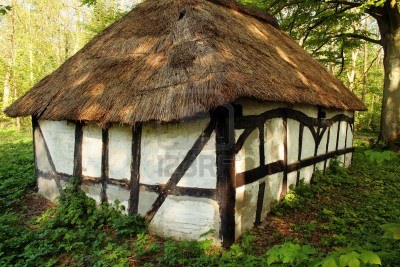
My Inner Hut is a simple, single-room dwelling deep within the heart of an ancient forest, close to a slow-moving river that winds its way through the trees and out into the wider world beyond.  It is a simple wattle and daub hut, with a thatched roof that occasionally needs repair and a dirt floor.  Inside there is a table in the centre, with two benches on either side, a bed along one wall and a chest at the foot of the bed.  There is a much-used hearth on the back wall, and a good stack of firewood both inside and outside the hut.  There is also a chair pulled up near the hearth, and a large wooden basin on a separate smaller table under the window.  Herbs are hung to dry from the ceiling, and my staff leans in the corner by the door.

This hut is my safe space and my starting point for any adventures that I may wish to undertake in the inner realms.  Sometimes it is simply enough to just spend some time in the hut, or around it, looking at the herbs growing nearby, sitting by the river’s edge and watching the water flow past.  If there is an issue to deal with, I can either deal with it in this safe space, or venture further out into the woods to find just what it is that needs to be taken care of, knowing that I always have this safe haven, this little sanctuary to return to should it be needed.

Boundaries: Dancing with Nemetona

Akram Khan Dance Company, from the Vertical Road tour

Akram Khan Dance Company, from the Vertical Road tour

Having danced deeply with the goddess Nemetona this winter, which has also inspired me to write my second book for Moon Books, the issue of boundaries returns again and again in relation to human interaction, in every day life with people that I share this journey with.

Our own personal nemeton, that space around us that we do not allow anyone but those with whom we are most intimate with, expands and contracts with each person that we meet.  Some we might shy away from, some we might fling our souls wide open to.  What I have learned is that boundaries must be kept, in order to keep the nemeton intact.

This is difficult for me, as I enjoy ecstatic relationship –I crave it in my Druidry, in my life.  Yet I have learned with whom it is appropriate, and with whom it is not.  To utterly dissolve into the moment of the sunset, or opening my soul to the bluebell wood as I lie beneath the gently swaying branches of oak and sycamore, or deep within the heart of ritual where transformation, celebration, integration take place – these are the times when it is not only appropriate, but relatively safe to do so.  I know that the bluebell wood will not harm me, will not abuse the relationship.  Sadly, this is often not the case with many humans that we meet.

Perhaps that is why it is so much easier for me, as a Druid, to find relationship with the beech tree at the bottom of the garden, or the badger that comes looking for birdseed and peanuts, than the average human being.  I have not been hurt by these creatures – even when my soul is laid bare, I have not come to harm.  The seaside has not taken advantage of that moment when we are soul naked, seeking deep ecstatic relationship.  Perhaps this is because the sea does not want, does not need as we humans need.

Human relationship is so very different, for so much of it is heavily dependent on need, on desires.  We seek a give and take in our relationships, if they are to be healthy.  When there is not balance, it is unhealthy, and often advantage of another is occurring.

Saddened by and a little wiser by past experiences, I have to relearn again and again where my edges are, and where they meet with others.  Telling myself over and over again that I will not be hurt by certain people, or that I will allow love in from others – this is what is so very important.  This is what Nemetona teaches me each and every day.

By becoming aware of our own boundaries, we can then act honourably with other humans we meet, and indeed with all of nature. Sometimes it is wholly inappropriate to fling our souls open to the lake at moonrise – that is why in Druidry we ask permission to share our soul touch with others.  Maybe this is what is lacking in much of human interaction – that permission is not sought. It is either given when not asked for, or taken even when it is not sought.

In the midst of all this, all we do is dance with Her as best we can, sometimes ecstatically, sometimes deep within our boundaries, ever awake and aware of our relationship to Her and to the rest of the world.

“And those who were seen dancing were thought to be insane by those who could not hear the music.” – Friedrich Nietzsche

Druidry – What is Awen?

In Druidry, we learn often hear the word, awen, being used, but what exactly is awen?   Loosely translated from Welsh, it means flowing spirit, or flowing inspiration.  Awake to our own energy, and stretching out towards the energy of nature around us, we begin to see just what awen is.  It is an opening of one’s self, of one’s spirit or soul, in order to truly and very deeply see.  When we are open, we can receive that divine gift, inspiration that flows, whether it is from deity, nature, or whatever it is that you choose to focus on.

For awen to exist, there must be relationship.  We cannot be inspired unless we are open, and we cannot be open unless we have established a relationship, whether that is with the thunder, the blackbird or a god.  It is cyclical in nature; we open and give of ourselves and in doing so we receive, and vice versa.  Letting go, releasing into that flow of awen allows it to flow ever more freely, and we find ourselves inspired not only in fits and bursts of enlightenment or inspiration, but all the time, carrying that essence of connection and wonder with us at all times.  There is, of course, a line to be drawn, for we can’t be off our heads in ecstatic relationship with everything all the time.

But just what is awen?  It is an awareness, not just on a physical and mental level but on a soul deep level – an awareness of the entirety of existence, of life itself.  It is seeing the threads that connect us all.  It is the deep well of inspiration that we drink from, to nurture our souls and our world and to give back in joy, in reverence, in wild abandon and in solemn ceremony.

Many are familiar with the Welsh tale/myth of Cerridwen and her cauldron, the three drops of awen falling onto Gwion’s finger and bringing his wisdom in the form of poetic inspiration, shape-shifting and prophecy.  Some liken this story to a Bardic initiation, or the three grades of Bard, Ovate and Druid.  In any case, drinking from the cauldron of the Goddess is to drink deeply of awen.

Many Druid rituals begin or end with singing or chanting the awen. When doing so, the word is stretched to three syllables, sounding like ah-oo-wen.  It is a lovely sound, that opens up the heart and soul. Sung/chanted together, or in rounds, it simply flows, as its namesake determines.  Our hearts literally can open if we let them when chanting or singing the awen.

Yet I am sure that the awen is different for each and every Druid.  The connection, and the resulting expression of that connection, the Druid’s own creativity, can be so vast and diverse.  It is what is so delicious about it – we inhale the awen and exhale our own creativity in song, in dance, in books, in protest marches – the possibilities are endless, as is the awen itself.


Awen and Peace – East meets West

Further exploring the nature of peace, what leads me to understand the fundamental precept behind achieving peace is through compassion.  But what is compassion?

Dictionary definitions say that it is a state of sympathy with someone who is suffering, and yet that doesn’t adequately describe compassion in my mind, in either the Zen or the Druid tradition.  Two words in Sanskrit delve a little closer, such as karuna, a gentle affection and a willingness to bear others’ pain, or metta, often described now as loving kindness, acting for the benefit of all living things with a selfless attitude.

The Dalai Lama stated “Genuine compassion must have both wisdom and lovingkindness. That is to say, one must understand the nature of the suffering from which we wish to free others (this is wisdom), and one must experience deep intimacy and empathy with other sentient beings (this is lovingkindness)” –  (The Essence of the Heart Sutra).

For me, compassion is all about relationship, about an integration with the world, with the universe. As the native American saying goes – “We are all related”.  (Not just humanity, but essentially go far enough back and see that we are all star stuff.)  In order for this integration to occur, we have to learn how to lose that sense of self, for is there is a separate self, there can be no true integration, only the state of sympathy.  There is someone observing someone else’s suffering, and helping to alleviate their suffering but still retaining a sense of Us and Them. In Buddhism, wisdom, or prajna, is most often found through the teachings of No Self, or attana.

In my studies in Zen Buddhism, we are taught to help wherever we can, as selflessly as is possible, which is true compassion. If you help someone and then expect a reward, there is still a separate self expecting reward from a separate person.  We have to learn to drop all expectations. The Tibetan practice of Lojong’s final slogan is brilliant in this regard – Do Not Expect Applause.  Only then, there is there an integration of everyone involved.

In Druidry, this integration is often termed as relationship – but again, words fail to describe the enormity of the meaning behind it all. Druidry also uses the word, awen, a Welsh word with several interpretations: poetic inspiration and flowing spirit to name a few.  For me, awen is the life “force” itself, in its myriad expressions, in constant change and flux.

To find true peace, one must release into this, into awen, losing that sense of separateness, and in doing so discovering the nature of compassion in soul to soul relationship.


The Call for Peace

Druid ritual in many traditions usually begins with what is known as The Call for Peace.  It is an affirmation that there is peace between everyone involved, and an aspiration that there be peace throughout the length and breadth of the world.  In ancient Roman times, Caesar documented some of the roles of the Druids in his time, stating how they were exempt from military service, did not carry weapons and often acted as intermediaries between warring tribes.  It was said that they could walk between the two front lines of battle and come through unscathed, for such was their role that none contended with their wish for peace.

Finding peace in today’s society is very, very difficult. I’m sure it was in ancient times as well, but I can only comment on the time that I live in with any sort of accuracy, however subjective or flawed my opinion may be.  When we make the call for peace in ritual, are we sure that there is peace within, nevermind without?

One has to begin with a definition of peace.  Here are some dictionary definitions:-

  1. the normal, nonwarring condition of a      nation, group of nations, or the world.  

This is interesting, as it infers that the normal state of the world would be a non-violent state between nations, groups of nations or the entire planet.  I do wonder if this time has ever existed.  This doesn’t only relate to the human species either – packs of wolves may fight for territory, as any of the feline persuasion as well.  However, I do like the sentiment behind this definition – that it is the normal state of affairs, and we are living abnormally, even if that has been since the dawn of time…

2. a state of mutual harmony between people or groups, especially in personal relations: Try to live in peace with your neighbours.

Indeed, this is a closer definition to what I think most people would believe peace to be, as we can relate to that on a much more personal level – not everyone is involved in a war-like conflict, even if their nation may be.

3. the normal freedom from civil commotion and violence of a community; public order and security: He was arrested for being drunk and disturbing the peace. 

Again, here we see the idea of normalcy being in a non-violent community.   It implies that we should, as a whole, be living in a non-violent, orderly and secure environment.

4. cessation of or freedom from any strife or dissension.

Again, many would relate to this definition, even if it can be somewhat vague, for everyone’s idea of strife or dissension could be entirely subjective – some people enjoy heated debate, others find it upsetting.

For me personally, turning over the idea of what is peace, I’ve come across words such as holistic, integration, relationship.  To be at peace, we must be at peace with everything else.  In a shared world, this is so difficult as to be nigh impossible – a few have claimed it (Buddha) and a few strive to live it in their mortal lives (again, Buddha, but also figures such as Dalai Lama, Mother Theresa, Gandhi).

Mulling over the idea of a pagan monastery all winter long, I would imagine that this peace would be so much easier to achieve in a state of withdrawal from the world, even with a group of like-minded people.  This withdrawal would also offer up the opportunity to integrate more fully with your religion without distraction, inasmuch as we are in a fairly secure environment in which to explore our religious passions.  We can focus on our relationship with others, with deity, with the world, without too much interference from modern day society.

But what is so bad about modern day society in which we cannot find peace?

Again, this is only a personal viewpoint, but seeing horrid images in the media of the strife that occurs all over the world affects our personal peace.  Bombarded by television shows that glorify arguments between individuals, families (I’m thinking Eastenders type here, but also reality shows such as X Factor, where we are invited to judge and determine who is better than another person and also become involved in criticism (see previous blog post on the critical mind).  How can I be at peace with the world when my morning radio alarm goes off and the first thing I hear of is how some man brutally beat an 80 year old woman to death in her own home?  Even if we don’t have televisions or radios in our home, they are prevalent elsewhere – there are even petrol stations in Amercia that have television screens on the pumps that play the news!

There are gods within Paganism that are associated with strife, with war.  Some of them also have healing qualities as well, showing a well-rounded, cyclical nature.  Perhaps establishing a relationship with these gods, if like me you are a polytheist, is the way ahead.  When the lines of communication open, and the nemeton is shared, our true selves can be expressed, whether that is with the gods or a badger.

Buddhism would say that the road to peace lies in compassion.  I’m still working hard on that one, bringing ideas of empathy and relationship which are a little closer to the language that I understand in Druidry.  I can see that we are all related, every single human being on this planet.  Every living thing is related in some form or other.  We are all star stuff.

So, back to the call for peace in Druid ritual – how definitively can we use the words below, as so many have done before?

Deep within the still centre of my being

May I find peace.

Silently within the quiet of the Grove

May I share peace.

Gently (or powerfully) within the greater circle of humankind

May I radiate peace. (OBOD http://www.druidry.org/events-projects/peacemaking-druidry)


The Druid Universal prayer makes no mention of peace, but does hint at it in the form of love at the end:


Grant o Goddess thy protection,

And in protection, strength,

And in strength, understanding,

And in understanding, knowledge,

And in knowledge, the knowledge of justice,

And in the knowledge of justice, the love of it,

And in the love of it, the love of all existences.

And in the love of all existences,

The love of Goddess and all goodness.  (Iolo Morganwg)

In order for there to be peace, there must be relationship. If there is no relationship, then anything apart from ourselves, or even our very self, can be an abstract.  So, perhaps when using either of the above, or our own call for peace within Druid ritual, we establish a connection, a relationship with everyone and everything inasmuch as we can, in order to better work with them towards a life filled with peace.  We can see where there is a need for peace in the world, and try to relate to that need in order to bring it about, or at the very least to understand it.  Where there is no need then there is peace.

The issues of need with regards to peace are interesting – these can vary from our need for peace to our everyday basic human needs, such as food, water, shelter and clothing. Where these needs are not met again there can be no peace.  We strive towards fulfilling our needs – that word, strive, with its same root as strife.

The call for peace is a good grounding platform in Druid ritual. It can bring everyone to a single intention, which in its form is the essence of ritual – actions based on intention in order to create relationship.  I’m not entirely sure that I am, as yet, able to state with absolute certainty that there is peace within any particular ritual, yet I am more than willing to share that intention of creating peace. Perhaps this is the more important of two, and focusing (perhaps pedantically) on whether or not there is peace is missing the mark.

May there be peace throughout the world.

Exploring the nature of criticism…

I don’t put much store in astrology, but when people say Virgos are very critical, I can’t really deny it. All the Virgos that I know are – then again, I also know a lot of people who aren’t Virgos who are…

Ever since my post on the death of Margaret Thatcher and my criticism on the subsequent behaviour of those who downloaded Ding Dong I have been thinking about the criticisms that I hold on to in everyday life, and those that I feel I need to share with others.

In order to criticise something, there must be a sense of self, someone who is standing back and commenting.  Yet in Zen, the goalless goal is to integrate completely, so that the sense of self falls away and we are completely immersed in the here and now, in the environment, in life itself.  As a Druid this is so very appealing, for I long to release into nature to become a part of it; to stop distancing myself from it with ideas and notions of who I am, which are constantly changing anyway.  Pondering on the idea of self, Zen would offer that the sense of self is but an illusion that we create and cling to, for various reasons – out of security, fear and ego-driven desires.  Therefore, holding on to an illusion is a little bit of a waste of time. Criticising someone else’s is a total waste.  If it’s not real, there’s no point.

We have this idea about our selves, that we have created throughout our lives.  What if this sense of self was just those ideas that we repeat the most, the ones that we like the best (or hate the most), the ones that shout the most loudly in our heads? Ideas are not real things – they are abstracts.  Experience is the key here, for experience is not an abstract.

So, back to criticism – in a Zen Druid worldview, is it ever right or worth the effort to criticise something?  There’s that old adage – if you’ve got nothing good to say, don’t say anything at all. For me, this is not enough, for when something needs changing, when those who can’t speak for themselves need a voice, I will speak out against it.  The key here is to do so with respect, honour and integrity. I’m still learning.

Also, offering criticism when it is not asked for is an easy trap to fall into.  Our lives are filled with it – we are inundated with television shows like Big Brother, or more importantly other reality shows such as The X Factor, Dancing on Ice, Strictly Come Dancing, etc. where we are expected to criticise, where we are voting for who we wish to win.  The judges on these shows often criticise dishonourably, mocking and offering nothing helpful. Sometimes they are offering good criticism and are right (at least, we agree with them).  (Spot the paradox – I just criticised judges on reality shows J).  At any rate, what these shows may do is to make us feel better about ourselves, with an underlying fear that we could be that person being criticised.   What I am suggesting is that maybe we need to detatch from the world of dishonourable relationship, where criticisms are just plain mean, or mis-informed.  I know I’m still working on it personally, as per my Maggie post earlier.

In Zen Buddhism Right Speech is part of the Eightfold Path.  I remind myself of this every time that I can before I now offer criticism.  Yet Right Speech does not say “do not to criticise”, but rather to reflect on whether this criticism is beneficial to anyone.  Talking about people behind their backs, offering criticism when it is not asked for, or condemning people when you have absolutely no idea what their motivations are is not altogether “right”.  Yet Zen states that we will never fully know the motivations of others, and that reflecting on this is also a waste of time.  So before you say something about someone, ask yourself – “Is this beneficial to anyone? Is this making the world a better place?” If so, then go ahead – with love and compassion we certainly need to do this in our world.  If the answer is no, then keep it to yourself, or even better, let it go, seeing it for what it is – an illusion, in most cases.  We are not omniscient – therefore our opinions on most things are subjective, and indeed flawed in that regard.

In Zen there is a saying – “Do not seek the truth, only cease to cherish opinions”.  This really strikes a chord with me. It is not saying that we shouldn’t have opinions, but that we should hold to them lightly, for how often has your opinion on something changed?  My Thatcher post and subsequent discussion changed my opinion, certainly.  If we cherished opinions so highly, we could never learn new things, progress and really be in the here and now, in a state of true experience. We would be holding so tightly to things that shift and change, that are never constant. It’s like trying to hold water in your hands – no matter how tightly you squeeze, a little water always dribbles out.

So, next time I am about to criticise something, I will consider Right Speech. I will also question what or who it is that I am criticising, as well as just who I think is doing the criticising. Most likely, I will have no idea on either score, and therefore either keep my mouth shut or investigate further, delving deep into experience before coming to any conclusions.

Having a critical mind is a wonderful thing.  It can really help us to see what can be done in the world to make it a better place. How we use it is entirely up to us.  Also losing your critical mind can be a wonderful thing, being utterly absorbed into the natural world, at one with everything.  The paradox is delicious.

New book contract accepted! Dancing With Nemetona

Have just accepted my third book contract with Moon Books, another in their Pagan Portals series, entitled Dancing With Nemetona – A Druid’s exploration of sanctuary and sacred space.  This work will focus on sanctuary and sacred spaces, exploring the Goddess of the Sacred Grove, Nemetona.  Check out the Moon Books website here, and see their latest releases… www.moon-books.net

Here’s a little taster…

It had been a long and challenging day at work. I drive home, the windows open and the radio off, fully immersing myself in the act of driving, leaving behind what happened at work and becoming entirely aware of the present moment.  I feel the sandy roads beneath the wheels, the smell of the newly ploughed fields lifting my heart and filling my nostrils with that sweet earthy scent.  The village finally comes into view, the 30 mile an hour speed restriction delineating the edges of this space that I call home, and I slow down, driving under the speed limit through the little street past the village shop and post office, turning into my road.   

The tires crunch the rocks in my driveway, and I park the car, switching off the engine.  I take a deep breath, and look at my home, smiling.  Mindfully, I open the car door and grab my handbag, closing the door shut behind me and walking towards the front door, focusing on each and every step that brings me closer to Her.  I take my keys out and with intent, turn the key in the lock and enter the porch, softly closing the door behind me.  I take off my shoes and hang up my coat and then open the main door to the house. 

My soul opens of its own accord, my own nemeton relaxing and expanding so that it merges with the physical space of the house itself, with Her.  I place my hand on the door lintel and whisper a prayer, “Thank you My Lady for this sacred place, this haven of four walls and for providing me with a home.  I am truly honoured.”  I feel the acceptance and smile, entering the home fully, saying hello to the cats and dropping my keys in the bowl.   

Our homes are often places of comfort and rest, if we feel inspired by Her to make them so and if we are attuned with Her energy.  We must first have some sort of idea of who we are, in order to express ourselves and Her in our homes in order to create a sense of calm, well-being and a nurturing environment.  We cannot simply emulate what we think looks nice in a book or a magazine, but we must feel it in our body, in our blood and in our mind that this is a reflection of what our vision of hearth and home is for us.

It will be different for each person.  Everyone has different views on aesthetics, décor, and arrangement.  Everyone has different budgets and limitations.  Everyone has different energies and inspirations and abilities to make these things manifest.  What we must try to do is to do is to create that sense of welcoming when we walk in the door, to connect with Nemetona in our homes and to honour her for all that she provides.

Here we go A’Maying…

kentwell hall may day

This weekend at Kentwell Hall the Tudor Re-enactment team were in full swing.  Celebrating May Day, they brought to life old customs and traditions for all to enjoy.

First of all, we had to go A’Maying, which is where the tree is felled for the May Tree.  (The maypole with ribbon dancing is a Victorian invention).  With drummers drumming and pipers piping we followed the procession into the woods to where our chosen tree stood.  As we neared the spot, the music stopped and voices were hushed.  The Woodsman and several other men went forward to fell the tree in silence, for they did not want to awaken the Forest Spirit, Jack in the Green.  It was all to no avail, for as soon as axe touched wood out sprang Jack, with green cloak billowing and mossy hair and beard bristling beneath his hood.  He attacked viciously the Woodsman, but the men managed to pull Jack away, and finally subdued him enough to send him back into the heart of the wood.  The tree fell slowly, and I whispered a prayer of thanks to it for its sacrifice.

All the men then gathered around the fallen tree, picking it up and heaving it onto their shoulders to take back to the village.  The music started again, and we followed in procession through the fields to our destination.  Once there, we were invited to tie ribbons onto the May tree, with the intention of making a wish that would come true in a year and a day.  The men then attached ropes to the May tree and hoisted it into a hole they had made into the ground, and wedged it tight.  The May Tree now stood proud in the centre of the village.

Later that day the main procession went from the village to the Hall – and what a sight it was.  The May Queen, a young girl of about 9 or 10 years of age sat bareback upon a beautiful Suffolk Punch horse, that had daffodils plaited into mane and tail.  The young girl was dressed in a simple white gown, and her golden hair shone in the sunlight – indeed, her whole being shone with pride and excitement as she lead the procession.  Behind her in a wagon were her maidens, more young girls dressed in white, waving to the crowd.  The musicians followed, singing their traditional May songs, and the banner bearers with their colourful standards brought up the rear.  It was truly spectacular, with the flags waving in the wind, the music lifting hearts and souls.

Once in the courtyard of the Hall, the May Queen dismounted, and followed the Lady of the Hall into the wagon with the handmaidens.  The Lady of the Hall the crowned the May Queen with a wreath of flowers, to much applause. As the May Queen descended, a fury in green swept through the crowd, and Jack O’ the Green came flying in, grabbing the May Queen and hoisting her over his shoulder. The men ran after him, finally capturing him once again and rescuing the May Queen.  They forced Jack to kneel before her and asked the May Queen if she forgave him.  The young maiden went forward and placed her hand upon Jack’s head, and forgave him, sending him back into the deep woods where he belonged.  “Hail Jack,” I whispered.  “Know that you are honoured”.

The mummers then performed a hilarious play about St George and the Dragon, and then the procession moved back to the village.  There, the music kicked up again in full tilt, and we began the spiral and circle dances around the May tree.  I could feel the energy humming through the crowd, into the ground, making my feet want to move.  A handsome young lad grabbed my hand, asking if I wanted to dance – I said yes, and we swept into the circle, laughing.  I was later joined by my husband, and we performed a traditional tudor dance with many others, where the men and women each have their turns to run, jump, clap and turn.

After the dancing I sat upon the green sward, listening to the musicians and feeling the energy that was created in that spot.  It was joyous, and marked a very important time when winter was bid farewell, and summer was welcomed.  I’m sure the Tudor Re-enactors will have a splendid evening to themselves tonight once the crowds have gone home and the gates are closed.

I wish we had more of these celebrations where I live – I have danced a Victorian Maypole but once, and love the energy that these rituals create.  If you have a chance, go to Kentwell Hall this weekend, and join in the festivities.

For more information on Kentwell Hall activities throughout this summer, please see www.kentwell.co.uk.

Beltane – welcoming the summer

Beltane – the fire festival celebrating the arrival of summer. All throughout the UK, last night and today Pagans and non-Pagans alike are joining in the festivities of this special time of the year, with Morris dancing and bonfires, Maypoles and feasting.  A long weekend awaits us with a bank holiday Monday, where many pubs will host barbeques and hog roasts, entertainment and more.

After a very long winter, this festival is most welcome.  At Imbolc and the Spring Equionox, we quietly ushered in the lengthening days, the gradual shift towards the summer solstice, noticing the ever changing cycles around us.  Now it is a time for the first of what I deem the “louder” festivals of summer, where drumming and dancing and cavorting are done with abandon.

Here where I live in Suffolk, it’s not quite time however.  I prefer to celebrate Beltane when the May is out; when the hawthorn flowers in the softest shades of pink-tinged white.  It will be another week or two yet before these blossoms begin the scent the hedgerows, and bring with them that sense of a definitive coming of summer.

For me, Beltane is also a time when it is finally warm enough to stay outside comfortably, to sit in meditation or to make love under the dappled light of the sun beneath the tender new canopy of leaves deep within the forest.  The Goddess is still waking up, slowly, soon to dance freely with the Lord of the Wildwood. It is not yet time to awaken her fully with shouts and drumming and the ecstatic pleasure of ritual love-making – not quite yet.

I can feel the anticipation growing inside me, as I long to reach out towards the sunlight and stretch my soul into the warm air, or to dance in the summer rain.  It is coming, it is coming…