Midsummer

Ah – midsummer. I remember when I first moved to these isles over 16 years ago from Canada – it was a cold and wet summer, and I wondered just what on earth I had done. And yet, the light fascinated me at that time of year, and later at the winter solstice, the darkness. It was so much more than where I grew up – the twilight of midsummer and the barest space of total darkness, the unrelenting darkness that forces you to face it head on in winter. The difference in latitude was a great teacher – (Montreal, 45.5N, London 51.5N).

 
The current is running strong in the British Isles right now. As I go to my outdoor altar every evening, laying my hands upon the soft, mossy earth I feel the white dragon that has risen to the surface and is dancing in the ethereal currents of energy crisscrossing the land. It is a time of great joy, of celebration.

 
This is a time of year to be proud of what you have done so far in the year’s cycle. But beware – the carpet can be pulled from underneath you, and the harvest may not quite be as expected. For this brief moment, however, we can perform this wonderful balancing act, in a liminal time before the tide tips over and we tumble headlong with it. It is important to be proud of what you have achieved – it is too easily done to become prideful.

 
Stand and feel the earth beneath your feet. Feel the serpent energy rising, the dragons of these lands, filling your soul with this time of year. Reflect on your achievements, and state them aloud under the eye of the sun. Confirm for yourself the good that you have done for the world, for your family, your community, for yourself. Let the sun’s rays witness this confirmation.

 
On Saturday I will be reflecting on the good investment of my solar panels – this time of year it is especially rewarding to know that the longer daylight hours are helping others in the village, ie. local businesses. I will take a bow for the two books published (and doing well), and the third and fourth on their way. I will applaud the money that has been raised for various charities through a lot of hard work in fundraising, events and suchlike over the course of the year. For this brief moment, I will take pleasure in my achievements, and remind myself that this is why I do the work I do, and live the life that I live. I will remember this moment in the darker times, to guide me through them and out the other side.

 
And then I will immerse myself once again, into the landscape, losing that sense of self and becoming a part of it, letting it guide me, teach me, blend with my blood and my bones with the whispers of the ancestors blessing it all.

Offense taken, Mr Fry

*Warning – this blog post contains strong language*
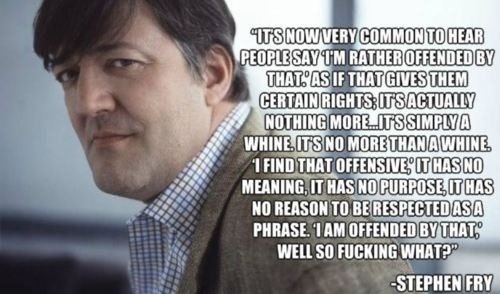
 
stephen-fry-on-offenceI’ve been thinking about Stephen Fry’s little rant that made the rounds of social media a year or so back. It’s something I’ve been meaning to comment on for a while, mulling it over thoroughly, discussing it with other people and trying to understand the mindset that would provide such an opinion.

 
In short, I just can’t understand why he would say such a thing.

 
The blog Tea Leaves and Dog Ears has provided a good reply to his statement. However, there are still a lot of people who agree with Fry’s sentiment, including Ricky Gervais, who stated on his Facebook page in August 2013:

 
“We have to stop this recent culture of people telling us they’re offended and expecting us to give a fuck.”

 
Fry and Gervais’ comments are nothing short of belligerent. When someone does not care regarding the effect their words and actions have on society in general, they are also not acting in any way with compassion. Fry’s comments about taking offense are well and good if he is the one being offensive, however, as in Tea Leaves and Dog Ears’ blog, when it is his own person that is being offended, the tables turn and a double standard occurs.

 
I’ve been studying the Celtic worldview for some while now, diving in to the history and research, and have come across one perspective time and again: that of personal responsibility. In a culture, in a society, we all have a personal responsibility to behave in accordance with that society and the laws that it contains. If we don’t like them, we should be able to speak out against them in a peaceful manner, protesting using our freedom of speech. Yet every action, every word that comes out of our mouths we are responsible for, whether spoken with mindfulness or mindlessness.

 
I believe that Fry’s and Gervais’ comments were spoken out of mindlessness. In Mr Fry’s case, also taken out of context. I also believe that they would, and probably have, taken offense at something since they made those comments. It is human nature to have an opinion. We have a voice and we use it. Sometimes we do so with full intention, sometimes we do not think before we speak.

 
I simply cannot fathom walking around, saying things without thinking of the repercussions my words and actions would have on the world. My sense of personal responsibility lies too thickly ingrained in my soul. It is confirmed by my Druidry, by my spiritual path. Stating that those who are taking offense are merely having a “whine” is to diminish their point of view, their opinion as worthless. It goes against the very freedom of speech that the original rant seems to hold up.

 
Sometimes it can be hard to find the words at the exact moment the offense is being taken. We’re not all eloquent beyond belief, able to put thoughts and emotions into carefully constructed arguments on the spot. It is a talent that some people have, some do not. We should not dismiss those who cannot find the words to express their true feelings, who can only say at that moment that they’ve taken offense. We have hurt someone’s feelings. We hate it when our feelings get hurt. Why do we forget that when we are the ones that are creating the offense?

 
Acting with compassion in all things is central to Buddhism. Right Speech is part of the Eightfold Path. I personally do not believe that Fry or Gervais’ comments are made with this in mind. Speech, words and stories were very important to the Celtic ancestors. The Druid teachings up until the modern day were never written down, for various reasons – to keep it within a political and spiritual elite in Classical times, for example. Going back further than this brief point in history, the written word did not exist for our Bronze Age or Neolithic ancestors. What was said, expressed in a language either now lost or evolved into our current tongue mattered. Even before verbal language, body language meant so much. Just watch two strange cats meeting each other, eyeing each other up for the first time…

 
So, we shouldn’t dismiss someone for taking offense simply because they cannot express in words at that time what it is that is hurting them. It’s difficult for a lot of people. And what of those non-human beings that we hurt? We must act with compassion, yes – but we must also be allowed to stand up for our rights, to be able to express it in our own time without being told that we are simply “whining”.

 
Supporting Fry and Gervais’ statements can lead to all sorts of messy encounters. Sexual harassment, jokes of a sexist, racist or religious nature can lead to a culture sliding down the slippery slope of intolerance, misogyny and bigotry. The words “rape culture” are hot right now, filled with debate about what it is and what is isn’t, who is contributing to it and who isn’t. Again, here I think that personal responsibility is key to working in honourable relationship with the world at large. Not giving a f*ck isn’t.

 
There is also the argument that letting go without taking offense is the best way forward. However, this only applies to a comfortable Western point of view, where one isn’t being shot at, forced to marry their rapist, or being subjected to all manner of discrimination due to the colour of their skin, their gender or their religious beliefs.
We are a vocal tribe now, and as such we should discuss things with compassion. Simply stating that someone is whining is not taking a look at the broader picture. In doing so, one is dismissing another human being. In time, someone may find the words to express their offense – it is a matter of eloquence and language, not one of who is right and who is wrong. Dismissing the other for taking offense is, in my opinion, repulsive and incorrigible. It is bad behaviour and bad form.

 
Stand up for what you believe in. Express yourself as eloquently and as honourably as you can. Consider the impact that your words will have on the world at large. Use the tenets of Right Speech and personal responsibility to the best of your ability. It is all that we can do. We may fail, we may be brought up on it, and it is up to us to make amends. Do not let pride get in the way. No one is infallible.


Celebrating 50 years of OBOD

OBOD logoThis weekend the Order of Bards, Ovates and Druids celebrated 50 years of their organisation, founded by Ross Nichols (Nuinn). The weekend ran from Friday 6 to Monday 9 June, with fringe events and a spectacular evening of arts and entertainment on the Saturday, all held within Glastonbury town centre.

 
I had been asked by chosen chief, Philip Carr-Gomm if I would be available for an interview on the Friday afternoon of the event, as well as be a part of the author’s table on the Sunday. It was an honour and a pleasure to be able to do so, and to attend the variety of other things happening all over the weekend.

 
After a 7.5 hour drive from where I live on the coast of the North Sea in Suffolk, we arrived with 10 minutes to spare before my interview with Phillip (which will be available on the OBOD podcast, Druidcast at a later date alongside other authors and figures within Druidry and OBOD). I hobbled into the venue (having pinched a nerve in my hip the day before) and was greeting warmly by Jo, who was working in the Avalon Foundation office, Kris Hughes (one of the most lovely, witty and funny Druids you will ever meet – do check out his books and the Anglesey Druid Order) and then by Philip himself, whom I’d only ever known via email correspondence. Philip has a wonderful way of making you feel at ease, ensuring that things will run smoothly without having to say a word. He is one of those people who is utterly devoted to his passions in life, and be completely un-egotistical about it all, considering his position within the Order and in modern Druidry itself. The cult of celebrity exists even in the modern pagan world, but it has not and I highly doubt will ever influence this genuine and endearing soul.

 
As the interview began, Philip set me at ease straight away – it was like talking to an old friend. The people attending the interview as audience members were absolutely lovely as well – it was nice to be able to connect with them and honour their support.

 
After the interview I headed to the Goddess Temple, to decompress and honour this very sacred time and place. We then had supper and went back to our B&B, which was about 4 miles out of town, as when I tried to book three months earlier the town had already been overrun by Druids seeking lodging!

 
The following morning we attended the official opening of the weekend event. Caitlin Matthews made the first speech, talking about what it means to be a Druid today, and how those who follow the path of Druidry can proudly call themselves Druid. Professor Ronald Hutton then gave an endearing roast and toast speech about the OBOD and Philip himself, which had us all in stitches, particularly when he likened Philip’s personal appearance to a dandelion puff and fighting the urge to blow on this head to release the seeds into the world. Phillip then spoke about the Order, and a powerful dramatic interpretation of the trees of the ogham was enacted. The most beautiful aspect of the entire morning’s event, however, was the cascading chant of Awens that Damh organised. Four hundred voices raised in celebration and joy chanted the sacred sound that sent beautiful rays into the heavens even as it shook the grounds of the Abbey wherein we were situated.

 
Later that day was a very special ceremony on the top of Glastonbury Tor that honoured the Druidry of the past, present and future. A moving sight was seeing those that were in the different schools of learning (Bards, Ovates and Druids) coming forward and standing in three lines before the tower of St Michael, looking like three rays of awen in their tabards of blue, green and white.

 
In the evening the Eisteddfod was absolutely superb, with offerings from a Dutch opera singer, as well as brilliant drumming and poetry. Afterwards the chairs were cleared away and the evening’s bands came on – the dance floor was heaving and the energy was amazing. Fifteen minutes before the scheduled end of the evening, Damh jumped offstage and ran out the tent to lead us to a very special surprise in the Abbey grounds – a spectacular fireworks display that lit up the whole town. As the last of the light and noise faded into the night, the awen chant seemed to flow from the very ground itself, as hundreds of Druids honoured the peace, love, passion and more in their souls in the darkness as it sounded from their voices one last time.

 
The following morning I sat at the author’s table with fellow Druid authors such as Cat Treadwell, Robin Herne, Kris Hughes and more. It was a lovely chance to connect with people and offer signed copies of our work, sharing in the very special energy that Druids seem to have when it comes to learning, reading, and always questing the awen.

 
After that I headed to the Red Spring for some quiet, personal time – sadly the White Spring was not open. I honoured this most sacred place in England and then it was time to leave, back to my home on the other side of the country.

 
All in all, this weekend was filled with lovely, beautiful people who had a deep love of Druidry and the land upon which they lived. It made me proud to call myself Druid, to make me really feel part of a tribe of people who have created a lasting tradition built upon the wisdom of the ancestors of the past and holding a deep and abiding bond for our ancestors of the future that will follow in our footsteps. Long may it continue.


Dealing with depression and despair…

Dealing with depression and despair…

Being kind isn’t all that hard. Being jolly and upbeat all the time is – and is a denial of our emotions and bodily responses to certain situations.

 
I woke up yesterday in a bad mood – which has spilled over into today. The reasons for it are numerous: tiredness, frustration, a lack of compassion in the world amongst others. The Zen thing to do would be to be present in the moment, for in this moment there is all that we need. There is nothing but this moment. Feelings of despair arise when we separate ourselves from the moment, and think about the past or the future, dwelling on certain aspects and perhaps not seeing the bigger picture (or perhaps even seeing the bigger picture, which can cause us to despair even more).

 
Yes – I am quite comfortable in this present moment as I write this. I am not being shot at. I am not in fear for my life. My loved ones are safe. I have a cup of tea, and enough food to eat. My body is clean, my clothes warm. Compared to many, what on earth am I doing feeling despondent?

 
Humanity’s blessing, and curse, is the ability to see the bigger picture. This can lead to glorious ideas about the direction we should take; it can also lead to despair when we take into consideration the negative aspects of our lives on this planet. Focusing on just the positive isn’t balanced – neither is focusing on the negative. As a Druid, I am constantly seeking balance and harmony, to find my place in the world and to serve this world in the best capacity that I can, being true to my nature and honourable in my deeds.

 
I sometimes fail at this. I sometimes succeed. In this, there is balance. Of course, I aim to look at things from a balanced perspective, but on the whole we are conditioned throughout our lives to try and look at things positively. However, when looking at things negatively, we need to remember that negative does not equal apathy. If there is something we do not like, we can seek a way to change it. It’s in our hands.

 
This is not denying the negative. It is living a life with intention. Creating peace is damned hard work. It requires a person to see all sides of a story and work with the ideals of compassion and empathy. If we only acknowledged the positive things in our lives, our compassion and empathy would be seriously diminished.

 
I sometimes find myself thinking that Buddhist monks have got it pretty easy, secluded away in their monasteries, not engaging with the real world. Some do. However, I remind myself that other monks have engaged with the world in ways that I probably will never be able to – think Thich Nhat Hanh helping to rebuild villages during the Vietnam War, not taking sides with anyone and simply helping people as best he could. I’m sure at some points he too despaired, seeing children dying, homes destroyed and his country torn apart. My despair pales in comparison to this.

 
This is not to say that I should not acknowledge my own despair, however. If I did, if I pushed it to one side to focus on the positive, I’m sure that it would return to bite me on the ass at the most inopportune moment. We don’t have to give in to feelings of despair, but neither should we push them aside. We normally don’t push feelings of joy aside – we like to experience these. All feelings should be felt – and then we can move on.

 
So, tired after dance rehearsals and depressed by the amount of litter that I see along the roadsides that I will have to clear (again), apprehensive about coming engagements and a workload that was supposed to be lighter this year being heavier than ever, I am feeling my despair, my depression. I am allowing it to move through me, so that I can come out the other side having had the experience, which will hopefully transform into some sort of wisdom.

 
This despair will be self-contained – I will not be taking it out on others. I will try not to snap at people even though my emotions and reactions feel more “on edge” than normal. You can despair at the world and still be kind. You can reach out a hand to friends or family if you need to. You can write about it in a blog.

 
Above all, you are allowed to feel it, in your bones and in your soul.

Reblog: The Druid Approach to Ageing

Here is  my latest blog post for my channel, Druid Heart at SageWoman’s blogs on Witches and Pagans.

Coming up to my fortieth year, I’ve been doing quite a bit of meditation upon the concept of ageing, and what it means to a woman in modern Western society.

 
As you all know, we have such a skewed view of aging in our culture and society – young equals beautiful when it comes to the homo sapiens. We do not judge the beauty of trees, flowers, cats or clouds, mountains or rivers by their age – why on earth do we do it for our own species?

 
Obvious reasons come down to one thing – money. Beauty is big business, and what better way than to create a marketing campaign that cannot fail – for everyone will get older. There’s no denying it. Feed upon our Western fear of ageing and death, and make big bucks while doing it. For the Druid, it is saddening, filling us with despair at times.

 
Beauty comes in all shapes and forms. For the animist Druid even more so. Value has no age limit – each thing has its own inherent value, its own inherent beauty. It is spirit given form. That spirit cannot be anything but beautiful. Truth is beauty, beauty truth. Living one’s truth is living beautifully. (See my previous post for Moon Books’ blog, on Truth, Honour and Service – http://moon-books.net/blogs/moonbooks/truth-honour-service/).

 
Why do we separate ourselves from our own truth when it comes to physical appearance? Because of the incessant marketing campaign mentioned above, to make us feel constantly dissatisfied with our appearance. No one can avoid ageing, but we can make everyone paranoid about it. What if we just stopped listening to Them, and just started listening to Us, the gods, the ancestors and the natural world around us?


To read more, click HERE

Calling Oneself a Druid

A blog post about whether to call yourself “Druid” or not has been brewing in my mind for weeks – when do we think we can claim the title?

 
Simply because in the past one could not claim to be a Druid until after 19 years training (depending upon the source you use) doesn’t mean that we still have to follow that way of thinking today. The Celts did many things that we don’t or wouldn’t do today. For instance, the ancestors performed animal sacrifice – we don’t. We have to adapt to the modern day to be able to let our path expand and fulfill our needs of today.

 
To call oneself a Druid is to simplify our intention – how else would we go about it? To say “I am a follower on the path of Druidry” just doesn’t roll off the tongue in casual conversation. The term is there to clarify the path, not to claim grand titles. Christians don’t believe that they are Christ. Buddhists don’t claim to be The Buddha (they are all Buddhas). Therefore, those that follow the path of Druidry, in my view, can call themselves Druid – what are the alternatives? Druidists? Druidans? Druidarians?

 
Doesn’t quite work.

 
If we don’t adapt the Celtic worldview to ours, we are simply are creating or following dogma, which is an anathema to Druidry, in my view. We should learn all that we can from our Celtic ancestors, to inform our current worldview. The future is built brick by brick up on the past. The ancient Celtic worldview teaches us of a time in history, a specific point and that specific point only. What is no longer relevant to modern day society we need to address, and find new ways of making it work. We aren’t changing it into a completely new religion – it must adapt and flow like the awen itself.

 
Therefore, to me a beginner on the Druid path may call him or herself a Druid without fear. So can one who has followed the path for 7, 13, 25 years or more. What matters more than the amount of time you have spent on this path is what lies within your heart.

 
If you love and honour nature, if you seek to learn and inform your worldview from it and feel called to the path of Druidry, then you are a Druid. Walk your talk, live in balance and harmony, and inform yourself – become a student of life. Learn history, language, biology, ecology and astronomy. Gain the intelligence and use it – experience it. That is the path to wisdom. Above all, honour your own nature as well – for in seeing the divinity within nature, we see the nature of the divine.

Relationship and worship

Within any relationship there is a give and take, an exchange of energy that flows, spiralling in and out and around, up and down and out and through. Within some practices of paganism, and dependent upon the individual, there can be too much one-sidedness in their relationship with deity, the spirits of place, the ancestors, etc. Often this is the individual asking or petitioning other powers all the time, or simply taking without giving anything in return. Sometimes it is the other way around, where a devotee gives and gives but is reluctant to ask for anything in return. I tend to fall into this latter category all too often.

My life, my rituals, my energy is utterly devoted to the land, the gods and the ancestors. They are my inspiration, they are my connection to the awen. I do not know what I would do now without them. As such, I let them know that they are honoured with daily prayers and devotions, in ritual work and in secular work. Their inspiration sings deep within my soul, feeding my own creativity and actions.

In ritual especially, I find it difficult to ask for anything. I am aware that so many people in our modern society, and indeed within paganism itself, take and take without giving anything in return. I am paranoid that I will fall into that category; that I should I ask for anything I will be lumping myself in with those who take advantage of the beautiful energy of a place, or who bother their gods, or who work magic without forethought.

I know that it is silly, even ridiculous to think this sometimes. However, I think that it also keeps me in check, keeps my ego in check, and allows me to remember my place within the web. I am a part of the tapestry, not separate, and therefore everything that I do affects the whole. Yet I can be so afraid sometimes to move some threads, to take some energy that lies within their warp and weft that perhaps my own colour fades, or becomes too thin. Reciprocity works both ways.

I am uncomfortable asking for things in ritual or in prayer. Why should this be? In my relationship with my partner, I am not afraid to ask for the things I need, for I know that good communication is key to any relationship. I need to understand, to really see and feel this truth in my relationship to the land, the ancestors and the deities as well.

Perhaps it is because they are so much bigger than I am – I am but a drop in the ocean. Yet I am still part of the ocean, whose power lies in its collective drops of water, singing and blending with the songs of wind and rain and sun. I can call upon that power for I am that power, and that power is me. I am a leaf on a tree and the tree itself – there is no separation. My gods live within me as much as they exist without. Separation is nothing but illusion.

Perhaps this is what some pagans have an aversion to when they consider the term “worship”. Taken from the Old English weorthscipe, it is the value of something – what it is worth to the individual. Weorth – worth, and scipe – condition. Worship is not bowing and grovelling before the gods, as some may perceive it to be – it is judging the worth of something in order to be able to fully relate to it. I hold my gods, the land and the ancestors in high esteem and therefore they are worthy of my attention. What I need to realise is that perhaps I too am worthy of their attention.

I’m working on it…

Reblog: Peace – Knowing When to Speak Out and When to Keep Silent

This is a reblog from my latest post at SageWoman Magazine’s channel, on Witches and Pagans: for the full article click HERE

This past week I have had to hold my tongue. Sometimes it felt like I was holding my tongue so hard all I could taste was blood.

A few people have told me that I should have spoken up, said my piece right there and then, never holding back. However, what I have learned in my own life experience and in my Druid path is that there is time to speak up, and a time to hold your tongue. It all relates to one word – peace.

It has often been said that the Druids were not only the political advisors and religious authority to the Celts, but that they were also the peacemakers within society. They had the power to walk between the battle lines without being harmed, such was their honouring of the notion of peace and their own personal authority and control. As a student of Zen Buddhism as well as Druidry, I have come to know the concept of peace from another worldview that blends in beautifully with what I hold to be true in my path.

Peace is when there is no need. Peace is when we are able to step outside of our ego and relate to the world with loving kindness. Peace is when we are able to find compassion, both for ourselves and for others.

Peace and truth are inexorably entwined within the Druid tradition. Only when we have discovered the nature of truth are we able to find peace. Truth is our natural place in the world, in its cycles and rhythms, the flow of life itself. It is in the riding of the currents of awen that we come to know truth in all its forms. When we know truth, we find peace…

Continued HERE


Never stop learning…

Never stop learning.  That should not only be a Druid mantra, but one for the entire human species!

I’ve taken this year off to really dive deep into new studies, experiences and finding a very deep Druidry within my soul.  So far it’s been exceptional – I have learned so many things about myself, about how my brain and body works, how I interact with others and how I take inspiration from the natural world around me.

I’ve always been an avid student of life.  I’ve always loved being a student – whether it was elementary or high school, college or university.  I’ve always had a hunger to learn more about the way life works, about philosophy, history, biology and ecology.  That enthusiasm has never faded, and I should hope with all my heart it never does.

Too often we can become complacent in our lives, thinking that we know all that we need to know for however long a time until the awen hits us in the face and we wake up, wanting to quest deeper, to learn more, to snack on those little hazelnuts of wisdom like the salmon in the sacred well.  For a while I was content that I had learned enough about Druidry, about Paganism – I now see how foolishly wrong I was.  There is always something more to learn, something new to experience. When we stop learning, we stop growing, both mentally and spiritually.  We have such capacity within our brains to ever expand our horizons, but the safe and comfortable instinct can easily override that desire to broaden the boundaries.

At this point in my life, when I will be turning 40 this August, I realise just how little I know about anything.  I also know that I will never know everything about anything at all.  What I do know is that I will never stop learning, never stop freeing my mind so that my ass will follow.  It always leads to wondrous new places filled with the wisdom that can only be gained by combining experience with learning.

I am devouring books and exploring the Celtic heritage of the land where I live, in East Anglia, UK.  Often overshadowed in my particular region by the Saxon ship burial and village kingdom near Sutton Hoo, historically there isn’t all that much available about the Celtic Trinovantes that lived in my area (the much more popular Iceni tend to overshadow them). I’m learning more about their stories, from academic research to spending hours listening to the land and the stories gleaned from the wind.

I’ve also spent the winter really looking at my self, the reasons why I have done things in the past, my motives and intentions for the future. It has been a real eye-opening experience, visiting all those dark and light places in the soul, seeing what works in harmony and what doesn’t. Exploring the nature of Truth, looking at how I can live the truest expression of my soul, fitting in not only with my true nature but the entirety of the natural world around me.  Re-reading Graeme K Talboys’ Way of the Druid lead to weeks and weeks of reflection on what the nature of Truth is to the Druid – I heartily recommend that book to anyone interested in the Druid path.  I’m sure there is a future blog post on it when I have managed to put down all that I have gleaned into words…

Taking time out for your self, for your studies and for your spiritual path can be the best thing you have ever done.  It shakes off the comfortable shackles of complacency and breathes pure awen deep into your soul.  It awakens you to life, and that is a gift in itself.

What does it mean to be a Druid today?

acornWhat does it mean to be a Druid in this modern day and age?

Being a Druid today does not mean trying to live in the same manner as our Celtic ancestors did in this land. We simply couldn’t – with our technology and changed world, our religion or spirituality must change. We can still follow the intention of our ancestors of blood, of the land or of tradition.  We can honour the land upon which we live, work to live in tune with the natural cycles of life, and live a life that is filled with honour, integrity and truth.  These latter three haven’t changed much over the course of millennia; they are still pretty much the same as they always were. Honour is living with great respect for yourself and for the world, for living a life filled with integrity and truth. Integrity is having the will to stand for what you believe in, even through the darkest nights of the soul.  It is standing strong though buffeted by high winds; it is living your soul truth.  Truth is living in accordance to the natural principle of life; it is finding your place in life and not working out of the bounds that our own bodies and souls are bound to in this life.  It is living in accordance with the natural world.

The Druids of old lived their religion – it wasn’t just a matter for the weekend, or eight times a year during the festivals.  Today we too can truly live our religion, allowing it to imbue our spirit with the inspiration to live a life that is wholly integrated between the spiritual and the mundane – in fact, the Druid would say that there is no separation, whether she be a Druid from the Iron Age or a Druid today. It is living in service, giving back for that which sustains us. We may not have the status of the Druids of old, which could be of benefit or detriment – power can corrupt, even as it can make the world a better place. Druids today show their power in their service and devotion to the natural world – from being a judge in the law courts to an RSPCA animal rescuer.  Our love of nature, whether bestowed by ancient or modern Druids, guides our way of life and our worldview.

The Druids of old were of the Celtic peoples – yet today one can be called a Druid without any Celtic ancestry.  Within Druidry, we honour the ancestors in a triad – ancestors of blood, of land and of tradition.  Where we may lack in one, we may find inspiration and guidance from the other two.  As far as I am aware, I have no Celtic ancestry in my recent heritage, however living in Britain and following teachers on the Druid path fill out two sides of the triad, providing me with balance.  I learn from studying what the Celtic worldview was like, from politics and culture, art and history, archaeology and more.  This fills in the last gap, which, all things considered, even those people who can claim Celtic descent should fully investigate. For those of Celtic descent living in other places of the world, their blood and tradition help to balance out their work with the spirits of a new land, and so on.

I do not try to reconstruct what the ancients did – that would not make sense in the modern world.  I understand things that the ancestors did not about nature – equally they understood things that I never could.  I use my knowledge, which is ever growing, to help me adapt my religion to better harmonise and be in balance with the world.  I use the Celtic worldview, as stated above, to guide me to live in accordance with the time and space of the here and now.

Druidry is all about relationship, whether ancient or modern.  While the ancient Druids may have tried to placate the gods with offerings or sacrifice, modern Druids may appear to do the same, but not for quite the same reasons.  We can never truly know the reasons why the ancients did what they did, as they did not write it down.  However, today we may offer daily gifts of thanks to the spirits of place in order to establish a relationship with them, to better understand and to show our gratitude. In relationship there is give and take – we seek the balance in all things.  We may howl at the wind in an attempt to understand why we are standing in the rain, soaked to our underwear, and receive the most blessed inspiration in doing so. We may just get wet.

Ancient Druids were the educated class, from what we can gather from the historical accounts by others about Druidry.  Today, Druids seek to sacrifice ignorance and to learn all that we can about our place in the world.  A Druid might be inspired to heal with herbs, and learn all that he can about that path. Another might be a poet or author, and use words to convey the awen bestowed by the gods, the ancestors and the land. Yet another might be a park ranger, working to protect wildlife – the possibilities are endless.  What links them all is in the continuous learning – we can never know everything about anything.  Druids are constantly learning. Even teachers and priests in the community are always learning, and never afraid to do so, for to do otherwise is simply allowing pride and passivity to come in the way of our relationship with the world.

It goes without saying that all Druids have a love and affinity with nature.  This love guides us in all that we do; it is our inspiration, our awen.  To be a Druid today is to live in accordance with nature, honouring nature in all that we do, with dedication and devotion, in service to the land, our gods and the community. In that, it is not so different from what we believe the ancients did!