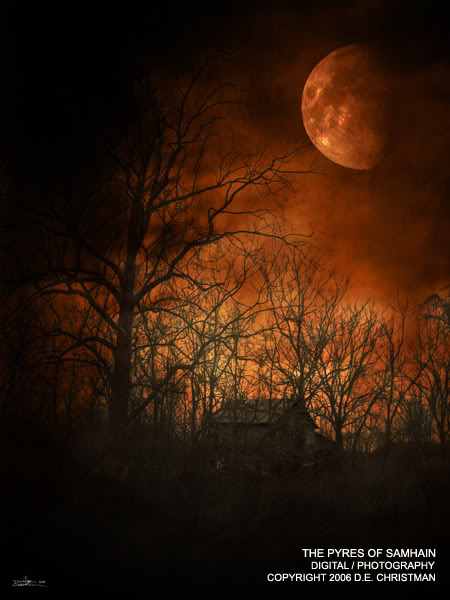
Samhain Musings…

Samhain, the time when the veils between the worlds are thin… I’ve been wondering about this term of phrase lately.  Why, on certain dates of the year, should the veil be thinner than at other times? Is there even such a thing as a veil between the worlds?

More and more I lean towards the negative – that there is indeed no veil, that the dead and the living walk side by side.  That there is no Otherworld, that the Otherworld and this world are all the same – it’s only our perception of it that makes it “other”.  We like to separate things, we human beings, to classify and put them in a place where we can understand them from a stand-offish perspective.  I would posit that, looking at nature, nothing is that simple, or can be tied so neatly to an idea.

Taking inspiration from the natural world around us, we see the living and the dead working together all of the time, whether it is autumn, winter, spring or summer.  Things are dying around us constantly – there is no specific season for it. Animals die, plants die, cells die – it does not wait for autumn. I admit, in the Fall we see the foliage around us withdrawing into itself, the leaves falling, the grasses returning to their roots, energy moving in different directions, from out into the sunlight to deep within the earth. This is not a death, however it may appear – simply a reversal of direction.

Like the double helix, energy is always moving, and never in one direction only. When everything appears to be dying here in the Northern Hemisphere, it is beginning to come to life in the Southern Hemisphere. The tides and times of life follow no one set of rules.

I may die in the autumn, I may die in the spring. Whenever I do die, my body will in turn nourish the soil, plants, fungi, animals and legion of other living beings on this planet in that great symbiosis of simply being. It does not rely on a season.  I do not cease to be, either. I simply cease to be in some form or other – my body will take on a new form. My soul – I believe that too will take on a new form, if nature has taught me anything.

In our agricultural year and society here in the Northern Hemisphere, we are at the end of our harvest season, and in that time we are able to take a break as the final crops have come in.  But we are still making our preparations for winter. Is there really a time to rest, to relax, before the snows come?  For some animals this is the busiest season, the squirrels squirreling away their stores, for example.  I’m sure our ancestors would have been busy all throughout the year, just trying to stay alive.

I’ve often thought of autumn as a time of rest, of rejuvenation.  I see now that perhaps “rest” wasn’t quite right.  Autumn is more a time of reflection, of going through what we have learned through the year, and through all the years of our lives.  It is a time to not stop, per se, but to take stock.

Along the way, our ancestors, who are with us always, can help us, guide us throughout our lives.  Having a special time of year set aside to acknowledge them is a good thing, but I would posit that we should honour where we have come from, our stories and our heritage, all that brought us to this point in time each and every day.  It is not a one-off thing. Like the holiday of Thanksgiving, I really enjoy and appreciate the sentiment, but carry that same sentiment with me throughout the year.

All that being said, this IS my favourite time of the year. I love the colours, the smells, the feeling in the air of the approaching winter, the stories of summer lingering upon our lips in reflection and contemplation.

Side by side with the ancestors, I honour the season, the tides and times of life, death, and rebirth.

Sacrifice

(This is from an article that I wrote for The Druid Network a few years ago…)

Many people in the pagan community have differing ideas on the concept of
sacrifice. Here I can only offer my own view, to share with others. These words,
much as the notion of sacrifice, are a purely personal experience.

Let me first describe what to me is the difference between an offering and a
sacrifice. Offerings can be daily elements of the ritual of our lives; offerings
of incense, of songs to the dawn, food from each meal. Offerings are often given
in thanks; for the day, for the restoration of health to a loved one, for a
wandering pet’s return. For some, offerings are a return of what we have in
abundance, for example, a farmer returning a sheaf of wheat to the land, or some
of the autumn’s blackberry port that was made poured back beneath the bushes
from whence the fruit was obtained. Offerings are used to establish a
relationship, to give back for what we have received in turn from an honourable
existence. They nurture a relationship. So, in that context, what is sacrifice?

For me, sacrifice is something that you just don’t want to give up. It hurts.
Yet, to be able to move onto the next level, to deepen a relationship further,
instead of just nurturing it with an offering, a sacrifice must be made.
Sacrifice is giving up something that is sacred to you. It can’t be easy. It
can’t be something that has outlived its purpose. It can’t be something that you
don’t really care about, or that you have in abundance. It can’t be something
that can be replaced. It has to show dedication, devotion, commitment. It has
got to hurt.

When I speak of hurting, I don’t mean physical pain, although that too in a
way can be seen as a sacrifice. If something will forever be changed because of
it, then perhaps it can be deemed as sacrifice (a tattoo, for instance). To push
through barriers of pain can be a sacrifice of what we strive for as human
beings – comfort being one of the greatest drives. Yet there can be an emotional
pain in sacrifice as well. That the physical pain in sacrifice is our own cannot
be questioned – we should never harm another being in the name of sacrifice, or
for whatever reason. If we are to sacrifice our own personal comfort, then it
must be sufficient to move onto a new level of relationship. We may not always
be willing to sacrifice, however, we can be ready to.

Some argue that time can be sacrificed, yet I would argue that if one has
come to a relationship with the god of Time, then one will find that they have
all the time in the world to attain what they wish. Time, for me, can only be an
offering, even though it can be seen as irreplaceable. Time is not a sacrifice
when it means spending more time at the local soup kitchen and less time in
front of the television – it is merely a reprioritising of time, and what is
important.

Can money be a sacrifice? Again, this for me is more of an offering than a
sacrifice for most people. Money can be replaced, for instance. Yet, if one
gives all their money to another, is that not a sacrifice? Perhaps yes, perhaps
no. For me, money can always be made, yet I live in the luxury of not worrying
too much about where my next meal comes from. So, for me, money is an offering,
much as food and time.

So what constitutes sacrifice? In my own experience, an item (so far it has
always been an item) must be thought over for hours, even days, as to whether or
not I wish to sacrifice it. If I can find other things that I would willingly
sacrifice before it, then they are not worthy. Some might think of this train of
thought as merely masochistic. Again, it comes down to what is truly sacred to
one’s self, and what one needs to do in order to progress to the next level.

Recently, I spent all night in my tepee, knowing that I had to sacrifice
something in the morning before the ritual. I knew that I wanted to go deeper
into my druidry, and that the spirits of place and my gods required it of me. I
hummed and hawed over it, wondering if I had anything else in my pack that I
could sacrifice instead of my beloved and sacred bead bracelet. I didn’t. It was
either my eagle pendant or my bracelet. I couldn’t sacrifice my wooden beaded
necklaces, they were just too easy – I didn’t have a large enough emotional
attachment to them. The spirits of place would not accept that offering, as I
felt. It was not sufficient in order to attain the deeper relationship
that I craved. My eagle pendant, after long thought, was replaceable, though I
would miss it dearly in the months that it would take to find another one. My
bracelet, however, one of a kind with many dear memories attached, was not at
all replaceable. That would be my sacrifice.

I have also sacrificed a medicine bag, and a wedding ring. None of these
items I wanted to let go, but just knew I had to if I was to progress
along my spiritual journey. I miss them dearly, but the value in giving them up
makes up for their loss, in a sense. I have a deeper understanding about myself,
about what is important to me, and by sacrificing these things to the spirits I
feel that they know me better, know my intentions more clearly, and that we have
a stronger, deeper, newer and more committed relationship for it. To me, that is
the true nature of sacrifice.

Reblog from SageWoman: Samhain Approaching

My latest blog for SageWoman’s online channel: http://witchesandpagans.com/SageWoman-Blogs/samhain-approaching.html

Digital art by Ado Ceric, http://www.adoceric.com/Digital7.php

Digital art by Ado Ceric, http://www.adoceric.com/Digital7.php

As I sit here, writing this, the rain taps at the window, the wind howling down the street, carrying with it the scent of winter and the first of the autumn leaves. The sky is fast moving and furious – low dark grey clouds set amidst a backdrop of pure white/grey.  The central heating has been turned on.  The apples are juicy on the trees.  The starlings are flocking together. Welcome, Autumn.

My favourite season – as you may have guessed. From bright, sunny days where the sun shows the last of its strength, to watery, wind-filled days like these, it is a season of change like no other.  Quick, altogether too quickly, it is over, at least the Fall is, when the leaves change and drop to the ground.  After that, it seems Winter is here – only allowing Autumn a brief time of grace to shine in her beauty before all is blanketed under the dreamy cold slumber of Winter.

It is third week of October – and the hectic days of summer leading to the Equinox have long passed.  I feel I can almost catch my breath – almost.  The main bulk of the harvest is done – both agriculturally and in a personal sense.  I have worked hard this year, and the rewards have been great.  There are always disappointments – from the tomatoes that didn’t do well to the vagaries of life.  But Autumn, with her beauty, captures our hearts and our minds, our attention, and causes us to stop, to listen and watch Her before She is gone.

Samhain is just around the corner.  Time to let go of that which did not come to fruition. It is also a time to carry forth and collect the seeds of our new intentions – for we cannot throw these to the winds just yet.  We release the dross of our lives into the flames of Samhain fires, and protect the seeds of new ideas and next year’s harvest within the larder of our souls.  We cannot release everything – we must hold onto something to take us into the new year, something to sow our intentions with. It could be lessons learned, ideas that did have the time to grow, or ideas that came too late in the season to be utilised to their full potential. And so carry them over we must.

I hope your harvest has been bountiful, and that what you carry over be blessed as well. May the release of Samhain and the dreamy slumber of winter nurture you. May you find beauty and strength in this, the most inspiring and beautiful of all seasons.  May the Goddess of Autumn bring you joy as she does me. x

Reblog : Standing on the knife’s edge of the equinox

Here is a reblog of my post on the SageWoman’s channel at Witches and Pagans… http://www.witchesandpagans.com/SageWoman-Blogs/the-knife-edge-of-the-equinox.html

Now we are diving deep into the cool waters of the West, into autumn’s light.  The equinox is just around the corner, and the new moon of September passed.  This year we will be blessed by a nearly full moon over the equinox, which is at 21:44 on Sunday, 22 September (where I live in the UK).  The tipping point is near, the balance will shift, and we will enter into the fading times of restful thought, of dreaming in the dark.

This is a pivotal point of the year.  Relishing in that special moment, when day and night are equal, we can ride that wave of energy, humming with all that we bring to it, the sacredness of the time and place in which we celebrate.  Standing at the edge, looking over the horizon for a moment, maybe two; we breathe deeply before we fall forward into our lives once again, with its cycles and spirals.

As we plunge into the depths of the dark half of the year, what will we bring with us along the journey?  Now is the time to think about what it is that we wish to carry forward, and what it is that we wish to leave behind.  It is a time to think about honour, integrity, loyalty, courage and wisdom.  It is a time to look at our actions, at our lives, and see in what way we can live in a more truthful way to our own wild natures, yet still moving within the compass of compassion and awareness.

Are you living your ethical code?  Are you in tune with your moral ideal? If not, now is the time to address that.  Looking over the year, our lives, generations upon generations of souls, we see what seeds have been planted, and which are most beneficial for all.  We carefully collect these seeds, to carry them with us through the dark months, to plant again next year.  We hone our sense of ethics, we look deeply into the meaning of honour.  What actions have we made that have been dishonourable? What will we do to ensure that this does not happen again? How can we live in tune with our ideals, and support our community, our planet, and our universe?

I know I am breathing deeply of late, with prayers into the growing dusk and spending time reflecting upon what has been, what requires change.  For me, autumn is a time of reflection, the light upon the water. And as I stand on the knife’s edge, I hold close to my heart my inspiration, my awen, and laughing I will fall forward into the cool darkness of winter, knowing that the cycle continues.

Four Mantras for Good Relationship

Vietnemese Zen Buddhist monk, Thich Nhat Hanh recently spoke in a live webstream from Plum Village (the community he set up in France) about many things, one of which really struck a chord with me about relationships.  He has produced four mantras which help us to learn compassion for each other, and to better open up lines of communication, which is key to any relationship. The four mantras are:

  • Darling, I’m here for you.
  • Darling, I know you are there…and I’m so happy you are there.
  • Darling, I know you suffer…that is why I am here for you.
  • Darling, I suffer – I am trying my best to practice. Please help me.

The first mantra, “Darling, I’m here for you” demonstrates that the other is not alone in this world. Indeed, we are never alone – the idea of being alone is one that has hounded us ever since we made the mind/body disconnection.  The rationalists and the materialists have argued this one thoroughly, so I won’t go into it here, but suffice it to say that within most branches of paganism, the mind are body are thought of as connected.  That being said, through our bodies we are all connected to every other thing on this planet – we contain minerals in our blood that are found in stars, we breathe the air our ancestors breathed, we are all held down by gravity.  There can be no separation in the truest sense.  Our current lives lead us to believe that there is separation – could this simply be a marketing ploy, to divide and conquer?  Something to think about later… but I digress.  When we say “Darling, I’m here for you” we are putting the needs of another ahead of our own, as well as showing them that they are not alone.  In today’s society, that can be and is a great gift that we can give to others.

The second mantra, “Darling, I know you are there, and I am so happy you are there” shows us the joy that others give us, simply by sharing this journey is life.  It is a simple recognition of another soul, which again in today’s society can be so lacking. We lead such virtual and busy lives that speaking these words can reconnect us to the one that means so much to us.  We take so many things for granted, and we should never, ever take our loved ones for granted.  We must remind ourselves each and every day how wonderful it is to have these people in our lives. Allowing ourselves to feel the joy in having someone in our life is another gift, and when we express that joy, that joy spreads throughout the world.

The third mantra, “Darling, I know you suffer, that is why I am here for you” enables us to feel compassion for others in our lives, to show them that we see that they suffer.  So often people feel that they are suffering alone, and when we acknowledge the suffering of others, we immediately have more compassion for them, whether they are our loved ones or not. Everyone is fighting their own battles.  This changes not only our worldview, but changes the perception of those whom we are trying to connect to. Simply listening to someone, truly listening to them, is a great aspect of this mantra.  So often we are not listened to – we are often heard, but is anyone really listening? To give your full heart and attention when someone is trying to connect with you, or vice versa, is key to any relationship.

The fourth mantra, “Darling, I suffer – I am trying my best to practice. Please help me” is perhaps the hardest one to fulfil.  So often our egos get in the way that we simply cannot ask for help, let alone allow others to see our suffering.  How many times have you “suffered in silence”? Why do we do this?  Sometimes, when a loved one has upset us, and then they ask us “What is wrong?” our immediate response is “Nothing,” filled with anger, fear and tension.  They know that something is wrong, but we refuse to tell them in an attempt to punish them for hurting us.  If we allow that hurt to express itself, it will not linger and communication can open up in order to find a resolution.  If we simply answered the question, without judgement or anger, we might be able to see the other side.  We must admit to others that they have upset us, and we must do our best not to let our anger get control. We feel our anger, but we do not attach to it. By not attaching to it, we can talk about it with greater compassion and find greater healing.  We do our best to practice.  When we ask for help, we are putting aside our egos and allowing that other person in.  It’s not easy, but it does change everything. So often our anger is based on a misperception, and allowing the room for that perception to be corrected gives us greater scope for compassion in the world today.

These four mantras are changing the way that I relate to others, I feel in a truly positive and beneficial way for everyone.  For that, I am truly thankful!

Reblog from SageWoman: In Autumn’s Light

Deer in the mistHere is my latest blog for the SageWoman’s blog channel at Witches and Pagans, on the subject of the coming of autumn, my favourite season. x

http://witchesandpagans.com/SageWoman-Blogs/in-autumn-s-light.html

Living with Right Speech

From Lammas, the first harvest, to the Spring Equinox, in my spirituality I focus on a specific aspect of the Buddhist Eightfold path – Right Speech.  For every one of the eight pagan festivals, I have corresponded a part of the Eightfold path, finding a great blending of the two traditions together (see my book, Zen Druidry, for more details http://www.moon-books.net/books/pagan-portals-zen-druidry).  To me, at this time of year when the Celtic peoples gathered together to celebrate the harvest, participate in games and competitions, wedding ceremonies and such, considering how to converse and behave appropriately was paramount in order for the tribe to thrive and meet other tribes without violence or bloodshed.  I see this paralleled in the Eastern concept of Right Speech.

So, what do we mean when we speak of Right Speech?  The concept of right speech involves four elements; abstaining from false speech, abstaining from slanderous speech, abstaining from harsh speech and abstaining from idle chatter.  For the Buddhist, this shows the sacredness of speech, and gives us a framework within which we can work towards more compassionate and thoughtful speech.

Here is a quote taken from The Secular Buddhist:

“The Buddha divides right speech into four components: abstaining from false speech, abstaining from slanderous speech, abstaining from harsh speech, and abstaining from idle chatter. Because the effects of speech are not as immediately evident as those of bodily action, its importance and potential is easily overlooked. But a little reflection will show that speech and its offshoot, the written word, can have enormous consequences for good or for harm. In fact, whereas for beings such as animals who live at the preverbal level physical action is of dominant concern, for humans immersed in verbal communication speech gains the ascendency. Speech can break lives, create enemies, and start wars, or it can give wisdom, heal divisions, and create peace. This has always been so, yet in the modern age the positive and negative potentials of speech have been vastly multiplied by the tremendous increase in the means, speed, and range of communications. The capacity for verbal expression, oral and written, has often been regarded as the distinguishing mark of the human species. From this we can appreciate the need to make this capacity the means to human excellence rather than, as too often has been the case, the sign of human degradation.” http://www.thesecularbuddhist.com/nep_04.php

Living in such a verbal society, we must take extra special care of our words, both verbal and written.  It is an increasingly difficult thing to do, in my opinion, when we are living “virtual lives” more and more with the internet.  We have an “online presence” as much as our real physical presence.  It is up to the individual how closely the two are related.

What we say, both physically in face to face encounters, as well as in a virtual community or forum may have varying degrees of impact, dependent upon who is actually listening.  The fact of the matter remains – whether it is virtual or physical, there is an impact.  For someone to be cruel to another person online could have devastating consequences (as we have seen recently with the suicide of two teenagers bullied on a social media forum).  A person may be attacked by an online community, and feel no repercussions whatsoever.  In a face to face situation, the reverse might happen.  One thing remains – we are personally responsible for our own behaviour, for we cannot control the behaviour of others. We can lead by example, but underlying fundamental control of others is beyond our grasp.

I have been verbally attacked on social media forums, bullied and trolled.  As yet, it still does not get any easier with time.  I stand by the view that the internet is as much a tool for sensitive souls as it is abused by being a playground for trolls.  I do not think that sensitive souls should have to “toughen up” in order to be online or to deal with face to face encounters. I think that people should be responsible and culpable for their actions, whether virtual or real, and take others thoughts and feelings into consideration.

As a recent example, a friend of mine told me that there is now a new term in a couple of UK LRP (LARP) communities/systems which is replacing a previous term.  He finds this fascinating, as he loves studying etymology.  It is indeed food for thought!  The previous term within the community was “special snowflake”, something that people used to deride another person on the basis that snowflake in question thought of themselves as being unique, and therefore life should go according to their own terms on this basis.  The new term that has cropped up to replace this,  is “bluebell”.

Now, some of you may know of my decision to abstain from a particular company due to the reason that I cannot condone the fact that each spring they hold battles in woodland that is carpeted with the most brilliant bluebells.  For an in depth look at this, please see my previous post “ Druidry and Choices” here: https://downtheforestpath.wordpress.com/2013/06/04/druidry-and-choices/.  It would appear that some players have decided to take it upon themselves to take this particular subject and twist it around to insinuate that I was a “special snowflake”.  There was some agreement by players on a social media board, before it exploded and abuse and trolling were hurled by some members.  All I asked what if others felt the same way as I did about protecting what I saw as a beautiful woodland – I did not, in fact, want to change the system to suit my needs.

And so, the new term “bluebell” has been born to denote a self-centred, self-indulgent ignorant person who wants to have their own way as opposed to someone who loves and cares for the environment.  This was, in all honesty, quite hurtful for me to hear, and I wondered at the people who would twist such a simple stance to suit their own agenda.

Then it got me thinking.

So, why on earth would someone want to do such a thing?  The obvious response is that it makes them feel better about themselves by putting someone or something down.  I cannot know for certain, however that this is the case.  Looking at popular culture, however, would seem to indicate that this may, indeed be the way that things are heading.  Why? Because more and more we see people criticising others using derogatory terms.  Instead of discussion, debate and honest criticism, we see through television and other media people judging other people with harsher and harsher verbal terminology.  Just watch any “reality” television show where they have judges – how many judges simply put a value on a performance without becoming personal?  There is a growing trend for celebrity television judges to make it personal, to get people on their side, to appear “cool” or “funny”.  This is also the case in everyday life.

In our ever-growing faceless society, the need to “save face” is, ironically, coming to the fore.  With an unseen audience of who knows how many, we feel we have to witty and clever. (Yes, I do see the irony in putting this in an online blog).  For some, the easiest way to do this is by putting another person down – in essence, to be “bigger and more clever”.  Well, as the British saying goes – it’s not big and it’s not clever.

Having spoken to people in science based professional fields, there still seems that there is the ability for disagreement on a subject to occur within the professional sphere without someone feeling the need to act “big and clever”.  Of course, there are always exceptions, but generally debate is still held within certain bounds of respect and integrity that may be lacking in popular culture debates and interactions.  They are able to criticise things without being derogatory, something which I think is falling by the wayside in mainstream society.  I’m still mulling this one over, and your thoughts would be appreciated!

I’ve said it before and I’ll say it again – you don’t need to blow out someone else’s candle for yours to burn all the brighter.  We can use words and speech, whether online or offline to interact with each other respectfully.  In Zen, it is agreed that we cannot control the behaviour of others, and so to ponder why people do the things they do is, in fact, a bit of a waste of time.  But I still do wonder why people do the things they do – I can’t help it, and I’m working on it as much as I can – I’m no Buddha.  I find it easy to have pity for people, however, pity requires making a judgement call on their life which may or may not be true – ie. I pity someone because they must have such a dull life they have to hurt other people to make themselves feel better.  This isn’t right, I know.  What I should be doing is having compassion for people – compassion, unlike pity, requires a total lack of judgement on the individual’s part.

Compassion is both the easiest thing and the damned hardest thing in the world.  To learn the ways of compassion, one must first release the notion of the self, the ego that one clings to, in order to see that we are all related, that we are all connected – that there are no “special snowflakes” or even “bluebells” 🙂   There is no one to hurt and be hurt by.  We are all Buddhas.  By taking advice from Buddha’s Eightfold Path, we can learn how to live more compassionately.  By focusing this Lammastide on Right Speech, I hope to change my behaviour so that I may benefit the world and not just my own agenda.  Like racism, sexism and a host of other human ills, hateful speech is learned behaviour.  The good thing about that is that it can be unlearned.

Like I said, I’m working on it.

Namaste

These past two months, and these last two weeks in particular, I have noticed an increase in disrespectful behaviour on several Facebook groups that I am a part of.  Some of these groups have absolutely nothing to do with each other, so there is no correlating theme that might suggest crossover between them. So what is causing people to behave so badly in a public forum?

Trolling and dishonourable behaviour has always plagued online discussions, due to the lack of face to face contact and the deterioration of basic social skills as a result of an increased virtual presence and virtual world.  One can very easily be rude to a faceless person, or a faceless mass – there is no real-time, real-life repercussions in most cases (barring those individuals who have been prosecuted for various internet related crimes and misdemeanours, such as bullying or trolling on gross levels, often involving minors).  It’s a sad state of affairs, and I fear for the future of social interaction in a world where people are addicted to their phones and other social media (yes, I spot the irony in an online blog, but bear with me) and are increasingly isolating themselves whilst under the illusion of always being connected.

People being rude for apparently no reason, people are trying to publicly shame another person or group, people for whom basic manners is all but lost, people with low self-esteem or any other number of issues that lead too poor behaviour.  But why this sudden increase lately?

I wonder whether it has something to do with the weather.  Here in Britain, in a climate that for the most part does not suffer the extremes that other countries deal with on a regular basis, when it is very hot or very cold there can be a rise in poor behaviour.  These past few weeks Britain has experienced a heat wave, which may have something to do with what is happening in these groups.  In Psychology Today, Amie Gordon states “in the summer, hotter weather was associated with being in a more negative mood. Heat is also associated with increased aggression. So when you find yourself feeling sad, grouchy, or wanting to punch someone in the middle of summer, try taking a weekend trip to somewhere cool.”  (For the full article, see http://www.psychologytoday.com/blog/between-you-and-me/201301/sour-in-the-sun-3-unexpected-ways-weather-affects-your-mood).  Dr Joh Grohol wrote a in his online blog “Heat waves are related to more violent behavior and aggression,  may be associated with higher drug and alcohol abuse,  anxiety tends to decrease with a rise in temperatures,  depression and lowered mood tends to increase with a rise in temperatures, high levels of humidity — which often accompany a heat wave — lower concentration,  high humidity also increases sleepiness (probably related to poor sleep) and  high humidity also appears related to a lack of vigor and energy”  (http://psychcentral.com/blog/archives/2011/07/20/the-psychology-of-a-heat-wave).

Though we are not, and can never be, separate from external forces such as the weather, we are also highly equipped to deal with our emotions and behaviour through cultural and social standards, upbringing and self-discipline.  We are not slaves to these either, but can use them to help reinforce a positive world-view and to make this world a better place for all beings. It is entirely in our hands.

When we are engaging with the world, whether it is using an online presence or a physical face to face engagement, we have to remember that we are dealing with another soul.  This is a person who has thoughts and feelings, a history and a future, a journey in life that they are trying to complete perhaps as best they can.  It’s all too easy to forget this.  I am often reminded by the simple Hindu word/phrase, Namaste – my spirit honours your spirit.  (http://en.wikipedia.org/wiki/Namaste). Keeping this in mind has helped me a great deal.

This is not to say that simple acceptance of bad behaviour should take place, that we cannot change the world, that you shouldn’t stand up for what you believe in – if you need to speak out on an issue, then you should, with honour and respect.  I have done so in the past, and indeed am currently doing so in this very blog.  Note that I have not named names, groups, or anything that would personally implicate another soul.  Instead, I am trying in my own little way to work through this issue, have my say and try to make the world a better place.

So, if you are ever tempted to belittle, degrade, shame another person, either in person or in an online forum, perhaps in the hopes of getting people to “your side” of the issue, remember that there are no sides, that there is no real need for this behaviour, no positive effect on the world at large.  Talk about it, talk it through with respect.  Love and compassion are key, and where two souls meet but cannot agree, then, with respect, bow and walk away.

Being kind is not difficult.

And if all else fails, find somewhere cool to think it through first. Namaste

Welcome Home – Soul Retrieval Part 3

IMG_1505 (800x600) (2)The final piece awaited, locked within myself and held in trust by an old friend.  I had found those fragments of my soul through a two week exploration, being in the beauty of my ancestral home and surrounded by family.  It had been a lot easier than I had anticipated – perhaps it had something to do with being home, physically home in a place that meant so much to me. At any rate, it was the right choice to make, to follow this path of soul retrieval and finding the essential self on my own, instead of following the “traditional” shamanic route.  I am more comfortable with my own tradition – to each their own on this gorgeous journey of life.

The fourteen year old girl who hid away because she was bullied and found sanctuary with the horses in the valley – all I had to do was stand at the valley edge, where I could see her, extend my hand and watch her turn to me, smile, and extend hers – across the valley she flew back into me.  The 24 year old woman, who was about to leave Canada for the first time with her new husband, once again leaving behind everything she knew to face the unknown, and who did not want to come with me, choosing instead to remain on that path that she walked every day as she waited for the visa clearance – she was equally easy to find.  On a hot, humid evening I found her as I walked down that same path, and she walked towards me and straight into me, my heart feeling full as I told her that everything turned out okay, that there was nothing to fear. She settled at once within me and I felt both heavier and lighter at the same time, my heart a little fuller.  I now just needed one more piece to make the puzzle complete.

And so we went to the power spot, where the river met the lake, in the late afternoon sunshine.  In the sand on the beach, I drew a circle around me, reinforcing the nature of the cyclical, the sacredness of the world, the fact that there is no beginning and no end.  I made my prayers to the spirits of place, the four quarters of the world and the ancestors.  I sat down and made clear my intention, and then my friend joined me to help.

He reminded me of that part of myself that I felt I had left behind, that I had trouble reaching lately. He described, in detail, aspects of her that I had forgotten completely. Seeing myself reflected through his eyes, she came back to life.  Being with someone who knew me so deeply was not only a comfort, but he was also my guide back to her. And in doing so, he surprised himself by finding a part of his own soul that he had nearly forgotten.

With open arms I welcomed her back. We hugged each other with tears in our eyes as we both remembered our essential selves, and honoured the beauty and sacredness of the moment, this life, this world.

Welcome home.

Grab that strawberry!

The wild strawberries are now out in my garden, and I am reminded of this Zen story.

A man traveling across a field encountered a tiger. He fled, the tiger after him. Coming to a precipice, he caught hold of the root of a wild vine and swung himself down over the edge. The tiger sniffed at him from above. Trembling, the man looked down to where, far below, another tiger was waiting to eat him. Only the vine sustained him. Two mice, one white and one black, little by little started to gnaw away the vine. The man saw a luscious strawberry near him. Grasping the vine with one hand, he plucked the strawberry with the other. How sweet it tasted!

What if I told you that we choose to let our emotions, our grief, the struggles of living day to day affect us?  Who on earth would willingly choose to allow these to happen? Those who are afraid to face them, to engage with them. They are often the people who believe that mediation is all about pushing your feelings away for a space in time in which to breathe. While this can be a short-term coping mechanism, in the long term it achieves nothing. We must choose to face the abyss, and have the abyss stare back at us (Nietzche).

So many people believe Zen or Buddhist meditation is all about emptying the mind, to achieve nothingness. To wilfully push out everything and focus on nothing. However, in doing so, as soon as when we stop focusing on nothing, everything else comes rushing back in.

If, instead, we focus on issues that we are facing when we meditate we can resolve them – perhaps not all in one sitting, but over time, getting to know our fears in order to work with them.  We’ll never know how to break free of our demons until we can name them.

Simply sitting, zazen, is a brilliant tool for focusing the mind on the here and now. Laying aside the past and future for a session, we immerse ourselves in the present moment, fully aware of everything going around us.  Sometimes when we do this, feelings come up, of sadness or despair, joy or tranquillity.  We can ignore these feelings, and see them come back and back again, or we can engage with them.

Engaging with them does not mean to fall utterly within their tantalising spell, however. Through our previous sessions of simply being in the moment, focused, we have developed two great tools – the power of concentration and the power of detachment.  Think of them as your power tools 😉

Using concentration, we can fully focus on the emotion, the memory – whatever it is that pops into our head, giving it our full attention. With detachment, we see it for what it is – something that exists in our minds only, that has no substance.  Using both tools, we can delve even further if we so wish, looking to where the thoughts may stem from.  Then, equally with both tools, we can see that it is a choice as to whether we allow the thought or memory to control our lives, or whether we choose otherwise.

It’s our choice as to whether we hold on to things, or whether we engage with them.  You can’t fight what you don’t know. Face the fear, the emotion, and come out the other side, naming it, staring straight back at it, knowing that it no longer has a hold over you. Some demons never go away, but are silenced for a time, and letting go is never a one-time process. We have to let go each and every day, face our fears, our emotions, stoically in order to understand ourselves and others.  Enjoy the present moment.

It’s your choice.