Awen and Peace – East meets West

Further exploring the nature of peace, what leads me to understand the fundamental precept behind achieving peace is through compassion.  But what is compassion?

Dictionary definitions say that it is a state of sympathy with someone who is suffering, and yet that doesn’t adequately describe compassion in my mind, in either the Zen or the Druid tradition.  Two words in Sanskrit delve a little closer, such as karuna, a gentle affection and a willingness to bear others’ pain, or metta, often described now as loving kindness, acting for the benefit of all living things with a selfless attitude.

The Dalai Lama stated “Genuine compassion must have both wisdom and lovingkindness. That is to say, one must understand the nature of the suffering from which we wish to free others (this is wisdom), and one must experience deep intimacy and empathy with other sentient beings (this is lovingkindness)” –  (The Essence of the Heart Sutra).

For me, compassion is all about relationship, about an integration with the world, with the universe. As the native American saying goes – “We are all related”.  (Not just humanity, but essentially go far enough back and see that we are all star stuff.)  In order for this integration to occur, we have to learn how to lose that sense of self, for is there is a separate self, there can be no true integration, only the state of sympathy.  There is someone observing someone else’s suffering, and helping to alleviate their suffering but still retaining a sense of Us and Them. In Buddhism, wisdom, or prajna, is most often found through the teachings of No Self, or attana.

In my studies in Zen Buddhism, we are taught to help wherever we can, as selflessly as is possible, which is true compassion. If you help someone and then expect a reward, there is still a separate self expecting reward from a separate person.  We have to learn to drop all expectations. The Tibetan practice of Lojong’s final slogan is brilliant in this regard – Do Not Expect Applause.  Only then, there is there an integration of everyone involved.

In Druidry, this integration is often termed as relationship – but again, words fail to describe the enormity of the meaning behind it all. Druidry also uses the word, awen, a Welsh word with several interpretations: poetic inspiration and flowing spirit to name a few.  For me, awen is the life “force” itself, in its myriad expressions, in constant change and flux.

To find true peace, one must release into this, into awen, losing that sense of separateness, and in doing so discovering the nature of compassion in soul to soul relationship.


Exploring the nature of criticism…

I don’t put much store in astrology, but when people say Virgos are very critical, I can’t really deny it. All the Virgos that I know are – then again, I also know a lot of people who aren’t Virgos who are…

Ever since my post on the death of Margaret Thatcher and my criticism on the subsequent behaviour of those who downloaded Ding Dong I have been thinking about the criticisms that I hold on to in everyday life, and those that I feel I need to share with others.

In order to criticise something, there must be a sense of self, someone who is standing back and commenting.  Yet in Zen, the goalless goal is to integrate completely, so that the sense of self falls away and we are completely immersed in the here and now, in the environment, in life itself.  As a Druid this is so very appealing, for I long to release into nature to become a part of it; to stop distancing myself from it with ideas and notions of who I am, which are constantly changing anyway.  Pondering on the idea of self, Zen would offer that the sense of self is but an illusion that we create and cling to, for various reasons – out of security, fear and ego-driven desires.  Therefore, holding on to an illusion is a little bit of a waste of time. Criticising someone else’s is a total waste.  If it’s not real, there’s no point.

We have this idea about our selves, that we have created throughout our lives.  What if this sense of self was just those ideas that we repeat the most, the ones that we like the best (or hate the most), the ones that shout the most loudly in our heads? Ideas are not real things – they are abstracts.  Experience is the key here, for experience is not an abstract.

So, back to criticism – in a Zen Druid worldview, is it ever right or worth the effort to criticise something?  There’s that old adage – if you’ve got nothing good to say, don’t say anything at all. For me, this is not enough, for when something needs changing, when those who can’t speak for themselves need a voice, I will speak out against it.  The key here is to do so with respect, honour and integrity. I’m still learning.

Also, offering criticism when it is not asked for is an easy trap to fall into.  Our lives are filled with it – we are inundated with television shows like Big Brother, or more importantly other reality shows such as The X Factor, Dancing on Ice, Strictly Come Dancing, etc. where we are expected to criticise, where we are voting for who we wish to win.  The judges on these shows often criticise dishonourably, mocking and offering nothing helpful. Sometimes they are offering good criticism and are right (at least, we agree with them).  (Spot the paradox – I just criticised judges on reality shows J).  At any rate, what these shows may do is to make us feel better about ourselves, with an underlying fear that we could be that person being criticised.   What I am suggesting is that maybe we need to detatch from the world of dishonourable relationship, where criticisms are just plain mean, or mis-informed.  I know I’m still working on it personally, as per my Maggie post earlier.

In Zen Buddhism Right Speech is part of the Eightfold Path.  I remind myself of this every time that I can before I now offer criticism.  Yet Right Speech does not say “do not to criticise”, but rather to reflect on whether this criticism is beneficial to anyone.  Talking about people behind their backs, offering criticism when it is not asked for, or condemning people when you have absolutely no idea what their motivations are is not altogether “right”.  Yet Zen states that we will never fully know the motivations of others, and that reflecting on this is also a waste of time.  So before you say something about someone, ask yourself – “Is this beneficial to anyone? Is this making the world a better place?” If so, then go ahead – with love and compassion we certainly need to do this in our world.  If the answer is no, then keep it to yourself, or even better, let it go, seeing it for what it is – an illusion, in most cases.  We are not omniscient – therefore our opinions on most things are subjective, and indeed flawed in that regard.

In Zen there is a saying – “Do not seek the truth, only cease to cherish opinions”.  This really strikes a chord with me. It is not saying that we shouldn’t have opinions, but that we should hold to them lightly, for how often has your opinion on something changed?  My Thatcher post and subsequent discussion changed my opinion, certainly.  If we cherished opinions so highly, we could never learn new things, progress and really be in the here and now, in a state of true experience. We would be holding so tightly to things that shift and change, that are never constant. It’s like trying to hold water in your hands – no matter how tightly you squeeze, a little water always dribbles out.

So, next time I am about to criticise something, I will consider Right Speech. I will also question what or who it is that I am criticising, as well as just who I think is doing the criticising. Most likely, I will have no idea on either score, and therefore either keep my mouth shut or investigate further, delving deep into experience before coming to any conclusions.

Having a critical mind is a wonderful thing.  It can really help us to see what can be done in the world to make it a better place. How we use it is entirely up to us.  Also losing your critical mind can be a wonderful thing, being utterly absorbed into the natural world, at one with everything.  The paradox is delicious.

Recharge, Renew, Release

We all need a place to retreat to, every now and then.  A place to withdraw, to regroup, to reharness our energy and so to come back out into the world with renewed energy.  Everyone is familiar with the summer holiday, or some time off in the bleak of midwinter.  These are chances to lay aside the worries of work, and to get back in touch with yourself, your family, and what really matters.  However, what if we managed to do that each and every day? Mini or micro-breaks, at least once a day, to reconnect those threads of the weave that we have dropped, to re-establish relationships and to fully honour the time that we are alive…

Every day is a chance to stop, to enter into ritual, to take a step back and simply savour the moment.  We can become so out of tune with our own bodies, is it any wonder that other people often baffle us?  By understanding our selves, we can better understand others, and so work to help others in a more positive and productive way.

So we create the micro-retreat. Once a day, we stop, and take a moment to watch the moon, or sit on a cushion and meditate, to attune to our sense of self.  When we find that centre point, that sense of self, we can then let it go, and seek out the deeper connections that can be found when the self is released.  We are all living on this planet together, and by dropping that sense of self we can release into the flow that is awen, that is life and inspiration itself, flowing through space and time.  It is a chance to connect with the earth, with deity, with everyone and everything on the planet, instead of just your own sense of self. How wonderful is that?

I do not underestimate the significance of focusing on the self in order to improve one’s life – change must come from within.  However, there is so much more to the world than the little universe we create around our sense of self – a brilliant world full of myriad possibilities.  Take for instance the ability to shape-change – we must first be able to drop our sense of self in order to take wing as the marsh harrier, or stalk a pheasant through the underbrush like a fox.  On a broader level, we can simply place our hands on the earth and feel all of life humming from this planet, but first we must silence the chattering self within in order to listen and to hear it fully, with an open heart.

To be able to open ourselves up to the grander scheme of things, we must find a place where we are held, where it is easy for us to open up our nemeton and let go into the unknown.  Creation of a sacred space is key for some – whether we physically create a space or whether we simply expand our own nemeton to that which we would connect, with honour and respect.  We must first know where our edges are before we can release them and step over them into the unknown.

In Zen, it is acknowledged that the sense of self is an illusion – it is made up of the opinions and experiences that resonate the most strongly within us, that we wish to cultivate, or which touch on on such a deep soul level.  Yet these are all attachments, to which we must release in order to fully connect with the world at large.  In the Ten Bulls, the seeker finally does manage to let go, to become one with everything, but more importantly, he then takes that back into the world and works in the world with that knowledge. Releasing into the void in order to connect fully takes great courage, great time and great skill. Yet it is so simple that it feels impossible.

This is where discipline is key.  We must make the time if we truly do want to do this.  We must want it with all our heart and soul. In Zen, there is a saying that you must want it as much as a man whose head is held under water wants air.  If you want it that much, you will make the time.

Stepping away from the loudness and hectic pace of our modern lives we can find the time to simply “be”.  We aren’t human beings most of the time; we are human doings.  We must relearn that art of simply being which can then connect us to everything else.  Once we simple “are”, then that sense of self fades away and the multitudes of awen around us are allowed to flow into and around us – we hear what in Druidry is known as “the song”.

Take a micro-retreat, once a day, several times a day.  Watch the sun rise and the sun set, and let go into that experience.  The world is so much larger than you – why not experience it wholly and with reverence and honour?  Weaving those dropped threads, you will become an integral part of the tapestry of life once again, and not just a loose thread dangling in the wind.  Not going with the flow, but being the flow itself.

Marvellous.

A Most Excellent Book by Thich Naht Hanh

“Promise me, promise me this day, promise me now, while the sun is overhead exactly at the zenith, promise me: … Even as they strike you down with a mountain of hatred and violence; even as they step on you and crush you like a worm, even as they dismember and   disembowel you, remember, brother, remember: man is not your enemy.
The only thing worthy of you is compassion – invincible, limitless, unconditional.   Hatred will never let you face the beast in man.
One day, when you face this beast alone, with your courage intact, your eyes kind, untroubled (even as no one sees them), out of your smile will bloom a flower.
And those who love you will behold you across ten thousand worlds of birth and dying.
Alone again, I will go on with bent head, knowing that love has become eternal.
On the long, rough road, the sun and the moon will continue to shine.”
~Thich Nhat Hanh
Here is an article and book promotion of Thich Naht Hanh’s view on understanding our enemy, and working towards love and peace. http://mettarefuge.wordpress.com/2010/08/06/thich-nhat-hanh-can-we-understand-the-suffering-of-our-enemy/
Peace out. x

Face the Abyss…

As per my latest blog post, I’ve been inspired to go media free one day a week, when I am home and have access to the internet, television and radio – it’s easy to go media free when on holiday, for instance, but not when we’re home alone, and have to be alone with ourselves. No phone calls, no internet, no television, no radio. One day a week, to get back in touch with myself. To remember a time before all this media and social media became so important. A time to remember what really matters.  A time to read, to meditate, to go for walks, to sing, to dance, to play an instrument, to create.

Look into the abyss, and the abyss looks back at you…

Three useful words…

On one of my favourite television shows, two characters were taking a road trip, and the tire blew.  They got out of the car, and the young man said “Well, that happened.”  His girlfriend queried this -“Is that all you’ve got to say?”

I like his attitude.  There are many, many things in our life that are beyond our control.  We have no control over other people, the weather, the bus timetable.  It’s an acceptance of things the way they are – that doesn’t mean that you don’t have to change it if you aren’t happy with it, but it is the path of least suffering.

Those three words also state that whatever happened no longer exists – it is in the past, and the past is ungraspable.  So is the future. We only have the now. Let’s get on with it.

I could rant and rail about other people’s behaviour and actions. Or I could get on with living my own life the best that I can.  I can use the people and situations around me as inspiration to be the best person I can be at this point in time.  I can also release any notion of control, for it is a fallacy at best.

Yes, certain events in human history are exceptionally horrid – it’s hard to say those three words about things like the holocaust, for example.  It’s not letting go of the responsibility of our actions; it’s more about getting on with making things better instead of dwelling in our heads with our emotions and not really achieving anything.  If a loved one dies, these three words aren’t particularly comforting.  But it can give us a context, where we can feel the emotion at the time, and then work to make the world a better place in the precious time that we have left.

The next time something happens that has the ability to upset me, this is what I’m going to say. “Well, that happened”.

Back to Reality

Reality is a slippery little devil.  Our minds are so adept at creating our own version of reality that the boundaries between what is real and what is not can become so blurred as to be indistinguishable.

Our thoughts can control us so much that they can keep us running around in circles, spinning off into the depths of our minds and in doing so, missing out on all the wonders and also the reality of the present moment.  Most people don’t enjoy being in the present moment – they avoid it at all costs. However, this is because they have probably, for the most part, never ever truly experienced being in the present moment. (See my previous blog post on mindtraps for more on this subject – https://downtheforestpath.wordpress.com/?s=mindtraps.)

But I digress.  Problems arise when our perceptions of reality become twisted with the imaginative and creative thought processes that our human brains are so capable of.  This was made clear when my husband received a phone call last night from someone he hadn’t heard from in a long time.  When he queried why the person hadn’t been in touch (he didn’t have their number) they stated that he had become upset at their last conversation, and that he had put the  phone down on them.

This was not true – I don’t believe he has ever put the phone down on anyone, and especially would never do so to this person.  This person had left the real conversation months ago, and was not satisfied with the outcome.  And so, this person developed in their minds ways that it would appear that they had been wronged, so that they could continue to avoid reality and live in their preferred state of being the victim.  They may have told and retold the story of the conversation in their minds over and over again, changing the details until, after a period of days, weeks or months, reality had changed. Stories change with the telling, we know this.  But we are fooling ourselves when we keep changing reality to suit our own egos and emotions.

I remember times when I’ve done this myself in the past – sometimes it is to justify certain behaviour, or to explain events.  The key is to become aware of when you are doing it, to stop and say “Right.  I know what the facts are, and I’m going to stick to them, and not change them to suit my own desires”.  I still get surprised when I see this in other people – I’ve had people accuse me of certain things, of promising others and of creating a totally separate reality to that which actually occurred.  It can be hurtful, at times, until you understand the thought process that creates this – you then realise that you had no part in it, that it became an entity totally foreign to your own being.

This doesn’t mean that you are not responsible for your actions – we all must be the best human beings we can at this present moment. Actions have consequences. However, we must also be aware and have some compassion for those who are caught up in their own realities, to a certain extent. We don’t have to live in them, or even partake of that reality, but we can understand the reasons why.

We have to learn how to live in the here and now.  Being alive and present in the here and now allows no time for emotional attachment to our thoughts and feelings – we still respond emotionally to situations, but we don’t become attached to the emotion itself.  As I left work yesterday, after a long staff meeting, my colleague was upset at what was said about our department, which was, unwittingly or not, derogatory.  Not only does this emphasise that we need to think very clearly before we speak, but also that we also cannot attach to the emotions that follow after a certain event.  I too was very displeased with the outcome of the meeting and the insinuation, and driving home could feel anger welling inside, threatening to ruin the whole drive home and run well into the evening. However, I caught myself, and brought myself back to reality and the present moment.  What was the present moment? Driving home, in the late afternoon sun, putting miles between myself and the event, figuratively and literally.  It was no longer happening now, except in my head.  I could either let it continue to live in my head, or simply enjoy the evening. I chose the latter.

This doesn’t mean that the issue will not be dealt with. It will, in a calm, rational and compassionate way.  But it won’t dictate reality for me – reality is what it is, and nothing more.  When the time is appropriate, the issue will be raised without undo emotional attachment to the residual event that still exists in our minds, which may have altered slightly or even greatly since the actual event occurred – reality is a slippery devil indeed.  I will not go over the event again and again in my mind, perhaps changing reality in doing so.  I will deal with the facts.

Let us continue to tell stories, but not make up the story of our own life.  Our own lives are brilliant and fascinating enough – we don’t need to add more drama to them.  By doing so, we will miss our own lives, living instead in our minds and foregoing some of the wondrous nature that is constantly unfolding right before our very eyes.  We can hurt other people by making up stories to suit our egos and our needs, and the person whom we hurt most is ourselves.

Reality is not such a bad place.  Really.


Defeating the Goblin King

Dreams
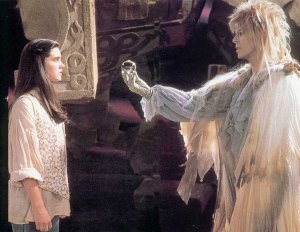
I’m a big David Bowie fan, after having fallen in love with him as a young teenager, watching Jim Henson’s film, Labyrinth. He played the Goblin King, a creature who was used to getting things his own way – he was all powerful, and the Labyrinth was his to control. Or so he thought.

It’s a wonderful tale, of a young girl coming into adolescence, of learning that life is not always what it seems, and that life is unfair. It’s also about making friendships along the way, about being kind and also familial obligations. There are so many ways to interpret the film, and I thought to look at it from a Zen point of view. It was interesting.

Our thoughts often control us, without our even realising it. These thoughts, these intangible things, have so much power over our lives. We believe in our thoughts so much, and hold to them so much. We hold on so tightly to our thoughts, and to ourselves. Who would we be without our thoughts?

Yet in Zen we try to realise the control that our thoughts have over us, by acknowledging them, by becoming the observer. Bit by bit, as we sit in meditation and go through our daily lives, we begin to see patterns emerging. We may have a thought about ourselves – I’m artistic. We tell everyone that, reinforcing that thought. Yet that is not all that we are – we may be good with animals, gardening, maths, etc. The repetitive thoughts, the ones that we say over and over again to ourselves, become a reality for us. Yet they are still thoughts, not reality. There is no substance to them.

Of course, not all thoughts are bad. We need to think, to work out problems, to get out of bed in the morning even. It is in the attachment to the thoughts that gives them a false substance, a false reality. It also can give us great pleasure, living in this fantasy land of our thoughts – it means the hardships of real life cannot affect us there. We are safe, in the bubble of our thoughts.

Most of us spend a lot of time being controlled by our thoughts – we never even realise it. Much like Sarah, the protagonist in the film, was being controlled by the Jareth, the Goblin King without her knowledge, we aren’t even aware of the power that they hold over us. They make us run around in circles, not getting anywhere, simply thinking, thinking, thinking – where is the doing? Where is the experience? We get angry at someone, and have a thought about that. Then we attach to that thought, and it can affect us for the rest of the day, week, year, or our entire lives. We all have emotional responses to situations, and thoughts about everything – but the attachment to them is where stumble and fall on each and every step. There is no progress – we’ve fallen down the oubliette of our thoughts until we are completely trapped in a small, dark and confined space.

Instead of simply experiencing the anger and then letting it go, we’ve become a prisoner of our thoughts about the situation. And all the while, the Goblin King laughs to himself, safe in his tower, loving to watch us run around in circles as the sands of time run out.

When we sit in zazen, however, we begin to notice our thoughts, our patterns of behaviour. By being the observer, we can take a step back from our thoughts and look at them without attaching to them. We can see the physical manifestations of them in our body as well – a contraction in our jaw, the hunching of our shoulders, our heart beating faster. By becoming aware, of thoughts, and indeed, of all our surroundings, we are better able to respond to situations than before. Sarah didn’t see through the illusion for a long time in the film – even though she was reminded by other characters, time and again, that nothing is what it seems. Slowly though, the illusion wavered, and the cracks in the false reality began to show. The bubble was broken, and Sarah was somewhat freed, for a time. When she finally saw through the illusion fully, and took the great leap into the unknown, literally and figuratively, that’s when she was able to come face to face with the Goblin King himself, to bring him out of hiding and face him in a final battle.

So, after much practice in zazen, after much meditation and time spent being the observer to all the thoughts that run around in our head, without getting caught up in them, we face them down. We say “enough” – we are not going to be controlled by them any longer. We see the thoughts for what they are. The thoughts fight back, with everything that they’ve got – Jareth holds out the most potent, alluring thing that we all hold so dear – our dreams. He offers them to Sarah, but Sarah now sees through the false reality. She then recites the final lines from her book back to the Goblin King, saying the powerful, magical words that will defeat him.

“Through dangers untold and hardships unnumbered, I have fought my way here to the castle beyond the Goblin City, to take back the child that you have stolen. For my will is as strong as yours, and my kingdom is as great. You have no power over me.”

Those six words – “you have no power over me” is what can release us from the labyrinth of our minds, from the traps that our thoughts can create when we attach to them. We suddenly become free, to experience, to return to our pure self, to break loose of the chains and to truly live life to the fullest.

So, the next time we fall into despair, wishing our lives were different, we can simply say those six words – you have no power over me. When our minds are rushing around as we try to meditate, we simply observe them without getting caught up in them, and repeat you have no power over me. When someone says something nasty to us, we feel the emotion, we react (hopefully with compassion) and then we let the experience go, without attaching to it, simply by saying you have no power over me.

Then and only then can the Goblin King be defeated, and we freed from the labyrinth of our minds.

Though, I must admit, I’m sure some of us would prefer to stay in there with David Bowie 😉

Living the Dream…

Life can have so many problems. Life isn’t just life for most people. Sometimes it’s like trying to fart against a thunderstorm. Other days it’s all unicorns and rainbows. But looking deeper, into the reasons why we hurt, why we suffer, we begin to see patterns emerging that can help us to stop living the dream. Stop living the dream? Why would we want to do that? Isn’t “living the dream” the whole goal of life?

Our problems can seem huge to us at times. Yet these problems are only the front line – there is usually a deeper problem underneath that hides in the layers of these other problems. The trick is to spot the tricky little devils. Sitting with the problems helps – literally sitting yourself down, maybe having a chat with yourself and then some good old mindful meditation can do the trick. The more we do this, the easier it gets to spot the real problem.

Today, I felt bad – I felt used. I thought that was my problem. After sitting myself down, I realised that wasn’t the real problem – the real problem was insecurity. Peeling away the layers revealed this deep-rooted problem – and then I realised that it wasn’t really a problem either. I was feeling insecure. A feeling is a thought with an emotion attached to it, which often manifests itself physically in the body. I was in a state of contraction – I needed to release the contraction somehow, and the best way to do that is to understand it. Once understood, it was an “oh, of course” moment. The bad feelings left. In fact, it wasn’t even bad – it was just life.

Our problems, our depression, our anger occurs when life doesn’t happen the way we would like it to. When we understand this, we see our folly – life happens. The winds blow without first consulting us, people die without saying goodbye, friends come and friends go – there’s nothing we can do about that. What we can do is alter our reactions to it all.

So, instead of living the dream, why not try living the reality? That is where the real gem lies.

Face to Face or Phone to Phone?

phoneSocial media today has led, as many are probably aware, to a serious decline in face to face interaction.  We are a social species, and everyone needs a little social interaction.  What I am discovering more and more is that people are forgetting, or never even learning, the niceties of a social situation – standing in line at the fairtrade coffee house and actually making eye contact with the person in front/behind you, maybe even smiling and talking to them.  I think we all, to a certain degree, need a little social interaction – face to face, even if we are self-proclaimed “not a ‘people person’”.  We are in dire peril of losing all our social graces. And yes, I do realise the slight hypocrisy of making my views aware on an online blog. 🙂

Last month when I went out to dinner with my husband and father in law, I noticed a couple at the table next to us.  They barely said two words to each other – either one or both spent most of the time on their mobile phones – not talking to other people on the phone, but presumably doing something with an app, or most likely checking social network sites.  I was truly saddened by this.  How many people spend their lives, head down, looking at a small screen to catch up with the latest? What about the world going on around them?

A few months before, in a crowded bar my friend and I asked to join a couple of lads at their table, as there were none free and my back was hurting – I needed to sit down.  They kindly agreed, and spent most of the time talking to themselves – fine, I wasn’t looking for conversation with them at any rate.  However, when one went to the bar to get drinks for the both of them, and my friend was also at the bar, I was left alone with one of the lads.  As soon as he was left alone, he went head down to his phone, completely ignoring everything and everyone around him.  Same thing happened at my local pub, sitting at the bar and chatting with the bartender and the bloke next to me – as soon as she left to get an order the bloke next to me put his head down and went straight for the phone.  Why go the pub at all?

What I worry about is the ability to interact with people in real life situations seriously declining.  Mere politeness is on the decrease, as any walk down a busy London street can testify.  I’m not expecting an ethical debate on animal testing, or politics, or whatever from someone standing in line with you, but what I would like to suggest is to put down the phone and at least acknowledge the person near you. Or at the very least, put the device away when you are walking down the street – a friend of mine nearly got run over last year because he was checking his phone.  How many phone related accidents do we need to hear about? Be aware of your surroundings.

One of my work colleagues told me of his New Year’s resolution last year, which I thought was brilliant.  He resolved to never pretend to not “see” somebody – to always acknowledge.  He thought it was really empowering  and I could see why – even when someone has pretended not to see you, you still go up and say “hi!”.  This most basic acknowledgement is such a small, yet significant thing.

Life is happening all around these people who are addicted to their phones, or tablets – using them to block out the world, or to avoid a social situation in which they are not comfortable. But really – it’s not that hard.  Someone isn’t going to bite your head off for smiling at you as you pass them in the street, or waiting in line at the shops.  Even if you are terribly shy – just try it.

I do wonder if there is a serious mobile phone addiction – a couple of days ago I saw a young couple walking out the door of a local recreational pool, both with phones in hands in case anyone should ring them – ready to answer at a moment’s notice.  Are they really that important? Are the callers? What about each other? Is this not a statement that whoever might ring them is more important than the person they are currently with, in person?

I’m sure I have some sympathisers – people who hate it when they go out to the pub or for coffee with a friend, and the friend puts the phone down on the table, right in front of them, face up, in case they receive a Facebook notification, an email or a call.  When I am with someone, I am with them. Fully. I think that anything less is rude, and a little saddening – judgement call, I know.  I really am attempting to understand rather than judge, but I realise I am failing in understanding – unless it truly is an addiction.  What do you think? Are people addicted to their phones? If so, isn’t there something we should do about it?

Lives are being wasted away.  If you are a person who always has their phone on, may I suggest you turn it off for a day, then two, then a week.  See if you have truly missed anything.  Don’t check Facebook for a day, then two, then a week, and again – did you really miss anything?  Be with the person you are with.  Acknowledge others around you.  Take that damned phone off the table and look the person in the eye.  Be there. Awake. Aware.