Death, Reincarnation and Impermanence

I haven’t sung for a while now. Sometimes when you’re sad or grieving, your body and soul just don’t want to sing.

Thankfully, I have friends and family who have been wonderful, who make me laugh and cry with tears of laughter alongside my tears of unhappiness. Both forms of tears are equally valid, and equally necessary during the time that you grieve.

Having spent the last few weeks thinking about death, I felt that I could now share some ideas with you that I have had about it.  I have been terribly upset at the loss of a very good friend, whom I will never see again.  There is a hole in my life where she used to be, and I still find myself looking for her after all these weeks. Good friends are deeply treasured, and a true blessing.

Meditating upon the nature of death, I have come to the same realisation that Alanis Morrissette came to in her song, “Thank You”.  At one point in the lyrics she states “How about not equating death with stopping”.  I have taken comfort in these words over the last few decades, but never really considered them deeply within my own soul – they were a kind hand on my shoulder from someone who empathises. Now I see the totality of the statement, with a little insight from the Buddhist notion of impermanence and the Druid views of both awen and animism.

The Buddhist view of life is that everything is impermanent, therefore we should try to not cling to anything, even our sense of self, with too much energy. Looking closer at this idea, we see that we are constantly changing, in our ideas, our opinions, our way of life, and we are not the same person we were, say 10 years ago. On a more physical level, we are also constantly changing, sloughing off old skin, our hair growing, our bodies changing shape as we grow older.  Clinging to one thing leads to suffering – if we simply accept that change is a part of life then our suffering will be reduced.

Meditating up on this over the last week, some core truths have sprung up for me that have helped with my suffering.

We are all made up of energy, energy that is in constant motion.  This energy did not spring out into being – you cannot get something from nothing.  This energy is in constant change and flux, according to the environment and circumstances it finds itself in.  Therefore, a Zen koan suddenly made sense to me: “What was the face you wore, before you were born?”

I realised that had never been born.  When we think of being born, we think of suddenly coming into being, but we have already been existing since the dawn of time. It is only our form that has changed with the millennia.  Can we really pinpoint the time we were born, or created? Is creation when egg meets sperm? I am contained in the blood of my father’s fathers and my mother’s mothers as well – can there be a cut-off point? I am the genetic result of thousands of ancestors – where do they end and I begin?  Thinking more laterally as well, I am made up of some of the minerals found in stars and galaxies far away. My blood contains water that I have drunk from all over the world in my lifetime. In this water is life and death of legion of beings. Where do I begin?

In Druidry, many Druids are also animists, believing in the inherent value of all things, whatever their form.  Nothing is more valid or worth more than another thing – they are simply existing in various forms that we perceive throughout our lifetime.  This worldview incorporates the smallest atom to the largest mountain.

If I cannot pinpoint the time when I began to exist, then there cannot be a point in time when I die.  I shall simply change form, the energy running on different currents and in different patterns. Thinking about my friend, I was blessed to know her in her most recent physical form for years, which was always changing anyway.  She has not died, per se – energy cannot simply cease to be.  We often think of death as annihilation. It cannot be so – energy moves but cannot be destroyed.  And so, her current form is undergoing a different process of change. The accepted concept of birth may find its opposite in death, but the term life has no opposite.

What happens to our souls when we die, if we believe in souls, is still the great mystery. But what I’ve come to realise is that at the very least, we can take inspiration from the physical and perhaps also apply that to the idea of the soul as well.  The physical form has now been returned to the earth, decomposing through the process of bacteria and other creatures that are working to change the physical form.  But the energy is still there, being changed into millions of different forms in the circumstance.  Flesh is being eaten by worms and turned into rich soil. That rich soil will feed the plants atop her grave. Those plants will release oxygen into the atmosphere. That oxygen will be breathed by all manner of creatures, or even combine with hydrogen to form water. So, my friend is there, in her grave, but she is also in the plants, in the air, in the clouds, in the water, and inside me.  Her physical form has changed, but it was always changing anyway. Impermanence.

Once I gained this insight, my suffering was eased somewhat.  Not only for the loss of her in my life, but also my own fears of death.  There is no such thing as stopping. Death is not annihilation. It is simply a process, like birth is, into a different and ever-changing physical form. Whether the soul follows some parts in this process is up for question – I like to think so.

Perhaps this is what reincarnation is all about.  The nature of change, the nature of being. Perhaps I have simply been looking at reincarnation too literally.  Reincarnation is simply the new physical form something takes when the circumstances are favourable to its existence. Myself included.

My friend is still here, for she can never go away.  All that has ever been is still here, in some form or another.  We can take comfort in that and ease our own suffering. We can take inspiration from that and live our lives in accordance with it, allowing us to not just to go with the flow, but to be the flow itself, whether that is of the river, the wind, our bloodlines, the Tao or the awen itself.

Thank you, dear friend, for the inspiration and the teaching.  You have taught me so much over the years, and I look forward to still many lessons to come.

Reposted from my blog at SageWoman: http://www.witchesandpagans.com/SageWoman-Blogs/death-impermanence-and-reincarnation.html
Zen and the Awen

The Celts had Indo-European roots, migrating across Europe and leaving their mark across many countries.  They share many similar spiritual beliefs to other traditions – Buddhist, Saxon and Norse just to name a few.  There are similarities in artwork and other modes of creative expression.  Finding something that is “pure” in any tradition is, at least in my opinion, unattainable. We are constantly being influenced by other people, whether it was 50 years ago, 500 or 5,000 years ago.

Incorporating Zen and Druidry has given me a personal life path that makes a lot of sense in my daily practice.  Simply because Zen Buddhism is an Eastern tradition doesn’t mean that it can’t work with what is commonly thought of as a Western tradition.  (For a more in depth look at Druidry and other Dharmic paths, including Buddhism, Jainism and Hinduism, Philip Carr-Gomm has written a brilliant page on The Order of Bards, Ovates and Druids’ website – http://www.druidry.org/druid-way/other-paths/druidry-dharma.)

Zen and Druidry blend together to form a life path that is utterly devoted to being in the present, giving the Druid a total immersion within nature.  This immersion, not just going with the flow but being the flow itself, is what makes it so special. Zen teaches us to let go of our sense of self, to silence our chattering minds in order to be able to pay attention to the world at large. It also teaches us of discipline, learning how our minds work and how we are so often ruled by our minds, through bad habits, reactionary living, destructive behaviour and so on.

With Soto Zen, the mind is brought under control through hours and hours of meditation, of learning to simply “be”, slowly and gently silencing our “monkey mind” so that we may better hear the songs of the universe.  This is what is meant by releasing the sense of self – it is not, as so many people assume it to be, becoming a mindless zombie.  It is allowing other songs, other voices to be heard above our own so that we may better integrate. We will still have opinions, but we will cherish them less, for we know that everything is in constant change and flux.  We will have a sense of self, but again we hold to it lightly so that we may better see where we fit in the world and where we can do the most good. It is not annihilation – it is immersion, awareness and mindfulness.

Within Druidry, we learn to work with awen, with inspiration and the flow of life itself to see where we fit in the grand scheme of things. We work to see how we can live with the least harm to ourselves and the planet, and also what we can do to make the world a better place.  We work to create peace within ourselves and peace in the outer world as well.  Using our natural abilities and skills, we may work with songs and poetry, or with visions or herbal medicine, with roles in teaching and counselling, in law or in environmentalism – the list is endless.  We are devoted to helping and conserving nature and our planet, sharing the awen and giving back for what we have received.

Using the techniques from Zen for training the mind and the love of nature from Druidry we can find a way to immerse ourselves in our spirituality that is so deeply integrated on so many levels.  When out walking in the forest, we can lose our sense of self in order to become the forest.  Once we are the forest, we are able to drink deeply from the flow of awen that is all life around us.  We become the trees, the deer, the fox, the boulder, the streams and the badger.  We can learn so much from this integration which can also rejuvenate us, providing us with even more inspiration.  We are not looking at ourselves being at one in the forest; we have lost even that in order to become the forest.  When we are fully immersed in simply “being”, we are fully in the flow of awen.

Our footsteps become lighter, our passage barely noticeable. Like the deer, we are able to bound through the trees, awake and aware to every sense.  Indeed, all our sense become sharper, clearer, for our minds are not running us ragged thinking about what to have for dinner, that paper that is due, the meeting we have on Monday.  Fully in the moment, we become the awen.

Zen Buddhism has also leant another aspect to my Druidry that has been rich and rewarding – the idea of compassion. Again, many people misinterpret compassion, seeing it as weak, or being a pushover. Why be kind to others when so few are kind to us?  Living with compassion is what enables us to connect once again to that all important word in Druidry – awen.  The songs of life can only be heard if we try to understand them. We cannot understand them unless we open ourselves to compassion.

In one of the Grail legends, Perceval reaches the wounded Fisher King, and is invited into his castle.  The knight does not ask the King why he is wounded, or how it happened. He shows no interest in learning the story behind the wounded King. Upon sharing a meal with the King, the knight also sees a courtly procession whereby a young maiden carries the Grail through the hall repeatedly throughout the night. Again, trying to appear worldly and nonchalant, Perceval does not ask about this.  These two incidents are the clues in which the Fisher King might be healed, and in which Perceval failed at his chance in finding the Grail.  If he had only asked the King “What ails thee?” then the King would have been instantly and magically healed.  If Perceval had only asked “Whom does the Grail serve?” he would have understood its purpose, and achieved the totality of his quest.

The simple question of “What ails thee” is the showing of compassion.  It is taking ourselves outside of our own minds and our own troubles and asking another person what is wrong, seeking to alleviate their suffering. Also, by asking our selves (the separation of the words, instead of writing ourselves is intentional here) “What ails thee?” we take the time to look within, to perhaps explore shadow aspects of ourselves.  Within many Eastern traditions, it is through meditation that we understand our selves better, and also understand and redirect our reactions to the world – ie. instead of simply reacting to an event, we act with intention, with mindfulness and awareness. With the Grail question, we can ask this of our selves as well as others in pretty much any situation, therefore eliminating a reactionary response for a more intentional approach. In doing so, we may just find the healing for our selves and the world that is so needed.

The second Grail question, “Whom does the Grail serve?” invites us to question our intention.  Whether we are experiencing pleasant or unpleasant aspects in our lives, we can ask our selves “who does this serve?”, thereby eliminating that which is no longer necessary, and bringing joy, awe and wonder back into our lives.  With old habits and patterns of behaviour that we wish to be freed from, we can simply ask this question over and over again until we have the answer that is required for spiritual growth.  We can ask this question in every aspect of our lives, from our weekly shopping (in order to make better choices not only for ourselves, but the planet) to our everyday interactions with other people.  If we are making a positive change instead of falling into negative, but comfortable patterns then we are on the road to spiritual progress. Reminding our selves of the Grail questions has been integral to my learning these past few months, becoming a mantra for everyday life.

In our quest for wholeness, we can either run around in circles, questing after the Grail through established means, or we can simply look within to gain a better perspective on compassion and the divine, whether it be male or female, or even genderless.  It is the deep exploration within that allows us to bring that knowledge out into the world – we cannot simply spend our lives gazing at our own navels – we must bring the Grail out for the benefit of others. We must offer the gifts of compassion and self-awareness. In this, the Grail Mysteries are best served.

In this way as well, both Eastern and Western traditions come together to allow us to help not only our own suffering, but that of the world.  We can learn the values of compassion and mindfulness, and we also look deep within for the inspiration to live an integrated life that reflects the natural cycles of the world around us.

We do not simply touch the awen every now and then – we become the awen ourselves.

(From my blog at Moon Books – http://moon-books.net/blogs/moonbooks/zen-and-the-awen/)

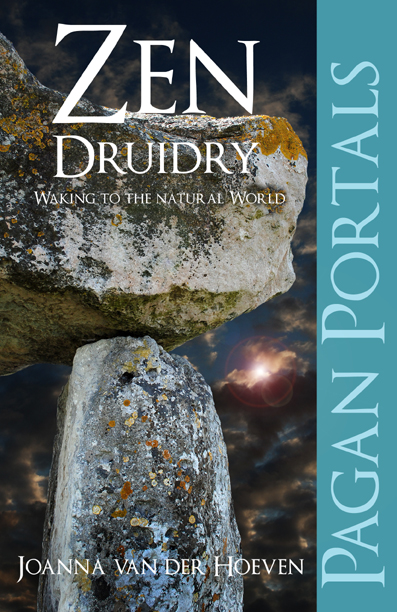
Zen Druidry

zen druidryZen Druidry still at the low Kindle price of UK  £1.23 – what a lovely number! Paperback copies available starting at £1.05, used copies from only 99p. In the US, copies start from $2.02 (another lovely number) and in Canada from $0.01!!!) . Read reviews by leaders and authors in the pagan community such as Philip Carr-Gomm, Graeme Talboys, Nimue Brown and more! Part of Moon Books‘ Pagan Portals series.

Buy in the UK here

Buy in USA here

Buy in Canada here

For other countries, please refer to Amazon provider associated.

Love Thyself

Love Thyself

Today I have the day to myself – no one else, just me in the house with my cat. For me, it is pure bliss. After the sometimes chaotic nature of the holiday season spent in constant company, whether that is with beloved family or friends, a little downtime is a blessing.  I love these moments, when I am free to do as I choose, when the house is quiet and no one needs anything.  I can write or listen to music, meditate without extraneous noise, or simply just sit in the conservatory with a cup of tea and enjoy the silence and the season. After busy times, I crave solitude.

In today’s society, however, I am seeing more and more evidence that people do not want to spend time with themselves.  There are constant distractions everywhere, the worst culprit being mobile phones.  Not only are they being used to call or text people constantly, but now people can tweet, check their facebook or email and never spend a moment without their “friends”.  I remember about six months ago going to my local pub and sitting at the bar, chatting to the bar staff. Other locals were around me sharing conversation, but once the bartender had disappeared they all lowered their heads and were on their phones, thumbs hammering away.  I have gone out to dinner on numerous occasions where I see other couples sitting across from each other not talking to each other but on their phones. It makes me so sad that people do not want to be together physically when they are given the precious opportunity. What I find perhaps even more distressing is the fact that people don’t know how to be alone either.

In a supermarket queue, no one can just stand there anymore and wait in line, either simply being and standing, or making eye contact with others, offering a smile, perhaps some comment on the weather.  I respect it when people don’t want to talk to strangers – I can feel annoyed when people want my attention and I don’t want to give it to them at that particular moment. It can feel intrusive.  Men who expect you to flirt back, for instance. But I digress – surrounded by real people in the supermarket queue, people would rather look to a tiny screen that acknowledge those around them, or perhaps even succumb to their own thoughts for the barest instant.

I know that I am assuming much here – I can’t know what really goes on in other people’s heads.  But I think it is a fair assumption to make.  Being alone is scary for a lot of people, especially if they’re not used to it. What worries me is that a whole generation of human beings is living without the blessing of time spent by and with themselves. They will never experience that exquisite silence when the gadgets are turned off. They will never know their own thoughts, being constantly distracted by the thoughts of others. They might never truly know themselves.

Time spent alone is precious time to look within, to check on our self and see if everything is okay.  Not enough time is spent doing this, in my opinion.  Giving this gift of attention to our selves, we can see where we are simply reacting to events, instead of acting with intention.  It gives us a chance to be compassionate with our selves, and thereby allowing us to be more compassionate with others.  We check in on others all the time with social media – what I suggest is that we check in with ourselves as well.

Mindfulness and meditation are two great ways to check in with the self, to see how you are doing at this particular moment in time.  Breathing in, being aware of the breath, you can do this anywhere – even in the supermarket queue.  Simply saying “breathing in, I am aware that I am breathing in, breathing out, I am aware that I am breathing out” in your mind as you breathe gives you a moment in time that is all your own.  I like to do this regularly, and also to see where I am holding tension in my body.  Often I will find that my right shoulder is raised, and I can make a conscious effort to relax my muscles, giving them a rest as well as my mind.  I am unconsciously tensing, perhaps protectively with my dominant arm against some unperceived threat. When I am aware of this, I see that there is no threat, and can relax and enjoy the moment better.

In meditation, simply stopping is a brilliant way to get back in touch with your self.  Sitting on a cushion, perhaps some incense burning as an offering, simply spend time with your self and your thoughts.  See the thoughts in your mind as they arise, but do not attach to them – let them go. See and discover how crazily the mind works, how hurried and fast thoughts arise. Just as quickly as they come, let them go, and slowly, with time and with effort, with a little discipline, the thoughts will begin to settle like mud in a pond, eventually allowing clear insight into the depths. It doesn’t happen all at once, and takes dedication, but it is so worth it.

Spend some time with yourself today, even if it only for two minutes. Breathe, stand outside after work and smell the night air.  Take a candlelit bath and really feel the water surround you, relaxing your body and noticing where there may be tension.  Sit at your meal and savour each and every bite, really paying attention to what it is that you are putting in your mouth.  Lying down to sleep, do a full body sweep with your mind to feel areas of tension, relaxing the muscles one by one.

And for the love of your self, turn your phone off. x

When compassion is challenged…

Some people have differing opinions to ours.  That is their entitlement – we all may agree or disagree with each other, have different viewpoints and perspectives.  Only we can see the world through our own eyes, layered with our own experiences, trials and tribulations. Only we know our own story fully and completely.  No other can know us the way we know ourselves, the reasons for our actions and the choices we make.

Everyone is on their own path, fighting their own battles, making their own decisions according to the principles that they live by, the culture and society they grew up in, and their own soul’s calling.  We should never berate another for following their own path. We can certainly disagree, and stand up for what we believe in, whether that is against a political party, a company, an abusive relationship – but we must always remember that belittling someone is never the right thing to do.  People will make bad choices, people will not care about the same things that we do. However, making fun of them does not solve anything. Looking down on someone means that you have placed yourself in a position of authority or power over them – an illusory pedestal.

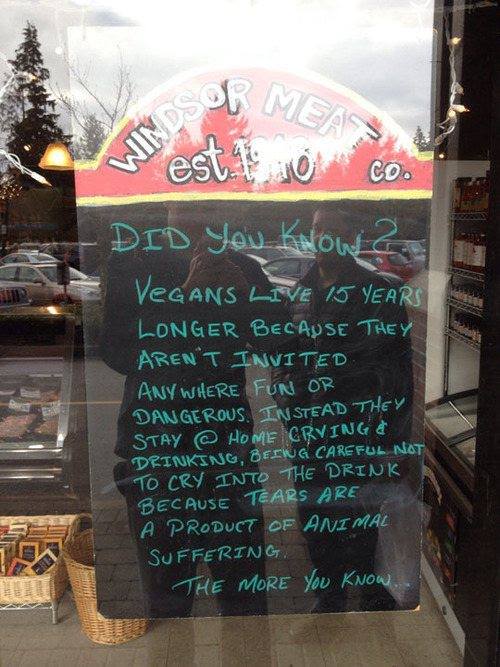
meat coThe photo here is an example of a meat company who are putting down vegans in order to gain more people to their “side”, using “humour” as a unifier against some perceived threat to their way of life. What we have to realise is that there are no sides in life – only differing choices and opinions.  There is no Us and Them – there is only the human experience.  The entire Us and Them mentality has led to the most atrocious human behaviour possible – war and genocide, murder and rape, crime and racism, just to name a few.

Those who choose to become vegan or vegetarian have their own reasons – health, weight loss, environmentalism, religion.  It is wrong to belittle someone for any of these reasons. In fact, it is wrong to belittle anyone – end of story.  I disagree with people all the time, and I know I’m not perfect, but when I catch myself belittling someone I do my best to stop it, to realise that they are on their own journey, and to have compassion for them.  I do not want to be like the person who wrote this sign. I choose to behave differently.

I chose to become vegetarian twenty years ago, and am currently in the switch to vegan. This is my personal choice, based on research and religious reasons that ring true to my own soul. This may not be the same choice for other people, and I understand that.  However, I do tire of people making fun of my choice – I have had to endure that for over twenty years.  It is inevitable at dinner parties where someone who doesn’t know you very well, and who is a self-confessed “meat lover”, will question your choice at the dinner table, confronting you on your life path when all you want to do is eat with a good conscience and enjoy your meal with your friends or family, in harmony.  The ubiquitous “screaming vegetables” always comes up, and I must explain my reasons for becoming vegetarian or remain silent. Sometimes I choose to, other times I simply let it be. For the sake of peace, I make a decision based on compassion for all those who are sharing the meal with me. I only wish certain others could do the same.

Would it be correct to challenge someone on their religion at the dinner table? I don’t think so.  What about their decision to join Amnesty International, or Greenpeace?  Would it be right to poke fun at someone because they looked different? We must appreciate each other’s diversity, and in that appreciation realise that we are all human beings on our own journeys- that unifying factor within the diversity is what compassion is all about.

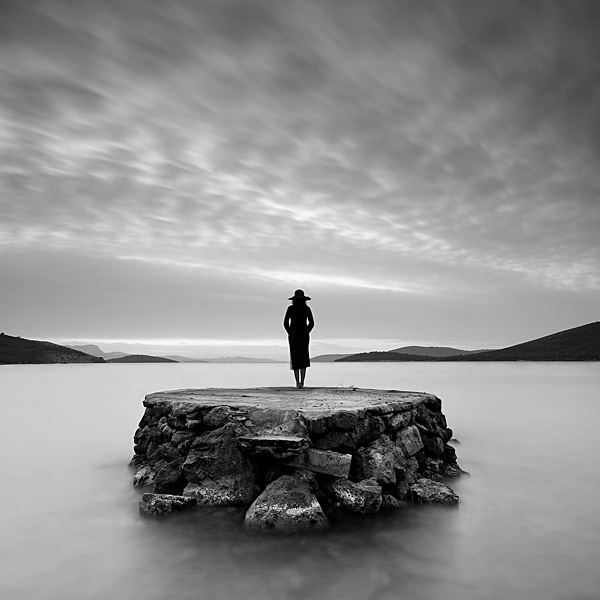
looking downThat is why in response to the photo above, I am posting this other photo.  It reflects and is only my opinion, but it matters to me in my spiritual journey.  Zen Buddhism tells us to hold to our opinions lightly, and indeed I see the wisdom in this. Our opinions are always changing – we are always learning and growing.  However, we must do so with compassion and awareness of the journey of others as well, even those who challenge us and our opinions.  I must have compassion for the people who own that meat company, realising that they have their own reasons for writing this sign, however much I disagree with them. I can voice my own opinion against it with this blog, with my words, with respect and as much understanding as my situation allows.  I don’t have to think it is right. I don’t have to agree with them. But I shall not belittle them for their opinion.

Watching Parliament in full swing makes me cringe – I remember the first time I saw a “discussion” which never let the other side finish what they were saying, instead making so much noise as to drown out the current speaker’s voice in a wall of derision.  This was how our country was and is being governed. It saddened and enraged me – this so-called civilised way of government.  How much better could it be if we just took the time to listen to each other without judgement, allowing the other person their say, and respectfully choosing to disagree if it does not ring true to our souls?  If the government cannot govern their behaviour in Parliament, why should the people? I found it so saddening, and still do…

Never be afraid to speak out against what you think is wrong, or for what you believe in. However, do so with compassion, with respect. Otherwise, you are simply acting and reacting to the bad behaviour of others. Remember also that acting with compassion does not necessarily elevate you above these others – you are not “good” for acting compassionately. You are simply acting compassionately – that is all.

Live with honour and dignity. Act with love and compassion. It’s not that hard. Blessings on your journey. X

Working with Kindness

Many religions and spiritualities the world over teach that kindness and compassion is the way to live your life in order the create harmony and peace not only for yourself, but for the rest of the world.  This is a form of service, which I think may be lacking in much of modern paganism.  It is in the service to others where we truly shine.  The Sisterhood of Avalon states it beautifully in a triad – service to the self, service to the Sisterhood and service to the Goddess.  Like most things, it starts from within and then spreads to the wider community and the world at large.  Sadly, perhaps due to the growing number of self-help books and various psychologies, this service tends to stop at the self.  Instant gratification in our capitalist society combined with living in relative ease can allow complacency in our lives and in our minds.  We can become grasping even, wanting to be healed, looking for that one thing or one person who will heal us, as we have been taught my marketing campaigns the world over.  Me, me me. I, I, I.

There seems to be a great need for healing in the world today.  Paganism embraces this healing with open arms, honouring it in all its various forms.  We are often told that we must first heal ourselves before we can heal others. In this, I very much agree.  It’s often the hardest thing to heal yourself – focusing on others is much easier than coming face to face with your own pain, grief, demons or shadow self.  However, we can become too engrossed in looking inwards that we forget to look outwards as well.  Too much self-awareness and not enough external awareness.  It can even border on or become egocentric.

The key here I believe lies in kindness.  Through these last few months, when the darkness of winter takes hold and we are gifted with the time and space to reflect, we can look at how we can be kind to ourselves.  This is the best thing we can do for ourselves in terms of our own healing.  It is easier to forgive others for hurting us, or causing us stress, grief or pain than it is to forgive ourselves for doing things that we regret.  Yet we must look at ourselves in the same light as we do others and be able to forgive ourselves in order to move the service from self to others, through the act of love and kindness.  This is our service to our self.

We have to be aware of our edges – we must create boundaries so that when we allow kindness to flow through us we have an awareness that not everyone will be kind in return.  This is not a shutting down or closing off of the soul to others – it is simply being prepared.  Like meeting a strange dog or cat for the first time, we are unsure as to how they will react, and so we proceed with caution.  We still show compassion and love and try to help them should they need it in any way possible. We will also do all that we can to prevent being bitten. This is our service to others.

I have been too open – I have not guarded my boundaries as well as I should have. I have loved freely and been bitten on the ass in return.  I have learned to use boundaries to let me help myself and to help others.  In Brian Froud’s latest faery oracle card deck, there is a card that I drew called The Lady of Faith.  She wears a helmet and shoulder armour, but her breast is bare of armour and she is leaning towards something with a hand to her heart.  This card shows that we must protect ourselves but still allow our hearts to move us in kindness and compassion.

I recently saw a documentary on Phil Robertson, of Duck Dynasty fame about how he transformed his life through his religion and coming to know God and Jesus.  While we may not share the same religious points of view we can agree that it all comes down to kindness.  He described when he was making a living fishing on the river and other “river rats” would come and steal from his nets.  After he had found Jesus, he worked with the idea of kindness and so, when he caught them stealing again, offered them the fish freely.  They took it and responded to his kindness by never stealing from him again.  Phil stated that he will act towards all things with kindness, but still carry a shotgun in case all things weren’t kind to him.

This is very similar to a Zen Buddhist story, where a monk is sitting and praying in his cave high on the mountaintop. A thief comes upon him and threatens him. The monk looks at the thief and states that if he wanted his possessions so badly, feeling he had to threaten and steal them, then he would freely give them if that was his need.  The thief left bewildered and the monk sat outside, looking up at the moon.  “If only I could have given him this beautiful moon”, he said. (Some argue that the monk should have done a Phil Roberston and had a shotgun as well, but that doesn’t fit in with the peaceful and non-violent ideals that the monk held to.)

Living to our ideals, exploring our shadow aspects (those aspects of the soul that we fear, that we loathe, that we deny) and giving back to the world results naturally in leading the way to the further service to the gods.  We dedicate our lives to kindness and compassion with full awareness and in doing so, reflect the true nature of not only our being, but of being.  For me, the gods that I follow all have an aspect of peace and kindness that we can find in their stories to inspire us along our own life’s journey.  Tyr, most often seen as a god of war and justice, to me also represents kindness to animals and loyalty as when he fed the wolf, Fenris, when no one else would.  Nehelennia, the goddess of the North Sea rages and leaves us with a fresh world – sometimes battered but ever inspired by the impermanence of all things.  Morrighan heals after the battles and rejuvenates after the blood is spilled.  Nemetona teaches of boundaries as well as love and peace.  In this I have dedicated myself to learning and being open to the awen of their songs.

Through coming into our own true potential, we are better able to serve ourselves, our community and our gods.  The key to it all is through kindness.  How very simple, how often this message had been repeated over thousands of years. How easy it is to forget in today’s society.  Yet when we open ourselves to the possibilities and let kindness lead us in our actions, peace and harmony are a natural result.

When Maiden, Mother, Crone isn’t right…

My latest blog for SageWoman…

http://www.witchesandpagans.com/SageWoman-Blogs/when-maiden-mother-crone-isn-t-enough.html

After having spent a lovely weekend in Glastonbury with a dear friend, I noticed that there is a lot of focus on the triumvirate of Maiden, Mother and Crone. Walk into any shop and you will find this triple goddess littering shelves, books about these aspects and people talking about where they are in relation to Her.

This triple goddess, however, leaves me a bit cold. Childless by choice, I have no relationship with the Mother aspect of Her, and absolutely no desire for one.  Yet is seemed to be constantly thrown in front of me – at a certain age, we should be entering our Mother phase. My little inner anarchist said bollocks to that.

Firstly, I’ve always had difficulty with a triple goddess, reflected in the phases of the moon for, as everyone knows, there are four phases – waxing, full, waning and new or dark moon.  So, a triple goddess of the moon makes no sense for me personally, though it may work for others.

Secondly, there are many women out there who can identify with my choice of not bearing any children and for whom the phase of motherhood may seem out of place.  I understand that the term motherhood may have many different meanings – you can give birth to ideas, or nurture your own environment. However, to me the term mother has always been a literal one. It is partly why I don’t believe in an all-loving Mother Goddess.  I have a physical mother and no need for a metaphysical one.  My deities of nature do not have the usual aspects of motherhood instilled within them. They simply are what they are, whether that is wind and rain, fog or mist, love, anger and fear, time and tides, floods and drought.

So what is a person to do when bombarded by this triple goddess? It seems taken for granted that everyone identifies with such, especially women. This is not the case. Perhaps we need to find something else that works for us individually.

I considered over the weekend how to change the triumvirate of Maiden, Mother and Crone.  Some ideas that I have considered are Maiden, Priestess, Queen and Crone – and the aspect of Mother could easily fit into one of two categories there should the need arise.  This would also seem to fit in with the phases of the moon – Maiden as the growing, waxing moon, Priestess in the fullness of her power, Queen as we journey into the wisdom of sovereignty with our maturation, and Crone as we delve deep into the darkness and journey towards the winter of our lives.  This feels easier for me, without adding pressure of having to procreate to fit into one of her aspects.

I have heard of people replacing the Mother with Warrior, or Amazon, but this does not sit right with me.  As a Druid I am dedicated to peace, working to create peace in the world through empathy and compassion, using the Bardic arts that I am graced with, as well as the Ovatic gift of vision.

Perhaps I take this just a little too literally, a little too seriously.  As a woman who has made the decision not to have children however, I feel that it is sometimes necessary to redefine the boundaries of what we currently hold to be our personal truths in our ever-changing society.  I feel this is even more necessary in our spiritual worldviews. For me, religion should be an ever-evolving thing, growing with the person and with the society, holding a sacred relationship to our past while looking towards our ancestors of the future.

Rise in Druidry

There is a marked increase in the rise people who follow a Druid path and, indeed, all Pagan paths. Why should this be?

In today’s society, we can become so distanced from nature that we feel we need to do something to return to it; something that will connect us once again with the rhythms and flows of life.  However, this separation is in itself an illusion that we have created, for we can never be separate as long as we are living and breathing in this world. By mere fact of our existence, by the breath that we share with all other beings on this planet, we have a shared existence and a shared experience. We are never disconnected; we are never truly alone.

The illusion can be very convincing though.  It is supported with lifestyles and gadgets that seem to help fund the energy of the illusion.  We commute to work on a train with hundreds of people and feel lonely, as everyone is reading a paper, on their phones or listening to their music, shutting out everyone else. For some highly sensitive individuals, this is even a self-preservation technique.  We have mobile phones that can connect us with thousands of people anytime, anywhere (apparently) and yet we have very little human interaction with most of them.  We live in smaller and smaller family units where interaction with grandparents, cousins, aunts and uncles is ever decreasing for whatever reason – time, distance, etc.

Paganism and Druidy in particular can serve to address this need to reconnect, illusion or no.  It can offer us a group of like-minded people who share certain worldviews, or who like to perform ritual a certain way, or support environmental or political causes alongside their spirituality.  It may be discussion groups and forums, moots, talks, workshops, camps and retreats that we share and find inspiration in.  It is looking for that connecting thread that says we are part of a tribe.

With so many technological advances, someone might be drawn to Druidry to get away from their machines, the hum of electricity and the constant noise in an attempt to return to the natural cycles that are reflected in our environment.  Some may be called by poetry of the Romantics, or through historical references or self-actualization.  Some may be following their blood lineage of a Celtic heritage, others might feel called by the land upon which they live and use Druidry as the language with which to communicate.

For me personally, the draw to Druidry was in its simplicity. There are so many forms of Druidry, some highly ceremonial, some more ‘mud and blood’.  It is to the latter, the experiential Druidry, the simple but not simplistic view of the world and its rhythms and cycles that calls me further in.  With no need for magical spells or intricate ceremonies, no regalia or ritual items necessary, just plain and simple communion and communication with nature is what called me.  A fondness and easy way with animals and plants almost made the choice for me. Service to the land, the ancestors and the community is the key tenet of my practice, in that order.

More and more, people are choosing to follow a nature-based spirituality.  Their reasons may be legion, but love of nature is at the very heart.  For me, to be a Druid means not only a love of nature, but service to nature, to the world. We cannot take with abandon – we must give back. We must work hard to protect the things we love from our ever increasingly secular society and its rampant technological advances that do not take into consideration the impact on the rest of the world and indeed, the bigger picture. It is about seeing the sanctity and the sacredness in all things, using the language of Druidry to help us relate.

Druidry is all about the bigger picture. It is about our legacy and what we will leave to our ancestors of the future. It is learning from the past and living fully in the present, mindful of how we live and how we love. It is an ever evolving tradition that works with the talent and energy of the individual in service to the whole.

With the rise of numbers in Druidry, we need to remember this service to the world.  It is not only something for us, but something for the entire planet. We do not practice Druidry for our selves, but for the benefit of all.  This is not altruistic, merely an outcome of service to the land.  In service we grow in our selves, not the other way around. We must look deep within to find our reasons for our Druidry, taking a long hard look at our selves. We must also remember to look outside our selves to the world at large.

We practice, we work, we serve, we step back and regroup in order to practice, to work and to serve. It is a cycle that is represented in the seasons, in the life cycles of everything around us.  It is the awen. It is courage. It is Druidry.

The Sensitive Soul

Being quite sensitive, as in having senses that are very much alive, awake and aware, can leave someone shaking with overload or feelings of being overwhelmed. Working with the senses we find that it is truly a gift, not a curse.

I am a very sensitive person. Not just in the emotional sense but also in my physical senses.  I have very acute hearing (though sometimes selective, my husband says).  I am very sensitive to light levels.  I am extremely sensitive to changes in the weather, barometric pressure changes often giving me headaches or feelings of nausea. I have very delicate tastebuds – food that is barely spicy for most people sets my mouth on fire.  My sense of smell is such that it can often hinder as much as help me in my life – I find it hard to overcome any smell that I find unpleasant.  As for touch, perhaps it has to do with living with practical awareness as much as possible that allows me to really feel things – when I’m typing on the keyboard I really feel the keys, when I am driving I feel the road through the steering wheel – I have very vivid memories relating to the sense of touch.

I can easily be overwhelmed by today’s society.  Walking in the local garden centre a few months back, I had to leave as I was bombarded with visual displays in every aisle, each one making a different noise, talking about a different product, clashing with each other and taking attention away from other things. It became one big not-so-background mess of noise and sound and sight that I had to leave. I later emailed the garden centre to tell them of this – they agreed that others had complained as well.

If a thunderstorm is coming, I know it. If it will soon clear, I know it. I can feel it in my bones.  It can leave me on the bed, nauseous.  However, when it does arrive, I can also revel in the glorious energy that it brings. It needn’t always be a detriment.

When walking in the woods, the slightest sound or flicker of movement makes me aware of the presence of deer, ghosting through the trees.  My fingers touching the bark of an old friend, an old oak, I can feel the years of its growth, its songs and its stories. Listening to the waves of the North Sea lapping upon the shingle beach, I can hear the songs of my ancestors.

Like all things, I’ve simply learned to adapt my sensitivity and to avoid situations where I become overloaded.  Large cities are difficult for me, so I tend to stay away from them.  Cinemas are far too loud and so, if there a movie I must see in the cinema and cannot wait for the dvd or television release, I bring earplugs.  Similarly, I can use those earplugs when at the garden centre, though they seem to have toned down on their visual displays since I last contacted them.

I see my sensitivity as a blessing.  I can smell winter approaching. I can feel the point when the sun has set past the horizon.  I can stroke my cat’s fur in full awareness.  Work with the gifts that you are given.  Nothing is great and glorious, everything has a shadow side. Learning that the shadow is not something negative is truly freeing and enabling.

Beware the Green-Eyed Monster…

Social media can be a very good thing. It’s good at getting the word out, or for sharing ideas. It can also be a place where we can feel inadequate, where jealous feelings of other’s lives can creep into our thinking and affect how we live.

First of all we must remember that what we see online is not the 100% truth.  What people post on Facebook or Twitter or any other media or forum is not the whole enchilada. We look up someone on Facebook who doesn’t post anything negative, has beautiful photos and deep insights and feel that we are inadequate in our own lives.  What we have to remember is that this is simply a portrayal of a person and not the person themselves. To know the person, we must know them in person, spend a lot of time with them and connect, soul to soul. You can’t do that on a computer in my opinion. You can find a lot of commonalities with what you both have decided to put out there, however it is not the big picture.

Jealousy is an interesting beast.  What causes it? More often than not, it is through experiences that we have gone through that reflect upon our current and future situations.  Something may have happened to us in the past, an emotional pain that casts its pall over everything.  If we are jealous of what we perceive to be someone’s great life on the internet, what is it that is making us jealous? What is causing feelings of inadequacy, or anger, or resentment? Could it be someone in your past that you didn’t live up to, or dreams that you haven’t fulfilled, failings that have been brought to light?  Do they reflect our inner demons, perhaps of low self-esteem or external validation?

Catch yourself the next time you feel jealousy creeping in. Examine it. Why are you jealous? What is the root cause? It is not the person causing the feelings but your own inner self. Why should that be? The person is not the root of the problem – what’s happening in the mind is.  We cannot blame other people’s lives for our feelings of jealousy for they all stem from within.

Wouldn’t it feel better if we let go of these jealous feelings? What if we celebrated others’ successes instead of wallowing in inadequacy? What if we realised that others’ lives are not a reflection of our own? What if we stepped outside our narrow worldview, our egocentric perspective and honoured others for being what they are? The world does not revolve around you, so why persist in these feelings?

Letting go of jealousy is hard. It requires a lot of investigation into the darker regions of the mind but it is well worth it.  We can lead happier, more satisfying and positive lives when we are aware of the green-eyed monster and lay it to rest. So, the next time you are on Facebook and think “my life sucks compared to hers/his” remember, not only are you not seeing the bigger picture; you are also not seeing your self.