You Are Doing It Wrong…

bunneh powaIn my 20+ years of being a Pagan, I have met the most wonderful, inspiring people. I have also come across my fair share of people who seem to revel in trying to take other people down.  A lot of this, I’ve found, stems from the thinking that “you’re doing it wrong”.

For me, in anyone’s religion or spirituality, there is no right and wrong way of doing whatever inspires them, whatever heals their soul and whatever helps them to establish that connection with the songs of life.  I liken it to creating art, for it is an expression of one’s soul, one’s inspiration.  Would Da Vinci tell Jackson Pollack that he’s doing it wrong? Maybe, but both are equally an expression of the artist, both are equally art.  I must confess, I have in the past walked around art museums, seen a painting, and thought “I can do that – that’s not art”.  I’ve since seen the error of that thinking, and the divide that it creates.  Is a six-year old’s expression of a drawing of their mother any less worthy than a piece by Donatello? However, I digress.

Believing that there is only one way of doing things leads to all sorts of problems within the human psyche.  Out of that stems arrogance, division, and narrow-mindedness, just to name a few.  We would not have the wonders that we know today had everyone thought there was only one way of doing things.  We would not have a wealth of theologies from which to delve in and expand our human awareness, and awareness of the planet.  We would not have the wonders of the modern technological age.  We would not have impressionists, or the romantics.  We would not have haiku and sonnets.

The people that have inspired me have been those who have had the courage to follow their own path.  Figures in Druidry such as Emma Restall Orr (http://emmarestallorr.org) come to mind, people who couldn’t find what they needed to nourish their souls in what they found already existed, and so blended what mattered most to them with existing ideas, creating new ways of doing things.  Twenty years ago, Emma’s mud and blood approach to Druidry was unique, and she had her fair share of people telling her that she was “doing it wrong”, I’m sure.  Now, she is one of the most prolific writers and public figures in Druidry, inspiring millions with her approach, and making them find their own way through the forest.  It’s bloody marvellous.

I have seen some pagan groups or individuals put another group or individual down, because They Are Doing It Wrong.  Oftentimes as well, some pagans will use the term “fluffy bunny” to denigrate someone else’s path when it differs from theirs.  The fluffy bunny syndrome I find fascinating – not in the bunnies themselves, but in the way that people use this approach to make their path seem more valid.  Why on earth would anyone want to do such a thing?

A lot of this stems from the fact that assumptions are made about people. This is especially rife on the internet, where one can judge another without ever even meeting them in the flesh. These assumptions become rapid fire judgements, in which their path is better, their way of doing things holding a greater validity. This is expounded by the fact that they feel they are free assume and judge others in front of the watchful gaze of thousands.

Simply because one does not share the same opinion as you, doesn’t mean that theirs lacks validity.

I could equally assume that the people making such comments have deep-seated fears about their own path, or have had troubling experiences in the past that makes them lash out, that they lack self-esteem and this makes them feel better about themselves – but again, these are all assumptions.  We have no idea why people do the things they do. We cannot get inside people’s heads.  What we can do, however, is realise that everyone is on their own journey.

Each spiritual path, each way of doing things, is as unique as the person who is travelling along in this journey of life.  Instead of denigrating people who choose a different path, another way of doing things, differing from the norm or not following the traditional way of doing things, how about celebrating this as wonderful expressions of the soul? We celebrate art in museums in the same way, why can we not do so with spirituality? Both are expressions of the soul.

If someone wants to wear black from head to toe, cover themselves in tattoos and piercings and do ritual with the Sisters of Mercy playing in the background, then that’s brilliant – if it opens their soul to the experience and gives them what they need, the connection that is at the heart of all religions and spirituality, then let them do so without criticism and judgement. Equally, if someone wants to cover themselves in glitter and wear fairy wings, channelling white light energy into their hamster, Brutus, to clear his conjunctivitis alongside with the prescription drugs from the vet, then that is equally fabulous.  To each their own.  Remember The Rede – An it harm none, do what ye will.

In Paganism, there is no one right way of casting a circle. There is no one right way of meditation.  There is no one right way of soul retrieval.  There is no one right way of invoking the gods and goddesses.  There is no one right way of making an offering, of praying, or dancing.  This also applies to all religions, not just Paganism.

I have recently been tagged into the “category” of “New Agers” looking for the next new and best spiritual thing.  It can be frustrating at first, being looked down the nose at by some people. It is also completely bemusing.  Comments such as these are always made by people who don’t know me personally.  Assumptions and judgements abound.  I have seen and experienced things that would make some people wet their pants.  I also *heart* faeries and unicorns.  Does that make what I do any less valid than anyone else? Does it make my way better? I don’t think so.

My Way Of Doing Things Is Better Than Yours has led to all sorts of horrific things; war and strife, racism and sexism, just to name a few.  Condemning other paths because they do not adhere to what you think is the right way of doing things is, quite frankly, a waste of time.

And so I salute all those who sing their soulsongs freely, and let their true selves shine through, whatever their path, inspiring others.  And I would also say, do not let others tell you what is the “correct” way of doing things.  Do not let others denigrate your path – let them say what they will, then smile, shrug, and keep going.  We all must walk our own paths, and no one else can do that for us.  Sure, there are plenty of people who can guide us along, and become great teachers – but be wary of those who tell you that you should trudge silently along the path when you feel you should dance, skip, or cartwheel.

I look forward to seeing you along the journey!
Grab that strawberry!

The wild strawberries are now out in my garden, and I am reminded of this Zen story.

A man traveling across a field encountered a tiger. He fled, the tiger after him. Coming to a precipice, he caught hold of the root of a wild vine and swung himself down over the edge. The tiger sniffed at him from above. Trembling, the man looked down to where, far below, another tiger was waiting to eat him. Only the vine sustained him. Two mice, one white and one black, little by little started to gnaw away the vine. The man saw a luscious strawberry near him. Grasping the vine with one hand, he plucked the strawberry with the other. How sweet it tasted!

What if I told you that we choose to let our emotions, our grief, the struggles of living day to day affect us?  Who on earth would willingly choose to allow these to happen? Those who are afraid to face them, to engage with them. They are often the people who believe that mediation is all about pushing your feelings away for a space in time in which to breathe. While this can be a short-term coping mechanism, in the long term it achieves nothing. We must choose to face the abyss, and have the abyss stare back at us (Nietzche).

So many people believe Zen or Buddhist meditation is all about emptying the mind, to achieve nothingness. To wilfully push out everything and focus on nothing. However, in doing so, as soon as when we stop focusing on nothing, everything else comes rushing back in.

If, instead, we focus on issues that we are facing when we meditate we can resolve them – perhaps not all in one sitting, but over time, getting to know our fears in order to work with them.  We’ll never know how to break free of our demons until we can name them.

Simply sitting, zazen, is a brilliant tool for focusing the mind on the here and now. Laying aside the past and future for a session, we immerse ourselves in the present moment, fully aware of everything going around us.  Sometimes when we do this, feelings come up, of sadness or despair, joy or tranquillity.  We can ignore these feelings, and see them come back and back again, or we can engage with them.

Engaging with them does not mean to fall utterly within their tantalising spell, however. Through our previous sessions of simply being in the moment, focused, we have developed two great tools – the power of concentration and the power of detachment.  Think of them as your power tools 😉

Using concentration, we can fully focus on the emotion, the memory – whatever it is that pops into our head, giving it our full attention. With detachment, we see it for what it is – something that exists in our minds only, that has no substance.  Using both tools, we can delve even further if we so wish, looking to where the thoughts may stem from.  Then, equally with both tools, we can see that it is a choice as to whether we allow the thought or memory to control our lives, or whether we choose otherwise.

It’s our choice as to whether we hold on to things, or whether we engage with them.  You can’t fight what you don’t know. Face the fear, the emotion, and come out the other side, naming it, staring straight back at it, knowing that it no longer has a hold over you. Some demons never go away, but are silenced for a time, and letting go is never a one-time process. We have to let go each and every day, face our fears, our emotions, stoically in order to understand ourselves and others.  Enjoy the present moment.

It’s your choice.


Druidry and the Ancestors of Tradition

In Druidry, often the  ancestors are honoured from three different spheres that can overlap each other. These spheres are the ancestors of blood, who share our bloodlines; the ancestors of place, with whom we now share our physical space; and ancestors of tradition, those who have practiced in the same vein as we do.

Often, the ancestors of tradition can become relegated to the back-burner; most often when people think of ancestors it is those of their family lines that they think of.  Also, ancestors of place can take precedence in a setting where their songs are still widely sung and heard in the deepening twilight.  The ancestors of tradition, however, will always hold a special place in our hearts if we make room for them.

Some people may have inspired us on our spiritual and religious path. They may not even have been of the same spirituality or religion, but share ideals held in common.  Oftentimes, these can be seen as the more prominent people of the traditions, those who have garnered a supposed “higher” status due to their position, their accomplishments and their deeds.  The cult of celebrity is rampant even among us pagans.  Some are widely known not only for their virtue, but because of who they are – the Dalai Lama for example. Others have been known by the virtue of their deeds (not to say the Dalai Lama isn’t worthy) and an example that springs to mind is Mother Theresa, or Dr Martin Luther King Jr.  All these people can be ancestors of tradition if we hold the same beliefs, morals and attitudes as they do, even though they are not necessarily, or essentially pagan (whatever that may mean!).

Celebrity pagans abound, now due to social media, the increase of pagan books being published and television and radio appearances.  These people to whom the media seek out for whatever reason can be seen as an ancestor of tradition. We may not like what they are saying or representing, but they have become the spokespeople that others are listening to. This can be disheartening when you don’t agree with their principles or the execution of shared principles. It can also result in elation when there is agreement – yes, someone “important” is saying what I’ve been saying all along, what needs to be said, what needs to be done, etc.  Whether we choose to honour them or not is our decision.

Just because someone has written a book, or ten books, or appeared on television or the radio, doesn’t make them any more noteworthy than the pagan who quietly picks up litter by the roadside and sings to the sunset in her organic garden.  It is the cult of celebrity that has changed our perceptions.  Our ancestors of tradition incorporate all ancestors of tradition, from the inspiration gained from the wailing women in black on Anglesey who stood alongside the others to oppose the Romans, to the RSPB volunteer who speaks out against those who wish to harm birds of prey out of fear and ignorance.  We may take inspiration from acclaimed authors whose words strike a chord in our hearts – equally, we may take inspiration from the pagan family in the next town over who host seasonal celebrations in their backyard for all in the community.

Honour should not be bestowed simply because of celebrity.  Equally, honour should be bestowed from within as well as from without.  In honouring your very own self as part of a spiritual or religious tradition, you also honour those in whose footsteps you may follow, whose words we listen for on the dawn’s solar wind.

The ancestors of tradition are a vital part of my own Druidry, and consist of people from all over the world who share the same worldview as I do.  Some of them are considered celebrities, some no one has ever heard of. What matters most is that in honouring them I am also honouring the tradition itself, its values and what it means to be a pagan.  It is all too easily forgotten.

P.S. I would like to take this opportunity to thank the people of Melange Magique, a pagan supply store in Montreal who have recently had to close down. That shop started me on my pagan path, and I will always be grateful, as I’m sure thousands of other pagans are for what they achieved these last few decades.

The Spirits of Place Within Me

mont_tremblantAfter having had wonderful conversations with an old friend of mine, and currently reading “Pagan Visions for a Sustainable Future” the concept of the spirits of place has gained an even greater standing in my Druidry.

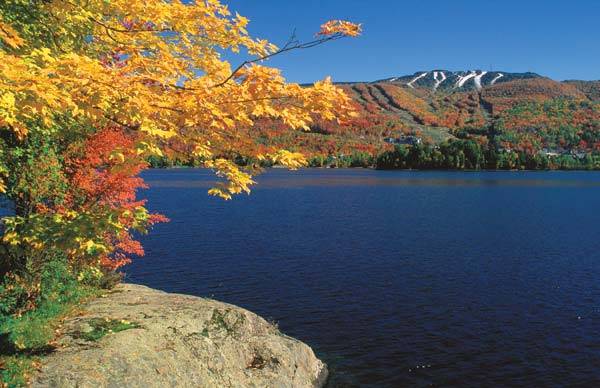
I have always loved the hills and mountains, the forests and rivers where I grew up in the Laurentians.  These ancient volcanic hills, softly rounded ,weathered and tree-covered sing to my soul.  They are not only a part of the landscape in which I grew up in – they are a part of very own self as well.

The water that I drank flowed from the rivers than ran between the mountains, fast in the spring with snowmelt, crashing over rapids and making its way southward through towns and villages.  This river fed the many lakes, along with mountain streams that flowed down the granite hills, bubbling and jumping merrily through moss-covered stones.  This is the water that I drank – it was a part of me, the rivers and the lakes, the mountain streams.

The clouds that scudded the hilltops gave rain that added to those mountain springs and rivers.  Those clouds were a part of me.

The sandy plateau in the midst of these mountains is where our house was built. It was the literal foundation for a very happy childhood.  Upon this soil I grew up. I tasted it upon my skin after a day spent outside, I inhaled the scent after a summer rain, smelt it on the cat’s fur when she came inside after rolling in the sand.  This soil is a part of me.

The sunlight beaming down upon my warm skin as we sat on the lakeside beach, slowly browning or freckling skin, drinking it in – that sunlight is a part of me.

The thunder and lightning storms that raged across the skies in the heat of August, restoring the balance and refreshing the body after the humidity of the day – those storms are a part of me.

The dairy cows in the lowlands fed by the river and other rivers gave us milk and cheese as we were growing up.  Those cows, the grass they fed upon, are a part of me.

The mulch thick and deep in the forest floor in late autumn, with mushrooms poking through and the wonder of life all around – that is a part of me.

Though I may now live thousands of miles away, all these things are still a part of me.  If we think about it even further, the minerals in our blood, the iron from stars in galaxies far away are a part of us – there is everything in us and we are in everything.

Go deep enough, feel all these things in your soul, have your mind blown time and again.  It begins to make sense, offers some comfort in our sometimes senseless society.

Words can give us glimpse – it is in the experiencing and relationship where the magic happens.


Druidry and Choices

Sometimes we have to make choices in our lives that don’t give us pleasure, that don’t make our lives easier, that go against the popular majority.  If we are to live with a strong moral and ethical code, we will have to make a stand somewhere, even if we are standing alone.

In my Druid practice, there is a very strong ethical stance with regards to the environment.  It’s why I’ve been vegetarian for nearly twenty years, and why I’ve since gone vegan.  I’ve made a vow not to buy any new clothes for over a year, in order to learn to make do with what I have, or to buy second-hand items when necessary.  I use organic, SLS free bath and beauty products as much as I can. I recycle.  I use vinegar and water to clean my house, sometimes scented with an essential oil. My garden is organic.  These choices have not made my life any easier – in fact, rather the opposite.  But it’s a choice that really wasn’t a choice – I couldn’t follow my religious path without making those changes in my life.

This weekend I had to make a choice about one of my many hobbies as well – LRP, or LARP (live action role-playing).  This system runs its events on land that is leased from other landowners, which has several large fields and a patch of woodland – a great site. However, this spring, the event held battles in the woods, which were in full bloom with bluebells.  Large sections were trampled underfoot by hundreds of people.

An active member of The Woodland Trust, this shocked me to the core.  Bluebell woods are protected, but this was still happening.  After writing to the company owner, I’m still not certain anything will change, or be done about it.  I am sincerely hoping that they will get in touch with the landowners, The Woodland Trust and Natural England about the issue, and how it can be resolved.  I have written to all concerned about the issue. Until then, I cannot give the company any more of my money, for that would be condoning the destruction of bluebell woods.  It’s terribly sad, for I have a lot of friends within that community, but I cannot compromise my principles in this regard.

Druidry is all about relationship, and we can easily forget that relationship is not only with each other as human beings, but with the earth as a whole.  To run through bluebell woods, destroying them underfoot as I “play” out a battle is completely disregarding any relationship to the woods, the protected flora, and all future sites as well.  We must make a stand for what we believe in, when things aren’t right – and especially for those who cannot speak for themselves, whether it be a bluebell, a dog being kicked by its owner, violence towards women, a teenager throwing a soda can onto the verge.

Balancing strong environmentalism whilst living in the 21st century is difficult.  I still have to drive a car fuelled with a non-renewable resource.  My house is heated with oil.  Our electricity is from coal-fired power stations and nuclear power stations.  However, I strive to do the best I can – it’s better than doing nothing at all.

A good resource for living ethically within the Druid Tradition can be found on The Druid Network’s website here – http://druidnetwork.org/what-is-druidry/ethical-living/

Excerpt from new book: Dancing With Nemetona

inner hutAs well as external, physical manifestations of sanctuary, there are also inner sanctuaries that we can create, filled with the blessing and the power of Nemetona – a space where we can feel safe, a place where transformation, healing, integration and all manner of things can take place.  Some Druid Paths construct what is called the Inner Grove (a place of ritual and transformation in the mind) and that shall be dealt with in a different chapter on sacred groves.  What I would like to suggest here is not so much an inner ritual arena, but a safe place to use as a “base” – I like to think of it as my Inner Hut.

Creating inner worlds is not only great fun, but a great way to express and confront issues that we physically may not be able to, or which may not be appropriate to do.  Several of my teachers have used the idea of an inner safe place which we can use as a starting point, and from there travel out into the wider realms of the mind, exploring what we need to explore.  We may have fantastical adventures in our inner worlds, or enjoy the more mundane things within them that we may not have the time to do in our physical world.  The Inner Hut provides the starting point, the sanctuary.

My Inner Hut is a place that I can go to in meditation, when I am called to journey, perhaps, or when I feel I need to really take a good look at something that is troubling me in my life, or when I simply need to be refreshed by the blessings that particular sanctuary provides.  If an answer isn’t available in the so-called mundane world, one may be found in the inner world.

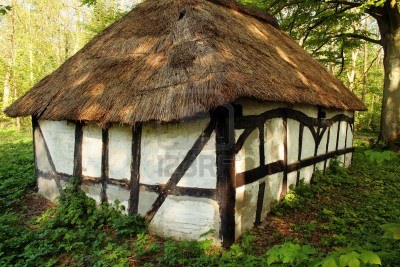
My Inner Hut is a simple, single-room dwelling deep within the heart of an ancient forest, close to a slow-moving river that winds its way through the trees and out into the wider world beyond.  It is a simple wattle and daub hut, with a thatched roof that occasionally needs repair and a dirt floor.  Inside there is a table in the centre, with two benches on either side, a bed along one wall and a chest at the foot of the bed.  There is a much-used hearth on the back wall, and a good stack of firewood both inside and outside the hut.  There is also a chair pulled up near the hearth, and a large wooden basin on a separate smaller table under the window.  Herbs are hung to dry from the ceiling, and my staff leans in the corner by the door.

This hut is my safe space and my starting point for any adventures that I may wish to undertake in the inner realms.  Sometimes it is simply enough to just spend some time in the hut, or around it, looking at the herbs growing nearby, sitting by the river’s edge and watching the water flow past.  If there is an issue to deal with, I can either deal with it in this safe space, or venture further out into the woods to find just what it is that needs to be taken care of, knowing that I always have this safe haven, this little sanctuary to return to should it be needed.

Boundaries: Dancing with Nemetona

Akram Khan Dance Company, from the Vertical Road tour

Akram Khan Dance Company, from the Vertical Road tour

Having danced deeply with the goddess Nemetona this winter, which has also inspired me to write my second book for Moon Books, the issue of boundaries returns again and again in relation to human interaction, in every day life with people that I share this journey with.

Our own personal nemeton, that space around us that we do not allow anyone but those with whom we are most intimate with, expands and contracts with each person that we meet.  Some we might shy away from, some we might fling our souls wide open to.  What I have learned is that boundaries must be kept, in order to keep the nemeton intact.

This is difficult for me, as I enjoy ecstatic relationship –I crave it in my Druidry, in my life.  Yet I have learned with whom it is appropriate, and with whom it is not.  To utterly dissolve into the moment of the sunset, or opening my soul to the bluebell wood as I lie beneath the gently swaying branches of oak and sycamore, or deep within the heart of ritual where transformation, celebration, integration take place – these are the times when it is not only appropriate, but relatively safe to do so.  I know that the bluebell wood will not harm me, will not abuse the relationship.  Sadly, this is often not the case with many humans that we meet.

Perhaps that is why it is so much easier for me, as a Druid, to find relationship with the beech tree at the bottom of the garden, or the badger that comes looking for birdseed and peanuts, than the average human being.  I have not been hurt by these creatures – even when my soul is laid bare, I have not come to harm.  The seaside has not taken advantage of that moment when we are soul naked, seeking deep ecstatic relationship.  Perhaps this is because the sea does not want, does not need as we humans need.

Human relationship is so very different, for so much of it is heavily dependent on need, on desires.  We seek a give and take in our relationships, if they are to be healthy.  When there is not balance, it is unhealthy, and often advantage of another is occurring.

Saddened by and a little wiser by past experiences, I have to relearn again and again where my edges are, and where they meet with others.  Telling myself over and over again that I will not be hurt by certain people, or that I will allow love in from others – this is what is so very important.  This is what Nemetona teaches me each and every day.

By becoming aware of our own boundaries, we can then act honourably with other humans we meet, and indeed with all of nature. Sometimes it is wholly inappropriate to fling our souls open to the lake at moonrise – that is why in Druidry we ask permission to share our soul touch with others.  Maybe this is what is lacking in much of human interaction – that permission is not sought. It is either given when not asked for, or taken even when it is not sought.

In the midst of all this, all we do is dance with Her as best we can, sometimes ecstatically, sometimes deep within our boundaries, ever awake and aware of our relationship to Her and to the rest of the world.

“And those who were seen dancing were thought to be insane by those who could not hear the music.” – Friedrich Nietzsche

Druidry – What is Awen?

In Druidry, we learn often hear the word, awen, being used, but what exactly is awen?   Loosely translated from Welsh, it means flowing spirit, or flowing inspiration.  Awake to our own energy, and stretching out towards the energy of nature around us, we begin to see just what awen is.  It is an opening of one’s self, of one’s spirit or soul, in order to truly and very deeply see.  When we are open, we can receive that divine gift, inspiration that flows, whether it is from deity, nature, or whatever it is that you choose to focus on.

For awen to exist, there must be relationship.  We cannot be inspired unless we are open, and we cannot be open unless we have established a relationship, whether that is with the thunder, the blackbird or a god.  It is cyclical in nature; we open and give of ourselves and in doing so we receive, and vice versa.  Letting go, releasing into that flow of awen allows it to flow ever more freely, and we find ourselves inspired not only in fits and bursts of enlightenment or inspiration, but all the time, carrying that essence of connection and wonder with us at all times.  There is, of course, a line to be drawn, for we can’t be off our heads in ecstatic relationship with everything all the time.

But just what is awen?  It is an awareness, not just on a physical and mental level but on a soul deep level – an awareness of the entirety of existence, of life itself.  It is seeing the threads that connect us all.  It is the deep well of inspiration that we drink from, to nurture our souls and our world and to give back in joy, in reverence, in wild abandon and in solemn ceremony.

Many are familiar with the Welsh tale/myth of Cerridwen and her cauldron, the three drops of awen falling onto Gwion’s finger and bringing his wisdom in the form of poetic inspiration, shape-shifting and prophecy.  Some liken this story to a Bardic initiation, or the three grades of Bard, Ovate and Druid.  In any case, drinking from the cauldron of the Goddess is to drink deeply of awen.

Many Druid rituals begin or end with singing or chanting the awen. When doing so, the word is stretched to three syllables, sounding like ah-oo-wen.  It is a lovely sound, that opens up the heart and soul. Sung/chanted together, or in rounds, it simply flows, as its namesake determines.  Our hearts literally can open if we let them when chanting or singing the awen.

Yet I am sure that the awen is different for each and every Druid.  The connection, and the resulting expression of that connection, the Druid’s own creativity, can be so vast and diverse.  It is what is so delicious about it – we inhale the awen and exhale our own creativity in song, in dance, in books, in protest marches – the possibilities are endless, as is the awen itself.


Awen and Peace – East meets West

Further exploring the nature of peace, what leads me to understand the fundamental precept behind achieving peace is through compassion.  But what is compassion?

Dictionary definitions say that it is a state of sympathy with someone who is suffering, and yet that doesn’t adequately describe compassion in my mind, in either the Zen or the Druid tradition.  Two words in Sanskrit delve a little closer, such as karuna, a gentle affection and a willingness to bear others’ pain, or metta, often described now as loving kindness, acting for the benefit of all living things with a selfless attitude.

The Dalai Lama stated “Genuine compassion must have both wisdom and lovingkindness. That is to say, one must understand the nature of the suffering from which we wish to free others (this is wisdom), and one must experience deep intimacy and empathy with other sentient beings (this is lovingkindness)” –  (The Essence of the Heart Sutra).

For me, compassion is all about relationship, about an integration with the world, with the universe. As the native American saying goes – “We are all related”.  (Not just humanity, but essentially go far enough back and see that we are all star stuff.)  In order for this integration to occur, we have to learn how to lose that sense of self, for is there is a separate self, there can be no true integration, only the state of sympathy.  There is someone observing someone else’s suffering, and helping to alleviate their suffering but still retaining a sense of Us and Them. In Buddhism, wisdom, or prajna, is most often found through the teachings of No Self, or attana.

In my studies in Zen Buddhism, we are taught to help wherever we can, as selflessly as is possible, which is true compassion. If you help someone and then expect a reward, there is still a separate self expecting reward from a separate person.  We have to learn to drop all expectations. The Tibetan practice of Lojong’s final slogan is brilliant in this regard – Do Not Expect Applause.  Only then, there is there an integration of everyone involved.

In Druidry, this integration is often termed as relationship – but again, words fail to describe the enormity of the meaning behind it all. Druidry also uses the word, awen, a Welsh word with several interpretations: poetic inspiration and flowing spirit to name a few.  For me, awen is the life “force” itself, in its myriad expressions, in constant change and flux.

To find true peace, one must release into this, into awen, losing that sense of separateness, and in doing so discovering the nature of compassion in soul to soul relationship.


The Call for Peace

Druid ritual in many traditions usually begins with what is known as The Call for Peace.  It is an affirmation that there is peace between everyone involved, and an aspiration that there be peace throughout the length and breadth of the world.  In ancient Roman times, Caesar documented some of the roles of the Druids in his time, stating how they were exempt from military service, did not carry weapons and often acted as intermediaries between warring tribes.  It was said that they could walk between the two front lines of battle and come through unscathed, for such was their role that none contended with their wish for peace.

Finding peace in today’s society is very, very difficult. I’m sure it was in ancient times as well, but I can only comment on the time that I live in with any sort of accuracy, however subjective or flawed my opinion may be.  When we make the call for peace in ritual, are we sure that there is peace within, nevermind without?

One has to begin with a definition of peace.  Here are some dictionary definitions:-

  1. the normal, nonwarring condition of a      nation, group of nations, or the world.  

This is interesting, as it infers that the normal state of the world would be a non-violent state between nations, groups of nations or the entire planet.  I do wonder if this time has ever existed.  This doesn’t only relate to the human species either – packs of wolves may fight for territory, as any of the feline persuasion as well.  However, I do like the sentiment behind this definition – that it is the normal state of affairs, and we are living abnormally, even if that has been since the dawn of time…

2. a state of mutual harmony between people or groups, especially in personal relations: Try to live in peace with your neighbours.

Indeed, this is a closer definition to what I think most people would believe peace to be, as we can relate to that on a much more personal level – not everyone is involved in a war-like conflict, even if their nation may be.

3. the normal freedom from civil commotion and violence of a community; public order and security: He was arrested for being drunk and disturbing the peace. 

Again, here we see the idea of normalcy being in a non-violent community.   It implies that we should, as a whole, be living in a non-violent, orderly and secure environment.

4. cessation of or freedom from any strife or dissension.

Again, many would relate to this definition, even if it can be somewhat vague, for everyone’s idea of strife or dissension could be entirely subjective – some people enjoy heated debate, others find it upsetting.

For me personally, turning over the idea of what is peace, I’ve come across words such as holistic, integration, relationship.  To be at peace, we must be at peace with everything else.  In a shared world, this is so difficult as to be nigh impossible – a few have claimed it (Buddha) and a few strive to live it in their mortal lives (again, Buddha, but also figures such as Dalai Lama, Mother Theresa, Gandhi).

Mulling over the idea of a pagan monastery all winter long, I would imagine that this peace would be so much easier to achieve in a state of withdrawal from the world, even with a group of like-minded people.  This withdrawal would also offer up the opportunity to integrate more fully with your religion without distraction, inasmuch as we are in a fairly secure environment in which to explore our religious passions.  We can focus on our relationship with others, with deity, with the world, without too much interference from modern day society.

But what is so bad about modern day society in which we cannot find peace?

Again, this is only a personal viewpoint, but seeing horrid images in the media of the strife that occurs all over the world affects our personal peace.  Bombarded by television shows that glorify arguments between individuals, families (I’m thinking Eastenders type here, but also reality shows such as X Factor, where we are invited to judge and determine who is better than another person and also become involved in criticism (see previous blog post on the critical mind).  How can I be at peace with the world when my morning radio alarm goes off and the first thing I hear of is how some man brutally beat an 80 year old woman to death in her own home?  Even if we don’t have televisions or radios in our home, they are prevalent elsewhere – there are even petrol stations in Amercia that have television screens on the pumps that play the news!

There are gods within Paganism that are associated with strife, with war.  Some of them also have healing qualities as well, showing a well-rounded, cyclical nature.  Perhaps establishing a relationship with these gods, if like me you are a polytheist, is the way ahead.  When the lines of communication open, and the nemeton is shared, our true selves can be expressed, whether that is with the gods or a badger.

Buddhism would say that the road to peace lies in compassion.  I’m still working hard on that one, bringing ideas of empathy and relationship which are a little closer to the language that I understand in Druidry.  I can see that we are all related, every single human being on this planet.  Every living thing is related in some form or other.  We are all star stuff.

So, back to the call for peace in Druid ritual – how definitively can we use the words below, as so many have done before?

Deep within the still centre of my being

May I find peace.

Silently within the quiet of the Grove

May I share peace.

Gently (or powerfully) within the greater circle of humankind

May I radiate peace. (OBOD http://www.druidry.org/events-projects/peacemaking-druidry)


The Druid Universal prayer makes no mention of peace, but does hint at it in the form of love at the end:


Grant o Goddess thy protection,

And in protection, strength,

And in strength, understanding,

And in understanding, knowledge,

And in knowledge, the knowledge of justice,

And in the knowledge of justice, the love of it,

And in the love of it, the love of all existences.

And in the love of all existences,

The love of Goddess and all goodness.  (Iolo Morganwg)

In order for there to be peace, there must be relationship. If there is no relationship, then anything apart from ourselves, or even our very self, can be an abstract.  So, perhaps when using either of the above, or our own call for peace within Druid ritual, we establish a connection, a relationship with everyone and everything inasmuch as we can, in order to better work with them towards a life filled with peace.  We can see where there is a need for peace in the world, and try to relate to that need in order to bring it about, or at the very least to understand it.  Where there is no need then there is peace.

The issues of need with regards to peace are interesting – these can vary from our need for peace to our everyday basic human needs, such as food, water, shelter and clothing. Where these needs are not met again there can be no peace.  We strive towards fulfilling our needs – that word, strive, with its same root as strife.

The call for peace is a good grounding platform in Druid ritual. It can bring everyone to a single intention, which in its form is the essence of ritual – actions based on intention in order to create relationship.  I’m not entirely sure that I am, as yet, able to state with absolute certainty that there is peace within any particular ritual, yet I am more than willing to share that intention of creating peace. Perhaps this is the more important of two, and focusing (perhaps pedantically) on whether or not there is peace is missing the mark.

May there be peace throughout the world.