Leo Babuata’s 12 Essential Rules to Live More Like a Zen Monk

12 Essential Rules to Live More Like a Zen Monk  (taken from http://zenhabits.net/12-essential-rules-to-live-more-like-a-zen-monk/)

“We have more possibilities available in each moment than we realize.” – Thich Nhat Hanh

Post written by Leo Babauta.

I’m not a Zen monk, nor will I ever become one. However, I find great inspiration in the way they try to live their lives: the simplicity of their lives, the concentration and mindfulness of every activity, the calm and peace they find in their days.

You probably don’t want to become a Zen monk either, but you can live your life in a more Zen-like manner by following a few simple rules.

Why live more like a Zen monk? Because who among us can’t use a little more concentration, tranquility, and mindfulness in our lives? Because Zen monks for hundreds of years have devoted their lives to being present in everything they do, to being dedicated and to serving others. Because it serves as an example for our lives, and whether we ever really reach that ideal is not the point.

One of my favorite Zen monks, Thich Nhat Hanh, simplified the rules in just a few words: “Smile, breathe and go slowly.” It doesn’t get any better than that.

However, for those who would like a little more detail, I thought I’d share some of the things I’ve discovered to work very well in my experiments with Zen-like living. I am no Zen master … I am not even a Zen Buddhist. However, I’ve found that there are certain principles that can be applied to any life, no matter what your religious beliefs or what your standard of living.

“Zen is not some kind of excitement, but concentration on our usual everyday routine.” – Shunryu Suzuki

    1. Do one thing at a time. This rule (and some of the others that follow) will be familiar to long-time Zen Habits readers. It’s part of my philosophy, and it’s also a part of the life of a Zen monk: single-task, don’t multi-task. When you’re pouring water, just pour water. When you’re eating, just eat. When you’re bathing, just bathe. Don’t try to knock off a few tasks while eating or bathing. Zen proverb: “When walking, walk. When eating, eat.”
    2. Do it slowly and deliberately. You can do one task at a time, but also rush that task. Instead, take your time, and move slowly. Make your actions deliberate, not rushed and random. It takes practice, but it helps you focus on the task.
    3. Do it completely. Put your mind completely on the task. Don’t move on to the next task until you’re finished. If, for some reason, you have no choice but to move on to something else, try to at least put away the unfinished task and clean up after yourself. If you prepare a sandwich, don’t start eating it until you’ve put away the stuff you used to prepare it, wiped down the counter, and washed the dishes used for preparation. Then you’re done with that task, and can focus more completely on the next task.
    4. Do less. A Zen monk doesn’t lead a lazy life: he wakes early and has a day filled with work. However, he doesn’t have an unending task list either — there are certain things he’s going to do today, and no more. If you do less, you can do those things more slowly, more completely and with more concentration. If you fill your day with tasks, you will be rushing from one thing to the next without stopping to think about what you do.
    5. Put space between things. Related to the “Do less” rule, but it’s a way of managing your schedule so that you always have time to complete each task. Don’t schedule things close together — instead, leave room between things on your schedule. That gives you a more relaxed schedule, and leaves space in case one task takes longer than you planned.
    6. Develop rituals. Zen monks have rituals for many things they do, from eating to cleaning to meditation. Ritual gives something a sense of importance — if it’s important enough to have a ritual, it’s important enough to be given your entire attention, and to be done slowly and correctly. You don’t have to learn the Zen monk rituals — you can create your own, for the preparation of food, for eating, for cleaning, for what you do before you start your work, for what you do when you wake up and before you go to bed, for what you do just before exercise. Anything you want, really.
    7. Designate time for certain things. There are certain times in the day of a Zen monk designated for certain activities. A time for for bathing, a time for work, a time for cleaning, a time for eating. This ensures that those things get done regularly. You can designate time for your own activities, whether that be work or cleaning or exercise or quiet contemplation. If it’s important enough to do regularly, consider designating a time for it.

  1. Devote time to sitting. In the life of a Zen monk, sitting meditation (zazen) is one of the most important parts of his day. Each day, there is time designated just for sitting. This meditation is really practice for learning to be present. You can devote time for sitting meditation, or do what I do: I use running as a way to practice being in the moment. You could use any activity in the same way, as long as you do it regularly and practice being present.
  2. Smile and serve others. Zen monks spend part of their day in service to others, whether that be other monks in the monastery or people on the outside world. It teaches them humility, and ensures that their lives are not just selfish, but devoted to others. If you’re a parent, it’s likely you already spend at least some time in service to others in your household, and non-parents may already do this too. Similarly, smiling and being kind to others can be a great way to improve the lives of those around you. Also consider volunteering for charity work.
  3. Make cleaning and cooking become meditation. Aside from the zazen mentioned above, cooking and cleaning are two of the most exalted parts of a Zen monk’s day. They are both great ways to practice mindfulness, and can be great rituals performed each day. If cooking and cleaning seem like boring chores to you, try doing them as a form of meditation. Put your entire mind into those tasks, concentrate, and do them slowly and completely. It could change your entire day (as well as leave you with a cleaner house).
  4. Think about what is necessary. There is little in a Zen monk’s life that isn’t necessary. He doesn’t have a closet full of shoes, or the latest in trendy clothes. He doesn’t have a refrigerator and cabinets full of junk food. He doesn’t have the latest gadgets, cars, televisions, or iPod. He has basic clothing, basic shelter, basic utensils, basic tools, and the most basic food (they eat simple, vegetarian meals consisting usually of rice, miso soup, vegetables, and pickled vegetables). Now, I’m not saying you should live exactly like a Zen monk — I certainly don’t. But it does serve as a reminder that there is much in our lives that aren’t necessary, and it can be useful to give some thought about what we really need, and whether it is important to have all the stuff we have that’s not necessary.
  5. Live simply. The corollary of Rule 11 is that if something isn’t necessary, you can probably live without it. And so to live simply is to rid your life of as many of the unnecessary and unessential things as you can, to make room for the essential. Now, what is essential will be different to each person. For me, my family, my writing, my running and my reading are essential. To others, yoga and spending time with close friends might be essential. For others it will be nursing and volunteering and going to church and collecting comic books. There is no law saying what should be essential for you — but you should consider what is most important to your life, and make room for that by eliminating the other less essential things in your life.

“Before enlightenment chop wood and carry water. After enlightenment, chop wood and carry water.” – Wu Li

Back to Reality

Reality is a slippery little devil.  Our minds are so adept at creating our own version of reality that the boundaries between what is real and what is not can become so blurred as to be indistinguishable.

Our thoughts can control us so much that they can keep us running around in circles, spinning off into the depths of our minds and in doing so, missing out on all the wonders and also the reality of the present moment.  Most people don’t enjoy being in the present moment – they avoid it at all costs. However, this is because they have probably, for the most part, never ever truly experienced being in the present moment. (See my previous blog post on mindtraps for more on this subject – https://downtheforestpath.wordpress.com/?s=mindtraps.)

But I digress.  Problems arise when our perceptions of reality become twisted with the imaginative and creative thought processes that our human brains are so capable of.  This was made clear when my husband received a phone call last night from someone he hadn’t heard from in a long time.  When he queried why the person hadn’t been in touch (he didn’t have their number) they stated that he had become upset at their last conversation, and that he had put the  phone down on them.

This was not true – I don’t believe he has ever put the phone down on anyone, and especially would never do so to this person.  This person had left the real conversation months ago, and was not satisfied with the outcome.  And so, this person developed in their minds ways that it would appear that they had been wronged, so that they could continue to avoid reality and live in their preferred state of being the victim.  They may have told and retold the story of the conversation in their minds over and over again, changing the details until, after a period of days, weeks or months, reality had changed. Stories change with the telling, we know this.  But we are fooling ourselves when we keep changing reality to suit our own egos and emotions.

I remember times when I’ve done this myself in the past – sometimes it is to justify certain behaviour, or to explain events.  The key is to become aware of when you are doing it, to stop and say “Right.  I know what the facts are, and I’m going to stick to them, and not change them to suit my own desires”.  I still get surprised when I see this in other people – I’ve had people accuse me of certain things, of promising others and of creating a totally separate reality to that which actually occurred.  It can be hurtful, at times, until you understand the thought process that creates this – you then realise that you had no part in it, that it became an entity totally foreign to your own being.

This doesn’t mean that you are not responsible for your actions – we all must be the best human beings we can at this present moment. Actions have consequences. However, we must also be aware and have some compassion for those who are caught up in their own realities, to a certain extent. We don’t have to live in them, or even partake of that reality, but we can understand the reasons why.

We have to learn how to live in the here and now.  Being alive and present in the here and now allows no time for emotional attachment to our thoughts and feelings – we still respond emotionally to situations, but we don’t become attached to the emotion itself.  As I left work yesterday, after a long staff meeting, my colleague was upset at what was said about our department, which was, unwittingly or not, derogatory.  Not only does this emphasise that we need to think very clearly before we speak, but also that we also cannot attach to the emotions that follow after a certain event.  I too was very displeased with the outcome of the meeting and the insinuation, and driving home could feel anger welling inside, threatening to ruin the whole drive home and run well into the evening. However, I caught myself, and brought myself back to reality and the present moment.  What was the present moment? Driving home, in the late afternoon sun, putting miles between myself and the event, figuratively and literally.  It was no longer happening now, except in my head.  I could either let it continue to live in my head, or simply enjoy the evening. I chose the latter.

This doesn’t mean that the issue will not be dealt with. It will, in a calm, rational and compassionate way.  But it won’t dictate reality for me – reality is what it is, and nothing more.  When the time is appropriate, the issue will be raised without undo emotional attachment to the residual event that still exists in our minds, which may have altered slightly or even greatly since the actual event occurred – reality is a slippery devil indeed.  I will not go over the event again and again in my mind, perhaps changing reality in doing so.  I will deal with the facts.

Let us continue to tell stories, but not make up the story of our own life.  Our own lives are brilliant and fascinating enough – we don’t need to add more drama to them.  By doing so, we will miss our own lives, living instead in our minds and foregoing some of the wondrous nature that is constantly unfolding right before our very eyes.  We can hurt other people by making up stories to suit our egos and our needs, and the person whom we hurt most is ourselves.

Reality is not such a bad place.  Really.


The Kid

I just watched a Bruce Willis movie, called “The Kid”.  I enjoyed it, though it may be a bit saccharine for some – and yes, I did cry at the happy ending.  It’s a story of a bitter and spiritually dead but incredibly wealthy image consultant who meets his eight year old self, and has to relearn things about himself in order to save himself from a lonely end.  It also showed us that we should never forget our child self, and the dreams that child self had.

What did I want to be when I was eight years old? I can’t quite remember, and I’m not even sure that I thought that far ahead when I was eight.  If I did, I’m pretty sure that I would have wanted to be a fairy elven princess living in a castle in England.  Well, eight year old self, I didn’t do too bad. I’m a Druid living in a beautiful house in the English countryside – it’s pretty close.

What would I say to my eight year old self? Yes, there were rough spots and there were glorious spots.  There were heartbreaking tragedies and uplifting victories. There were mistakes and compassion, beauty and ugliness, and everything in between.  But it all turned out good.

In the movie, the 40 year old self and the eight year old self then meet the 70 year old self.  So, I wonder what my 70 year old self would say to me?  I hope that I have made that person proud, as proud as my eight year old self.  I would hope that life would be filled with love and compassion, and that I would never stop dreaming; never lose that eight year old self.

What would your eight year old self say to you?

The Nature of Prayer

A television show that I enjoy, which originally aired in the late 90’s through to 2002, is Dharma and Gregg. It is about a free-spirited woman with two hippy parents who is very spiritual, very loving and very funny. She marries a conservative born and bred lawyer, and the exchange and growth between the two is what makes this such a great show.

At one point Dharma is praying in a hospital chapel, and her spirit guide, a Native American named George whom she connected with personally before he died, comes to her aid and offers advice in her time of need. He hears her praying, having a conversation with whatever deity will listen, and offers these very poignant words which I remember to this very day.

“So, you’re having a conversation with the Great Spirit, the Creator of All Things, and you’re doing the talking?”

This, indeed defines for me the nature of what prayer is seen as today. Even if we are not asking for anything, a lot of prayer consists of a one-way conversation between the individual and the deity/spirit in question. Prayer is a relationship, for me – and as such necessitates a give and take in everything, including both spoken and unspoken words. Too often in prayer, we forget to listen.

Have you ever had to listen to someone go on and on, and know that they are simply enjoying their own drama? If someone comes to you and asks sincerely for advice, then they will tell their tale and then listen – otherwise it is simply a self-indulgence that is ego-based. Communing with deity means a communication from both sides.

Prayer is also not something done only in times of need. How annoying is it when a friend only comes to you when they need something? A good relationship is being there for someone, to listen and aid a friend, and with a Zen attitude, not expect anything in return. This is a huge ask. I’m not terribly great at it – I still have some expectations, though I am working on the philosophy behind the Zen attitude. I’ve had friends that only take from you, physically or spiritually, and give nothing back. It isn’t nurturing, and that is the main difference, I think.

For relationships don’t simply happen – they do require nurturing and attention, kind of like a houseplant, when I come to think of it. There are some friends who I don’t see for years, due to distance, but when I do see them it is like no time has ever passed, no miles could ever come between. It is because these friends nourish me, as I hope I do for them. It is the same with the gods – some I haven’t communed with for years, but they still hold a special place in my heart, which is renewed upon experience. I sincerely hope this doesn’t sound too self-centred.

I’ve since dropped the friends who are no longer nurturing, who only have their best interests to heart. I have been used by several people, and it’s never nice. The same goes with any deity – I will not pray to any god or goddess who is simply in it for themselves. I seek wholesome, nurturing relationships with my gods, my friends and the environment – it is part and parcel of being a Druid.

So what is the nature of Prayer? The nature is to nurture. It is to establish a connection that sustains everyone involved and which makes this world a better place. It is a give and take, listening and responding, with honour and with integrity and to the best of our ability.

Life itself is prayer.

Defeating the Goblin King

Dreams
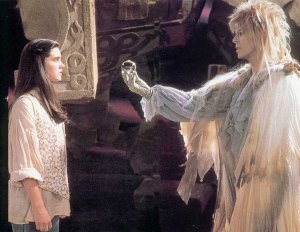
I’m a big David Bowie fan, after having fallen in love with him as a young teenager, watching Jim Henson’s film, Labyrinth. He played the Goblin King, a creature who was used to getting things his own way – he was all powerful, and the Labyrinth was his to control. Or so he thought.

It’s a wonderful tale, of a young girl coming into adolescence, of learning that life is not always what it seems, and that life is unfair. It’s also about making friendships along the way, about being kind and also familial obligations. There are so many ways to interpret the film, and I thought to look at it from a Zen point of view. It was interesting.

Our thoughts often control us, without our even realising it. These thoughts, these intangible things, have so much power over our lives. We believe in our thoughts so much, and hold to them so much. We hold on so tightly to our thoughts, and to ourselves. Who would we be without our thoughts?

Yet in Zen we try to realise the control that our thoughts have over us, by acknowledging them, by becoming the observer. Bit by bit, as we sit in meditation and go through our daily lives, we begin to see patterns emerging. We may have a thought about ourselves – I’m artistic. We tell everyone that, reinforcing that thought. Yet that is not all that we are – we may be good with animals, gardening, maths, etc. The repetitive thoughts, the ones that we say over and over again to ourselves, become a reality for us. Yet they are still thoughts, not reality. There is no substance to them.

Of course, not all thoughts are bad. We need to think, to work out problems, to get out of bed in the morning even. It is in the attachment to the thoughts that gives them a false substance, a false reality. It also can give us great pleasure, living in this fantasy land of our thoughts – it means the hardships of real life cannot affect us there. We are safe, in the bubble of our thoughts.

Most of us spend a lot of time being controlled by our thoughts – we never even realise it. Much like Sarah, the protagonist in the film, was being controlled by the Jareth, the Goblin King without her knowledge, we aren’t even aware of the power that they hold over us. They make us run around in circles, not getting anywhere, simply thinking, thinking, thinking – where is the doing? Where is the experience? We get angry at someone, and have a thought about that. Then we attach to that thought, and it can affect us for the rest of the day, week, year, or our entire lives. We all have emotional responses to situations, and thoughts about everything – but the attachment to them is where stumble and fall on each and every step. There is no progress – we’ve fallen down the oubliette of our thoughts until we are completely trapped in a small, dark and confined space.

Instead of simply experiencing the anger and then letting it go, we’ve become a prisoner of our thoughts about the situation. And all the while, the Goblin King laughs to himself, safe in his tower, loving to watch us run around in circles as the sands of time run out.

When we sit in zazen, however, we begin to notice our thoughts, our patterns of behaviour. By being the observer, we can take a step back from our thoughts and look at them without attaching to them. We can see the physical manifestations of them in our body as well – a contraction in our jaw, the hunching of our shoulders, our heart beating faster. By becoming aware, of thoughts, and indeed, of all our surroundings, we are better able to respond to situations than before. Sarah didn’t see through the illusion for a long time in the film – even though she was reminded by other characters, time and again, that nothing is what it seems. Slowly though, the illusion wavered, and the cracks in the false reality began to show. The bubble was broken, and Sarah was somewhat freed, for a time. When she finally saw through the illusion fully, and took the great leap into the unknown, literally and figuratively, that’s when she was able to come face to face with the Goblin King himself, to bring him out of hiding and face him in a final battle.

So, after much practice in zazen, after much meditation and time spent being the observer to all the thoughts that run around in our head, without getting caught up in them, we face them down. We say “enough” – we are not going to be controlled by them any longer. We see the thoughts for what they are. The thoughts fight back, with everything that they’ve got – Jareth holds out the most potent, alluring thing that we all hold so dear – our dreams. He offers them to Sarah, but Sarah now sees through the false reality. She then recites the final lines from her book back to the Goblin King, saying the powerful, magical words that will defeat him.

“Through dangers untold and hardships unnumbered, I have fought my way here to the castle beyond the Goblin City, to take back the child that you have stolen. For my will is as strong as yours, and my kingdom is as great. You have no power over me.”

Those six words – “you have no power over me” is what can release us from the labyrinth of our minds, from the traps that our thoughts can create when we attach to them. We suddenly become free, to experience, to return to our pure self, to break loose of the chains and to truly live life to the fullest.

So, the next time we fall into despair, wishing our lives were different, we can simply say those six words – you have no power over me. When our minds are rushing around as we try to meditate, we simply observe them without getting caught up in them, and repeat you have no power over me. When someone says something nasty to us, we feel the emotion, we react (hopefully with compassion) and then we let the experience go, without attaching to it, simply by saying you have no power over me.

Then and only then can the Goblin King be defeated, and we freed from the labyrinth of our minds.

Though, I must admit, I’m sure some of us would prefer to stay in there with David Bowie 😉

Face to Face or Phone to Phone?

phoneSocial media today has led, as many are probably aware, to a serious decline in face to face interaction.  We are a social species, and everyone needs a little social interaction.  What I am discovering more and more is that people are forgetting, or never even learning, the niceties of a social situation – standing in line at the fairtrade coffee house and actually making eye contact with the person in front/behind you, maybe even smiling and talking to them.  I think we all, to a certain degree, need a little social interaction – face to face, even if we are self-proclaimed “not a ‘people person’”.  We are in dire peril of losing all our social graces. And yes, I do realise the slight hypocrisy of making my views aware on an online blog. 🙂

Last month when I went out to dinner with my husband and father in law, I noticed a couple at the table next to us.  They barely said two words to each other – either one or both spent most of the time on their mobile phones – not talking to other people on the phone, but presumably doing something with an app, or most likely checking social network sites.  I was truly saddened by this.  How many people spend their lives, head down, looking at a small screen to catch up with the latest? What about the world going on around them?

A few months before, in a crowded bar my friend and I asked to join a couple of lads at their table, as there were none free and my back was hurting – I needed to sit down.  They kindly agreed, and spent most of the time talking to themselves – fine, I wasn’t looking for conversation with them at any rate.  However, when one went to the bar to get drinks for the both of them, and my friend was also at the bar, I was left alone with one of the lads.  As soon as he was left alone, he went head down to his phone, completely ignoring everything and everyone around him.  Same thing happened at my local pub, sitting at the bar and chatting with the bartender and the bloke next to me – as soon as she left to get an order the bloke next to me put his head down and went straight for the phone.  Why go the pub at all?

What I worry about is the ability to interact with people in real life situations seriously declining.  Mere politeness is on the decrease, as any walk down a busy London street can testify.  I’m not expecting an ethical debate on animal testing, or politics, or whatever from someone standing in line with you, but what I would like to suggest is to put down the phone and at least acknowledge the person near you. Or at the very least, put the device away when you are walking down the street – a friend of mine nearly got run over last year because he was checking his phone.  How many phone related accidents do we need to hear about? Be aware of your surroundings.

One of my work colleagues told me of his New Year’s resolution last year, which I thought was brilliant.  He resolved to never pretend to not “see” somebody – to always acknowledge.  He thought it was really empowering  and I could see why – even when someone has pretended not to see you, you still go up and say “hi!”.  This most basic acknowledgement is such a small, yet significant thing.

Life is happening all around these people who are addicted to their phones, or tablets – using them to block out the world, or to avoid a social situation in which they are not comfortable. But really – it’s not that hard.  Someone isn’t going to bite your head off for smiling at you as you pass them in the street, or waiting in line at the shops.  Even if you are terribly shy – just try it.

I do wonder if there is a serious mobile phone addiction – a couple of days ago I saw a young couple walking out the door of a local recreational pool, both with phones in hands in case anyone should ring them – ready to answer at a moment’s notice.  Are they really that important? Are the callers? What about each other? Is this not a statement that whoever might ring them is more important than the person they are currently with, in person?

I’m sure I have some sympathisers – people who hate it when they go out to the pub or for coffee with a friend, and the friend puts the phone down on the table, right in front of them, face up, in case they receive a Facebook notification, an email or a call.  When I am with someone, I am with them. Fully. I think that anything less is rude, and a little saddening – judgement call, I know.  I really am attempting to understand rather than judge, but I realise I am failing in understanding – unless it truly is an addiction.  What do you think? Are people addicted to their phones? If so, isn’t there something we should do about it?

Lives are being wasted away.  If you are a person who always has their phone on, may I suggest you turn it off for a day, then two, then a week.  See if you have truly missed anything.  Don’t check Facebook for a day, then two, then a week, and again – did you really miss anything?  Be with the person you are with.  Acknowledge others around you.  Take that damned phone off the table and look the person in the eye.  Be there. Awake. Aware.

Druidry and the Ten Bulls

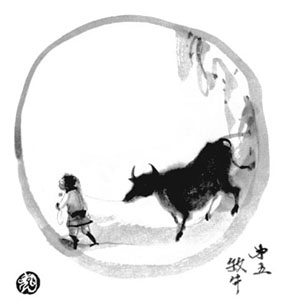
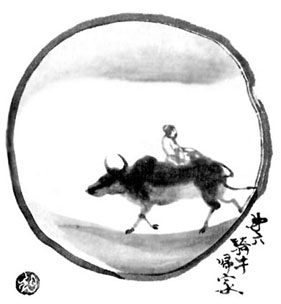
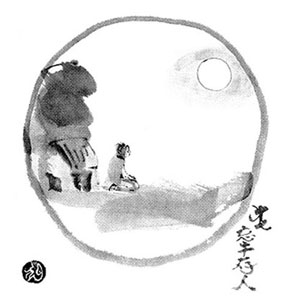
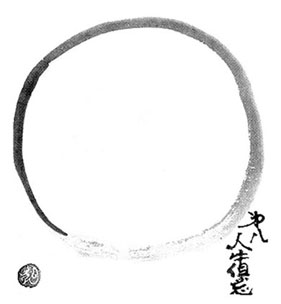
The Ten Bulls is an illustrated poem used by followers of Zen Buddhism to explain the search for enlightenment.  For me, it also represents the search for meaning in my own Druidry and indeed, in my own life in general.  It can be applied to everything, but for the purposes of this blog I’ll stick to Druidry. To see the Ten Bulls, otherwise known as the Ox-herding pictures, you can follow this link:- http://www.sanbo-zen.org/cow_e.html.

The search for enlightenment, the search for the Self and meaning is a major part of any religion or spirituality.  What will explain that sense of something missing, that lacking? What will fill it, or guide us to fill it in? What will help us to realise our full potential and live according to our True Self?

For me, this has been blending Zen with Druidry, and in the Ten Bulls can be encapsulated quite neatly.  They are, as follows:-

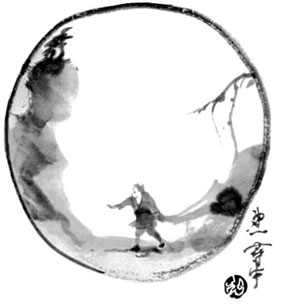
 1.In Search of the Bull

1

When we first come to Druidry, we do not really know what it means, for there are no long-established formal schools or training that we know of.  We can look to history, and then find out about courses now offered in Druidry through various organisations, but is this Druidry? It is certainly a version of it – Druidry is what it is, to each and every person. Moreover, to each and every person, it is different, yet still falls under a single banner. Confusing? Hell yeah. In a way, I think it’s meant to be. It encourages us to get out there, and find out more – beginning the adventure.


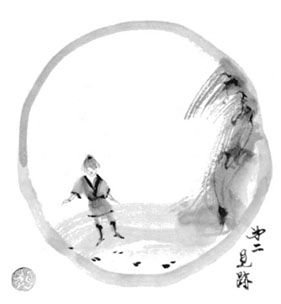
2.Discovery of the Footprints

2

We have begun our adventure, and are searching now for what Druidry is.  We catch glimpses of it in the works and writings of others, yet we still have not experienced Druidry for ourselves.  Like the wind, we can’t see it, we can only see its effect on other things.  We continue and go deeper into our Druidry to find out what it really is.


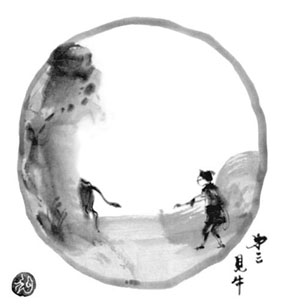
3.Perceiving the Bull

3

We’ve caught a glimpse!  We’ve had an insight into what Druidry is – we know that we’re now on the right path in our journey of self-discovery. Yet it is still not entirely clear – the experience is not yet full.  We run after the bull in the hopes of understanding.


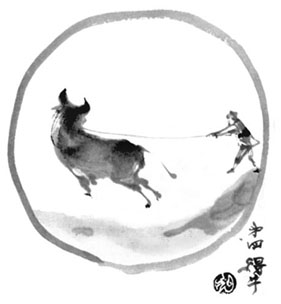
4.Catching the Bull

4

We’ve found our Druidry!  After many twists and turns, we’ve come across a path, or developed our own, that seems to flow with the essential spirit that we call the Self.  We may find several bulls, even, until we find the right bull, but eventually we come across a method, training, or experience that reflects our inner core. We harness that energy, but what do we do with it now?


 5.Taming the Bull

5

We learn that knowing what Druidry is, is simply not enough. We must practice with it, again and again, experience it and not simply read about it.  We hold rituals, we meditate, we get our fingernails dirty.  We do the work necessary, and learn discipline.


6.Riding the Bull Home

6

This is Druidry! This is what it means, and it is a joyous expression of our inner souls.  We have a sense of “coming home” – we know how to celebrate the seasons and each other, and we may find the beginnings of an inner peace hitherto unknown.


 7.The Bull Transcended

7

We then realise that Druidry is not something external, nor even internal – that it is something to be lived.  There is no separateness, no duality to Druidry – it is not a way of life, but it is life itself.  There is a stillness to it.


8.Both Bull and Self Transcended

8

We are no longer separate from the world and from Druidry either.  Druidry is us, it was always us.  We experience each and every moment with the same reverence we would to ritual – everything becomes sacred.


 9.Reaching the Source

9

We have reached the source of life itself, and find that meaning or no meaning have no place – only life itself. There is no Druidry. There is no Self. There is no separateness.  All is unified under the banner of Life, changing moment by moment, unconcerned with meaning or no meaning.


10.Return to Society

10We return to integrate what we have learned from our experiences, to share them and to help others who may be seeking.  We do what we need to do for ourselves, our family, the environment without any selfish thoughts – we simply do.  With the knowledge that we have gained that so expresses ourselves, and which is known as Druidry, we live as best we can, in the world, present, awake and aware.


The Myth of the Moral Highground

Is there such a thing as a moral highground?  I have heard people say that they can accept certain people’s behaviour, on the basis that they “are a better person”.  They have chosen their beliefs in themselves, their faith, whatever, and made a judgement call as to who is a better person.  But then, who is a better person above them? And above them? Isn’t it all about perspective anyway?

Believing that we are better than someone else is a falsity and a tragedy, in my opinion.  It can lead to all sorts of destructive behaviour, from bullying to arrogance to war.  Passing a homeless drug addict in the street – do you believe that you are better than that person? Finding out about someone’s infidelity – does that make you a better person? Working for charities, donating time and money – does that make you a better person?

Do you think Mother Theresa thought she was better than the rest of us by doing what she did? I hardly think so.

We all make mistakes. We all have moments of enlightenment, and moments of dark despair. Our lives have happiness and tragedy in them.  Yet claiming that we are better than someone else is simply to say that our circumstances are better than theirs – and circumstances can change on a dime.  As a noun, the dictionary defines circumstance as “a condition, detail, part, or attribute, with respect to time, place, manner, agent, etc., that accompanies, determines, or modifies a fact or event; a modifying or influencing factor: Do not judge his behaviour without considering every circumstance”.  We cannot even consider every circumstance, for we are in no way omniscient. We could become the homeless drug addict, and then where has the better person gone?

We are all on a level playing field.  The search for a moral highground is like looking for the Holy Grail.  All that each person can do is simply to do the best that they can at any given point in time. Sometimes their best may not be all that “good”, whether the person has had moments of enlightenment or not.  Yet to judge ourselves against others only separates us further from others, which leads to an Us and Them mentality, in which horrendous things can occur such as war.

Surely we need morals to follow, else anarchy would reign?  For the most part, most people naturally want to do “good”.  Morals are constantly changing as well, as are opinions – else women would still be the property of their husbands, African Americans would still be relegated to the back of the bus and Britain would be ruled by the Christian Church. Trying to gain the moral highground on a level playing field just doesn’t work – you’d simply be jumping up and down trying to get above everyone else, and yet gravity would bring you back down each time.

Realising that no one is better than anyone else is the key to living a happier life, for you and everyone around you.  People who think that they are better may fall into destructive patterns.  They may not realise that by blowing out someone else’s candle, it doesn’t make theirs burn all the brighter.

Yet there is nothing wrong with living a life of discipline, and of trying to better oneself – to be more aware of one’s own patterns of behaviour.  If we accept that we are only doing the best we can at this point in time, there’s nothing to say that we can’t do better in the future. But we shouldn’t strive to do or be better than other people.  The work should be done on ourselves, with the realisation that the thinking behind “I am better than her” does not make you better, and can, indeed, make you worse.  It is simply putting one’s self onto a pedestal to gain the moral highground, and anyone can fall off the pedestal easily.  I know that the next time I find myself thinking that, I am going to step off my pedestal and get back to the level playing field, where I can look everyone in the eye and see that we are only doing as we can, and just to do the best that I personally can, which is no better than anyone around me.

Kierkegaard and the Bullies

Perfect love means to love the one through whom one became unhappy – Soren Kierkegaard

Following on from a recent blog post about forgiveness, putting into practice the habit of it is, as is everything, much easier said than done. So I’m going to share some personal things in this blog post, which I don’t often do, but which I think is necessary to give it some context, and to perhaps allow for people in their own situation to relate to it in some way.

Kierkegaard’s reflection on forgiveness inspired me today to do something which I have never been able to do.  Forgive the bullies.  Thinking about forgiveness a lot lately, I have decided that the best place to start was at the beginning, when the first people who treated me badly first made an impression on my mind and my life.

I had a really happy childhood, growing up in beautiful countryside in a very loving family.  I exceled in school – primary school was a breeze.  I was top of the class in both academia and athletics – I loved them both. I was confident and happy – it was a great time for me.  However, things changed when I went to secondary school.

The first half of the first year went well – though it was a shock moving from a Grade Six class that had five people in it to class sizes of twenty to thirty children.  The school was enormous compared to my primary school, but I adapted pretty well (and much thanks to a map my sister drew especially for me to find my classes in the many halls, which was my saviour that first month!).  I was confident and smart and making new friends under quite difficult circumstances to a very sensitive child.  And then came the bullies.

They were two years older than me, and came from the same region, so we shared the long bus journey together (an hour each way, a total of two hours a day). That was where it all started.  Name calling on the bus – for whatever reason, began the whole affair.  I assume that it was because I was tall, pretty, blond and happy – though I can never truly know the full reason behind it.  Sometimes people simply think that blowing out another person’s flame will make theirs shine all the brighter, but that just isn’t the case – everyone knows two flames are brighter than one alone.  For whatever reason, the bullying started.

Being confident, I decided to fight back.  I was smart, and could have a comeback for anything. Everyone, from television and film and books, said that if you fight back, the bullies will leave you alone.

That is not the case.

I fought back, with words, not allowing them to see that they were hurting me – throwing it back at them, and also hoping that others around me would rally to the cause and that we would all overthrow this minority of bullies who seemed to control “the bus”.

That was not the case either.

People didn’t stand up for me. But I still persevered, fighting back as best I could. Eventually it did get me down, and I started to doubt myself. But I stayed as strong as I could. They put glue in my hair. They threw food and garbage at me. They called me names. They threatened me.  They taunted me every time we passed in the hallway until I avoided all the main halls and used the back stairs, entrances and exits as much as I could. I still held fast to the belief that it was because they were jealous – I stayed strong in my convictions, but it really, really started to get me down. I dreaded going to school every day, and dreaded the bus ride there and back.  I joined after school clubs just so I wouldn’t have to take the same bus as they did home – I could take a later bus. I longed for the two days of respite that the weekend brought – Fridays after the bus dropped me off was like a whole new world of freedom to be me again.

It became so bad one day though, that I had had just about enough of it all and, with no holding back, turned around to where they had moved up in the now almost empty bus to sit directly behind me and taunt me ceaselessly.  I let it rip, verbally, with all the hate, spite , viciousness and intelligence that I possessed. Their faces were shocked, and then anger took over. One girl grabbed me by the hair and started banging my head against the bus window, over and over again.  An older boy came down from the back of the bus and pulled her off of me – I had started physically fighting back – and we were separated.  I got off the bus seconds later at my stop, adrenaline bursting along with tears as soon as the bus was out of sight – I wasn’t going to let them see me cry.  I hated myself and my life.

The next day we were, of course, called into the Principal’s Office.  After a few minutes, where I (with seething calm) stated my case and then the other girl was allowed to state hers, she simply began to cry.  I was too angry to care about why she was crying – she had made my life a living hell.  I sincerely hoped the Principal was not “duped” by her show – though on reflection I do believe that she was a truly unhappy girl in an unhappy situation, the details of which I still am not aware of to this day – only rumours.

Nothing came of it for me – but I think she may have received a three-day suspension or something similar, though the memory of that is a little fuzzy.  What I do remember is that evening she called my house, and my mother answered the phone.  The girl threatened my mother and family, and also said that she didn’t care if she got expelled from school – she could always transfer to SAA.   My mother said, “Go ahead, please do.  BECAUSE THAT’S WHERE I WORK.” We never got a phone call from her again.

The bullying eased off from then on – just some taunts and words passing in the hallway. By this point, I saw the light at the end of the tunnel – the bullies were graduating that year, and once they were gone the school “was mine” again, in the sense that I could live, learn and do as I pleased and enjoy every second of it.  They graduated, or failed – I don’t really know, but they left. Those last two years of my high school life were some of the best years of my life.

I still suffered from confidence issues – walking past a group of people laughing, I would assume they were laughing at me.  Sometimes I still do – though now I catch myself and, with a wry grin, shrug it off.  But one thing I’ve never been able to do is to forgive them for the years and years of torment that they put me through.  Well, today I decided that enough is enough.

I have carried these bullies with me for 27 years now, and I’m more than ready to put them down.  As in my previous blog post, the story of the monks and the sack of potatoes, I really don’t want to carry anger and hate to these people anymore – I’m going to empty the sack, and maybe one day lose the sack altogether so that it can never be filled with anger again.  For anger is the cause of pain and suffering in the world – it is the root behind most, if not all, sufferering and “evil”.  So, no more, thank you very much.  I forgive you, CB, KJ, WG, D and A – I don’t want to carry you around any more.  I hope that your lives are much happier now, and filled with love.  Tears are welling up in my eyes even as I write this – the release is overwhelming.  I have compassion for myself and for you.  May you live well.

And so, I aim for what Kierkegaard wrote – for love is compassion and forgiveness.  I am emptying my sack, one by one, and looking for perfect love with every person who has made me unhappy.  In this way, I believe, the world can and will be a better place.  Namaste.

Going lightly through life…

As I was out walking the other day, the saying” Living well is the best revenge” popped into my mind.  After a moment’s thought, an additional part to the saying came to mind – “yet if you are focused on revenge, you are not living well”.

At this time of year, when peace on earth and goodwill towards men is often heard, I thought that the addition was rather apt.  For the first part of the saying, it almost deals with the issue, but yet does not allow for forgiveness.  We are still holding a grudge towards someone for what they have done to us.

It reminded me of a story that I recently read, where a group of young monks were given a sack and a bunch of potatoes.  The Master told them that for every grudge, for every thing they could not let go, they had to put a potato in the sack and carry it with them – a physical reminder of the thoughts that they carry around in their heads, which can be outwardly reflected in our behaviour and even our bodies.

After a while, the young monks decided that it was much easier to forgive and let go than to keep carrying around this heavy load the whole time. So, one by one, the potatoes were taken out as they moved on, letting go.  Yet, even as they emptied their sacks, they realised that the sacks could be refilled, and quite easily as well.  So they discarded their sacks – seeing that the sack was as important as the potato. The potatoes were the thoughts, the sack was their very self.  If they held onto their sense of self as lightly as they did their thoughts, seeing that there is no duality and that all things are connected, then there would be no sack, no potatoes, and no burden to carry through life.

I have applied that story to all the old and new grudges that i have been carrying in my life – why would I want to carry them in the first place? Letting go, leaving it all behind and holding very lightly to opinions and the sense of a separate self seems to be the way forward.  It’s not easy, however. Forgiving someone means letting go of any sense of righteousness.  It means letting go of the idea that someone is wrong.  It means simply living in the moment and enjoying it for every second that it exists.  The saying goes “forgive and forget”.  Now, forgetting is much easier than forgiving. I think simply forgiving is enough – forgetting means that it may happen again.  Forgiving implies understanding and not judgement.

So, now is the time to live well, letting go of any ideas of revenge, of grudges.  Life is far, far too short to carry around all that we do not need.  Go lightly through life.  And blessings of the season to you.