Defeating the Goblin King

Dreams
I’m a big David Bowie fan, after having fallen in love with him as a young teenager, watching Jim Henson’s film, Labyrinth. He played the Goblin King, a creature who was used to getting things his own way – he was all powerful, and the Labyrinth was his to control. Or so he thought.

It’s a wonderful tale, of a young girl coming into adolescence, of learning that life is not always what it seems, and that life is unfair. It’s also about making friendships along the way, about being kind and also familial obligations. There are so many ways to interpret the film, and I thought to look at it from a Zen point of view. It was interesting.

Our thoughts often control us, without our even realising it. These thoughts, these intangible things, have so much power over our lives. We believe in our thoughts so much, and hold to them so much. We hold on so tightly to our thoughts, and to ourselves. Who would we be without our thoughts?

Yet in Zen we try to realise the control that our thoughts have over us, by acknowledging them, by becoming the observer. Bit by bit, as we sit in meditation and go through our daily lives, we begin to see patterns emerging. We may have a thought about ourselves – I’m artistic. We tell everyone that, reinforcing that thought. Yet that is not all that we are – we may be good with animals, gardening, maths, etc. The repetitive thoughts, the ones that we say over and over again to ourselves, become a reality for us. Yet they are still thoughts, not reality. There is no substance to them.

Of course, not all thoughts are bad. We need to think, to work out problems, to get out of bed in the morning even. It is in the attachment to the thoughts that gives them a false substance, a false reality. It also can give us great pleasure, living in this fantasy land of our thoughts – it means the hardships of real life cannot affect us there. We are safe, in the bubble of our thoughts.

Most of us spend a lot of time being controlled by our thoughts – we never even realise it. Much like Sarah, the protagonist in the film, was being controlled by the Jareth, the Goblin King without her knowledge, we aren’t even aware of the power that they hold over us. They make us run around in circles, not getting anywhere, simply thinking, thinking, thinking – where is the doing? Where is the experience? We get angry at someone, and have a thought about that. Then we attach to that thought, and it can affect us for the rest of the day, week, year, or our entire lives. We all have emotional responses to situations, and thoughts about everything – but the attachment to them is where stumble and fall on each and every step. There is no progress – we’ve fallen down the oubliette of our thoughts until we are completely trapped in a small, dark and confined space.

Instead of simply experiencing the anger and then letting it go, we’ve become a prisoner of our thoughts about the situation. And all the while, the Goblin King laughs to himself, safe in his tower, loving to watch us run around in circles as the sands of time run out.

When we sit in zazen, however, we begin to notice our thoughts, our patterns of behaviour. By being the observer, we can take a step back from our thoughts and look at them without attaching to them. We can see the physical manifestations of them in our body as well – a contraction in our jaw, the hunching of our shoulders, our heart beating faster. By becoming aware, of thoughts, and indeed, of all our surroundings, we are better able to respond to situations than before. Sarah didn’t see through the illusion for a long time in the film – even though she was reminded by other characters, time and again, that nothing is what it seems. Slowly though, the illusion wavered, and the cracks in the false reality began to show. The bubble was broken, and Sarah was somewhat freed, for a time. When she finally saw through the illusion fully, and took the great leap into the unknown, literally and figuratively, that’s when she was able to come face to face with the Goblin King himself, to bring him out of hiding and face him in a final battle.

So, after much practice in zazen, after much meditation and time spent being the observer to all the thoughts that run around in our head, without getting caught up in them, we face them down. We say “enough” – we are not going to be controlled by them any longer. We see the thoughts for what they are. The thoughts fight back, with everything that they’ve got – Jareth holds out the most potent, alluring thing that we all hold so dear – our dreams. He offers them to Sarah, but Sarah now sees through the false reality. She then recites the final lines from her book back to the Goblin King, saying the powerful, magical words that will defeat him.

“Through dangers untold and hardships unnumbered, I have fought my way here to the castle beyond the Goblin City, to take back the child that you have stolen. For my will is as strong as yours, and my kingdom is as great. You have no power over me.”

Those six words – “you have no power over me” is what can release us from the labyrinth of our minds, from the traps that our thoughts can create when we attach to them. We suddenly become free, to experience, to return to our pure self, to break loose of the chains and to truly live life to the fullest.

So, the next time we fall into despair, wishing our lives were different, we can simply say those six words – you have no power over me. When our minds are rushing around as we try to meditate, we simply observe them without getting caught up in them, and repeat you have no power over me. When someone says something nasty to us, we feel the emotion, we react (hopefully with compassion) and then we let the experience go, without attaching to it, simply by saying you have no power over me.

Then and only then can the Goblin King be defeated, and we freed from the labyrinth of our minds.

Though, I must admit, I’m sure some of us would prefer to stay in there with David Bowie 😉

Living the Dream…

Life can have so many problems. Life isn’t just life for most people. Sometimes it’s like trying to fart against a thunderstorm. Other days it’s all unicorns and rainbows. But looking deeper, into the reasons why we hurt, why we suffer, we begin to see patterns emerging that can help us to stop living the dream. Stop living the dream? Why would we want to do that? Isn’t “living the dream” the whole goal of life?

Our problems can seem huge to us at times. Yet these problems are only the front line – there is usually a deeper problem underneath that hides in the layers of these other problems. The trick is to spot the tricky little devils. Sitting with the problems helps – literally sitting yourself down, maybe having a chat with yourself and then some good old mindful meditation can do the trick. The more we do this, the easier it gets to spot the real problem.

Today, I felt bad – I felt used. I thought that was my problem. After sitting myself down, I realised that wasn’t the real problem – the real problem was insecurity. Peeling away the layers revealed this deep-rooted problem – and then I realised that it wasn’t really a problem either. I was feeling insecure. A feeling is a thought with an emotion attached to it, which often manifests itself physically in the body. I was in a state of contraction – I needed to release the contraction somehow, and the best way to do that is to understand it. Once understood, it was an “oh, of course” moment. The bad feelings left. In fact, it wasn’t even bad – it was just life.

Our problems, our depression, our anger occurs when life doesn’t happen the way we would like it to. When we understand this, we see our folly – life happens. The winds blow without first consulting us, people die without saying goodbye, friends come and friends go – there’s nothing we can do about that. What we can do is alter our reactions to it all.

So, instead of living the dream, why not try living the reality? That is where the real gem lies.

Druidry and the Ten Bulls

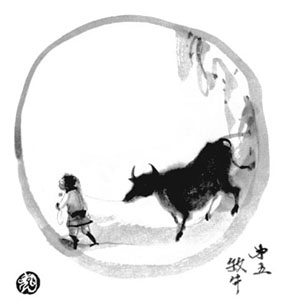
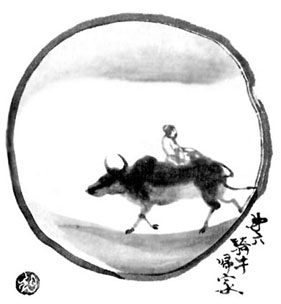
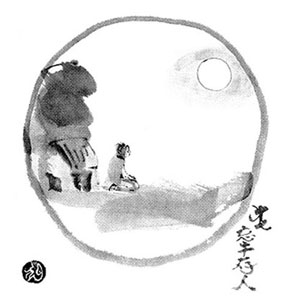
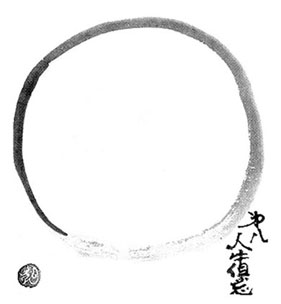
The Ten Bulls is an illustrated poem used by followers of Zen Buddhism to explain the search for enlightenment.  For me, it also represents the search for meaning in my own Druidry and indeed, in my own life in general.  It can be applied to everything, but for the purposes of this blog I’ll stick to Druidry. To see the Ten Bulls, otherwise known as the Ox-herding pictures, you can follow this link:- http://www.sanbo-zen.org/cow_e.html.

The search for enlightenment, the search for the Self and meaning is a major part of any religion or spirituality.  What will explain that sense of something missing, that lacking? What will fill it, or guide us to fill it in? What will help us to realise our full potential and live according to our True Self?

For me, this has been blending Zen with Druidry, and in the Ten Bulls can be encapsulated quite neatly.  They are, as follows:-

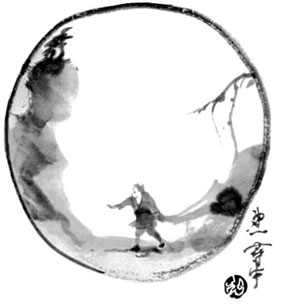
 1.In Search of the Bull

1

When we first come to Druidry, we do not really know what it means, for there are no long-established formal schools or training that we know of.  We can look to history, and then find out about courses now offered in Druidry through various organisations, but is this Druidry? It is certainly a version of it – Druidry is what it is, to each and every person. Moreover, to each and every person, it is different, yet still falls under a single banner. Confusing? Hell yeah. In a way, I think it’s meant to be. It encourages us to get out there, and find out more – beginning the adventure.


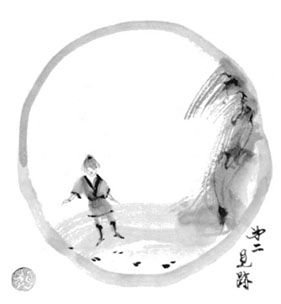
2.Discovery of the Footprints

2

We have begun our adventure, and are searching now for what Druidry is.  We catch glimpses of it in the works and writings of others, yet we still have not experienced Druidry for ourselves.  Like the wind, we can’t see it, we can only see its effect on other things.  We continue and go deeper into our Druidry to find out what it really is.


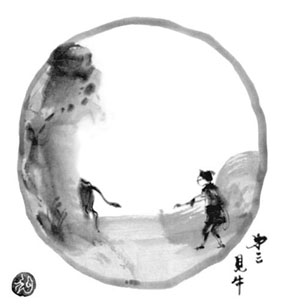
3.Perceiving the Bull

3

We’ve caught a glimpse!  We’ve had an insight into what Druidry is – we know that we’re now on the right path in our journey of self-discovery. Yet it is still not entirely clear – the experience is not yet full.  We run after the bull in the hopes of understanding.


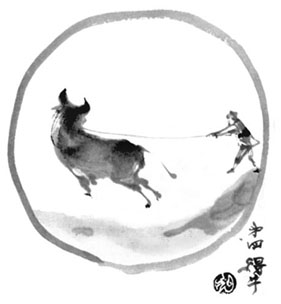
4.Catching the Bull

4

We’ve found our Druidry!  After many twists and turns, we’ve come across a path, or developed our own, that seems to flow with the essential spirit that we call the Self.  We may find several bulls, even, until we find the right bull, but eventually we come across a method, training, or experience that reflects our inner core. We harness that energy, but what do we do with it now?


 5.Taming the Bull

5

We learn that knowing what Druidry is, is simply not enough. We must practice with it, again and again, experience it and not simply read about it.  We hold rituals, we meditate, we get our fingernails dirty.  We do the work necessary, and learn discipline.


6.Riding the Bull Home

6

This is Druidry! This is what it means, and it is a joyous expression of our inner souls.  We have a sense of “coming home” – we know how to celebrate the seasons and each other, and we may find the beginnings of an inner peace hitherto unknown.


 7.The Bull Transcended

7

We then realise that Druidry is not something external, nor even internal – that it is something to be lived.  There is no separateness, no duality to Druidry – it is not a way of life, but it is life itself.  There is a stillness to it.


8.Both Bull and Self Transcended

8

We are no longer separate from the world and from Druidry either.  Druidry is us, it was always us.  We experience each and every moment with the same reverence we would to ritual – everything becomes sacred.


 9.Reaching the Source

9

We have reached the source of life itself, and find that meaning or no meaning have no place – only life itself. There is no Druidry. There is no Self. There is no separateness.  All is unified under the banner of Life, changing moment by moment, unconcerned with meaning or no meaning.


10.Return to Society

10We return to integrate what we have learned from our experiences, to share them and to help others who may be seeking.  We do what we need to do for ourselves, our family, the environment without any selfish thoughts – we simply do.  With the knowledge that we have gained that so expresses ourselves, and which is known as Druidry, we live as best we can, in the world, present, awake and aware.


The Myth of the Moral Highground

Is there such a thing as a moral highground?  I have heard people say that they can accept certain people’s behaviour, on the basis that they “are a better person”.  They have chosen their beliefs in themselves, their faith, whatever, and made a judgement call as to who is a better person.  But then, who is a better person above them? And above them? Isn’t it all about perspective anyway?

Believing that we are better than someone else is a falsity and a tragedy, in my opinion.  It can lead to all sorts of destructive behaviour, from bullying to arrogance to war.  Passing a homeless drug addict in the street – do you believe that you are better than that person? Finding out about someone’s infidelity – does that make you a better person? Working for charities, donating time and money – does that make you a better person?

Do you think Mother Theresa thought she was better than the rest of us by doing what she did? I hardly think so.

We all make mistakes. We all have moments of enlightenment, and moments of dark despair. Our lives have happiness and tragedy in them.  Yet claiming that we are better than someone else is simply to say that our circumstances are better than theirs – and circumstances can change on a dime.  As a noun, the dictionary defines circumstance as “a condition, detail, part, or attribute, with respect to time, place, manner, agent, etc., that accompanies, determines, or modifies a fact or event; a modifying or influencing factor: Do not judge his behaviour without considering every circumstance”.  We cannot even consider every circumstance, for we are in no way omniscient. We could become the homeless drug addict, and then where has the better person gone?

We are all on a level playing field.  The search for a moral highground is like looking for the Holy Grail.  All that each person can do is simply to do the best that they can at any given point in time. Sometimes their best may not be all that “good”, whether the person has had moments of enlightenment or not.  Yet to judge ourselves against others only separates us further from others, which leads to an Us and Them mentality, in which horrendous things can occur such as war.

Surely we need morals to follow, else anarchy would reign?  For the most part, most people naturally want to do “good”.  Morals are constantly changing as well, as are opinions – else women would still be the property of their husbands, African Americans would still be relegated to the back of the bus and Britain would be ruled by the Christian Church. Trying to gain the moral highground on a level playing field just doesn’t work – you’d simply be jumping up and down trying to get above everyone else, and yet gravity would bring you back down each time.

Realising that no one is better than anyone else is the key to living a happier life, for you and everyone around you.  People who think that they are better may fall into destructive patterns.  They may not realise that by blowing out someone else’s candle, it doesn’t make theirs burn all the brighter.

Yet there is nothing wrong with living a life of discipline, and of trying to better oneself – to be more aware of one’s own patterns of behaviour.  If we accept that we are only doing the best we can at this point in time, there’s nothing to say that we can’t do better in the future. But we shouldn’t strive to do or be better than other people.  The work should be done on ourselves, with the realisation that the thinking behind “I am better than her” does not make you better, and can, indeed, make you worse.  It is simply putting one’s self onto a pedestal to gain the moral highground, and anyone can fall off the pedestal easily.  I know that the next time I find myself thinking that, I am going to step off my pedestal and get back to the level playing field, where I can look everyone in the eye and see that we are only doing as we can, and just to do the best that I personally can, which is no better than anyone around me.

Kierkegaard and the Bullies

Perfect love means to love the one through whom one became unhappy – Soren Kierkegaard

Following on from a recent blog post about forgiveness, putting into practice the habit of it is, as is everything, much easier said than done. So I’m going to share some personal things in this blog post, which I don’t often do, but which I think is necessary to give it some context, and to perhaps allow for people in their own situation to relate to it in some way.

Kierkegaard’s reflection on forgiveness inspired me today to do something which I have never been able to do.  Forgive the bullies.  Thinking about forgiveness a lot lately, I have decided that the best place to start was at the beginning, when the first people who treated me badly first made an impression on my mind and my life.

I had a really happy childhood, growing up in beautiful countryside in a very loving family.  I exceled in school – primary school was a breeze.  I was top of the class in both academia and athletics – I loved them both. I was confident and happy – it was a great time for me.  However, things changed when I went to secondary school.

The first half of the first year went well – though it was a shock moving from a Grade Six class that had five people in it to class sizes of twenty to thirty children.  The school was enormous compared to my primary school, but I adapted pretty well (and much thanks to a map my sister drew especially for me to find my classes in the many halls, which was my saviour that first month!).  I was confident and smart and making new friends under quite difficult circumstances to a very sensitive child.  And then came the bullies.

They were two years older than me, and came from the same region, so we shared the long bus journey together (an hour each way, a total of two hours a day). That was where it all started.  Name calling on the bus – for whatever reason, began the whole affair.  I assume that it was because I was tall, pretty, blond and happy – though I can never truly know the full reason behind it.  Sometimes people simply think that blowing out another person’s flame will make theirs shine all the brighter, but that just isn’t the case – everyone knows two flames are brighter than one alone.  For whatever reason, the bullying started.

Being confident, I decided to fight back.  I was smart, and could have a comeback for anything. Everyone, from television and film and books, said that if you fight back, the bullies will leave you alone.

That is not the case.

I fought back, with words, not allowing them to see that they were hurting me – throwing it back at them, and also hoping that others around me would rally to the cause and that we would all overthrow this minority of bullies who seemed to control “the bus”.

That was not the case either.

People didn’t stand up for me. But I still persevered, fighting back as best I could. Eventually it did get me down, and I started to doubt myself. But I stayed as strong as I could. They put glue in my hair. They threw food and garbage at me. They called me names. They threatened me.  They taunted me every time we passed in the hallway until I avoided all the main halls and used the back stairs, entrances and exits as much as I could. I still held fast to the belief that it was because they were jealous – I stayed strong in my convictions, but it really, really started to get me down. I dreaded going to school every day, and dreaded the bus ride there and back.  I joined after school clubs just so I wouldn’t have to take the same bus as they did home – I could take a later bus. I longed for the two days of respite that the weekend brought – Fridays after the bus dropped me off was like a whole new world of freedom to be me again.

It became so bad one day though, that I had had just about enough of it all and, with no holding back, turned around to where they had moved up in the now almost empty bus to sit directly behind me and taunt me ceaselessly.  I let it rip, verbally, with all the hate, spite , viciousness and intelligence that I possessed. Their faces were shocked, and then anger took over. One girl grabbed me by the hair and started banging my head against the bus window, over and over again.  An older boy came down from the back of the bus and pulled her off of me – I had started physically fighting back – and we were separated.  I got off the bus seconds later at my stop, adrenaline bursting along with tears as soon as the bus was out of sight – I wasn’t going to let them see me cry.  I hated myself and my life.

The next day we were, of course, called into the Principal’s Office.  After a few minutes, where I (with seething calm) stated my case and then the other girl was allowed to state hers, she simply began to cry.  I was too angry to care about why she was crying – she had made my life a living hell.  I sincerely hoped the Principal was not “duped” by her show – though on reflection I do believe that she was a truly unhappy girl in an unhappy situation, the details of which I still am not aware of to this day – only rumours.

Nothing came of it for me – but I think she may have received a three-day suspension or something similar, though the memory of that is a little fuzzy.  What I do remember is that evening she called my house, and my mother answered the phone.  The girl threatened my mother and family, and also said that she didn’t care if she got expelled from school – she could always transfer to SAA.   My mother said, “Go ahead, please do.  BECAUSE THAT’S WHERE I WORK.” We never got a phone call from her again.

The bullying eased off from then on – just some taunts and words passing in the hallway. By this point, I saw the light at the end of the tunnel – the bullies were graduating that year, and once they were gone the school “was mine” again, in the sense that I could live, learn and do as I pleased and enjoy every second of it.  They graduated, or failed – I don’t really know, but they left. Those last two years of my high school life were some of the best years of my life.

I still suffered from confidence issues – walking past a group of people laughing, I would assume they were laughing at me.  Sometimes I still do – though now I catch myself and, with a wry grin, shrug it off.  But one thing I’ve never been able to do is to forgive them for the years and years of torment that they put me through.  Well, today I decided that enough is enough.

I have carried these bullies with me for 27 years now, and I’m more than ready to put them down.  As in my previous blog post, the story of the monks and the sack of potatoes, I really don’t want to carry anger and hate to these people anymore – I’m going to empty the sack, and maybe one day lose the sack altogether so that it can never be filled with anger again.  For anger is the cause of pain and suffering in the world – it is the root behind most, if not all, sufferering and “evil”.  So, no more, thank you very much.  I forgive you, CB, KJ, WG, D and A – I don’t want to carry you around any more.  I hope that your lives are much happier now, and filled with love.  Tears are welling up in my eyes even as I write this – the release is overwhelming.  I have compassion for myself and for you.  May you live well.

And so, I aim for what Kierkegaard wrote – for love is compassion and forgiveness.  I am emptying my sack, one by one, and looking for perfect love with every person who has made me unhappy.  In this way, I believe, the world can and will be a better place.  Namaste.

Going lightly through life…

As I was out walking the other day, the saying” Living well is the best revenge” popped into my mind.  After a moment’s thought, an additional part to the saying came to mind – “yet if you are focused on revenge, you are not living well”.

At this time of year, when peace on earth and goodwill towards men is often heard, I thought that the addition was rather apt.  For the first part of the saying, it almost deals with the issue, but yet does not allow for forgiveness.  We are still holding a grudge towards someone for what they have done to us.

It reminded me of a story that I recently read, where a group of young monks were given a sack and a bunch of potatoes.  The Master told them that for every grudge, for every thing they could not let go, they had to put a potato in the sack and carry it with them – a physical reminder of the thoughts that they carry around in their heads, which can be outwardly reflected in our behaviour and even our bodies.

After a while, the young monks decided that it was much easier to forgive and let go than to keep carrying around this heavy load the whole time. So, one by one, the potatoes were taken out as they moved on, letting go.  Yet, even as they emptied their sacks, they realised that the sacks could be refilled, and quite easily as well.  So they discarded their sacks – seeing that the sack was as important as the potato. The potatoes were the thoughts, the sack was their very self.  If they held onto their sense of self as lightly as they did their thoughts, seeing that there is no duality and that all things are connected, then there would be no sack, no potatoes, and no burden to carry through life.

I have applied that story to all the old and new grudges that i have been carrying in my life – why would I want to carry them in the first place? Letting go, leaving it all behind and holding very lightly to opinions and the sense of a separate self seems to be the way forward.  It’s not easy, however. Forgiving someone means letting go of any sense of righteousness.  It means letting go of the idea that someone is wrong.  It means simply living in the moment and enjoying it for every second that it exists.  The saying goes “forgive and forget”.  Now, forgetting is much easier than forgiving. I think simply forgiving is enough – forgetting means that it may happen again.  Forgiving implies understanding and not judgement.

So, now is the time to live well, letting go of any ideas of revenge, of grudges.  Life is far, far too short to carry around all that we do not need.  Go lightly through life.  And blessings of the season to you.

The Self, and No Self

Who am I?

Philosophers, religions, spiritualities and people all over the world have asked themselves this question. Lately, I too have been asking myself this – and looking into the meaning of the self, to see if there truly is a Self there to begin with.

The Materialists would say that there is no self at all – that there is no consciousness, that we are simply matter and energy and the result of material interactions.  Descartes stated “I think therefore I am”, to which the Materialists refuted Descartes dualism of a separate mind and body, ridiculing it as “ghost in the machine”.  Zen and Buddhism talks about a True Self that can only be realised by dropping all ideas of the self and achieving a pure state of being in the moment, a state of total selflessness in every sense of the word.

Nietzche stated that “We have never sought ourselves, how could it happen that we should ever find ourselves?”  Like the Materialists, he believed that we are a result of our experiences and actions, but that there still was a Self, a consciousness.  In order to be complete, Nietzche said that we must learn acceptance – to accept everything we have ever done.  I find this fascinating, because how many times have we done things our lives, stating that we were out of our minds, or did something “that was not me at all” – stepping outside of the core idea of what we are.  This acceptance, instead of avoidance, is key to the deeper understanding of the self, in my opinion.  Acceptance doesn’t mean liking everything that we may have done in the past, nor does it define us in the present moment, but what it does allow is a total non-judgemental overview of the self, and in doing so, a deep awareness that we might not achieve by avoidance of the subject.

Before Nietzche, Kierkegaard put forward the notion of choosing to be self-aware.  We are homo sapiens, after all – in fact, I believe the proper term for our species is homo sapiens sapiens – the beings that are aware that they are aware.  Kierkegaard stated that when we choose to be self-aware, we are both aware of our self and, at the same time, aware that we are aware of our self.  Observing the observer who is observing.  Yet, we choose not to observe, because we often don’t like what we see, or experience, either in the past, present or future.

This is all fascinating. And also requires some very deep thinking.  I’m currently exploring the theory of No Self from Zen Buddhism, which is a paradigm of course, as is much in Zen.  The No Self is also the True Self.  It states that our real self is in existence, always, and always has been.  It is pure, and shining free – we only distract ourselves from it to such an extent that we never see it.  Zen states that we are already complete, already whole, already perfect.

This is pretty simple to understand, and it makes sense.  The difficulties, the suffering in our lives detract us away from spending time in the pure moment, in which the True Self resides.  We suffer because we want things to be different, because we desire things, people, etc – and are not happy with the present moment as it is. If we are happy and accepting of the present moment as it is, without judgement of good or bad, or any attachment to it at all (see previous blog post on understanding, not judgement) then we can rediscover this True Self.  By letting go of all notions of the Self, we return to the core, essentially.

In Zen Buddhism, the term mu can mean a multitude of things – it essentially, and paradoxically, means “nothing”.  It can be termed as “no self”, “no ego”, “no holiness” and “impermanence”.  It is the transcending of all things, the enlightenment experience, the complete and utter letting go of affirmations and negations.  It is an answer to some Zen koans (questions asked to break apart the mind and let in a new way of understanding).  Zen master Keido Fukishima, like Kierkegaard, promotes the self-inquiry into our own being and mind, to be aware that we are being aware.  In Zen, this has the goalless goal of letting go – once we have found our mind, we lose it (not in an insane way, I might add) and in the losing, in the understanding of the impermanence of all things, including the mind and the self, we rediscover the True Self.  Keido Fukushima says, “Zen teaches us how to live by inquiring into and clarifying ourselves. This self-questioning is well suited to our contemporary ways of thinking. Rather than seeking salvation through an “other” or through grace, we achieve it on our own.”

Fukushima delves further into this idea, stating “The experience of mu may at first glance seem purely negative or passive,” he says, “but it is not so at all. Being mu, or empty of self, allows one to actively take in whatever comes. Our world today and all in it are separated into dualistic distinctions of good and evil, birth and death, gain and loss, self and other, and so on. By being mu, not only does one’s self-centeredness disappear, the conflicts that arise with others dissolve as well. Here is a simple example: When we look at a mountain, we tend to observe it as an object. But if we are mu, we no longer see the mountain as an object; we identify with it; we are the mountain itself. This transcendence of duality may sound like some psychic ability or spiritual power someone possesses. But that is not true. Rather, it is simply and naturally a case of being free, creative, and fresh. We become human beings full of boundless love and compassion.”

This rejects the dualists’, such as Descartes, theories and instead breaks down all barriers, which is both liberating and frightening at the same time.  There is no Us and Them, no Self and the Other – if we truly let go of all attachment we become one with everything.  Are we willing to do that, or do are we too attached to our sense of self to experience that? Can we truly dissolve into everything?

It comes in small flashes, in glimpses, for me so far.  The world, wrapped up in an apple, in a drop of rain, in the flight of a hawk.  Barriers have dropped, ego and self has fallen away, and we see the multitude of the universe (another paradox!).

This is passing through the Gateless Gate – I’ve also heard it called the groundless ground.  In realising the impermanence of everything, including the Self, we have a platform from which to jump off and into real living, where every moment counts and is never the same.  The Self changes from moment to moment.

This is hard, for we have spent our whole lives creating this sense of self, this timeless sense of self that we think defines us.  After seeing Taylor Swift’s new video, Trouble, in which she states “…I don’t know if you know who you are, until you lose who you are” really hit home.  I don’t think she meant this in a Zen sense, as she seems pretty attached to her past experiences (and boyfriends) but the statement really hit home.  She talks about losing her balance.  I really identified with this statement, having recently lost my balance in these last few months.  But what did I lose my balance from? Is the concept of balance just another distraction? I’m still working on it.

Starting with acceptance, and then moving on, letting go, without attachment, is crucial.  Maybe then the True Self will shine again, for longer and longer moments, ever shifting, ever changing, always truthful.

However, as Freud said, “It’s just a theory.”

No Hope

It is so hard to live life as it is, to accept life as it is.  Our mind does everything it can to avoid it, for various reasons.  In Zen, we often see the mind often trying to avoid suffering in any way it can. This could be suffering in the conventional sense, but it also has a deeper meaning – dukkha, a Sanskrit word which in Buddhism means dissatisfaction, or a sense of unease, or even dis-ease.  We are all dissatisfied with some aspect of our lives, and it is so easy to live in the “if only” reality – the world of possibility instead of the world that is. Why? It’s nice in there.

Yet, to achieve enlightenment, one of the main ways to banish dukkha from your life is to simply live in the present moment, to accept it for what it is. Neither pessimistic, nor optimistic – just life as it is.  When judgements of good or bad are seen for the illusions that they are – things that make us attach to a situation – then they simply fall away and we can truly see clearly.

Surya Das emphasizes the matter-of-fact nature of dukkha:

Buddha Dharma does not teach that everything is suffering. What Buddhism does say is that life, by its nature, is difficult, flawed, and imperfect. […] That’s the nature of life, and that’s the First Noble Truth. From the Buddhist point of view, this is not a judgement of life’s joys and sorrows; this is a simple, down-to-earth, matter-of-fact description.

This was brought home to me over 10 years ago when, after visiting her dying sister in the hospital, my mother came home and told me something that really changed her viewpoint and mine on the situation.  She said to my aunt, “But why you?” to which my aunt simply replied – “Why not me?”

This simple acceptance of life as it is, instead of railing against it, led to a life of less suffering.  I still carry those words with me today, when I think that things or life is happening “to me”, instead of just happening.  Life isn’t good or bad, it simply is. Things aren’t happening to me, things are happening.  Good and bad are judgement calls that we make to avoid living in the present moment most of the time.

Charlotte Joko Beck wrote of No Hope in her book, Everyday Zen.  This wasn’t the same as hopelessness – it simply meant not wishing for things to be other than they are, for the moment we are doing that we lose the gift of the present moment. Now, while a prisoner of war might wish not to be tortured at this very moment, most of us aren’t living in that situation.  Even as my aunt was dying, she accepted the situation. It simply was. It was stepping outside of the mind trap of living in an alternate reality where our dukkha doesn’t exist and seeing that it is a part of life that we cannot “escape” from. All the wishing in the world cannot change the world.  Only actions taken in the present moment can change the world.

So it isn’t a passive response to the world – oh, there is nothing I can do, I should live without hope.  If we are in a harmful situation, then we take action in the present moment to change it if we can. If we are being abused, mistreated, see others being hurt, we take action in the present moment to change that. We have the ability to respond – responsibility.  Life is constant change. We can also work to sustain that change for future generations. But it requires us to live with the courage to be fully present in our lives as they are.  Step outside of your head for a moment, and take a look at the world around you, without judgement, seeing things clearly.  It could change your life.

The Dying of the Light

Dylan Thomas’ poem, “Do not go gentle into that good night” is often in my thoughts at this time of year, when the winter solstice is approaching and the ever increasing night draws close, the cold winds howling outside.  Yet I do not agree with the poem’s repetitive line – “Rage, rage against the dying of the light“.  

Though wise men at their end know dark is right,
Because their words had forked no lightning they
Do not go gentle into that good night.

Good men, the last wave by, crying how bright
Their frail deeds might have danced in a green bay,
Rage, rage against the dying of the light.

It would seem that the wise know dark is right, and yet their pride, hubris or egos get in the way of going gently into that good night, as their words “had no forked lighting” – they want to be remembered for their wise words, at least, is the suggestion. The true wise person has no need of such external gratification – wisdom is inherent, not granted externally. Written for his father, whom Dylan Thomas wanted to die raging instead of quietly, perhaps for his own selfish attachment or whatever reason, is still spoken of today when the nights are long and we seek illumination in every sense of the word. 

It’s all around us – gaudy, flashing lights – some set at incredible speed settings that I can only assume is to disorientate the viewer, often going up before the leaves have fallen from the trees and the ground not yet frozen.  Many, many people are raging against the dying of the light, putting up the Christmas or Yule lights, lighting the darkness and consuming considerable amounts of energy at this time of year in a display that is somewhat missing the point.  As pagans, we celebrate the return of the sun after the winter solstice, certainly – but we should also honour the darkness in the days leading up to the solstice with equal measure. 

Christmas or Yule lights can certainly be very pretty – if done tastefully, and using very low energy lights, turning off others that we would normally have on at this time of year to offset the energy.  But first we must come to grips with the darkness before we light the lights.  We must look into ourselves to see why and what it is that we fear, loathe, or deny in the darkness – why we are so hesitant to look into the abyss.  Is it because we, as Dylan Thomas did, equate darkness with death?

Yet it is the time of year when death is all around us.  One look at our gardens instantly confirms this – very few things are still alive above ground.  A cycle has ended, and the seeds of the next generation lie below ground to await the return of the light – but they know that this does not happen instantaneously on the winter solstice.  They respond to the growing light and warmth slowly, in the months after the solstice, in their own time, and hopefully not too soon, like some of my daffodils did last January…

Acceptance of death is key here.  We should not rage against it, but embrace it as part of the cycle.  Many people think that death is the opposite of life – yet death is a singular event, and as such its opposite would be birth.  Life has no opposite.  We do not rage against a birth – why should we rage against a death? 

Taking inspiration from the natural world around us, we follow its rhythms and cycles and turn inwards to nurture that which is most precious to us, to guard it for the coming year ahead. It is in that darkness where we can truly know ourselves, our thought patterns, our behavioural tendencies.  Looking inwards into our own darkness we can find that small spark of light that needs to be kept safe in the darkness until it is ready to come to light, and not be snuffed out like a candle in the winter wind. It is time to cease looking for a distraction from the darkness all around us, and instead focus on our own wellbeing, and nurturing that seed of inspiration within, as well as facing our own death and fear.  It is all too easy to lose that in the crowds doing late-night shopping amidst chintzy tinsel and bright lights, with tinny music being piped into the stores that are overheated because they leave the door open to attract more customers into the lure of consumerism.  If we must, we must, but then seek the darkness to recoup and recover. 

Honour the darkness for the wonderful rest that it brings.  Without it we would have no spring.  Celebrate the darkness – turn off all the lights and central heating during the evening of the winter solstice, if you can, and truly experience the time of year. At midnight, light the fire in the hearth or candles in the house to honour the change, slowly, very slowly, lest we become blinded by the artificial return of the light and stumble around unable to see.  Do not rage against the dying of the light – for all the rage in the world will not stop death or the darkening days leading up to the solstice. Embrace, embrace the dying of the light.