Silence, the Author and Freedom

This long bank holiday weekend just gone has been spent mostly listening. I’ve stopped talking, for the most part; I’ve stopped the mental chatter to gain clarity. My aid in this exercise was drawing, working with coloured pencils where the only thing that mattered was the lines, the colours, the paper. My self had fallen away, and I was better able to see clearly. Art is liberation. Art is freedom.

As a writer, sometimes it’s hard to just stop. I’m usually always writing, at least in my head. Like a musician who writes their own music, who is always composing, I am always putting into words what is influencing me, what the muses whisper. It’s hard to turn that off sometimes. Through meditation I am able for thirty minutes to an hour to switch it off. Days of mindfulness. Through trancing I am able to leave it behind. Dancing also does it – especially dancing with my professional dance troupe, where when we are improvising we have to listen so hard to each other’s bodies that our own selves don’t get in the way. But this weekend the awen came through drawing and colouring.

When we’re quiet, when we’re still, we’re able to hear the world around us. When we stop that mental chatter, when we stop telling and retelling ourselves the story of our selves then we can hear the stories of others. We can be influenced and learn from the stories of others. We learn that we are not always right. We learn that we are not always wrong. We learn that we are never the same person every morning that we wake up. We change, we grow, we recede, we die and do it all over again the next day. In this exercise we learn that it is okay to differ from the person you were yesterday, that your opinions and thoughts will change over time, else they become dogma.

But essentially we have to learn to switch off first, before we can get to that head space. We need to find the silence, the void, the empty cauldron. Only when we are empty can we be filled. Only when we’ve poured out all the contents can we refill it with what nourishes us. We can’t subsist on the same old same old each and every day. We have to let things go, we have to have new ideas, new inspiration. Living in the present moment is what this is all about. Stuck in the past, we are not open to new ideas. Lost in the future, those ideas will never come. Here and now. Perfect freedom.

Tomorrow I will be a different person. Today I am different from yesterday. I question who this person really is, and then I let the question go. It doesn’t really matter. What really matters is freedom.

Be the change you want to see in the world…

https://youtu.be/oqGPa84jM2M

Peace in Druidry

The word peace means many different things to many different people. Some see peace as simply the cessation of aggression or violence. Others see it as a way of life, a philosophy. Still again others see it as a mere dream, while others see it as the ultimate goal. But just what is peace, and what does it mean in a Druid context?

In our society, we strive for so much. Some things are worth working for, putting all our heart and soul into, such as equality, environmentalism and a better way of life for all beings. Some things we strive for are not so worthy – material wealth, social, economic and political power, fame or authority. For many in today’s society, it’s a dog eat dog world, and to get ahead you have to step over others in the race for the top. In reality, there is no top rung on that ladder – there isn’t even a ladder to begin with. All these notions of power are entirely illusionary, when looked at from a basic ultimate view that we are all just beings co-existing with each other on this little planet. Allow me explain.

The illusion of separateness has caused our world so much pain. When we see ourselves as separate, we begin to lose the notion of the sacredness in everything. There is absolutely no possible way for anyone or anything to be separate from anything else. We human beings are made up of minerals and atoms, of genetic information from all our ancestors (human and non-human), of sunlight and wind and rain. We are all star-stuff. We have not come out of nowhere, to suddenly exist and then just as suddenly depart when our earthly lives are snuffed out. The clouds in the sky have always been, and always will be. They may change their form, becoming humid wisps of cloud and ice, to larger clouds that then change into rain. That rain falls onto the earth, to be drunk by human and non-human animals alike, by the garden plants and the trees, by the birds and the bees. This water is released once more into the atmosphere through a myriad of ways – sweat, piss, moist exhalation, dewdrops. Back into the sky it goes, to once again form a cloud. We have clouds within our bodies, in the food that we eat, in the water that we drink, in our genetic makeup. We are clouds and the clouds are us.

Once we see the interconnectedness of all things, we realise that to strive for power or control over anything is as fleeting as the life of a cloud. All things are connected, and all things are impermanent. This is an essential tenet of Eastern philosophies, which is strongly reflected in a Druid’s perspective when viewed as part of the natural cycle. Nothing ever stays the same, not the river, not the sky, not the grass, not the tadpole. Everything is in constant change and flux. The key to finding peace within this constant change is acceptance of the impermanence, allowing our hearts to find ease from the fears and insecurities that arise when we fight against change.

A wave does not stress out about dying when it crashes upon the shoreline. It knows that it is water. The wave is simply the form that it took for however long a time. It knows that it is connected with everything else on this planet – there is nothing that exists outside it in a separate context. The web of life, the threads of connections are all around us. When we see those threads we lose the fear of death, instead seeing the cycles that allow us to really come to terms with the concept of changing forms. Death is not annihilation – it is simply becoming a new form, a new way of being.

The basic fact of life is that we will all die. So what is this struggle, what is this constant striving towards ideas of ownership, of power and rule, of games played with lives? To what purpose does it serve when we will all return to the earth in some form or another, when we come to an understanding that we are not separate from anything else? When can we move from concepts such as birth and death?

As humans we have developed a sense of self-awareness that actually hinders the possibility of finding a true and real sense of peace. We are often so self-focused that we are blinkered to everything else, to the entirety of existence. When we are only in tune with ourselves, how can we ever find harmony without? Stuck within the whirls and eddies of the mind, we will never notice the birdsong, or the rain upon our shoulders, the cry of a hungry child or the yowl of a cat in heat. When we look beyond ourselves is when we will be able to find peace. When we are able to work for the benefit of others instead of just ourselves, the world will know harmony. As we are all co-existing on this planet, it just makes sense to work together. However, the illusion of separateness is strong.

Peace is not just something for stoned hippies to think about and discuss – it is a very real and powerful way of being in the world. Through sensing our connection to the world we find a place of true power, power that comes from within that allows us to work for the benefit of all. This power cannot and will never be a “power over” anyone or anything else, as writer and activist Starhawk expresses often in her work. This power from within is the deep core of true expression, of a sustainable relationship working in tune with the entirety of existence.

Peace is not just a cessation to war and violence. Peace comes from a very real and deep understanding of our selves, of our behaviour and our way of being in the world. Many people within the pagan community seek to find a better way of being in the world. They focus on working on the self, through years of self-discovery, journeys, pilgrimages, workshops, training and the like. For many, the journey stops there, at the betterment of the self. What I would posit in this essay is that in order to bring about true peace in the world, we then have to let go of ideas of the self, in order to focus on the wider world. It is a letting go of the blinkers that hinder our ability to work with others compassionately, in real empathy and attunement to the natural cycles.

This is deep integration, of immersion in the world to allow for true peace to flow. Where there are no barriers of you and me, no sense of the “other”, then we can truly work together to bring balance and harmony to our world. It is often said in historical and academic accounts that Druids were the peacemakers of their world and their society. Did they have a deep understanding of the connectedness of all life, did they allow their sense of self to fall away in order to bring about peace between warring tribes, between the workings of the human race and other species, in their work with the gods? We will never know, but it is something that I think is perhaps lost in today’s Druidry.

Peace is often not the main focus for those who come to Druidry. They often seek a spiritual path that allows them to explore the true nature of their self, to affirm their beliefs in a like-minded community. This is brilliant, and of course very useful for all, however it cannot end there. In my opinion, there must be a return for the lessons that we learn, an exchange, a flow from one to the other that allows for true and sustainable relationship. When we step beyond our selves and begin to truly understand what it means as a Druid to live a life in service to the gods, the community and the land then we are really coming to terms with the concept of peace within a Druid context.

Too many are living a reactionary life, caught within the trapping of their minds and unwilling or unable to see the world around them and their part in the weave that is the tapestry of life. They cannot sense all the other threads around them, or if they do sometimes they feel competition, or aggressiveness towards them. It is a sickness in our culture and society that we are brought up in such an environment. Instead of supporting each other and rooting for each other, if we have an issue with someone we do the exact opposite, for whatever reason. In sacred relationship, especially within a Druid context, we don’t have to like everyone we meet or interact with. However, we can see them for what they are: a part of the sacredness in all life. As Bobcat once wrote many years ago, it’s all about sacred relationship – when we walk through the woods we avoid the nettles. We don’t have to cut them all down in order to continue, yet we can still honour their existence and their place in the web of life. Essentially, we don’t have to hurt others who may even have hurt us – if we do that, we are simply living reactionary lives. Let’s live active lives instead, claiming full responsibility for our actions and in doing so achieve peace. Even if others hurt us, we don’t have to continue the cycle of hurt – we can walk around the nettles.

Peace must first come from within. If we are hurt or angry, we are not at peace. We must take some time to look at our hurt and our anger, and see where they really stem from. As Zen Buddhist monk Thich Nhat Hanh states, we must take care of our anger in order to transform it. When we finally sit with our emotions, we open the doors to empathy and compassion. Compassion is as mis-interpreted as the concept of peace is: compassion is simply looking at the bigger picture, attempting to understand the whole. It doesn’t necessarily mean unconditional love for all beings, though if we are truly and utterly open in our hearts that will ultimately be the outcome. It’s a tough call for most to make – in fact, only the Buddha himself has done it so far. However, we can take the wisdom of wider learning to help us understand others and thereby finding peace. If someone hurts us, we can sit with our anger and hurt, looking at it relating to our self. We can then extend that investigation – this is where most contemplation ends in day to day life. However, working through an entirely self-focused view, we can then begin to look at the person who hurt us, seeing that they too suffer. It’s not pleasant to cause suffering – not unless there is something severely wrong with the brain and a mental fissure stops that basic understanding and empathy. Have you ever betrayed anyone or said anything unkind? Did it make you feel better? Have you ever intentionally said something to hurt someone? Did you ever believe in the illusion that to being someone down raises you up? We all have. What we can do now is stop that cycle and truly live a life filled with intention, instead of reactionary living.

The Druid looks to nature for inspiration on how to live a live immersed and integrated with the whole. When we see the complex web of existence, when we bring our focus to an ecosystem, we see how everything works with the other in some shape or form to bring about the continuation of existence. We can look to ideas from permaculture, from biology, from ecology in order to grasp that sense of working together to create a beneficent environment. As Druids we don’t look to humanity for authority – we seek that from nature instead.

In gaining the wider perspective we can allow room in our hearts for a deep and abiding peace. We can still work actively in the world to bring about peace – we needn’t suddenly find peace and sit back while the world struggles on around us, our environment is destroyed and people are attacking each other. It means that from a very deep well we can work to nourish our communities, bringing a much-needed draught of inspiration or awen. In doing so, we are Druid.

News and events roundup February

February was a particularly busy month – with the opening of Druid College UK being a huge success!  We are now already halfway full in our bookings to begin Year 1 in October this year, and the response has just been amazing.  Social media posts engagement has numbered over 100,000 views, with thousands of shares and likes.  A big thank you to everyone who has supported this project! There are still spaces left on the course, so if you’re interested please email me for further details.

Lots of support has also been received since the interview I had with OBOD’s chosen chief, Philip Carr-Gomm last year at the Order of Bards, Ovates and Druids‘ 50th anniversary gala. The Druidcast interview went out in January, and there has been lots of interest since then, certainly keeping me busy! At the end of February I also did an interview for Upon a Pagan Path, which aired early this month – Tommy the interviewer was such a lovely chap.

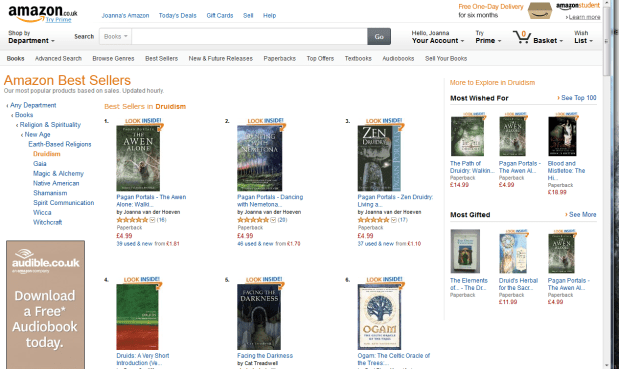
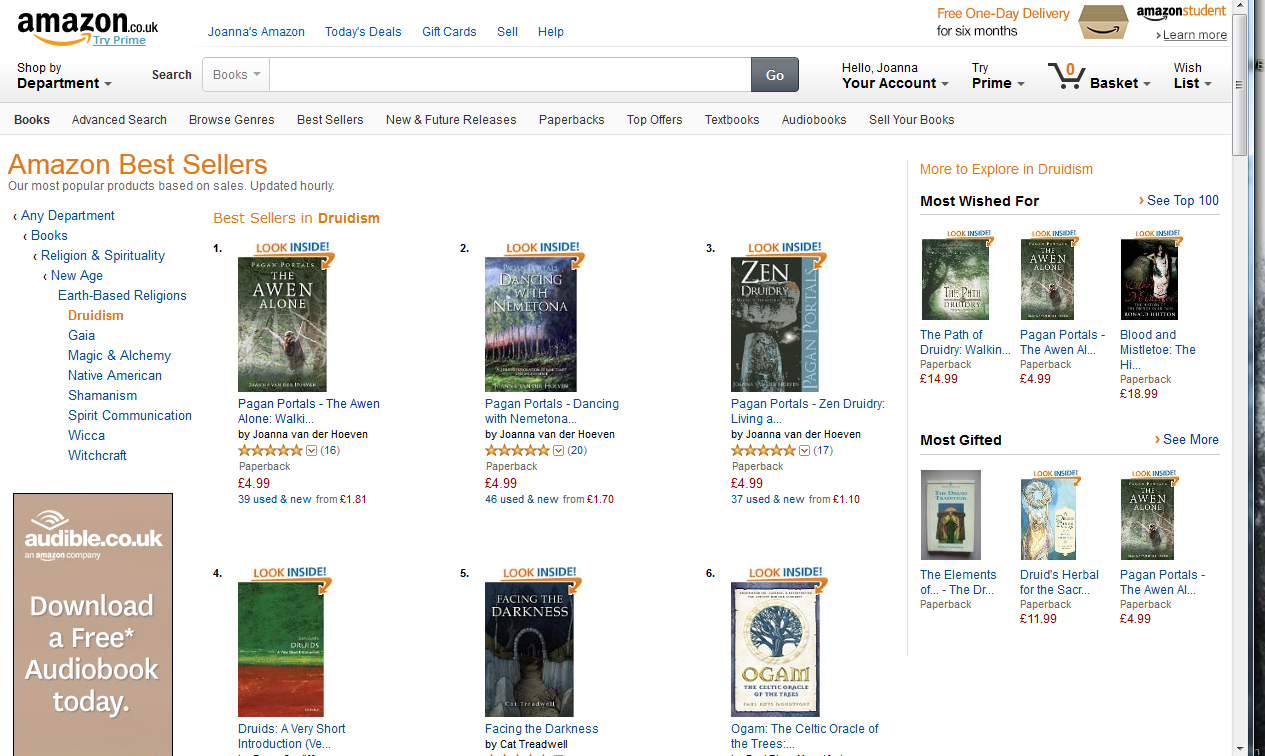
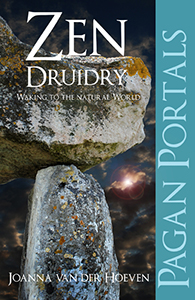
February also saw all three of my books, Zen Druidry, Dancing With Nemetona and The Awen Alone reach the Number 1, 2 & 3 spot on Amazon!  What a day that was – I was and still am flabbergasted.

The next couple of months are going to be equally busy. On Saturday 28 March I will be giving a talk at Leaping Hare in Colchester on the goddess Nemetona. I’ve been going to Leaping Hare for many, many years now and it is an absolute honour to be asked to present at this year’s gathering. I’m looking forward to seeing many familiar faces from the Eastern Region!

But before Leaping Hare I’m heading over to Glastonbury, to enjoy a little break and celebrate the Spring Equinox with some lovely friends.  We’ll also be seeing our friends Serpentyne who are doing a gig on Sat 21st – a medieval ball! Don’t miss it – it’s going to be great. We’re very much looking forward to performing with Serpentyne this summer at the Corn Lammas Gathering 21-23 August as Gypsy Dreams Belly Dance.  (I’ll also be sharing  a stall with my lovely, arty, crafty sisters and selling books – do pop by for a chat!).

The Beltane Picnic hosted by the Pagan Federation will take place this year on 24 May at The Roundhouse in Essex.  I’ll be there with my belly sisters performing again, and also doing book signing – I love this event so much, and have been going for a few years now – it’s such a warm, friendly, welcoming atmosphere of celebration!

If you’re in the Suffolk area on 18th & 19th April, check out the Woodbridge Mind Body Spirit Festival. It’s a lovely gathering of really cool folk who have created a wonderful two day festival celebrating alternative therapies, lifestyles and just sharing the love. I’ll be doing a chakra cleansing workshop on the Saturday, as well as performing with my dance troupe.  Shimmy shimmy shimmy!

And lastly, big thank you to everyone who has supported this blog and who continues to do so. Since the beginning of January we have had over 10,000 views on here alone, with many new people subscribing. Virtual hugs all around!

Interview by Upon A Pagan Path March 2015

Here is an interview I had with Tommy from Upon a Pagan Path podcast, where we discuss my books, meditation, prayer and more!

Listen HERE.

A good day…

A good day…

Absobloominglutely stunned.

Thank you all so much for your support! My heartfelt thanks to the community, to the ancestors and to the gods for my many blessings.

May we be the awen!!!

Best sellers Druidism

Love

Many of us have heard the saying “Love means never having to say you’re sorry”. Like all sayings, they can be misinterpreted. Love is one of the most powerful gods. Love is so much more than romance, than warm fuzzy feelings for another. Love can be an unshakeable force, it can inspire us to greatness or tear us apart.

Never having to say sorry with regards to love has been misused by many as an excuse to behave badly, to not care about the feelings of others, to live in a purely self-centred state. It is also often implied that if we really love someone we should always be willing to forgive their behaviour. In Buddhism, it is widely regarded that we are all Buddhas, that we all have the ability for true compassion. However, we are also all human, with all the wonderful implications, limitations and foibles that it entails.

We have all known people whose behaviour has been less than glowing, who are so entrapped in their own worlds and minds that they often create a reality which is completely and utterly different to the one that you may experience. As humans, we have a shared reality and shared human experience, but as beings that are supposedly self-aware we become trapped in this self-awareness to the point of it spilling over into less than glowing behaviour. Love accepts the humanity of everyone. Love accepts reality. Love is compassion.

Compassion, however, doesn’t mean we have to take everyone’s crap. Compassion is understanding, trying to see the bigger picture, to understand why someone behaves the way that they do. In this attempt, we step outside of our “small selves” and out into a greater reality. We open up our perception. We may never truly understand, but at least in the attempt we see that the world is more than just our experience, our perceived reality. We recognise the experience and reality of others.

When that reality hurts us, when people do or say things to undermine us for whatever reason, should we simply forgive and move on? I’m not entirely sure it’s within human capacity to truly forgive, though people like Zen monk Thich Nhat Hanh are real-life inspirations for this way of being. We may find that the hardest person to forgive is ourselves. Perhaps we need to focus less on “us” forgiving “them” and simply focus on living our own lives in way that means that we will never have to say “I’m sorry” to another. This, in my opinion, is the real interpretation of the saying “Love means never having to say I’m sorry”.

We may fail, and there is nothing wrong with saying “I’m sorry”, however.

When we come against people we simply cannot be with, we can still try to understand them, to look beyond our self. It can often put us into the bigger picture, allowing more of a peripheral vision of the world that encompasses everything and in doing so, allowing the self to fall away in integrated living. Sometimes we simply have to walk away from that relationship in order to work compassionately with our selves, for we simply suffer too much at that given time to be able to function properly. We can do this with partners we’ve been romantically involved with – when it no longer works, we can bow to each other and walk away with respect, and hopefully a little compassion for both them and ourselves.

What we have to focus on most though is our own life, and our own behaviour. We have to live our lives in a way that means we will hopefully never have to apologise for our behaviour. It’s not an easy path, but it’s one that is worthwhile. In doing so, we will walk lightly upon the earth, loving the earth with every fibre of our being, loving everything on the earth with eyes wide open and a heart filled with compassion. We can love life, the power of the gods moving through us and around us, and live our lives in celebration of this.

As the first snowdrops bloom here in the UK, and the songs of the birds change to love of each other, of the warming sun and the greening of the land, may our hearts too be filled with love.

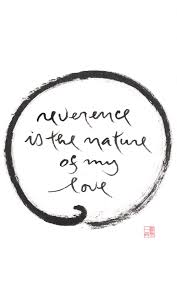
reverence

My interview with Philip Carr-Gomm

Druidcast 94 is now out, with the Order of Bards, Ovates and Druids‘ Chosen Chief, Philip Carr-Gomm interviewing me last June for their 50th anniversary gala. We talked about religion and philosophy, my books and also what is Druidry today. Have a listen, and check some great music and another great talk by Jonathan Wooley on Druidry and the young adult!

http://druidcast.libsyn.com/druidcast-a-druid-podcast-episode-94

Acts of Compassion

There are many ways we can be compassionate in today’s society. Compassion is merely trying to understand, to see beyond your own point of view and share in humanity as a whole.  An act of compassion need not be grand – it can be as simple as giving up your seat on the bus, or smiling at someone who looks down as you walk past them on the street.

I came across this beautiful story from Jason at Parallax Press today, and had to share it. May peace and love fill your heart and soul, and flow out into the wider world.

I just came back from the Deer Park Holiday Retreat last week, and the theme this year was “New Year, New You.”

While there, we watched Thich Nhat Hanh’s New Year dharma talk from 2013. In the talk, he said something that was very interesting: “There can’t be a new year if there isn’t also a new you.” If we do not have the intention to water the seeds of transformation within us, he elaborated, the so-called new year will continue to be very much like the old, not only for us, but also the world.

With that in mind, I had the privilege of sharing my own insights on the transformative practice of compassion with many of you at the retreat. I shared the story of a life-changing incident that occurred many years ago when I was sixteen and volunteering at a community legal clinic for those who could not afford attorneys.

It was while working there as a receptionist that I encountered a very literal case of “saying hello to your suffering.”

One day at the clinic, I picked up the phone to answer a call as I routinely did, and I heard the sound of a woman crying and what sounded like the humming and whirring of a train or subway car pulling into a station.

“My husband has been beating me and I have no money for a divorce. I should jump onto these tracks and kill myself.”

I realize now that this woman had not only called the clinic for help, but had begun the process of saying hello to her suffering. And suffering had said hello to me that day.

Even as she contemplated her own annihilation on those steel tracks with the train arriving ever closer, she had enough strength within herself to call a total stranger who happened to be a completely unprepared sixteen year old.

In his latest book No Mud, No Lotus, Thich Nhat Hanh writes:

The work of mindfulness is first to recognize the suffering and second to embrace it. A mother taking care of a crying baby naturally will take the child into her arms without suppressing, judging it, or ignoring the crying. Mindfulness is like that mother, recognizing and embracing suffering without judgment. So the practice is not to fight or suppress the feeling, but rather to cradle it with a lot of tenderness, (pp. 26-27).
Rather than saying to the woman, “I’m only sixteen years old; I don’t know what your suffering is, nor how to help you,” I simply listened to her with all my heart, cradling her suffering gently in my arms.

I listened to her for an hour or more, and gradually the crying stopped and I could not hear the train.

I am not so presumptuous to claim that I saved this woman’s life, but what I can say is that my act of compassion sprouted within her the beginnings of a lotus from the mud.

If you’re going through a difficult time, Parallax hopes that the new year leads to the blossoming of a new you. To help get you started, here’s one of my favorite passages from No Mud, No Lotus: 

Releasing the Arrow

There is a Buddhist teaching found in the Sallatha Sutta, known as The Arrow. It says if an arrow hits you, you will feel pain in that part of your body where the arrow hit; and then if a second arrow comes and strikes exactly at the same spot, the pain will not be only double, it will become at least ten times more intense.

The unwelcome things that sometimes happen in life—being
rejected, losing a valuable object, failing a test, getting injured in an accident—are analogous to the first arrow. They cause some pain.

The second arrow, fired by our own selves, is our reaction, our storyline, and our anxiety. All these things magnify the suffering. Many times, the ultimate disaster we’re ruminating upon hasn’t even happened.

We may worry, for example, that we have cancer and that we’re going to die soon. We don’t know, and our fear of the unknown makes the pain grow even bigger.

The second arrow may take the form of judgment (“how could I have been so stupid?”), fear (“what if the pain doesn’t go away?”), or anger (“I hate that I’m in pain. I don’t deserve this!”). We can quickly conjure up a hell realm of negativity in our minds that multiplies the stress of the actual event, by ten times or even more.

Part of the art of suffering well is learning not to magnify our pain by getting carried away in fear, anger, and despair. We build and maintain our energy reserves to handle the big sufferings; the little sufferings we can let go…

Mindful Mondays

Mindfulness is THE buzzword in self-improvement and New Age circles, but what does it really mean? If we go back to basics, we find that it is rooted in Buddhism, and can be easily explained in two simple phrases.

Chop wood. Carry water.

This is actually a pared down version of a slightly longer Zen story, wherein an enlightened monk recalls his process to enlightenment. He stated “When I was unenlightened, I chopped wood and carried water. When I became enlightened, I chopped wood and carried water.”

A lot of the time it can feel like we’re carrying wood and chopping water – not really getting anywhere, flailing around with a dripping axe. But when we stop, focus and concentrate, usually things become smoother, get done quicker and with little drama. Some may not want that – they enjoy the distraction that the flailing causes, or the drama, but after a while it can wear thin. Applying mindfulness, which is simply paying attention, can help alleviate any dis-ease that we may feel in our lives. That’s not to say that we’ll feel great all the time, but just by being in the present moment and not attaching to past experiences, dwelling on them or getting stuck in an emotion we can just get on with plain living.

So, with all that in mind, I’ve decided to dedicate an entire day to mindfulness each week. Ideally, I try to be mindful all the time, but I’m no Buddha. Having an entire day to focus on this will hopefully trickle down into the rest of the week, and all my thoughts, actions and their consequences. I’ve deemed this my Mindful Mondays.

So, what does this all mean? It means that when I’m eating breakfast, I’m just eating breakfast – not reading a book or article. When I’m washing the dishes, I’m just washing the dishes and not singing along to the latest Taylor Swift album. When I’m out walking, I am walking mindfully, at whatever speed, paying attention to my steps and my surroundings – not planning my evening meal. When I’m stroking my cat, I’m not thinking about writing the next chapter of my book. When I’m driving I’m really feeling the road beneath me, not dwelling on the driver that decided to overtake me on a blind summit. When I’m out for a meal with friends, I’m really paying attention to what they are saying, and not already forming a reply to their words before they’ve even finished talking.

Mindful Mondays are all about paying attention.

With that centred awareness, with that focus, we can simplify our lives immensely (part of my New Year’s resolution). People often fear that we will be less productive, but actually we will do jobs better, more efficiently, if we maintain that focus.

Being aware of your movements as well is doing a great kindness to your body. When we are walking down the stairs, we are focusing on our body moving. We will find that our movements may become less hurried and more graceful. A calm descends on our way of being. Like a leaf falling from the tree, we simply are in that moment, either floating down serenely or caught in a whirlwhind – either way it is done with grace.

So, like the monk who realised that life doesn’t change after enlightenment and that you still have to do the things you have to do, what you can change is how you do them. Mindfully, with awareness, focus and concentration. Give it a try, and let me know how you get on! Even if a day is too much, try an hour or half an hour each day. You don’t have to change your schedule, just do everything in it mindfully.

May you be peace as you chop wood and carry water.

ch5