The Call for Peace

Druid ritual in many traditions usually begins with what is known as The Call for Peace.  It is an affirmation that there is peace between everyone involved, and an aspiration that there be peace throughout the length and breadth of the world.  In ancient Roman times, Caesar documented some of the roles of the Druids in his time, stating how they were exempt from military service, did not carry weapons and often acted as intermediaries between warring tribes.  It was said that they could walk between the two front lines of battle and come through unscathed, for such was their role that none contended with their wish for peace.

Finding peace in today’s society is very, very difficult. I’m sure it was in ancient times as well, but I can only comment on the time that I live in with any sort of accuracy, however subjective or flawed my opinion may be.  When we make the call for peace in ritual, are we sure that there is peace within, nevermind without?

One has to begin with a definition of peace.  Here are some dictionary definitions:-

  1. the normal, nonwarring condition of a      nation, group of nations, or the world.  

This is interesting, as it infers that the normal state of the world would be a non-violent state between nations, groups of nations or the entire planet.  I do wonder if this time has ever existed.  This doesn’t only relate to the human species either – packs of wolves may fight for territory, as any of the feline persuasion as well.  However, I do like the sentiment behind this definition – that it is the normal state of affairs, and we are living abnormally, even if that has been since the dawn of time…

2. a state of mutual harmony between people or groups, especially in personal relations: Try to live in peace with your neighbours.

Indeed, this is a closer definition to what I think most people would believe peace to be, as we can relate to that on a much more personal level – not everyone is involved in a war-like conflict, even if their nation may be.

3. the normal freedom from civil commotion and violence of a community; public order and security: He was arrested for being drunk and disturbing the peace. 

Again, here we see the idea of normalcy being in a non-violent community.   It implies that we should, as a whole, be living in a non-violent, orderly and secure environment.

4. cessation of or freedom from any strife or dissension.

Again, many would relate to this definition, even if it can be somewhat vague, for everyone’s idea of strife or dissension could be entirely subjective – some people enjoy heated debate, others find it upsetting.

For me personally, turning over the idea of what is peace, I’ve come across words such as holistic, integration, relationship.  To be at peace, we must be at peace with everything else.  In a shared world, this is so difficult as to be nigh impossible – a few have claimed it (Buddha) and a few strive to live it in their mortal lives (again, Buddha, but also figures such as Dalai Lama, Mother Theresa, Gandhi).

Mulling over the idea of a pagan monastery all winter long, I would imagine that this peace would be so much easier to achieve in a state of withdrawal from the world, even with a group of like-minded people.  This withdrawal would also offer up the opportunity to integrate more fully with your religion without distraction, inasmuch as we are in a fairly secure environment in which to explore our religious passions.  We can focus on our relationship with others, with deity, with the world, without too much interference from modern day society.

But what is so bad about modern day society in which we cannot find peace?

Again, this is only a personal viewpoint, but seeing horrid images in the media of the strife that occurs all over the world affects our personal peace.  Bombarded by television shows that glorify arguments between individuals, families (I’m thinking Eastenders type here, but also reality shows such as X Factor, where we are invited to judge and determine who is better than another person and also become involved in criticism (see previous blog post on the critical mind).  How can I be at peace with the world when my morning radio alarm goes off and the first thing I hear of is how some man brutally beat an 80 year old woman to death in her own home?  Even if we don’t have televisions or radios in our home, they are prevalent elsewhere – there are even petrol stations in Amercia that have television screens on the pumps that play the news!

There are gods within Paganism that are associated with strife, with war.  Some of them also have healing qualities as well, showing a well-rounded, cyclical nature.  Perhaps establishing a relationship with these gods, if like me you are a polytheist, is the way ahead.  When the lines of communication open, and the nemeton is shared, our true selves can be expressed, whether that is with the gods or a badger.

Buddhism would say that the road to peace lies in compassion.  I’m still working hard on that one, bringing ideas of empathy and relationship which are a little closer to the language that I understand in Druidry.  I can see that we are all related, every single human being on this planet.  Every living thing is related in some form or other.  We are all star stuff.

So, back to the call for peace in Druid ritual – how definitively can we use the words below, as so many have done before?

Deep within the still centre of my being

May I find peace.

Silently within the quiet of the Grove

May I share peace.

Gently (or powerfully) within the greater circle of humankind

May I radiate peace. (OBOD http://www.druidry.org/events-projects/peacemaking-druidry)


The Druid Universal prayer makes no mention of peace, but does hint at it in the form of love at the end:


Grant o Goddess thy protection,

And in protection, strength,

And in strength, understanding,

And in understanding, knowledge,

And in knowledge, the knowledge of justice,

And in the knowledge of justice, the love of it,

And in the love of it, the love of all existences.

And in the love of all existences,

The love of Goddess and all goodness.  (Iolo Morganwg)

In order for there to be peace, there must be relationship. If there is no relationship, then anything apart from ourselves, or even our very self, can be an abstract.  So, perhaps when using either of the above, or our own call for peace within Druid ritual, we establish a connection, a relationship with everyone and everything inasmuch as we can, in order to better work with them towards a life filled with peace.  We can see where there is a need for peace in the world, and try to relate to that need in order to bring it about, or at the very least to understand it.  Where there is no need then there is peace.

The issues of need with regards to peace are interesting – these can vary from our need for peace to our everyday basic human needs, such as food, water, shelter and clothing. Where these needs are not met again there can be no peace.  We strive towards fulfilling our needs – that word, strive, with its same root as strife.

The call for peace is a good grounding platform in Druid ritual. It can bring everyone to a single intention, which in its form is the essence of ritual – actions based on intention in order to create relationship.  I’m not entirely sure that I am, as yet, able to state with absolute certainty that there is peace within any particular ritual, yet I am more than willing to share that intention of creating peace. Perhaps this is the more important of two, and focusing (perhaps pedantically) on whether or not there is peace is missing the mark.

May there be peace throughout the world.

Exploring the nature of criticism…

I don’t put much store in astrology, but when people say Virgos are very critical, I can’t really deny it. All the Virgos that I know are – then again, I also know a lot of people who aren’t Virgos who are…

Ever since my post on the death of Margaret Thatcher and my criticism on the subsequent behaviour of those who downloaded Ding Dong I have been thinking about the criticisms that I hold on to in everyday life, and those that I feel I need to share with others.

In order to criticise something, there must be a sense of self, someone who is standing back and commenting.  Yet in Zen, the goalless goal is to integrate completely, so that the sense of self falls away and we are completely immersed in the here and now, in the environment, in life itself.  As a Druid this is so very appealing, for I long to release into nature to become a part of it; to stop distancing myself from it with ideas and notions of who I am, which are constantly changing anyway.  Pondering on the idea of self, Zen would offer that the sense of self is but an illusion that we create and cling to, for various reasons – out of security, fear and ego-driven desires.  Therefore, holding on to an illusion is a little bit of a waste of time. Criticising someone else’s is a total waste.  If it’s not real, there’s no point.

We have this idea about our selves, that we have created throughout our lives.  What if this sense of self was just those ideas that we repeat the most, the ones that we like the best (or hate the most), the ones that shout the most loudly in our heads? Ideas are not real things – they are abstracts.  Experience is the key here, for experience is not an abstract.

So, back to criticism – in a Zen Druid worldview, is it ever right or worth the effort to criticise something?  There’s that old adage – if you’ve got nothing good to say, don’t say anything at all. For me, this is not enough, for when something needs changing, when those who can’t speak for themselves need a voice, I will speak out against it.  The key here is to do so with respect, honour and integrity. I’m still learning.

Also, offering criticism when it is not asked for is an easy trap to fall into.  Our lives are filled with it – we are inundated with television shows like Big Brother, or more importantly other reality shows such as The X Factor, Dancing on Ice, Strictly Come Dancing, etc. where we are expected to criticise, where we are voting for who we wish to win.  The judges on these shows often criticise dishonourably, mocking and offering nothing helpful. Sometimes they are offering good criticism and are right (at least, we agree with them).  (Spot the paradox – I just criticised judges on reality shows J).  At any rate, what these shows may do is to make us feel better about ourselves, with an underlying fear that we could be that person being criticised.   What I am suggesting is that maybe we need to detatch from the world of dishonourable relationship, where criticisms are just plain mean, or mis-informed.  I know I’m still working on it personally, as per my Maggie post earlier.

In Zen Buddhism Right Speech is part of the Eightfold Path.  I remind myself of this every time that I can before I now offer criticism.  Yet Right Speech does not say “do not to criticise”, but rather to reflect on whether this criticism is beneficial to anyone.  Talking about people behind their backs, offering criticism when it is not asked for, or condemning people when you have absolutely no idea what their motivations are is not altogether “right”.  Yet Zen states that we will never fully know the motivations of others, and that reflecting on this is also a waste of time.  So before you say something about someone, ask yourself – “Is this beneficial to anyone? Is this making the world a better place?” If so, then go ahead – with love and compassion we certainly need to do this in our world.  If the answer is no, then keep it to yourself, or even better, let it go, seeing it for what it is – an illusion, in most cases.  We are not omniscient – therefore our opinions on most things are subjective, and indeed flawed in that regard.

In Zen there is a saying – “Do not seek the truth, only cease to cherish opinions”.  This really strikes a chord with me. It is not saying that we shouldn’t have opinions, but that we should hold to them lightly, for how often has your opinion on something changed?  My Thatcher post and subsequent discussion changed my opinion, certainly.  If we cherished opinions so highly, we could never learn new things, progress and really be in the here and now, in a state of true experience. We would be holding so tightly to things that shift and change, that are never constant. It’s like trying to hold water in your hands – no matter how tightly you squeeze, a little water always dribbles out.

So, next time I am about to criticise something, I will consider Right Speech. I will also question what or who it is that I am criticising, as well as just who I think is doing the criticising. Most likely, I will have no idea on either score, and therefore either keep my mouth shut or investigate further, delving deep into experience before coming to any conclusions.

Having a critical mind is a wonderful thing.  It can really help us to see what can be done in the world to make it a better place. How we use it is entirely up to us.  Also losing your critical mind can be a wonderful thing, being utterly absorbed into the natural world, at one with everything.  The paradox is delicious.

New book contract accepted! Dancing With Nemetona

Have just accepted my third book contract with Moon Books, another in their Pagan Portals series, entitled Dancing With Nemetona – A Druid’s exploration of sanctuary and sacred space.  This work will focus on sanctuary and sacred spaces, exploring the Goddess of the Sacred Grove, Nemetona.  Check out the Moon Books website here, and see their latest releases… www.moon-books.net

Here’s a little taster…

It had been a long and challenging day at work. I drive home, the windows open and the radio off, fully immersing myself in the act of driving, leaving behind what happened at work and becoming entirely aware of the present moment.  I feel the sandy roads beneath the wheels, the smell of the newly ploughed fields lifting my heart and filling my nostrils with that sweet earthy scent.  The village finally comes into view, the 30 mile an hour speed restriction delineating the edges of this space that I call home, and I slow down, driving under the speed limit through the little street past the village shop and post office, turning into my road.   

The tires crunch the rocks in my driveway, and I park the car, switching off the engine.  I take a deep breath, and look at my home, smiling.  Mindfully, I open the car door and grab my handbag, closing the door shut behind me and walking towards the front door, focusing on each and every step that brings me closer to Her.  I take my keys out and with intent, turn the key in the lock and enter the porch, softly closing the door behind me.  I take off my shoes and hang up my coat and then open the main door to the house. 

My soul opens of its own accord, my own nemeton relaxing and expanding so that it merges with the physical space of the house itself, with Her.  I place my hand on the door lintel and whisper a prayer, “Thank you My Lady for this sacred place, this haven of four walls and for providing me with a home.  I am truly honoured.”  I feel the acceptance and smile, entering the home fully, saying hello to the cats and dropping my keys in the bowl.   

Our homes are often places of comfort and rest, if we feel inspired by Her to make them so and if we are attuned with Her energy.  We must first have some sort of idea of who we are, in order to express ourselves and Her in our homes in order to create a sense of calm, well-being and a nurturing environment.  We cannot simply emulate what we think looks nice in a book or a magazine, but we must feel it in our body, in our blood and in our mind that this is a reflection of what our vision of hearth and home is for us.

It will be different for each person.  Everyone has different views on aesthetics, décor, and arrangement.  Everyone has different budgets and limitations.  Everyone has different energies and inspirations and abilities to make these things manifest.  What we must try to do is to do is to create that sense of welcoming when we walk in the door, to connect with Nemetona in our homes and to honour her for all that she provides.

New Retreat Weekends available!

Mongolian smallSanctuary Retreat 27-29 September 2013 

What is the basis of this weekend retreat?

This weekend retreat will focus entirely on the idea of Sanctuary.  From Friday 27th September through to midday on Sunday 29th this retreat is set in some of the most beautiful Suffolk countryside; it is as peaceful and as tranquil as you could possibly imagine. There will be talks, workshops, great vegetarian and vegan food – as well as your “own time” for you to explore the surrounding countryside through walks or even borrowing one of the bikes to cycle down the country lanes!

Everyone needs Sanctuary every now and then – a safe place where they can simple “be”.  The aim of this weekend is to explore the many definitions of sanctuary, and how to create that in our everyday life.  We will look at our own personal “space”, as well as the other spaces that we create, such as our home space and sacred space.  We will learn to acknowledge all the times in our lives when we are given sanctuary, thus establishing a deeper relationship with the concept and furthermore being able to bring it to the forefront of our lives.

Sanctuary gives us that space where we are allowed to be ourselves, fully without fear.  It is a temple, a sacred space, both within and without.  A goddess, Nemetona, is known here in the British Isles as well as in Gaul for being the Lady of Sanctuary.  She was celebrated in forest groves, the classical sources tell us, but she is to be found everywhere.  Sinking deep into her temple, dancing freely in the twilight, letting go of notions of that self that we have created, we have time to simply BE.  We return to the selfless source, if we so desire.  And yet, we must come back and define our edges once more, but this time they are perhaps softened, allowing more in, allowing sanctuary and compassion to those that need it. Though we may discriminate, Nemetona doesn’t.  That is why she is a goddess.

Explore where your edges meet with another, whether it be human, cat or tree.  Let go into the embrace of this Lady, to find out who you truly are.  In her temple, we are all perfectly who we are at this given moment.  Dance with her, and know what it means to be truly free.

What is the accommodation like?

In a beautiful part of rural Suffolk, just outside of Halesworth is a little gem – five acres of land owned by two wonderful people who are committed to sharing their passion for enjoying the outdoors in comfort, style and with full green credentials.

We will be sleeping in yurts; gorgeous and lush Mongolian tents.  Inside, there are real beds, futons, tables, chairs, dresser drawers and vanity mirrors – pure luxury camping!  Each yurt has its own log burner and comes with tea and coffee making facilities, as well as everything you would need – plates, cutlery, cups, mugs and more.  You will be sharing your yurt with one or two other people.  If you are coming with a friend, and would like to stay in the same tent, then please let us know.  Otherwise, we will draw straws and let the fates decide – you could end up with a new lifelong friend!

The owners, Kim and Nick, have created a space where you will be catered for fully – all you have to bring is yourself, and your own bedsheet and towel.  Everything else is taken care of for you.

There is a Main Barn where, if the weather is uncooperative, we will meet for the workshops, talks, evening chats, meals and more.  Inside the Main Barn is also an indoor kitchen, showers and loos.  There is also an outdoor kitchen, as well as outdoor hot showers – these are pretty special, and a normal shower will never again be able to compare!

How much is it?

Booking for this retreat weekend is £150 per person, which includes all activities, accommodation and food.

What is the schedule like?

Arrival is from 3pm onwards on the Friday night.  We will give you time to settle into your yurts, and then have a communal meal around 5.30 – 6pm.  After that, we will gather together around the fire or inside the main barn and go through what Sanctuary means to us.  We will have a talk from the event organiser, Joanna van der Hoeven, on how as a Druid the idea of sanctuary and sacred space is integral to her way of life.  We will look at Nemetona, the goddess of Sanctuary, as well as how in Druid and pagan ritual we create sacred space.  We will also look at how we can carry that sacred space within us at all times, allowing us to be truly free in our own self-expression, with honour and integrity. We will then do a short vocal exercise, where we can share the same space and let our voices blend together to create a sacred space.  Afterwards, we can then chat, have some hot chocolate or other drinks and then retire for the evening.

The following Saturday morning we will again meet for a communal breakfast.  After that we will gather together for a guided meditation session on how to ground and centre yourself.  Then we will have a workshop on learning to find where our edges are, and how they meet and interact with other people’s edges.  We will discuss the ethics of how we interact with others, and how we can allow our true selves to shine through with empathy and compassion.

After a communal lunch, we will then look at how we can create our own sacred spaces, in our homes, at our work desk, in our bedrooms and bathrooms and in our own mind.  We will then build our own altar which will act as a focus for the rest of the weekend and for the ritual later that evening, with things that we feel represent our true selves and our ideas of sanctuary.  We will also come up with a ritual for that evening, using our ideas of sacred space and sanctuary and working together to develop something that will be meaningful and profound for all.

From 3.30pm onwards is “free time”, where you will have a couple of hours to explore the ideas you have come across in talks and workshops, or chat with a new friend, go for a walk, bike ride, meditate – the choice is yours!  We will gather again at around 5.30 – 6pm for our evening meal.

After the meal we will have our ritual that we have created.  There will most likely be singing, drumming and dancing as well!  We will then retire for the evening.

Sunday morning we will gather for our last communal meal at breakfast.  We will have a short discussion on how we can bring what we have learned and ideas that we have come across over the weekend into our everyday lives.  We will again perform a short vocal sharing, allowing our voices to blend together in celebration of sacred space and sanctuary.  Then, it’s time to go home and allow Sanctuary to permeate into your life.

How do I book?

Simply email Joanna van der Hoeven at autumnsong@hotmail.co.uk to receive your booking form.  A £50 deposit will be required to secure your booking.  This deposit is non-refundable if you cancel your booking within four weeks of the event. The remainder of the booking fee will be due four weeks prior to the event (however if you want to pay it all up front then please feel free).  We can set up a payment plan of three instalments if you would prefer – please enquire.  If we are fully booked, we will have a waiting list available for any last-minute cancellations.

How can I find out more?

Simply email autumnsong@hotmail.co.uk if you would like more information on this weekend retreat.  For more information about the organiser, Joanna van der Hoeven, please visit her website at www.autumnsong.org.  Places are limited, so book early to reserve your space.

*  *  *

chalicwell1The Little Pagan Monastery, 11 – 13 April 2014 at Chalice Well Gardens, Glastonbury, is a weekend retreat that will follow and incorporate monastic traditions such as daily prayers, meditation, talks, lectures, chores and ritual for the Pagan.

Set in the beautiful and sacred Chalice Well Gardens, this three day, two night weekend will follow a strict routine and regime that hopes to inspire you to incorporate more spirituality in your daily practice at home.  Take what inspires you and run with it!

We have booked St Michael’s Lodge, which is a lovely guesthouse designed for peace and relaxation in mind.  Rooms are either single or shared, so be prepared to possibly share with a new friend!  There is a library where books may be borrowed, but please return them at the end of the weekend. There is also a lovely kitchen, and a meditation room for daily practice and connection.

The Meeting Room set right up against the gardens is where most of the weekend’s events will take place.  We also plan to do some work in the garden, as well as take trips out to Glastonbury Tor and the White Spring, weather permitting.  Come and experience the beauty of land, sea and sky atop the Tor, or take a healing plunge into the sacred pools of the White Spring, or simply come to enjoy the beauty of the Red Spring and the serenity of Chalice Well. The weekend will end with a ritual (if possible) by Chalice Well.

All food, drink and accommodation are included in the weekend retreat price.  A £50 deposit must be made up front to guarantee your booking, and will be non-refundable if you cancel within four weeks of the booking date.

If you desire to taste the monastic life, to pray, meditate, work and enjoy the silence in a special holy site with like-minded people, then this is the weekend for you!

£180 per person, cheque or paypal payment only. Please email autumnsong@hotmail.co.uk to book your place. If you are booking for more than one person please let me know and we will allocate you the double rooms first.

Many blessings!

Here we go A’Maying…

kentwell hall may day

This weekend at Kentwell Hall the Tudor Re-enactment team were in full swing.  Celebrating May Day, they brought to life old customs and traditions for all to enjoy.

First of all, we had to go A’Maying, which is where the tree is felled for the May Tree.  (The maypole with ribbon dancing is a Victorian invention).  With drummers drumming and pipers piping we followed the procession into the woods to where our chosen tree stood.  As we neared the spot, the music stopped and voices were hushed.  The Woodsman and several other men went forward to fell the tree in silence, for they did not want to awaken the Forest Spirit, Jack in the Green.  It was all to no avail, for as soon as axe touched wood out sprang Jack, with green cloak billowing and mossy hair and beard bristling beneath his hood.  He attacked viciously the Woodsman, but the men managed to pull Jack away, and finally subdued him enough to send him back into the heart of the wood.  The tree fell slowly, and I whispered a prayer of thanks to it for its sacrifice.

All the men then gathered around the fallen tree, picking it up and heaving it onto their shoulders to take back to the village.  The music started again, and we followed in procession through the fields to our destination.  Once there, we were invited to tie ribbons onto the May tree, with the intention of making a wish that would come true in a year and a day.  The men then attached ropes to the May tree and hoisted it into a hole they had made into the ground, and wedged it tight.  The May Tree now stood proud in the centre of the village.

Later that day the main procession went from the village to the Hall – and what a sight it was.  The May Queen, a young girl of about 9 or 10 years of age sat bareback upon a beautiful Suffolk Punch horse, that had daffodils plaited into mane and tail.  The young girl was dressed in a simple white gown, and her golden hair shone in the sunlight – indeed, her whole being shone with pride and excitement as she lead the procession.  Behind her in a wagon were her maidens, more young girls dressed in white, waving to the crowd.  The musicians followed, singing their traditional May songs, and the banner bearers with their colourful standards brought up the rear.  It was truly spectacular, with the flags waving in the wind, the music lifting hearts and souls.

Once in the courtyard of the Hall, the May Queen dismounted, and followed the Lady of the Hall into the wagon with the handmaidens.  The Lady of the Hall the crowned the May Queen with a wreath of flowers, to much applause. As the May Queen descended, a fury in green swept through the crowd, and Jack O’ the Green came flying in, grabbing the May Queen and hoisting her over his shoulder. The men ran after him, finally capturing him once again and rescuing the May Queen.  They forced Jack to kneel before her and asked the May Queen if she forgave him.  The young maiden went forward and placed her hand upon Jack’s head, and forgave him, sending him back into the deep woods where he belonged.  “Hail Jack,” I whispered.  “Know that you are honoured”.

The mummers then performed a hilarious play about St George and the Dragon, and then the procession moved back to the village.  There, the music kicked up again in full tilt, and we began the spiral and circle dances around the May tree.  I could feel the energy humming through the crowd, into the ground, making my feet want to move.  A handsome young lad grabbed my hand, asking if I wanted to dance – I said yes, and we swept into the circle, laughing.  I was later joined by my husband, and we performed a traditional tudor dance with many others, where the men and women each have their turns to run, jump, clap and turn.

After the dancing I sat upon the green sward, listening to the musicians and feeling the energy that was created in that spot.  It was joyous, and marked a very important time when winter was bid farewell, and summer was welcomed.  I’m sure the Tudor Re-enactors will have a splendid evening to themselves tonight once the crowds have gone home and the gates are closed.

I wish we had more of these celebrations where I live – I have danced a Victorian Maypole but once, and love the energy that these rituals create.  If you have a chance, go to Kentwell Hall this weekend, and join in the festivities.

For more information on Kentwell Hall activities throughout this summer, please see www.kentwell.co.uk.

Beltane – welcoming the summer

Beltane – the fire festival celebrating the arrival of summer. All throughout the UK, last night and today Pagans and non-Pagans alike are joining in the festivities of this special time of the year, with Morris dancing and bonfires, Maypoles and feasting.  A long weekend awaits us with a bank holiday Monday, where many pubs will host barbeques and hog roasts, entertainment and more.

After a very long winter, this festival is most welcome.  At Imbolc and the Spring Equionox, we quietly ushered in the lengthening days, the gradual shift towards the summer solstice, noticing the ever changing cycles around us.  Now it is a time for the first of what I deem the “louder” festivals of summer, where drumming and dancing and cavorting are done with abandon.

Here where I live in Suffolk, it’s not quite time however.  I prefer to celebrate Beltane when the May is out; when the hawthorn flowers in the softest shades of pink-tinged white.  It will be another week or two yet before these blossoms begin the scent the hedgerows, and bring with them that sense of a definitive coming of summer.

For me, Beltane is also a time when it is finally warm enough to stay outside comfortably, to sit in meditation or to make love under the dappled light of the sun beneath the tender new canopy of leaves deep within the forest.  The Goddess is still waking up, slowly, soon to dance freely with the Lord of the Wildwood. It is not yet time to awaken her fully with shouts and drumming and the ecstatic pleasure of ritual love-making – not quite yet.

I can feel the anticipation growing inside me, as I long to reach out towards the sunlight and stretch my soul into the warm air, or to dance in the summer rain.  It is coming, it is coming…

Sacred Pilgrimage

Lisa and I arrived at Stonehenge mid-morning, alongside the bus tours and family tourists ready to go inside the fence and have a closer look at the world famous site.

Walking over the ditch into the complex itself, I asked the spirits of place for permission to enter, and to let them know that they were honoured.  The response I got – “Meh.”  They didn’t care.

Standing as close to the stones as you can get, it all looked rather small.  The jackdaws were having a lovely time of it, enjoying the attention. The stones, however, did not.  They still stood as tall and as proud as they were able, with the eyes of the world upon them, and yet they hated being a tourist attraction, a place where people simply come, look and then carry on with no real connection being made.  The stones themselves had withdrawn fully into their own being, not letting anyone or anything in.  They hated the tourists, unlike the jackdaws, who loved them (and the goodies that they brought).

For me, Stonehenge is a place of solemn ritual, not a place for hooting and hollering as the sun rises over that special point in the sky over specific stones.  It is a temple not unlike Notre Dame Cathedral – and you wouldn’t go in there and raise a racket, would you?  The original intention is lost to history, but if you try to feel it, to connect with it, there was something very wrong, and very sad about it all.  The intention wasn’t right.  I am perfectly aware that this is only my opinion, and that people may feel something totally different from the place.

Leaving Stonehenge we then made our way to Glastonbury; it was the destination to our pilgrimage.  We came in over the Butleigh road and saw the Tor shining in the sun – what a sight is always is!  Our hearts immediately opened to it, and we entered the sacred place that we call Avalon.

We made our way first and foremost to the Goddess Temple, to honour the Goddess. Inside was a Red Tent, which we smiled at the synchronicity of it all, for Red Tents have been popping up all over in our lives this past month.  The temple today was not a very restful or peaceful place, but I suppose that it is always shifting and changing. Children were running underfoot as we entered, and then the attending priestesses whispering loudly the whole time intruded a bit on my wish for silent reflection and immersion into the Goddess – along with the loud chinking of change right by my head as they emptied the donation pot to take to the bank before it closed. I know it is all necessary, but it certainly wasn’t peaceful. However, this was my first visit to the Temple, and so without going back to compare I know that my view is very one-sided.

Our B&B was on the hillside of the Tor itself, a lovely place with a labyrinth in the front yard and very down to earth, welcoming hosts with sharp wits and a love for the place that was infectious.  We climbed the Tor to watch the sunset and welcome the full moon as she rose, large and pinky-orange.  Time stood still on the Tor, and we have never experienced a sunset that slow, or a moonrise that took so long, but perhaps that was simply because the wind howled around us and we were freezing out butts off! Still, we gently drummed as we waited for the moon to rise on the sheltered side of the Tor, and eventually we did see it in its fully glory (though our best view was from the B&B itself!).

The following day we went to the White Spring, where we had booked an hour’s slot for peaceful ritual and awakening to this newly re-dedicated place of devotion to the powers of water and the Goddess herself.  The Victorians destroyed the old place where the White Spring used to tumble, covering the flora in calcite and making it a beautifully fey place, where green and white sparkled in the cove.  They had built a pumphouse in that very magical spot, to divert the water from the White Spring for Glastonbury town – a very foolish move, for it only lasted a couple of years before the pipes became so calcified that they could no longer use them. Glastonbury now gets it water from the Mendips, I believe.

At any rate, the pumphouse was reopened by the White Spring Trust, and is now one of the most evocative places that I have ever been. We were greeted by a lovely chap who showed us how to lock ourselves in, and then once we were sealed in the very dark, cavernous building we set to work.  Entering the threshold, the first view is of a large pool that the Trust built to collect water, a still and circular mirror surrounded by candles and fed in and out by a little waterfall.  Tall arched pillars stand to either side – it really does look like a film set, I thought!  So wonderful, so full of water – the sound of water was all that you heard, rushing down into the pool from the top of the left wall, and then out the other side, never disturbing the still surface of the large sacred pool itself. There was an altar to the Goddess, Brigit on the left hand side, and an altar to the Lord of the Wildwood on the right hand side.  We said our prayers to both, and sang our song of welcoming to the spirits of place, honouring them for all that they were. We disrobed, and then sang some more, honouring this very special place. Lisa took her drum out, and drummed softly.  We came together in front of the pool, and then it was time.

Stepping up onto the ledge, Lisa drummed and sang the Goddess chant, as I stepped into the pool of ice cold water.  The water was not very deep, but so very cold – I had been swimming in the deepest lakes of Sweden, and they were not this cold. Raising my hands over my head, I called to My Lady, to let her know that I loved and honoured her with all my body and soul, and lowered myself slowly into the black depths.  Once the water was past my waist, I could no longer breathe it was so icy cold – all you could do at that point was hold your breath and go completely under.  Coming back out, still unable to breathe, I gathered myself and rose up, standing with my arms wide, finally able to once again open my lungs and experience what can only be likened to the first breath of a newborn babe.  Exhilarated I raised my voice in zaghareet, my soul flung wide open to this Goddess of the Waters that was both so welcoming and so challenging. Grinning, I made my way out of the pool, and took up the drum as Lisa entered the still waters.

The beautiful follower of Elen, Lisa was all Earth Goddess energy blending into that of water as she slowly lowered herself, and came back up spiritually inspired to make the changes she so desired.  It was beautiful to witness and behold, as the candles flickered and the sound of the water falling mixed with my voice in chant as we gave ourselves up to the White  Spring.  Once out of the water, we drummed and danced in a soft, feminine way, and made our offerings.

Dried and with our time up, we left that dark and sacred place and stepped out into the sunshine once more.  We grounded ourselves and ate something, and then went to the Red Spring at Chalice Well Gardens, there to quietly reflect on what Glastonbury meant to us, and what we could give to honour it for all that is was.  A beautiful golden/yellow energy flowed from the wellhead, making  me smile as I sat beside it and opened my nemeton to this peaceful place, calling to my goddess Nemetona and letting my self release into her beauty in this wonderful place.  We need more places like Chalice Well and the White Spring, I said to myself, more places where one can open their soul in safety and honour the gods and goddesses that call to them, the spirits of place and the ancestors.  There were evocative places of reflection and communion.  I know that this can be found anywhere, but sometimes it is just nice to go to a place of beauty to be inspired, to open your eyes and see that beauty everywhere.  It’s difficult to explain.

We left the Red Spring and went back to Wellhouse Lane, just the other side of the wall to the road that now separates the White and Red Spring.  I took my bottles of water from each Spring and, with Lisa watching for traffic, stood in the middle of the road and brought the two waters together as they should have done, as they used to do, before the road was built and they were diverted from flowing together.  In the midst of the chaos of human life, I asked for peace and in the hope that one day these two otherworldly springs may once again join together.  A mother and a young child watched, and then came up to me afterwards, the young child wanting to speak to me.  “He thought you were a fairy”, the mother said, smiling as she later ushered him away.

We then spiralled up the Tor, making three circuits as we wound our way up.  Sitting at the top, with the spirits of the waters flowing from beneath the Tor, the ground rising up to meet the sky, the Spirits of the Three Worlds sang deep in our veins.  With so much elemental energy buzzing, I found it hard to connect – but moving aside I took out my medicine bag and reconnected with my self, and reminding myself before I could once again let go and feel that wonderful place again.  To let go of the self, you have to know the self first and foremost, I thought.  The sun shone brilliantly, the wind whipping our hair and the waters singing in our hearts.

After supper we retired back to the B&B, where we had our final experience of water in the land of Avalon, that land of water and mist – a lovely Jacuzzi!

After our vegetarian organic breakfast the next morning – this B&B had such a wonderful ethos – we made our way to Avebury.  The sun was hidden in a grey mackerel sky, for which we were thankful – our eyes did need a break after days and days of sunshine.  We walked the circle from quadrant to quadrant, honouring the stones that still stood and those that still lay beneath the ground, as well as those now broken up into wall boundaries, or buildings.  The most poignant part for me was coming to the inner circle where the Obelisk stone once stood.  Walking the circle as much as I could (for a church and other buildings were now in the place of where some of the inner circle lay) my gaze looked out and saw the stones as they would have been, as they should have been, though they were no longer there.  They were clear as day to my eyes, and Lisa’s chant that she received as a gift at the top of the Tor rang through my head the whole time.  I spiralled inwards towards the marker where the Obelisk once stood, and saw it standing huge and dark before me. I spiralled in and out of time, sometimes taking steps in this time, with the cars and tourists on the road, children playing on the banks, other times in a place of serene quiet where the huge sky overhead surrounded this massive stone. Flying through the shifts in time were the jackdaws, one who flew right next to me over where the Obelisk once stood – and through it where it now did stand, flickering in and out of time.  I made my offering there and then, and took out my stone that I have had for over twenty years, with the raven on it.  Another jackdaw alighted on the ground next to me, and I smiled at the little feathered fellow, saying my prayers to the spirits of place and honouring the ancestors.

Emerging back fully into the present time, we then visited the last two quadrants, where little newborn lambs with their umbilical cords still dangling down pranced near their mothers in soft and fuzzy joy.  Upon completing our circuit of the stones we then headed back home, stopping at West Kennet Longbarrow and Silbury Hill.

When we reached the barrow two youngsters emerged from the dark tomb, one with a drum, smiling at us and greeting us.  A felt a surge of energy follow them as they left, kind of pushing them back out into the sunlight even as I smiled at them and greeted them back.  I stood at the entrance and said a prayer to the ancestors and to My Lady of Sanctuary, knowing that I was entering a very sacred space.

The tomb was beautiful, but felt wrong – not because it was not a place for the living, though that could have been a big part of it, but that the energy there again was not right. Rose petals were strewn on the floor in the main back chamber, and unlit and dead tea lights were left in niches in the walls where the previous people had decided to leave them – littering, in my opinion.  I whispered my prayers for the ancient dead and left.

Standing out in the now emerging sunlight, we turned and looked back to the tomb.  It felt halfway between the open and welcoming energy of Glastonbury and the “piss off” energy of Stonehenge – it was withdrawing into itself, but hadn’t gone as far as Stonehenge yet.  The people who were coming here were had perhaps the best of intentions, but still not quite seeing the original intention, which is now lost to the mists of time.  However with a little common sense could it be sensed once again – it was a place of the dead.

Drumming and raising energy were all wrong for this barrow.  This was a place of silence, of darkness and of cool earth energy.  People were walking on top of the barrow, further leading to the erosion.  Why was this not fenced off to preserve this ancient monument of the dead?  Wildflowers grew upon the top of the barrow, being trampled by tourists and ritualists alike, along with other fauna that we heard in the yellowed grasses that had overwintered there – mice or birds squeaking deep within the sheltered blades of grass.

I think that the main thing for the barrow and Stonehenge was a loss of respect, something that was still quite evident and strong at Avebury and Stonehenge.  The Goddess was still be honoured at Glastonbury, but the intention at Stonehenge and West Kennet was lost.  They needed to become holy places once more. Failing that, we needed to create new ones.  Simply because something is ancient didn’t make it more worthy of honour that a newly built stone temple or place of burial for our dead.

Driving slowly through to the last stretch of home, through “Antler Alley” as I call it, where herds of deer live nearby, as well as the badgers, foxes, owls and other creatures, I considered the weekend, asking myself what I got out of it.  I then realised that a pilgrimage wasn’t about what you got out of it – it was about what you put in.  A pilgrimage was about giving yourself, of making the most of the time and energy that you put into it and offering yourself to the journey and the places themselves, which was what I had done.  It was a sacred time to stop and to honour all that which inspired you, to give of yourself without asking for anything in return. The gods, spirits of place and the ancestors should simply be honoured for what they are, not for what they can give us.

A sacred pilgrimage is an act of love and devotion to all that you consider sacred, and will reawaken your soul so that you can carry that into back to your homes and lives, sensing and seeing the sacred in everything.

 

The Maiden

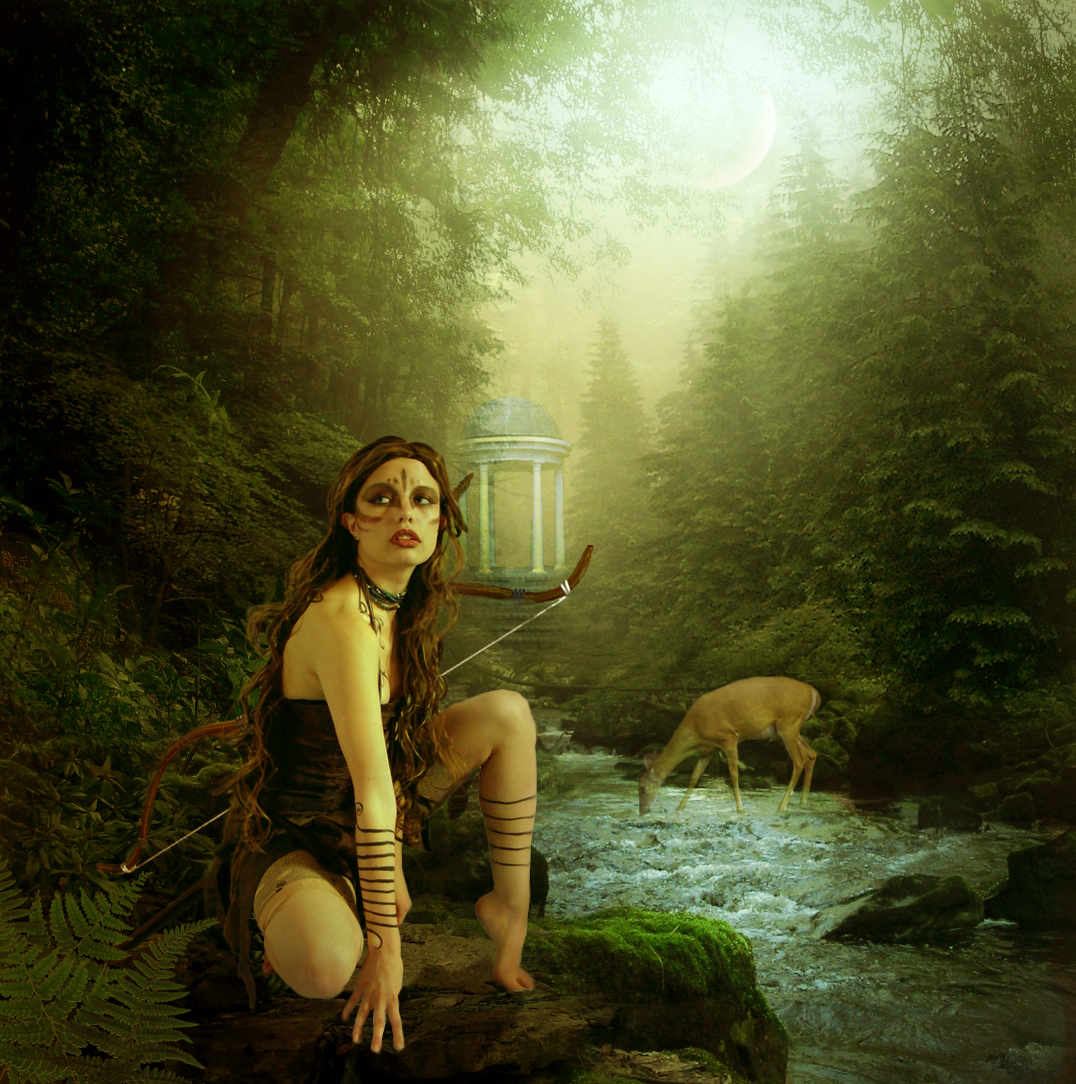
I have always loved The Maiden Goddess, in her many forms.  When I first started learning other mythologies from around the world as a child, it was the image of Artemis that struck me the most – a glorious, strong young woman with her bow, surrounded by animals under a waxing crescent moon.  Someone who knows what they want and yet keeps it to themselves, guarding their bodies and sense of self and opening only to those they choose to love – the Maiden’s love was not unconditional.  She ran through the forest with muddy feet and wild hair, in skins and with fetishes dangling in the breeze.  She still does.

As I near 40, the sensible part of me tells me that I should at least be looking into the Mother Goddesses, before I turn to face the Crone. The Maiden in me tells her to bog off.

It’s in the waxing time that I long to dance and sing, that the energy is rising, when my blood stirs with passion.  I love that crescent that hangs in the sky, a silver arc of glory and strength, bending but not breaking, supple and strong.  The full moon does, of course, sing to me as well, as does the waning and new moon – I honour all the tides and times as they flow through this life and through me, connecting me with everything.  Autumn is my favourite season – not a time of the Maiden, you might say – but the Maiden would say otherwise, for this is hunting season for us humans, where she and the Lord of the Wildwood watch over both predator and prey.

I suppose that being childless by choice has much to do with my perspective on the Maiden.  She is free, unburdened, yet still carrying great responsibility.  She is not naïve, she is not immature – for me she is strong-willed and determined.  She is not innocence and unknowing – she IS a goddess after all, remember.  She likes children but sees no need to have her own, for it does not fit in with her plans.

I don’t seek a Mother Goddess, perhaps because I have never felt the need for one.  My own physical mother provides me with that love that only a mother can.  I personally don’t believe in an all-loving Mother Goddess anyway – the Goddess as nature for me could never be so. Nature doesn’t give two hoots about humanity.

Even my Lady Nemetona, the goddess of sanctuary, is not a Mother-type figure.  She provides us with that space where we can be, where our soul truth can sing, however she is not motherly in the way that she provides it.  She allows for that space to be – like a priest, she facilitates the power within and without to allow that time for growth, or reflection, or whatever it is that you seek. It is up to you to use it correctly.  She watches over sacred sites, stone circles and deep lakes, mountaintops and dark caves where people have come for millennia, or for a season, to make ritual and connect with that which the Druids call awen.  She holds a space, indeed she may hold us for a time, but it is so that we can better understand ourselves and the world, rather than out of any love. She is a Maiden goddess to me, true to herself, aware of her boundaries and setting them clearly.

The Crone awaits me in the dark depths of winter, and perhaps one day I will seek her out. However, I have a feeling that the Maiden will still be at my side, forever and always running with me through forest and field under the bright sunshine, shooting our bows deep into the heart of consciousness and forever singing under the light of the waxing moon.

Recharge, Renew, Release

We all need a place to retreat to, every now and then.  A place to withdraw, to regroup, to reharness our energy and so to come back out into the world with renewed energy.  Everyone is familiar with the summer holiday, or some time off in the bleak of midwinter.  These are chances to lay aside the worries of work, and to get back in touch with yourself, your family, and what really matters.  However, what if we managed to do that each and every day? Mini or micro-breaks, at least once a day, to reconnect those threads of the weave that we have dropped, to re-establish relationships and to fully honour the time that we are alive…

Every day is a chance to stop, to enter into ritual, to take a step back and simply savour the moment.  We can become so out of tune with our own bodies, is it any wonder that other people often baffle us?  By understanding our selves, we can better understand others, and so work to help others in a more positive and productive way.

So we create the micro-retreat. Once a day, we stop, and take a moment to watch the moon, or sit on a cushion and meditate, to attune to our sense of self.  When we find that centre point, that sense of self, we can then let it go, and seek out the deeper connections that can be found when the self is released.  We are all living on this planet together, and by dropping that sense of self we can release into the flow that is awen, that is life and inspiration itself, flowing through space and time.  It is a chance to connect with the earth, with deity, with everyone and everything on the planet, instead of just your own sense of self. How wonderful is that?

I do not underestimate the significance of focusing on the self in order to improve one’s life – change must come from within.  However, there is so much more to the world than the little universe we create around our sense of self – a brilliant world full of myriad possibilities.  Take for instance the ability to shape-change – we must first be able to drop our sense of self in order to take wing as the marsh harrier, or stalk a pheasant through the underbrush like a fox.  On a broader level, we can simply place our hands on the earth and feel all of life humming from this planet, but first we must silence the chattering self within in order to listen and to hear it fully, with an open heart.

To be able to open ourselves up to the grander scheme of things, we must find a place where we are held, where it is easy for us to open up our nemeton and let go into the unknown.  Creation of a sacred space is key for some – whether we physically create a space or whether we simply expand our own nemeton to that which we would connect, with honour and respect.  We must first know where our edges are before we can release them and step over them into the unknown.

In Zen, it is acknowledged that the sense of self is an illusion – it is made up of the opinions and experiences that resonate the most strongly within us, that we wish to cultivate, or which touch on on such a deep soul level.  Yet these are all attachments, to which we must release in order to fully connect with the world at large.  In the Ten Bulls, the seeker finally does manage to let go, to become one with everything, but more importantly, he then takes that back into the world and works in the world with that knowledge. Releasing into the void in order to connect fully takes great courage, great time and great skill. Yet it is so simple that it feels impossible.

This is where discipline is key.  We must make the time if we truly do want to do this.  We must want it with all our heart and soul. In Zen, there is a saying that you must want it as much as a man whose head is held under water wants air.  If you want it that much, you will make the time.

Stepping away from the loudness and hectic pace of our modern lives we can find the time to simply “be”.  We aren’t human beings most of the time; we are human doings.  We must relearn that art of simply being which can then connect us to everything else.  Once we simple “are”, then that sense of self fades away and the multitudes of awen around us are allowed to flow into and around us – we hear what in Druidry is known as “the song”.

Take a micro-retreat, once a day, several times a day.  Watch the sun rise and the sun set, and let go into that experience.  The world is so much larger than you – why not experience it wholly and with reverence and honour?  Weaving those dropped threads, you will become an integral part of the tapestry of life once again, and not just a loose thread dangling in the wind.  Not going with the flow, but being the flow itself.

Marvellous.