Solitude and Serenity

I spent a wonderful couple of days by myself, “glamping” in a yurt for my 40th birthday. It was heaven.

I love spending time by myself. I always have. Don’t get me wrong, I love my friends and family, but I am entirely comfortable in my own company for long periods of time. Growing up as a teenager, I didn’t have any close friends nearby – my boyfriend was about 20 miles away, and so I only saw him about every other weekend when not at school. My other school friends were over 60 miles away. After school and weekends then were spent by myself, alone in the woods or wandering the village, immersed in the songs of the place.

Turning 40 gave me the perfect excuse to hole up away from everybody for a couple of days. It was time to be entirely selfish – time to spend solely on me, on thinking about my past, present and future. Looking over the last 40 years, and thinking about where I am now, I am very hopeful and content about the future, whatever it will bring. Looking at myself from a different viewpoint as well helped to confirm my sense of self; I thought about how my family see me, my friends, my colleagues, my peers, my cats, etc. Fully grounding in my sense of self, of knowing who I was, I was then able to let that go.

Sitting vigil at night in front of the campfire, with the stars shining brightly overhead and the fire burning merrily, I was able to let go of the past, be in the present and not worry about the future. I knew who I was, and I was able to let that go as well, to simply be in the moment with the darkness, the owls, the crickets and the night air. It was wholly freeing.

We do not spend enough time alone, in my opinion. Four days without phones, television, radio or internet was lush, with time spreading out before me in a lazy spiral. I ate when hungry and slept when tired, not matter what the time of day was. I was able to allow my thoughts to slowly dissipate in the wind, and I found myself becoming more and more a part of the landscape. I no longer thought about Facebook or the emails that awaited me. I was free.

Of course now I am back, and there are business emails to deal with, blogs to be written and thoughts to be shared with friends and family. But these moments of stillness, when utterly alone I was able to let go into the world has carried with me to an even greater extent than I thought possible.

The thought of going on social media gave me a slightly sinking feeling. I had emails and deadlines to meet. I did not want the television on. But I share my life with others, with my husband and my friends, and I cannot retreat entirely from the world. What I can do, however, is to re-prioritise how my time is spent, both with others and by myself.

The monastic life is all about retreating from the world in order to better engage with it. Time spent alone is finding solace for the soul, slowing down thoughts and finding out what really matters. Put away your phone. Get off the computer. Turn off the television and the radio and simply sit, wherever you are. Be in that space. Let that space get to know you. Go outside, alone, for hours at a time and feel yourself slowing down, thoughts receding until you are simply in the present moment, awake and aware to the world around you.

It was the greatest gift I could ever have received on my birthday.

Thich Nhat Hanh on No Self

Meditating upon this for a couple of years now, I was absolutely delighted to come across this little question and answer session with Thay back in 2010.  His thoughts on ancestors, on no self and awareness were exactly the same as my own, and resonate deeply within my soul.

Whoever I am.

World Suffering – Thich Nhat Hanh

This little gem came as a great reminder today, when the suffering of the world threatened to overwhelm me.  Bursting into tears as I watched on the BBC news children’s toys scattered in the rubble of the Gaza bombings,, their bodies being loaded together into the mortuary. Rude people at the village shop blocking other people’s cars, and making them wait until they finish shopping to move their car, even after the person has asked them to politely to move.  Loud, overbearing people in the bays next to you at the driving range.  The obnoxious amount of money spent on the World Cup Football in Brazil while people starve in the streets.

Thich’s words were a welcome reminder to find the beauty, and to nourish ourselves in order to better serve the world, in a world filled with suffering – not to be overwhelmed by it, but to find the beauty to carry on regardless. To find a community as well, of like-minded souls, who can inspire you on your journey through life.  To be out in nature, and to see the wonder and live with the awe of a child again.

Then, you will be better able to serve the world, instead of submitting to the suffering and the grief, the rage and the injustice.  Returning to the centre, finding peace and being peace is all that matters.

Unconditional Love

In the Goddess Temple in Glastonbury this June, as I sat down to find some space after an interview with Philip Carr-Gomm for Druidcast, a lady approached me and asked if I would write a blog post about unconditional love. She said she was having trouble with this concept, and I said I would do my best. I have been thinking about this matter for a few weeks now, mulling it over and letting it settle in my mind before putting words to paper (or a computer screen, as it were – it just seems less poetic).

First, we have to define just what love is. The Oxford English dictionary defines it thus:
• A strong feeling of affection
• A great interest and pleasure in something
• A person or thing that one loves

A difficult one; look at several other dictionaries and you’ll notice that even they cannot seem to agree on what love is first and foremost. It is such a widespread and subjective concept that changes depending upon culture, religious or philosophical points of view. In an Eastern tradition such as Buddhism, love is more than affection, pleasure or something that one loves. Indeed, in most traditions it is more than that: love is peace; love is understanding; love is compassion; love is life itself.

For me, love is all these things. That is why it is so difficult to define. When considered in this context, love is, in itself, unconditional – or is it? Can you put a condition on the notion of peace, of understanding, of compassion, of life itself?

In a way, yes. Throughout the world, peace, understanding and living are kept under certain conditions in order to benefit the greater good. Laws and customs in every society are created for the supposed benefit of all – is this love? Laws and customs are a condition for keeping the peace, yet when we consider things such as genital mutilation, are we acting on a condition that brings about love?

Reining it back in for a moment, in most Eastern traditions love equals compassion. So, what is compassion? I’ve talked about the nature of compassion for years on this blog, considering it from every angle possible. Compassion is trying to see the bigger picture, to see that everyone suffers, and to alleviate suffering, both yours and the world at large. This compassion does not mean that you then become a doormat, however. The Dalai Lama states in his essay on “Compassion and the Individual”:

“[w]hen a problem first arises, try to remain humble and maintain a sincere attitude and be concerned that the outcome is fair. Of course, others may try to take advantage of you, and if your remaining detached only encourages unjust aggression, adopt a strong stand. This, however, should be done with compassion, and if it is necessary to express your views and take strong countermeasures, do so without anger or ill-intent.”

In this quote, compassion comes about with a concern that the outcome is fair. Fairness is, in itself, yet another subjective concept that means so many different things to so many different people. It would appear that we’re already on shaky ground before we’ve even gotten through to the concept of unconditional love. However, in the “without anger or ill-intent” there seems to be a key.

If we do not harbour anger or ill-intent towards anyone, is this the gift that unlocks the door to unconditional love? It just might be. I may disagree with political parties, companies, individual persons, but I do not wish them harm. I may hate most of David Cameron’s policies, but I would not wish him personally to come to harm. I may write petitions, raise money or volunteer, protest his policies; I may express my point of view with words and conviction, strong in my personal belief of what is right. I can do all of this without ill-intent. Without anger? Sometimes, but not all the time. For me, anger and ill-intent are two very separate issues.

So what is unconditional love? Is it living in a world without ill-intent towards other beings, human and non-human? I’m not sure that quite covers it – loving someone and not wishing them harm are not exactly the same thing. Is anger here the key to unlocking this further mystery?

What is anger? I’ve pondered this one for years, and have come to the conclusion that anger has its roots in fear. I become angry because I fear my personal rights are compromised. I become angry because I fear for the safety of a bluebell wood. I become angry because I fear for the well-being of a friend who suffers. This anger is directed, focused into non-violent action and activism. It is fear that is transformed into energy for what I perceive to be the greater good. Like everything, it is subjective. Is this anger all that bad then, considering the focus? Looking and understanding fear helps me to use anger and to understand anger in others. When someone shouts abuse at me, I understand their fear. It doesn’t mean I have to like it, but I understand it. With Thich Nhat Hanh’s concept of “Engaged Buddhism”, one can work to counter that fear and anger and stand up for what they believe is right, while maintaining an awareness of the whole.

There is a saying, “love means never having to say you’re sorry”. This is not to mean that one should behave badly, without thought or care for others – quite the contrary. It means that one should live a life that causes the least amount of suffering for others, so that you will never have to apologise in the first place. It’s a nice thought, and one to work towards. It carries the notion of personal responsibility for all actions.

In my opinion, it is all that we can do to become aware of our emotions, of our fears and our passions and work for the greater good in all that we do. I can look to my gods for inspiration.
With regards to Druidry, it is often said that we do not submit to our gods, for to do so would destroy us. In Druidry, anger is a god. Love is equally a god. Should we therefore not submit to love, either? More questions…

We may have to take a strong stand in our convictions at times. We have to look at the nature of love, of anger and of fear and understand the currents of these energies to better understand their influence in our lives. Thinking about these energies more often than not brings up more questions, making us quest ever deeper for the awen that will show us the way to peace.

Perhaps love is more akin to the concept of animism, which Emma Restall Orr defines as seeing the inherent value in all things. We do not need conditions to make this idea work. We value everything, no matter what, and work with our gods to better understand the nature of all being and all beings, questing the awen that will allow us to tap into that well and drink deeply.

So is this unconditional love? Or is it a case of only if when there is absolutely no fear, can there be unconditional love. Is that humanly possible? I’m not so sure yet – I’m still thinking about it. Is animism the inspiration that will unlock the mystery of unconditional love?

Midsummer

Ah – midsummer. I remember when I first moved to these isles over 16 years ago from Canada – it was a cold and wet summer, and I wondered just what on earth I had done. And yet, the light fascinated me at that time of year, and later at the winter solstice, the darkness. It was so much more than where I grew up – the twilight of midsummer and the barest space of total darkness, the unrelenting darkness that forces you to face it head on in winter. The difference in latitude was a great teacher – (Montreal, 45.5N, London 51.5N).

 
The current is running strong in the British Isles right now. As I go to my outdoor altar every evening, laying my hands upon the soft, mossy earth I feel the white dragon that has risen to the surface and is dancing in the ethereal currents of energy crisscrossing the land. It is a time of great joy, of celebration.

 
This is a time of year to be proud of what you have done so far in the year’s cycle. But beware – the carpet can be pulled from underneath you, and the harvest may not quite be as expected. For this brief moment, however, we can perform this wonderful balancing act, in a liminal time before the tide tips over and we tumble headlong with it. It is important to be proud of what you have achieved – it is too easily done to become prideful.

 
Stand and feel the earth beneath your feet. Feel the serpent energy rising, the dragons of these lands, filling your soul with this time of year. Reflect on your achievements, and state them aloud under the eye of the sun. Confirm for yourself the good that you have done for the world, for your family, your community, for yourself. Let the sun’s rays witness this confirmation.

 
On Saturday I will be reflecting on the good investment of my solar panels – this time of year it is especially rewarding to know that the longer daylight hours are helping others in the village, ie. local businesses. I will take a bow for the two books published (and doing well), and the third and fourth on their way. I will applaud the money that has been raised for various charities through a lot of hard work in fundraising, events and suchlike over the course of the year. For this brief moment, I will take pleasure in my achievements, and remind myself that this is why I do the work I do, and live the life that I live. I will remember this moment in the darker times, to guide me through them and out the other side.

 
And then I will immerse myself once again, into the landscape, losing that sense of self and becoming a part of it, letting it guide me, teach me, blend with my blood and my bones with the whispers of the ancestors blessing it all.

Offense taken, Mr Fry

*Warning – this blog post contains strong language*

 
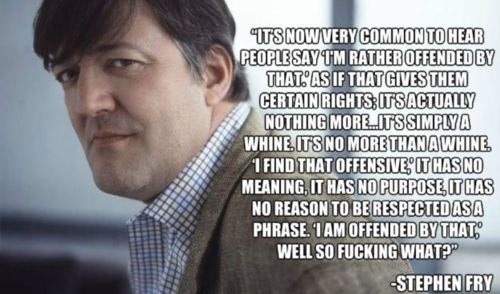
stephen-fry-on-offenceI’ve been thinking about Stephen Fry’s little rant that made the rounds of social media a year or so back. It’s something I’ve been meaning to comment on for a while, mulling it over thoroughly, discussing it with other people and trying to understand the mindset that would provide such an opinion.

 
In short, I just can’t understand why he would say such a thing.

 
The blog Tea Leaves and Dog Ears has provided a good reply to his statement. However, there are still a lot of people who agree with Fry’s sentiment, including Ricky Gervais, who stated on his Facebook page in August 2013:

 
“We have to stop this recent culture of people telling us they’re offended and expecting us to give a fuck.”

 
Fry and Gervais’ comments are nothing short of belligerent. When someone does not care regarding the effect their words and actions have on society in general, they are also not acting in any way with compassion. Fry’s comments about taking offense are well and good if he is the one being offensive, however, as in Tea Leaves and Dog Ears’ blog, when it is his own person that is being offended, the tables turn and a double standard occurs.

 
I’ve been studying the Celtic worldview for some while now, diving in to the history and research, and have come across one perspective time and again: that of personal responsibility. In a culture, in a society, we all have a personal responsibility to behave in accordance with that society and the laws that it contains. If we don’t like them, we should be able to speak out against them in a peaceful manner, protesting using our freedom of speech. Yet every action, every word that comes out of our mouths we are responsible for, whether spoken with mindfulness or mindlessness.

 
I believe that Fry’s and Gervais’ comments were spoken out of mindlessness. In Mr Fry’s case, also taken out of context. I also believe that they would, and probably have, taken offense at something since they made those comments. It is human nature to have an opinion. We have a voice and we use it. Sometimes we do so with full intention, sometimes we do not think before we speak.

 
I simply cannot fathom walking around, saying things without thinking of the repercussions my words and actions would have on the world. My sense of personal responsibility lies too thickly ingrained in my soul. It is confirmed by my Druidry, by my spiritual path. Stating that those who are taking offense are merely having a “whine” is to diminish their point of view, their opinion as worthless. It goes against the very freedom of speech that the original rant seems to hold up.

 
Sometimes it can be hard to find the words at the exact moment the offense is being taken. We’re not all eloquent beyond belief, able to put thoughts and emotions into carefully constructed arguments on the spot. It is a talent that some people have, some do not. We should not dismiss those who cannot find the words to express their true feelings, who can only say at that moment that they’ve taken offense. We have hurt someone’s feelings. We hate it when our feelings get hurt. Why do we forget that when we are the ones that are creating the offense?

 
Acting with compassion in all things is central to Buddhism. Right Speech is part of the Eightfold Path. I personally do not believe that Fry or Gervais’ comments are made with this in mind. Speech, words and stories were very important to the Celtic ancestors. The Druid teachings up until the modern day were never written down, for various reasons – to keep it within a political and spiritual elite in Classical times, for example. Going back further than this brief point in history, the written word did not exist for our Bronze Age or Neolithic ancestors. What was said, expressed in a language either now lost or evolved into our current tongue mattered. Even before verbal language, body language meant so much. Just watch two strange cats meeting each other, eyeing each other up for the first time…

 
So, we shouldn’t dismiss someone for taking offense simply because they cannot express in words at that time what it is that is hurting them. It’s difficult for a lot of people. And what of those non-human beings that we hurt? We must act with compassion, yes – but we must also be allowed to stand up for our rights, to be able to express it in our own time without being told that we are simply “whining”.

 
Supporting Fry and Gervais’ statements can lead to all sorts of messy encounters. Sexual harassment, jokes of a sexist, racist or religious nature can lead to a culture sliding down the slippery slope of intolerance, misogyny and bigotry. The words “rape culture” are hot right now, filled with debate about what it is and what is isn’t, who is contributing to it and who isn’t. Again, here I think that personal responsibility is key to working in honourable relationship with the world at large. Not giving a f*ck isn’t.

 
There is also the argument that letting go without taking offense is the best way forward. However, this only applies to a comfortable Western point of view, where one isn’t being shot at, forced to marry their rapist, or being subjected to all manner of discrimination due to the colour of their skin, their gender or their religious beliefs.
We are a vocal tribe now, and as such we should discuss things with compassion. Simply stating that someone is whining is not taking a look at the broader picture. In doing so, one is dismissing another human being. In time, someone may find the words to express their offense – it is a matter of eloquence and language, not one of who is right and who is wrong. Dismissing the other for taking offense is, in my opinion, repulsive and incorrigible. It is bad behaviour and bad form.

 
Stand up for what you believe in. Express yourself as eloquently and as honourably as you can. Consider the impact that your words will have on the world at large. Use the tenets of Right Speech and personal responsibility to the best of your ability. It is all that we can do. We may fail, we may be brought up on it, and it is up to us to make amends. Do not let pride get in the way. No one is infallible.


20 Things You May Not Know About the “Zen Druidry Lady”

Some things you may not know about the “Zen Druidry Lady” 🙂


  • I spent my spare time in my youth figure skating at the ice rink at the end of my street all winter long
  • When I wasn’t figure skating, I was cross-country skiing or downhill skiing
  • I know all the lyrics to pretty much every Taylor Swift song
  • I know the entire script of Jim Henson’s movie, Labyrinth, by heart
  • I played the head of a pirate nation in a Live Action Role-Playing system
  • I was also an elf in another LARP system
  • I began writing my first book when I was fourteen
  • I only have an automatic, not manual driver’s license (but I can drive/operate a tractor with bucket)
  • I used to ride a Yamaha Xmax before I got my driver’s license
  • I was a volunteer and member of the Valley Farm Mounted Troop, part of the Suffolk Division of the Legion of the Horse for the Volunteer Corps of Frontiersmen
  • I also competed in Western horse-riding competitions
  • I rode down the aisle, side-saddle, next to my husband (who was on his own horse) at our wedding
  • I sing silly, improvised songs to my cats. A lot.
  • My cats LOVE my songs.
  • I play golf (at eco-friendly sites)
  • I never measure the quantities of anything when I bake – I always wing it
  • I am a very good swimmer
  • I do a very good screaming chimpanzee impersonation
  • I work for one of the largest classical music festivals in the world
  • I can play the guitar, strumstick, drums, flute, recorder, harmonica, and piano (none of them particularly well)


Dealing with depression and despair…

Dealing with depression and despair…

Being kind isn’t all that hard. Being jolly and upbeat all the time is – and is a denial of our emotions and bodily responses to certain situations.

 
I woke up yesterday in a bad mood – which has spilled over into today. The reasons for it are numerous: tiredness, frustration, a lack of compassion in the world amongst others. The Zen thing to do would be to be present in the moment, for in this moment there is all that we need. There is nothing but this moment. Feelings of despair arise when we separate ourselves from the moment, and think about the past or the future, dwelling on certain aspects and perhaps not seeing the bigger picture (or perhaps even seeing the bigger picture, which can cause us to despair even more).

 
Yes – I am quite comfortable in this present moment as I write this. I am not being shot at. I am not in fear for my life. My loved ones are safe. I have a cup of tea, and enough food to eat. My body is clean, my clothes warm. Compared to many, what on earth am I doing feeling despondent?

 
Humanity’s blessing, and curse, is the ability to see the bigger picture. This can lead to glorious ideas about the direction we should take; it can also lead to despair when we take into consideration the negative aspects of our lives on this planet. Focusing on just the positive isn’t balanced – neither is focusing on the negative. As a Druid, I am constantly seeking balance and harmony, to find my place in the world and to serve this world in the best capacity that I can, being true to my nature and honourable in my deeds.

 
I sometimes fail at this. I sometimes succeed. In this, there is balance. Of course, I aim to look at things from a balanced perspective, but on the whole we are conditioned throughout our lives to try and look at things positively. However, when looking at things negatively, we need to remember that negative does not equal apathy. If there is something we do not like, we can seek a way to change it. It’s in our hands.

 
This is not denying the negative. It is living a life with intention. Creating peace is damned hard work. It requires a person to see all sides of a story and work with the ideals of compassion and empathy. If we only acknowledged the positive things in our lives, our compassion and empathy would be seriously diminished.

 
I sometimes find myself thinking that Buddhist monks have got it pretty easy, secluded away in their monasteries, not engaging with the real world. Some do. However, I remind myself that other monks have engaged with the world in ways that I probably will never be able to – think Thich Nhat Hanh helping to rebuild villages during the Vietnam War, not taking sides with anyone and simply helping people as best he could. I’m sure at some points he too despaired, seeing children dying, homes destroyed and his country torn apart. My despair pales in comparison to this.

 
This is not to say that I should not acknowledge my own despair, however. If I did, if I pushed it to one side to focus on the positive, I’m sure that it would return to bite me on the ass at the most inopportune moment. We don’t have to give in to feelings of despair, but neither should we push them aside. We normally don’t push feelings of joy aside – we like to experience these. All feelings should be felt – and then we can move on.

 
So, tired after dance rehearsals and depressed by the amount of litter that I see along the roadsides that I will have to clear (again), apprehensive about coming engagements and a workload that was supposed to be lighter this year being heavier than ever, I am feeling my despair, my depression. I am allowing it to move through me, so that I can come out the other side having had the experience, which will hopefully transform into some sort of wisdom.

 
This despair will be self-contained – I will not be taking it out on others. I will try not to snap at people even though my emotions and reactions feel more “on edge” than normal. You can despair at the world and still be kind. You can reach out a hand to friends or family if you need to. You can write about it in a blog.

 
Above all, you are allowed to feel it, in your bones and in your soul.

The Power of Love

I dreamt the other night that I was on a bus, and we were driving up a hill. I was sitting up front, behind the driver, and as we rounded a corner I knew that we were going too fast – we skidded off the road and then off the cliff.

 
We plummeted through the air, the fall foliage from the treetops skimming the bottom of the bus. I decided to try and make my way to the back of the bus, where I might stand a slim chance of survival when we hit the ground. Fighting against gravity, I pulled myself up two, three, four rows. By now, I realised that we would soon hit the ground, and so I thought to myself “It’s time to turn around, and see death as it approaches”. I turned to face my impending doom.

 
The ground rushed up to meet us, but we just managed to miss – it was an outcropping of the same cliff. So we continued our plummet, the wind rushing around us. I made my way further to the back of bus, hoping to survive the final crash. At about halfway, I turned once again to meet my fate. I watched the ground come closer, and just before we hit, I said “I love you”. I pictured my husband’s face, but it was not only for him that the words were meant; I felt love also for my family, my friends, and the entire planet. I felt love for ALL life. It was the most extraordinary feeling.

 
No sooner had those words escaped my lips, and the feeling of love filled my heart, that the bus caught a thermal updraft, and we swooped inches above the ground, rising softly to land as lightly as a feather upon the ground.

 
I woke up, completely astounded.

 
That was the power of love.