Out on the half mile stretch of road on the heath leading up to the village, bright yellow rubber gloves on and hauling rubbish bags, I am picking up litter. Towards the end of the work, a car pulls in by mine, already loaded with two full bags. Chap steps out.
“Community service?” he says.
“Nope. Voluntary.” I reply.
A look of utter perplexity overwhelms his face, and he is lost for words. After several moments of awkward silence, he manages to form his thoughts. “Excuse me, but… why?”
A smile crosses my face. “Because I love this place.”
The look of incomprehension has not left his face. Another pause. “Nick ****. Local Wildlife Trust Manager. And you are?”
Druidry
To be or not to be – that is the question…
Questioning your spiritual and religious path is something that happens to almost everyone who is travelling down the winding trackways of life, with its twists and turns, surprises and disappointments. For the most part, we try to find others who are on a similar path, to share in the experience, to help us perhaps with their stories, to provide guidance or simply reassurance that we are on the correct path. We as a species are a tribal people. We also love to put things into categories and boxes, in order to make some sort of sense of life. With religion or spirituality, it’s never that easy.
Our path may have been walked by others for many years – or we may be forging out on our own. It helps if we can name our path, as if in naming we can further clarify the intention behind the journeying. We can get caught up in the naming, trying to find where we fit in the world, finding some definition that makes sense to us and to everyone else. Sometimes there is no sense to be made, for if we are walking between worlds, defining it using the terms of just one world can make it seem less than what it really is, what it feels like to us, and how we experience it.
When we are researching our path, we come across definitions that others have used, that they may still use and hope that perhaps we will fit somewhere within them. Yet the fit isn’t quite right – either the hem is too low, the collar too tight, the colour is wrong. We may like the cut but not the pattern. It may not be suitable in all weathers – you get my point. When I first started out, it was on the path of Wicca, back in the early 1990s, then coming to Druidry shortly after the new millennium had begun. I’ve studied other religious paths along the way – Buddhism and Zen, Native American, Romany Chovihano, Heathenry and more. Always questing the awen, I’ve often found that there is no monopoly on wisdom. I’ve incorporated elements of all these into my own Druidry and, by doing is, is it still Druidry?
For me, yes – it is. My path is based on the wisdom of this land and the ancestors. This is the base from which I work, flavoured with ideas and teachings from other paths. Yet it is still, in essence, Druidry – at least in my own eyes. Others might disagree. For me, Druidry is simply a word that describes the language of my spirituality, of my religion. In it I find the wisdom of the oak – for me it is that simple.
Questioning and questing are valuable assets in our spiritual paths – they are a force against complacency, against blind acceptance. They make us address the issues of words and ideas thoroughly in a meaningful way that pertains to us alone. I’ve witnessed many thoughtful words from people looking at their own path, and trying to find a definition that works. Nell wrote on her blog, The Animist Craft of community (click HERE for full article). Lorna Smithers currently has found a new path that makes sense for her (click HERE) and Nimue Brown has discussed it in various forms on her posts, Disillusioned with Druidry and Walking your Own Pagan Path (and written a book, Spirituality Without Structure). Emma Restall Orr even touched upon this issue in “Essays in Contemporary Paganism” (Moon Books, 2013) in her essay, “After Paganism”. After spending around 30 years being a leading figure in the Druid community, she now states on her website [accessed 25 June, 2014]:
“Studying Druidry from the mid 1980s, I worked for The Order of Bards Ovates and Druids, then The British Druid Order, where I was joint chief for some 9 years alongside Philip Shallcrass. In 2002 I left to found The Druid Network, which now runs without me. While my time within Druidry was enormously valuable, I would no longer term myself a Druid.”
Our beliefs and attitudes are always shifting, always questing the awen in different ways. We may walk a path for a while, for many years even, and then find that we’d rather follow something else or create a new path deep through the forest of our souls. We may find that we do not fit in with the definition others ascribe to a path, such as Druidry. We may shrug off what others say and continue to call ourselves Druids, feeling that the word itself, and not the adherents to it, adequately describe our own path.
For me personally, I’m happy with the term, Druid, even though I disagree with a lot of what other Druids do, just as much as I agree with them. Though others may say or do things I find embarrassing, or simply wrong, they do not describe my path any more than those who I find inspirational and wise. Are we trying too hard to find definitions of what we are, or what we aren’t, or is this an exercise that is necessary in order not only to define our own paths, but our own selves? Where does intention fit in with this idea? Are you happy with the terms you or others have ascribed to your own path? Do these terms matter?
Unconditional Love
In the Goddess Temple in Glastonbury this June, as I sat down to find some space after an interview with Philip Carr-Gomm for Druidcast, a lady approached me and asked if I would write a blog post about unconditional love. She said she was having trouble with this concept, and I said I would do my best. I have been thinking about this matter for a few weeks now, mulling it over and letting it settle in my mind before putting words to paper (or a computer screen, as it were – it just seems less poetic).
First, we have to define just what love is. The Oxford English dictionary defines it thus:
• A strong feeling of affection
• A great interest and pleasure in something
• A person or thing that one loves
A difficult one; look at several other dictionaries and you’ll notice that even they cannot seem to agree on what love is first and foremost. It is such a widespread and subjective concept that changes depending upon culture, religious or philosophical points of view. In an Eastern tradition such as Buddhism, love is more than affection, pleasure or something that one loves. Indeed, in most traditions it is more than that: love is peace; love is understanding; love is compassion; love is life itself.
For me, love is all these things. That is why it is so difficult to define. When considered in this context, love is, in itself, unconditional – or is it? Can you put a condition on the notion of peace, of understanding, of compassion, of life itself?
In a way, yes. Throughout the world, peace, understanding and living are kept under certain conditions in order to benefit the greater good. Laws and customs in every society are created for the supposed benefit of all – is this love? Laws and customs are a condition for keeping the peace, yet when we consider things such as genital mutilation, are we acting on a condition that brings about love?
Reining it back in for a moment, in most Eastern traditions love equals compassion. So, what is compassion? I’ve talked about the nature of compassion for years on this blog, considering it from every angle possible. Compassion is trying to see the bigger picture, to see that everyone suffers, and to alleviate suffering, both yours and the world at large. This compassion does not mean that you then become a doormat, however. The Dalai Lama states in his essay on “Compassion and the Individual”:
“[w]hen a problem first arises, try to remain humble and maintain a sincere attitude and be concerned that the outcome is fair. Of course, others may try to take advantage of you, and if your remaining detached only encourages unjust aggression, adopt a strong stand. This, however, should be done with compassion, and if it is necessary to express your views and take strong countermeasures, do so without anger or ill-intent.”
In this quote, compassion comes about with a concern that the outcome is fair. Fairness is, in itself, yet another subjective concept that means so many different things to so many different people. It would appear that we’re already on shaky ground before we’ve even gotten through to the concept of unconditional love. However, in the “without anger or ill-intent” there seems to be a key.
If we do not harbour anger or ill-intent towards anyone, is this the gift that unlocks the door to unconditional love? It just might be. I may disagree with political parties, companies, individual persons, but I do not wish them harm. I may hate most of David Cameron’s policies, but I would not wish him personally to come to harm. I may write petitions, raise money or volunteer, protest his policies; I may express my point of view with words and conviction, strong in my personal belief of what is right. I can do all of this without ill-intent. Without anger? Sometimes, but not all the time. For me, anger and ill-intent are two very separate issues.
So what is unconditional love? Is it living in a world without ill-intent towards other beings, human and non-human? I’m not sure that quite covers it – loving someone and not wishing them harm are not exactly the same thing. Is anger here the key to unlocking this further mystery?
What is anger? I’ve pondered this one for years, and have come to the conclusion that anger has its roots in fear. I become angry because I fear my personal rights are compromised. I become angry because I fear for the safety of a bluebell wood. I become angry because I fear for the well-being of a friend who suffers. This anger is directed, focused into non-violent action and activism. It is fear that is transformed into energy for what I perceive to be the greater good. Like everything, it is subjective. Is this anger all that bad then, considering the focus? Looking and understanding fear helps me to use anger and to understand anger in others. When someone shouts abuse at me, I understand their fear. It doesn’t mean I have to like it, but I understand it. With Thich Nhat Hanh’s concept of “Engaged Buddhism”, one can work to counter that fear and anger and stand up for what they believe is right, while maintaining an awareness of the whole.
There is a saying, “love means never having to say you’re sorry”. This is not to mean that one should behave badly, without thought or care for others – quite the contrary. It means that one should live a life that causes the least amount of suffering for others, so that you will never have to apologise in the first place. It’s a nice thought, and one to work towards. It carries the notion of personal responsibility for all actions.
In my opinion, it is all that we can do to become aware of our emotions, of our fears and our passions and work for the greater good in all that we do. I can look to my gods for inspiration.
With regards to Druidry, it is often said that we do not submit to our gods, for to do so would destroy us. In Druidry, anger is a god. Love is equally a god. Should we therefore not submit to love, either? More questions…
We may have to take a strong stand in our convictions at times. We have to look at the nature of love, of anger and of fear and understand the currents of these energies to better understand their influence in our lives. Thinking about these energies more often than not brings up more questions, making us quest ever deeper for the awen that will show us the way to peace.
Perhaps love is more akin to the concept of animism, which Emma Restall Orr defines as seeing the inherent value in all things. We do not need conditions to make this idea work. We value everything, no matter what, and work with our gods to better understand the nature of all being and all beings, questing the awen that will allow us to tap into that well and drink deeply.
So is this unconditional love? Or is it a case of only if when there is absolutely no fear, can there be unconditional love. Is that humanly possible? I’m not so sure yet – I’m still thinking about it. Is animism the inspiration that will unlock the mystery of unconditional love?
Midsummer
Ah – midsummer. I remember when I first moved to these isles over 16 years ago from Canada – it was a cold and wet summer, and I wondered just what on earth I had done. And yet, the light fascinated me at that time of year, and later at the winter solstice, the darkness. It was so much more than where I grew up – the twilight of midsummer and the barest space of total darkness, the unrelenting darkness that forces you to face it head on in winter. The difference in latitude was a great teacher – (Montreal, 45.5N, London 51.5N).
The current is running strong in the British Isles right now. As I go to my outdoor altar every evening, laying my hands upon the soft, mossy earth I feel the white dragon that has risen to the surface and is dancing in the ethereal currents of energy crisscrossing the land. It is a time of great joy, of celebration.
This is a time of year to be proud of what you have done so far in the year’s cycle. But beware – the carpet can be pulled from underneath you, and the harvest may not quite be as expected. For this brief moment, however, we can perform this wonderful balancing act, in a liminal time before the tide tips over and we tumble headlong with it. It is important to be proud of what you have achieved – it is too easily done to become prideful.
Stand and feel the earth beneath your feet. Feel the serpent energy rising, the dragons of these lands, filling your soul with this time of year. Reflect on your achievements, and state them aloud under the eye of the sun. Confirm for yourself the good that you have done for the world, for your family, your community, for yourself. Let the sun’s rays witness this confirmation.
On Saturday I will be reflecting on the good investment of my solar panels – this time of year it is especially rewarding to know that the longer daylight hours are helping others in the village, ie. local businesses. I will take a bow for the two books published (and doing well), and the third and fourth on their way. I will applaud the money that has been raised for various charities through a lot of hard work in fundraising, events and suchlike over the course of the year. For this brief moment, I will take pleasure in my achievements, and remind myself that this is why I do the work I do, and live the life that I live. I will remember this moment in the darker times, to guide me through them and out the other side.
And then I will immerse myself once again, into the landscape, losing that sense of self and becoming a part of it, letting it guide me, teach me, blend with my blood and my bones with the whispers of the ancestors blessing it all.
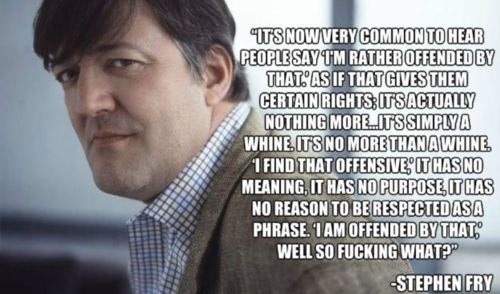
Offense taken, Mr Fry
*Warning – this blog post contains strong language*
I’ve been thinking about Stephen Fry’s little rant that made the rounds of social media a year or so back. It’s something I’ve been meaning to comment on for a while, mulling it over thoroughly, discussing it with other people and trying to understand the mindset that would provide such an opinion.
In short, I just can’t understand why he would say such a thing.
The blog Tea Leaves and Dog Ears has provided a good reply to his statement. However, there are still a lot of people who agree with Fry’s sentiment, including Ricky Gervais, who stated on his Facebook page in August 2013:
“We have to stop this recent culture of people telling us they’re offended and expecting us to give a fuck.”
Fry and Gervais’ comments are nothing short of belligerent. When someone does not care regarding the effect their words and actions have on society in general, they are also not acting in any way with compassion. Fry’s comments about taking offense are well and good if he is the one being offensive, however, as in Tea Leaves and Dog Ears’ blog, when it is his own person that is being offended, the tables turn and a double standard occurs.
I’ve been studying the Celtic worldview for some while now, diving in to the history and research, and have come across one perspective time and again: that of personal responsibility. In a culture, in a society, we all have a personal responsibility to behave in accordance with that society and the laws that it contains. If we don’t like them, we should be able to speak out against them in a peaceful manner, protesting using our freedom of speech. Yet every action, every word that comes out of our mouths we are responsible for, whether spoken with mindfulness or mindlessness.
I believe that Fry’s and Gervais’ comments were spoken out of mindlessness. In Mr Fry’s case, also taken out of context. I also believe that they would, and probably have, taken offense at something since they made those comments. It is human nature to have an opinion. We have a voice and we use it. Sometimes we do so with full intention, sometimes we do not think before we speak.
I simply cannot fathom walking around, saying things without thinking of the repercussions my words and actions would have on the world. My sense of personal responsibility lies too thickly ingrained in my soul. It is confirmed by my Druidry, by my spiritual path. Stating that those who are taking offense are merely having a “whine” is to diminish their point of view, their opinion as worthless. It goes against the very freedom of speech that the original rant seems to hold up.
Sometimes it can be hard to find the words at the exact moment the offense is being taken. We’re not all eloquent beyond belief, able to put thoughts and emotions into carefully constructed arguments on the spot. It is a talent that some people have, some do not. We should not dismiss those who cannot find the words to express their true feelings, who can only say at that moment that they’ve taken offense. We have hurt someone’s feelings. We hate it when our feelings get hurt. Why do we forget that when we are the ones that are creating the offense?
Acting with compassion in all things is central to Buddhism. Right Speech is part of the Eightfold Path. I personally do not believe that Fry or Gervais’ comments are made with this in mind. Speech, words and stories were very important to the Celtic ancestors. The Druid teachings up until the modern day were never written down, for various reasons – to keep it within a political and spiritual elite in Classical times, for example. Going back further than this brief point in history, the written word did not exist for our Bronze Age or Neolithic ancestors. What was said, expressed in a language either now lost or evolved into our current tongue mattered. Even before verbal language, body language meant so much. Just watch two strange cats meeting each other, eyeing each other up for the first time…
So, we shouldn’t dismiss someone for taking offense simply because they cannot express in words at that time what it is that is hurting them. It’s difficult for a lot of people. And what of those non-human beings that we hurt? We must act with compassion, yes – but we must also be allowed to stand up for our rights, to be able to express it in our own time without being told that we are simply “whining”.
Supporting Fry and Gervais’ statements can lead to all sorts of messy encounters. Sexual harassment, jokes of a sexist, racist or religious nature can lead to a culture sliding down the slippery slope of intolerance, misogyny and bigotry. The words “rape culture” are hot right now, filled with debate about what it is and what is isn’t, who is contributing to it and who isn’t. Again, here I think that personal responsibility is key to working in honourable relationship with the world at large. Not giving a f*ck isn’t.
There is also the argument that letting go without taking offense is the best way forward. However, this only applies to a comfortable Western point of view, where one isn’t being shot at, forced to marry their rapist, or being subjected to all manner of discrimination due to the colour of their skin, their gender or their religious beliefs.
We are a vocal tribe now, and as such we should discuss things with compassion. Simply stating that someone is whining is not taking a look at the broader picture. In doing so, one is dismissing another human being. In time, someone may find the words to express their offense – it is a matter of eloquence and language, not one of who is right and who is wrong. Dismissing the other for taking offense is, in my opinion, repulsive and incorrigible. It is bad behaviour and bad form.
Stand up for what you believe in. Express yourself as eloquently and as honourably as you can. Consider the impact that your words will have on the world at large. Use the tenets of Right Speech and personal responsibility to the best of your ability. It is all that we can do. We may fail, we may be brought up on it, and it is up to us to make amends. Do not let pride get in the way. No one is infallible.
Reblog from DruidHeart: Hello, Jack
Here’s a reblog of my latest post for Druidheart, on the SageWoman channel at Witches and Pagans.
At this time of year, I always honour Jack.
Who is Jack? Why, Jack In the Green, of course! Although Mr Sparrow does deserve high praise indeed – but I digress. When the greening has taken over the land, when everything suddenly seems to explode in a riotous cacophony of twisting tendrils, blooming buds, leafy mounds and pollen induced insanity – this is when Jack is in His element.
Up until now, things have been fairly orderly. The weeds have, for the most part, been kept under control. Everything seems to have taken its turn in coming out – the columbine turning the garden all shades of pink through to purple. A couple of weeks later and BAM! Chaos reigns. Each green and growing thing is no longer playing nice; now it’s a competition for the most light, the best position. We had a lovely calm before the storm in May, now the party well and truly has begun.
As we edge ever closer to the summer solstice, so too does Jack creep further into our hearts, into our psyche. Sleep patterns are disturbed by the long evenings and early mornings (here in the UK). We spend every moment we can enjoying this weather, for it can all change tomorrow into a cold, dreary day. We barbeque at every opportunity. We attend festivals and gatherings, meeting new people and seeing old friends. We have come out of our shell, so to speak, to dance in the full light of the sun. We make noise. We laugh. We love out in the open in the lingering twilight.
Jack can bring all these wonderful things to the fore. He can also run you ragged. Like tending a garden – we have to keep Him in check or else he will just run you crazy until you’re lying on the floor, wondering how on earth you got there. There’s a rush to do things, to make use of the wonderful light and time of year. We’re overbooked – we’re double and triple-booked in some cases. We’re teetering on the edge of the solstice, and Jack is waiting to push you over the edge.
Cont’d
To read the full article, click HERE
20 Things You May Not Know About the “Zen Druidry Lady”
Some things you may not know about the “Zen Druidry Lady” 🙂
- I spent my spare time in my youth figure skating at the ice rink at the end of my street all winter long
- When I wasn’t figure skating, I was cross-country skiing or downhill skiing
- I know all the lyrics to pretty much every Taylor Swift song
- I know the entire script of Jim Henson’s movie, Labyrinth, by heart
- I played the head of a pirate nation in a Live Action Role-Playing system
- I was also an elf in another LARP system
- I began writing my first book when I was fourteen
- I only have an automatic, not manual driver’s license (but I can drive/operate a tractor with bucket)
- I used to ride a Yamaha Xmax before I got my driver’s license
- I was a volunteer and member of the Valley Farm Mounted Troop, part of the Suffolk Division of the Legion of the Horse for the Volunteer Corps of Frontiersmen
- I also competed in Western horse-riding competitions
- I rode down the aisle, side-saddle, next to my husband (who was on his own horse) at our wedding
- I sing silly, improvised songs to my cats. A lot.
- My cats LOVE my songs.
- I play golf (at eco-friendly sites)
- I never measure the quantities of anything when I bake – I always wing it
- I am a very good swimmer
- I do a very good screaming chimpanzee impersonation
- I work for one of the largest classical music festivals in the world
- I can play the guitar, strumstick, drums, flute, recorder, harmonica, and piano (none of them particularly well)
Celebrating 50 years of OBOD
This weekend the Order of Bards, Ovates and Druids celebrated 50 years of their organisation, founded by Ross Nichols (Nuinn). The weekend ran from Friday 6 to Monday 9 June, with fringe events and a spectacular evening of arts and entertainment on the Saturday, all held within Glastonbury town centre.
I had been asked by chosen chief, Philip Carr-Gomm if I would be available for an interview on the Friday afternoon of the event, as well as be a part of the author’s table on the Sunday. It was an honour and a pleasure to be able to do so, and to attend the variety of other things happening all over the weekend.
After a 7.5 hour drive from where I live on the coast of the North Sea in Suffolk, we arrived with 10 minutes to spare before my interview with Phillip (which will be available on the OBOD podcast, Druidcast at a later date alongside other authors and figures within Druidry and OBOD). I hobbled into the venue (having pinched a nerve in my hip the day before) and was greeting warmly by Jo, who was working in the Avalon Foundation office, Kris Hughes (one of the most lovely, witty and funny Druids you will ever meet – do check out his books and the Anglesey Druid Order) and then by Philip himself, whom I’d only ever known via email correspondence. Philip has a wonderful way of making you feel at ease, ensuring that things will run smoothly without having to say a word. He is one of those people who is utterly devoted to his passions in life, and be completely un-egotistical about it all, considering his position within the Order and in modern Druidry itself. The cult of celebrity exists even in the modern pagan world, but it has not and I highly doubt will ever influence this genuine and endearing soul.
As the interview began, Philip set me at ease straight away – it was like talking to an old friend. The people attending the interview as audience members were absolutely lovely as well – it was nice to be able to connect with them and honour their support.
After the interview I headed to the Goddess Temple, to decompress and honour this very sacred time and place. We then had supper and went back to our B&B, which was about 4 miles out of town, as when I tried to book three months earlier the town had already been overrun by Druids seeking lodging!
The following morning we attended the official opening of the weekend event. Caitlin Matthews made the first speech, talking about what it means to be a Druid today, and how those who follow the path of Druidry can proudly call themselves Druid. Professor Ronald Hutton then gave an endearing roast and toast speech about the OBOD and Philip himself, which had us all in stitches, particularly when he likened Philip’s personal appearance to a dandelion puff and fighting the urge to blow on this head to release the seeds into the world. Phillip then spoke about the Order, and a powerful dramatic interpretation of the trees of the ogham was enacted. The most beautiful aspect of the entire morning’s event, however, was the cascading chant of Awens that Damh organised. Four hundred voices raised in celebration and joy chanted the sacred sound that sent beautiful rays into the heavens even as it shook the grounds of the Abbey wherein we were situated.
Later that day was a very special ceremony on the top of Glastonbury Tor that honoured the Druidry of the past, present and future. A moving sight was seeing those that were in the different schools of learning (Bards, Ovates and Druids) coming forward and standing in three lines before the tower of St Michael, looking like three rays of awen in their tabards of blue, green and white.
In the evening the Eisteddfod was absolutely superb, with offerings from a Dutch opera singer, as well as brilliant drumming and poetry. Afterwards the chairs were cleared away and the evening’s bands came on – the dance floor was heaving and the energy was amazing. Fifteen minutes before the scheduled end of the evening, Damh jumped offstage and ran out the tent to lead us to a very special surprise in the Abbey grounds – a spectacular fireworks display that lit up the whole town. As the last of the light and noise faded into the night, the awen chant seemed to flow from the very ground itself, as hundreds of Druids honoured the peace, love, passion and more in their souls in the darkness as it sounded from their voices one last time.
The following morning I sat at the author’s table with fellow Druid authors such as Cat Treadwell, Robin Herne, Kris Hughes and more. It was a lovely chance to connect with people and offer signed copies of our work, sharing in the very special energy that Druids seem to have when it comes to learning, reading, and always questing the awen.
After that I headed to the Red Spring for some quiet, personal time – sadly the White Spring was not open. I honoured this most sacred place in England and then it was time to leave, back to my home on the other side of the country.
All in all, this weekend was filled with lovely, beautiful people who had a deep love of Druidry and the land upon which they lived. It made me proud to call myself Druid, to make me really feel part of a tribe of people who have created a lasting tradition built upon the wisdom of the ancestors of the past and holding a deep and abiding bond for our ancestors of the future that will follow in our footsteps. Long may it continue.
30-Day Plastic Packaging Challenge
For the month of July, I’m issuing myself a challenge – to not buy any food that is packaged in plastic.
The amount of plastic in our lives is just incredible. We don’t realise it half the time – we’ve grown accustomed to it. When we do buy it, with awareness, we know that we will recycle it appropriately. But what if we addressed our need for plastic in the first place? What would the outcome of that be? This is going to be my little experiment.
The dangers of plastic to the environment are legion. When it’s not getting tangled up in the flora and fauna, it’s left to release noxious fumes in vast quantities at disposal sites. It floats in our oceans, causing litter in areas where no human has ever tread. Two thirds of the EU’s plastic is still being burned or ending up in landfills. Greenhouse gases from these incinerators are unbelievable.
Not to mention that most plastics are made from petrochemicals. Why support that industry when solar, wind and water could be used?
Plastic in food packaging hasn’t been around long enough to test the long-term effects that it might cause upon our health. We may very well find that in 50 years, levels that we thought were “safe” from plastic in our food could very well be extremely detrimental to our health.
So, for an entire month, I am going to go plastic-free when it comes to food. In fact, I’m going to try and reduce ALL packaging as much as possible. I’ve got the month of June to use up what stock I have in my fridge and cupboards, and to also research where I can get fresh food that is plastic-free.
If you would like to join me in this challenge, please comment below and share your intention, either on your own blog or other social media. Link back to this blog if you like. If a month is too long, try a week, or a fortnight. Find out what impact plastic packaging in having on your personal life, and look into what it’s doing to the planet as a whole.
Good luck, and do please share with me your stories if you decide to take up the challenge!
OBOD 50th Anniversary Gala, Glastonbury
I’m getting ready to head over to Glastonbury this weekend, for the Order of Bards, Ovates and Druids at their 50th Anniversary Gala! I’ll be interviewed by chosen Chief, Philip Carr-Gomm on the Friday afternoon (4pm, Avalon Room, Avalon Foundation) of the weekend event (6 – 9 June 2014). This interview will also be available at a later date on their podcast.
I’ll also be at the author’s table for the Fringe event on Sunday, between 10.30am – 1pm. Hope to see you there!
May we be the awen.
P.S. To read my review of the event, click HERE