Adventures in Stoicism – Week 1

'News gets out that the Stoics' annual party has been cancelled.'

‘News gets out that the Stoics’ annual party has been cancelled.’

So, as readers of this blog may be aware, I’m doing a course in Stoicism, giving some Western philosophy a go, taking a break from my studies in Eastern traditions. The basic premise behind Stoicism really intrigues me. It all boils down to “living in agreement with nature”. The course describes it as thus:

“Stoicism is a complex philosophy in some respects and it’s beyond the scope of this training to go into it in much detail. However, the central teaching was summed up fairly concisely. Stoicism teaches that the goal of life is “living in agreement with Nature”. The Stoics took that to mean, not retreating to a quiet life in the countryside, but rather living “in accord with virtue” or excelling as a human being. Living in agreement with our own nature means flourishing and fulfilling our potential, by cultivating reason and thereby achieving strength of character and practical wisdom. The outcome of our actions, whether we achieve external “success” or “failure”, is therefore less important than the nature of our own character.”

Being a Druid, the whole idea of living in agreement with nature I find highly appealing. It is, after all the goal of the Druid, is it not? For this course, I am taking the Stoic goal word for word here, and not adding on the extra interpretation that so many seem to use, that being, living in accordance with our own nature, or living in accordance with human nature. To me, that seems an unnecessary addition, and not quite in tune with my religious beliefs. It seems to separate the human from nature, where in my mind human nature is a part of nature, just we humans are a part of an ecosystem. To separate the human from nature, to create any lines of division are completely illusory; mental constructs created by human beings for whatever reason: superiority over other beings, separation from the material and the spiritual, and so on. I’m taking the Stoic goal word for word here, because it makes much more sense to me on my quest for integration.

The next aspect of the course that should be interesting is as follows:

“Your overall goal in this four-week training program is to learn to live more consistently in accord with traditional Stoic values, or with “virtue” and practical wisdom, and to evaluate the results for your quality of life. The most important aspect of this will be training yourself to consistently place more importance on your own character and actions than upon external events. You’ll also be training yourself to cultivate mindfulness so that you avoid going along with any thoughts, actions, or feelings, that may interfere with that goal.”

Having studied Eastern traditions, namely Buddhism for so many years, this both makes total sense to me and also presents a different point of view from which to operate. Within Buddhism, we are taught very similar concepts, cultivating mindfulness so that we do not fall into the traps of bad behaviour, allowing our thoughts and feelings to control our lives. As Lao Tzu said, ““Watch your thoughts, they become words; watch your words, they become actions; watch your actions, they become habits; watch your habits, they become character; watch your character, for it becomes your destiny.” That makes perfect sense, and is a very noble thing to do. The difference in Stoicism lies perhaps in the cultivation and support of your own character, identity or self. Within Buddhism, we are taught not to transcend the physical or the material, as so many people wrongfully assume, but to transcend the notion of a separate self to the rest of existence. By living mindfully, wholly within our bodies, aware of our actions, thoughts and so on, we see that the illusion of separation is just that, an illusion. There really is no self.

In Stoicism, there is indeed a more defined sense of self, one that must be cultivated in order to live in accordance with nature. It goes without saying that placing more importance on your own actions rather than external events is the way forward to creating a life of harmony, but the difference lies in the importance of your character as well. Maybe Lao Tzu’s quote above bridges the gap between Buddhism and Stoicism, for it mentions the importance of character. On the other hand, maybe I’m misinterpreting the whole thing, and confusing “character” with “self”. It will be interesting to see if I can make that distinction as the course progresses, in accordance with the principles behind Stoicism.

What I love, and what works with the philosophies that I have previously studied, but perhaps doesn’t stress as much as Stoicism does, is the following from the course:

“Some things are “up to us”, or under our direct control, whereas others are not up to us.

  • Encheiridion, 1


In the next sentence, Epictetus explained that Stoics mean what is “up to us” in the sense of being completely voluntary and within our sphere of control. In a word, as he puts it, this means our actions. That includes our external behaviour but also certain mental acts, such as voluntarily judging something to be desirable or undesirable. Everything else is only under our control indirectly, as a consequence of our actions, which means that other factors can always intervene to thwart our intentions. Those things, which are not our actions, are referred to as “externals” or “indifferent” things. The Stoics often sum up the most significant and problematic externals as: health, wealth, and reputation. Pain and pleasure are also “indifferent” in the sense of being things that happen to us, rather than things we do. When our voluntary actions are good, that’s called “virtue”, and when they’re bad, that’s called “vice”. So acting with virtue rather than vice, in this sense, is the main thing that is “up to us”. Indeed, we’re told the Stoics sometimes defined the fundamental goal of life as “living in accord with virtue”.

Epictetus goes on to say that the root cause of most emotional suffering is placing too much value on these external things, on things beyond our direct control. Becoming overly-attached to externals makes us all the “slaves” of our passions, he says. That’s definitely something worth thinking about, isn’t it? The Stoics therefore repeatedly advised their students to notice when they were experiencing unhealthy emotions or desires, feelings they might want to change. When this happens we’re to pause for a moment and try to grasp very clearly what aspects of the situation are entirely within our sphere of control.”

Focusing on what is under our control, and what is not, is indeed a part of Buddhism. However, the stress that the Stoics put on this concept in relation to living in virtue is much stronger. Attachment to our thoughts and emotions is very similar within the two traditions, and mindfulness of when we are acting out inappropriately is a key concept. However, within Stoicism the difference lies in that we perhaps don’t detach from all emotions or passions, but instead cultivate virtue over vice. I am hesitant in this regard, worrying about cultivating a sense of pride that might impede the Stoic sense of being. Buddhism states that all attachments, to the good or bad, are impediments on the way to enlightenment. The goal of integration is to move beyond attachments into a pure moment of utterly being. Stoicism doesn’t ask us to move beyond striving to do good, to excel in virtue, to perhaps in a sense attach to these ideals. There isn’t the “goalless goal” in Stoicism that there is in Buddhism. It’s fascinating.

With these goals and concepts in mind, working them with my Druidry is, I think, going to be an enlightening experience. I’m eager to see if it truly does lead towards a life in accordance with nature. After working this week with the course, already some things are starting to “click”, and work easier than with some of the Eastern concepts. Then again, it may simply be my interpretation of these concepts that is the greatest challenge towards understanding and integration.

Moving forwards

You can’t stay stuck. You either have to move forward, sideways, or back the way you came. You have to find a way to follow the flow, to get where you need to go. This was made all the more clear to me today as my husband and I snowshoed the trails around my parents’ home.

These were trails that I had known all my life. In my youth I had spent many long hours in the forest, no one for miles around, hiking the trails in all seasons, with only the birds and the tracks of fox, deer, squirrel and rabbit to keep me company. Some of the trails I had made by my own passage, which are now no longer in existence. Things change, paths come and go.

We strapped on our snowshoes and headed out into familiar backcountry. It was beautiful, with a couple of feet of snow on the ground, heavy on the tree branches and falling lightly out of the grey sky. We followed an old trail that had a few deviances from its orginal path. When the path just ended for no reason, we decided to continue on; we weren’t forging a new trail, and others had gone before. We weren’t too bothered: we knew the area pretty well. A couple of miles up the mountain was a road, and a couple of miles below was the river. Eventually if you got too lost, you could just either head uphill or downhill. Walking parallel to the hill would either hit another road or powerlines, so you could again get your bearings pretty quickly. We had a phone if we needed a pickup from any of the roads.

Still, it was an adventure. The trail moved into unfamiliar terrain, and at one point near the top of the mountain there suddenly appeared “No Tresspassing” signs in the middle of the forest where the trail just stopped. We had been out for hours and we stopped, discussing the best thing to do. It was getting cold, we had climbed 90% of the mountain, and could either spend what little energy we had left trying to find the connecting path that should have been there (even though this meant trespassing) or go back the long way we came. Tired, sweaty and getting cold, we decided to keep going ahead, despite the signs. (Please note: this is not an endorsement to trespass on private property – it all depends on the circumstances.) The old trail used to go through this newly acquired or newly signed property, and I knew we weren’t far from the connection off towards the east. It was the best decision we could make, given our current circumstances and situation. We tried our GPS, but for some reason it had decided not to work. We had to rely on gut instinct. Ten minutes later, after walking past a dozen signs, the trail suddenly appeared again, this time with new signs and following a different path. Breathing a sigh of relief, we continued, moving forward, knowing that home was that much closer. We took out the compass and confirmed that we were indeed heading east, which is where we wanted to go.

The trail had changed, and though the name was familiar the terrain wasn’t. But eventually the trail connected to the old trail that I knew and had grown up with, for we saw some of the old signs that had been screwed into the trees. These little metal signs had been attached to the tree for so long that they were half covered by the tree, which had grown around it, and would eventually swallow them whole. I smiled, realising that these signs were new when I was younger, and reflected the growing, changing, ever flowing nature of time, and the nature of nature itself.
We found our third connection, and came out onto the road with great relief. It had been quite an adventure, physically challenging and mentally stressful, not knowing where you were, breaking the rules and hoping that your insinct is right. Some trails had drastically changed, some were the same, but moving forwards was essential in order for us to find the way home. As we walked down the road in the falling snow, I thought how much this reflected life in general.

Sometimes we work bloody hard to get where we need to go. It can be physically, mentally and emotionally challenging. What matters most though is taking those first steps, and getting out there, finding the path that works for you. It may not matter too much which path you start out on, as long as you do start. Sure, you might have to break a few rules on the way. Sure, you may seriously doubt yourself. Sure, you may find the path twists and turns unexpectedly. You may be exhausted. But at least you are trying. At least you are not stuck. Out there, in the backcountry woods, being stuck can be fatal. So you keep moving, you keep going.

We are resourceful creatures. Sometimes we just have to listen to our guts. I was so thankful when we found that connecting trail, confirming that my sense of direction had been right. We use what we have been gifted with, what we have learned, and what we are continuing to learn to help us move forward. Sometimes we may even have to move backwards for a while, retrace our steps in order to find a better path. Sometimes we may not even have a destination in mind; the journey is enough. Take pleasure in the journey, the good and the bad, the stresses and the glories. Use your wits and intelligence, your physical strengths, your intuition, your friends and family to help you get where you want or need to go. One foot in front of the other. You can do it.

All you need to do is keep moving.

Nature is in contant flux. It is never the same day twice. Everything is changing, growing and fading, living and dying. Follow that flow. Be the flow itself.

Busy times ahead!

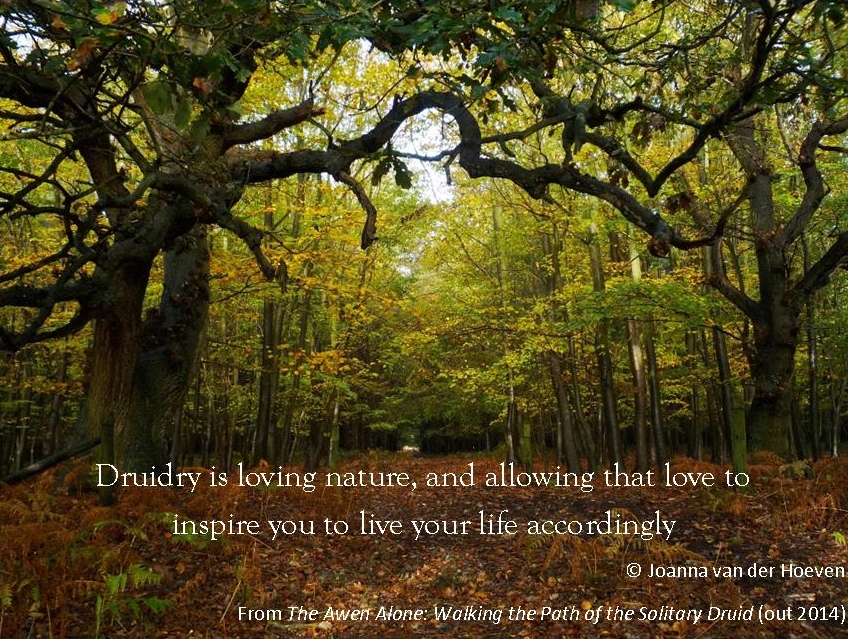
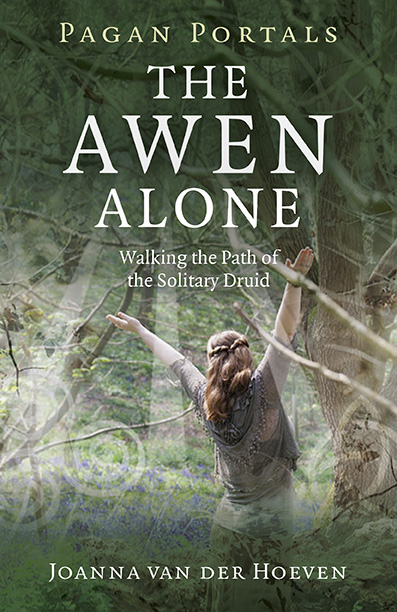
The Awen Alone Joanna van der Hoeven

My latest book, The Awen Alone: Walking the Path of the Solitary Druid has broken through another sales barrier last month – I am really pleased and very grateful for the warm reception that this book has received! I am currently working on a new book at the moment, diving in and getting stuck into a much more in-depth piece of work entitled Druid: Priest of Nature.   I hope to have finished writing this one by this time next year – wish me luck!

Working with the Gods

Working with the gods in Druidry is perhaps one of the most intense, exhilarating and powerful experiences we can have. Why is this?

To work with the gods, we require utmost honesty and truth. If we are to open our souls to the gods, and see theirs in return, we have to be utterly aware of who and what we are, baring all without the masks of self-protection, negation, pride or any number of human foibles. It comes close to the Wiccan saying of “in perfect love and perfect trust”, yet I would simply change the word “trust” to “honesty” here.

Trusting a god of nature may not always be a wise thing to do. Gods of nature do not always have our best interests at heart. Gods of nature are there to express their soul song, whether that be in the gift of nourishing herbs and berries or the destruction of a hurricane. I don’t necessarily put my trust in an oncoming storm, but I am willing to be utterly open and honest with it. The same could be said of any interaction or relationship. Trust is an odd thing, an investment in the behaviour of others of which we have no control. I’d rather focus on being open and honest in my relationships with the gods, with the humans and other animals around me, with the tree and stone folk. They do not necessarily require my trust, but by working and being truthful and honest, a deeper and more meaningful relationship is established.

Over the last few years I have worked deeply with Brighid. She came to me at Imbolc three years ago, as a goddess of these British Isles. She was the land itself, not a goddess “of the land”. It’s difficult to describe the difference, but in the bones of the earth beneath my feet I see her solid foundation. In the energy that rises and falls with the seasons I see her own tides rising and falling. In the air that moves across this land I feel her breath, sometimes filled with the scents of the sea less than a mile away, sometimes with the rich earthy scent of the heathland. The rain that falls is filled with her blessings, the sun that shines filled with her joy and nourishment. She works to her own cycles, and I must learn to work with her.

She is not always giving, she is not always nourishing. She asks that we stand on our own two feet and have the courage to help ourselves. She blesses my garden with her light, but she does not do it for me – I have to work with that, for sometimes it can be too strong, and I must balance it with the water caught in my rain barrels from her previous storms. I have to learn to dance with her, to follow her rhythms and movements with respect. I have to listen, deeply, to the music that is the great song, the Oran Mòr. From that deep listening comes an understanding and inspiration, the awen that is sought after and the heart of Druidry.

I cannot deceive my gods. Not because they are omnipotent, but rather the relationship wouldn’t work, wouldn’t flow smoothly if I was anything other than open and honest with them, about myself, about my relationship with the world. I wouldn’t be deceiving them, but deceiving myself by trying to hide behind facades. There is no room for growth, for change, unless we make room by letting go of certain things. We must empty our cup for it to be filled.

When we are open and honest with the gods, their wisdom and energy can flood through us, helping us to understand our place in the world, how we can work in the world in balance and harmony. This is an exquisite gift, an exchange of energy that we see reflected in nature all around us, yet which seems so out of reach for us so often. The mere simplicity of it all is what makes it the greatest challenge, for it requires us to throw away all the dross, to change our own mindset and see the world with a new perception that may or may not support our current view. To change our view of the world can turn it upside-down, can shake our foundations down to the ground. However, sometimes this is necessary in order to rebuild a stronger foundation, with clear perception, un-muddied by our habitual thinking.

Years have passed and still I am only beginning to learn this wonderful new dance with my goddess. She is teaching me new steps, new movements, new music. With an open heart I am willing to learn, to give it my best, and above all, to enjoy every single moment of it.

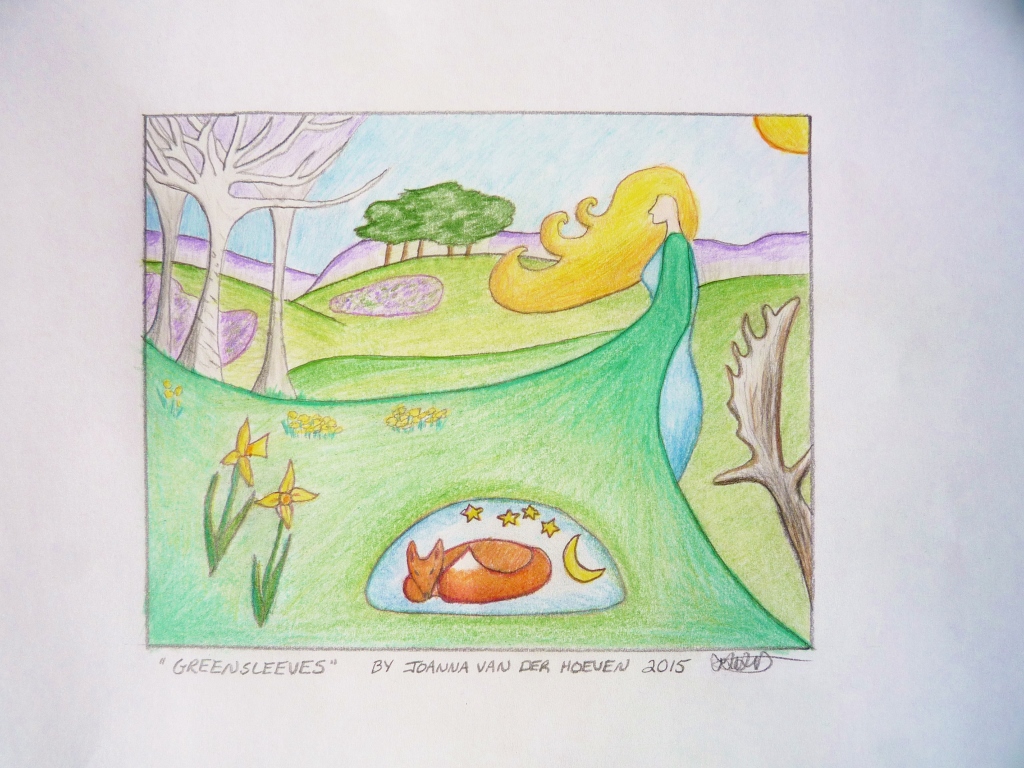
Greensleeves

Thought it was past time I got the coloured pencils out again, and here is the outcome. I think there is still work to do on it, but that can wait until tomorrow.  Here is “Greensleeves”. 🙂

"Greensleeves" © Joanna van der Hoeven 2015

“Greensleeves” © Joanna van der Hoeven 2015

Love

Many of us have heard the saying “Love means never having to say you’re sorry”. Like all sayings, they can be misinterpreted. Love is one of the most powerful gods. Love is so much more than romance, than warm fuzzy feelings for another. Love can be an unshakeable force, it can inspire us to greatness or tear us apart.

Never having to say sorry with regards to love has been misused by many as an excuse to behave badly, to not care about the feelings of others, to live in a purely self-centred state. It is also often implied that if we really love someone we should always be willing to forgive their behaviour. In Buddhism, it is widely regarded that we are all Buddhas, that we all have the ability for true compassion. However, we are also all human, with all the wonderful implications, limitations and foibles that it entails.

We have all known people whose behaviour has been less than glowing, who are so entrapped in their own worlds and minds that they often create a reality which is completely and utterly different to the one that you may experience. As humans, we have a shared reality and shared human experience, but as beings that are supposedly self-aware we become trapped in this self-awareness to the point of it spilling over into less than glowing behaviour. Love accepts the humanity of everyone. Love accepts reality. Love is compassion.

Compassion, however, doesn’t mean we have to take everyone’s crap. Compassion is understanding, trying to see the bigger picture, to understand why someone behaves the way that they do. In this attempt, we step outside of our “small selves” and out into a greater reality. We open up our perception. We may never truly understand, but at least in the attempt we see that the world is more than just our experience, our perceived reality. We recognise the experience and reality of others.

When that reality hurts us, when people do or say things to undermine us for whatever reason, should we simply forgive and move on? I’m not entirely sure it’s within human capacity to truly forgive, though people like Zen monk Thich Nhat Hanh are real-life inspirations for this way of being. We may find that the hardest person to forgive is ourselves. Perhaps we need to focus less on “us” forgiving “them” and simply focus on living our own lives in way that means that we will never have to say “I’m sorry” to another. This, in my opinion, is the real interpretation of the saying “Love means never having to say I’m sorry”.

We may fail, and there is nothing wrong with saying “I’m sorry”, however.

When we come against people we simply cannot be with, we can still try to understand them, to look beyond our self. It can often put us into the bigger picture, allowing more of a peripheral vision of the world that encompasses everything and in doing so, allowing the self to fall away in integrated living. Sometimes we simply have to walk away from that relationship in order to work compassionately with our selves, for we simply suffer too much at that given time to be able to function properly. We can do this with partners we’ve been romantically involved with – when it no longer works, we can bow to each other and walk away with respect, and hopefully a little compassion for both them and ourselves.

What we have to focus on most though is our own life, and our own behaviour. We have to live our lives in a way that means we will hopefully never have to apologise for our behaviour. It’s not an easy path, but it’s one that is worthwhile. In doing so, we will walk lightly upon the earth, loving the earth with every fibre of our being, loving everything on the earth with eyes wide open and a heart filled with compassion. We can love life, the power of the gods moving through us and around us, and live our lives in celebration of this.

As the first snowdrops bloom here in the UK, and the songs of the birds change to love of each other, of the warming sun and the greening of the land, may our hearts too be filled with love.

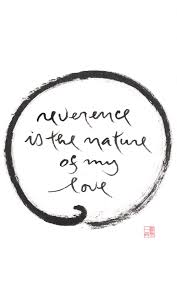
reverence

Exciting News – Druid College UK is born!

After months of planning and preparation, Druid College UK is born! Working with our sister college in Maine USA, the Druid College is dedicated to Earth-centered spirituality, to the integrity of our natural home, and to the crafting of sacred relationship. In short, The Druid College devotes its presence—and it is its sole intent—to prepare priests of Nature.

Foundations for this life-long journey are established by a three-year, intensive study. Unlike contemporary universities, Druid studies are furthered not only by personal reflection but primarily by ongoing personal connection and spiritual guidance of (i.e., apprenticeship to) a Druid Priest. In the UK as of 2015, those people are Joanna van der Hoeven and Robin Herne.

Being a priest of nature does not mean being an intermediary, but instead living a life in service, crafting a sacred relationship with the land, the ancestors and the gods. It requires service to the community as well as the land, wherein the priest acts as guide, witness or celebrant to a journey or journeys of crafting sacred relationship.

There are many Druid Orders and other pagan and earth-based organizations that offer solid training within their respective traditions. The Druid College is for those who wish to journey further. We wish to work with those who want to be ‘carriers’ of Nature-based spirituality – as compared to ‘followers’. We saw a need for a programme for people who desire to go deeper, for those who wish to be in service, to fill the role of priest for their community and the land they dwell in.

The College accepts as first-year apprentices people of all walks and intent. The focus for the first year is on the fundamentals of Druidry and reweaving our personal connection to Earth and to our ancestors and heritage. Commitment to the full programme is not required in order to join in the first year of training.

Our second year training is reserved for those who desire to continue their journey into the priesthood, to step into the role of priests of Nature, to serve the land and its people. Our programme is one of preparing people to be in service, such as prison ministry, working with the dying, or being a priest of the land, offering healing where there is desecration.

The nature of year three is that of being in the role as priests. We envision this year as one of walking the path and sharing those activities with the staff and other apprentices, learning from each other, acknowledging the work, declaring your “Chair” and manifesting it locally.

The Druid College is not an accredited college and offers no degree programme.

For full information, see the Druid College website HERE.

Programme overview:

Year One of the Apprenticeship

“Reweaving the Broken Connection to the Land”

Year one studies include:

Core principles and teachings of Druidry, Living with Honour, Grounding, Working with the Ancestors, Animism and the Spirits of Place, Listening and Druid meditation, Awen and the cycle of creativity, Working with the Nemeton, Developing Authentic Relationship, Inspiration and the Poetic arts, Storytelling and cultural heritage, The Cycle of Life and the “Wheel of the Year”, Working with the Gods/Deity, Anarchism and the end of Submission, Emotions and “riding the energies”

Year Two of the Apprenticeship

“Training in the Crafts of Shapeshifting, Healing, and in the Arts of Transformation”

Year two studies include:

The Awakened Life; Ritual Trance Induction, Crafting Sacred Ritual; Healing; Prophecy and the Seer; Defining what is meant by Applied Inspiration in Service; Ethical Leadership; Bridge-building as Peacework; Justice and Permaculture; Philosophy; Nature and Relationship to Consumption; Preparations for Declaring your “Chair”

Year Three: Practicum

Declaring your “Chair” and manifesting it locally

Purposeful Sharing in Community

Applied Trancing as Priestly Evolution

Training to Lead Ecstatic Ritual

Two large gatherings of the entire College

Possible ritual of Ordination

The Teenage Druid

Taken from my latest blog post at at Druid Heart on SageWoman’s channel at Witches and Pagans…

10361054_598064806967174_1548976491936707739_nWhen people think of Druids, the image that often comes to mind is not that of a young person, a teenager perhaps. And yet, how many young Druids are there out there, waiting to be recognised? How many teenagers feel the call to live in balance and harmony, with a deep love and respect for the natural world, and a great desire to live with honour and integrity based upon those very same things? Quite a few, I’m sure. I was one of them.

A lot of Druid organisations, groves and orders will not accept members under 18 years of age. This can leave the younger, aspiring Druid twisting in the wind, so to speak. Where should they turn to for information, for advice? Real life teachers are hard to come by. If they are available, many do not wish to teach the under 18s for various reasons. Younger people as well have all sorts of limitations. How can they find the right path for them with their limited means? Finances, access to resources, time – all of these can be very tight for the younger person who also has to deal with the pressures of school, clubs, family obligations and so on.

Most Druids first turn to books to learn more about Druidry. It is a great way to gain a good basic understanding of what Druids do, when they do it and how they go about it. However, they do not actually make the Druid. Books are getting more and more expensive as well, and may not be affordable to the younger person. So what can they do when they can’t afford all the lovely, shiny new books available on the market today?

My advice would be to go to the library. Research, if you have the time after your ordinary school work, to look up everything that you can about the Celts. This may sound more like a history lesson that actually learning Druidry, but the Druid worldview is based upon the Celtic worldview – they cannot be separated. Druidry grew out of Celtic culture and society, therefore to understand Celtic culture and society is to understand, to a certain extent, the world of the Druid.

Most libraries don’t have a great Pagan section. Let’s face it, even today a lot of libraries consider Paganism to still be a part of the “dark arts”, something of the occult. I remember in my local library in Canada, the only books on paganism that were available were two books, one called something like “The Occult” and the second all about Gardnerian Witchcraft. It gave me a tiny flavour of modern Paganism, but still it was far off the mark from what I practice today.

However, though the stock in the library can be scarce when it comes to Pagan, and specifically Druid books, it doesn’t hurt to try and ask them to order it in for you. Often, Druid books have very non-threatening titles which may pass under the radar of even the most vigilant anti-Pagan librarian.

Book learning is just one aspect of learning, however. Information is gained from books, wisdom is gained from doing stuff. Druidry is not a passive way of being. It asks us to be fully present in the moment, connected to nature and the world in order to better understand our place in it, and to live in balance and harmony. That is something that cannot just be thought about. So how does the young Druid go about this aspect of Druid learning?

The very first, and most important thing is just to go outside. Be in nature. Get to know nature, and let it get to know you. Watch the sun rise and set. Watch the moon rise and set. Notice the animals in your area. Record what they are doing – find out all that you can about their behaviour. Learn the names of plants and stones. Feel the rain upon your face. Sit under the light of the full moon. Walk in the forest silently, listening to nature around you. Look up to the sky and learn the names of the constellations. Some of these may be more difficult for the aspiring urban Druid, but you can still persevere.

Learn how to meditate. Again, the library will come in handy for this, and it’s free. There are loads of videos on Youtube on how to meditate – I love Zen meditation, otherwise known as mindfulness meditation. My favourite teacher is Thich Nhat Hanh

Likewise, there are videos on Youtube about Druidry. Even a Beginner’s Guide in several parts. Do a Youtube search on popular Druids, such as Emma Restall Orr or Phillip Carr-Gomm – they will turn up some great stuff. Also, Google articles by the people whose books you can’t afford or obtain – there is a LOT of info available for free on the internet. The Order of Bards, Ovates and Druids have a regular podcast, called Druidcast, which has music, interviews and features every month. The American ADF also have a great podcast. The Druid Network is where I got my start in all things Druid – access to all the articles is free. There are hours upon hours of information there – waiting to be used practically, to be turned into wisdom.

As some point you may want to take some online courses, again if schoolwork allows. A lot of Druid courses cost money, and rightfully so – there are a lot of materials and time that have gone into the preparation of these. However, most teenagers cannot afford the cost of these courses, or do not meet the over 18 requirement. So what to do?

Again, head over to the Druid Network. There are free online courses available there, with no age limit. I particularly recommend Emma Restall Orr’s A Perennial Course in Living Druidry. Robin Herne’s Polytheistic Druidry course is also available. You can even read Emma Restall Orr’s first book, Principles of Druidry, online.

Another piece of advice I would give to the young, aspiring Druid is this: do not become despondent when you find that many, many people base your wisdom upon your age. Especially on internet forums, but almost equally so in real life. So many older people seem to think that wisdom and intelligence is based up on the number of years you have spent upon this planet – this is, in my opinion, complete bollocks. I have known wise children and stupid adults aplenty in my lifetime. Please, please, please do not despair, do not give up. Continue to seek out your Druidry, continue to ask questions, to learn more. If anyone makes you feel stupid for asking, or dismissed you based upon your age, well, quite frankly, they’re not worth knowing.

Keep at it, and do not become discouraged at the lack of training for under 18s. If you love nature, if you feel deep in your blood and bones the rhythms of the earth, the call of the Goddess, the pull of the land, sea and sky within your soul then nothing can stop you starting on your path. Indeed, you have already started.