Reblog: Lammas, Don’t Fear the Reaper

This is a reblog from my channel at SageWoman for Witches and Pagans at PaganSquare. To read the full article, click HERE.

The grain harvest is being collected in the fields around my home. The usually still and silent evening air is filled with the sound of combine harvesters, accentuated every now and then with the hoot of a tawny owl. Lammas is upon us.

Standing on a footpath that divides two large fields, one side filled with barley just reaped, the other with wheat standing pale golden in the sun, I raise my hands to the blue sky and give my thanks for all that nourishes us. I walk a ways into the cut field, the harsh stubs of barley amid the dry, sandy earth and place my hands upon the soil. Thank you for your blessing, may the land be nourished even as it nourishes us. Hail and thanks be to the goddess. I then move to stand on the edge of the wheat field, allowing its song of potential to flow through me. I brush the bent heads filled with seed and say another prayer of thanks.

This is a wonderful time of year, when the songs of the ancestors flow through the rural heartlands of Britain. Though the way we harvest is different, still there is that cycle of growth, of planting and harvesting. After the long hot days of midsummer, the lengthening evenings are welcome, bringing cooler air. Though the dog days may still lie ahead of us, there is something different in the air at this time of year. The scents have changed, the leaves are dark green and heavy, the foliage beginning to choke out and fall back.

I love this time of year. The birds have fledged, and the muntjac deer are at the end of their mating season. The stag barks occasionally for his hind on the other side of the hedge, and this year’s badger family come to visit every night to eat the fallen birdseed from our table and the peanuts that we put out. The sidhe are active at their special spots, over by the burial mound as they are at each of the fire festivals. It is a time of celebration, though there is still much work to be done…

Continue to the full article HERE

Book reviews: *A Legacy of Druids* and *Fairycraft*

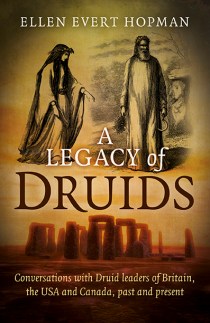
A-Legacy-of-Druids-coverA Legacy of Druids by Ellen Evert Hopman is a capsule held in time, with interviews by Druids from all over the world that were taken twenty years ago. It is interesting to hear their stories, especially from those people I know now, and whose perceptions have changed with the passage of time.

It’s not a book on how to be a Druid, but rather a conversation with an entire room full of them. You get to “work the room” so to speak in this volume, finding so many different personalities, histories and visions for the future. The foreward by Philip Carr-Gomm was perhaps the most interesting for me, and which coincided with my perception of Druidry as it is today. That this should be so is obvious; as a nature-based tradition, Druidry is always evolving, and here was have the proof that this is so.

Dynamics, schisms, traits, perspectives of different Druid traditions, with a lot of American vs British is reflected in the interviewees’ words. That these perceptions and their individual predictions for the future have changed over the last twenty years is, I think, a very good thing. With the popularity of the internet, dialogue has opened across vast oceans, with views being shared, references, academia, experiential gnosis and more. The divide between the two has lessened greatly, to the benefit of all.

Of course, I did not agree or resonate with the words of every Druid (or Druid friendly person) interviewed. Like being at a party, there are some people you want to hang out with and others that you don’t. But all of it is informative, in its raw, unedited state. You get real flavour of who that person was at that time, and what Druidry meant to them at that particular point in time.

A very interesting, and original work. I would love to see a modern version of this done, with as many of the same people in the original work, as well as new voices!

fairycraftI thoroughly enjoyed Morgan Daimler’s Fairycraft. This book is the follow-up to her Pagan Portals Fairy Witchcraft, and goes into deeper depth for this particular practice.

This book is extremely well-researched, and contains as well as a plethora of information, the author’s own experiences in the tradition. This down to earth practicality is what sets this book apart from others on the subject. It is divided into many sections, each with their own sub-section detailing the matter fully and capably. Not only do you learn fairy lore and customs, but this book also provides you with rituals and rites, prayers and holiday suggestions suited to one who wishes to honour or develop a deepening relationship with the fey, the sidhe, the gods and the ancestors.

Daimler’s writing is sincere and succinct, not overly flowery and not trying to impress, but rather expressing honestly what she has learned through her many years of experience in the tradition. I especially enjoyed the final portion of the book, entitled “Living Witchcraft”, for it gave me a deeper insight into the tradition and its practicalities, and also the author herself. I’ve enjoyed all of Daimler’s works, and look forward to reading more.

Lammas/Lughnasadh blessings!

Blessings of the harvest to you all. x

lammas wendy andrews

Painting by Wendy Andrews: http://www.paintingdreams.co.uk

New Patreon Page!

16Hiya! I’ve just started a Patreon Page, where people can support me and help fund new projects that I have on the go. As you can see from my previous blog post, I’ve got a new video series on Druid Ritual Tools, as well as the other videos for Down the Forest Path Video blog. The original Down the Forest Path blog has been going for a few years now, and I’ve had so many wonderful emails and messages from the readers. If you can support me on my Patreon page as well, that would be wonderful!

It’s getting harder and harder to be a successful writer/artist/insert alternative occupation here/ these days, and any patronage is always welcome. I love blogging, both written and video, but it does take time away from writing my books, both on Druidry and also the fantasy fiction that I am currently working on. If you can spare it, I’d greatly welcome your support, either financially or just keep sending the good vibes and messages here!

I’ve met the most wonderful people here, and truly appreciate all of my readers who take the time out of their day to come and visit me here and on my video blog, or who read my books.  May we be the awen, one and all!

To see my Patreon Page, and the projects that I am currently working on, click HERE.

Druid Ritual Tools: Cup, Cauldron and Bowl

Here is the second installment in my Druid Ritual Tools series for Down the Forest Path Video Blog: the cup, cauldron and bowl. I hope you enjoy!

Review: Zen for Druids

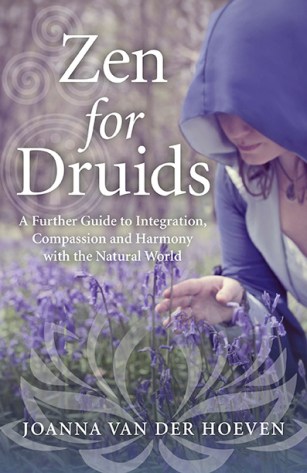
Here is a review by Maria Ede-Weaving on Philip Carr-Gomm’s blog for my upcoming book, Zen for Druids: A Further Guide to Integration, Compassion and Harmony with the Natural World (due out this October, and now available for pre-order). Thank you, Maria, for your lovely words!

Zen for Druids front coverI am a massive fan of Joanna van der Hoeven’s books. They are wonderfully accessible whilst still conveying a depth and clarity that helps the reader to really connect with the wisdom of the subject. Her latest offering does just that. ‘Zen For Druids’ is a companion to her earlier work ‘Zen Druidry, exploring Zen Buddhism and Druidry by illustrating how these spiritual paths can complement one another in practice.

The book is written in five parts. The first explores Druidry and the Dharma giving an excellent overview of Buddhism’s Three Treasures; The Four Noble Truths; The Five Precepts; The Eightfold Path and The Sixteen Bodhisattva Precepts and how these relate to Druid philosophy.

The second part takes us through the Pagan Wheel of the Year and how Zen Buddhism can enrich the understanding and honouring of these festivals. Joanna includes some really useful tips at the end of each festival section, with ideas to deepen your experience of each.

Part three focuses on Meditation; part four on Mindfulness and part five on Integration, each section helping to both explain the underlying spiritual meaning of these practices whilst giving practical advice, exercises and encouragement. I particularly enjoyed the section on Integration where the author writes beautifully about Awen and Relationship as a connecting, compassionate force that reveals the interconnectedness of life.

In her chapter on Ego, Self and Identity the author tackles the thorny issue of the Ego. In many spiritual texts, the Ego can so easily be labelled the ‘bad guy’ but Joanna skilfully explores the difference between Representational Ego and Functional Ego, redeeming the Ego’s useful functions whilst suggesting a compassionate approach to its more challenging aspects.

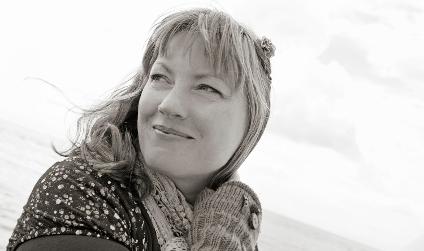
Joanna van der Hoeven

The concepts in this book take some thoughtful pondering but the beauty of Joanna’s writing is that it cracks open what initially appear to be very complex ideas and gets straight to the heart of each. Obviously the real work is in the dedicated practice of a spiritual path but Zen For Druids offers a wonderful foundation to build upon. In every page you can sense that the author has learned these insights through experience, that she really understands and lives these principles from a place of deep heart-knowing. We move from a purely intellectual grasping of a subject to this heart-led living of a spiritual path through the constant connection and exploration of that path; Joanna van der Hoeven’s fabulous book is both an inspiring and deeply practical aid to help you on that journey.

I highly recommend this book. It is proof of how seemingly different spiritualities can enrich each other, and for those of us who are drawn to both western and eastern paths, it’s a real gem!

Zen For Druids is now available on Moon Books for pre-order. 

Interview on A Kitchen Witch’s Blog

Kitchen Witch BlogI was recently interviewed by Rachel Patterson of the Kitchen Witch School of Natural Witchery – you can read the entire interview by clicking HERE.

Reblog: Anarchy and the End of Submission

Here is a reblog of my latest post on my channel at SageWoman Magazine for Witches and Pagans. To see the original post, clicke HERE.

Following an earth-based tradition such as Druidry is wonderfully empowering, and also beneficent to the whole, if we move beyond our self-centredness and work towards a life in service to our environment, the gods, the ancestors, the spirits of place. With such a tradition, there is no requirement for a belief in anything. There is no supernatural. There is only nature, glorious nature, right in front of our eyes. What we see, what we interpret with our senses, requires no belief, only a willingness to experience, to learn, to think and to create truly deep, inspiring relationships.

This sort of tradition, this sort of thinking, means that Druidry is different for each individual. What that also means is that we accept the experience of others within the tradition, and there is no right or wrong, per se, only interpretation and experience. There is no liturgy within Druidry. Yet we find it rooted in a landscape and in a culture, to which we can honour and learn from while making it work for us in an individual sense. Coming from a standpoint of no agreed standpoint, this can seem confusing and bewildering to some in the Druid tradition, and a source of great freedom for others.

The gods in Druidry are the gods of nature, both the natural world and of human nature (and beyond). They are forces of nature that without due respect, can kill, injure or destroy. Love, lust, rain, storm, wind, sun, snow, ice, war, birth, death: all of these are gods. Yet they are not gods to whom we bow down in some religious hierarchy. The gods of nature are those that we work with, together, in order to function properly in an ecosystem. There is no hierarchy in nature either; the concept of a food chain is a purely human invention to make humans feel superior, and therefore able to exploit, all life forms beneath them. The shark that swims with you in the ocean has another point of view on this so-called food chain. So does the flesh-eating virus, or the wildfire.

If we believe in some hierarchy, then we need to submit to an authority. The Druid knows that there is no authority in some uber-being above us. There are only the forces of nature that we work with, that we create relationship with, which we try to understand so that we may move through life in greater awareness and with more ease. If we submit to the forces of nature, we will perish. If we submit to the ocean, as my teacher Bobcat used to say, we will drown. There is no room for this sort of attitude within Druidry. It’s all about relationship.

Do the gods care for us? I have no idea. I’ve argued the case on both sides, and come to realise this year that I just don’t know anymore. And in that not knowing is glorious freedom. All I do know is that the rain falls, the sun shines, the moon orbit around the earth and pulls the seas with its circuit. Do any of these care? Does it matter if they do, or if they don’t? If it doesn’t matter, if we don’t need them to care, then we can just get on with the basic act of living. If we need them to care, then are we are searching for something outside of ourselves, for some sort of assurance that everything will be alright? As if seeking some form of parental nourishment, we may want someone to hold us, to take our hand, to fight the bad things and take them away. Or are we simply working with another force that has a holistic worldview, one that we aspire to, and seeks to work with us to create such a world? To give it yet another perspective, we might also want an authority to tell us what to do. In this regard, at least, the Druid knows differently.

We might pray or talk to the gods in order to try to understand a situation, but we know that they aren’t going to solve all our problems for us. We might work with the powers of earth, air, fire and water, or the realms of land, sea and sky to find out how we can re-enchant our lives with deeper meaning, but in the end how we live our lives is where the real magic and power of transformation lies, not with some external authority. Even if there is a benevolent source or deity watching after us, who cares about humanity, we can still do all that we can to make our own lives better with our own skills and experience first and foremost. We cannot leave it all up to some external force outside ourselves, for in doing so we release all sense of accountability and responsibility for our actions. We certainly don’t need more of that in the world today.

Anarchy is often seen as chaos, as a lack of organisation or structure. When we apply it to deep relationship with the world around us, however, the very basis of that relationship transforms the word into liberation from illusion. No longer are we held back by believing in a superior force, whether it is deity, the government or your boss at work. Instead, through real relationship we see how we work and live with these to create an ecosystem that is hopefully functional and sustainable. We do not seek authority in anything, but co-operation. Nature is our greatest teacher, and one to be respected, but not something to submit to in any sense.

We have to look to our own self-governance, governance of our very own self. We have to take personal responsibility for our actions, our thoughts, our words and our deeds. When we become aware of these things, we can then extend that self-governance to see how we can work in our own ecosystems without a hierarchal sense of authority, without judgement or power struggles. But we must first come to be at ease with our selves, to loosen the constraints of our own egos before we take it out into the wider world. Otherwise everything will still be about an assumed power, or level of authority that is not/cannot be questioned. We must question everything, first about ourselves, our beliefs, our attitudes, our lives and then about the rest of the world. In this, we become active members of an ecosystem, rather than passive passengers simply along for the ride. We work in co-operation with all other beings, for the benefit of the whole.

Anarchy requires us to think.

We may require or be in a position of leadership from time to time, and we understand that leadership is not equated to hierarchy. The flock of starlings move together, seeming as one, based upon the actions of one individual starling, dancing their mesmerising dance across the sky, showing off their skill, practicing their acrobatics against predation, revelling in the joy of being alive. The flock of geese is led by an individual at the front of the formation, but this position of leadership is always changing, allowing rest and an opportunity for others to take the lead. Where one goose becomes ill or injured, others will drop out of the flock to stay behind with it, until it either recovers or dies, and then re-join the flock as soon as it can. This is leadership without hierarchy, without authority. It is doing what needs to be done, without the games of power and control.

We know that not all sources of perceived power in this world share the same moral or ethical framework as we do. But if we take personal responsibility for our own selves, we can work for change and transformation on a personal and fundamental level over which we have absolute control. I will reiterate: personal responsibility. Not as a nation, not as a race, not as a species. We cannot dictate to others one way to do things, that our way is right, but rather accept responsibility for our own individual actions, our own time on this planet. We cannot simply follow unquestioningly what others say and do, think or behave, because we are intelligent, free-thinking individuals. There is no one way to do things, no one authority that we must submit to, no “one size fits all”. We honour the soul of every creature that we meet, and in doing so we also deeply learn the real value of co-operation, being active rather than passive. We learn to listen, to work with others, the art of compassion. We understand that cultural and societal influences may differ with regards to ethics and morality, and all that we can do is to work on being the best that we can personally be, living our truth and letting that be the example that needs to be set in the world today. Over that, and that only, do we have control.

Therein lies the true power of anarchy, and the end of submission.

The Return

So today it is Canada Day, where back home everyone is celebrating their happiness in a country that is working towards a better future for all, under the leadership of a sincere and honest politician. (Yes, they do exist). Yesterday in my little village here on the edge of England, looking out over the North Sea towards Europe, someone had written racist slogans on the traffic signs and one For Sale sign. I stand on the shingle beach and weep for what has happened to this country.

And yet, Brighid, Brigantia, the goddess that is this land by whatever name, does she care? The wheat is still growing in the fields, the deer still bounding across the heath, the magpies chittering in the garden. The troubles of humanity, I wonder: do they affect her as well? When we finally manage to wipe ourselves off the planet, she will go on, regardless…

I return to my garden, and sit at my altar beneath the beech tree, the dryad spirit singing softly to me, reminding me to listen. And so I listen, to the wind through the leaves, to the blackbird singing, the chickens squawking down the road. I listen to the hum of the earth, the heartbeat of my lady. I release my fear, my anguish through my tears even as the rain falls, washing my face with its song. And I return to this place, to the songs all around me that are not the songs of humanity. I remember that I am part of a much bigger web.

My lady grabs me by the hand and whooshes me across this country, riding the dragon lines of her energy. I am at Avebury, where a ritual for peace is being held. I am at a lonely stone circle in Dartmoor, the heavy slate skies and thunder booming overhead. I am at the edge of Loch Lomond in Scotland, with the fey crowding all around me. I am at the edge of the Atlantic on the coast of Ireland, the waves crashing against the rocks.

I am then taken deep below the ground, through the sand and silt, through layers of rock. I am in the deepest darkness, where the hum and heartbeat of this little planet hurtling through space is strongest. And then suddenly I am thrown out into the sky, riding the winds and lost in perfect freedom. I am diving deep into the realm of the sea, where the songs of whales guide me towards peace.

And I am back in my garden, my breath coming hard, my eyes snapping open.

I am more than my species. I am more than my gender. I am more than my nationality. I am more than my politics.

And my lady smiles.

Communication Breakdown: The EU Referendum

We need to change the way we communicate. Right now. Here in the UK, everyone is reacting to other people’s reactions, in an insane run of events that has led to unprecedented turmoil and upset. People aren’t talking to each other. Germany refuses to talk to the UK parliament until they begin the leave negotiations. Labour ministers refuse to talk to their leader about the best way forward. The Prime Minister is resigning, leaving the talking to whoever takes up the difficult role. Friends are attacking and “unfriending” each other all over social media. This sort of behaviour is based in punishment: an eye for an eye. We have been hurt, we will hurt in response. We are emotional creatures.With the lines of communication closed, we are stuck here in limbo, everyone reacting instead of acting with intention. Reactive behaviour is, for the most part, usually not the best behaviour.

Emotional responsibility is something that is seriously lacking in our society. In fact, any responsibility is met with apprehension, especially personal responsibility. Far too many are eager to find power under the guise of responsibility for others, but when it comes to perhaps changing their own behaviour they will never even consider it. It’s everyone else’s fault, people are stupid, people are ignorant. We will not even talk about changing our own behaviour, lest we admit to something that needs improvement. Sure, we’ll criticise the hell out of others, for don’t we see that every day in the media, from television entertainment shows to the PM’s questions every Wednesday lunchtime? And yet, where is the real communication?

If we are emotionally responsible, we won’t simply unfriend someone on Facebook because they didn’t vote the same way we did. So what if a friend voted for Leave? So what if a Remainer said something stupid in response? They are reacting. We can stop, see their pain, see their fear, try to see why they are reacting in such a way. In that stopping, in that attempt to understand, there is compassion. And where there is compassion, hopefully the lines of communication can reopen, and respectful behaviour ensue. Hopefully then, we are acting with intention, not in reaction.

Sometimes it just isn’t possible, and I understand that. Sometimes someone hurts us so bad, has just been so horrid that we will simply not put ourselves in that position ever again. This is something that has usually happened over a longer period of time, where the behaviour has been repeated again and again. We give them a second chance. And maybe a third. And then, if there is no value, if there is no respect, if there is no honour then we can walk away, in peace. And wishing them peace. But if walking away in anger, without first trying to establish the lines of communication: if this is the first and only thing we do, then there is very little chance of reconciliation, of compassion, of communication. Maybe we just have to accept that humans will be humans, that they will do and say stupid things, that they have opinions, both good and bad, and we will also have ours, good and bad, stupid and brilliant. But if we stop talking to them, we lose all chance of hope for a future together.

There is so much divisiveness right now, in this so-called United Kingdom. There has been blood shed, a life lost, and more death threats to others because of fear, because of lack of communication, because of ignorance, because of poor communication, because of misinformation and manipulation. There is a growing blatant and overt racism and prejudice, fuelled by ignorance, by fear. If we are talking to each other, then maybe this can be overcome. Where we are no longer talking, there is no hope for change.

We need to change the way we communicate. Right now.