So, I’m going to try out something a little different on this blog, and every Friday try to post a great new food recipe. I’m trying out loads of new quick and easy vegan food recipes, and will post the best ones up here on a Friday Foodie section! Something a little light-hearted – and please share your recipes too! (Vegan or vegetarian).
Recipe for Jo’s Spicy Vegan Bean Burgers:
Fry off an onion, half a grated carrot and half a red pepper in some oil
Chop into chunks and boil a sweet potato and the other half of the carrot
Heat up a can of kidney beans so that you can mash them
Mash the boiled sweet potato and carrot with the beans
Add the fried onion and carrot
Add as much fresh chopped or dried chili as you like
Add salt and pepper to taste
Add 100g of bread crumbs and about 3/4 cup of flour
Work with hands and make into patties, then pop in fridge for about half hour
Fry up (about 5 mins either side) and serve with salsa, or Jo’s easy quacamole (mash an avocado with some egg-free mayonaise)
Makes about 4 enormous burgers, or six normal size…
We are still taking bookings for The Little Pagan Monastery – if you would like to try a weekend away dedicated to the spiritual, and finding ways of incorporating that into your everyday life, then this may be just the thing! Set within the beautiful grounds of one of England’s most holy sites, Chalice Well Gardens, let this weekend inspire you!
I’ve recently watched Dan Snow’s latest expedition, to travel down the Colorado River through the Grand Canyon in three boats from the late 19th century, just as Powell did. It was a really interesting show (not just because of the equally gorgeous and intelligent Mr Snow) that not only demonstrated the awesome power of the elements, but also those of human nature.
Each boat has three people in it – an experienced helmsman, an experienced boatman and a novice. The three novices were Dan, Mike (you may know him from Springwwatch) and another chap whose name eludes me – historian, ecologist and geologist respectively. They all had to work together as a team to see it through to the end – 18 days of incredible physical and mental challenge amidst one of the world’s most beautiful and dangerous environments.
Each person had to pull their own weight, despite their experience, and each person did so without fail. They all tried their hardest and it was inspiring to see. What was not so inspiring was another aspect of human nature that arose from one of the boats – namely, the blame game.
In one of the three boats, Mike was having a harder time than the other novices. Whether that was simply his lack of skill and learning, or insufficient support and teaching from his colleagues, is up for debate – we could not see everything that happened in this edited television show. What I did see however, was an aspect of human nature that really opened up my eyes not only to how other people treat each other, but how I’ve treated others in the past as well.
It started with the “expert whitewater kayaker” beginning to complain to the camera about Mike and his lack of ability. It would seem that instead of taking extra time to help the novice and support him, he would rather complain to the camera away from the group. He blamed Mike for the difficulty their boat was having in the rapids. However, what we all saw was at the first set of rapids, the kayaker falling out of his seat pretty much at the first bump. Whether this started off something in his mind that needed to help him save face, changing the focus from his own inability, mistake or accident, and blaming someone else for it we can never know for certain. It certainly appeared that way to me.
Since then, he complained on several occasions to the camera in isolation. Then his helmsman made a mistake, taking the boat down backwards in the hopes of having better steering in one section of rapids. The boat that went through before managed it. I’m not an experienced boatman, but I could see in those churning waters that the oar would snap like a twig if caught on a rock, which it did. After that, the helmsman began to complain to the camera as well about Mike, who was simply doing his best to row and keep the boat going straight and bail when he needed to – there really was nothing else he could do. At one point we saw the helmsman shout at Mike to bail, and Mike’s pail got caught up in part of the boat’s rigging – not that it would have mattered, for bailing in the middle of those rapids was, to me, pointless – the boat was already full at and the mercy of the river. Mike began bailing as fast as he could, but another wave just crashed right in. He would have been better off rowing, but he still got yelled at.
This all made me very uncomfortable. I hate seeing people getting picked on when they are trying their best. But I was also inspired by Dan’s boat, which seemed to have some sort of Zen Master at the helm. This chap was brilliant – he was so calm, so peaceful, never shouting orders and seeming at one with the river – when he took his boat down the rapids, he steered it down the path of least resistance, without effort. A beautiful thing to witness. Soft spoken and mild-mannered, and an accomplished musician, his calming influence was a gentle reminder to me to keep my Zen on and have compassion, even for those who were irritating the hell out of me on the show.
That’s not to say that the Zen Master Helmsman’s boat didn’t make any mistakes. His boat came the closest to capsizing in one of the most difficult rapids. They didn’t make the line they were going for down between the rocks, and got swept away down a fast sluice heading straight towards the canyon’s rock walls. His oar got ripped from his hands in the roiling water, and they were at the mercy of the river. The other helmsman would have shouted his head off at this point, but Zen Master Helmsman kept his cool – it was a beautiful thing to behold. He had lost his oar, all manner of steering, and the boat swept into the curve of the canyon (you can see it on the video). The boat kept to the curve, the water sweeping it close but not up against the canyon wall. Then the boat began to tip over on its right side. Dan lost his seat and fell into the right side wall, nearly out of the boat. ZMH calmly reached for the left side of the boat, push against it with his body weight, counterbalancing the tipping boat, and it righted itself. You can’t hear it on the video, but he was also calmly talking and encouraging his fellow crewman throughout, saying “Stay calm, just stay in the boat, take it easy”. They made it through, without yelling, without panic, without blame.
Everyone makes mistakes. With three people in a boat, you cannot blame one person for the boat going wrong. Everyone is in it, working together to try and go in the same direction. There are so many variables that to blame one person it pointless. Staying calm, looking out for your crew members and acting with compassion is the way forward. By observing this, the three simply followed the river’s flow. There was nothing else they could do, so why increase suffering?
Compassion is all about reducing your suffering. The two complainers in the other boat did not seem to grasp this. Instead of helping they made things worse. I hate to think what would have happened had it been their boat that nearly capsized. However, their boat did not escape unscathed of a terrifying experience.
On the next section of these last, and most dangerous rapids, Mike’s boat lost their helmsman as he was washed away in a giant wall of water that hit the boat. No one’s fault – you cannot blame crew or wave or river any more than you can blame the sun for shining. The helmsman managed to hang onto his oar under the water, and pull himself back to the boat, floating down the rest of the rapids with it, finally being pulled back into the boat at the first opportunity. This was the changing point for that crew.
The fragility of human existence hits hard when confronted with the very sudden realisation that you or someone you know could have died in a certain experience or circumstance. This realisation did indeed hit Mike hard, as we saw when the camera was on him when they were on the beach after these rapids – he was brought to tears by the whole experience. It also brought the crew together – the kayaker who originally tried to blame Mike for everything saw Mike’s suffering, and came up to give him a hug. Petty blame games mean nothing when you realise just how precious and precarious life really is. Alleviating suffering is much more conducive to peace than creating more suffering in this lifetime.
What I realised from this show is that blaming people does not solve anything. It does not even make you feel better – it increases your own suffering, because everything that person does upsets or annoys you from then on. Also, when you blame someone, you instantly block out any form of objectiveness in the situation. You have established a truth for yourself that blinds you to seeing the bigger picture. Believing in this truth is dangerous. Believing that one person is wrong and that you are right is what has caused innumerable amounts of suffering in the world. Opening your heart and mind in compassion, in trying to see the bigger picture and in trying to make the world a better place would be far more beneficial to all.
I looked back at the times in my life when I had played the blame game, making others the culprit for everything that had gone wrong. Like those boats in the river, there were so many variables that one person could not be responsible for everything. The only thing we can be responsible for is ourselves in this life. If we try to help others instead of break them down, if we see our own failings before we blame others, we might change our behaviour into something that is more compassionate.
Driving to the RSPCA today to visit a cat that I am adopting, I was cut off by a car speeding in a residential area. My reaction to it was simply to keep driving, and hope that the person in the speeding car finds peace within him or herself that could be reflected in their driving. Getting mad at the other driver would not solve anything except to make me suffer. (On the way home, I did see that they are now installing speed cameras along that stretch of road, for which I am glad).
We all make mistakes. We can blame others for what we perceive to have gone wrong with our lives. Or we can simply get on with making this world a better place, communicating with compassion towards everyone, even our enemies. We may then realise that we do not have enemies in the first place. We can even wallow in guilt, blaming ourselves for everything that has gone wrong instead of working out best to improve the situation – I know which I would rather engage with. We stand strong, we act responsibly – like ZMH we have the ability to respond to a crisis situation with calmness and grace, even when faced by enormous odds and potential life-threatening situations. We are all simply boats on a river, either working together or alone to stay afloat, at the mercy of the elements and each other.
I am taking a leaf out of Zen Master Helmsman’s book. He was a total dude.
I haven’t sung for a while now. Sometimes when you’re sad or grieving, your body and soul just don’t want to sing.
Thankfully, I have friends and family who have been wonderful, who make me laugh and cry with tears of laughter alongside my tears of unhappiness. Both forms of tears are equally valid, and equally necessary during the time that you grieve.
Having spent the last few weeks thinking about death, I felt that I could now share some ideas with you that I have had about it. I have been terribly upset at the loss of a very good friend, whom I will never see again. There is a hole in my life where she used to be, and I still find myself looking for her after all these weeks. Good friends are deeply treasured, and a true blessing.
Meditating upon the nature of death, I have come to the same realisation that Alanis Morrissette came to in her song, “Thank You”. At one point in the lyrics she states “How about not equating death with stopping”. I have taken comfort in these words over the last few decades, but never really considered them deeply within my own soul – they were a kind hand on my shoulder from someone who empathises. Now I see the totality of the statement, with a little insight from the Buddhist notion of impermanence and the Druid views of both awen and animism.
The Buddhist view of life is that everything is impermanent, therefore we should try to not cling to anything, even our sense of self, with too much energy. Looking closer at this idea, we see that we are constantly changing, in our ideas, our opinions, our way of life, and we are not the same person we were, say 10 years ago. On a more physical level, we are also constantly changing, sloughing off old skin, our hair growing, our bodies changing shape as we grow older. Clinging to one thing leads to suffering – if we simply accept that change is a part of life then our suffering will be reduced.
Meditating up on this over the last week, some core truths have sprung up for me that have helped with my suffering.
We are all made up of energy, energy that is in constant motion. This energy did not spring out into being – you cannot get something from nothing. This energy is in constant change and flux, according to the environment and circumstances it finds itself in. Therefore, a Zen koan suddenly made sense to me: “What was the face you wore, before you were born?”
I realised that had never been born. When we think of being born, we think of suddenly coming into being, but we have already been existing since the dawn of time. It is only our form that has changed with the millennia. Can we really pinpoint the time we were born, or created? Is creation when egg meets sperm? I am contained in the blood of my father’s fathers and my mother’s mothers as well – can there be a cut-off point? I am the genetic result of thousands of ancestors – where do they end and I begin? Thinking more laterally as well, I am made up of some of the minerals found in stars and galaxies far away. My blood contains water that I have drunk from all over the world in my lifetime. In this water is life and death of legion of beings. Where do I begin?
In Druidry, many Druids are also animists, believing in the inherent value of all things, whatever their form. Nothing is more valid or worth more than another thing – they are simply existing in various forms that we perceive throughout our lifetime. This worldview incorporates the smallest atom to the largest mountain.
If I cannot pinpoint the time when I began to exist, then there cannot be a point in time when I die. I shall simply change form, the energy running on different currents and in different patterns. Thinking about my friend, I was blessed to know her in her most recent physical form for years, which was always changing anyway. She has not died, per se – energy cannot simply cease to be. We often think of death as annihilation. It cannot be so – energy moves but cannot be destroyed. And so, her current form is undergoing a different process of change. The accepted concept of birth may find its opposite in death, but the term life has no opposite.
What happens to our souls when we die, if we believe in souls, is still the great mystery. But what I’ve come to realise is that at the very least, we can take inspiration from the physical and perhaps also apply that to the idea of the soul as well. The physical form has now been returned to the earth, decomposing through the process of bacteria and other creatures that are working to change the physical form. But the energy is still there, being changed into millions of different forms in the circumstance. Flesh is being eaten by worms and turned into rich soil. That rich soil will feed the plants atop her grave. Those plants will release oxygen into the atmosphere. That oxygen will be breathed by all manner of creatures, or even combine with hydrogen to form water. So, my friend is there, in her grave, but she is also in the plants, in the air, in the clouds, in the water, and inside me. Her physical form has changed, but it was always changing anyway. Impermanence.
Once I gained this insight, my suffering was eased somewhat. Not only for the loss of her in my life, but also my own fears of death. There is no such thing as stopping. Death is not annihilation. It is simply a process, like birth is, into a different and ever-changing physical form. Whether the soul follows some parts in this process is up for question – I like to think so.
Perhaps this is what reincarnation is all about. The nature of change, the nature of being. Perhaps I have simply been looking at reincarnation too literally. Reincarnation is simply the new physical form something takes when the circumstances are favourable to its existence. Myself included.
My friend is still here, for she can never go away. All that has ever been is still here, in some form or another. We can take comfort in that and ease our own suffering. We can take inspiration from that and live our lives in accordance with it, allowing us to not just to go with the flow, but to be the flow itself, whether that is of the river, the wind, our bloodlines, the Tao or the awen itself.
Thank you, dear friend, for the inspiration and the teaching. You have taught me so much over the years, and I look forward to still many lessons to come.
Within Druidry, and indeed in modern Paganism, it is usual to adopt a craft name within your tradition. It is not necessary, and if you feel that you don’t need one, or one doesn’t appeal, then by all means forego the craft name. However, choosing a craft name, or having one bestowed upon you can enhance your connection to your tradition, if you allow it.
Craft names can provide an air of mystery and magic. We can choose something that reflects our work, such as Oak Seeker, Coll (hazel, if working with ogham), or Pathfinder. We can choose something that reflects a part of the environment that we love – Alder, Willow, Rain. We can put two words together that express a deep part of our soul, or a deep love that we have, such as Gentle Bear, Running Horse, or my craft name – Autumn Song. We can adopt names of the gods and goddesses that we love, such as Nehalennia, Freya, Lugh, Branwen, Rhiannon, Bridget. There are also mythological names like Merlin, Morgan and Nimue that might strike a chord deep within our hearts. We can even choose names from fantasy books that we love – Gandalf, Radagast, Arwen, Goldberry, Eomer, Eowyn, Faramir (all Lord of the Rings names). What matters most is that our name expresses a deep part of our soul; that when we utter it, write it, exhale it into the twilight it means something to us, connects us to the awen.
You can inscribe your craft name upon your altar, or your tools. You can sign correspondence with it. You may even change your name to your craft name if you feel that better reflects who you are. I like having both names, as I can honour my two grandmothers for whom I am named after, and honour my tradition with my craft name. Besides, it took me long enough to learn how to write my own name, and I’m sticking to it…
We might choose our craft name, or we might be gifted it by another. We could meditate, commune with the local spirits of place, or deity, and ask that they bestow us a name. In some magical traditions, a craft name is given upon initiation into the tradition, or upon completion of various grades. When working alone, we do not have to wait to have a name bestowed upon us – we can seek it out ourselves from whatever inspires us whenever we feel ready. We can ask our ancestors, our spirit guides, even friends and family for ideas and inspiration.
Our craft names may also change with time. As we grow and develop in our spirituality, we might find that we outgrow our name, and thereby be inspired to choose another that better suits our current work. We can include our naming in ceremonies, whether it is our first time or our fifth time in choosing a craft name. Taking on a name is not something to be done lightly, however. It requires much thought and meditation if you wish for it to be important to your work.
Whatever name you choose, or however you decide to be named, honour that name with all that you are. Find ways of being that reflect your name in deep and compassionate ways, working to create peace and harmony in your life and in all life around you.
The Celts had Indo-European roots, migrating across Europe and leaving their mark across many countries. They share many similar spiritual beliefs to other traditions – Buddhist, Saxon and Norse just to name a few. There are similarities in artwork and other modes of creative expression. Finding something that is “pure” in any tradition is, at least in my opinion, unattainable. We are constantly being influenced by other people, whether it was 50 years ago, 500 or 5,000 years ago.
Incorporating Zen and Druidry has given me a personal life path that makes a lot of sense in my daily practice. Simply because Zen Buddhism is an Eastern tradition doesn’t mean that it can’t work with what is commonly thought of as a Western tradition. (For a more in depth look at Druidry and other Dharmic paths, including Buddhism, Jainism and Hinduism, Philip Carr-Gomm has written a brilliant page on The Order of Bards, Ovates and Druids’ website – http://www.druidry.org/druid-way/other-paths/druidry-dharma.)
Zen and Druidry blend together to form a life path that is utterly devoted to being in the present, giving the Druid a total immersion within nature. This immersion, not just going with the flow but being the flow itself, is what makes it so special. Zen teaches us to let go of our sense of self, to silence our chattering minds in order to be able to pay attention to the world at large. It also teaches us of discipline, learning how our minds work and how we are so often ruled by our minds, through bad habits, reactionary living, destructive behaviour and so on.
With Soto Zen, the mind is brought under control through hours and hours of meditation, of learning to simply “be”, slowly and gently silencing our “monkey mind” so that we may better hear the songs of the universe. This is what is meant by releasing the sense of self – it is not, as so many people assume it to be, becoming a mindless zombie. It is allowing other songs, other voices to be heard above our own so that we may better integrate. We will still have opinions, but we will cherish them less, for we know that everything is in constant change and flux. We will have a sense of self, but again we hold to it lightly so that we may better see where we fit in the world and where we can do the most good. It is not annihilation – it is immersion, awareness and mindfulness.
Within Druidry, we learn to work with awen, with inspiration and the flow of life itself to see where we fit in the grand scheme of things. We work to see how we can live with the least harm to ourselves and the planet, and also what we can do to make the world a better place. We work to create peace within ourselves and peace in the outer world as well. Using our natural abilities and skills, we may work with songs and poetry, or with visions or herbal medicine, with roles in teaching and counselling, in law or in environmentalism – the list is endless. We are devoted to helping and conserving nature and our planet, sharing the awen and giving back for what we have received.
Using the techniques from Zen for training the mind and the love of nature from Druidry we can find a way to immerse ourselves in our spirituality that is so deeply integrated on so many levels. When out walking in the forest, we can lose our sense of self in order to become the forest. Once we are the forest, we are able to drink deeply from the flow of awen that is all life around us. We become the trees, the deer, the fox, the boulder, the streams and the badger. We can learn so much from this integration which can also rejuvenate us, providing us with even more inspiration. We are not looking at ourselves being at one in the forest; we have lost even that in order to become the forest. When we are fully immersed in simply “being”, we are fully in the flow of awen.
Our footsteps become lighter, our passage barely noticeable. Like the deer, we are able to bound through the trees, awake and aware to every sense. Indeed, all our sense become sharper, clearer, for our minds are not running us ragged thinking about what to have for dinner, that paper that is due, the meeting we have on Monday. Fully in the moment, we become the awen.
Zen Buddhism has also leant another aspect to my Druidry that has been rich and rewarding – the idea of compassion. Again, many people misinterpret compassion, seeing it as weak, or being a pushover. Why be kind to others when so few are kind to us? Living with compassion is what enables us to connect once again to that all important word in Druidry – awen. The songs of life can only be heard if we try to understand them. We cannot understand them unless we open ourselves to compassion.
In one of the Grail legends, Perceval reaches the wounded Fisher King, and is invited into his castle. The knight does not ask the King why he is wounded, or how it happened. He shows no interest in learning the story behind the wounded King. Upon sharing a meal with the King, the knight also sees a courtly procession whereby a young maiden carries the Grail through the hall repeatedly throughout the night. Again, trying to appear worldly and nonchalant, Perceval does not ask about this. These two incidents are the clues in which the Fisher King might be healed, and in which Perceval failed at his chance in finding the Grail. If he had only asked the King “What ails thee?” then the King would have been instantly and magically healed. If Perceval had only asked “Whom does the Grail serve?” he would have understood its purpose, and achieved the totality of his quest.
The simple question of “What ails thee” is the showing of compassion. It is taking ourselves outside of our own minds and our own troubles and asking another person what is wrong, seeking to alleviate their suffering. Also, by asking our selves (the separation of the words, instead of writing ourselves is intentional here) “What ails thee?” we take the time to look within, to perhaps explore shadow aspects of ourselves. Within many Eastern traditions, it is through meditation that we understand our selves better, and also understand and redirect our reactions to the world – ie. instead of simply reacting to an event, we act with intention, with mindfulness and awareness. With the Grail question, we can ask this of our selves as well as others in pretty much any situation, therefore eliminating a reactionary response for a more intentional approach. In doing so, we may just find the healing for our selves and the world that is so needed.
The second Grail question, “Whom does the Grail serve?” invites us to question our intention. Whether we are experiencing pleasant or unpleasant aspects in our lives, we can ask our selves “who does this serve?”, thereby eliminating that which is no longer necessary, and bringing joy, awe and wonder back into our lives. With old habits and patterns of behaviour that we wish to be freed from, we can simply ask this question over and over again until we have the answer that is required for spiritual growth. We can ask this question in every aspect of our lives, from our weekly shopping (in order to make better choices not only for ourselves, but the planet) to our everyday interactions with other people. If we are making a positive change instead of falling into negative, but comfortable patterns then we are on the road to spiritual progress. Reminding our selves of the Grail questions has been integral to my learning these past few months, becoming a mantra for everyday life.
In our quest for wholeness, we can either run around in circles, questing after the Grail through established means, or we can simply look within to gain a better perspective on compassion and the divine, whether it be male or female, or even genderless. It is the deep exploration within that allows us to bring that knowledge out into the world – we cannot simply spend our lives gazing at our own navels – we must bring the Grail out for the benefit of others. We must offer the gifts of compassion and self-awareness. In this, the Grail Mysteries are best served.
In this way as well, both Eastern and Western traditions come together to allow us to help not only our own suffering, but that of the world. We can learn the values of compassion and mindfulness, and we also look deep within for the inspiration to live an integrated life that reflects the natural cycles of the world around us.
We do not simply touch the awen every now and then – we become the awen ourselves.
Such kind words from a lovely lady – I am truly honoured to be numbered among these authors. Do check out their books, websites and blogs! Awen blessings to you all. x
I found Autumn Barlow’s guest post deeply resonant, yesterday. Partly because I’m crap at being told what to do, and the more strident the instruction, the more likely I am to prickle and resist. I hate being ordered about, and books are no exception.
Like Autumn, I read my share of magic books when I was younger, and I didn’t really get on with them. I had the advantage that there was Paganism rife in my family already, and I knew a few things. Most critically, I knew that magic is will, and that the methods of magic are therefore only a focus of will, so it really doesn’t matter what colour the candle is, and if needs be you can do it without one. I was not impressed by books of spells that were clearly more about prancing about looking witchy, than getting anything done. I also had philosophical…
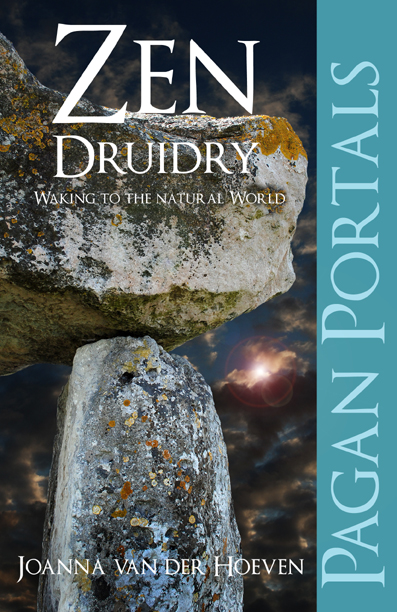
Zen Druidry still at the low Kindle price of UK £1.23 – what a lovely number! Paperback copies available starting at £1.05, used copies from only 99p. In the US, copies start from $2.02 (another lovely number) and in Canada from $0.01!!!) . Read reviews by leaders and authors in the pagan community such as Philip Carr-Gomm, Graeme Talboys, Nimue Brown and more! Part of Moon Books‘ Pagan Portals series.
The twentieth century saw some radical cultural shifts for the western poor. We moved away from self-sufficiency, and towards consuming low cost goods. We stopped cooking from scratch and bought processed food. Many of the skills that had historically been essential for paupers, became lost to the vast majority. We’d ushered in a new era of prosperity and ease, and no one would ever have to cut worn bed sheets in half again to re-sew them for a re-use.
Now, many people are finding they don’t have the money to support the lifestyle they’d once taken for granted. It comes as a shock. Being poor is very hard if you have no idea how to do it. Let’s just consider food. If you can grow your own veg and fruit, make jam from the fruit, keep a few chickens, if you know how to re-use your leftovers, how never to…




 Down the Forest Path