Reblog: How Altars can Alter our Practice

Reblogged from my channel, Druid Heart, at Witches and Pagans.

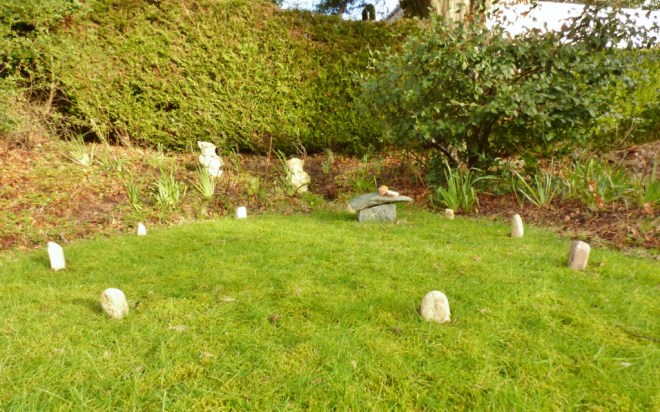
P1000491 (1024x640)Altars can have a very significant role in daily practice and worship, providing a focal point in establishing relationship. I try to highlight this importance with my students, explaining the benefits of have a focus within an area in which to open up communication with the spirits of place (or land, sea and sky), the ancestors, and the gods. Communication is essential to good relationship, and finding a spot to come back to again and again helps us to not only strengthen the bond between the person and the place, but also gives it a ritual context within which to commune. Often this ritual context is held within a temple, whether it is a building or creation of stone and/or timber, or a sacred circle cast with energy around the practitioner. The importance of the altar and the temple should not be taken for granted, though neither are exactly essential.

When beginning on the Druid path, having a place to work in that you can come back to repeatedly creates a special bond between the person and the place. A place has a very real impact upon a person, as we come to realise that we are not separate from the rest of the natural world. When we find our place within a place we are able to communicate openly, sharing freely that wonderful dose of awen (inspiration), the hum of energy where souls meet… (cont’d)

To read the full article, click HERE.

Reblog: Riding the Tides of Samhain (No sh*t, no flowers)

Here’s a link to my latest blog post on my channel at SageWoman on the Witches and Pagans site. Blessings of the Samhain tide!

“I can make whatever choices I want in my life, and I will live with the consequences of those choices. But if I want to live a life close to my deepest desires, I have to risk knowing who I really am and have always been. Knowing this, then I can choose.”

Oriah Mountain Dreamer, The Invitation

We live in a culture and a world of avoidance.  Television, social media, alcohol and drugs are just a few escape routes we have to avoid truly knowing who we really are.  At this time of year, when Samhain is fast approaching we cannot avoid the very real fact that we will die, that death is unavoidable, though we may try.  Looking at death straight in the eye can reveal some very hard truths about ourselves, about how we live in the world, and what our responsibility and duty is to the ancestors, not only ancestors of the past but perhaps more importantly, ancestors of the future.

Continued… to read the full blog post, click HERE.

Reblog: Full review of The Salmon in the Spring

Salmon-in-the-SpringI’ve finally managed to put together a cohesive account of my experience with this book over on my blog at SageWoman – if you’re interested, please click HERE for the full article.

Harvest blessings,

Jo. x

Reblog: Ancestors and Integration

© Photography by Emily Fae, www.photographybyemilyfae.com

Here is a taster from my latest blog post at SageWoman – I’ve also got an article coming up in the next print edition of SageWoman magazine, so keep an eye out!

I learned something fascinating this weekend. I learned that as women, when we are in our mother’s womb, we already have all the ovum (eggs) that we will release during our fertile years. So, to put that into context, when my mother was in my grandmother’s womb, I was also there, partly, as one of the eggs that would be fertilised by my father. This link only occurs in women, and it just blew my mind. I was in my grandmother’s womb.

Our lines of ancestry can be glorious and transformational journeys of discovery. Not only in a historical sense, exploring records and genealogy, but also connecting spiritually with our ancestors. As the darkness creeps in and the days get shorter, in the cooling air with the harvest being taken in the fields all around me, my thoughts turn to my ancestors and to the self, releasing into the approaching autumn and finding great comfort and joy in the letting go.
In order to release that sense of self, however, we must first come to know our self.

Exploring who we are, where we came from, what makes us “us” is key to this work. Understanding circumstances, experiences, lines of ancestry can enrich our lives and help us to uncover depths of our own soul that may have previously escaped our notice.

To read more/full article, click HERE.

Reblog: Harvest-Time

Here is my latest post for SageWoman Magazine’s blog channel at Witches and Pagans…

Every day at this time of year, either morning or evening, I do some gardening, keeping back the riotous growth that excels in this season. If I didn’t, many plants would simply take over the garden, crowding out some other favourite plants. Though these crowders may be near the end of their cycle, in their death they will still smother those that have great potential, as their time is arriving. It’s a hard time of year to keep on top of things, as the sun is so hot in our south-facing garden, and time is limited to mornings and evenings when we won’t burn to a crisp or keel over from heat exhaustion. Jack in the Green is running riot, uncaring, reaching for the sun, drinking in the rain.

Yet if I want my irises and lilies to survive, I must release them from the choking hold of ground creepers/covers that threatens their existence. I must carefully weed out and try to keep under control those plants whose vigorous growth would otherwise overwhelm others. In this, I feel a kinship to my ancestors, not only my recent ancestors whose work with plants runs in my blood, but also ancestors of this land who depended upon agriculture to survive. Both physically and metaphorically, this is the ideal time to sort the wheat from the chaff.

Even as I hear the tractors and combine harvesters rumbling in the fields on the other side of the street, so too do I look both within and without to see what needs harvesting, and if the harvest has been good. Getting out in the garden brings it all home, showing that if you take on the responsibility of growing things, of nourishing them, then you must do your job well in order for your harvest to be good. Walking out in the fields after supper, running my hands over the tops of the wheat and barley that grow around here, I make my prayers for the harvest to go well, for the people to be nourished and for the land to be treated well. The time nears for when we give back in great gratitude as Lammas, Lughnasadh, Harvest-time arrives…

To read the full article, click HERE.

Reblog: In the summertime…

Here’s a taster of my latest blog post at SageWoman Magazine’s site, to read the full post click HERE!

P1060324 (1024x768)I love the summer. The heat of the sun, the long days, the unending twilight at this time of year – it’s a brilliant time to be alive. I find at this time of year there is nowhere to hide: you must face what the light shines on you or try to hide in air-conditioned rooms with recycled air, breathing in that stale, same old, same old.

It’s a time when the layers come off, physically and metaphorically. As we expose some skin to the wonderful sunlight (with proper protection) so too do we expose our souls to the light, shining it in all the corners of our psyche. Summer is a time for exploration, for rejuvenation, for relaxation. It’s time to let your hair down and get a bit sweaty.

Many within the pagan tradition see Samhain as the time to face demons, your monsters that can take over and lead you into unacceptable behaviour. But for me it is summer, where I can lay them out on the lawn and watch them wriggle in the full light of the sun – that is where I find the denouement, the closure in my life’s little episodes.

Summer is a time when I have to face certain things head on: my body for one…

To read full article, click HERE.

Reblog: Experiencing the Sacred

This is a reblog of my latest post from my channel at SageWoman’s blog, on Witches and Pagans.

Friend and fellow colleague, Kevin Emmons, once described the sacred as “A simple thought that isn’t so simple. What we see and experience as sacred is what allows us to glimpse the eternal through cracks in consciousness caught in the field of time.” I love it when people say things that really make you think. You can find links to other inspiring writers on my personal blog at Down the Forest Path.

As a Druid and animist, to me everything is sacred. Everything is sacred, and yet everything is also mundane. As author and Zen teacher Charlotte Joko Beck once said “Nothing is special. And when nothing is special, everything is”. She wrote an entire book, called Nothing Special. I highly recommend it.

Kevin’s words are beautiful, evoking an image of eternity in which we can only catch glimpses. My Zen Buddhist tendencies lead me to question whether anything is eternal, as the main tenet of Buddhism is the impermanence of everything, and yet there is a certain paradox in that the energy of life is never-changing: it only changes in the forms that it takes. Energy manifests itself as different forms of matter dependent on circumstances such as environment, genetics, etc. So yes, the energy is eternal, but the manifestation is not.

Catching glimpses of this energy, of the sacred through cracks in consciousness is an absolutely delicious concept. It reminds me of Emily Dickinson’s poetry, when she speaks of nature as in XCII:

To my quick ear the leaves conferred;    

The bushes they were bells;      

I could not find a privacy             

From Nature’s sentinels.            

In cave if I presumed to hide,            

The walls began to tell;               

Creation seemed a mighty crack              

To make me visible.

We cannot escape life. It is always there, always around us, and we are always a part of its flow. There is no separation, only integration. We live with each other; we live because of each other in a beautiful dance throughout the ages. These cracks in our consciousness allow us to break through our perceived reality, and move beyond perceptions, beyond subjectivity into the entirety of being.

Our senses are so beneficial to us, and yet they also are the cause of our subjectivity. We see the world through our own eyes, feel through our own fingers, listen with our own ears. Everyone is different, yet everyone has a shared experience. When the species is the same, there is a deeper shared experience, an understanding and knowing where the Other is not so “other”. Transcendence is moving beyond the senses, moving beyond the boundaries and definitions into pure understanding, pure experience. Then there is no “I” or “Me”, there is no “You” or “Them” – just life, glorious life.

Our consciousness is a blessing, a gift. It is also the greatest hurdle to overcome, for it shouts aloud and above the songs of the earth, drowning out the consciousness of other beings in our own minds. Cracking open our consciousness we allow those other songs to come through, to inspire us, to nourish us, to blend with our song in a wonderful symphony of energy manifesting, over and over again.

These cracks of consciousness are caught in the field of time (however you may view time, whether it be linear, circular, etc.). Energy manifests, for a time, and then changes its form. Time is what creates the impermanence that is so vital to life. Without time, there would be no conception, no materialisation, no death and no decay. Within the moveable boundaries of time we see a progression of the eternal processes of birth and decay. Time is a gentle sanctuary, an indiscriminate boundary that allows these processes to occur.

And so, the sacred is that which allows us to glimpse the eternal. The sacred is anything and everything, if only we open up our senses and move beyond our perceptions. Through the cracks of consciousness within the fields of time we perceive this sacredness, flowing and changing, manifesting and decaying, a boundless stream of energy moving through the cosmos.

May you see through the cracks to glimpse the sacred.

Reblog: Reach for the light, rooted in the earth…

The days are getting so long, with early sunrises and late sunsets. And yet, there still doesn’t seem to be enough time to do everything in a day at this time of year. My schedule is packed, and I’m very tired but happy at the end of each day. Summer madness has sprung, with so much to do! This is a re-blog from my latest post at SageWoman, where during this time of greatest light it’s essential to keep our feet rooted in the ground while reaching for the heavens.

The swirls and eddies of the rising tide pull us ever closer into the dizzying dance that is summer. Here in the British Isles, summer is when everything happens: festivals appear from May to September, weekend events and week-long retreats. It’s a busy time of year, when we ride the solar energies to the point of highest light. We feel our spirits rising with the sun, and let its rays illuminate our paths and nourish us body and soul.

It’s easy to get caught up in the frenzy. My schedule is packed until October, with pagan events, priestly duties and more. By the end of May I can already begin to feel a little burned out, and summer hasn’t even really gotten into its stride yet. What I have to do is look to nature for inspiration.

The growing tides of light can entice us to do more than we should, to overbook or overcommit ourselves. What we don’t want to happen is to have the summer solstice upon us and be too tired to celebrate it. We need to harness our energies, to pool our resources so that we can access those lush depths when the time is right…

To read the full article, click HERE.

Reblog: Immanence and Transcendence

Here is a lovely reblog from a fellow wanderer down the forest path and friend.  Her words are beautiful, moving, and resonate deeply within my blood and bones…

I have been pondering these two words in relation to spiritual beliefs and religious practise for some time off and on, now and then, here and there. As these things happen they came back to me as I was bent over cleaning out the cats’ litter trays late last week.

I have ruminated about the nature of earth based and book based belief systems. I have pondered upon the impact on the peoples from earth based and book based religions with regards to migration. I have wondered how to frame an understanding of immanence and transcendence that works for me and in my religious and spiritual life as a Druid…

To read the full article, click HERE.

Reblog: A Guide to Cultivating Compassion

Here is a reblog from Leo’s wonderful site.  Number six is the most difficult, but perhaps the most important.  🙂

A Guide to Cultivating Compassion in Your Life, With 7 Practices

“If you want others to be happy, practice compassion. If you want to be happy, practice compassion.– Dalai Lama

By Leo Babauta

I believe compassion to be one of the few things we can practice that will bring immediate and long-term happiness to our lives. I’m not talking about the short-term gratification of pleasures like sex, drugs or gambling (though I’m not knocking them), but something that will bring true and lasting happiness. The kind that sticks.

The key to developing compassion in your life is to make it a daily practice.

Meditate upon it in the morning (you can do it while checking email), think about it when you interact with others, and reflect on it at night. In this way, it becomes a part of your life. Or as the Dalai Lama also said, “This is my simple religion. There is no need for temples; no need for complicated philosophy. Our own brain, our own heart is our temple; the philosophy is kindness.”

Definition
Let’s use the Wikipedia definition of Compassion:

Compassion is an emotion that is a sense of shared suffering, most often combined with a desire to alleviate or reduce the suffering of another; to show special kindness to those who suffer. Compassion essentially arises through empathy, and is often characterized through actions, wherein a person acting with compassion will seek to aid those they feel compassionate for.

Compassionate acts are generally considered those which take into account the suffering of others and attempt to alleviate that suffering as if it were one’s own. In this sense, the various forms of the Golden Rule are clearly based on the concept of compassion.

Compassion differs from other forms of helpful or humane behavior in that its focus is primarily on the alleviation of suffering.

Benefits
Why develop compassion in your life? Well, there are scientific studies that suggest there are physical benefits to practicing compassion — people who practice it produce 100 percent more DHEA, which is a hormone that counteracts the aging process, and 23 percent less cortisol — the “stress hormone.”

But there are other benefits as well, and these are emotional and spiritual. The main benefit is that it helps you to be more happy, and brings others around you to be more happy. If we agree that it is a common aim of each of us to strive to be happy, then compassion is one of the main tools for achieving that happiness. It is therefore of utmost importance that we cultivate compassion in our lives and practice compassion every day.

How do we do that? This guide contains 7 different practices that you can try out and perhaps incorporate into your every day life.

7 Compassion Practices

  1. Morning ritual. Greet each morning with a ritual. Try this one, suggest by the Dalai Lama: “Today I am fortunate to have woken up, I am alive, I have a precious human life, I am not going to waste it. I am going to use all my energies to develop myself, to expand my heart out to others, to achieve enlightenment for the benefit of all beings, I am going to have kind thoughts towards others, I am not going to get angry or think badly about others, I am going to benefit others as much as I can.” Then, when you’ve done this, try one of the practices below.
  2. Empathy Practice. The first step in cultivating compassion is to develop empathy for your fellow human beings. Many of us believe that we have empathy, and on some level nearly all of us do. But many times we are centered on ourselves (I’m no exception) and we let our sense of empathy get rusty. Try this practice: Imagine that a loved one is suffering. Something terrible has happened to him or her. Now try to imagine the pain they are going through. Imagine the suffering in as much detail as possible. After doing this practice for a couple of weeks, you should try moving on to imagining the suffering of others you know, not just those who are close to you.
  3. Commonalities practice. Instead of recognizing the differences between yourself and others, try to recognize what you have in common. At the root of it all, we are all human beings. We need food, and shelter, and love. We crave attention, and recognition, and affection, and above all, happiness. Reflect on these commonalities you have with every other human being, and ignore the differences. One of my favorite exercises comes from a great article from Ode Magazine — it’s a five-step exercise to try when you meet friends and strangers. Do it discreetly and try to do all the steps with the same person. With your attention geared to the other person, tell yourself:
    1. Step 1: “Just like me, this person is seeking happiness in his/her life.”
    2. Step 2: “Just like me, this person is trying to avoid suffering in his/her life.”
    3. Step 3: “Just like me, this person has known sadness, loneliness and despair.”
    4. Step 4: “Just like me, this person is seeking to fill his/her needs.”
    5. Step 5: “Just like me, this person is learning about life.”
  4. Relief of suffering practice. Once you can empathize with another person, and understand his humanity and suffering, the next step is to want that person to be free from suffering. This is the heart of compassion — actually the definition of it. Try this exercise: Imagine the suffering of a human being you’ve met recently. Now imagine that you are the one going through that suffering. Reflect on how much you would like that suffering to end. Reflect on how happy you would be if another human being desired your suffering to end, and acted upon it. Open your heart to that human being and if you feel even a little that you’d want their suffering to end, reflect on that feeling. That’s the feeling that you want to develop. With constant practice, that feeling can be grown and nurtured.
  5. Act of kindness practice. Now that you’ve gotten good at the 4th practice, take the exercise a step further. Imagine again the suffering of someone you know or met recently. Imagine again that you are that person, and are going through that suffering. Now imagine that another human being would like your suffering to end — perhaps your mother or another loved one. What would you like for that person to do to end your suffering? Now reverse roles: you are the person who desires for the other person’s suffering to end. Imagine that you do something to help ease the suffering, or end it completely. Once you get good at this stage, practice doing something small each day to help end the suffering of others, even in a tiny way. Even a smile, or a kind word, or doing an errand or chore, or just talking about a problem with another person. Practice doing something kind to help ease the suffering of others. When you are good at this, find a way to make it a daily practice, and eventually a throughout-the-day practice.
  6. Those who mistreat us practice. The final stage in these compassion practices is to not only want to ease the suffering of those we love and meet, but even those who mistreat us. When we encounter someone who mistreats us, instead of acting in anger, withdraw. Later, when you are calm and more detached, reflect on that person who mistreated you. Try to imagine the background of that person. Try to imagine what that person was taught as a child. Try to imagine the day or week that person was going through, and what kind of bad things had happened to that person. Try to imagine the mood and state of mind that person was in — the suffering that person must have been going through to mistreat you that way. And understand that their action was not about you, but about what they were going through. Now think some more about the suffering of that poor person, and see if you can imagine trying to stop the suffering of that person. And then reflect that if you mistreated someone, and they acted with kindness and compassion toward you, whether that would make you less likely to mistreat that person the next time, and more likely to be kind to that person. Once you have mastered this practice of reflection, try acting with compassion and understanding the next time a person treats you. Do it in little doses, until you are good at it. Practice makes perfect.
  7. Evening routine. I highly recommend that you take a few minutes before you go to bed to reflect upon your day. Think about the people you met and talked to, and how you treated each other. Think about your goal that you stated this morning, to act with compassion towards others. How well did you do? What could you do better? What did you learn from your experiences today? And if you have time, try one of the above practices and exercises.

These compassionate practices can be done anywhere, any time. At work, at home, on the road, while traveling, while at a store, while at the home of a friend or family member. By sandwiching your day with a morning and evening ritual, you can frame your day properly, in an attitude of trying to practice compassion and develop it within yourself. And with practice, you can begin to do it throughout the day, and throughout your lifetime.

This, above all, with bring happiness to your life and to those around you.

“My message is the practice of compassion, love and kindness. These things are very useful in our daily life, and also for the whole of human society these practices can be very important.” – Dalai Lama