Lessons from a River

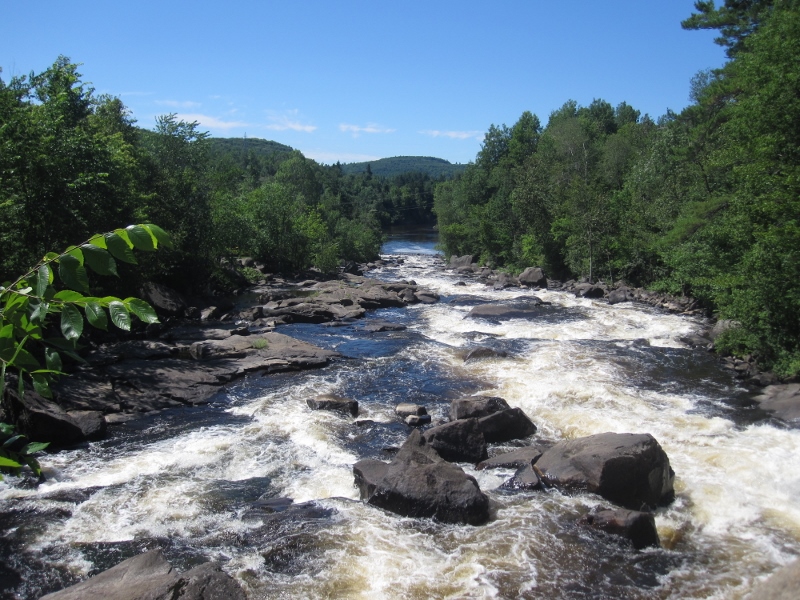
IMG_1505 (800x600)Sitting on the edge of the North River where I grew up, I feel the energies of the water’s flow, the water molecules and its soulsong moving through the landscape and through my own soul. Known for its rapids, it attracts many visitors in the spring (when its wild rush from snowmelt takes the breath away) and in the autumn (when the trees’ fiery colours blaze against the white foam). There are many places to sit amidst the rapids when the water is low enough, and that’s where most people like to sit, right in the heart of the dramatic whirl and rush of water as it crashes, engulfing the senses until you can hear nothing but water, water, water.

But it’s not here that I like to sit – I much prefer to be at the bottom of the rapids, where the drama ends and then there’s a flat stillness, where the bubbles and foam slowly pop as they moves downriver, the surface reflecting the trees and sky above. I sit on a rock and feel the rush of movement to my right, the great dramatic unfolding of the rapids. To my left is utter stillness, where the ducks and gulls are fishing. Right before me is where the two meet, slowing into stillness, settling into another current of energy. Where edges meet there is great power and learning.

I turn my head to the right and look back up to the rapids, and see my own thoughts as the rocks that the waters of my soul crash up against time and again, causing the water to explode high into the air or tumble in whirlpools, hitting one rock and then another on its way down. Those rocks are someone who still tries to upset, annoy, or undermine me and I smile to those rocks, compassion flowing though my soul and the through the landscape towards that person as I see their own personal suffering, even though I long ago decided I wouldn’t stick around for further abuse. I see my physical limitations, my body slamming against the rocks of rheumatoid arthritis and perimenopause, and the hidden rocks within my genes that may surface one day as breast cancer or high blood pressure. I smile to these rocks as well, knowing that even as I crash against them I am still moving around them, ever downriver towards the calm when there are no more rocks. I see a myriad of thoughts that my brain crashes against, creating dramas and I smile to all of these rocks, turning my head to follow the flow and see ahead of me where it begins to settle, as I settle upon my rock watching the willow leaves fall around me and into the river, a heron flying past.

I see that water is water, whether it is still or riding on great foaming crests that reach many metres into the sky. The water that roils is the same water that settles, and when all the obstacles are taken away it resolves to a beautiful and serene flat plain that reflects everything around it. Through meditation and compassion, integration with the world around me, seeing the soul behind the soul and the true nature of all existence, I too settle and reflect the world around me, a calm and peace from deep within. Though there may be more rapids ahead, I know the nature of water and of my own soul, for they are one and the same.
The Myth of Duality

It’s hard to escape the ingrained duality of our culture and mindset in the Western world. For so many hundreds of years we have listened and taken as fact that the mind and body are separate, that the individual is separate from nature. This is a concept that abounds even in Modern Paganism, which in my opinion hinders the way forward for many people who are truly trying to integrate, to live in harmony with the natural world. By creating a divide we are instantly alienated from a world to which we have a natural birthright.

Even some proponents of non-duality still can get caught out on certain issues – take the Otherworld for instance. If we truly believed in an inclusive and shared reality, a shared experience in which there is no subject and object, but instead a collection of subjects in shared experience then we come close to the core of animism. However, many Pagans still believe that when we die, our soul splits from our bodies and goes “somewhere else”: The Otherworld, the Summerlands, etc. What I would posit is that there is no “other”, just as there is no such thing as “away”. I am fully aware that not all Pagans are animists, but for me personally they go hand in hand.

Jason Kirkey touches on this subject in his book, The Salmon in the Spring. He sees the Otherworld as a different mode of perception, more than a physical place that is different to this world. By opening our perception we can see the Otherworld, which really is our world in its full entirety, unhindered by concepts of dualism.

We live in a shared reality, though many choose not to accept this. We are, in each and every second, undergoing a shared experience. There can be no such thing as a solitary experience. We are in contact with the world each and every moment. As I sit here typing, I am experiencing the clack of the keyboard and its plastic keys, the light from the monitor, the air around me, the draft from the window, the light filtering through the cloudy skies, my cat complaining for more food. I am experiencing all these things, and all these things are also experiencing me. In this context, there is no subject/object, for in order for there to be an object there needs to be separate reality and experience entirely isolated from everything else. This is simply not possible – no one lives in a vacuum.

When I am walking to my Tai Chi class in the rain, I am experiencing the rain and the rain is experiencing me. When I am in class, I am experiencing the instructor and other class members, and they are experiencing me. When I place my foot carefully on the floorboards of the hall, I am experiencing the floorboards and the floorboards are experiencing me. As an animist, for me there is no such thing as inanimate objects, or even objects at all – everything is filled with energy in motion, which creates mass and density, and everything is subject to the world around it.

Creating a division, between Us and Them, between animate and inanimate is a huge cause for the troubles we are now experiencing politically, environmentally and socially. When we realise that everything is shared experience, then we automatically work for the benefit of the whole rather than ourselves, for we realise that there is no such thing as just “ourselves”. We are an integral part of the whole, and being integral it only comes as natural that we should live our lives in service to the whole.

This is the main focus of Druidry for me in my personal life. Living a life in service means thinking, acting, living for the whole rather than the self. It’s not done in an altruistic sense, but in a holistic sense. By dropping the illusion of separation I can experience the world on a much deeper level, and have a greater relationship because the illusory barriers and boundaries of dualism have simply disappeared.

In my opinion, Descartes has a lot to answer for.

Darkness, the Self and Release

I wept this morning, over a photo of a man fleeing his Syrian homeland with his two children, stepping out of the boat, clutching his loved ones close to him and weeping himself. What uncertainty faces this family, along with the other refugees arriving on the islands of Greece? What could it possibly feel like to leave all that you know, out of fear for your life and those that you love, hoping that your decision will be the right one?

This is probably not a decision that I shall ever have to make in my lifetime. It is moments like these that remind me to step beyond myself, to get outside of my head, to stop thinking in the context of “me” and move forward into integrated relationship. Doing this keeps things in perspective, and keeps my own troubles, pains and dark wolves at bay. When the weight of the world seems to push me under, I get beyond myself and into the wider web. It is something that I’ve been writing about for months now, about deep integration, about dropping the illusion of the self, about seeing the interconnectedness of all things.

I look out my window and see a leaf on the beech tree. That leaf is not separate from the other leaves. That leaf is not separate from the branch, or any part of the tree. The tree is the leaf and the leaf is the tree. Even when the leaf falls in the autumn, it lands on the ground at the base of the tree, decaying into the soil, feeding the roots and is still a part of the tree. Watching this cycle, witnessing it from a Druid perspective I see how the illusion of separateness causes us so much suffering. There is no “Us” and “Them”. There is only life.

Deep integration and dropping the sense of self. Seeing beyond the “me, myself and I” keeps my head above the water, rafting the currents of life. When things are at their darkest, I can release into that darkness, dropping the edges and boundaries and allowing a greater perspective than could ever be achieved thinking that I am confined to this body and this mind. When the sheer stupidity of the human race threatens to drag me down, when my body is in great pain, when I see others suffering, I release into the darkness and there find the potential that awaits, like the seed in wintertime. If I fail in that endeavour, then there is always a back-up, words spoken by someone whose name I cannot remember, but goes something along the lines of:

“When I am in pain, show me someone who is in agony. When I am hungry, show me someone who is starving…”

Again, this lets me step beyond my self, to allow me a greater perspective. Pain and suffering, cruelty and bad behaviour all stem from misperceptions. If we can get past that notion of the self, that self-centredness, then we can dance with the divine in a beautiful, graceful round surrounded by the stars, galaxies and all life as we know it. In doing so we are free.

Reblog: Ancestors and Integration

© Photography by Emily Fae, www.photographybyemilyfae.com

Here is a taster from my latest blog post at SageWoman – I’ve also got an article coming up in the next print edition of SageWoman magazine, so keep an eye out!

I learned something fascinating this weekend. I learned that as women, when we are in our mother’s womb, we already have all the ovum (eggs) that we will release during our fertile years. So, to put that into context, when my mother was in my grandmother’s womb, I was also there, partly, as one of the eggs that would be fertilised by my father. This link only occurs in women, and it just blew my mind. I was in my grandmother’s womb.

Our lines of ancestry can be glorious and transformational journeys of discovery. Not only in a historical sense, exploring records and genealogy, but also connecting spiritually with our ancestors. As the darkness creeps in and the days get shorter, in the cooling air with the harvest being taken in the fields all around me, my thoughts turn to my ancestors and to the self, releasing into the approaching autumn and finding great comfort and joy in the letting go.
In order to release that sense of self, however, we must first come to know our self.

Exploring who we are, where we came from, what makes us “us” is key to this work. Understanding circumstances, experiences, lines of ancestry can enrich our lives and help us to uncover depths of our own soul that may have previously escaped our notice.

To read more/full article, click HERE.

Right, Wrong and the Self

Working with thoughts on the self, and release of the self these last few years (even more so since the publication of my first book, Zen Druidry) has been the focus of my studies and journey on the path of Druidry, yet has lately become the centrepoint in my vision of my own personal Druidry, ethics and the act of living with awareness.

We can appear, online at least, to be very focused on our individual selves, even to the point of megalomania. Social media comes from an individual’s personal viewpoint, or a company’s, a philosophy – it is an entity in and of itself. As an author it can appear even worse – we write, constantly, sorting out issues, celebrating life in all its glory with words spread across the screen if we decide to share those ideas and inspiration into the wider world.

Yet in my personal, living practice it is quite different. Yes, I do think a lot – but it is thoughts on the dissolution of the self in order to greater experience the world around me. Ironic, writing a blog post about it, but there you go.

Considering ethics within Paganism, there are many levels of “rightness” and “wrongness”, both morally, legally, socially and culturally. What matters most in our current culture here in Britain is legality, with social and cultural repercussions following the legal ones in order of importance (in secular circles) to consider. Morality can kind of get a back seat on this ride, all too sadly. However, what I’ve been thinking about is right and wrong and the ego, the sense of self that is always grasping to have its own expression heard, justifying itself and seeking validation any which way it can (yes, this blog is an irony in that, as well).

The most poignant thing that I have realised is that even though there is right and wrong, it doesn’t actually make anyone better if they are right, or worse if they are wrong. Just because someone is right doesn’t make them a better person, a better human being, nor vice versa. Even in a legal context, even if someone is found wrong, guilty of whatever transgression, it doesn’t make us better – it just makes us legally right.

Legally right may not even mean morally or ethically right. As a species, I don’t think we can actually live without a concept of right and wrong, as it is so ingrained into our psyche. That spark of human consciousness overrides the concept with the constant striving of the ego, the neocortical part of the brain laying down all manner of experience, assumptions, judgements, memories, possible outcomes etc. It’s often said that we instinctively know right from wrong, but does right and wrong have anything to do with instinct, or it is a purely human construct?

I know when someone is doing something wrong in my own social context, in my culture and society. I can condemn their behaviour as wrong, as something that needs to be addressed in order to fulfil our social contract with each other. I can report abusive behaviour, I can write letters of protest to local planning authorities, I can sign petitions and raise money to benefit those in need. All of these things do not make me a better person. They just make me, me.

The man who kicks his dog, I can report to the RSPCA. That doesn’t make me better than him though. The woman who abuses her child, I can also report to the authorities – that doesn’t make me better than her in any way. I may be right in thinking that these things are wrong, but it doesn’t make me a better person for not doing these things.

Ideas of right and wrong often include a judgemental factor that makes us feel that we are better than others. That is the striving of the ego for validation in any form, its screaming claws inside our head hoping for some sort of recognition. What we need to do is to be right, but not have the need to feel right, to feel better for being right.

In taking my inspiration, learning from the natural world around me, I am currently seeing things from a very different perspective. In a world where there is no human notion of right or wrong, and allowing my sense of self to dissolve slowly into that environment, whole new ideas on the nature of the human existence come blazing to the fore.

Stopping that chattering, self-centred mind to actually be in the world is time very well spent. Each time you do, you hear and learn more about the world, thus better defining your place within it. If you begin to lose even that, your sense of self, you come back less and less – the ego becomes smaller and smaller, and the true self has the opportunity to shine through.

Eventually, I hope to never come back at all.

ch2