Teaching without saying a word…

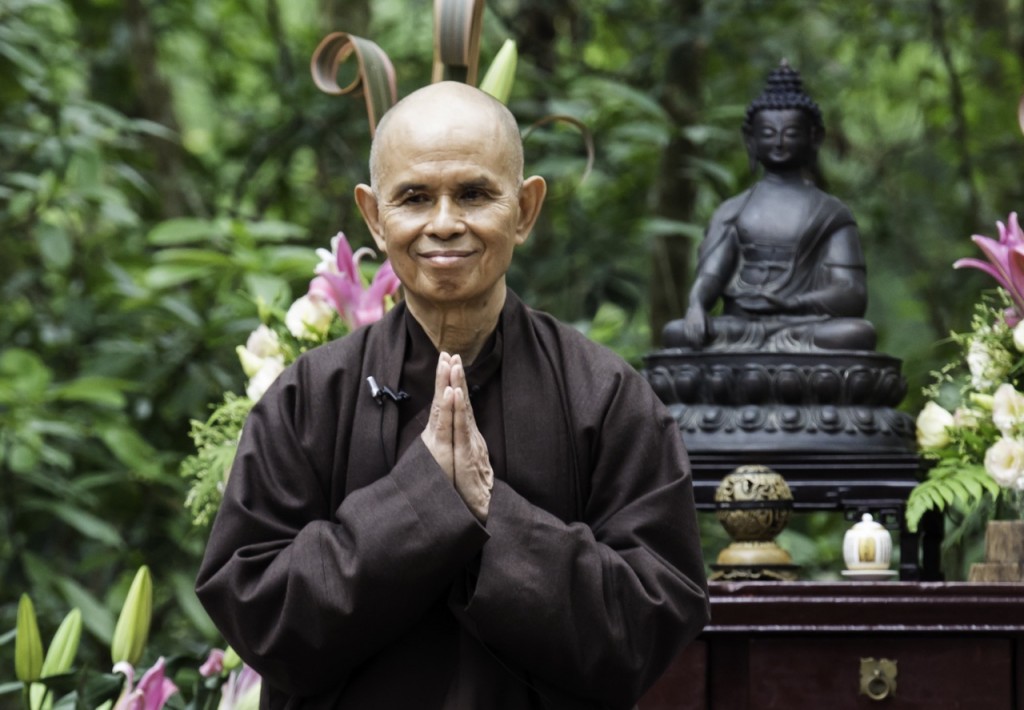
Thich Nhat Hanh by Kelvin Cheuk

Thich Nhat Hanh by Kelvin Cheuk

As Zen Buddhist monk, Thich Nhat Hanh’s health slowly begins to improve, he still provides an example of finding the joy, enchantment and wonder of the simplest things in life – eating a bite of food, taking a step upon Mother Earth, smiling at a friend.  Reading this latest update on his recovery, it really brought home the message that we can find joy anywhere, if we are able to open our hearts to it.  Despite circumstances that prove a tremendous difficulty, this gentle monk who has lived through war and exile continues to lead by example.  Thank you, and bless you, Thay for your teaching. May we be worthy students, and may we all find the joy and peace that is to hand in mindfulness.

Official Announcement

Plum Village, France
June 28, 2015

To all Plum Village Practice Centers,
To all Practice Centers and Sanghas World Wide,
To our Dear Beloved Friends,

We are happy to report that Thay’s health has improved greatly since he returned to his Plum Village Hermitage in early April. Every day Thay has been out in nature, enjoying the blossoms, listening to the birds and resting at the foot of a tree. Thay enjoys lying in his hammock next to the running creek, in the fresh cool of the bamboo grove he planted more than thirty years ago.

Doctors and nurses continue to visit Thay, and he receives physiotherapy, massage and acupuncture daily. The team of attendants continue to care for Thay and support his needs around the clock.

Despite his advanced age, Thay has been making remarkable progress.

One day, Thay decided for himself that he was ready to start swallowing solid food, and directed his attendants to prepare an apple, then a lemon and then an avocado. Thay enjoyed each bite with great delight, chewing each mouthful at least forty times before swallowing. Everyone was very surprised. Thay’s mindfulness, concentration and joy to really savor the food was remarkable. Since that day, with great concentration and determination, Thay has been able to enjoy feeding himself. The sisters have been investing their love and creativity in preparing diverse nutritious healthy food for Thay, which he eats with delight. As soon as Thay was able to nourish himself with several wholesome meals a day, he surprised all the doctors by successfully removing his own feeding tube, without any complications. Thay smiled, and we all smiled.

More recently, Thay has begun to develop his vocalisation, joining the attendants when they hum or sing. The first time this happened, one of the sisters was chanting in Vietnamese the name of Avalokita, the Bodhisattva of Great Compassion: Nam Mo Bo Tat Quan The Am. Thay suddenly pronounced the final sound “Âm” (pron. “um”) clearly and on cue. Miraculously, the word “Âm” actually means “sound”. Thay looked at those around him, his eyes gleaming, as if to say “everything is possible”. It was a very moving moment, and the attendants all gathered to continue to chant with Thay. Since that very first “um”, Thay now enjoys singing and humming every day, all the familiar Plum Village tunes in Vietnamese, English and French. At this point, Thay is able to voice the melody and, once in a while, he can form a word. He raises his arm in such a way as to express the meaning of each line, and has great joy and surprise every time he is able to produce a clear and accurate word.

Thay’s therapists have been struck by his extremely strong will to recover, and have pointed out to us that this is the most important factor in his rehabilitation. Thay has been very determined to train himself so he can recover his physical strength and regain his balance and posture. Thay is clear about what he wants to do, and what he does not want to do. He is now able to sit by himself, beautifully upright. In the last three weeks Thay has wanted to start walking, even though his right side remains paralysed. With the support of one attendant behind, and one at his right leg to help move it forward, Thay now practices walking meditation in the garden, several times a day. We can feel Thay’s delight and freedom at each step. Even though it takes great effort, we can see that, for Thay, each step is a step of victory, an affirmation of life and joy to be alive on this beautiful Mother Earth.

From time to time the whole monastic community of 150 monks and nuns has come to practice walking meditation with Thay. Last week we could feel Thay’s joy to see his disciples, and his happiness to lead the sangha in walking meditation. Thay pointed to the blue sky, the swaying bamboo, the smile of a brother, directing us to enjoy the present moment. Thay’s courage, determination and joy, despite his physical limitations, was a clear teaching for all those present as we walked behind Thay with our two healthy feet. With every step, Thay demonstrated that he will continue to practice no matter what the conditions. Thay was affirming that he would never desert the Path. He was encouraging us to stay on the path, and enjoy the wonders of life.

We would like to thank everyone for offering your loving support to Thay and the sangha through the past months. We are deeply grateful for your energy of compassion and prayers, and for your commitment to continue to practice mindfully and deeply for Thay. A special thank you to those who have sent us beautiful children’s drawings for Thay’s room and those who have sent us heartfelt donations to support Thay’s care.

The lotuses are blooming in our ponds, the plums are ripening in our orchards, and we are preparing our hamlets to welcome our guests for the Summer Retreat, around 800 people each week, for a whole month. The Summer Retreat is one of Thay’s favorite times of year. We will welcome families and children, and the Dharma Talks will be given by Thay’s continuation in the form of his Senior Dharma Teachers. Under the shade of the oak trees, bamboo groves and verandas in the late afternoon sun, we will see many circles of friends sharing deeply with one another. Hearts will be open, tears will be shed, as the sound of the bell reverberates.

Nine years ago Thay was asked,
“You will be 80 this year. Do you plan to retire as a spiritual teacher at any point?”

This is the answer he gave:

In Buddhism we see that teaching is done not only by talking, but also by living your own life. Your life is the teaching, is the message. And since I continue to sit, to walk, to eat, to interact with the Sangha and people, I continue to teach, even if I have already encouraged my senior students to begin to replace me in giving Dharma talks. In the last two years, I have asked Dharma teachers, not only in the monastic circle but also in the lay circle, to come up and give Dharma talks. Many of them have given wonderful Dharma talks. Some Dharma talks have been better than mine. I see myself in my continuation, and I will not retire. I’ll continue to teach, if not by Dharma talks then in my way of sitting, eating, smiling, and interacting with the Sangha. I like to be with the Sangha. Even if I don’t give a Dharma talk, I like to join walking meditation, sitting meditation, eating in mindfulness and so on. So don’t worry. When people are exposed to the practice, they are inspired. You don’t need to talk in order to teach. You need to live your life mindfully and deeply. Thank you.

These inspiring words are our compass as we prepare to lead retreats for thousands of people in the coming months: here in Plum Village this Summer, at the EIAB in Germany in August, and on the Miracle of Mindfulness Tour of the United States this fall. Please join us.

May you cherish the presence of those you love, and enjoy each step together.

With love and trust,

The Monks and Nuns of Plum Village

As Thay’s condition is now stable, and his path of recovery is long, we will post updates only occasionally. We will keep our global community informed of any major developments in Thay’s recovery. All official updates will continue to appear at plumvillage.orglangmai.orgvillagedespruniers.org, and www.facebook.com/thichnhathanh.

Tori Amos and Terrorism

Working on my new book, The Stillness Within – Finding Inner Peace in a Conflicted World has really given me the opportunity to delve deep into my own soul. This book is taken from writings on this blog and updated, collated and revised into a little book that will hopefully be a guidepost on the roads we travel to a place of peace.

I apologise if my posts here the last few weeks have been a bit scarce – I’m in full-on editing mode, and sorting out the cover this week too. One thing that I am exploring deeply this week, however, which may or may not make it into the edit of this book (time restrictions) is the notion of how much we fight ourselves, as well as each other. Watching some interviews with music artist Tori Amos the other day, she spoke of how we find our own personal power, which can defeat notions of terrorism. This terrorism is not in the conventional sense, however, but a personal terrorism that comes from within that seeks to obliterate rather than negotiate.

She stated that the song The Power of Orange Knickers, that deals with the theme of terrorism, kept drawing her in, deeper and deeper into different meanings of the word. “It’s easy to see the enemy in another country, it’s easy to see the enemy in another culture: find the enemy in your own culture, then find the enemy in your own being… we all have this part of ourselves that would choose to obliterate an idea instead of negotiate, because it takes a lot of skill to negotiate, but it doesn’t take a lot of skill to obliterate.”

Her words struck a chord with me. How often do we not allow for understanding to bring about a resolution to a conflict? In my book, I talk a lot about how compassion is understanding, trying to see the other side, trying to see the bigger picture. But in doing so, we may have to admit that we have a limited viewpoint, and worse still, that our viewpoint may actually be wrong. Our egos get in the way all the time, trying to save face, with bitter, hurtful words, bad or destructive behaviour or any other myriad ways which we employ to ensure that the façade that we are “right” is kept intact. But what happens when that is happening from within, not only doing it to others, but when we are doing that to ourselves?

For the most part, when we have been hurt, we often try to obliterate the person who has hurt us, punishing them in some way to make ourselves feel better. In severe cases of abuse this may not be the case, but in our day to day interactions with others, when someone does something we do not like, when they say something we disagree with, when we allow past events to influence the present moment, perhaps even dredging up old hurts and projecting them onto the current situation, we seek to annihilate the person whom we believe to be the current source of all our pain.

But what if that person is ourselves? What if we do as Tori states, and look to find this person within? We all have aspects of ourselves that are less than glowing, “darker” aspects that we would rather not face. We spend so much time deluding ourselves, our egos constantly chattering inside our heads convincing us that we are right, that they are wrong, that they are the enemy. The enemy is often lying within, silent and deadly, slowly and steadily killing all chances of peace and compassion.

We have to learn to negotiate with that aspect of ourselves, to talk with it, to try to understand it. In understanding this aspect, we find compassion, for ourselves and for others. In seeing the demons in our own soul we can better understand the demons in others. We have to become skilled negotiators, finding the right words that will cut through the pride and the ego, that will get to the heart of the matter in kindness and in love. We can’t just wade into our psyches and try to obliterate that aspect of ourselves; when we do that, we are just perpetuating the suffering in ourselves and in the world. We have to learn the deep art of communication, to open up the pathways of resolution. There are many choices we can make, if only we are able to see them.

Work towards an ending of the war within. Learn the arts of negotiation and communication. Take the time to look deeply, past the walls of the ego and through the memories of the past and the worries of the future. Look to the person you are right now. Find how you can heal her. Stop the cycle of hurt, pain suffering within and you will also stop that cycle without. It’s never too late.

For the full interview in which Tori Amos discusses the different songs on her album, The Beekeeper, please see below.

The Golden Seed out now!

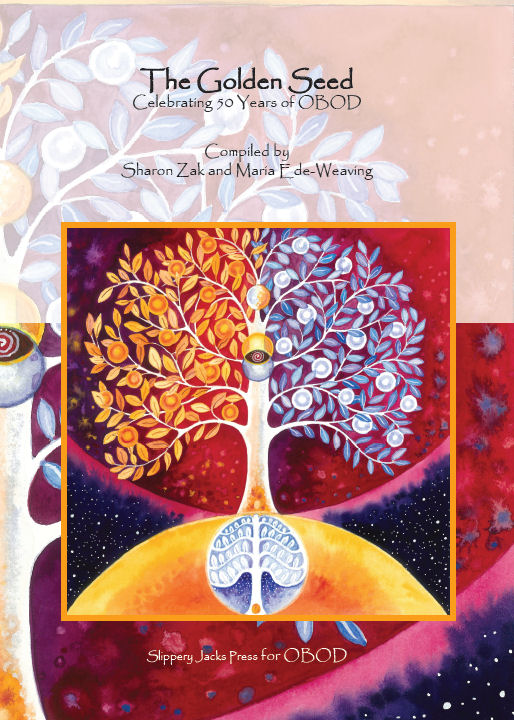
50 Druids were selected to contribute to Order of Bards Ovates and Druids (OBOD) 50th anniversary celebration book, The Golden Seed, and I was honoured and delighted to be one of them. Order your copy now of this wonderful book, with fabulous illustrations and also a DVD of the 50th Anniversary event in Glastonbury with photos and music by Damh the Bard! Pre-ordered copies are in the mail as of today – yay!

Golden Seed

Reblog: A Guide to Cultivating Compassion

Here is a reblog from Leo’s wonderful site.  Number six is the most difficult, but perhaps the most important.  🙂

A Guide to Cultivating Compassion in Your Life, With 7 Practices

“If you want others to be happy, practice compassion. If you want to be happy, practice compassion.– Dalai Lama

By Leo Babauta

I believe compassion to be one of the few things we can practice that will bring immediate and long-term happiness to our lives. I’m not talking about the short-term gratification of pleasures like sex, drugs or gambling (though I’m not knocking them), but something that will bring true and lasting happiness. The kind that sticks.

The key to developing compassion in your life is to make it a daily practice.

Meditate upon it in the morning (you can do it while checking email), think about it when you interact with others, and reflect on it at night. In this way, it becomes a part of your life. Or as the Dalai Lama also said, “This is my simple religion. There is no need for temples; no need for complicated philosophy. Our own brain, our own heart is our temple; the philosophy is kindness.”

Definition
Let’s use the Wikipedia definition of Compassion:

Compassion is an emotion that is a sense of shared suffering, most often combined with a desire to alleviate or reduce the suffering of another; to show special kindness to those who suffer. Compassion essentially arises through empathy, and is often characterized through actions, wherein a person acting with compassion will seek to aid those they feel compassionate for.

Compassionate acts are generally considered those which take into account the suffering of others and attempt to alleviate that suffering as if it were one’s own. In this sense, the various forms of the Golden Rule are clearly based on the concept of compassion.

Compassion differs from other forms of helpful or humane behavior in that its focus is primarily on the alleviation of suffering.

Benefits
Why develop compassion in your life? Well, there are scientific studies that suggest there are physical benefits to practicing compassion — people who practice it produce 100 percent more DHEA, which is a hormone that counteracts the aging process, and 23 percent less cortisol — the “stress hormone.”

But there are other benefits as well, and these are emotional and spiritual. The main benefit is that it helps you to be more happy, and brings others around you to be more happy. If we agree that it is a common aim of each of us to strive to be happy, then compassion is one of the main tools for achieving that happiness. It is therefore of utmost importance that we cultivate compassion in our lives and practice compassion every day.

How do we do that? This guide contains 7 different practices that you can try out and perhaps incorporate into your every day life.

7 Compassion Practices

  1. Morning ritual. Greet each morning with a ritual. Try this one, suggest by the Dalai Lama: “Today I am fortunate to have woken up, I am alive, I have a precious human life, I am not going to waste it. I am going to use all my energies to develop myself, to expand my heart out to others, to achieve enlightenment for the benefit of all beings, I am going to have kind thoughts towards others, I am not going to get angry or think badly about others, I am going to benefit others as much as I can.” Then, when you’ve done this, try one of the practices below.
  2. Empathy Practice. The first step in cultivating compassion is to develop empathy for your fellow human beings. Many of us believe that we have empathy, and on some level nearly all of us do. But many times we are centered on ourselves (I’m no exception) and we let our sense of empathy get rusty. Try this practice: Imagine that a loved one is suffering. Something terrible has happened to him or her. Now try to imagine the pain they are going through. Imagine the suffering in as much detail as possible. After doing this practice for a couple of weeks, you should try moving on to imagining the suffering of others you know, not just those who are close to you.
  3. Commonalities practice. Instead of recognizing the differences between yourself and others, try to recognize what you have in common. At the root of it all, we are all human beings. We need food, and shelter, and love. We crave attention, and recognition, and affection, and above all, happiness. Reflect on these commonalities you have with every other human being, and ignore the differences. One of my favorite exercises comes from a great article from Ode Magazine — it’s a five-step exercise to try when you meet friends and strangers. Do it discreetly and try to do all the steps with the same person. With your attention geared to the other person, tell yourself:
    1. Step 1: “Just like me, this person is seeking happiness in his/her life.”
    2. Step 2: “Just like me, this person is trying to avoid suffering in his/her life.”
    3. Step 3: “Just like me, this person has known sadness, loneliness and despair.”
    4. Step 4: “Just like me, this person is seeking to fill his/her needs.”
    5. Step 5: “Just like me, this person is learning about life.”
  4. Relief of suffering practice. Once you can empathize with another person, and understand his humanity and suffering, the next step is to want that person to be free from suffering. This is the heart of compassion — actually the definition of it. Try this exercise: Imagine the suffering of a human being you’ve met recently. Now imagine that you are the one going through that suffering. Reflect on how much you would like that suffering to end. Reflect on how happy you would be if another human being desired your suffering to end, and acted upon it. Open your heart to that human being and if you feel even a little that you’d want their suffering to end, reflect on that feeling. That’s the feeling that you want to develop. With constant practice, that feeling can be grown and nurtured.
  5. Act of kindness practice. Now that you’ve gotten good at the 4th practice, take the exercise a step further. Imagine again the suffering of someone you know or met recently. Imagine again that you are that person, and are going through that suffering. Now imagine that another human being would like your suffering to end — perhaps your mother or another loved one. What would you like for that person to do to end your suffering? Now reverse roles: you are the person who desires for the other person’s suffering to end. Imagine that you do something to help ease the suffering, or end it completely. Once you get good at this stage, practice doing something small each day to help end the suffering of others, even in a tiny way. Even a smile, or a kind word, or doing an errand or chore, or just talking about a problem with another person. Practice doing something kind to help ease the suffering of others. When you are good at this, find a way to make it a daily practice, and eventually a throughout-the-day practice.
  6. Those who mistreat us practice. The final stage in these compassion practices is to not only want to ease the suffering of those we love and meet, but even those who mistreat us. When we encounter someone who mistreats us, instead of acting in anger, withdraw. Later, when you are calm and more detached, reflect on that person who mistreated you. Try to imagine the background of that person. Try to imagine what that person was taught as a child. Try to imagine the day or week that person was going through, and what kind of bad things had happened to that person. Try to imagine the mood and state of mind that person was in — the suffering that person must have been going through to mistreat you that way. And understand that their action was not about you, but about what they were going through. Now think some more about the suffering of that poor person, and see if you can imagine trying to stop the suffering of that person. And then reflect that if you mistreated someone, and they acted with kindness and compassion toward you, whether that would make you less likely to mistreat that person the next time, and more likely to be kind to that person. Once you have mastered this practice of reflection, try acting with compassion and understanding the next time a person treats you. Do it in little doses, until you are good at it. Practice makes perfect.
  7. Evening routine. I highly recommend that you take a few minutes before you go to bed to reflect upon your day. Think about the people you met and talked to, and how you treated each other. Think about your goal that you stated this morning, to act with compassion towards others. How well did you do? What could you do better? What did you learn from your experiences today? And if you have time, try one of the above practices and exercises.

These compassionate practices can be done anywhere, any time. At work, at home, on the road, while traveling, while at a store, while at the home of a friend or family member. By sandwiching your day with a morning and evening ritual, you can frame your day properly, in an attitude of trying to practice compassion and develop it within yourself. And with practice, you can begin to do it throughout the day, and throughout your lifetime.

This, above all, with bring happiness to your life and to those around you.

“My message is the practice of compassion, love and kindness. These things are very useful in our daily life, and also for the whole of human society these practices can be very important.” – Dalai Lama

The Novice

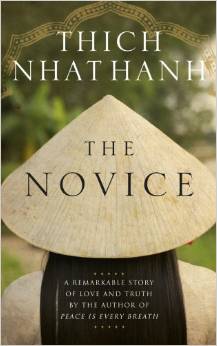
noviceWhilst on holiday in Brittany the past week (blog and photos to come!) I read Zen monk Thich Nhat Hanh’s novel, The Novice. It is his first novel, that tells the story of a young woman who has become a legend in Vietnam for paving the way for women to be nuns in the Buddhist tradition. It’s a short book, eloquently written and filled with wisdom throughout.

Kinh Tam is a beautiful young woman who has always felt a calling for deep learning through Buddhist enlightenment. As there were no temples for nuns at the time, she felt that her only option was to do what women did back then – marry and have children. However, her marriage failed as her in-laws falsely accused her of trying to kill her husband one night. Kinh Tam goes back home then, cuts off her hair and disguises herself as a boy, wandering for five days until she comes to a temple where she asks to be taken in as a novice.

She shows an aptitude unlike any other monk in her devotion to the Zen Buddhist teachings and carrying them out. She lives the perfections of generosity, mindfulness, magnanimity, diligence, patience and insight. She has already been through much, after the false accusations of attempted murder, and yet she holds true to her path, holding no malice to those who have wronged her through their own false perceptions.

A young noblewoman who visits the temple falls in love with the young “boy” monk, seeing in him such beauty that only an open-heart can radiate. Kinh Tam avoids her, with as much compassion as possible, as her secret cannot be found out else she faces expulsion. After Kinh Tam turns down the noblewoman’s request for a private meeting, the noblewoman woman becomes enraged, filled with her own anger and wounded pride, accusing the young novice of impregnating her when it was really a servant boy from her household whom she took to bed in anger and despair of not being able to sway the young novice from his devoted path.

Kinh Tam faces the dilemma of choice: tell everyone that it’s not possible, as she is a woman, or face beatings for her “transgressions”. Her love for her path is so strong that it sees her through the beatings, and yet again she never holds any malice towards the young woman (Mau), those who believe her false accusations and even those who beat her. She knows it is only their wrong perception of her that makes them act as they do, and the strength of loving kindness overcomes all the pain she endures.

Kinh Tam goes through further hardships, yet always with the endurance of a loving heart and the deep well of forgiveness. I won’t tell you the ending, but I was in tears as I read it – it was just so beautiful.

Kinh Tam’s story is one that can help anyone going through a rough time. It doesn’t matter what it is that you are enduring, whether it is being shot at, beaten, false accusations or someone trying to undermine you and your work – the open heart of compassion and seeing the unity of all things is stronger than any of these. Anyone can relate to Kinh Tam’s story. As a woman, I felt a deep bond with her struggles and an empathy for her trials and tribulations. I felt deeply the tug of sadness as one woman falsely accuses another (albeit unknowingly regarding the disguised gender, yet with an intended malice in any event). As a practitioner of Zen I found deep wisdom in the teachings that lay like little stars filled with light across the pages, twinkling with their insight into living a life of less suffering. We all suffer, for various reasons, but we can lessen that suffering through the open heart of compassion. Those who try to hurt us, physically, emotionally, intellectually, who undermine our person and our work, who tell lies and allow their pride, anger and other emotions to overwhelm their reason and the ability to see clearly the heart of the matter – these are things we all go through at some point in our lives. Whether it is through war, office/work politics or family issues, the cause is the same: wrong perceptions. Because they have a wrong perception of us, they act out, lash out, are ruled by the monkeys riding on their backs.

Yet we don’t have retaliate like for like. We can see their suffering, and still send them our love and compassion, even from afar. Because they perhaps have not seen that there is another option, they have no way out. Living through our actions, of opening our eyes to all possibilities and the reality of the present moment we can hopefully provide an example for a peaceful way of life that benefits the whole. We can forgive these misjudgements from others, as they are easily created. Through diligence we can work to dissolve these false perceptions within ourselves, through meditation, deep insight and the other teachings of Zen Buddhism.

I always doubted whether humans were truly capable of forgiveness. When explained through the words and story told by Thich Nhat Hanh, it makes so much more sense; it is so easy. There are three appendices to the story, one describing further the legend of Kinh Tam, the second describing the legacy of Kinh Tam by Sister Chan Khong of Plum Village monastery, and Thich Nhat Hanh’s own addendum about practicing love. These appendices are just as important as the story itself, for it shows “Engaged Buddhism” in action as Sister Chan Khong and Thich Nhat Hanh both relate how the practice of compassion helped them through the suffering of the Vietnam war, exile and more. We see first-hand how the Zen Buddhist precepts are put into practice, actually lived out in the lives of those who worked in the DMZ, offering wisdom and deep insight into how suffering is different for each individual and yet can be overcome when held in the arms of compassion.

In the UK, you can buy this wonderful little book from as little as £1.04 second-hand; do try to read it if you are at all interested in Zen Buddhism, mindfulness, compassion or loving kindness. If you feel you are suffering in any shape or form, this book might be able to help you find the way to transforming suffering into something that instead brings peace and harmony to your world, and thereby to the world at large.

May we be peace. x


1,000 Oceans

Another beautiful song that spoke to me many, many years ago and still makes me weep.  Let the earth heal you, let Her into your heart, free Her and yourselves from the cages we constantly build.  Love the Earth, love yourself, love each other.  Let love rule.

Healing Happens All Around

Just beautiful. Recorded in Plum Village Monastery (set up by Thich Nhat Hanh) by Tabea with the loving support of Sister True Vow.

Reblog: Meditation – The Gift of Transformation

My latest blog post for SageWoman 🙂

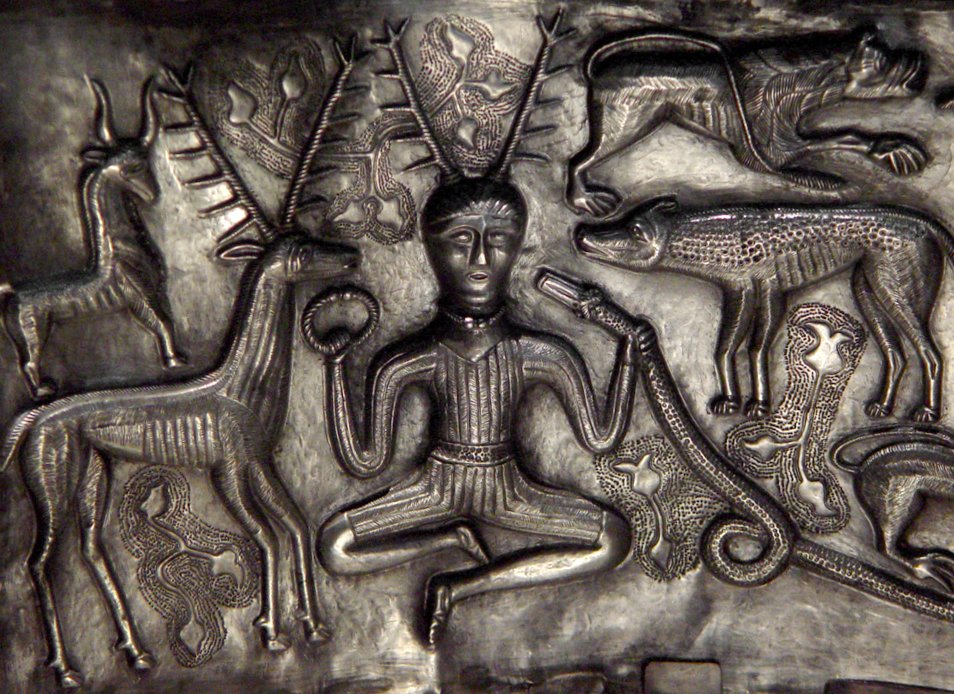
gundestrupMeditation is a huge part of my spiritual life. It is something that I try to do every single day, in various shapes and forms. I find that sitting meditation, or zazen is the best way for my self to refocus on what’s important, to stop the chattering ego and really get deep down to the issues at hand. So much clarity is gained from simply stopping, from allowing the silence to fill your soul. In that deep pool of quiet, in that dark heart of Cerridwen’s cauldron, lies transformation.

You have to be willing to do it, though. It’s difficult, as many of us don’t really like spending time alone, much less sitting still and “wasting time”. However, I would posit that this could very well be the best use of your time, realigning you to the present moment, grounding yourself in the reality of the here and now. We can get so carried away on our emotions, on our problems with the world, on our own sense of self that we become blinkered to the rest of existence. Life is constantly happening, all around us, and we hardly notice it. Sitting meditation is a great way to pay attention to it, to our selves, our bodies and our minds, to see how they work, to get in touch with them once again, thereby allowing us to get in touch with the rest of the world on a much clearer, positive level.

Like a deep pool, the waters may become disturbed, but if we stop the mud will eventually settle to the bottom, the clear water rising to the top to perfectly reflect the sky above. We can become as this pool, reflecting with clarity the present moment in all that we do, in all that we say and in all that we think. It’s not easy, but it’s well worth it.

To read more, click HERE

Be the change you want to see in the world…

https://youtu.be/oqGPa84jM2M

Peace in Druidry

The word peace means many different things to many different people. Some see peace as simply the cessation of aggression or violence. Others see it as a way of life, a philosophy. Still again others see it as a mere dream, while others see it as the ultimate goal. But just what is peace, and what does it mean in a Druid context?

In our society, we strive for so much. Some things are worth working for, putting all our heart and soul into, such as equality, environmentalism and a better way of life for all beings. Some things we strive for are not so worthy – material wealth, social, economic and political power, fame or authority. For many in today’s society, it’s a dog eat dog world, and to get ahead you have to step over others in the race for the top. In reality, there is no top rung on that ladder – there isn’t even a ladder to begin with. All these notions of power are entirely illusionary, when looked at from a basic ultimate view that we are all just beings co-existing with each other on this little planet. Allow me explain.

The illusion of separateness has caused our world so much pain. When we see ourselves as separate, we begin to lose the notion of the sacredness in everything. There is absolutely no possible way for anyone or anything to be separate from anything else. We human beings are made up of minerals and atoms, of genetic information from all our ancestors (human and non-human), of sunlight and wind and rain. We are all star-stuff. We have not come out of nowhere, to suddenly exist and then just as suddenly depart when our earthly lives are snuffed out. The clouds in the sky have always been, and always will be. They may change their form, becoming humid wisps of cloud and ice, to larger clouds that then change into rain. That rain falls onto the earth, to be drunk by human and non-human animals alike, by the garden plants and the trees, by the birds and the bees. This water is released once more into the atmosphere through a myriad of ways – sweat, piss, moist exhalation, dewdrops. Back into the sky it goes, to once again form a cloud. We have clouds within our bodies, in the food that we eat, in the water that we drink, in our genetic makeup. We are clouds and the clouds are us.

Once we see the interconnectedness of all things, we realise that to strive for power or control over anything is as fleeting as the life of a cloud. All things are connected, and all things are impermanent. This is an essential tenet of Eastern philosophies, which is strongly reflected in a Druid’s perspective when viewed as part of the natural cycle. Nothing ever stays the same, not the river, not the sky, not the grass, not the tadpole. Everything is in constant change and flux. The key to finding peace within this constant change is acceptance of the impermanence, allowing our hearts to find ease from the fears and insecurities that arise when we fight against change.

A wave does not stress out about dying when it crashes upon the shoreline. It knows that it is water. The wave is simply the form that it took for however long a time. It knows that it is connected with everything else on this planet – there is nothing that exists outside it in a separate context. The web of life, the threads of connections are all around us. When we see those threads we lose the fear of death, instead seeing the cycles that allow us to really come to terms with the concept of changing forms. Death is not annihilation – it is simply becoming a new form, a new way of being.

The basic fact of life is that we will all die. So what is this struggle, what is this constant striving towards ideas of ownership, of power and rule, of games played with lives? To what purpose does it serve when we will all return to the earth in some form or another, when we come to an understanding that we are not separate from anything else? When can we move from concepts such as birth and death?

As humans we have developed a sense of self-awareness that actually hinders the possibility of finding a true and real sense of peace. We are often so self-focused that we are blinkered to everything else, to the entirety of existence. When we are only in tune with ourselves, how can we ever find harmony without? Stuck within the whirls and eddies of the mind, we will never notice the birdsong, or the rain upon our shoulders, the cry of a hungry child or the yowl of a cat in heat. When we look beyond ourselves is when we will be able to find peace. When we are able to work for the benefit of others instead of just ourselves, the world will know harmony. As we are all co-existing on this planet, it just makes sense to work together. However, the illusion of separateness is strong.

Peace is not just something for stoned hippies to think about and discuss – it is a very real and powerful way of being in the world. Through sensing our connection to the world we find a place of true power, power that comes from within that allows us to work for the benefit of all. This power cannot and will never be a “power over” anyone or anything else, as writer and activist Starhawk expresses often in her work. This power from within is the deep core of true expression, of a sustainable relationship working in tune with the entirety of existence.

Peace is not just a cessation to war and violence. Peace comes from a very real and deep understanding of our selves, of our behaviour and our way of being in the world. Many people within the pagan community seek to find a better way of being in the world. They focus on working on the self, through years of self-discovery, journeys, pilgrimages, workshops, training and the like. For many, the journey stops there, at the betterment of the self. What I would posit in this essay is that in order to bring about true peace in the world, we then have to let go of ideas of the self, in order to focus on the wider world. It is a letting go of the blinkers that hinder our ability to work with others compassionately, in real empathy and attunement to the natural cycles.

This is deep integration, of immersion in the world to allow for true peace to flow. Where there are no barriers of you and me, no sense of the “other”, then we can truly work together to bring balance and harmony to our world. It is often said in historical and academic accounts that Druids were the peacemakers of their world and their society. Did they have a deep understanding of the connectedness of all life, did they allow their sense of self to fall away in order to bring about peace between warring tribes, between the workings of the human race and other species, in their work with the gods? We will never know, but it is something that I think is perhaps lost in today’s Druidry.

Peace is often not the main focus for those who come to Druidry. They often seek a spiritual path that allows them to explore the true nature of their self, to affirm their beliefs in a like-minded community. This is brilliant, and of course very useful for all, however it cannot end there. In my opinion, there must be a return for the lessons that we learn, an exchange, a flow from one to the other that allows for true and sustainable relationship. When we step beyond our selves and begin to truly understand what it means as a Druid to live a life in service to the gods, the community and the land then we are really coming to terms with the concept of peace within a Druid context.

Too many are living a reactionary life, caught within the trapping of their minds and unwilling or unable to see the world around them and their part in the weave that is the tapestry of life. They cannot sense all the other threads around them, or if they do sometimes they feel competition, or aggressiveness towards them. It is a sickness in our culture and society that we are brought up in such an environment. Instead of supporting each other and rooting for each other, if we have an issue with someone we do the exact opposite, for whatever reason. In sacred relationship, especially within a Druid context, we don’t have to like everyone we meet or interact with. However, we can see them for what they are: a part of the sacredness in all life. As Bobcat once wrote many years ago, it’s all about sacred relationship – when we walk through the woods we avoid the nettles. We don’t have to cut them all down in order to continue, yet we can still honour their existence and their place in the web of life. Essentially, we don’t have to hurt others who may even have hurt us – if we do that, we are simply living reactionary lives. Let’s live active lives instead, claiming full responsibility for our actions and in doing so achieve peace. Even if others hurt us, we don’t have to continue the cycle of hurt – we can walk around the nettles.

Peace must first come from within. If we are hurt or angry, we are not at peace. We must take some time to look at our hurt and our anger, and see where they really stem from. As Zen Buddhist monk Thich Nhat Hanh states, we must take care of our anger in order to transform it. When we finally sit with our emotions, we open the doors to empathy and compassion. Compassion is as mis-interpreted as the concept of peace is: compassion is simply looking at the bigger picture, attempting to understand the whole. It doesn’t necessarily mean unconditional love for all beings, though if we are truly and utterly open in our hearts that will ultimately be the outcome. It’s a tough call for most to make – in fact, only the Buddha himself has done it so far. However, we can take the wisdom of wider learning to help us understand others and thereby finding peace. If someone hurts us, we can sit with our anger and hurt, looking at it relating to our self. We can then extend that investigation – this is where most contemplation ends in day to day life. However, working through an entirely self-focused view, we can then begin to look at the person who hurt us, seeing that they too suffer. It’s not pleasant to cause suffering – not unless there is something severely wrong with the brain and a mental fissure stops that basic understanding and empathy. Have you ever betrayed anyone or said anything unkind? Did it make you feel better? Have you ever intentionally said something to hurt someone? Did you ever believe in the illusion that to being someone down raises you up? We all have. What we can do now is stop that cycle and truly live a life filled with intention, instead of reactionary living.

The Druid looks to nature for inspiration on how to live a live immersed and integrated with the whole. When we see the complex web of existence, when we bring our focus to an ecosystem, we see how everything works with the other in some shape or form to bring about the continuation of existence. We can look to ideas from permaculture, from biology, from ecology in order to grasp that sense of working together to create a beneficent environment. As Druids we don’t look to humanity for authority – we seek that from nature instead.

In gaining the wider perspective we can allow room in our hearts for a deep and abiding peace. We can still work actively in the world to bring about peace – we needn’t suddenly find peace and sit back while the world struggles on around us, our environment is destroyed and people are attacking each other. It means that from a very deep well we can work to nourish our communities, bringing a much-needed draught of inspiration or awen. In doing so, we are Druid.