Everyday Spirituality

How can we incorporate more spirituality into our everyday lives? By truly living our religion, our spirituality, our calling.

A religion or spirituality cannot be read about, or simply thought about – it must be experienced. Like life, it is in the doing that counts.  Yes, we must think – carefully and deeply, about what we do as human beings. We must also act upon that thinking with full awareness, otherwise the opportunity to really live slips us by.

There are so many ways we can bring more awareness and more spirituality into our daily routines.  For instance, a prayer upon awakening is a brilliant way to start the day. Whether you believe in the gods, or spirits of place, the ancestors or nature itself or all of the above is a matter for your own path.  But coming to an awareness of them physically, emotionally – through living your meditations can make all the difference.  Saying a prayer, either aloud or in your head first thing in the morning can put you in the right frame of mind to be mindfully spiritual for the rest of the day.  You can pray in all kinds of ways – prayers of thanks for a new day, prayers of peace and love, prayers of love for those in need.  It matters not what type of prayer; what matters most is that it is done, in a way that best suits you to get into a spiritual frame of mind.

When we then get up and perform our ablutions, we are already aware of the sanctity of life.  We can say a prayer of thanks to the goddess of the waters, the local water source, to the oceans of the world as we run the tap to wash our face.  We create an awareness of the sanctity of water.

When we make our breakfast, or pour a cup of tea, we give thanks to gods, the spirits, to the earth for her abundance.  We take time to acknowledge where our food and drink comes from, and in that acknowledgement continue in a sacred manner.  We are establishing a strong relationship with the world around us by doing so.  A prayer that I like to use before I eat is simple:

“I give my thanks for the food I am about to eat. To the spirits of land, sea and sky, know that you are honoured”. 

I not only say the words, but honour the lands that the food and drink came from, the blessings of sunshine and rain, the people who worked to bring it food to my table.  Seeing the bigger picture allows me to truly be grateful for all that I have.

I can say a prayer or chant a charm when I am about to drive my car somewhere. Equally, I can say a prayer of thanks for hearing the blackbird’s song of Spring, or upon seeing the sunshine after months of rain.  Seeing the moon, or a particular constellation in the sky evokes spontaneous prayers within me, said either aloud or in my mind.  Prayers to the rising and setting sun, to the rising and setting moon are said, as well as prayers before bed. Even getting into the bathtub can become spiritual, with an honouring of clean, hot water, or a pentagram or symbol of awen drawn on the water’s surface to acknowledge the sacredness. Gardening, working with others, before or after meditation – these are all good times for a quick prayer as well.

Certain times of day might be better for those who like a stricter routine. A set time in the morning, noon, afternoon and evening might be more suitable for those who can follow a tighter regime. It is all about personal choice.

It is not only prayer, but short rituals we can use – a bow to the sun or moon, the lighting of a candle upon awakening, offering of incense or food at the end of each day.  Taking the time is what is most important – taking the time to connect with the spiritual world around you. We are never alone; we cannot be separate. We all live together on this planet side by side. Seeing this connection is pure awen.

Create songs for the sunrise, or write new chants for the full moon.  Sing something improvisational when you see the first blackthorn in flower, or raise your arms to honour the sun dog’s myriad colours in the sky.  The secular world may try to make us feel silly about doing so – but just try it. You may just find that your soul opens in response.

For more ideas on how to incorporate spirituality and devotion in your everyday life, I am holding a retreat weekend in the sacred Chalice Well Gardens in Glastonbury from 11 – 13 April.  This weekend, entitled The Little Pagan Monastery, will be a weekend filled with prayer, devotion and ritual, visits to sacred sites, as well as discussion, meditation, and personal time to incorporate ideas into your life.  For more information, see the Retreat Weekends on this site.
Elen – The Wild Spirit

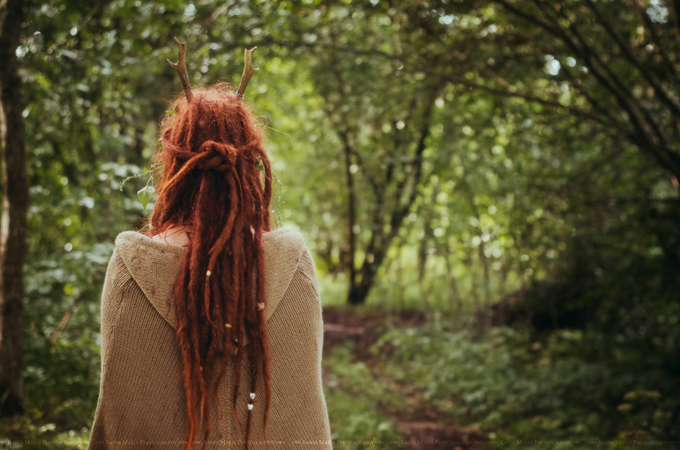
This is a reblog from my channel at SageWoman. Photo credit: Keeper of the Forest, by Rania Maria

elen1

She is with me – I can feel Her as soon as I step out the door.  She calls to me, she pulls me further away from the houses of humanity, deeper into the wilds; the windswept heath, the dark forest, the bright birch glades.  I smile and answer her call with a song in my heart, my footsteps getting lighter and lighter as I head out to meet Her. I walk taller, with more grace, my body flowing and moving without the restrictions that are usually placed upon it.  I feel an almost eldritch tingling in my blood – the awen is awakened.

My sense of self fades away, sloughing off in evanescent shades flowing behind me to melt into nothingness.  I blend in with my surroundings – wearing faded greens and browns but also my personal space, my nemeton, dissolving into the land around me. This dissolution, this immersion in the landscape brings me closer to Her.

Each step is a sacred prayer.  Gentle, aware, heel rolling to toe, I feel the earth beneath my feet.  This land is holy ground.  The air is sweet, tinged with scents of Spring and I see it reflected in the budding narcissus, the already blooming crocus.  The birds have changed their songs to those that speak of warmth and sunshine, soft rains and the greening.

My joy in Her flows out of me and back inwards in an endless cycle.  That joy is a quiet joy – there is no need to shout, no need for a fuss.  It is pure, it is simple. It is utter awareness of the present moment, and the present moment is all that there is.

I look into the shadows beneath a stand of low pines, and there they are – her children.  A small herd, of about a dozen, lie beneath the darkened canopy where no footpaths lie.  Here they can rest undisturbed.  I greet them ever so softly with my mind – I do not enter into myself to do this – it is merely an honouring and acknowledgement of their beauty without breaking the immersion in the present moment.

I continue on, blessed by the gift of seeing her children.  I know that I will see more.  I know too that I am of Her, related to Her, to her children.  She is within me and I am within her. The deer are within me and I am within them.  I only have to open my awareness to this to see the brilliance of this blessed gift. So simple, so easy.

The sunlight is warm upon my skin, the breeze is cool, playing with my hair and scarves, making them dance in the wind.  I come to a very special place, and there they are – a herd seventy strong.  They see me and wait – I wait also, allowing them the first move.  The leaders are then startled by something, and they run across the open grassland from forest cover to the cover of brush, all in a line, along a sacred trackway that they have made over hundreds of years.  This is Her trackway, and I watch with soaring spirit as they follow the flow of spirit across the heath.

I go to the birch trees to offer my greetings and leave a gift – a brilliant white egg-shaped stone I found amongst the heather.  I then make my way back across the heath, coming across the trackway that cuts the green sward in half.  I can still feel their energy – their silent, swift energy running towards the pine trees and dried bracken.  As I cross that line, I feel it moving through me, and I swirl it through my soul before letting it run free again along the deer path.  I am filled with golden light.

I can feel Her eyes upon me, watching from the forest edge.  Her antlered head is thrown back with laughter, Her green eyes dancing even as my soul dances.  Silently she shares in my joy and I in Hers, and then she disappears.

I make my way back towards home – there are a couple of deer hidden among the brush near to one of the paths I wish to take. I do not want to startle them – I choose another path.  Moving along the forest edge I look up, and see the large herd again, this time ghosting through the trees, running silently and swiftly between the beech trunks, flashes of light and darkness.  I bend down where I stand and bring my hands to the rich mossy ground.  Looking down, my pale skin shines silver-white in the light against the vibrant green of the soft carpet, as if moonlight, not sunlight shone upon them.  I close my eyes and breathe deep into the earth, giving of myself to Her.

Making my way homewards, I am always loathe to leave Her sacred ground.  She is always within my heart, and always within my spirit – a sense of wildness, of laughter and play, of wariness and strength.  She is muted when indoors, but She is there, deep within my soul even as I greet my Lady of Sanctuary upon entering the home. She smiles and reaches out to her Sister, Nemetona, the Lady of the Sacred Grove.

She is Elen, the wild goddess.  I honour Her with all that I am.

To find out more about my writing, please visit my author page at Amazon, where you will details on my books such as The Book of Hedge Druidry as well as The Path of the Hedge Witch

The Present Moment

mudraThe present moment – it is a gift, and that is why they called it the ‘present’.

This quote is true on so many levels.  When we are awake, when we are aware to the present moment, we can see it for the very real blessing that it is. For the majority of people who aren’t living in fear through war or famine, who aren’t suffering from chronic pain or disease – simply being in the present moment is the greatest gift we can give to ourselves. Being aware of the present moment, even when faced with such conditions, may help to alleviate suffering.

When we wake up in the morning, we can become fully aware of that moment upon waking. We can lie in bed, feeling our selves in our bodies, listening to any sounds around us. We can do a mental body scan, to see how we feel, if there is any pain or stiffness, any tightness held through residual stress. We can consciously work to try and let that go, in order to start the day right.

We get up, we go to the bathroom.  We can do this with full awareness. When brushing our teeth, we hear the water flowing through the tap, we give thanks that we have clean water at our disposal when so many others do not.  We brush our teeth while concentrating on the simple task of brushing our teeth. So often our minds are already in a meeting at work, that when we brush our teeth, the whole meeting is there brushing our teeth with us!

Concentrating on one task at a time not only does a better job at the task itself, but can also help us to overcome areas in our lives when we are not at the best we can be – say, due to stress perhaps, or depression. If we focus on one task at a time, taking it and really being in each moment, we do not have the opportunity to be stressed, for to be stressed we need to be thinking ahead.  We alleviate our own suffering by being fully aware – in the case of depression, we may not see an end to the suffering, which brings it about in a continuous cycle. By being in the moment, we are not looking forwards or backwards, inwards our outwards – we are simply being.

By being, we are not mindless zombies – we are, in fact, more fully aware than most people by using concentration and focus in order to move about our daily existence.  We will make less mistakes, we will be less clumsy. We will brush our teeth so much better. We will be mindful of each step we take, and so we will trip less, stumble less, walking in total awareness to wherever it is that we need to go.

We eat our breakfast mindfully, thankful for having food to eat. We close the door to our houses, thankful  that we have a home, a sanctuary from the elements in which to live.  We drive our cars mindfully, thankful that we have such luxurious modes of transportation. We work, thankful that we have a job to provide us with the means for food and shelter, as well as the opportunity to work with others, be creative, make the world a better place – whatever it is that your job entails. We do our work with full attention, whether it is sweeping a floor or updating a database. We are mindful of our posture during the work, of our breathing – we take moments to simply be, to assess our bodies and our minds.

Try doing this for an hour or so a day, then a full morning.  Try to maintain awareness for as long as the sun is shining, or the rain is raining.  Become more aware not only of yourself but of your environment. By doing so, you will find that life may flow more easily and that you see where you can fit in more harmoniously.  Your actions will become more graceful, your movements filled with awareness and intention. Let your thoughts follow your body, flowing gracefully and with intention instead of running rampant through the mind.

Notice how this makes you feel – and if it feels good, keep doing it! May you all be gifted with the present.

Sanctuary, Compassion and Freedom

We all need a little sanctuary in our lives. A place where we can let down our walls, let the barriers fall and simply be ourselves, wrapped in the security and safety of knowing that we are held.  My patron goddess, Nemetona, provides me with many opportunities to savour this precious moment, and to help create it for others.  She is the Lady of Holding, of Sacred Space, of Sanctuary.

Often when we meet others, especially human beings, our walls shoot up if they haven’t already been erected, and we are on the defensive.  We regard others warily, perhaps even as enemies; guilty until proven innocent.  A certain wariness around strangers makes sense – it’s an innate human instinct that we also see reflected elsewhere in the animal kingdom.  It is a form of self-preservation.  However, what I would posit is that we become so used to keeping those walls up, that we barricade ourselves inside our selves, unable to see the bigger picture, unable to truly experience compassion.

I am not saying that we should allow others to do as they will to us – wilfully harming another person in any way is completely wrong.  So often when I speak of compassion, people think it is an open invitation to be trod upon, to be used and abused by those who would seek to take advantage of us.  Instead, I try to explain the ideas of compassion, and also of engaged Buddhism – simply put, compassion is about trying to understand, to see around our own sense of self into the bigger picture. Engaged Buddhism is being active in a world to stop suffering, to speak up against violence and injustice and work to spread love and compassion.

My Lady Nemetona helps me with this.  By coming into her sacred embrace, I find that I remember what it is like to be open, to be held, to be free in utter sanctuary.  Thus inspired, I try to find ways to bring that inspiration out into the wider world, making it a better place.  When we are held, when we are free to be our true selves, we also provide the opportunity for awen, for inspiration, to fill our souls with joy and wonder at the simplicity of simply being.  We can then become a conduit for this energy, bringing about positive change in the world, even in the midst of suffering.

Working with Nemetona, we become aware of our boundaries, when we erect them and when we let them dissolve. We also see how we involuntarily create barriers, whether it is in our energetic fields, our communication, or our perception.  Through meditation and work with this particular goddess, I have found a way of both strengthening my inner sanctuary, thereby being able to let down those walls and openly experience situations with complete awareness.  In this, intention is key.

By being open, I am also being receptive to input that might otherwise pass me by through my own ego-centric mindlessness.  By working with sanctuary, I can see where I have lapsed and allowed others to abuse my trust, and where I will never allow that to happen again.  By being aware of how, why and who we engage with, and with what intention, we can change how we react to situation, acting with intention instead of a more reactionary type of living.  By becoming engaged with my boundaries, I am aware of when I need to strengthen or release them as appropriate.

It’s been a tough ride, sometimes, working with this goddess and with compassion.  It has shown me where I have failed so many times in the past.  Understanding and awareness of those failures, however, is not there to deter me; they are there to remind me, lessons learned and opportunities for further growth.  The key to working with boundaries and compassion, and indeed Nemetona Herself, lies in awareness – of the self, of others and of the world at large.  It’s not an easy path, but one well worth walking. It can lead us down the shadowy paths in the long dark night of the soul, but we can emerge into the light of the sacred forest grove, whether it be dappled sunlight, pale moonlight or starshine.  In that emergence lies our true nature, inspired by nature and surrounded by our natural sanctuary.

In that emergence lies our freedom.

Slow Down…

teaSlow down.

This little phrase may not only save your life, but can continue to make your life a lot easier.  I’ve been slowing down a lot this year, saying “no” to many things, acknowledging that there is already enough on my plate.  I’m taking time to simply be, to be in the moment, to stop the running around and to well and truly live.

Slowing down, physically, (and mentally, as a result – thoughts eventually stop racing around in your mind when your body slows down) can bring new joys in an otherwise missed-out world.  Eat your breakfast mindfully, slowly. Drink your tea mindfully, slowly.  Drive your car mindfully, slowly.  Just try these three things for the first week and you will notice a distinct improvement in how you feel. It’s amazing how changing small habits can have such a grand effect.

Eating and drinking too quickly, unaware of your food, can lead to stomach upsets, food waste, and over-eating just to name a few things.  Driving too quickly can result in loss of control of your car, and ultimately your life or the life of another.  Taking the time to really be in the moment of these “little” things, these everyday things, can bring a new awareness and gratitude for the small pleasures in life.

Feel the consistency of your breakfast banana, really smell it, touch it, run your fingers over it before you even peel it and begin eating.  Be thankful that you have that banana to eat. Savour each mouthful, chewing slowly, swallowing purposefully – it may sound silly, but just try it.  Drink your tea in beautiful china cups, taking the time to brew it carefully in a teapot, aware of every movement of your body as you do so.  Pour the tea with full awareness.  Raise the cup, feel the smooth porcelain on your lips just before the warm liquid dances on your tongue.  Be thankful that you have tea.  Touch your car before getting into it.  Sit down gracefully, feeling your body in the seat.  Start the engine mindfully, and drive with total awareness of the steering wheel beneath your hands, the road beneath the tires.  Be thankful that you have a car.

By slowing down you will may find yourself less stressed when you get to work, or when you arrive back home from work.  We are not meant to live under the constant stress that our everyday lives present us when we live un-mindfully.  By taking a few moments to slow down, to become aware of where we are and what we are doing, we can help heal and restore the balance in our lives.

Where Prayer and Meditation Meet…

meditationMeditation and prayer are sometimes seen as the same thing. It depends on what tradition you belong to, what form of meditation you take, and how you define prayer.  For some in the Christian tradition, prayer is about talking to God, meditation is about listening to God.  Others see prayer as a form of magic, with words and thoughts sent out in the hopes of altering what seems to be a predetermined course. Others still see prayer as a moment to reflect on our lives, and develop gratitude and compassion.  All of these things can be applied to meditation as well.

We meditate in order to create harmony in our lives, to work through a problem, to live a more authentic life filled with awareness. There is a goal in mind, even in Zen meditation, where we come across the conundrum of the goalless goal. Seeing our lives for the wonder that they are, we also raise compassion and empathy for all things within our souls.  The lines between prayer and meditation often blur.

Where prayer and meditation meet is in that quiet stillness, like that moment at dusk, when the world is hushed and we can truly listen, not only with our ears but with our hearts. It is a moment of utter peace, in the here and now. It is life, plain and simple.

The Little Pagan Monastery Retreat

We’ve got our weekend retreat coming up! 11 – 13 April, Chalice Well Gardens, Glastonbury, UK

Experience a weekend filled with devotion to the gods, the land and the ancestors – with prayer, meditation, discussion and ritual, as well as visiting sacred sites such as Glastonbury Tor and the White Spring on this unique retreat, The Little Pagan Monastery.  Stay at Chalice Well & gardens, at Little St Michaels where you will have 24 hour access to one of Albion’s most sacred places during your stay.  Incorporate daily prayer and ritual into your life, make new friends and enjoy some time spent away in an inspirational setting with like-minded people.

To book, please visit: The Little Pagan Monastery

Little Pagan Monastery Itinerary

Friday
5pm onwards – arrivals
6pm – Welcome talk
6.30pm – Supper
8pm – Evening prayer and group meditation
9pm – Free time

Saturday
7.30am – Morning personal meditation
8am – Morning Prayers and group meditation
9am – Breakfast
10.30 am – Discussion
12 noon – Midday prayers and group meditation
1pm – Lunch
2.30pm – Glastonbury Tor walk and meditation
5pm – Free time/gardening work
6pm – Supper
7.30pm – Discussion
9pm – Evening prayers

Sunday
7.30am – Morning personal meditation
8am – Morning Prayers and group meditation, followed by ritual
9am – Breakfast
10.30 am – White Spring visit
12 noon – Midday prayers and group meditation
1pm – Lunch
2.30pm – Farewell

Engaged Buddhism

Witnessing a discussion on social media made me a little uneasy at the way people treat other people whom they believe are wrong, either in virtual or real life.  I have seen this in the past many times; sometimes it is abuse, mockery, or belittling – yet each time it stops and makes me think about what I am doing to affect the world, looking at my reasoning, my motives, my intention. What I have been working on this past year is that those who disagree with us, those who challenge us, those who we absolutely hate, those we think are harmful to our world – all these people we need to accept.

Accept, you say?

Acceptance, yes, but in an egaged way.  This is not passivism.  Thich Naht Hanh coined the phrase “engaged Buddhism”, and this is active compassion in trying to create a better world.  Essentially, we accept that there are people out there who are different from us; we accept the world for being the crazy, mixed up, sometimes awful, sometimes beautiful place that it is.  We do not mock other’s beliefs, just as much as we do not condone the beliefs of others that we think are harmful and that cause suffering.

It’s a little hard to get the head around this concept. It’s taken me months to see where that balance point lies.

Thich Nhat Hanh wrote 14 principles of engaged Buddhism. The first one is the best.

“Do not be idolatrous about or bound to any doctrine, theory, or ideology, even Buddhist ones. Buddhist systems of thought are guiding means; they are not absolute truth.”

I personally love this. It reminds us that ideas are just that – ideas. It also demonstrates that everyone’s perception differs in slight or large ways, and that being bound up in our opinions can cause huge amounts of suffering.  Our opinions are constantly changing – as we learn and grow, as we sacrifice ignorance, we change.  This is reflected in the second principle –

“Do not think the knowledge you presently possess is changeless, absolute truth. Avoid being narrow minded and bound to present views. Learn and practice nonattachment from views in order to be open to receive others’ viewpoints. Truth is found in life and not merely in conceptual knowledge. Be ready to learn throughout your entire life and to observe reality in yourself and in the world at all times”.

Number three covers the area of engaged Buddhism, where we confront issues that we think could be harmful to others.

“Do not force others, including children, by any means whatsoever, to adopt your views, whether by authority, threat, money, propaganda, or even education. However, through compassionate dialogue, help others renounce fanaticism and narrow-mindedness.”

Note that here the key word is compassion – compassion is creating an understanding of all points of view and working respectfully with that new understanding to find a resolution if there is confrontation. Sometimes resolution cannot be found, but that does not mean we should stop trying, for who knows when the tides may turn? Thich Naht Hanh worked tirelessly during the Vietnam War, helping those who suffered from the tragedy that conflict brings. He never took a side, and was therefore looked upon with suspicion from both sides, eventually exiled from Vietnam after he went to speak in the United States about ending the suffering caused by war.

So often people think that the Buddhist notion of compassion is loving all things and allowing yourself to become a doormat.  The ninth principle covers this neatly;

“Do not say untruthful things for the sake of personal interest or to impress people. Do not utter words that cause division and hatred. Do not spread news that you do not know to be certain. Do not criticize or condemn things of which you are not sure. Always speak truthfully and constructively. Have the courage to speak out about situations of injustice, even when doing so may threaten your own safety.”

It is possible to speak out against an injustice in the world, against something you believe is wrong, without using words that cause division and hatred. Thich Nhat Hanh has been doing this for over half a century.  Using hateful terms, mockery and discredit of a person’s character are usually our first instincts in a confrontational situation. Stopping, pausing and truly thinking a situation out before you speak or act can result in much smoother and compassionate dialogue.  Instead of instantly reacting to a situation, you are engaging with the other person, not seeing an “Us and Them” concept but one of a unified world, where we are all connected.  I personally do truly believe that what we say, we are. Having studied the Buddhist principle of Right Speech on the Eightfold Path for a while now, it has changed my behaviour, how I act instead of reacting to a situation.  It has really been an eye-opener.

These are but a few principles of this concept of engaged Buddhism – more can be found out through his book,  ‘Interbeing’: Fourteen Guidelines for Engaged Buddhism, revised edition: Oct. l993 by Thich Nhat Hanh, published by Parallax Press, Berkeley, California.

May our hearts be open so that we can love those who challenge us, and in doing so create a world where harmony instead of discord is the song that we sing. It can be so tremendously difficult when those who challenge us are harming others with their actions.  May we engage instead of reacting. May we speak from our hearts, with love, compassion and kindess.

(To see all fourteen precepts of engaged Buddhsim, you can read them here)

Deep Paganism

Reblogged from my articles at Moon Books – http://moon-books.net/blogs/moonbooks/deep-paganism/

As Pagans I feel that we naturally tend towards a worldview that is less anthropocentric, especially if we follow an animistic path.  Our love of nature, whether it is the world around us, or human nature, or both leads us on a journey that can take us outside of our selves, and thereby gaining a wider perspective on the whole.

Deep ecology is about thinking less about the benefits towards humanity, and more about the benefits to the environment. Buddhism, with its tenets of compassion, is very much in a similar vein; we try to drop the ego in order to benefit the world, and by becoming less self-centred, are better able to help others.  Some spiritual and secular journeys can put too much stress on human relations, and not enough on the wider web of life.  Within Paganism, we can see that we are always connected, and that connection is what inspires us to lead a life more attuned to the natural cycles, or vice versa.

In my own Druidry, what I seek is total immersion in my natural environment. I strive to loosen my sense of self as an individual and instead seek to blend my song with that of the world around me, finding a harmonious union.  When out walking on the heath or in the woodland, I let the “I” drop away, and become totally immersed in the present moment. I feel that this gives me a greater connection to the world, allowing what Buddhism calls the dharma to flow.  Dharma is simply reality, which we so often tend to avoid at all costs. When we realise the beauty of the present moment, when we can truly live it in every sense of the word, then we are truly connected to everything.  We become part of everything, and in this I also see the Druid concept of awen, or flowing inspiration; the life force itself.

If I can free myself of myself, I can open truly to the songs of the universe.  There is no separation – I am the heath, the forest, the deer.  Movements are made in full awareness, and every step is taken in love and reverence. Every breath is a blessing. Everything my eye falls upon is a gift.

In living such a life, what is fundamental is a respect for all things. This is at the heart of animism, which sees the inherent value in all things just as they are.  No one thing is more worthy than another. Each thing is an expression of itself in full blossom, in full fruition.  Even my self, my physical self, is simply energy taking form as my body in this present momen t and perhaps even my mind), for however long or short a time span.  This body is in permanent change and flux, growing and changing shape, eventually dying. In death the change continues, and the form alongside the energy flows in different currents. My body will continue to change, as cells break down and bacteria work to return the physical form to the earth.  The process of life and death, of decay and regeneration is honoured within Druidry and within animism. No one process even is more important than the other. Birth is no more important than death. What we do realise is that life has no opposite – there is only flow, change, awen.

My sense of self is of little consequence in the grand scheme of things. What matters is that I pay attention to what is happening around me, and use that to inspire me to live my life accordingly, with honour and respect.  Paganism allows us to leave behind all the machinations of humanity to follow a different flow, one where we see where we fit in the puzzle.  The love of nature inspires us along the path, demonstrating that there is more to the world that our own human lives.  We are the country folk, the paganus. Even though we may live in cities, we still feel the pull and hum of nature around us, reflected in the sun’s cycles, the seasons, the flows of human nature.

Immersion is key.  If we can allow ourselves to not only ride the current, but become one with the flow itself, we are then blessed with a wholly different perspective not based upon human need and desire.  There is much more to the world than our anthropocentric view, and we honour that world with all that we are.