Living a Charmed Life

While the winds howl outside as winter lets us know that just because we have celebrated Imbolc, it doesn’t yet mean Spring is here, I have taken the last two weeks to rest in solitude. Staying home, organising and having a big clear-out, cleaning and simplifying has been a challenging fortnight. After the big family gatherings and the busy pace of the Yuletide holidays, Imbolc is often a quiet time for reflection. Being thrust into solitude after weeks spent with happy, noisy family members can be quite a shock to the system, but there are lessons to be learned with everything in life.

I give thanks that I have a home, a beautiful home that shelters me from the winter’s rages. As I lie in bed and hear the wind whipping around the house, the rain lashing against the window panes I remember that there are many who do not have this luxury, both human and non-human. As I walk outside in my garden, seeing the snowdrops and the crocus, the daffodils and the hellebore in flower I am reminded of the quiet, elegant beauty that exists even as the torrential storms pass overhead. The white serpent energy is slowly stirring in the ground beneath my feet, connecting all the areas of these sacred isles in a web of existence upon whose threads we can travel, if we dare. The hearth flame is utterly sacred, whether it is candles burning upon the mantlepiece or a cozy fire crackling in the evening. Being utterly awake to all these things reminds me of the constant stream of blessings and the sacredness of everything. There is nothing mundane in this world.

Chanting prayers to Brighid upon rising, giving thanks as the sun shines upon a new day, singing songs to the land as I dig into the earth of my garden, I know that there is no separation between what is sacred and what is not. I have come to realise that reciting little chants and prayers throughout the day helps to remind me of the sacredness of each and every moment, from preparing and eating food to cleaning the floors and windows, to laying myself down each night in the shelter of my home, my husband and cats with me. Inspired by the charms and chants, blessings and prayers found in works such as the Carmina Gadelica has led me to create my own, which is an incredibly fun thing to do in and of itself. But when applied to everyday life, singing my prayers throughout the day I really feel an ever deeper connection to the gods, the ancestors and the spirits of place. I can’t take them for granted anymore.

It brings a whole new meaning to living a charmed life.

Blessings of Imbolc!

http://www.paintingdreams

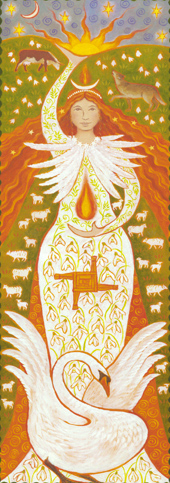
Brighid by Wendy Andrew http://www.paintingdreams.co.uk


Blessings of Imbolc!

It has been a mild winter here in the UK, and though where I live in Suffolk we haven’t had any floods, the ground is wet and squishy (where it isn’t sandy) and everything is looking forward to a good drying out. The little lawn out back has done its usual shift from grass to moss, and is utterly delightful underfoot (though wet). Deer and pheasants are regular visitors, especially now that food is becoming scarce and we put out birdseed, apples and bread daily. My husband did the RSPB Birdwatch yesterday, and we had a good number of different species to record and submit.

The land is stirring slowly from its light slumber. Last weekend at Druid College we noticed the blackthorn is in flower already, and we had two daffodils over the winter solstice on the south slope of our garden. The buds are on the birch and apple trees, the crocuses are poking through, and colour is slowly returning to the green and brown palette of winter.

As we were out walking yesterday, we felt the sun upon our backs, stronger and warmer than it had been for a long time. The scents from the ground rose to greet our noses with a wonderful sharp, earthy smell. The birdsong is changing, and the badger mums are out in full force foraging to keep their bellies full and provide milk for their young.

It’s a soft time of year, when things happen slowly, unlike the Spring Equinox, when everything seems to happen at lightning speed. We awaken groggy from our slumber, and move with care, taking our time and not rushing anything. This is the goddess Brighid’s time, a deity of infinite patience and understanding, of mindfulness and co-operation.

Tonight I shall be holding vigil after sunset, and on the morrow honouring Her with all that I am. Having spent the last three years getting to know Her better, a shift in our relationship seems nigh, and I eagerly anticipate working with Her guidance and inspiration on an even deeper level. She is the land of Britain itself, the green paddocks and pastures, the brown heathland, the dark forests and wind-swept moors. She is the serpent energy lying just beneath the surface of the earth, stirring it awake with her sinuous movement. She is the holy well and sacred flame. She is inspiration. She is the adder basking in the sun, the ewe and the lamb, the cattle that is so much a part of our history.

I know not what this year holds, but I do know that I walk it with Brighid.


I kindle my soul with the flame of Brighid:

Flame of courage, flame of joy.

Blessings of the deep well be upon me:

Drops of awen on my lips, on my work.

May Brighid guide me in my endeavours

This day and every day.


I lay myself upon the anvil of Brighid;

May my soul be tempered by experience,

May my heart be strengthened with compassion,

May my thoughts be shaped by love,

May I walk forth anew with the blessings of Brighid,

The Forger and the Flame.

Exploring Pagan Ethical Codes

The brilliant writer and Druid, Brendan Myers and I were interviewed recently by The Wild Hunt for their new series on Pagan Ethical Codes. Click HERE for the full interview!


Tyranny and the Oak

Tyranny and the Oak

Yesterday when I came home from work and walked through my door, I nearly burst into tears. Only days after agreeing on climate change policies in Paris, the UK government approved fracking under our national parks. Yes, protected areas of natural beauty and wilderness are now open to being fracked, so long as it is started just outside the park boundary. What’s worse, and which isn’t being talked about so much, is that the government has a veto power to override any area that has said “no” to fracking. Standing in the porch, despair just settled in, as it doesn’t seem to matter what we do, what we say, or how we live our lives. Those in power who are trying to line their own pockets and those of their constituents will do what they like, regardless. What’s the point?

Later that evening, as I lay in bed, unable to sleep, I tried to look beyond the despair, to see the situation from another perspective. As a Druid, I considered where I take my inspiration, where my soul finds sustenance, where that deep relationship happens that enables me to carry on, day after day. Where does the Druid get inspiration from? The Druid’s authority is nature. Not the government, not humanity, but nature. Looking deeply into the natural world, we can see how we can be in the world, continuing in our quest to live with honour and integrity, to the best of our abilities.

I thought of the oak tree. Druid; dru, meaning oak, and wid, meaning wisdom. The wisdom of the oak. What was the wisdom of the oak that could help lift me out of this despair, to continue to live in a tyrannical country where the people’s voices are not heard?

The oak tree grows, from a little acorn, into the best tree that it can dependent upon the conditions of its environment. Whether the soil is poor or good, the weather favourable or not, the tree will grow to the best of its ability, fulfilling its potential as an oak tree, singing its song clearly. Sometimes the conditions are perfect; sometimes they lead to the demise of the tree but still the tree carries on as best it can. One of two oak trees that I love split in half a couple of years ago in a wind storm, and yet it still carries on, the fallen half only half alive, the other half continuing as if nothing had changed. It knows its purpose as an oak tree, to grow, to live, to be in its environment. There are several old oaks trees around here that have suffered greatly from past storms, old age and more. But still they carry on. They inspire me.

Yes, someone could cut them down tomorrow. That does not mean that they will not be the best oak trees they can be right now. That does not mean that they will not produce acorns in the fall, or drop their leaves to sustain them through winter and spring. It does not mean that they will not provide food and shelter for those living near them. The wisdom of the oak.

I will continue to do what I can. I will continue to give, to care, to follow my Druid’s inspiration, the wisdom of the oak. Even if I break, even if I fall, still the dru wid will carry me. I will continue to live my live utterly dedicated to my gods, the ancestors, and the natural world. I will continue to seek deep integration with the land, and let the example of how I live my life to be my song sung into the winter’s night, filled with gratitude and reverence. I will continue to see the many blessings, and work against those seek to use nature only as a resource, fulfilling their greedy and empty lives with the hollow intake of cash. The oak tree will whisper its wisdom, to carry on, to grow, wherever you have taken root, wherever life takes you, whatever condition you find yourself in. And if you do this, you do not fail, you cannot fail, for you have found the meaning of life.

“Modern Druidry” – Talk given at the Woodbridge Mind Body Spirit Festival

Here’s my talk from this Saturday’s Mind Body Spirit Festival here in Suffolk – hope you enjoy it!

Toxic consumption

Leo Babuata’s recent blog post about reality came at a serendipitous moment when I was reading Thich Nhat Hanh’s “The World We Have: A Buddhist Approach to Peace and Ecology“. It is often said that we create our own reality, but I think that those words are often misinterpreted. Those who are suffering from famine or abuse have not necessarily created that reality – everyone’s reality is also a combination of others’ reality. However, what Leo and Thay point out that it is what we consume that helps to create our reality.

We are a consumer culture, here in the West. Some of us are trying to bring more awareness to what we consume, whether that is in material goods, food, petrol or electricity consumption, etc. What Leo and Thay speak of however is what we are consuming with our soul, with our heart, with our brain, mainly through media but also in the form of speech, gossip, etc. Thay speaks eloquently about this matter, stating that a lot of what we visually consume from the media is toxic. We watch television shows that are violent, or that pit people against each other in dishonourable ways. We are influenced by advertising. We may speak ill or dishonestly of others, or about ourselves. When we are doing this, we are taking in a toxicity that affects our very being. We can stand up for ourselves, certainly, speaking out against injustice with honesty and awareness. It doesn’t mean we will never speak out. What it does mean is that we become engaged in our living, in our being, in a positive way that benefits the whole, not just the self.

Life is a choice, for the most part. We can choose to not take in this toxicity, or be a part of it. That is not to say that we shut ourselves off from what is happening in the world. We need to know of the suffering that is occurring in the world in order to help alleviate it. But we can say no to violence as entertainment, to disrespect someone in order to “pass the time”. Everyone knows the saying “You are what you eat”. Let’s open this out to everything else that we consume. We can choose to be a part of this world, aware of what is happening, without taking in the vast amounts of toxic images and words; it is within our power.

Be aware of the world. Know that people are suffering from a horrific tragedy in Kenya. Know that people are suffering in your own hometown. Know too that you can choose to not play violent video games, or watch gory movies, to intake that violence into your consciousness. You can fill your heart with peace and loving kindness – it is your choice. You don’t have to read that magazine with photoshopped men and women. You don’t have to comment negatively on someone’s Facebook status. You don’t have to gossip about someone, or read about it in the latest trashy mag. You choose what you put out there into the world.

When we fill ourselves with positive things instead of toxic things, we can hopefully make this world a better place. What are your thoughts?

Peace in Druidry

The word peace means many different things to many different people. Some see peace as simply the cessation of aggression or violence. Others see it as a way of life, a philosophy. Still again others see it as a mere dream, while others see it as the ultimate goal. But just what is peace, and what does it mean in a Druid context?

In our society, we strive for so much. Some things are worth working for, putting all our heart and soul into, such as equality, environmentalism and a better way of life for all beings. Some things we strive for are not so worthy – material wealth, social, economic and political power, fame or authority. For many in today’s society, it’s a dog eat dog world, and to get ahead you have to step over others in the race for the top. In reality, there is no top rung on that ladder – there isn’t even a ladder to begin with. All these notions of power are entirely illusionary, when looked at from a basic ultimate view that we are all just beings co-existing with each other on this little planet. Allow me explain.

The illusion of separateness has caused our world so much pain. When we see ourselves as separate, we begin to lose the notion of the sacredness in everything. There is absolutely no possible way for anyone or anything to be separate from anything else. We human beings are made up of minerals and atoms, of genetic information from all our ancestors (human and non-human), of sunlight and wind and rain. We are all star-stuff. We have not come out of nowhere, to suddenly exist and then just as suddenly depart when our earthly lives are snuffed out. The clouds in the sky have always been, and always will be. They may change their form, becoming humid wisps of cloud and ice, to larger clouds that then change into rain. That rain falls onto the earth, to be drunk by human and non-human animals alike, by the garden plants and the trees, by the birds and the bees. This water is released once more into the atmosphere through a myriad of ways – sweat, piss, moist exhalation, dewdrops. Back into the sky it goes, to once again form a cloud. We have clouds within our bodies, in the food that we eat, in the water that we drink, in our genetic makeup. We are clouds and the clouds are us.

Once we see the interconnectedness of all things, we realise that to strive for power or control over anything is as fleeting as the life of a cloud. All things are connected, and all things are impermanent. This is an essential tenet of Eastern philosophies, which is strongly reflected in a Druid’s perspective when viewed as part of the natural cycle. Nothing ever stays the same, not the river, not the sky, not the grass, not the tadpole. Everything is in constant change and flux. The key to finding peace within this constant change is acceptance of the impermanence, allowing our hearts to find ease from the fears and insecurities that arise when we fight against change.

A wave does not stress out about dying when it crashes upon the shoreline. It knows that it is water. The wave is simply the form that it took for however long a time. It knows that it is connected with everything else on this planet – there is nothing that exists outside it in a separate context. The web of life, the threads of connections are all around us. When we see those threads we lose the fear of death, instead seeing the cycles that allow us to really come to terms with the concept of changing forms. Death is not annihilation – it is simply becoming a new form, a new way of being.

The basic fact of life is that we will all die. So what is this struggle, what is this constant striving towards ideas of ownership, of power and rule, of games played with lives? To what purpose does it serve when we will all return to the earth in some form or another, when we come to an understanding that we are not separate from anything else? When can we move from concepts such as birth and death?

As humans we have developed a sense of self-awareness that actually hinders the possibility of finding a true and real sense of peace. We are often so self-focused that we are blinkered to everything else, to the entirety of existence. When we are only in tune with ourselves, how can we ever find harmony without? Stuck within the whirls and eddies of the mind, we will never notice the birdsong, or the rain upon our shoulders, the cry of a hungry child or the yowl of a cat in heat. When we look beyond ourselves is when we will be able to find peace. When we are able to work for the benefit of others instead of just ourselves, the world will know harmony. As we are all co-existing on this planet, it just makes sense to work together. However, the illusion of separateness is strong.

Peace is not just something for stoned hippies to think about and discuss – it is a very real and powerful way of being in the world. Through sensing our connection to the world we find a place of true power, power that comes from within that allows us to work for the benefit of all. This power cannot and will never be a “power over” anyone or anything else, as writer and activist Starhawk expresses often in her work. This power from within is the deep core of true expression, of a sustainable relationship working in tune with the entirety of existence.

Peace is not just a cessation to war and violence. Peace comes from a very real and deep understanding of our selves, of our behaviour and our way of being in the world. Many people within the pagan community seek to find a better way of being in the world. They focus on working on the self, through years of self-discovery, journeys, pilgrimages, workshops, training and the like. For many, the journey stops there, at the betterment of the self. What I would posit in this essay is that in order to bring about true peace in the world, we then have to let go of ideas of the self, in order to focus on the wider world. It is a letting go of the blinkers that hinder our ability to work with others compassionately, in real empathy and attunement to the natural cycles.

This is deep integration, of immersion in the world to allow for true peace to flow. Where there are no barriers of you and me, no sense of the “other”, then we can truly work together to bring balance and harmony to our world. It is often said in historical and academic accounts that Druids were the peacemakers of their world and their society. Did they have a deep understanding of the connectedness of all life, did they allow their sense of self to fall away in order to bring about peace between warring tribes, between the workings of the human race and other species, in their work with the gods? We will never know, but it is something that I think is perhaps lost in today’s Druidry.

Peace is often not the main focus for those who come to Druidry. They often seek a spiritual path that allows them to explore the true nature of their self, to affirm their beliefs in a like-minded community. This is brilliant, and of course very useful for all, however it cannot end there. In my opinion, there must be a return for the lessons that we learn, an exchange, a flow from one to the other that allows for true and sustainable relationship. When we step beyond our selves and begin to truly understand what it means as a Druid to live a life in service to the gods, the community and the land then we are really coming to terms with the concept of peace within a Druid context.

Too many are living a reactionary life, caught within the trapping of their minds and unwilling or unable to see the world around them and their part in the weave that is the tapestry of life. They cannot sense all the other threads around them, or if they do sometimes they feel competition, or aggressiveness towards them. It is a sickness in our culture and society that we are brought up in such an environment. Instead of supporting each other and rooting for each other, if we have an issue with someone we do the exact opposite, for whatever reason. In sacred relationship, especially within a Druid context, we don’t have to like everyone we meet or interact with. However, we can see them for what they are: a part of the sacredness in all life. As Bobcat once wrote many years ago, it’s all about sacred relationship – when we walk through the woods we avoid the nettles. We don’t have to cut them all down in order to continue, yet we can still honour their existence and their place in the web of life. Essentially, we don’t have to hurt others who may even have hurt us – if we do that, we are simply living reactionary lives. Let’s live active lives instead, claiming full responsibility for our actions and in doing so achieve peace. Even if others hurt us, we don’t have to continue the cycle of hurt – we can walk around the nettles.

Peace must first come from within. If we are hurt or angry, we are not at peace. We must take some time to look at our hurt and our anger, and see where they really stem from. As Zen Buddhist monk Thich Nhat Hanh states, we must take care of our anger in order to transform it. When we finally sit with our emotions, we open the doors to empathy and compassion. Compassion is as mis-interpreted as the concept of peace is: compassion is simply looking at the bigger picture, attempting to understand the whole. It doesn’t necessarily mean unconditional love for all beings, though if we are truly and utterly open in our hearts that will ultimately be the outcome. It’s a tough call for most to make – in fact, only the Buddha himself has done it so far. However, we can take the wisdom of wider learning to help us understand others and thereby finding peace. If someone hurts us, we can sit with our anger and hurt, looking at it relating to our self. We can then extend that investigation – this is where most contemplation ends in day to day life. However, working through an entirely self-focused view, we can then begin to look at the person who hurt us, seeing that they too suffer. It’s not pleasant to cause suffering – not unless there is something severely wrong with the brain and a mental fissure stops that basic understanding and empathy. Have you ever betrayed anyone or said anything unkind? Did it make you feel better? Have you ever intentionally said something to hurt someone? Did you ever believe in the illusion that to being someone down raises you up? We all have. What we can do now is stop that cycle and truly live a life filled with intention, instead of reactionary living.

The Druid looks to nature for inspiration on how to live a live immersed and integrated with the whole. When we see the complex web of existence, when we bring our focus to an ecosystem, we see how everything works with the other in some shape or form to bring about the continuation of existence. We can look to ideas from permaculture, from biology, from ecology in order to grasp that sense of working together to create a beneficent environment. As Druids we don’t look to humanity for authority – we seek that from nature instead.

In gaining the wider perspective we can allow room in our hearts for a deep and abiding peace. We can still work actively in the world to bring about peace – we needn’t suddenly find peace and sit back while the world struggles on around us, our environment is destroyed and people are attacking each other. It means that from a very deep well we can work to nourish our communities, bringing a much-needed draught of inspiration or awen. In doing so, we are Druid.

Reblog: The Solitary Path

Here is a reblog from my channel, Druidheart at SageWoman on the Witches and Pagans website, exploring a little of what the solitary path means to me.

The Solitary Path

Posted by Joanna van der Hoeven on Tuesday, 10 March 2015 in SageWoman Blogs

aloneSome people find comfort and deep learning in solitude. Others find inspiration and wisdom in the interaction with others, where the edges of our souls meet. I find a good balance between the two in my life, needing solitary reflective contemplation and the shared words, laughter and brilliance of my friends to encourage and nourish creativity. I have a strong circle of female friends with whom I share ritual practice, dance, creative crafts and good food, alongside weekends away, sometimes as “girly” weekends, sometimes as spiritual pilgrimages.

I have found ritual with these ladies deeply inspiring, and the bond that it creates reminds me of the sanctity within all our relationships. However, I mostly practice my Druidry on a solitary level, literally walking the wild paths of the heath or deep into the heart of the forest alone. In those moments I feel a deep connection to the world around me, whereas in ritual with others I feel a deep connection to them.

I think a balance is definitely required, in working both alone and with others. But here I shall speak of working alone, and the benefits that can be obtained from following a spiritual path with your own wits, instinct and inspiration to guide you.

I think that more of us need to spend quality time alone. I realise that in our society many people already feel alienated and isolated, but I wonder how much of that stems from not really being able to properly be with your self. I worry about the next generation, who have phones and tablets and a constant barrage of virtual communication that they can resort to anytime they are left alone. I remember a time when my husband was away for a work conference, and feeling the need for human company I went down to the local pub to chat with others from the village at the bar. There was conversation between the customers and the publican, but as soon as she left to go to the kitchen conversation died, and people went straight to their phones rather than talk to each other. I sat there, wondering what on earth has gone wrong with our society in that we cannot talk to each other anymore, but I digress.

The need for other human companionship can be strong, and it’s not a need that we should ignore, being a social species. However, what I would posit is that we certainly do need to learn how to be alone, to listen to ourselves, to become attuned to our thoughts and behaviour in order to better understand ourselves. I strongly feel that when we understand ourselves, we understand others and can be in the world with more empathy and compassion. Often I have taken time out away from the world in order to better understand it – in this I feel a very strong connection with monastic traditions. By removal from the world and the thoughts of others I can better hear the gods, the ancestors and the spirits of place all around me. By spending time alone with my thoughts I learn the cycles that they go through, paying attention to them and really noting them. With a little Zen, when we actually pay attention to our thoughts they don’t control us as much as they might otherwise, offering us an opportunity to live with real intention instead of leading reactive lives.

Spending time in mediation alone, learning how the mind works we can then begin to hear the songs of others as naturally our thoughts quiet down. We have paid them attention, and now that our thoughts have received the attention they desired, they no longer crave more. We hear the birdsong, we feel the sunlight on our skin, the wind in our hair where otherwise we might have been distracted by thoughts, feelings, emotions and situations. The world opens up, and we are once again reminded that the world is more than just us – that we are a part of a beautiful living, breathing system where everything is inter-related. It is an exquisite gift.

Spend more time with yourself. If you can, spend half an hour, an hour or a couple of hours each day alone, perhaps going for a walk or meditating. If at all possible, go on a weekend solo retreat, or a weeklong solo retreat in a place that inspires you, where you can really connect with what is important and with your own beautiful self. Learn to love that self for what she is, for who she is and connect with her, giving her as much time as you would your dearest friends.

When we learn to love our own self, that love will then spill out into the wider world, nourishing and sustaining others.

For more on the solitary path, see my latest book The Awen Alone: Walking the Path of the Solitary Druid, available now through Moon Books.