Lucid dreaming

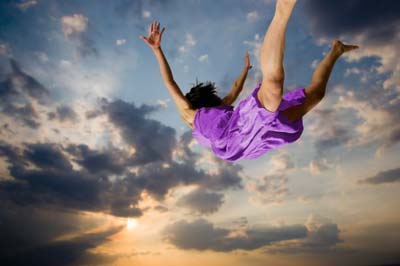
sleep flyingLately I’ve been getting pretty good at flying.

Once a month, or every couple of months, I have a flying dream. Lately they’ve been intentional, as just before I fall asleep, or when I awaken into another sleeping pattern in the middle of the night or early morning, I say to myself “I really fancy another flying dream”. Starting to take control of your dreams is often termed “lucid dreaming”, usually best experienced in lighter stages of sleep than in deep or exhausted sleep. I’ve done this various times, to turn around dreams that have gotten out of hand, situations that are getting ugly, and lately in order to experience true joy and freedom.

My last flying dream a couple of days ago was very interesting. In the previous flying dream, I restricted myself to an abandoned house that my sister was going to buy, so that I could practice flying without anyone knowing. For some reason, it was important to keep this a secret, and not let anyone know of my special power. In the latest dream, I took it outside, and didn’t really care who saw me flying around. It was freedom in every sense.

Feeling a bit homesick, I decided to go and visit my childhood home in flight mode, and then I was flying up my parents’ street, seeing the house and the hills and miles of forest behind. I thought “Wouldn’t it be cool to see my hills and forest from the air? I’ve never seen them from that vantage point. It would be great to see home from a bird’s eye view.” I swooped past the house and rose up high into the air, past the ridge letting the vast expanse opened out before me.

Only it wasn’t home. Or at least, it wasn’t the home of my childhood.

Spreading out before me was the gently rolling hills, fields, hedgerows and landscape of England. I shook my head and went back down for another swoosh up, telling myself that this time I would see home. Again, the same thing happened.

I slowly came out of the dream, exhilarated by all that flying. But I pondered the meaning of my semi-lucid state. I wasn’t able to see what I wanted to see. Or was I?

I have lived in Britain for over 15 years now. This dream has confirmed that this is my home now. While a large part of me will always remain in the hills and valleys, rivers and lakes of my home where I grew up, this is where I do my work, live my life, work with the ancestors and the gods. It was a beautiful affirmation of home, and freedom.

In what I suppose became a semi-lucid state, my sub-conscious helped me to realise and take to heart something that I had only considered in my head. Now I was able to feel it wholly, truly, in my entire being. I feel lucky and blessed.

May you all fly free!


Perception, assumption and suffering

How much of our lives are based around incorrect perceptions? How often does our emotional state and relationship with others fall apart based on incorrect perceptions? And just what is perception?

Perception is how we interpret the world, through our own subjectivity. We have a store consciousness built on our past experiences and those experiences related to us by others. We use this store consciousness to help inform us on our view of the world. It helps us to survive. We know that fire burns, so we don’t touch it. We know that cougars are dangerous, so we don’t approach. We look both ways (hopefully) before crossing the street. However, as our perception of the world is so subjective, how often do we get it wrong?

This is not to say that we should throw out all useful perception and experience. What we need to do is to become aware of our perceptions, and to see if we are making assumptions that aren’t based on actual fact. So much of our lives are built upon this, which is a rather shaky foundation.

Incorrect perception can lead to all sorts of problems and can create a huge amount of suffering. We might have the incorrect assumption that we are alone, which gives us the false perception that we are completely isolated from the rest of the world. We may react to a situation based on what we think someone said, rather than what they actually said, and thereby create a false perception of the actual event. We may assume from past experience that all politicians lie, and create a false perception that we cannot trust anyone, much less bother to vote. We might get angry at someone for their behaviour, without seeing the root causes behind it. Changing your perception leads to understanding, which is the essence of compassion.

We will still make mistakes, however. We have habits, ingrained learned behaviour that is difficult to overcome if we are not aware of it. However, once we see the patterns formed in learned behaviour, we can unlearn it. We can break free of negative, destructive cycles, beginning to heal ourselves and then work towards healing our community, our world.

By nature I judge everything – it’s simply a part of my personality. While it’s worth having to some extent, it’s also a detriment. What I have had to learn is how to judge without being judgemental. It may not sound like that great a difference, but really it is the foundation of trying to understand the human being.

Daily meditation helps with this on so many levels. Practising awareness for 10 to 20 mins a day in mindful meditation begins to seep into every aspect of your life. Once you become aware of your thought patterns and behavioural patterns, you can then learn to break free of these in order to live with more intention. Everyone can meditate to some extent – you just have to want to. You have to want to spend time with yourself, and thereby doing some pretty deep examination, coming to terms with the less than glowing aspects of your self, as well as embracing those parts of your self that nourish and bring peace. It’s very simple and sometimes very difficult. However, if you want to get off that treadmill of constant running, out of that vicious cycle you feel trapped in, it’s well worth the effort.

Next time you are angry, depressed or sad, take the time to look deeply into your perceptions. If you find that they are based on incorrect or unsubstantiated views, perhaps they are not perceptions but assumptions. You will have to let go of the anger, depression or sadness as well as the ego in order to fully see – things we like to cling on to for various reasons, ie. because we know we are right, because we know we are not good enough, etc. This knowledge is not true knowledge, but assumption based on false perception.

Doing this work can lead to a life filled with less suffering, and in doing so even bring more joy into the world. May we do the work with a peaceful heart and with pure intention.

The Curse of Self-Awareness

As homo sapien sapiens, the beings that are aware that we are aware, we have a great gift in terms of our species title (though personally I’m not sure that this is pertinent only to human beings). We also suffer from a great curse: the curse of self-awareness.

Being self-aware can help us to achieve wonderful, beautiful things, striving towards peace and harmony with all creatures with pure intention, awake and aware of how you respond to situations and seeing where you “fit”. It can also lead down the slippery slope of becoming drowned in your own sense of self and of not being able to see beyond that. We can get lost in our heads in a made-up world instead of actually being in reality. We can create situations, linger on emotions and situations that are no longer relevant, and simply be too self-focused, missing out on the beauty, wonder and magic that life can offer us at any given moment.

Much of Paganism and Druidry begins by looking at the self, of finding where we fit within nature. Locating that sense of self is important. However, it shouldn’t end there – we must look outwards as well, otherwise we are missing out on everything that nature is communicating with us in relationship. Druidry is, after all, all about relationship, a two-way flow of energy.

Lift the curse of self-awareness, and look beyond the self to be inspired by the beauty and wonder of the world around you. Finding where you fit, and then listening and being inspired by others, in whatever form they may be – that is the greatest gift.

Reblog: Reclaiming the word discipline and living with intention

This is a reblog from my blog, DruidHeart, at Sagewoman Magazine’s channel on Witches and Pagans.


discipline

ˈdɪsɪplɪn/

noun

noun: discipline

1.    the practice of training people to obey rules or a code of behaviour, using punishment to correct disobedience.

“a lack of proper parental and school discipline”

2.    a branch of knowledge, typically one studied in higher education.

“sociology is a fairly new discipline”


Wow. No wonder people hate the word discipline. It’s often equated with punishment, correcting a perceived disobedience. We are free people, we should be able to do what we want, when we want, so long as it harms none. Life is for living, right?

Of course, I would agree with the above, that we are free, that life is for living. However, I’m also here to reclaim the word discipline into something that is positive.

We live in a world filled with instant gratification. We have IPhones and tablets that can “connect” us with people anywhere, anytime, so that we never have to be alone (even in a crowd of people). We have hundreds upon hundreds of television channels that tempt us into thinking that something better than the current moment we are living in is on the tube. We have internet to answer all questions at the push of a button. We have access to food 24/7 (most of us) – we’re usually never too far away from our larders or a shop. We love to “treat” ourselves. Marketing has told us that “we’re worth it”, or making us feel that we’re not good enough, and with their product we will be. Problems solved, instantly.

Now, this isn’t a blog post about self-denial, asceticism or anything similar. It is about truly seeing and understanding our needs versus our desires. Our modern world has twisted our desires into needs, and it is up to us to rebalance, to rejig our way of thinking in order to live a life filled with more intention.

I work three jobs, alongside my work as a Druid priest. Time can be in pretty hard demand sometimes, but planning makes it all work. It takes effort, but that is what discipline is: effort made in order to improve a situation, to live a life of intention, to learn more about integration and compassion.

This is only an excerpt – to read the full article, click HERE.

Letting Go

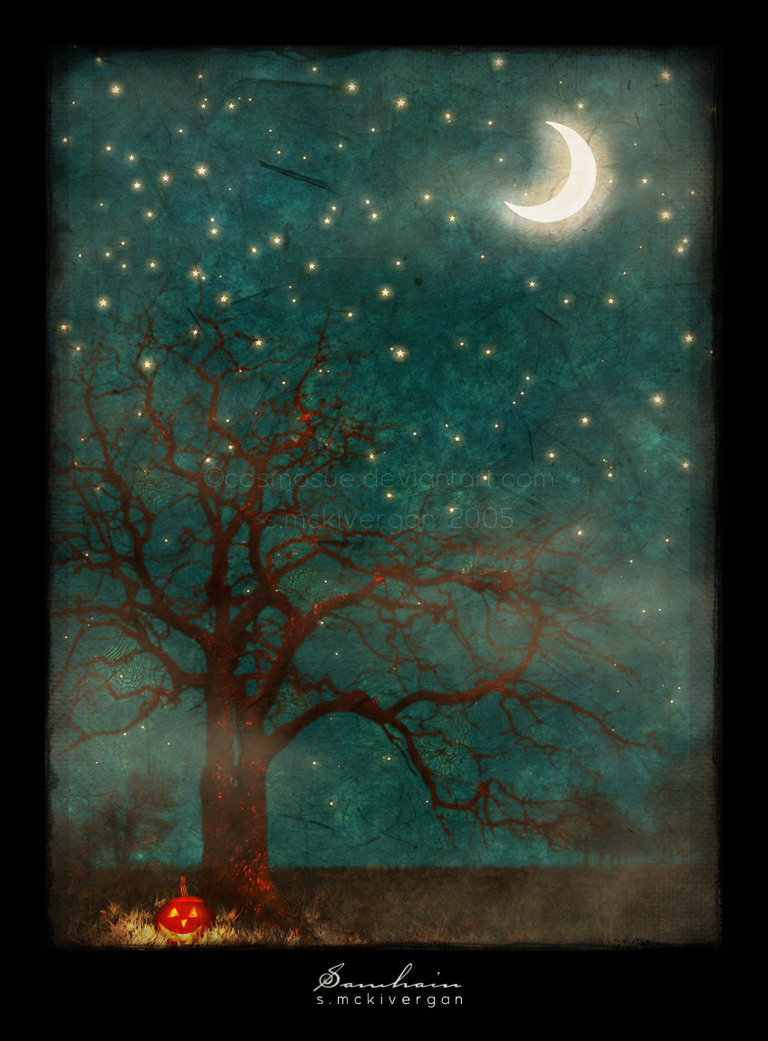
Taking inspiration from nature, many Pagans see this season as a time of letting go. Even as leaves fall from the tree, we let go of things in our lives that no longer nourish us. In the letting go, we allow new manifestations to feed our creativity and inspire us in our journey, even as the fallen leaves feed the soil around the tree.

There are many different kinds of things we let go – ideas, relationships, emotions, material possessions. They key here is that if they are no longer nourishing, then we can softly let them go into the lengthening nights, thinking deeply about our lives and carrying within us new seeds for the coming year. They might be the vegetable garden that didn’t work, the friendship that no longer feels right, grief or anger that we have experienced or even just clutter in our houses.

We can also learn from the letting go – we can try and plant a vegetable garden in a different spot, grow different vegetables. We can focus on the relationships that we have that make our souls sing, and open ourselves to new possibilities. We remember those who have passed away, or who are struggling in the shared human journey. We learn to cherish and make space in our homes and in our lives for things that bring us joy.

The tree does not mourn the falling leaf, nor does the leaf mourn the tree. In the letting go, we simply allow for new manifestations to occur.

Blessings of Samhain.

Reblog: The Love of the Darkness

This a reblog from my channel, DruidHeart at Witches and Pagans, on SageWoman’s channel:


The still centre.

Outside, in the dark, the air is finally still. Like rich swathes of fabric, the darkness hangs around me, enfolding me, wrapping me in its exquisite embrace. I sit, breathing in the night air, the smell of cedar and dew wet grass filling me with pure awen. The last of the crickets are singing in the remnant of summer’s growth, owls hooting softly in the distance and underneath the beech tree near Caia’s grave I let the songs of the night wash over me in waves of indigo and black.

The quiet is shattered by the call of a stag just on the other side of the hedge. Calling to the does, he is in full rut, looking for the ladies in the shelter of the night. He is maybe four feet away, and his bark and rumbles excite me with the power that he is emanating in following his soul’s truth. I can hear the slight shuffle of leaves and grass beneath his hooves as he paces up the track and then back down towards the nature reserve and farmer’s fields.

Overhead, a few stars are shining between the cloud cover, and the moon has not yet risen. My muscles have become fluid, my sense of self sliding into the darkness until there is no separation. There is no I am to compare with: I cannot even say “I am one with this land”, for there is no I. No me. Just life and death, a cycle and spiral mirrored in the galaxy that we perch upon the edge of, in the vastness of space and time.

But eventually I come back; there is an “I” once again. An “I” to speak from this still centre, to make sense of the experience. Sometimes I loathe that “I”, wanting to remain forever in the embrace of the darkness, boundless and floating, no edges and completely open, sharing with everything on this planet in the beautiful, soundless dance in the round of existence. The “I” always returns however, a little smaller, a little less sure of itself, and for this I am glad.

Deep within the depths of the stillness, the songs of the universe can be heard. Beyond the sense of self is all existence.

The love of the darkness, where there is nothing but potential.


To see the original post, click HERE.


Daily Meditation

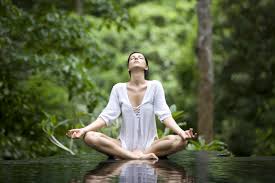
Meditation (source unknown)Meditation is a very important part of my spiritual path. I remember when I was a student with Bobcat (Emma Restall Orr) back in 2007, and the amount of meditation that she suggested was the minimum we do each day – it had seemed like a lot at the time (I had only begun to delve in Zen meditation at this point). She said that we should spend more time at our altars, at least with two twenty minute sessions per day. At first it was hard to get into, but then became easier at it became part of my life, part of my daily routine.

I took the sessions to longer periods of time, two thirty minute sessions. It meant getting up earlier and finding time when I came home from work before cooking dinner, or if that wasn’t possible finding time in the evening whenever it could fit in. There was great value in spending time before my altar, sitting in silence and communing with the gods, the ancestors and the spirits of place. It is often said that prayer is talking, and meditation is listening.

Learning more and more about meditation in its various forms, I realised that it could be done anytime, anywhere really – it didn’t have to be in front of the altar in a seated position. Seated meditation is still, for me, the best form, as quieting our bodies and our minds allows us a chance to get beyond our talking selves and into a space of pure being, where in stillness we settle even as the dusk falls upon the land. Like mud being churned in a pond, if we allow it to settle things become clear.

However, meditation could be taken out of that space and into the wider world. If I was away from home, and had no altar, I could take a walk and do some walking meditation. Lying in a bath, I could meditate there, fully aware of the water against my skin, the sounds and scents. In essence, meditation is simply giving your full attention to something, whether it is a stillness of the mind, the working through of a problem, walking down the street or paying attention to your breath. Work can become meditation – washing the dishes is meditation for me, as are other house chores. They are much more pleasant that way.

Riding my bike, driving my car, paddling my canoe – all these can be meditation. With meditation, if you are doing mindfulness meditation, you are not “zoning out” so to speak – you are fully aware of everything, allowing the illusion of the self to fade away in order to hear the wider world around you. Stopping the incessant internal dialogue, we step beyond our selves, allowing us a break from our egos. The more we do this, the more we are not ruled by our egos, living a life that is not reactive but completely and fully active: lived with intention.

Meditation is not all about sitting on a cushion chanting Om. It is living with full awareness, using techniques such as seated meditation to help you begin your journey. I would always advise seated meditation first, and then take that into other aspects of your life. Pretty soon you will find that you are living with much more awareness, much more mindfully. It’s not difficult to do.

Often people say that with the raising of a family they do not have the time to meditate. What I would suggest is that raising your family becomes a meditation. Pay attention to cooking the meals, when your children are speaking, when you are reading them a bedtime story. Be fully present with them and you are meditating. Be aware of your actions and reactions and you are meditating. Be aware of your breathing and you are meditating. You can do it.

Explore the many ways you can meditate. From finding that still centre, explore journeying, guided meditation, trancework and so on, keeping coming back to the simpler forms and the still centre. It will be well worth it.

Gods of Humanity

Often we relegate things like love and lust, rage and compassion, anger and fear into emotions. If we think of them as just emotions, we may not work with them on a level that is appropriate. In fact, if we do not give them the respect that they deserve, they can sneak up on us when we least expect it and give us a good kick up the arse.

My teacher, Bobcat told us students many years ago that we should regard them as gods. It took me a while to understand what she meant, and only after the experience of years since does it all seem clear to me now. We often have to stumble and fall before we actually pay attention to the ground we are walking upon. The idea of the gods of human tides took a good few years to sink in, but they now sit comfortably within my framework of ethics, living in honourable relationship.

Gods often demand respect. Not because they are seeking power over us and have something to prove, but rather that if we do not respect them we could be swept away on their currents of energy. It is often said that in Druidry we do not sublimate to the gods, but rather work to create a relationship with them that is rich and sustainable, as we do with all things.

The gods of the human tides are treated with the same respect as the gods of thunder and lightning, the sea and sun, the winter’s howling and the spring’s blooming. We must look carefully into our anger, our lust, our greed, our compassion, our generosity in order to understand the intention behind them better. If we are not careful, we can get swept away with them all too quickly. If we do not stand our ground we can jeopardise our entire existence, all that we have worked for, all our dreams and schemes, our morals and our ethics.

It requires a willingness to be soul naked and bare, to look inside the self and see the constructs of it in order to better understand why it works the way it does. It requires utter honesty. How many of us are completely honest with ourselves? Very few, if any.

I am not an exception. I have fallen before the gods of humanity, swept away on various currents and seeing the destruction that is wrought by the giving in to their powerful surge. It has led me to look deeper within myself to find the root causes of why I allowed that to happen, and in doing so ensuring that it doesn’t happen in the future. Creating a relationship with these gods means that I understand them better, and myself more, therefore acting with intention instead of simple reaction. Great doubt and insecurity, great fear and anger all lie within our souls. Facing these requires great courage and strength, great faith in ourselves and in the world around us.

None of us are perfect. But we learn from our mistakes, the tripping up awakening us, making us pay attention to the footsteps we take along life’s journey. Then each step is walked with honour, respect and integrity. Do not dwell on past mistakes, but do not let them happen again. Awake and aware, we walk forward, deeper into the heart of the forest and the wisdom of the oak.

Samhain, Death and Dying

Raven’s Hollowby Wyldraven © Wyldraven 2011- 2014 http://wyldraven.deviantart.com/art/Raven-s-Hollow-208469580

In a blog post written last year, I wrote about my contemplations on the Samhain tide of the year, touching upon the nature of death and the Otherworld.

As the darkness closes in with earlier nights and later mornings, thoughts and feelings seek out the lessons to be learnt in the growing dark, where boundaries fall away and where we know nothing at all. Walking through the garden at sunset, shuffling though the fallen beech leaves, greeting my cat at her gravesite (who passed away last Yule), watching as my garden plants return the energy to their roots, I am surrounded by death as much as I am surrounded by life.

Thoughts inescapably turn to death during the Samhain tide, where in Druidry it is recognised and not shuffled away, never to be spoken of in conversation, turning it “morbid” or filled with superstition that the mention death will bring. Death comes to us all, whether we talk about it or not. Might as well talk about it.

My first thoughts turn towards the concept of the Otherworld. Many within Druidry believe in such a place, or places, where our soul goes to rest, to party, to do whatever it is we believe it does, perhaps before we reincarnate. While I do believe in reincarnation, my belief is much more simplistic that this.

More and more I come to realise that, at least for me, there is only this world. There is no Otherworld. There is no veil between the worlds, for there is only this world. And what a wonderful, awe-inspiring world, filled with gods and ancestors and life and death.

The belief in reincarnation, that our soul lives on to occupy another body at a certain time either in the future or in the past, is based upon the belief that there is a place where our soul goes when we die. For me, there is no such thing as “away”. We cannot throw our garbage “away”. We cannot be “away” with the faeries. Our souls cannot go to a resting place before coming back to this world. There is only this world. Let me elaborate.

Using nature as my teacher, I look deeply at how death occurs, the process and the stories that unfold. Death is all around us, from the earth we walk on that is made up of millions of dead things, to the death that we ourselves create with our very existence. Life is also all around us, things coming into being and growing, being nurtured and nurturing in turn. When something dies, it returns back to the soil, to transform into another way of life. Essentially, for me this is what reincarnation is all about. Changing our form. When I die, my body will be devoured by bacteria and worms, become plant food and be drawn up through the roots of trees to be exhaled into the deepening twilight. This is change, this is reincarnation, becoming incarnate in another form, becoming incarnate in a legion of other forms.

My body is made up of a similar legion of other forms, dating back to when we were all just star stuff. Everything on this planet has an original ancestor of star material, and whatever came before stars. My body is made up of living things and dead things. In my bones are stars, in my blood is iron from the hills where I grew up. All these things are living through me, and will continue to live even when I die to be expressed in a different form. They don’t go anywhere but right here.

The human crisis of self-awareness has led to a clinging of the ego which convinces us that without the idea of a separate identity, a sense of self, an “I am” we are simply lost in complete annihilation upon death – that we cease to be. Screaming for attention, it feeds upon the fear and insecurity that the knowledge of our own deaths bring in the darkness. A few religions, philosophies and spiritualities overcome this fear, learning how to transcend the ego, to let it go in order to become one again with the universe. As a Druid and Pagan, this feels right to me, for this leads to a life that is completely integrated with the natural world around us. It drops the illusion of barriers between us and the environment, and allows for full immersion into the present moment where we can be awake and aware to every shimmering drop of existence.

Yet in modern paganism the focus is usually on the “I”, the personal transformation into a better being and a better Pagan, to search for the truth of our souls and to live that truth honourably in accordance with our tradition. Self-actualisation is a big thing, not only in Paganism but also around the world. Based on concepts of the self, a return to the self and coming into our own power, we work on our selves constantly. This in itself is not a bad thing, but for me it needs to go one step further. We have to look inside our selves to understand the nature of the self, and then we can be rid of it. Emma Restall Orr discussed this in a very poignant essay, “After Paganism”, in Moon Books’ Essays in Contemporary Paganism (2013).

Many would query the validity of this, as for them the be all and end all is their sense of self, what they can do and what they have achieved in the world. Without this sense of self, would they be able to make their dreams come true, to work for political and environmental causes, to further their own desires and needs?

While I do not, as yet, have an answer to this question, it is still one that is worthwhile in the asking. I truly believe that we can, at least for moments, perhaps days or weeks, months or even years to drop that sense of self in order to integrate fully with the world. When we have, we can come back to the world with a sense of self that is not separate, that observes but does not judge, that is wakeful and aware without needing to fight for its own existence.

Returning to the subject of death and dying, if we have sufficiently come to terms with the notion that the self is not separate, and that there is no need for an individuated self to exist then when we die, we simply return to the earth. That spark that is human consciousness, that allows us to think about life and death and the self, that too returns to the earth. I seriously question whether humans are the only beings on the planet with the capability of questioning on these subjects, for it my belief that we simply have not been able to language this with other species, out of ignorance or human arrogance, or perhaps both.

Everything returns to the earth. Everything. My consciousness will seep into the soil even as my blood and bones, hair and nails. In this, complete and utter integration will occur, a reincarnation into a myriad of forms. My songs will blow with the wind. My eyes will be in the heads of flowers. My heart will be deep in the darkness of the soil. I will not leave, I will forever be here, in this world, in a multitude of forms. The ego “I” that I speak of will be long gone, released willingly into the night, but the sefless “I” will still be here.

There is comfort in this, in the knowledge that when we die, we don’t go anywhere. The ancestors are always with us, everywhere. Everything that has ever lived and ever died is still here, in another form, whether pebble or mountain, horse or mouse. You can’t create something out of nothing. You can evolve, but that’s a different story – our story is one that is shared universally.

Some would say my thinking is based upon a materialistic view of the world, however, when everything is inspirited, when everything has a consciousness that is not separate, there can be no question that it is wholly animistic. It’s not just the case of “the worm crawls in, the worm crawls out, the worm plays pinochle on your snout” – there IS more to it. Death is not stopping. Death, or dying, is an event that takes place – it is not a “forever”. Death is not the opposite to life – the opposite of death is birth, a singular event. Life has no opposite.

If there is no opposite, then there is no need for other worlds. Everything is right here, right now. The gods of nature are all around us, in the sunshine and in the rain, in the air that we breathe, in the storm and in the drought. So too are the ancestors, our ancient ancestors and our grandmothers who all are letting go of their stories into the soil, to be told again in other forms.

I realise that my words may not be in tune with the majority of Pagans, however, they are spoken with the utmost respect. And in the darkness I breathe, deeply, until there is no longer anyone breathing.

Reblog: The Blessing of Samhain… If You Dare…

This is a reblog from my channel, DruidHeart, at the Witches and Pagans website. To read the full article, click HERE.

Here in the UK, the weather has turned and the colder air sweeps down from the North. Nights are longer, as the sun jumps along the horizon with each rising and setting, heading further and further towards the south. Trees are changing colours, and plants are beginning to die back, the green fading into golden and tawny hues, foliage less dense and earth beginning to peek through the underbrush.

The tide of Samhain has begun, when, after the autumn equinox we prepare for the darkness to come. The balance has been tipped, and we have tipped with it, our internal clocks trying to adjust to new temperatures and light levels. Often, we try to establish our centre, attempting to find some foothold or handhold in the coming darkness, our egos crying out the great rallying cry of “I AM!” The darkness, however, knows the folly of this, and smiles as it creeps ever closer.

In the darkness there are no guidelines. There are no boundaries. There is no up or down, no left or right. There is only impenetrable night, a sweet release from the constraints of the known…

To read the full article, click HERE.