
The Druid Path: A Modern Tradition of Nature Spirituality by John Michael Greer
Published by Sterling Ethos, 2021
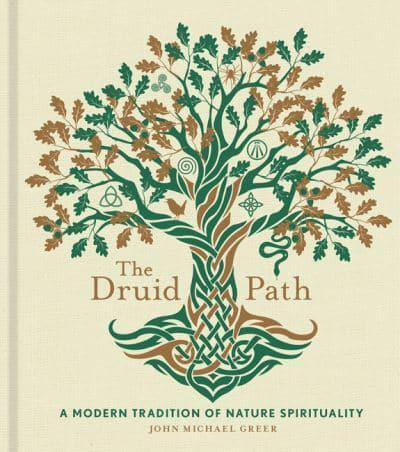
This book is a great introduction to Druidry. I love a hardcover book, and this little gem published by Sterling Ethos is a really nice production. The corded cover with embossed title, the interior illustrations and the overall print quality is superb. We need more Pagan books that pay attention not only to the content, but also to the print quality and aesthetic! This book will last a long time, for sure. It’s in a nice almost square format too, which is different. It is an introductory book, so it doesn’t go into great length on any given subject, but it does cover all the essentials necessary to begin your path of Druidry.
It is divided into four sections: Part One looks at the sources of Druidry, including the ancient Druids, the Druid Revival and Modern Druidry. This brief history of Druidry covers all the essentials, as well as some new things that I have never come across, including William Stukeley’s elephants (you’ll just have to read the book for more on that one). I am also pleased to see a section on Women in Druidry.
Part Two looks at the Druid teachings, the different strands of Druidry and exercises to help one not just read about it, but also turn it into personal wisdom through experience. The section on “The Two Currents” I had not come across before in my own Druid learning. This chapter discusses the solar current and the earth’s telluric current and how to incorporate that into your practice.
Part Three is the practice of Druidry, an essential section that really shows how Druidry is a living practice, something that must be done, not just read about. I especially like Greer’s words on Druidry as a craft:
“Druidry is not an ideology. Like basketry, forestry, and many other words that end with –ry, it can be best understood as a craft. You don’t become a basket maker or a forester by believing some set of opinions. You become a basket maker by learning and practising basketry, and you become a forester by learning and practising forestry. In the same way, you become a Druid by learning and practicing the craft of Druidry. One of the things this means is that becoming a Druid isn’t an all-or-nothing matter. You start becoming a Druid as soon as you begin learning some elements of the Druid craft, and you keep on becoming a Druid as long as you keep studying and practicing that craft.”
In this section, Greer also introduces us to divination through the Coelbren alphabet, which is not used as much as the Irish ogham taught by many other Druid authors, teachers and organisations. This chapter also gives you some more daily practices and a couple of rituals to get you started.
Part four is about initiation into Druidry. The word initiation means “to begin” and so the ritual set out in this section provides the reader with a definitive point in time where they can say that they started out on the Druid path with directed intention to practice this craft to the best of their abilities. The self-initiation ritual is simple but poignant. Greer ends the book with the following words:
“A more important source of guidance than books and organizations, however, is the time you spend working with the basic practices of Druidry, listening to the One Life, and learning from nature. No one can do that for you. The only thing that limits how much you can learn and grow on the adventure of Druidry is your own willingness to pursue it.”
There is also a helpful glossary, bibliography, recommended resources and index.
I was very pleased with this little book that holds much wisdom. I’d recommend it to anyone starting out on the Druid path who wants a concise introduction contained within a beautifully printed publication.
 Wicca for Beginners: A Guide to Wiccan Beliefs, Rituals, Magic and Witchcraft does just what it says on the tin. It’s a great guide for someone new to the path, or for anyone who wants to refresh their learning. In fact, if I were to recommend a beginner’s book to anyone new to the path, this book as well as Scott Cunningham’s works would be my first choice. Chamberlain goes into history of the tradition, which is something that Cunningham’s books are seriously lacking. She uses language that is easy and flowing, friendly and unassuming. I really like that in books that teach about anything, as I am easily put off with pomposity and obscurity.
 Wicca Book of Spells: A Beginner’s Book of Shadows for Wiccans, Witches and Other Practitioners of Magic again covers a wide range of material. While a couple of paragraphs on what a Book of Shadows is would have been nice, this tome dives straight into spellwork such as love spells (with the usual caveats on manipulation of individuals), prosperity spells, health and well-being spells and an eclectic mix of spellwork in the final chapter that includes kitchen witchery, elemental magic and more. Again, there is common sense and a good framework throughout this book to help the reader on their forays into the realms of spellcrafting. One small critique is that I would like to know if the spells included in the book are traditional, or if the inspiration came from somewhere historically. I have no qualms in new spells vs old spells, and I am a strong believer in working with what you’ve got to hand. This information may have been left out in the editing process, to keep the book to a size that works for beginners, though this is purely conjecture on my part. The spells were easy to follow and understand, and Chamberlain, like myself, is not averse to substitutions to make it work on a more personal level.
 I’ve just been introduced to Danielle Dulsky’s work, and I have to say, it’s been a pure joy to read Seasons of Moon and Flame: The Wild Dreamer’s Epic Journey of Becoming. Dulsky is the author of The Holy Wild, which I shall have to put on my list as well!
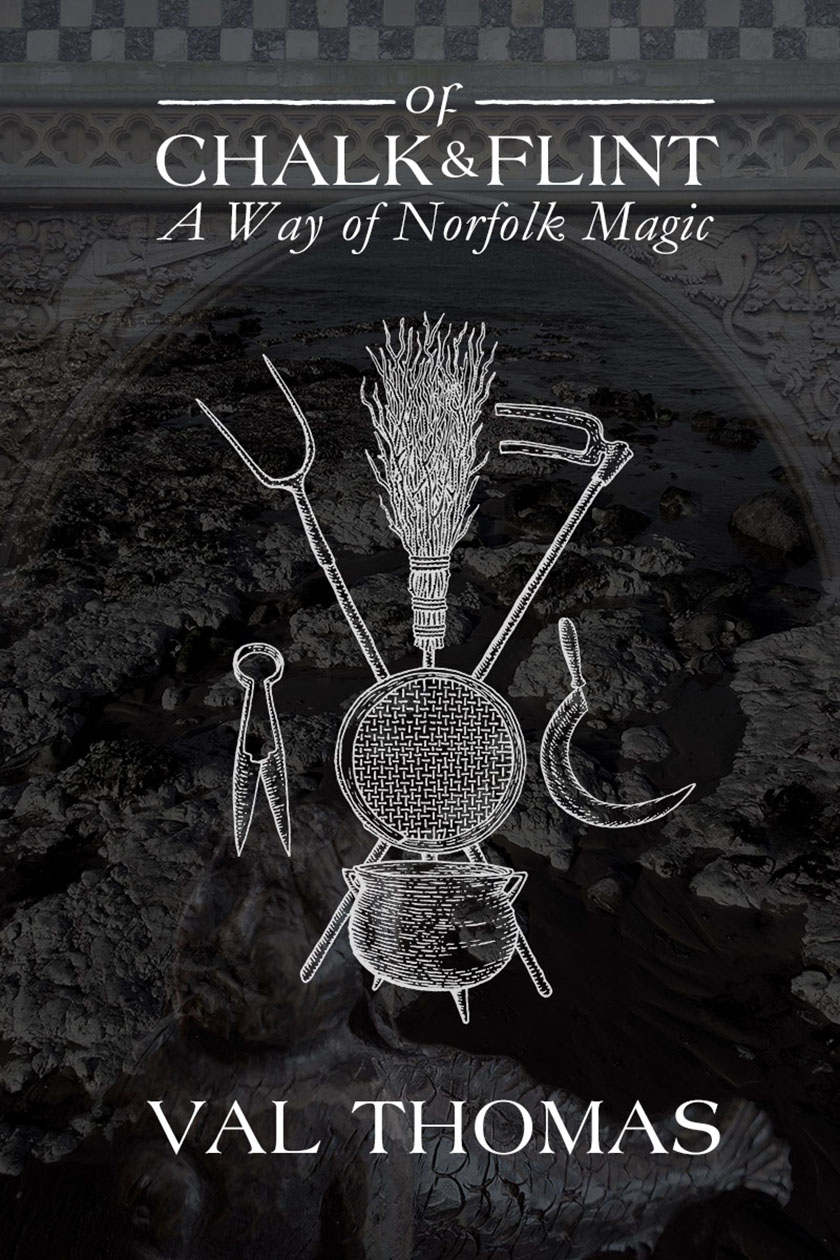 Val Thomas’
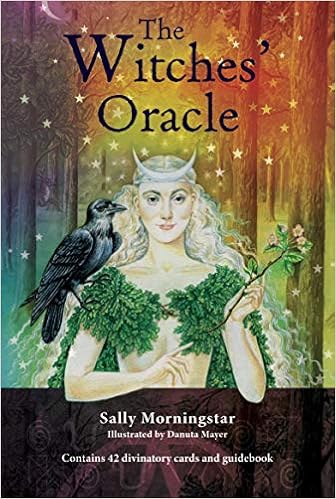 When I received The Witches’ Oracle, I thought that the cover looked familiar. When I opened it up, I knew why: I had this very deck that was released around twenty years ago! Originally called The Wicca Pack, this wonderful deck has been re-released by Eddison Books as The Witches’ Oracle.
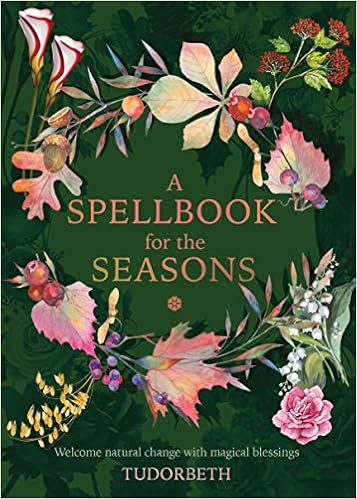 I also received A Spellbook for the Seasons, by Tudorbeth (aka Sarah Coyne). I have to say, I LOVE what they are doing with books these days. They are making books so beautiful again! This lovely hardcover comes filled with gorgeous artwork inside, and it truly is a pretty thing to have and to hold.
 Down the Forest Path