Samhain: Ancient and Modern

Here’s a taster of a blog that I put up yesterday for SageWoman’s channel at PaganSquare. To read the full post, click HERE.

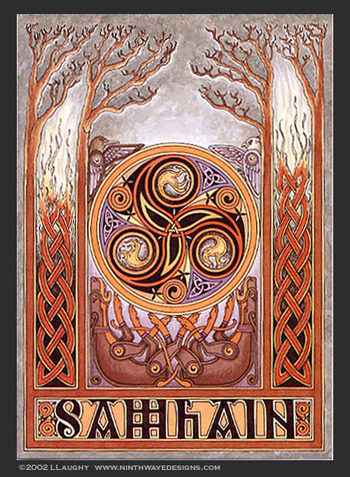
samhain 1Calan Gaeaf (Welsh) or Samhain (Irish) begins at sunset of 31st October and runs to to sunset 1st November according to most Western Pagan traditions. If working by the moon, it is the first full moon when the sun is in Scorpio. If working by the natural landscape, it is when the first frosts bite. Samhain was termed the Celtic New Year, as it marked the ending of one cycle and the beginning of another. The Celts reckoned their days from sunset to sunset, and so the start of the year would begin in the dark time at the beginning of winter. Samhain marked the first day of Winter.

Calan Gaeaf, however, is a time that is not a time, and therefore some Pagans honour this tide and season from 31st October right through to the Winter Solstice. It is a time after many things have died, and there is a stillness to the air, an Otherworldly feel in the silence. It’s a dark time here in the UK, with long nights on our northerly latitude, and usually a very wet time as well. It’s not hard to see how these months could be seen outside of time, outside of the cycles of life, death and rebirth.

Calan Gaeaf, Samhain, Hallowe’en, All Soul’s Night – for many pagans this is the ending of one year and the beginning of another. It is often seen as the third and final harvest – with the last of the apples harvested, the cattle were prepared for winter and the grain stored properly. It is also a time when it is said that the veil between the worlds is thin, and the realms of the living and the dead are laid bare to each other. We are approaching the darkest time of the year, and the killing frosts and snows await just around the corner. It is a time of letting go, of releasing into the dark half of the year, and getting rid of the dross in our lives so that we do not have to carry them with us through the long winter nights. We consciously make the effort to live better, meaningful lives and let go of all that holds us back – our fears and worries, our anger and hatred. We nurture the beneficial and the good that we have in our lives, ensuring that they are well kept for our plans to come at the winter solstice. So the cycle continues.  READ MORE…

Druid Ritual

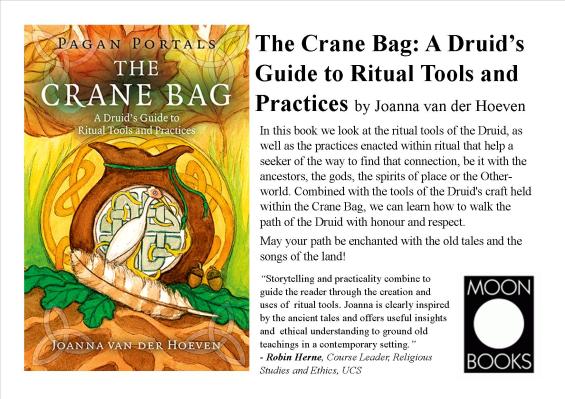
Crane Bag Advert 1It’s all 5 star reviews so far! Here’s an excerpt from my latest book, The Crane Bag: A Druid’s Guide to Ritual Tools and Practices which you can purchase from Amazon, Moon Books, Barnes and Noble and all good book retailers!

What is The Crane Bag?

The Crane Bag: A Druid’s Guide to Ritual Tools and Practices is a book in the Pagan Portals series that describes the ritual tools and practices found in the Druid tradition. As part of the Pagan Portals series, it is intended as a brief introduction to the subject, allowing the reader to further develop their own path in their own time and in their own fashion.

“The Crane Bag” is a wonderful theme in Celtic mythology, found mostly in the tales of the poet-warrior Fionn Mac Cumhail, who inherited the crane bag from his father. This bag held the special treasures of the land and was made from the skin of a crane who was, in actuality, a woman enchanted into crane form. We can view the myths that surround the crane bag as those of the gifts of sovereignty, bestowed by the goddess upon worthy heroes as is typical of Celtic mythology. The Goddess held great abundance and gifts within her womb, and only those who passed the test and were deemed fit were able to be gifted with this most precious treasure.  As the bestower of sovereignty, the Goddess fades and emerges time and again within the old stories, as does the crane bag, appearing and disappearing from myth when there is need.  The sea god, Manannan, is the original owner of the crane bag and through his love for the goddess gives and takes it back throughout the telling of the tales.

Within the mythology of the crane bag, those who follow the Celtic Druid tradition can come to know a very beneficial tool in their learning, the gifts of which are endless.  Within the crane bag are not only the tools of the Druid, but also a symbolism of the gift of the goddess, of sovereignty.  With the proper use, it can further the Druid in working with the tides of nature, finding their proper place in the grand scheme of things, living in balance, harmony and peace. In ritual use, these tools can guide the Druid to deeper levels of meaning and understanding within the tradition, helping the Druid on her journey throughout life towards integration in a holistic way of being in the world. We are able to find a deep connection, be it with the ancestors, the gods, the spirits of place or the Otherworld. Combined with the tools of the Druid’s craft held within the crane bag, we can learn how to walk the path of the Druid with honour and respect.

What is Ritual?

Ritual consists of a prescribed set of words and actions within a particular context used to bring about a desired outcome. Druid ritual uses words and actions within the context of an earth-based tradition to connect with the landscape, the gods, the ancestors and so on. For the Druid, connection, relationship and integration with the landscape are at the heart of all that she does, whether in ritual or not.  Ritual can be seen as a time set apart from daily life to reconnect the threads that bind us together with the land, with nature.  We take a step back from what is perceived as the mundane and acknowledge the sacred. Ultimately, the Druid strives to perceive the sacred in everything, and ritual helps the Druid to achieve that vision.

Our modern lives are so busy, with work, family, media, technology and more. Ritual helps us to step back from the busyness, into another way of being.  It is a change of consciousness, where we can shift our perception away from a singular view to a more plural view, integrating with the land around us, realising that we are a part of an ecosystem. Ritual is the act in the material world that connects us with a wider reality.  It is an experience, not just a thought.

Ritual is that which helps us ground and centre in the present moment. When we stop, when we take a break to perform a ritual, we become aware of who, where and what we are at a particular point in time. We are rooted in the here and now, awake and aware to all that is happening around us. When we are awake, we are able to find our place in harmony with nature, finding a deep peace both within and without. It gives us an intention, a focus with which to work in the Druid tradition, to reweave the threads of connection.

Ritual also helps us to find stability. When we create rituals to perform repeatedly, we bring that sacred perspective more and more into our everyday life. These rituals needn’t be identical each and every time; what is important is that the ritual is actually done.  It is the experience of ritual that helps us to self-locate. We cannot do that simply by thinking about it; we must act as well. When we have acted out our rituals with some regularity, we may find that our connection to the natural world deepens.  The ancient philosopher Lao Tzu once said:

Watch your thoughts, they become words;

watch your words, they become actions;

watch your actions, they become habits;

watch your habits, they become character;

watch your character, for it becomes your destiny.

We as humans are creatures of habit, and indeed these habits define us as people.  A repeated action or behaviour will certainly have an impact on who we are as an individual. By using ritual we can break off from bad habits and thought patterns, for example, and find the sacredness within and all around us. It requires practice, as in the Welsh saying at the beginning of this chapter. We cannot just think about ritual; we must do it.  If we take the time to reconnect with our place in the natural world, over and over again, then we will maintain that connection more and more throughout our lives until they are an example of pure integration and harmony.

Druid ritual is also a celebration.  The eight seasonal festivals of modern Druidry help us to remember what is going on in nature at the present moment. There are many books that cover the eight seasonal festivals, their origins, meanings and ways to celebrate, and so we will not cover that here (see bibliography and suggested reading for more). Rather, we will look at how Druid ritual is set up, from start to finish, using our tools from the crane bag to find our soul map in our own environment.

Ritual is also a tool for transformation. When we have worked with intention and grounded ourselves in the present moment, we cannot help but be transformed as our perception shifts from one perceived reality to another. Through the experience of ritual, we understand that our point of view is not the only one, and that perception shifts with intention. When we broaden our horizons, we cannot help but be transformed.

Re-enchanting the Soul

Work and familial obligations can sometimes weigh us down in a sea of mundane jobs, tasks, and commitments. With Druid ritual, we can re-enchant the soul to bring the magic back into our everyday lives, as we perceive the sacredness of all things. Then, we realise that there is no such thing as the mundane, only the sacred. The division between the two is realised as an illusion, and we are thus able to “travel between the worlds”.

The Druid is always questing for inspiration, or awen. Awen is a Welsh word, sometimes translated as “flowing spirit” or “flowing inspiration”.  Creativity is such a large part of the Druid path, where we are inspired and then inspire others in return. This exchange of inspiration is at the heart of all that we do, in deep relationship with the world around us. When we touch each other soul to soul, where we find intention blending together to work in harmony, then we are inspired. The Druid looks to the natural world around her to gain that inspiration.  She takes her cues from nature as to how to live in the present moment, utterly awake and aware. So inspired, she lives her life as best she can as part of that environment, in tune with all that shares the same space. By doing so, she also inspires others in return.

Simply by getting outside and into “nature”, our awareness shifts. Though nature is something that we are a part of all the time, we often see it as something “out there”, as external to ourselves. When we realise that we are a part of nature, we shift from a self-centred perspective to an integrated one, thereby opening our eyes to the beauty and wonder that lies all around us each and every day. Taking a walk helps us to see the beauty of an oak tree in full leaf, to feel the warm caress of the summer wind, to feel the blessing of the rain or the exhilaration of a snowstorm. We awaken our senses to the world around us simply by being out in it, in nature, away from central heating and electricity, away from cars, phones and computers. Though all these things can be of great benefit, when we re-attune our senses to our “natural” environment, we can also reawaken something that has long lain dormant within our souls. We can re-enchant our lives, re-wilding our souls.  We can return to the very roots of our being. We can find the child-like wonder while looking at an ants’ nest, or listening to the blackbird at dusk.  We no longer become bored or jaded, but rather totally awake to the world around us. Our lives are benefitted from this re-enchantment on every level. This is the awen.

This is also the importance of ritual. When we take the time to re-enchant our souls, we make our lives more magical, more meaningful and more present. We can step outside the realms of 9-5 living.  We enter into a state of intention and enchantment, inspired and inspiring others in return. In this, we find true relationship.

May your path be enchanted with the old tales and the songs of the land!

(Extract from The Crane Bag: A Druid’s Guide to Ritual Tools and Practices by Joanna van der Hoeven. www.joannavanderhoeven.com).

 

The birds have gone…

It is a melancholy time of year. Most of the fields are now lying still, shorn and with the stubbly remains jutting defiantly into the last of the summer sunshine. The house martins departed over the weekend; I had spent much of last week watching the elders teach the young ones how to glide and ride the air currents in preparation for their long trek to their winter homes. The sky is so silent and still without them, and there is a small space in my heart that is sad to have said goodbye to them. Good luck on your journey, little ones. May you be as safe as can be, and I hope to see you again next summer, when you herald in the start of the season of warmth and sunlight once again, alongside the calls of the cuckoo.

The full moon makes sleep difficult; dreams are seemingly random and exhausting, and will only have meaning when the actual events happen. My skills in divination and the sight are through dreams more than anything, but right now I’m so tired that I’ll be lucky to remember anything upon waking. It’s only in the actual doing or being somewhere that I’ll remember that I dreamt it, like on Saturday when I signed a new contract, and remembered writing an email with a query regarding it. In the dream, I had no idea who I was writing to or why; now it all makes perfect sense.

It is a time when we are seeing the fruits of our labour. But it is also a time when we cannot yet rest or lay down our tools, for there is still much to be done. There are many other harvests that await. I have had a good crop of raspberries this summer, and another one on the way. The first apple harvest was abundant, and the second looks to be even better from my three little trees. I have just released my seventh book, with another written and in production, and a whole new one to work on. Druid College’s next Year 1 session begins in October, but we have our first session of our Year 3 apprentices beforehand to journey with on pilgrimage to Glastonbury in September. There is still much to be done.

The leaves are beginning to change, and a soft sadness tinged with relief lies within my breast. It feels like I’ve cried a long time, and am releasing that juddery sigh that often follows a good sob. New things await, but the old ones are being put to bed first. Everything in its own time. Nature does not hurry, and yet everything gets done.

So this evening I will be honouring the full moon and the Lammastide, with ritual in the company of a couple of lovely ladies. As the combine harvesters grumble relentlessly in the background, we shall sing to the moon, and share in the bounty that we have received with the spirits of place, the ancestors and the gods. Bread that I will bake this afternoon will be our offering, as well as words and vows of the work to come.

The times of sadness and stillness are required, just as the times of light and laughter. For we cannot have one without the other. They are not opposites, but simply on different places in the spectrum of human emotion. We ride the currents in keeping with the tides and seasons, and work towards integration and harmony.

May we be the awen.

6

If you’ve enjoyed reading this blog post, or any others on this site, please consider contributing towards the future of Down the Forest Path with a £10 donation for a year’s support of the work. You can donate by clicking HERE.

The Journey Continues…

Well, another weekend of Druid College has come and gone, and it was our final weekend with our Year Two apprentices. We have worked with so much material, as well as so much self-exploration in these last two years, and now each apprentice is declaring their Chair, choosing the work that they will focus on in the coming Year Three.

It has been an honour and a pleasure to work with each and every apprentice through this two year journey, and it is with pride and honour that Robin and I are now guiding them in their journey for their final year. I have learned so much from each apprentice, been inspired by them and the work that they have done, and in doing so am inspired to continue the work that we started back in 2015.

We can learn so much from others, and widen our perspective of the world in so many ways. Being such a solitary creature myself, I often have to force myself out into these sorts of situations, being with other humans when I’d rather be deep in the forest or singing with the wild wind on a hilltop. But these moments of pure awen happen with every soul that we meet, whether it is a bee or a human being. Connecting, soul to soul with others in our journey through life can make the threads of awen shimmer and shine with magic and beauty that inspires us, helps us to continue, to carry on. It’s a give and take, a real and true relationship.

And so, with deepest gratitude and heartfelt admiration I see the apprentices off on their next journey. We will be travelling to Glastonbury on pilgrimage at the very start of Year Three in September, a journey that beings with the self and hopefully will end in utter integration with the world through each person’s unique gift of awen.

I thank you all for the journey, and look forward to continuing it with you.

Druid College UK are Crowdfunding for Scholarship Programme

At Druid College UK we are seeking people to help us create and sustain a scholarship programme, to enable those who wish to enroll but lack the funds to do so. At the moment we offer a discounted price for those on a low-income budget, but we only have a few places on the course where we are able to do this every year. With a scholarship programme, we would be able to extend this offer to many more people from all over the community who are seeking learning on their spiritual path.  Many of our students are also international students, and the travel expenses on top of the tuition fees can be a real challenge. So, if you can help us out by donating towards our scholarship programme, that would be greatly appreciated!

http://www.crowdfunder.co.uk/druid-college-uk-scholarship-programme

The Awen Alone Audiobook is now available!

cover high resThe Awen Alone audiobook is now here! Available through bandcamp, you can download the book, as well as receiving my music album, “Drops of Awen” for only £10. Also included are guided meditations and talks from previous workshops! More material will be added throughout the year. Your £10 yearly subscription allows you access to streaming or downloading all of the material, as well as having access to new material added each month. You can cancel your subscription at any time. Material includes:

The Awen Alone Audiobook
Drops of Awen Music Album
Chakra Talk and Guided Meditation
Talk on being a Modern Druid
Basic Meditation
“Rafting the Currents of Life” Meditation

Finding the Balance: Wedding Discipline to Devotion

Finding the Balance: Wedding Discipline to Devotion

Our culture of “not good enough” is so rampant, that it can be terribly hard to disassociate oneself from it. I was able to come to terms with the capitalist way of life here in our Western world through Eastern means, specifically through Zen Buddhism. That led to deep meditation, of simply being in the moment, of enjoying the simple things in life while maintaining a deep discipline of distancing myself from the “not good enough life” into one where “it is enough”. This occurred on both a physical and spiritual level. Indeed, it usually does, because the two cannot be separated from each other.

The discipline aspect was hard, at first. I didn’t feel like meditating, like being in the moment. I would do so without any spiritual or religious intent, per se; it was merely to be in the moment, experiencing my body without distraction, noticing my thoughts. As I became more proficient at this, through sheer dogged determination and mule-minded stubborness, the light began to shine through the cracks that had opened up in my mind and in my way of being in the world. I could see that it was all illusion, that what my mind created was illusion, that the way we thought and acted in the world was all based on illusion. At first I was angry at the deception, then I was sad, depressed at the state of the world and not seeing a way through. But through perseverance, I came through the other side. How did I persevere? Again, it was discipline, but this time it was wedded to devotion.

Discipline itself wasn’t enough to get me through. I knew I could do it, and indeed I had. But when I dropped out many things in my life, all the illusory things, I didn’t at the time realise that I had to fill up the hole that they left with something more nourishing. Instead, it left me feeling empty, which at first was an interesting way to be, but then voracious hunger kicks in, when we’re empty, when we need refuelling. Carefully deciding on the path that I wanted to take, in order to find and maintain a sovereign sense of self, I brought devotion into my practice, in order to grasp that deep intention and give meaning to all that I did. After all, isn’t that the meaning of life? To give your life meaning?

And so I devoted myself to the gods of my local landscape, and several other “traditional” gods within the Celtic pantheon, some that I had worked with for decades, others which called to me to come and dance with them, for however long or short a while. And so I did, weaving discipline, daily discipline, with devotion, giving meaning to the work that I did, both for myself and for the wider world. When the hole was filled, through the previous emptying of my mind and soul, it was enough.

This is not a one-off process, however. Every day I am learning just what enough means. We are bombarded each and every day by media trying to create feelings of inadequacy. It brings to mind the Druid maxim: the Truth against the World. I have to hold my truth, against that of the world around me which seeks to distance myself from my truth. I have to work hard to be sovereign of myself. The hard work is worth the effort.

That’s not to say that I don’t have my bad days, that I don’t slip into despair every now and then, of my own failings and that of the world. But when I go outside, listen to the blackbird singing songs of the Otherworld, when I see the herd of deer running through the woods, or the bloated corpse of a fallow deer rotting down into the leafmould; when I see the hawk flying over the treetops, screaming in hunger or joy, or the waves of the sea gently lapping the shingle and whispering secrets of the murky depths, I come back to an awareness of the Mystery. That Mystery is that the world is more than me, that I am a part of a great web, a connecting thread in all that there is, all that ever was, and all that shall ever be. I am the awen, from the depths I sing.

It’s important to remember that human beings are part of nature. Our culture tries to create the illusion of separateness, but when we pull back the veil we see the interconnectedness of all things. The air that I breathe is oxygen created by trees and plankton, grasses and daisies. They in turn take a deep breath of the carbon I expel from my lungs, in one great harmonious intake and outtake of a World Breath. Just breathing can connect us to each other, can remind us of that connection each and every day. That was why the sitting meditation, or zazen of my earlier days, of just focusing and concentrating on breathing was such a great stepping stone in my life. From there, from just sitting and breathing with the world, I came to a sense of connection that led to a life of devotion, where I work to achieve a sovereignty of self in a world that seeks to make me its subject and slave.

We might think that we aren’t equipped to do the daily practice, to help others, much less help ourselves. But we are, if we remember. Re-member: to bring together disparate parts of ourselves. If we remember that connection, the threads of awen that connect each and every life form to each other, then we can work to know that our existence is not just a mere blight on the planet. We have destroyed so much, and we are at a tipping point, for sure. But there is also the great possibility that this is the moment where we all wake up. That humanity undergoes a revolution of its own mind, its hive mind. That we open up to the wonderful magic of possibility. That we are able to use our intelligence, discipline, compassion, empathy and more to make this world a better place. Is this altruism? Not entirely, because we also will benefit greatly from this revolution. We are doing it because we know that we are all connected. We are all related.

For me, wedding discipline to devotion helped to give my life meaning, and to put my feet upon the path towards this revolution. Working with love and compassion, for myself and for the world around me gives my life meaning. Even when I’m not feeling particularly loving, especially towards humanity, I have to remember the potential, the possibility that we can change, that we can reweave our connection to the land. It’s the basis of the work I do at Druid College, to hope to inspire people find their sovereign self, to come to know what enough really is, to work with the gods, the ancestors, the spirits of place and to really understand on a deep level that we are the land. There is no separation. Lying down upon the mossy ground in my backyard, underneath the beech tree, tiny buds appearing on its ever-expanding canopy year upon year, I look up into the blue sky just beyond the tangled web and know that there is always possibility, that there is always change. Buddhism and Zen teach of impermanence; so too does Druidry, in the natural flow and cycles of the seasons of our lives. When we truly come to understand the nature of impermanence, we come to truly know abundance.

© Joanna van der Hoeven 2017

The Awen Alone Audiobook

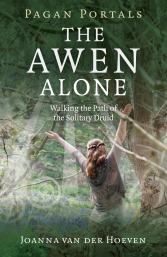
I am currently recording an audiobook of the best-selling The Awen Alone: Walking the Path of the Solitary Druid. This will be available through BandCamp later this spring, either in its entirety or chapter by chapter, whichever you prefer. There is currently a sample chapter available now, on Prayer that you can listen to and download to all your devices, to take with you anywhere. The marvels of technology!

cover high resClick HERE for more details.

Revenge of the Druids

This is a reblog from my channel, DruidHeart, at Witches and Pagans for PaganSquare. To read the full article in its original form,  click HERE.

Treat others as you would like to be treated. Such a simple phrase, yet so hard to comply with when we’ve been hurt or wounded in any way. Our first reaction is to hurt back, to wound in return. Yet is this how we would like to be treated? What if the person who hurt you didn’t even know that they had? What if it was completely intentional? Is it then justifiable to perpetuate the cycle of hurt? How do we, as Druids, work with anger and wounding in today’s society? How do we work with honour?

We don’t really know how the ancient Druids worked with the concepts of honour or revenge. We have an account of how the Druids stood on the shores of their sacred isle at Anglesey, just before the Romans invaded, and called down their magic and their might, black-robed women with wild hair brandishing torches and running between the Druid ranks. What those men and women were doing we just don’t know, but we can be fairly certain that they were protecting their land from invaders. Whether or not their magics would have been invoked without provocation is a total unknown, but here we have an example of defence, rather than offense. Boudicca wiped out Colchester and London in retaliation for the rape of her daughters by the Romans. Whether or not that great queen in history was a Druid or not, or advised by them, is debatable.

But that is ancient history. How do we, as Druids today, work with concepts of revenge? How do we deal with people hurting us, with our rights being taken away? How does the word honour factor into our everyday lives?

It’s difficult, especially when we have such a quick means of communication in our world. Emails and opinions can be shared without a second thought. People can comment, cut down, undermine, say whatever they feel like in the virtual realm and not really suffer very many consequences in the real world. Government lie to us outright, and have been caught out in their lies, and still there is no justice. Even the most kind-hearted person begins the feel the anger and rage boiling within, battling with compassion and love for the world that they live in, for the world they would like to see. How can we deal with these emotions? If someone is attacking us, how do we as Druids protect ourselves and yet find justice? How can we ensure that the balance is maintained?

The first idea that we need to let go of is the idea of revenge. We do not need to hurt someone when they’ve hurt us. We would like to, we desire to hurt them in response, but we don’t need to in order to continue in our daily lives. We have to work out the difference between our desires and our needs, as with so many other aspects of our lives. It’s perfectly human to want to hurt someone when they’ve hurt us, or upset us, or someone we love. It’s up to us how we act on those feelings, however. We have to be emotionally responsible.

Pride is an oft maligned trait in the human race. Pride can be the reason many people seek out to hurt others, trying to “save face” or in an attempt to not to face those aspects of themselves that they so dislike, instead waging a war outside of their inner worlds so that they don’t have to own up to their own shadow selves. Yet pride can also be a good thing. Our pride can be part of our self-respect. In this way, pride will not allow others to walk all over us, but neither does it seek to destroy others who don’t agree with us.

As Druids, we work in service: to the gods, to the ancestors and to the community. We know that we have to give back, that we have a responsibility in this world to ensure that the ecosystem in which we live is functioning well. A balanced, diverse, healthy ecosystem is where there is a give and take, and where relationship is the key matter of the discussion. Those relationships must work together, must find a way to honour each other in order to flow smoothly, to be efficient and benefit the whole. It is this whole that concerns us, as Druids, the most. The whole is what we work in service to, rather than the self. When we heal the whole, when we work holistically, then we also benefit the self. It’s not altruism, it just is.

When we are in positions of power, acts of anger and revenge can be even more devastating to the whole. We must learn how to work honourably with our power, out of self-respect and out of respect for the rest of the world. Without all those relationships, whether it is other humans, the bees, the mountains or the rivers, we would simply not exist. We don’t live in a bubble or a vacuum. We need others in order to survive. We must learn to work with others, even if we disagree with them. When others hurt us, we need to ride the currents of emotion and keep the bigger picture to hand, in order to work honourably. We need to let go of our destructive sense of pride and ego, and build on the better aspects of both. We need to work from a strong and balanced sense of self, and yet be able to let that sense of self go into the light of utter integration for the benefit of the whole.

Author, activist and Wiccan Starhawk write in her book The Twelve Wild Swans: A Journey to the Realm of Magic, Healing and Action:

“We let go of vengeance out of love and concern for our larger community. To be a true leader, we must be able to look at each of our acts and say, “How will this affect the community? Is it worth dividing the community for me to be proved right? Would I not be destroying the very source of support and healing that I most need?

“And we relinquish revenge because we hold a vision of healing, for ourselves and for the world. Magic teaches us that the ends do not justify the means. Instead the means themselves shape the ends that follow. We cannot achieve healing through vengeance. We cannot serve a broad vision by being petty and spiteful.”

If we are to be leaders in our community, allowing our actions to speak as loudly, if not more than our words, we need to relinquish forms of revenge and focus instead on healing. We don’t need to make someone look bad, to punish someone, to destroy them or perform character assassinations. We can’t push out people simply because they disagree with us. People will be annoying, will try to pick fights, will be aggressive or antagonistic. We don’t have to respond like for like. If we are to work as Druids in the community, we need to let go of our desire for the above when we are hurt, and instead focus on the need for healing in the community as a whole.

This doesn’t mean that we allow people to walk all over us. Whether it’s an individual, the government, whatever, we can still stand up for what we believe in. We can speak out against injustices, we can march in protest or start a campaign, raising money and supplies to help those in need. When it becomes personal, we can simply ignore it and get on with our lives, doing the work that needs to be done, having compassion both for ourselves and for the person who is antagonising us. We know that the work still needs to be done, and getting distracted because of false pride or ego is not helping the whole. We can work with our feelings of anger and injustice, and then see where they fit in the grand scheme of things. Will this benefit the whole?

It requires us to look deeply at ourselves first and foremost. When we are able to do that, we can begin to work honourably. We see our own failings, and we have compassion for ourselves. We see those same failings reflected in others, and we have compassion for them. We know that we live in an extremely damaged world, and that perpetuating the hurt and anger will only damage it further. We will stand up for what we believe in. We will speak out against bullies and those who would tout their privilege. We will seek political and social reform. We will endeavour to find the balance, to find a fairer system where the term justice actually means something. We will work to nourish and strengthen this planet that we live on, even as it nourishes us. And we will focus on working in relationship with everyone around us, deeply immersed in our own sense of self-respect and honour.

And in doing so, we relinquish the notion of revenge, and instead focus on healing for ourselves and for the world. That is the power of the Druid.

© Joanna van der Hoeven 2017

The Druid Network and IFN!

A momentous occasion! The Druid Network, as well as The Pagan Federation, have been accepted as full members of the Inter Faith Network! It’s been a long few years with some very dedicated people continuing to craft honourable relationship with the organisation and members of any and all faiths, and now The Druid Network and The Pagan Federation have had their religion recognised by the IFN in acceptance to the organisation. This means that there is even stronger legal footing for both organisations, as well as a broader acceptance of Druidry and Paganism (and other minority religions) into the whole. Well done!

The Wild Hunt published an article yesterday, read it in full by clicking HERE.

———————————————

wild-hunt-ifn-article-photo“The Druid Network (TDN) is ending 2016 on a high note after being accepted as a full member by The Inter Faith Network for the UK (IFN). Established in 2003 by prominent Druid Emma Restall Orr, TDN has gone from being a primarily web-based interface to establishing the Honouring the Ancient Dead (HAD) project, which aims to restore dignity to the human remains of those likely to be British Pagans, including those whose remains predate Christianity. TDN evolved further, becaming a charity and, most recently, the organization was granted full membership in the IFN, alongside the Pagan Federation.

TDN Media co-coordinator Joanna van der Hoeven says, “TDN now has an even greater legal standing, which others can follow, in having both legal and religious influence in the UK. There will also be greater communication between Druids and members of other religions, which is a wonderful thing to happen.”

The Druid Network was originally launched to bring together Druids from around the world, as well as others from similar Pagan/natural philosophy-based paths. The intention of the network was to allow people to exchange ideas and beliefs and, to this end, TDN has no hierarchical structure, other than what is needed for administration purposes.

TDN spans the continents of Europe, North America, South America and Oceania, and in 2010 was approved by the Charity Commission to apply for Religious Charity status. This was a major step toward Druidry becoming a recognised religion in the UK. Once TDN was approved by the Charity Commission, many members began discussing an application to the Inter Faith Network.

The Inter Faith Network for the United Kingdom (IFN) is itself a charity that was set up in 1987, the first of its kind in the world, as a way of promoting understanding and knowledge of different traditions in the UK. The organization’s aims are to highlight common ground, as well as educating the public about the distinguishing features of each tradition. Sixty different faith-based organizations were included in its initial set-up and over the years; this has expanded. In the 2013 report, almost 200 organizations were members.

IFN has worked tirelessly for over 25 years to promote its message and to advocate for understanding and education between communities. In an increasingly globalised world, IFN has also worked hard to support interfaith dialogue and good interfaith relations. However, the IFN had traditionally only represented people of majority religions. Those of minority practices, such as Druidry and Paganism, had found it difficult to become members of the IFN due to the previous membership criteria.

Phil Ryder, a member of The Druid Network, who has been spearheading the current IFN campaign, explains, “In the light of acceptance by the Charities Commission of Druidry as a valid religious practice, the thoughts were that it would be hard for IFN to reject (our) application.”

The first application, however, was rejected. “The reason given being that they only accepted the ‘big faiths’ as laid down in their constitution,” says Ryder.

TDN was wary of causing bad feeling with the IFN, as they did not want to jeopardise the solid links that had already been established. Ryder explains, “We clearly stated we would not be involved in any legal challenge, but put the case to IFN that their current membership policy was not acceptable in our pluralistic society and advised against allowing this to go to court.”

However, TDN’s ability to make its case for membership was also important. Ryder goes on to say, “We offered open and honest dialogue to argue our case and that of other minority groups currently excluded. This was the start of a lengthy journey of over two years with exchange of emails, phone calls and a face to face meeting that also involved the Pagan Federation…”

Continued HERE.