
 I was recently interviewed by Rachel Patterson of the Kitchen Witch School of Natural Witchery – you can read the entire interview by clicking HERE.
spirituality
Reblog: Anarchy and the End of Submission
Here is a reblog of my latest post on my channel at SageWoman Magazine for Witches and Pagans. To see the original post, clicke HERE.
Following an earth-based tradition such as Druidry is wonderfully empowering, and also beneficent to the whole, if we move beyond our self-centredness and work towards a life in service to our environment, the gods, the ancestors, the spirits of place. With such a tradition, there is no requirement for a belief in anything. There is no supernatural. There is only nature, glorious nature, right in front of our eyes. What we see, what we interpret with our senses, requires no belief, only a willingness to experience, to learn, to think and to create truly deep, inspiring relationships.
This sort of tradition, this sort of thinking, means that Druidry is different for each individual. What that also means is that we accept the experience of others within the tradition, and there is no right or wrong, per se, only interpretation and experience. There is no liturgy within Druidry. Yet we find it rooted in a landscape and in a culture, to which we can honour and learn from while making it work for us in an individual sense. Coming from a standpoint of no agreed standpoint, this can seem confusing and bewildering to some in the Druid tradition, and a source of great freedom for others.
The gods in Druidry are the gods of nature, both the natural world and of human nature (and beyond). They are forces of nature that without due respect, can kill, injure or destroy. Love, lust, rain, storm, wind, sun, snow, ice, war, birth, death: all of these are gods. Yet they are not gods to whom we bow down in some religious hierarchy. The gods of nature are those that we work with, together, in order to function properly in an ecosystem. There is no hierarchy in nature either; the concept of a food chain is a purely human invention to make humans feel superior, and therefore able to exploit, all life forms beneath them. The shark that swims with you in the ocean has another point of view on this so-called food chain. So does the flesh-eating virus, or the wildfire.
If we believe in some hierarchy, then we need to submit to an authority. The Druid knows that there is no authority in some uber-being above us. There are only the forces of nature that we work with, that we create relationship with, which we try to understand so that we may move through life in greater awareness and with more ease. If we submit to the forces of nature, we will perish. If we submit to the ocean, as my teacher Bobcat used to say, we will drown. There is no room for this sort of attitude within Druidry. It’s all about relationship.
Do the gods care for us? I have no idea. I’ve argued the case on both sides, and come to realise this year that I just don’t know anymore. And in that not knowing is glorious freedom. All I do know is that the rain falls, the sun shines, the moon orbit around the earth and pulls the seas with its circuit. Do any of these care? Does it matter if they do, or if they don’t? If it doesn’t matter, if we don’t need them to care, then we can just get on with the basic act of living. If we need them to care, then are we are searching for something outside of ourselves, for some sort of assurance that everything will be alright? As if seeking some form of parental nourishment, we may want someone to hold us, to take our hand, to fight the bad things and take them away. Or are we simply working with another force that has a holistic worldview, one that we aspire to, and seeks to work with us to create such a world? To give it yet another perspective, we might also want an authority to tell us what to do. In this regard, at least, the Druid knows differently.
We might pray or talk to the gods in order to try to understand a situation, but we know that they aren’t going to solve all our problems for us. We might work with the powers of earth, air, fire and water, or the realms of land, sea and sky to find out how we can re-enchant our lives with deeper meaning, but in the end how we live our lives is where the real magic and power of transformation lies, not with some external authority. Even if there is a benevolent source or deity watching after us, who cares about humanity, we can still do all that we can to make our own lives better with our own skills and experience first and foremost. We cannot leave it all up to some external force outside ourselves, for in doing so we release all sense of accountability and responsibility for our actions. We certainly don’t need more of that in the world today.
Anarchy is often seen as chaos, as a lack of organisation or structure. When we apply it to deep relationship with the world around us, however, the very basis of that relationship transforms the word into liberation from illusion. No longer are we held back by believing in a superior force, whether it is deity, the government or your boss at work. Instead, through real relationship we see how we work and live with these to create an ecosystem that is hopefully functional and sustainable. We do not seek authority in anything, but co-operation. Nature is our greatest teacher, and one to be respected, but not something to submit to in any sense.
We have to look to our own self-governance, governance of our very own self. We have to take personal responsibility for our actions, our thoughts, our words and our deeds. When we become aware of these things, we can then extend that self-governance to see how we can work in our own ecosystems without a hierarchal sense of authority, without judgement or power struggles. But we must first come to be at ease with our selves, to loosen the constraints of our own egos before we take it out into the wider world. Otherwise everything will still be about an assumed power, or level of authority that is not/cannot be questioned. We must question everything, first about ourselves, our beliefs, our attitudes, our lives and then about the rest of the world. In this, we become active members of an ecosystem, rather than passive passengers simply along for the ride. We work in co-operation with all other beings, for the benefit of the whole.
Anarchy requires us to think.
We may require or be in a position of leadership from time to time, and we understand that leadership is not equated to hierarchy. The flock of starlings move together, seeming as one, based upon the actions of one individual starling, dancing their mesmerising dance across the sky, showing off their skill, practicing their acrobatics against predation, revelling in the joy of being alive. The flock of geese is led by an individual at the front of the formation, but this position of leadership is always changing, allowing rest and an opportunity for others to take the lead. Where one goose becomes ill or injured, others will drop out of the flock to stay behind with it, until it either recovers or dies, and then re-join the flock as soon as it can. This is leadership without hierarchy, without authority. It is doing what needs to be done, without the games of power and control.
We know that not all sources of perceived power in this world share the same moral or ethical framework as we do. But if we take personal responsibility for our own selves, we can work for change and transformation on a personal and fundamental level over which we have absolute control. I will reiterate: personal responsibility. Not as a nation, not as a race, not as a species. We cannot dictate to others one way to do things, that our way is right, but rather accept responsibility for our own individual actions, our own time on this planet. We cannot simply follow unquestioningly what others say and do, think or behave, because we are intelligent, free-thinking individuals. There is no one way to do things, no one authority that we must submit to, no “one size fits all”. We honour the soul of every creature that we meet, and in doing so we also deeply learn the real value of co-operation, being active rather than passive. We learn to listen, to work with others, the art of compassion. We understand that cultural and societal influences may differ with regards to ethics and morality, and all that we can do is to work on being the best that we can personally be, living our truth and letting that be the example that needs to be set in the world today. Over that, and that only, do we have control.
Therein lies the true power of anarchy, and the end of submission.
Interview with Future Primitive
Here’s a link to my most recent interview with Future Primitive Podcasts from last week. I hope you enjoy!
Letting Nature Live Through Us – Click HERE for the full interview.
Guilty of Being Human
Looking at the feelings of guilt that can arise when following an Earth-based religion/spirituality, and how to get beyond them towards a life of integration.
Exploring Pagan Ethical Codes
The brilliant writer and Druid, Brendan Myers and I were interviewed recently by The Wild Hunt for their new series on Pagan Ethical Codes. Click HERE for the full interview!
“Modern Druidry” – Talk given at the Woodbridge Mind Body Spirit Festival
Here’s my talk from this Saturday’s Mind Body Spirit Festival here in Suffolk – hope you enjoy it!
Reblog: Full review of The Salmon in the Spring
 I’ve finally managed to put together a cohesive account of my experience with this book over on my blog at SageWoman – if you’re interested, please click HERE for the full article.
Harvest blessings,
Jo. x
Jason Kirkey: Celtic spiritual ecologist
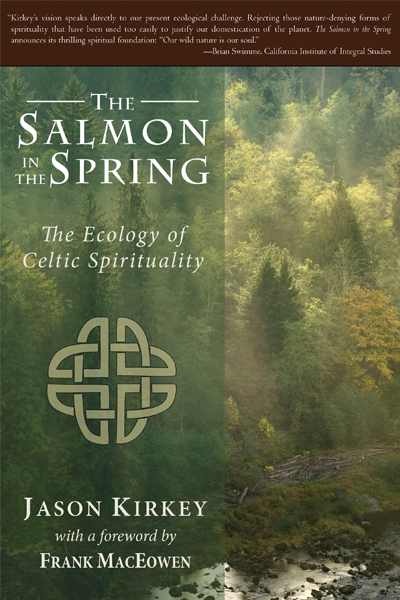 I had my mind blown a while back by Jason Kirkey’s book, The Salmon in the Spring. It is the best book I have ever read about Celtic spirituality, animism and ecology. Now, as I am re-reading it, again I am finding my head nodding in response to everything he says, like some little toy dog in the back of someone’s car. I am eagerly anticipating his new book, which hopefully will be available soon. Though I’ve never met him, or spoken to him, I feel a soul kinship to his words and thoughts that resonate so deeply with my own spirituality. Concepts of ego and environment, of humanity’s place within the whole, has left me once again reeling with a different perception. When I have found some handholds I shall write about it, first needing to find a more coherent sense of self in order to form the words 🙂
To find our more about Jason Kirkey, please visit his website HERE.
Reblog: Q&A: What is the Song of the World?
A brilliant blog post by Alison Leigh Lily, which has sparked something very special in my path through the forest!
The latest issue of the Alternative Religions Educational Network’s newsletter just came out this past weekend, and I was excited to be included as one of those featured in an interview with the editor, Christopher Blackwell. We chatted about my background being raised in a liberal Catholic tradition flavored by my father’s Irish heritage, and how that shaped my spiritual journey towards Druidry as I live and practice it today. It was great fun! One thing we touched on was the Oran Mór, or the Song of the World. Chris asked me to talk a little bit more about how this cosmological concept is reflected in my Druidry. You can read the excerpt here, or check out the whole interview.
Druid Camp 2014
Druid Camp was, once again, a wonderful experience. Though we were only there for Friday evening and Saturday, leaving early Sunday morning, it was an enriching time filled with laughter, good friends, a coming together of a tribe and community, and an honouring of the land. The focus of this year’s camp was environmentalism within a spiritual context.
We arrived Friday just after 7pm, after horrendous traffic on every single motorway – it took us over seven hours to get to Camp from the Suffolk Coast – three hours longer than usual. School holidays had just begun. We checked in and then hastily made our way to the ritual circle, where Phil and Ness were being handfasted. They had met at Druid Camp years ago, and were now taking their vows and pledging their love to each other, with the tribe and community acting as witness. It was beautiful.
Later that evening, Arthur ZZ Birmingham and then Ushti Baba, a gypsy/ska/folk band got the crowd on their feet and we danced the night away.
Saturday began with a lovely yoga session led by Theo, which worked out all the kinks from the night before and set us up perfectly for the day, followed by circle dancing. The morning meeting followed, where the next two days were laid out before us with an array of choices to make, which workshops to attend, and what was taking place where. The afternoon ritual was then planned, which I will come back to in a moment.
The marketplace at midday was the biggest I had ever seen it. Beautiful crafts and homemade wares were on display, as well as books, second hand clothing, incense, ritual gear, meads and wines. Arthur ZZ Birmingham led an improvised band (and I joined in on my new doumbek) and played some great blues tunes in the heat of the midday sun.
Mid-afternoon the healing and divination area was in full swing, as were the talks and workshops. I went to Brochfael’s talk on ethics within Paganism – something which I’ve been exploring quite a bit on this blog lately. Ideas were exchanged and points of view shared in a brilliantly painted teepee, with Will delivering his talk before a tableau of a red dragon dancing in the light of the sun.
Saturday afternoon’s ritual focus had an astrological bent – Mars in the various zodiac signs. Though I’m not a great believer in astrology, it did provide an interesting framework for ritual. The idea was that one woman would represent Boudicca, discovering and learning her warrior aspect as she dedicated herself utterly to the land. She was to move through the houses of the zodiac in which Mars resided for all ritual participants. Every single ritual participant was divided up into groups based upon which sign Mars was in for their own person – for me, Mars was in Virgo. The groups would then challenge and provide Boudicca with what she needed for her journey.
When the time came for the ritual, Mark Graham opened the circle and the woman who was chosen to play Boudicca entered, looking every inch the proud warrior queen, even down to the flaming red hair. Each house of the zodiac presented her with challenges and gifts, wisdom and advice as she progressed through the circle. It was so inspiring to see the creativity of everyone, wherein each group was so different and so unique, yet coming together to create a single ritual of great beauty.
After Boudicca (who was played by a woman aptly named Victoria) had processed and been blessed by the tribe in her protection of the land, everyone came together in the circle, chanting words dependent upon their ritual designation within the elements of earth, air, fire and water. The words flowed through each other in exquisite awen, as everyone circled and chanted, sang and set their hearts free in love of the land. I was quite overcome at this point, with the seagulls flying overhead, the wind upon my skin, the earth humming with energy beneath my feet and the waters of the Severn River encircling us upon this sacred hilltop. My love for this land and for the planet, the Earth itself, overwhelmed me and tears began to slide down my mud-stained cheeks as I called to my gods, opening my heart and soul to them in utter dedication and devotion. On the outer edges of the circle, I felt a great need to connect more fully with the earth, and dropped to my knees to lay my hands upon the sacred soil. Thankfully, those in the middle of the circle soon felt a similar need, and I was not trampled under Druidic feet! Everyone in the ritual knelt down to the ground, bringing their foreheads to touch the earth in peace and love, dedication and devotion to that which holds us so utterly and beautifully in the world. A selfless love flowed through me for the entirety of the world in a rush of pure, divine awen, and I tried not to sob out loud at the release.
After the ritual I made my way back to my tent, to process and integrate what I had just experienced. My husband and I then went out for dinner at the local pub, and coming back I meditated alone (in a field of sheep, so not entirely alone) watching the sun set over the hills within a bank of cloud, the crickets singing around me and the finches twittering overhead. Utterly spent, we had an early night that night.
Sunday we went for breakfast at the café, and had a great breakfast discussion with friends old and new about what they were working on in university, on gender roles and personal life experiences. This is what I love about Druid Camp – such engaging and brilliant discussion over beans on toast.
Then it was time for the long journey home towards the North Sea coast. Coming at last to our home, smelling the familiar scents of heath and forest, of sea and sky, I sat in my backyard by my altar and honoured the land upon which I live, connected as it is to all of the British Isles and the rest of the world. I said a prayer for peace, and reaffirmed my dedication once again to my gods, with the spirits of place and the ancestors as witness.
I can’t wait to see what will happen at next year’s camp.

The view from out tent of the Severn River and the rolling hills…

Brochfael’s talk on Pagan ethics in the painted teepee, or is it a hobbit about to be eaten by Smaug???
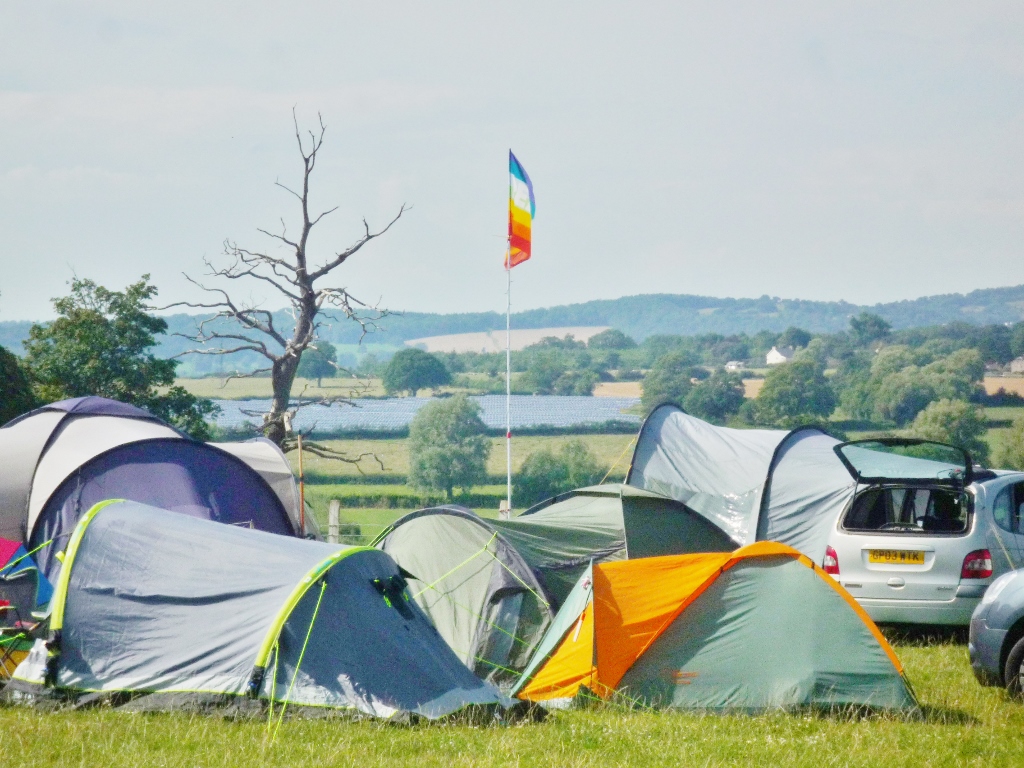
Solar panels in the distance… how apt…

The astrological houses for the big ritual on Saturday afternoon…
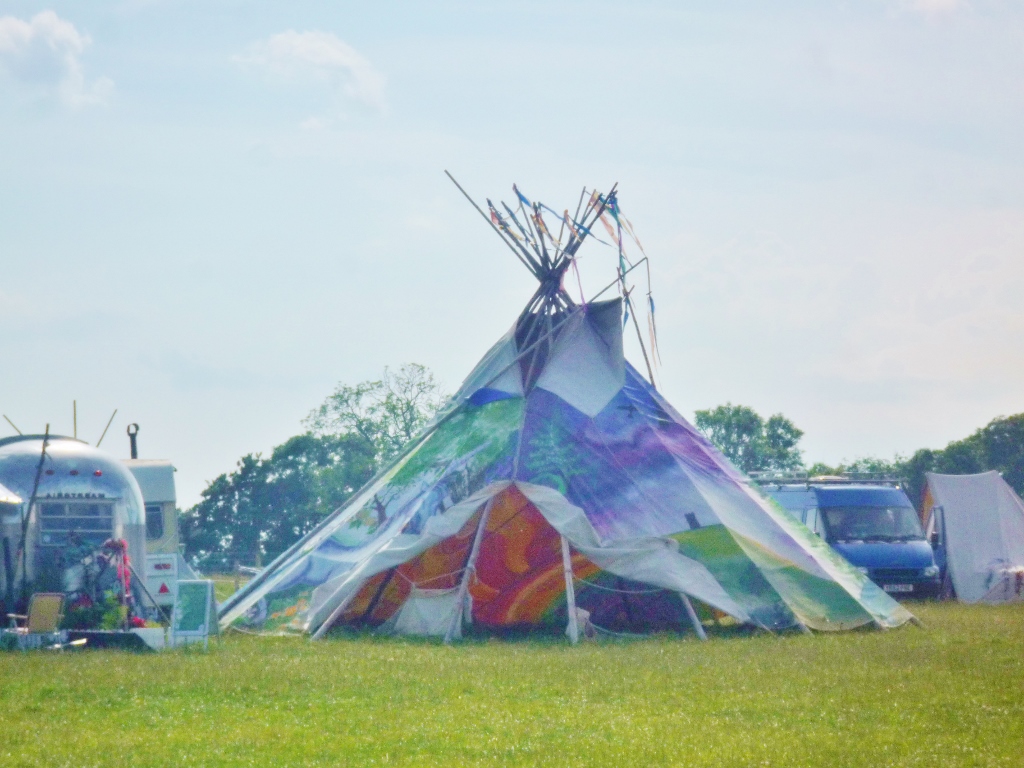
My favourite tepee in the whole world…

Ritual preparation…
 Down the Forest Path