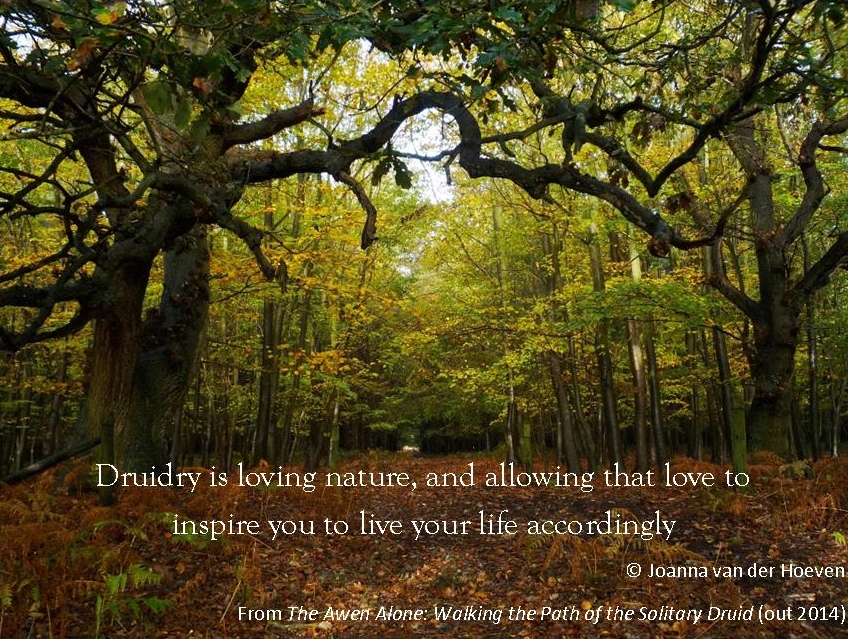
What is Druidry?

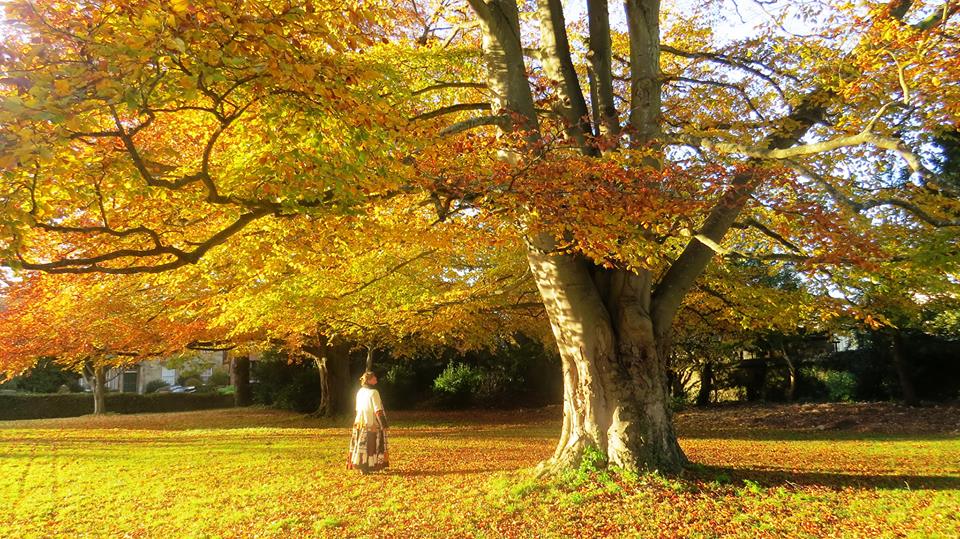 Within Druidry, and indeed in modern Paganism, it is usual to adopt a craft name within your tradition. It is not necessary, and if you feel that you don’t need one, or one doesn’t appeal, then by all means forego the craft name. However, choosing a craft name, or having one bestowed upon you can enhance your connection to your tradition, if you allow it.
Craft names can provide an air of mystery and magic. We can choose something that reflects our work, such as Oak Seeker, Coll (hazel, if working with ogham), or Pathfinder. We can choose something that reflects a part of the environment that we love – Alder, Willow, Rain. We can put two words together that express a deep part of our soul, or a deep love that we have, such as Gentle Bear, Running Horse, or my craft name – Autumn Song. We can adopt names of the gods and goddesses that we love, such as Nehalennia, Freya, Lugh, Branwen, Rhiannon, Bridget. There are also mythological names like Merlin, Morgan and Nimue that might strike a chord deep within our hearts. We can even choose names from fantasy books that we love – Gandalf, Radagast, Arwen, Goldberry, Eomer, Eowyn, Faramir (all Lord of the Rings names). What matters most is that our name expresses a deep part of our soul; that when we utter it, write it, exhale it into the twilight it means something to us, connects us to the awen.
You can inscribe your craft name upon your altar, or your tools. You can sign correspondence with it. You may even change your name to your craft name if you feel that better reflects who you are. I like having both names, as I can honour my two grandmothers for whom I am named after, and honour my tradition with my craft name. Besides, it took me long enough to learn how to write my own name, and I’m sticking to it…
We might choose our craft name, or we might be gifted it by another. We could meditate, commune with the local spirits of place, or deity, and ask that they bestow us a name. In some magical traditions, a craft name is given upon initiation into the tradition, or upon completion of various grades. When working alone, we do not have to wait to have a name bestowed upon us – we can seek it out ourselves from whatever inspires us whenever we feel ready. We can ask our ancestors, our spirit guides, even friends and family for ideas and inspiration.
Our craft names may also change with time. As we grow and develop in our spirituality, we might find that we outgrow our name, and thereby be inspired to choose another that better suits our current work. We can include our naming in ceremonies, whether it is our first time or our fifth time in choosing a craft name. Taking on a name is not something to be done lightly, however. It requires much thought and meditation if you wish for it to be important to your work.
Whatever name you choose, or however you decide to be named, honour that name with all that you are. Find ways of being that reflect your name in deep and compassionate ways, working to create peace and harmony in your life and in all life around you.
The Celts had Indo-European roots, migrating across Europe and leaving their mark across many countries. They share many similar spiritual beliefs to other traditions – Buddhist, Saxon and Norse just to name a few. There are similarities in artwork and other modes of creative expression. Finding something that is “pure” in any tradition is, at least in my opinion, unattainable. We are constantly being influenced by other people, whether it was 50 years ago, 500 or 5,000 years ago.
Incorporating Zen and Druidry has given me a personal life path that makes a lot of sense in my daily practice. Simply because Zen Buddhism is an Eastern tradition doesn’t mean that it can’t work with what is commonly thought of as a Western tradition. (For a more in depth look at Druidry and other Dharmic paths, including Buddhism, Jainism and Hinduism, Philip Carr-Gomm has written a brilliant page on The Order of Bards, Ovates and Druids’ website – http://www.druidry.org/druid-way/other-paths/druidry-dharma.)
Zen and Druidry blend together to form a life path that is utterly devoted to being in the present, giving the Druid a total immersion within nature. This immersion, not just going with the flow but being the flow itself, is what makes it so special. Zen teaches us to let go of our sense of self, to silence our chattering minds in order to be able to pay attention to the world at large. It also teaches us of discipline, learning how our minds work and how we are so often ruled by our minds, through bad habits, reactionary living, destructive behaviour and so on.
With Soto Zen, the mind is brought under control through hours and hours of meditation, of learning to simply “be”, slowly and gently silencing our “monkey mind” so that we may better hear the songs of the universe. This is what is meant by releasing the sense of self – it is not, as so many people assume it to be, becoming a mindless zombie. It is allowing other songs, other voices to be heard above our own so that we may better integrate. We will still have opinions, but we will cherish them less, for we know that everything is in constant change and flux. We will have a sense of self, but again we hold to it lightly so that we may better see where we fit in the world and where we can do the most good. It is not annihilation – it is immersion, awareness and mindfulness.
Within Druidry, we learn to work with awen, with inspiration and the flow of life itself to see where we fit in the grand scheme of things. We work to see how we can live with the least harm to ourselves and the planet, and also what we can do to make the world a better place. We work to create peace within ourselves and peace in the outer world as well. Using our natural abilities and skills, we may work with songs and poetry, or with visions or herbal medicine, with roles in teaching and counselling, in law or in environmentalism – the list is endless. We are devoted to helping and conserving nature and our planet, sharing the awen and giving back for what we have received.
Using the techniques from Zen for training the mind and the love of nature from Druidry we can find a way to immerse ourselves in our spirituality that is so deeply integrated on so many levels. When out walking in the forest, we can lose our sense of self in order to become the forest. Once we are the forest, we are able to drink deeply from the flow of awen that is all life around us. We become the trees, the deer, the fox, the boulder, the streams and the badger. We can learn so much from this integration which can also rejuvenate us, providing us with even more inspiration. We are not looking at ourselves being at one in the forest; we have lost even that in order to become the forest. When we are fully immersed in simply “being”, we are fully in the flow of awen.
Our footsteps become lighter, our passage barely noticeable. Like the deer, we are able to bound through the trees, awake and aware to every sense. Indeed, all our sense become sharper, clearer, for our minds are not running us ragged thinking about what to have for dinner, that paper that is due, the meeting we have on Monday. Fully in the moment, we become the awen.
Zen Buddhism has also leant another aspect to my Druidry that has been rich and rewarding – the idea of compassion. Again, many people misinterpret compassion, seeing it as weak, or being a pushover. Why be kind to others when so few are kind to us? Living with compassion is what enables us to connect once again to that all important word in Druidry – awen. The songs of life can only be heard if we try to understand them. We cannot understand them unless we open ourselves to compassion.
In one of the Grail legends, Perceval reaches the wounded Fisher King, and is invited into his castle. The knight does not ask the King why he is wounded, or how it happened. He shows no interest in learning the story behind the wounded King. Upon sharing a meal with the King, the knight also sees a courtly procession whereby a young maiden carries the Grail through the hall repeatedly throughout the night. Again, trying to appear worldly and nonchalant, Perceval does not ask about this. These two incidents are the clues in which the Fisher King might be healed, and in which Perceval failed at his chance in finding the Grail. If he had only asked the King “What ails thee?” then the King would have been instantly and magically healed. If Perceval had only asked “Whom does the Grail serve?” he would have understood its purpose, and achieved the totality of his quest.
The simple question of “What ails thee” is the showing of compassion. It is taking ourselves outside of our own minds and our own troubles and asking another person what is wrong, seeking to alleviate their suffering. Also, by asking our selves (the separation of the words, instead of writing ourselves is intentional here) “What ails thee?” we take the time to look within, to perhaps explore shadow aspects of ourselves. Within many Eastern traditions, it is through meditation that we understand our selves better, and also understand and redirect our reactions to the world – ie. instead of simply reacting to an event, we act with intention, with mindfulness and awareness. With the Grail question, we can ask this of our selves as well as others in pretty much any situation, therefore eliminating a reactionary response for a more intentional approach. In doing so, we may just find the healing for our selves and the world that is so needed.
The second Grail question, “Whom does the Grail serve?” invites us to question our intention. Whether we are experiencing pleasant or unpleasant aspects in our lives, we can ask our selves “who does this serve?”, thereby eliminating that which is no longer necessary, and bringing joy, awe and wonder back into our lives. With old habits and patterns of behaviour that we wish to be freed from, we can simply ask this question over and over again until we have the answer that is required for spiritual growth. We can ask this question in every aspect of our lives, from our weekly shopping (in order to make better choices not only for ourselves, but the planet) to our everyday interactions with other people. If we are making a positive change instead of falling into negative, but comfortable patterns then we are on the road to spiritual progress. Reminding our selves of the Grail questions has been integral to my learning these past few months, becoming a mantra for everyday life.
In our quest for wholeness, we can either run around in circles, questing after the Grail through established means, or we can simply look within to gain a better perspective on compassion and the divine, whether it be male or female, or even genderless. It is the deep exploration within that allows us to bring that knowledge out into the world – we cannot simply spend our lives gazing at our own navels – we must bring the Grail out for the benefit of others. We must offer the gifts of compassion and self-awareness. In this, the Grail Mysteries are best served.
In this way as well, both Eastern and Western traditions come together to allow us to help not only our own suffering, but that of the world. We can learn the values of compassion and mindfulness, and we also look deep within for the inspiration to live an integrated life that reflects the natural cycles of the world around us.
We do not simply touch the awen every now and then – we become the awen ourselves.
(From my blog at Moon Books – http://moon-books.net/blogs/moonbooks/zen-and-the-awen/)
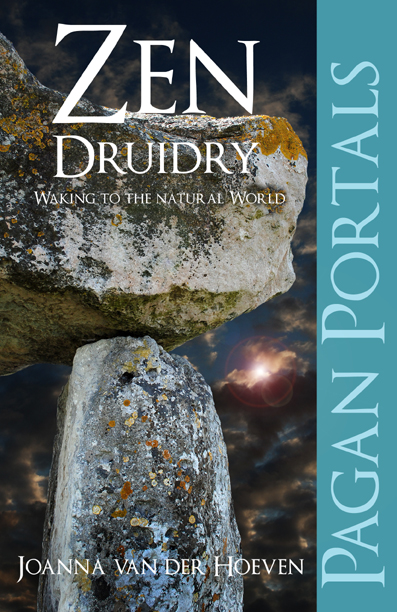 Zen Druidry still at the low Kindle price of UK £1.23 – what a lovely number! Paperback copies available starting at £1.05, used copies from only 99p. In the US, copies start from $2.02 (another lovely number) and in Canada from $0.01!!!) . Read reviews by leaders and authors in the pagan community such as Philip Carr-Gomm, Graeme Talboys, Nimue Brown and more! Part of Moon Books‘ Pagan Portals series.
Buy in the UK here
Buy in USA here
Buy in Canada here
For other countries, please refer to Amazon provider associated.

Today I have the day to myself – no one else, just me in the house with my cat. For me, it is pure bliss. After the sometimes chaotic nature of the holiday season spent in constant company, whether that is with beloved family or friends, a little downtime is a blessing. I love these moments, when I am free to do as I choose, when the house is quiet and no one needs anything. I can write or listen to music, meditate without extraneous noise, or simply just sit in the conservatory with a cup of tea and enjoy the silence and the season. After busy times, I crave solitude.
In today’s society, however, I am seeing more and more evidence that people do not want to spend time with themselves. There are constant distractions everywhere, the worst culprit being mobile phones. Not only are they being used to call or text people constantly, but now people can tweet, check their facebook or email and never spend a moment without their “friends”. I remember about six months ago going to my local pub and sitting at the bar, chatting to the bar staff. Other locals were around me sharing conversation, but once the bartender had disappeared they all lowered their heads and were on their phones, thumbs hammering away. I have gone out to dinner on numerous occasions where I see other couples sitting across from each other not talking to each other but on their phones. It makes me so sad that people do not want to be together physically when they are given the precious opportunity. What I find perhaps even more distressing is the fact that people don’t know how to be alone either.
In a supermarket queue, no one can just stand there anymore and wait in line, either simply being and standing, or making eye contact with others, offering a smile, perhaps some comment on the weather. I respect it when people don’t want to talk to strangers – I can feel annoyed when people want my attention and I don’t want to give it to them at that particular moment. It can feel intrusive. Men who expect you to flirt back, for instance. But I digress – surrounded by real people in the supermarket queue, people would rather look to a tiny screen that acknowledge those around them, or perhaps even succumb to their own thoughts for the barest instant.
I know that I am assuming much here – I can’t know what really goes on in other people’s heads. But I think it is a fair assumption to make. Being alone is scary for a lot of people, especially if they’re not used to it. What worries me is that a whole generation of human beings is living without the blessing of time spent by and with themselves. They will never experience that exquisite silence when the gadgets are turned off. They will never know their own thoughts, being constantly distracted by the thoughts of others. They might never truly know themselves.
Time spent alone is precious time to look within, to check on our self and see if everything is okay. Not enough time is spent doing this, in my opinion. Giving this gift of attention to our selves, we can see where we are simply reacting to events, instead of acting with intention. It gives us a chance to be compassionate with our selves, and thereby allowing us to be more compassionate with others. We check in on others all the time with social media – what I suggest is that we check in with ourselves as well.
Mindfulness and meditation are two great ways to check in with the self, to see how you are doing at this particular moment in time. Breathing in, being aware of the breath, you can do this anywhere – even in the supermarket queue. Simply saying “breathing in, I am aware that I am breathing in, breathing out, I am aware that I am breathing out” in your mind as you breathe gives you a moment in time that is all your own. I like to do this regularly, and also to see where I am holding tension in my body. Often I will find that my right shoulder is raised, and I can make a conscious effort to relax my muscles, giving them a rest as well as my mind. I am unconsciously tensing, perhaps protectively with my dominant arm against some unperceived threat. When I am aware of this, I see that there is no threat, and can relax and enjoy the moment better.
In meditation, simply stopping is a brilliant way to get back in touch with your self. Sitting on a cushion, perhaps some incense burning as an offering, simply spend time with your self and your thoughts. See the thoughts in your mind as they arise, but do not attach to them – let them go. See and discover how crazily the mind works, how hurried and fast thoughts arise. Just as quickly as they come, let them go, and slowly, with time and with effort, with a little discipline, the thoughts will begin to settle like mud in a pond, eventually allowing clear insight into the depths. It doesn’t happen all at once, and takes dedication, but it is so worth it.
Spend some time with yourself today, even if it only for two minutes. Breathe, stand outside after work and smell the night air. Take a candlelit bath and really feel the water surround you, relaxing your body and noticing where there may be tension. Sit at your meal and savour each and every bite, really paying attention to what it is that you are putting in your mouth. Lying down to sleep, do a full body sweep with your mind to feel areas of tension, relaxing the muscles one by one.
And for the love of your self, turn your phone off. x
Some people have differing opinions to ours. That is their entitlement – we all may agree or disagree with each other, have different viewpoints and perspectives. Only we can see the world through our own eyes, layered with our own experiences, trials and tribulations. Only we know our own story fully and completely. No other can know us the way we know ourselves, the reasons for our actions and the choices we make.
Everyone is on their own path, fighting their own battles, making their own decisions according to the principles that they live by, the culture and society they grew up in, and their own soul’s calling. We should never berate another for following their own path. We can certainly disagree, and stand up for what we believe in, whether that is against a political party, a company, an abusive relationship – but we must always remember that belittling someone is never the right thing to do. People will make bad choices, people will not care about the same things that we do. However, making fun of them does not solve anything. Looking down on someone means that you have placed yourself in a position of authority or power over them – an illusory pedestal.
 The photo here is an example of a meat company who are putting down vegans in order to gain more people to their “side”, using “humour” as a unifier against some perceived threat to their way of life. What we have to realise is that there are no sides in life – only differing choices and opinions. There is no Us and Them – there is only the human experience. The entire Us and Them mentality has led to the most atrocious human behaviour possible – war and genocide, murder and rape, crime and racism, just to name a few.
Those who choose to become vegan or vegetarian have their own reasons – health, weight loss, environmentalism, religion. It is wrong to belittle someone for any of these reasons. In fact, it is wrong to belittle anyone – end of story. I disagree with people all the time, and I know I’m not perfect, but when I catch myself belittling someone I do my best to stop it, to realise that they are on their own journey, and to have compassion for them. I do not want to be like the person who wrote this sign. I choose to behave differently.
I chose to become vegetarian twenty years ago, and am currently in the switch to vegan. This is my personal choice, based on research and religious reasons that ring true to my own soul. This may not be the same choice for other people, and I understand that. However, I do tire of people making fun of my choice – I have had to endure that for over twenty years. It is inevitable at dinner parties where someone who doesn’t know you very well, and who is a self-confessed “meat lover”, will question your choice at the dinner table, confronting you on your life path when all you want to do is eat with a good conscience and enjoy your meal with your friends or family, in harmony. The ubiquitous “screaming vegetables” always comes up, and I must explain my reasons for becoming vegetarian or remain silent. Sometimes I choose to, other times I simply let it be. For the sake of peace, I make a decision based on compassion for all those who are sharing the meal with me. I only wish certain others could do the same.
Would it be correct to challenge someone on their religion at the dinner table? I don’t think so. What about their decision to join Amnesty International, or Greenpeace? Would it be right to poke fun at someone because they looked different? We must appreciate each other’s diversity, and in that appreciation realise that we are all human beings on our own journeys- that unifying factor within the diversity is what compassion is all about.
 That is why in response to the photo above, I am posting this other photo. It reflects and is only my opinion, but it matters to me in my spiritual journey. Zen Buddhism tells us to hold to our opinions lightly, and indeed I see the wisdom in this. Our opinions are always changing – we are always learning and growing. However, we must do so with compassion and awareness of the journey of others as well, even those who challenge us and our opinions. I must have compassion for the people who own that meat company, realising that they have their own reasons for writing this sign, however much I disagree with them. I can voice my own opinion against it with this blog, with my words, with respect and as much understanding as my situation allows. I don’t have to think it is right. I don’t have to agree with them. But I shall not belittle them for their opinion.
Watching Parliament in full swing makes me cringe – I remember the first time I saw a “discussion” which never let the other side finish what they were saying, instead making so much noise as to drown out the current speaker’s voice in a wall of derision. This was how our country was and is being governed. It saddened and enraged me – this so-called civilised way of government. How much better could it be if we just took the time to listen to each other without judgement, allowing the other person their say, and respectfully choosing to disagree if it does not ring true to our souls? If the government cannot govern their behaviour in Parliament, why should the people? I found it so saddening, and still do…
Never be afraid to speak out against what you think is wrong, or for what you believe in. However, do so with compassion, with respect. Otherwise, you are simply acting and reacting to the bad behaviour of others. Remember also that acting with compassion does not necessarily elevate you above these others – you are not “good” for acting compassionately. You are simply acting compassionately – that is all.
Live with honour and dignity. Act with love and compassion. It’s not that hard. Blessings on your journey. X
Here’s a little taster from my upcoming book, Dancing With Nemetona, published with Moon Books, available this spring…
Lady of Ritual
 Ritual – the word rolls off the tongue. It evokes images of moonlight and standing stones, or incense and flower filled temple rooms, women and men gathered under the stars or the light of day to celebrate an aspect of life, death and rebirth.
Ritual is as simple or complex as we allow it to be. We can follow a set liturgy, or we can create our own path. Within paganism, both are equally acceptable. As paganism is, technically, a newly rebirthed religion the question of authenticity with regards to validity is moot – someone, somewhere along the line, whether it was 60 years ago, 600 years ago or 60,000 years ago made it up at some point. That has no bearing on its validity.
When we create ritual, we are taking a moment, taking time out, to celebrate or honour a specific moment in time. It may be as simple as saying a prayer of thanks at sunrise or sunset, or it may be a full blown affair held within a stone circle, with 20 or more participants, having rehearsed their roles and re-enacting a mythic drama. Whatever ritual you choose to perform, establishing a relationship with Nemetona can be a rich and rewarding experience to lend to these sacred acts.
Nemetona is Lady of the Sacred Grove, where it is believed that ritual occurred in past history. The ritual itself is just as important as the setting. It must speak to us, must sing to our soul, otherwise, what is the point?
As the Lady of Holding, of guarding and watching over our sacred space, our created sanctuaries, Nemetona is also a lady of ritual, integral to it if we so desire. She moves in circles and in cycles, and therefore when we hold a ritual circle, we can invoke her easily within that sacred place. She is all that is within the sacred circle, and also all that is without. Like a vase, the vase is not only the boundaries of its own edges, but also the emptiness within that allows it to be a vase.
We can call upon Nemetona in ritual, to protect our sacred circle, to bless it, or simply to witness what it is that we are doing within that space (or all three). She can be called upon before a ritual to help define its intent and purpose. She is the Lady of Holding, and within her embrace we are free to be and do as we wish. Within the sacred ritual circle, she enables change and growth, safety and security where we might otherwise not feel it to be.
Within the ritual circle is a space where we can grow, where we can make associations and develop our spirituality to its true potential. Within the sacred circle, we overlay it with our associations in ritual such as the elements, our spirit guides, ancestors, gods and goddesses and more. By finding out where these “fit” in the sacred ritual circle, held within the arms of Nemetona we come to truly understand ourselves, and the greater world at large.
Zen Druidry is at No.1 on Amazon’s Druidism best seller category – thank you all for your support! x
Wishing you all a very Happy New Year. Thank you all so much for your support with this blog – it has truly stunned me to see all the comments, views and other blogs posts shared here.
In 2013, Octopus dance had over 18,000 views, from 92 different countries. Thank you so much for sharing your creativity, for being the awen, and for allowing me to share mine.
Quotes from Mary Oliver come to mind:
“Instructions for living a life.
Pay attention.
Be astonished.
Tell about it.”
― Mary Oliver
“to live in this world
you must be able
to do three things
to love what is mortal;
to hold it
against your bones knowing
your own life depends on it;
and, when the time comes to let it go,
to let it go”
― Mary Oliver, New and Selected Poems, Vol. 1
“Keep some room in your heart for the unimaginable.”
― Mary Oliver
Many, many blessings to each and every one of you, and may your journey in 2013 be filled with the wonder that is truly living life, and filled with the awen. Remember – don’t just go with the flow – be the flow itself. x
Reblogged from my channel at SageWoman: My latest blog post for SageWoman… http://www.witchesandpagans.com/SageWoman-Blogs/the-grail-mysteries.html
These past few months I have been delving into Grail stories and mythology, looking for their inner messages and healing stories. I have been working with Jenah Telyndru’s Avalon Within: A Sacred Journey of Myth, Mystery and Inner Wisdom since September, and have just finished reading Jean Shinoda Bolen’s Crossing to Avalon: A Woman’s Midlife Pilgrimage. There is a lot of resonance and wisdom in both these books, that has opened up my eyes to the Grail stories and also the wisdom of Avalon in ways I never could have dreamt of.
I had always been fascinated by the tales of Arthur and Morgan le Fey since I was a child. Stories of knights riding out on quest, of otherworldly women bestowing kingship, of wizards and wisemen, chivalry and courage and love all held a special place in my heart. I had always wanted to visit Britain, to see the land that these stories contained – I never thought I would end up living there, but life has its twists and turns.
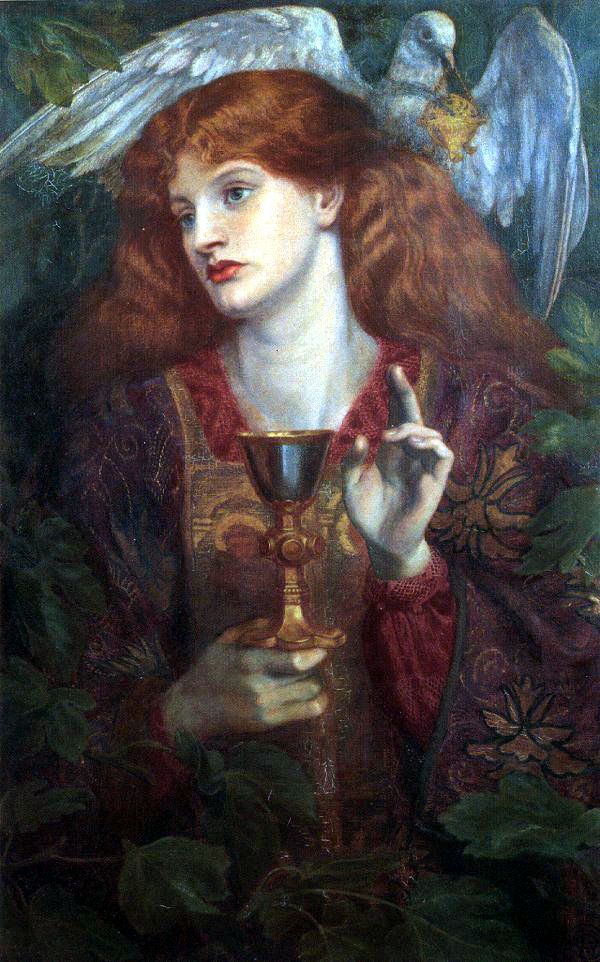
The Grail Mysteries are utterly fascinating. What I am currently exploring is the figure of the Grail Maiden, the only one able to handle the blessed object. Whether she is Pagan or Christian is of little consequence – what matters is that she is the one who is carrying it forth into the world.
The Knights of King Arthur’s court see a vision of the Grail, carried through his Great Hall by a Great Lady – some say Morgan herself, others the Lady of the Lake, or an angel. This sends them into a frenzied search for the Grail – most of his knights take it upon themselves to find this holy object, winning it for themselves, for salvation or fame, freedom or a connection with the divine feminine. Little is said of the Grail Maiden after this – the attention is all bestowed upon the knights and their quests.
The Grail Maiden appears once again in the tales, when Perceval reaches the Fisher King. This wounded king is reflected in his kingdom, which is barren wasteland. Until the King is healed, the land cannot be healed. What is most interesting is that the Grail is carried through his Court each and every day, and yet he cannot receive its healing properties. Two questions must be asked first in order for the King to be healed – “What ails thee?” and “Whom does the Grail serve?”. Perceval, in an attempt to appear grand and unaffected, being now a ‘famous Knight of King Arthur’s Court on Quest’, does not question the wound on the King when he sees it, though he does notice it and wonder. When the Grail is brought through the Court time and again in a repetitive procession throughout dinner, again Perceval ignores it, trying to appear nonchalant. In his refusal to show empathy or compassion, curiosity or care he loses his chance to heal the kingdom and also his chance at the Grail and the Divine Feminine. The Grail and castle disappear the next morning.
So, back to the Grail Maiden – why is it that a woman can only carry this vessel? Many will say that women are natural vessels of the Goddess, and this rings true enough. In Arthurian tales, women are also the bearers of Sovereignty, also reflected in other tales from the land, such as the Welsh Mabinogian. The vessel is the source of the Divine Feminine, therefore it is fitting that is it borne by a woman. Women bear children, bringing new life into the world (with the help of men, of course). There are certain things that only women can understand through shared stories and life experiences – moon bleedings, bearing children, social and cultural successes and struggles. The knights on quest are seeking this source of the Divine Feminine, lacking it in their own souls, longing to reach out to the Goddess but unable within the constraints of their religion and their faith.
The quest for the Grail is also an inner quest – it is not all about externally seeking something that is outside our selves. Often the Divine Feminine can be missing from a woman’s life as well. For reasons too legion to go into here, seeking out a female goddess can be a deep and meaningful way to connect with our own self and, in doing so, other women, humanity and the world at large.
What the knights seems to miss, on the whole, is that the Grail is Woman. Through honouring Woman as well as Man he can come to bridge the gap, come to know the divine. It is right there in front of their eyes, but they choose not to see it. For women, coming to understand our own selves is the forerunner to compassion and empathy not only for our sisters, but everything. In seeing and seeking the Grail within, we can heal our own wounds. We must also ask ourselves the questions that Perceval did not.
By asking our selves (the separation of the words, instead of writing ourselves is intentional here) “What ails thee?” we take the time to look within, to perhaps explore shadow aspects of ourselves. Within many Eastern traditions, it is through meditation that we understand our selves better, and also understand and redirect our reactions to the world – ie. instead of simply reacting to an event, we act with intention, with mindfulness and awareness. With the Grail question, we can ask this of our selves as well as others in pretty much any situation, therefore eliminating a reactionary response to a more intentional approach. In doing so, we may just find the healing for our selves and the world that is so needed.
The second Grail question, “Whom does the Grail serve?” invites us to question our intention. Whether we are experiencing pleasant or unpleasant aspects in our lives, we can ask our selves “who does this serve?”, thereby eliminating that which is no longer necessary, and bringing joy, awe and wonder back into our lives. With old habits and patterns of behaviour that we wish to be freed from, we can simply ask this question over and over again until we have the answer that is required for spiritual growth. We can ask this question in every aspect of our lives, from our weekly shopping (in order to make better choices not only for ourselves, but the planet) to our everyday interactions with other people. If we are making a positive change instead of falling into negative, but comfortable patterns then we are on the road to spiritual progress. Reminding our selves of the Grail questions has been integral to my learning these past few months, becoming a mantra for everyday life.
In a patriarchal culture and society, the loss of the feminine can be devastating, as it was to the knights of the Round Table. In our quest for wholeness, we can either run around in circles, questing after the Grail through established means, or we can simply look within to gain a better perspective on compassion and the divine, whether it be male or female, or even genderless. It is the deep exploration within that allows us to bring that knowledge out into the world – we cannot simply spend our lives gazing at our own navels – we must bring the Grail out for the benefit of others. We must offer the gifts of compassion and self-awareness. In this, the Grail Mysteries are best served.
 Down the Forest Path